
 Isotopic Enrichment of Lithium-6 for Thermoluminescent Dosimeter Application
Abstract
Extracted from the mineral spodumene, the element lithium naturally has two stable isotopes: 7Li (approximately 92.6%) and 6Li (approximately 7.4%). These isotopes have a variety of applications, from the pharmaceutical industry to electrochemistry. Due to its high efficiency and environmental benefits, global production of electric vehicles with lithium-ion batteries reached 10.5 million vehicles in 2022. In the nuclear field, 7Li is widely used in reactors at the Angra dos Reis Nuclear Power Plant in Brazil as pH stabilizer on primary coolant. On the other hand, 6Li, with its high cross sections for absorption of thermal neutrons, is used in the thermonuclear field and for the production of tritium in fusion reactors. In addition, 6Li is used in thermoluminescent dosimeters due to its thermoluminescent properties, making it effective for measuring ionizing radiation. This work aims to present a new technology for lithium enrichment in Brazil, focusing on the isotopic separation of 6Li and 7Li for their respective industrial applications, seeking Brazilian independence regarding the acquisition of this enriched isotope. The ion exchange technique, involving isotope separation by equilibrium isotopic fractionation between two phases, is highlighted as a method to achieve this goal. pH and electrical conductivity were measured in the samples to correlate with Li concentration. The results of the isotopic analysis showed an enrichment of 10.12% for 6Li and 95.86% for 7Li.
Keywords:
Lithium-6; thermoluminescent dosimeter; ion exchange; ICP-MS
Resumo
Extraído do mineral espodumênio, o elemento lítio possui naturalmente dois isótopos estáveis: 7Li (aproximadamente 92,6%) e 6Li (aproximadamente 7,4%). Esses isótopos têm várias aplicações, desde a indústria farmacêutica até a eletroquímica. Devido à sua alta eficiência e benefícios ambientais, a produção global de veículos elétricos com baterias de íon-lítio atingiu 10,5 milhões de unidades em 2022. No campo nuclear, o 7Li é amplamente utilizado em reatores na Usina Nuclear de Angra dos Reis, no Brasil, como estabilizador de pH no sistema de refrigeração primário. Por outro lado, o 6Li, com suas altas seções transversais para absorção de nêutrons térmicos, é usado no campo termonuclear e para produção de trítio em reatores de fusão. Além disso, o 6Li é utilizado em dosímetros de radiação devido às suas propriedades termoluminescentes, tornando-o eficaz para medir radiação ionizante. Este trabalho tem como objetivo apresentar uma nova tecnologia para enriquecimento de lítio no Brasil, com foco na separação isotópica de 6Li e 7Li para suas respectivas aplicações industriais, buscando a independência brasileira a respeito da obtenção deste isótopo enriquecido. A técnica de troca iônica, envolvendo separação de isótopos por equilíbrio no fracionamento isotópico entre duas fases, é destacada como um método para atingir esse objetivo. pH e condutividade elétrica foram medidos nas amostras para correlacionar com a concentração de Li. Os resultados da análise isotópica apresentaram um enriquecimento de 10,12% para 6Li e 95,86% para 7Li.
Palavras-chave:
Lítio-6; dosímetro termoluminescente; troca iônica; ICP-MS
1. INTRODUCTION
Extracted from the mineral spodumene, the element lithium naturally possesses two stable isotopes: 7Li (approximately 92.6%) and 6Li (approximately 7.4%) [1]. These isotopes have various applications, ranging from the pharmaceutical industry to electrochemistry [2]. It is estimated that due to their high efficiency and environmental reasons, global production of electric vehicles with lithium-ion batteries reached 10.5 million vehicles in 2022 [3].
In the nuclear field, the isotopes 6Li and 7Li behave differently. In Brazil, 7Li is widely used in reactors of Nuclear Power Plant, at Angra dos Reis (RJ), as pH stabilizer on primary coolant of PWR nuclear reactors, thus preventing the reactors corrosion [4]. On the other hand, the presence of 6Li can decrease the reactor's efficiency, as this isotope has high cross-sections, absorbing thermal neutrons and providing large amounts of energy. For this reason, it is highly applied in the thermonuclear field [5]. 6Li can also be used for tritium production through neutron bombardment in a fusion nuclear reactor [5].
Despite this, there is currently no national development for the purification and separation of these isotopes, which means Brazil still depends on their strategic importation, as shown by the agreement signed between Eletronuclear and the Russian state-owned company Rosatom in 2023 for the supply of lithium isotopes [6].
Moreover, 6Li also has an application in radiation dosimeters due to its thermoluminescent capability. A thermoluminescent dosimeter is a device used to measure doses of ionizing radiation received, through the light emitted by a thermoluminescent crystal in the detector. In this regard, the radiation-sensitive crystal used for this type of dosimeter is lithium fluoride, where the 6Li isotope is sensitive to thermal neutrons [7]. In the LiF crystal lattice, there are traps that keep the electrons trapped after alpha radiation. Upon heating the crystal, these electrons are released, and light is emitted, making it possible to measure the received radiation [1;5,7]. Therefore, LiF chips are commonly enriched with 6Li for the efficiency of the dosimeter detector [1].
Thus, this work aims to present an alternative technology, as well as mercury-free, for lithium enrichment in the national territory, seeking Brazilian independence regarding the acquisition of this element, through the isotopic separation of 6Li and 7Li for their respective applications in the industry.
1.1 Ion Exchange for isotopic enrichment
The ion exchange technique is a method where isotope separation is achieved through the equilibrium in isotope fractionation between two phases: a stationary phase (ion exchange resin) and a mobile phase. In this process, one of the isotopes is adsorbed onto the resin, forming a band that moves through the column by interaction with a displacement solution. The rate of band movement is determined by the equilibrium between the eluent solution and what is adsorbed in the band. The adsorption band moves while maintaining a constant and distinguishable length from the displacement solution. The isotopes in the band are reorganized in the order of their distribution coefficients, where 6Li demonstrates a greater affinity for the resin used on this work, thus remaining more retained in it compared to 7Li. Therefore, this isotope is enriched on the final portion of the lithium band. This technique is widely used for isotopes of light elements due to its simplicity and the achievement of satisfactory separation factors [8].
Displacement chromatography is a recommended technique for large-scale production of isotopes and can be applied for the enrichment of lithium isotopes (6Li and 7Li). This method utilizes both commercially available resins and resins synthesized with crown ether in silica microspheres, which have demonstrated better performance [9].
In the literature, several research studies related to the separation of lithium isotopes via displacement chromatography can be found, which do not use mercury. The most widely used resin with this technique is the strong cation exchange resin AG 50w x8, x12, and x16 with different lithium solutions (Chloride, Hydroxide, Carbonate, and Acetate) [10, 11, 12, 13]. These studies indicate a low separation factor, meaning that many displacement cycles are required to achieve enrichment of > 99% for both isotopes.
2. MATERIALS AND METHODS
For the enrichment of 6Li, a system consisting of four acrylic columns (13 mm diameter, 100 cm length) was employed, arranged to allow the solution to circulate through them in series multiple times. The columns were filled to a height of 92.4 cm with AG 50W X16 cation exchange resin (200-400 MESH). This setup operated in a cyclic mode via an automated vacuum device, returning the solution to the first column after it traversed the fourth. The first column was saturated with LiCl to form a Lithium band, and a solution of 0.15 M calcium acetate was used to displace this band. This displacement cycle was repeated until the band had traveled a total distance of 1,016.4 cm, equivalent to passing through 11 resin columns. 10 ml samples were collected, corresponding to 10 cm of the band. In total, 74 samples were collected that represented the lithium band.
All samples had their pH, electrical conductivity, concentration (measured through ICP-OES), and isotopic ratio (measured by ICP-MS) determined. The pH and electrical conductivity measurements of the 74 representative samples of the Li band were correlated with the Li concentration results obtained by ICP-MS, aiming to establish a quick parameter for identifying the presence of Li in the sample.
For the calculation of the correlation coefficient, the following equation was used:
Where x and y are the average of each parameter. Correlation is interpreted according to the obtained ρ-value, with 0.9 or higher (positive or negative) indicating a very strong correlation. 0.7 to 0.9 (positive or negative) indicates a strong correlation. 0.5 to 0.7 (positive or negative) indicates a moderate correlation. 0.3 to 0.5 (positive or negative) indicates a weak correlation. 0 to 0.3 (positive or negative) indicates a negligible correlation.
3. RESULTS AND DISCUSSIONS
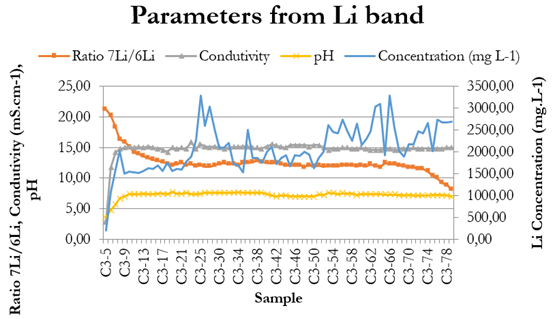
The results of the pH, electrical conductivity, lithium concentration, and 7Li/6Li isotopic ratio measurements are presented in the graph shown in Figure 1.

Results of pH, electrical conductivity, concentration, and isotopic ratio measurements of the 74 representative samples of the lithium band.
A clear isotopic separation was observed, with 6Li reaching 10.12% abundance at the rear of the band and 7Li reaching 95.86% at the front. These results confirm the previously discussed higher affinity of the lighter isotope for the resin, which dictates this specific distribution profile along the band.
Using the results of electrical conductivity and Li concentration, a correlation coefficient of 0.97 was calculated, indicating linearity between the two parameters. Between conductivity and pH, a correlation coefficient of 0.87 was obtained, indicating linearity between these two parameters as well. Electrical conductivity was the parameter chosen to more quickly select samples containing Li to be analyzed by ICP-MS.
In this work, the isotopic separation factor was calculated using Equation 2 [11, 14], and the enrichment factor of the fractions was calculated after a displacement of 1,016.4 cm. Equations 3 and 4 were applied for and, respectively, following the approach proposed by Zhang et al. (2007) [15].
Vi: Volume of the i-th fraction collected in l
Ci: Molar concentration of Li in the i-th fraction
R0: Ratio of 6Li to 7Li in the eluant used
Ri: Ratio of 6Li to 7Li in the i-th fraction
Q: Total exchange capacity of the column used
andBased on the experimental data from this study, a separation factor (α) of 1.0054 was obtained, surpassing the 1.0036 value reported by Hagiwara et al. (1969) [16] for a similar resin with lower crosslinkage (12%). Notably, that study achieved a 15% 6Li abundance after a 150 m band displacement, whereas this study reached a 10.65% 6Li abundance with a displacement approximately 15 times shorter (10.16 m). These findings demonstrate the superior suitability of the AG 50W-X16 resin compared to the AG 50W-X12 for isotopic enrichment in LiCl media; this is consistent with the predictions by Powell et al. (1962) [11], which suggest that resins with higher crosslinkage provide enhanced isotopic separation. Furthermore, the local enrichment factors (ε) of 1.7680 for 6Li and 1.4866 for 7Li confirm that circulating the lithium band through multiple cycles is an effective strategy for achieving high enrichment levels over significantly reduced distances.
4. CONCLUSIONS
The results obtained are the outcome of the initial research procedures, constituting a part of an ongoing preliminary study. Thus, with the advancement of this work, it is possible to achieve an even higher degree of enrichment. Therefore, it can be concluded that the procedure for separation and enrichment of Li isotopes via ion exchange is suitable for the proposed objective.
ACKNOWLEDGMENTS
The authors would like to acknowledgment the Institute of Energy and Nuclear Research (IPEN) for providing resources and infrastructure, and Companhia Brasileira de Lítio (CBL) for the financial support in this research.
DATA AVAILABILITY STATEMENT
Interview transcripts and qualitative data are not publicly available due to confidentiality commitments made to research participants. Aggregated data supporting the findings are available from the corresponding author upon reasonable request and subject to participant privacy protections.
REFERENCES
-
1 CONNOR, N.; Radiation Dosimetry. Disponível em: https://www.radiation-dosimetry.org/pt-br/o-que-e-um-dosimetro-termoluminescente-tld-definicao/ Acesso em: 20 ago. 2024.
» https://www.radiation-dosimetry.org/pt-br/o-que-e-um-dosimetro-termoluminescente-tld-definicao/ -
2 LAFER, B.; AMARAL, J. A utilização da espectroscopia de lítio por ressonância magnética (7Li-MRS) no transtorno bipolar. Revista Brasileira de Psiquiatria, v. 23, p. 55-57, 2001.https://doi.org/10.1590/S1516-44462001000500016
» https://doi.org/10.1590/S1516-44462001000500016 -
3 USAI, L. ; LAMB, J. J. ; HERTWICH, E. ; BURHEIM, O. E. ; STRØMMAN, A. H. Analysis of the Li-ion battery industry in light of the global transition to electric passenger light duty vehicles until 2050. Environ. Res.: Infrastruct. Sustain., v. 2, p. 011002, 2022.https://doi.org/10.1088/2634-4505/ac49a0
» https://doi.org/10.1088/2634-4505/ac49a0 -
4 BAN, Y.; NOMURA, M.; FUJII, Y. Chromatographic Separation of Lithium Isotopes with Silica Based Monobenzo-15-crown-5 Resin. Journal of Nuclear Science and Technology, [Publisher Location], v. 39, n. 3, p. 279-281, 2022.https://doi.org/10.1080/18811248.2002.9715187
» https://doi.org/10.1080/18811248.2002.9715187 - 5 MIESLER, G.; FISCHER, P.; TARR, D.; Química Inorgânica, 5ª ed., Pearson Education. São Paulo, 2014, p 258.
-
6 A Corporação Estatal de Energia Nuclear ROSATOM. Rosatom [360]. Disponível em: https://rosatomnewsletter.com/pt/2023/04/27/isotope-of-cooperation/ Acesso em: 20 ago. 2024.
» https://rosatomnewsletter.com/pt/2023/04/27/isotope-of-cooperation/ -
7 CAMPOS, L.; Termoluminescência de materiais e sua aplicação em dosimetria da radiação. Cerâmica, v. 44, p. 290, 1998.https://doi.org/10.1590/S0366-69131998000600007
» https://doi.org/10.1590/S0366-69131998000600007 -
8 DING, X. & LIU, X. Nitrogen isotope separation by ion exchange chromatography. Em: Ion Exchange Technologies. Londres: Intechopen Limited, p. 343 - 366, 2012.https://doi.org/10.5772/51311
» https://doi.org/10.5772/51311 -
9 SUGIYAMA, T.; SUGIURA, K.; TANAKA, M.; ENOKIDA, Y. Lithium isotope separation with displacement chromatography using crown ether resin immobilized on porous silica beads. Fusion Engineering and Design, v. 87, p. 1186- 1189, 2012.https://doi.org/10.1016/j.fusengdes.2012.02.092
» https://doi.org/10.1016/j.fusengdes.2012.02.092 - 10 LEE, D. A.; BEGUN, G. M. The enrichment of Lithium isotopes by ion-exchange chromatography. I. The influence of the Degree of Crosslinking on the separation factor. Contribution from the chemistry division, Oak Ridge National Laboratory, 1958.
-
11 POWELL, J. E. The separation of lithium isotopes by ion Exchange. J. Inorg. Nucl. Chem., v. 24, p. 183 - 186, 1961.https://doi.org/10.1016/S0022-1902(62)90273-7
» https://doi.org/10.1016/S0022-1902(62)90273-7 -
12 HAGIWARA, Z.; TAKAKURA, Y. Enrichment of stable isotopes, (III) enrichment of 6Li and7Li by ion exchange column. Journal of Nuclear Science and Technology, v. 6, n. 6, p. 326 - 332, 1969.https://doi.org/10.1080/18811248.1969.9732896
» https://doi.org/10.1080/18811248.1969.9732896 -
13 FUJINE, S. Theoretical study of lithium isotope separation by displacement chromatography. Separation Science and Technology, v. 17, n. 8, p. 1049 - 1064, 1982.https://doi.org/10.1080/01496398208060269
» https://doi.org/10.1080/01496398208060269 -
14 HAGIWARA, Z; TAKAKURA, Y. Enrichment of stable isotopes, (I) Separation factor of lithium isotopes in ion exchange chromatography. Journal of Nuclear Science and Technology, v. 6, n. 5, p. 279 - 284, 1969.https://doi.org/10.1080/18811248.1969.9732883
» https://doi.org/10.1080/18811248.1969.9732883 -
15 ZHANG, Y-H.; MIYAGAWA, N.; OI, T. Lithium isotope effects studied by ion exchange chromatography on silica beads loaded with semicrystaline titanium phosphate. Journal of Ion Exchange, v. 18, n. 4, p. 460 - 463, 2007.https://doi.org/10.5182/jaie.18.460
» https://doi.org/10.5182/jaie.18.460 - 16 HAGIWARA, Z; TAKAKURA, Y. Enrchiment of 6Li by ion exchange.Journal of Nuclear Science and Technology, v. 6, n. 3, p. 153 – 154, 1969.

 Source: Authors' own elaboration based on experimental data. pH, electrical conductivity, lithium concentration, and isotopic ratio across the lithium band samples.