 Brazilian Troglophilic Biodiversity: a neglected fauna in conservation actions
Abstract
Subterranean or hypogean habitats, despite colonization filters, can harbor high biodiversity with unique fauna and significant endemism. Traditionally, this biodiversity is categorized into Trogloxenes (organisms using the hypogean realm as shelters and frequently exiting to complete their life cycle), Troglophiles (“facultative cave-dwellers”), and Troglobites (restricted to subterranean habitats), according to Schiner-Racovitza (1907). Troglophilic organisms, capable of completing their life cycles in both epigean (surface) and hypogean environments, are crucial as potential ancestors of troglobites or possible recolonizers of the epigean environment if surface populations disappear. Biodiversity studies are vital for recognizing threats and enabling effective conservation policies. However, these studies often face Linnean (richness) and Wallacean (distribution) shortfalls due to difficulties in accessing subterranean habitats and taxonomic challenges, leading to uncertainties about the diversity and distribution of subterranean animals. In hypogean habitats, biodiversity projects have largely focused on troglobites, with troglophiles historically neglected in faunistic studies. To address this, we created a database on troglophiles by surveying works that presented faunistic lists of Brazilian caves and categorizations of their fauna. We also assessed the influence of shortfalls on knowledge of troglophilic biodiversity. We cataloged 223 described troglophilic species, distributed across 51 orders and five phyla, with spiders (49 species) being the main representatives. These species are found in 18 federative states and 10 biogeographical regions in Brazil, with a higher concentration in Minas Gerais and São Paulo, which encompass the Cerrado and Paraná Forest biogeographical provinces. We observed a strong influence of both Linnean and Wallacean shortfalls on the knowledge of Brazilian troglophiles and a complement to the Racovitizian shortfall was proposed, resulting from the difficulty in categorizing an organism as a troglophile, requiring ecological-evolutionary interpretation. The database will be available for future consultation and modification on the website of the Laboratório de Estudos Subterrâneos (https://www.lesbio.ufscar.br), under the name BioTroglophileBR.
Keywords
Troglophiles; Cave Fauna; Survey; Brazil; Shortfall; BioTroglophileBR
Resumo
Habitats subterrâneos ou hipógeos, embora possuam filtros para colonização, podem apresentar elevada biodiversidade, com fauna original e grande endemismo. Essa biodiversidade é classicamente categorizada em Trogloxenos (aqueles que usam o reino hipógeo como abrigos e precisam sair com frequência para completar seu ciclo de vida), Troglófilos (“moradores de cavernas facultativos”) e Troglóbios (restritos a habitats subterrâneos), sensu Schiner-Racovitza (1907). Organismos troglófilos são definidos como aqueles capazes de completar seus ciclos de vida tanto no ambiente epígeo (superficial) quanto no hipógeo e são importantes porque podem ser ancestrais potenciais dos troglóbios e/ou possíveis recolonizadores do ambiente epígeo em um evento de desaparecimento de populações superficiais. Os estudos de biodiversidade são muito importantes para reconhecer ameaças e permitir a criação e aplicação de políticas de conservação eficazes, mas são dificultados por shortfalls, principalmente Linneanas (riqueza) e Wallaceanas (distribuição), devido a impedimentos de acesso a habitats subterrâneos e/ou impedimentos descritivos ligado a problemas e dificuldades taxonômicas, que levam a incertezas sobre a diversidade e distribuição dos animais. Para habitats hipógeos, os projetos de biodiversidade concentram-se principalmente em troglóbios, e os troglófilos têm sido historicamente negligenciados em estudos faunísticos. Para tanto, criamos um banco de dados sobre troglófilos, realizando um levantamento detalhado de trabalhos que apresentavam listas faunísticas de cavernas brasileiras e respectivas categorizações de sua fauna. Além disso, consideramos se as shortfalls influenciaram o conhecimento da biodiversidade troglófila. Foram catalogadas 223 espécies troglófilas descritas, distribuídas em 51 Ordens e cinco Filos, dos quais os principais representantes são as aranhas (49 espécies). Essas espécies estão distribuídas em 18 estados federativos e 10 regiões biogeográficas do Brasil, com maior concentração nos estados de Minas Gerais e São Paulo, que compreendem as províncias biogeográficas do Cerrado e da Floresta do Paraná. Além disso, observamos uma forte influência das shortfalls linneana e wallaceana no conhecimento dos troglófilos brasileiros, e um complemento para a shortfall Racovitiziana foi proposto, decorrente da dificuldade em categorizar um organismo como troglófilo, o que requer interpretação ecológico-evolutiva. A base de dados obtida será disponibilizada para futuras consultas e modificações no site do Laboratório de Estudos Subterrâneos (https://www.lesbio.ufscar.br), sob o nome BioTroglophileBR.
Palavras-chave
Troglófilos; Fauna Cavernícola; Levantamento; Brasil; Shortfall; BioTroglophileBR
Introduction
Since its inception, biology has aimed to categorize organisms into patterns (Gleason 1926, Hortal et al. 2015) to create classifications that accurately represent the real world and can be used in scientific production (Rosen 1996, Hortal et al. 2015). While the notion of biological variety is as old as human consciousness (Mayr 1998, Franco 2013), the term “biodiversity” or “biological diversity” is relatively recent, first appearing in a publication in 1988 by biologist Edward O. Wilson (Franco 2013).
Biodiversity encompasses all species that exist and coexist in the biosphere, within a certain region, or over time. Its complexity and the difficulty of measuring it often make it vague and imprecise (Franco 2013). Anthropogenic actions, driven by increased production and consumption, generate irreversible effects of habitat degradation and fragmentation, threatening biological diversity (Walker & Steffen 1997) and increasing extinction rates (Pimm et al. 1995, Gallão & Bichuette 2018). Therefore, understanding biodiversity is crucial for recognizing threats and structuring effective conservation policies (Brooks et al. 2006, Gallão & Bichuette 2018), especially in fragile environments like subterranean (hypogean) habitats.
The hypogean environment (Figure 1) is a network of interconnected and heterogeneous subterranean spaces filled with water or air, allowing species to disperse (Juberthie 2000, Trajano & Bichuette 2006, Gallão & Bichuette 2015). These spaces range from millimetric fissures to large halls, the latter being accessible to humans and known as caves (Howarth 1983, Juberthie 2000, Zepon & Bichuette 2017). Their key characteristics include the permanent absence of light in deeper areas, high relative humidity, and stable temperatures aligned with local annual averages (Barr 1968, Moore & Sullivan 1997, Gallão & Bichuette 2018, Bichuette et al. 2019).

Examples of the subterranean habitats (caves). Containing (A) Três Cobras cave in Carinhanha, Bahia, (B) Altina cave in Carinhanha, Bahia, (C) Pedra da Cachoeira cave in Altamira, Pará, (D) Terra Ronca II cave in São Domingos, Goiás, (E) Lago Azul cave in Bonito, Mato Grosso do Sul, (F) dos Paiva cave in Iporanga, São Paulo, (G) Areias de Cima cave in Iporanga, São Paulo, and (H) Tapagem cave in Eldorado, São Paulo. Photographs: Maria Elina Bichuette.
These characteristics can act as an environmental filter (Fernandes et al. 2016, Bichuette et al. 2019), making colonization of this hypogean environment possible only for specific taxa that generally have “pre-adaptations” favoring them, such as a non-predominantly visual orientation and a generalist diet (Trajano & Bichuette 2006). Even so, subterranean habitats can have high biodiversity, with faunal originality and high species endemism (Gibert & Deharveng 2002, Gallão & Bichuette 2015).
Thus, subterranean fauna can be categorized into three groups following the ecological-evolutionary classification proposed by Schiner-Rzcovitza (1907) and redefined by Trajano (2012): Trogloxenes are organisms that have epigean source populations with individuals using subterranean resources; Troglophiles are organisms with source populations in both hypogean and epigean (surface) habitats, with individuals regularly moving between these habitats and promoting the introgression of genes selected under epigean regimes into subterranean populations (and vice versa); Finally, Troglobites are organisms with exclusively subterranean source populations and sometimes sink populations that can be found on the surface.
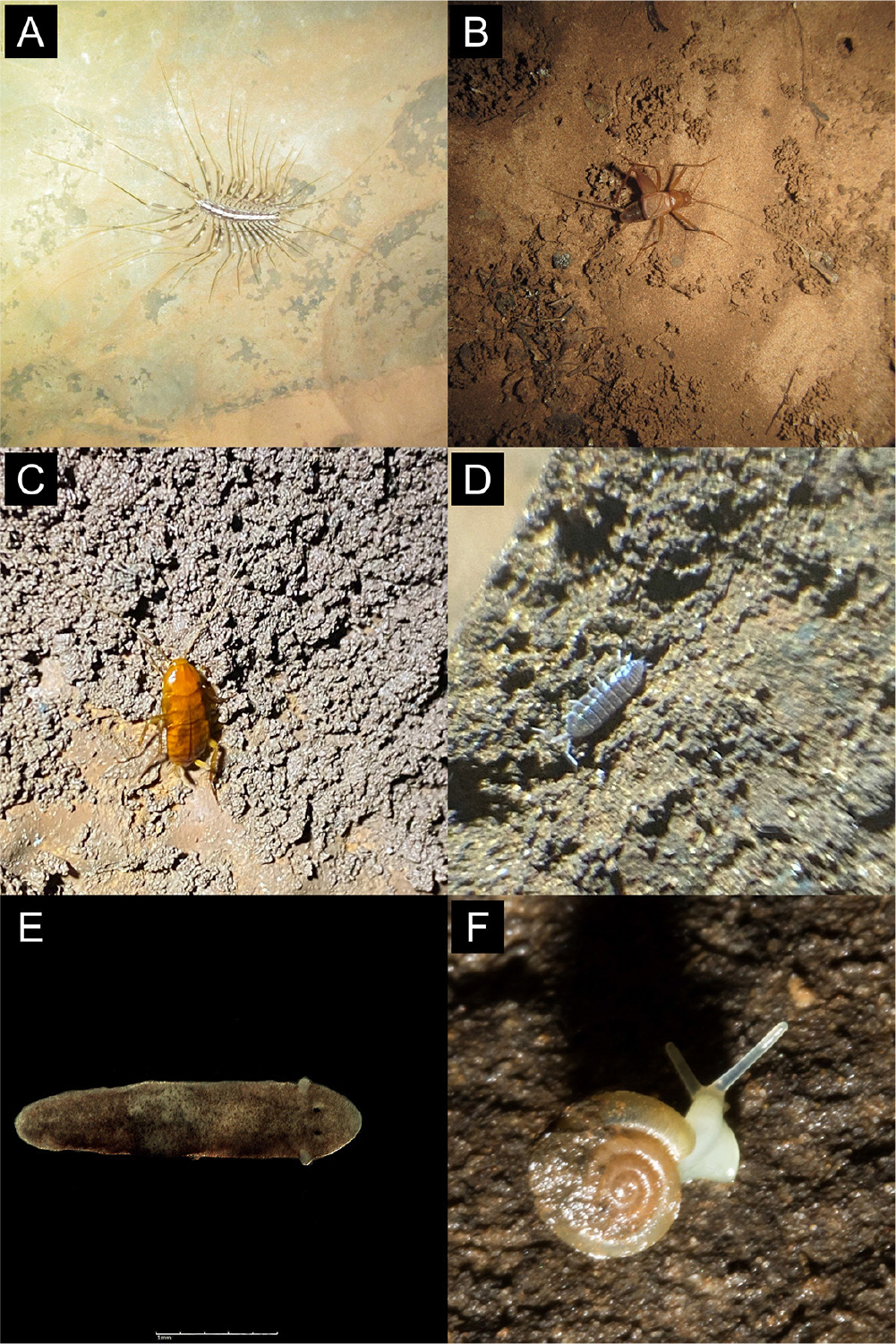
The animals known as troglophiles (Figure 2) are extremely important for subterranean habitats because, in addition to performing ecological functions in food webs, they are essential for maintaining gene flow with epigean environments through their entry into and exit from caves (Trajano & Bichuette 2006). Moreover, in most models of subterranean evolution, they are considered the originators of troglobites through the genetic isolation of initially troglophilic populations. Thus, their protection is essential since current troglophiles are potential ancestors of troglobites (Trajano & Bessi 2017). Finally, another important function is serving as recolonizers of the epigean environment in the case where species are scarce in this environment but abundant in the hypogean one, acting as “a key element for the survival of this meta-population or even the species” (Trajano & Bessi 2017).

Different troglophilic animals. Containing (A) a Chilopoda of the Order Scutigeromorpha, (B) a cricket of the Family Phalangopsidae, (C) a cockroach (Order Blattodea), (D) a woodlice (Order Isopoda), (E) a planaria of the Class Rhabditophora and (F) a mollusc of the Class Gastropoda, respectively. Photographs: Jonas Eduardo Gallão and Maria Elina Bichuette.
Currently, approximately 22,800 caves are registered in Brazil (CECAV 2022), but knowledge about these caves is uneven. Some regions are well-studied, while others have limited data, resulting in incomplete records of species abundance and richness (Trajano & Moreira 1991, Bichuette et al. 2019). This knowledge gap is due to shortfalls, particularly the Linnean and Wallacean shortfalls, which arise from the discrepancy between described and existing species and the lack of knowledge about species’ geographical distribution (Limolino 2004; Hortal et al. 2015). These shortfalls affect cave studies, as many subterranean habitats are difficult to access, and many collected species remain undescribed.
Furthermore, classifying organisms within the Schiner-Racovitza framework presents challenges for all categories, but especially for troglophiles, because it requires evidence of source populations in both subterranean and surface environments, such as signs of feeding and reproduction, as well as the presence of all life cycle stages in both environments (Trajano & Bessi 2017).
Moreover, the distinction between troglophiles and trogloxenes is more complex than it seems, as their differentiation is ecological and, in some cases, dependent on the availability of food resources. Many organisms usually recorded as trogloxenes can, in caves with great food resource availability, establish troglophilic populations. Another confusing factor is that both categories can move out of or into caves, with the main difference being that troglophiles can leave while trogloxenes must leave to complete their life cycle. Therefore, mere observations of presence and entry/exit are insufficient for categorization, requiring population studies on an annual timescale, which are not commonly applied in faunal surveys in caves (Trajano & Bessi 2017).
As a consequence, troglophilic species have been erroneously categorized or omitted from faunal lists and species descriptions. Additionally, they are often not considered in management plans, which can have adverse implications for conservation efforts (Trajano & Bessi 2017).
Technological advances and platforms for compiling biodiversity data have mitigated some shortfalls (Hortal et al. 2015). Databases like the Catalogue of Life (https://www.catalogueoflife.org/) and search tools on the CAPES Platform (https://www.periodicos.capes.gov.br/) and Google Scholar (https://scholar.google.com.br) are crucial resources. Thus, creating a database on troglophiles is fundamental for addressing knowledge deficits and understanding subterranean habitats. This study aims to establish an open, continuously updated database, called BioTroglophileBR, with records of Brazilian cave troglophiles. Additionally, we evaluate the influence of Linnean and Wallacean shortfalls on these data.
Material and Methods
1. Bibliographic research
For the bibliographic survey, searches were carried out in the digital literature collections: CAPES periodical (https://www.periodicos.capes.gov.br/), administered by the Brazilian federal government, and Google Scholar (https://scholar.google.com.br/). Initially, keywords and search filters were used to find studies related to biospeleology in Brazil, employing the terms “Brazil”, “Caves”, “Biodiversity” and “New Species” together. Subsequently, the terms “troglophiles” and “troglophilics” were added to refine the search, focusing on the target group. Finally, only studies published after 1995 were selected, as this was the year Ricardo Pinto-da-Rocha published the “Synopsis of the cave fauna of Brazil (1907-1994)” — the most recent and complete work compiling knowledge on Brazilian cave fauna.
The retrieved articles were analyzed, and the species/morphospecies identified as troglophiles or potentially troglophiles — based on their presence in both epigean and hypogean environments — were recorded and quantified in spreadsheets. Additionally, data on troglophilic organisms deposited in and registered with the scientific collection of the Laboratório de Estudos Subterrâneos (LES) at the Fereral University of São Carlos (São Carlos campus, Brazil) were incorporated into this database.
2. Nomenclature and classification review
Before being recorded in the database, taxa obtained from bibliographic sources and LES collection data were reviewed using reliable online biodiversity database, including:
-
- Catalogue of Life (COL - https://www.catalogueoflife.org/);
-
- Sistema de Informação Sobre a Biodiversidade Brasileira (SiBBr - https://sibbr.gov.br/);
-
- Global Biodiversity Information Facility (GBIF - https://www.gbif.org/);
-
- World Register of Marine Species (WORMS - https://www.marinespecies.org/);
-
- World Spider Catalogue (WSC - https://wsc.nmbe.ch/).
These databases were used to verify and update taxonomic classifications and nomenclatures changes since the original publications. To prevent future inconsistencies, a dedicated “Observations” tab was added to the database, recording the original name as they appeared in the source material.
3. Data analysis
The biodiversity data were compiled into tables using Microsoft Excel (version 2306, Office 2019). The spreadsheet was organized into eight columns:
-
- Taxon: Taxonomic classification (Class, Subclass, Order, Suborder, Family, Subfamily, Tribe and Subtribe);
-
- Genus, species or morphotype: The updated scientific name of the species or the morphospecies designation from the original article;
-
- Number of Caves Occurring: Number of caves where the species/morphospecies was recorded;
-
- State with Occurrence: Acronym of the Brazilian states where the species/morphospecies was documented;
-
- Caves with Occurrence: Names of all, or at least the main, caves where the species/morphospecies was found;
-
- Reference: Citation of the study from which the data were obtained or reference to the LES scientific collection;
-
- Observations: Notes on taxonomic or nomenclatural updates compared to the original source.
To quantify and analyze the data, only valid species were considered. For morphotypes that had not been identified at the species level and were recorded in multiple caves, this study introduced two estimation concepts:
-
- Minimum estimate: Assumes that a single species occurs in all recorded caves.
-
- Maximum estimate: Assumes that each cave hosts a distinct species.
For example, if one or more studies identified Loxosceles spider in 20 caves, without species-level identification, the “minimum estimate” considers a single species potentially occurring in all 20 caves, while the “maximum estimate” assumes up to 20 different species.
The data were analyzed using the R! platform version 4.4.1 (2024) and the R! Studio software (version 2024.04.2 Build 764), employing the tidyverse packages (Wickham et al. 2019) to generate graphical representations of:
-
- The taxonomic groups with the highest number of troglophilic representatives, highlighting differences in species richness and morphospecies among them;
-
- A comparison between species-level morphotypes, genus-level morphotypes, and those identified at higher taxonomic levels (Subfamily, Family, Suborder, or Order).
Additionally, kruskal-Wallis tests (1952) were performed using the rstatix package (Kassambara 2023) to assess significant differences in recorded species, minimum estimates, and maximum estimates of morphospecies across different Orders and Classes of troglophiles.
Kernel density maps were also generated to visualize the distribution of Brazilian troglophilic species. To achieve this, the especies occurrence coordinates were extracted from the bibliographic sources and LES collection data. When only cave names or codes were available, coordinates were retrieved from the Cadastro Nacional de Cavernas do Brasil (https://cnc2022devprovis1.websiteseguro.com/Default.aspx) and the 2021 Speleological Yearbook from the Centro Nacional de Pesquisa e Conservação de Cavernas (CECAV 2021). The obtained coordinates were mapped using Google Earth Pro software (version 7.3.6.9345; 2022 Google LLC) and exported as .kml files for processing in QGIS platform (version 3.28.2; 2023).
The final maps included a grid of biogeographic divisions based on Morrone’s (2011, 2014) framework, using the shapefile developed by Lowenberg-Neto (2016). Kruskal-Wallis analyses were conducted in R! platform (version 4.4.1; 2024) to test for significant differences in troglophilic species concentration across different Orders in various Biogeographic Provinces and Domains.
Results
According to our data, we recorded 223 species (Figure 3). At other taxonomic levels, we also recorded 213 genera, distributed across 178 families, 51 orders, 11 classes and five phyla (presented in Supplementary Material S1). The main representative Class of troglophiles was Arachnida, with the Orders Araneae (49 species) and Opiliones (13 species) having the highest species counts, along with Spirostrepida (16 species), Collembola (14 species) and Siluriformes fish (13 species).

In addition to the 223 valid species recorded, we estimated that between a minimun of 799 and a maximum of 2,412 different morphospecies may exist but have not been fully identified or determined. In terms of possible morphospecies, the Orders with the highest values under the minimum estimate were Araneae (167 morphospecies), followed by Coleoptera (92 morphospecies), Diptera (54 morphospecies), Spirostrepida (51 morphospecies) and Collembola (38 morphospecies). Under the maximum estimate, the highest values were recorded for Araneae (651 morphospecies), Diptera (355 morphospecies), Coleoptera (205 morphospecies), Orthoptera (181 morphospecies) and Spirostrepida (148 morphospecies) (Figure 4).

Statistical analyses indicated no significant differences in the number of species records across Classes. However, when analyzed at the Order level, significant differences were found (Table 1), confirming that certain Orders contain more troglophilic organisms than others.
Kruskal-Wallis tests comparing Classes and Orders of troglophiles. The “DF” column indicates the degrees of freedom applied in the statistical test, the “*” indicates significant difference between groups.
1. Taxonomic refinement and the Linnean shortfall
Evaluating the impact of the Linnean shortfall on troglophilic diversity records in Brazil reveals that the taxonomic impediment has influenced our understanding of species richness. The discrepancy between the number of determined species and the estimated number of morphospecies identified at the Genus level is significant, with the former representing only 86% of the latter (considering minimum estimates).
When considering morphospecies only at the higher taxonomic levels (Family, Order, or Class), this discrepancy becomes even more pronounced. In this case, the recorded troglophilic species represent only 27% of the minimum estimated numbers of existing morphotypes that remain unidentified or undescribed in the natural environment (Figure 5).

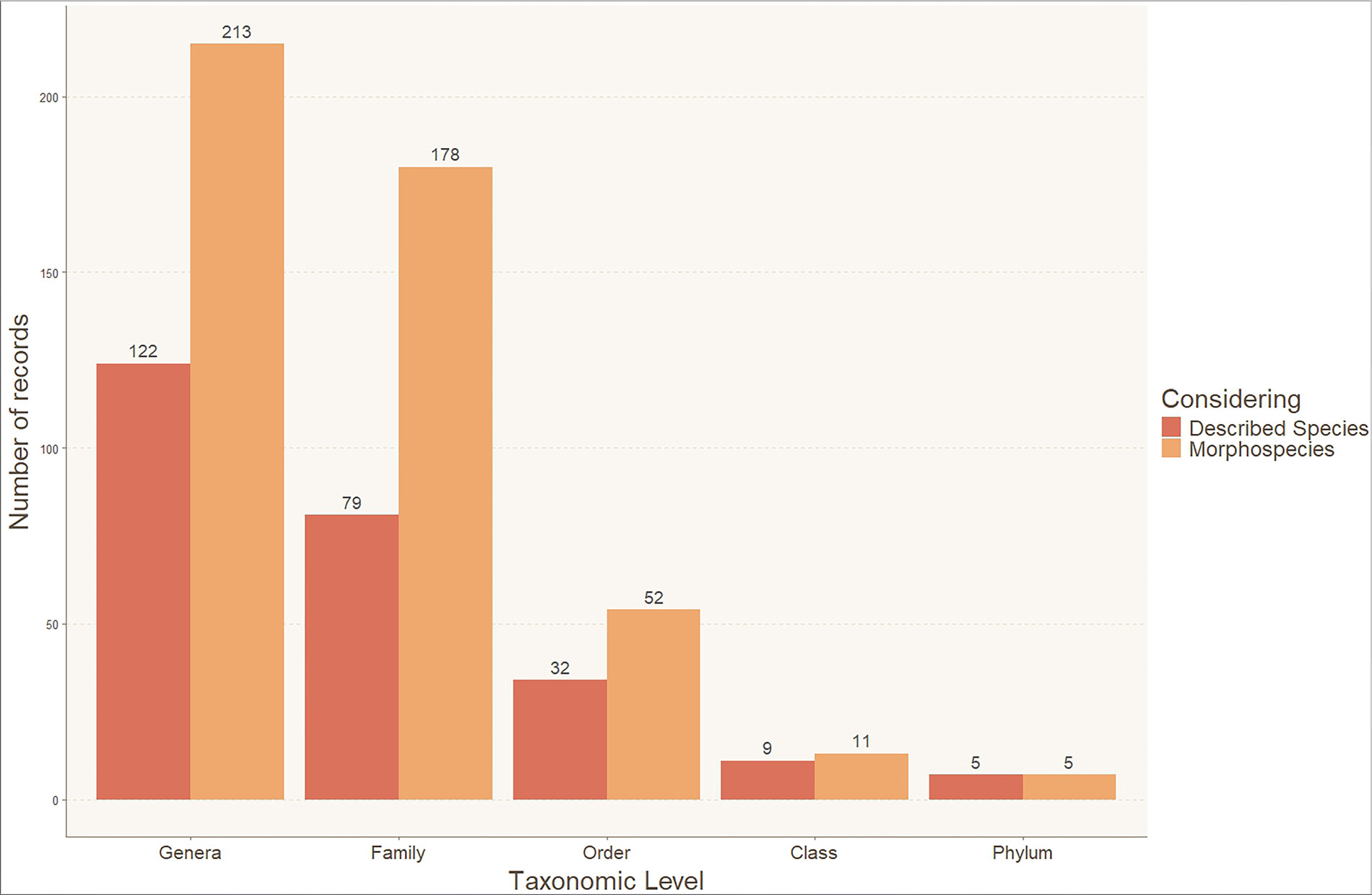
Graph showing the differences between the number of troglophilic species determined and the estimates. A - Valid species; B - Specimens identified up to the genus level, C - Specimens identified only at the higher level (Class, Order, Family).
Comparing the number of recorded Genera, Families, Orders, Classes and Phyla using only identified species versus including unidentified morphospecies, a clear increase in taxonomic richness is observed. Specifically, Genus records increased by approximately 76%, Family records by 125%, Order records by 62%, and Class records by 22% (Figure 6).

Graph comparing the record of Genera, Families, Orders, Classes and Phyla, taking into account only specific species, and considering morphotypes identified only at the level of Genus or at a higher level of classification.
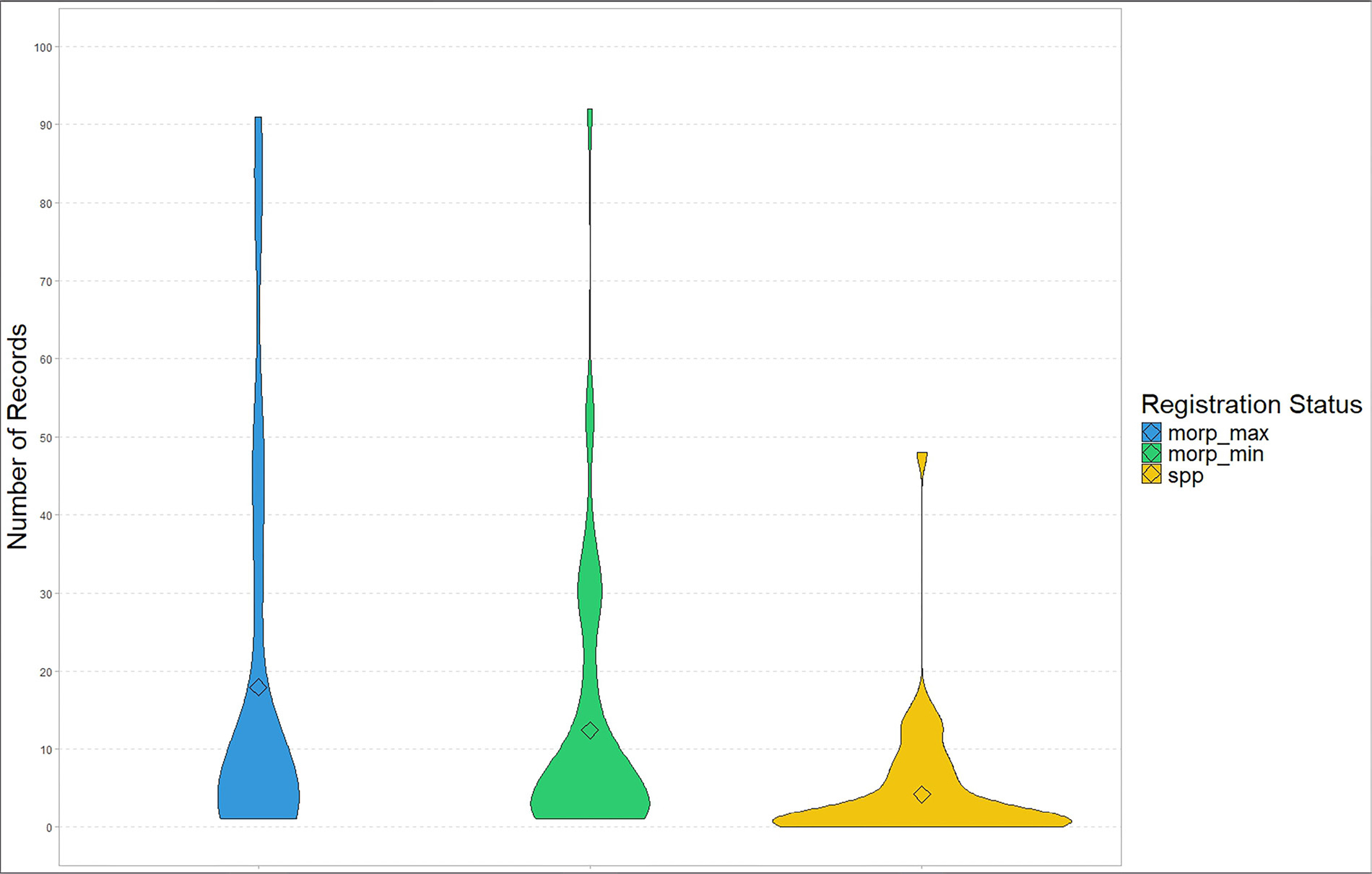
Kruskal-Wallis analysis showed significant differences between formally described species, the minimum estimate of possible morphospecies, and the maximum estimated of possible morphospecies (chi-squared = 24.742, df = 2, p-value = 4.239e-6). A post-hoc Dunn’s test (1964) for pairwise comparisons revealed significant differences between species and minimum morphospecies, as well as between species and maximum morphospecies (Table 2). These findings confirm the influence of the Linnean shortfall on taxonomic refinement and our real understanding of species richness in troglophiles (Figure 7).
Dunn’s tests (1964) comparing species, minimum morphospecies and maximum morphospecies across Orders. “N1” and “N2” represent the number of orders compared in each case. The number of “*” denotes the level of significance, where a higher count indicates greater significance in the Kruskal-Wallis test.

Violin graph comparing the number of records of maximum morphotypes (morp_max), minimum morphotypes (morp_min) and described species (spp). The diamond represents the average of the records.
Furthermore, our results indicate differences in the representativeness of troglophiles when comparing identified species with the minimum and maximum estimates (Figure 8). Significant increases in records and, representativeness was observed, particularly for the insect orders Diptera, Coleoptera and Orthoptera. However, for the order Opiliones (Arachnida), representativeness decreased when unidentified morphospecies were considered.

Graph of the change in representativeness of the main troglophile Orders according to status of described species (1), minimum morphotypes (2), maximum morphotypes (3).
2. Distribution of troglophiles and the Wallacean shortfall
The Brazilian troglophilic species that have been formally described are distributed across 18 of the country’s 27 federal states, with a greater concentration in the southeast, mainly in the states of Minas Gerais (94 species) and São Paulo (49 species). Although troglophile species are found in all regions of the country, there is a discrepancy in the number of records. Some regions, such as the southeast and midwest, have good sampling and records, while others, such as the northeast and south, are poorly in terms of troglophiles. Additionally, to date, there are no records of formally described species in the states of Acre, Alagoas, Amapá, Distrito Federal, Maranhão, Paraíba, Rio de Janeiro, Rondônia and Roraima.
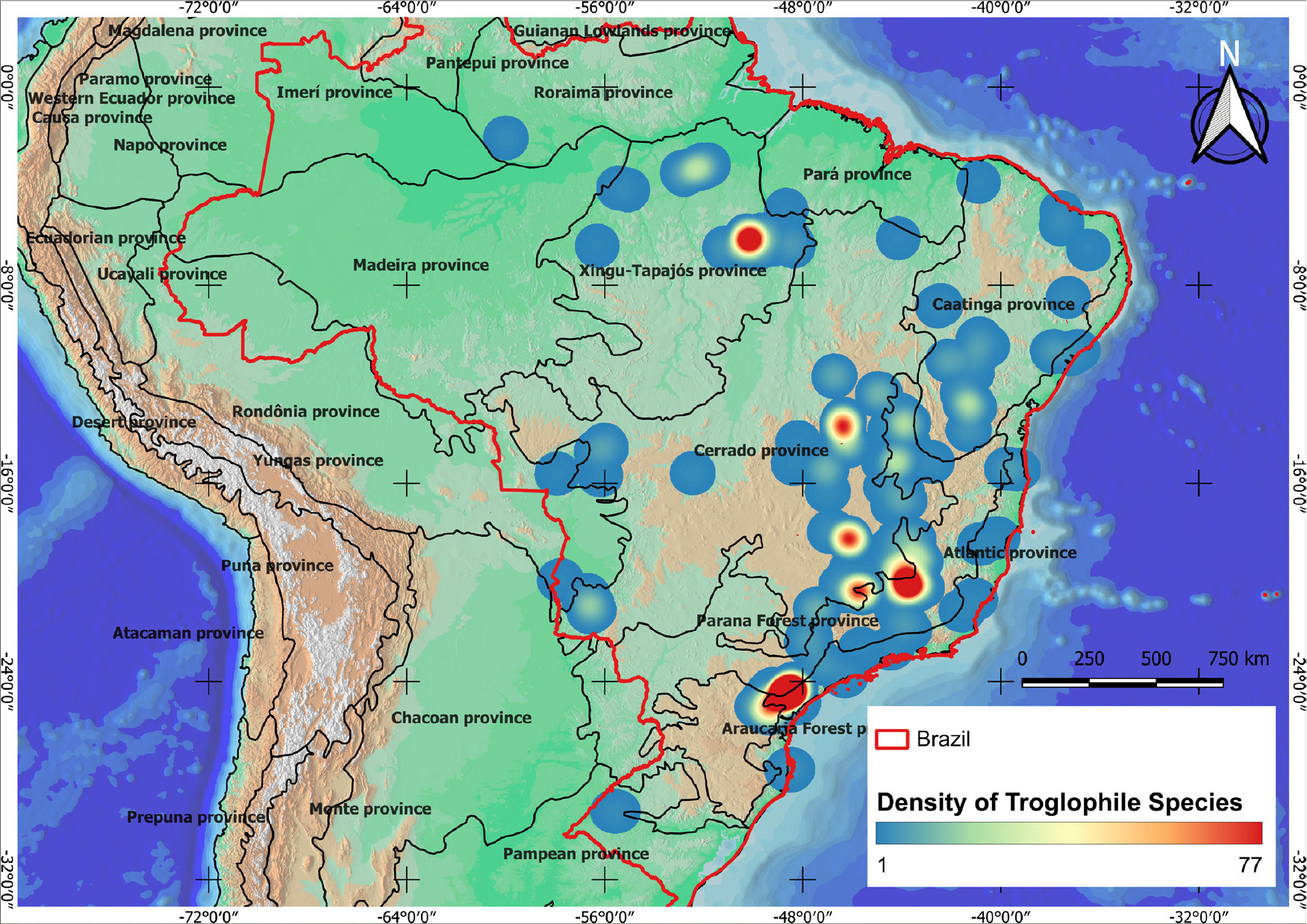
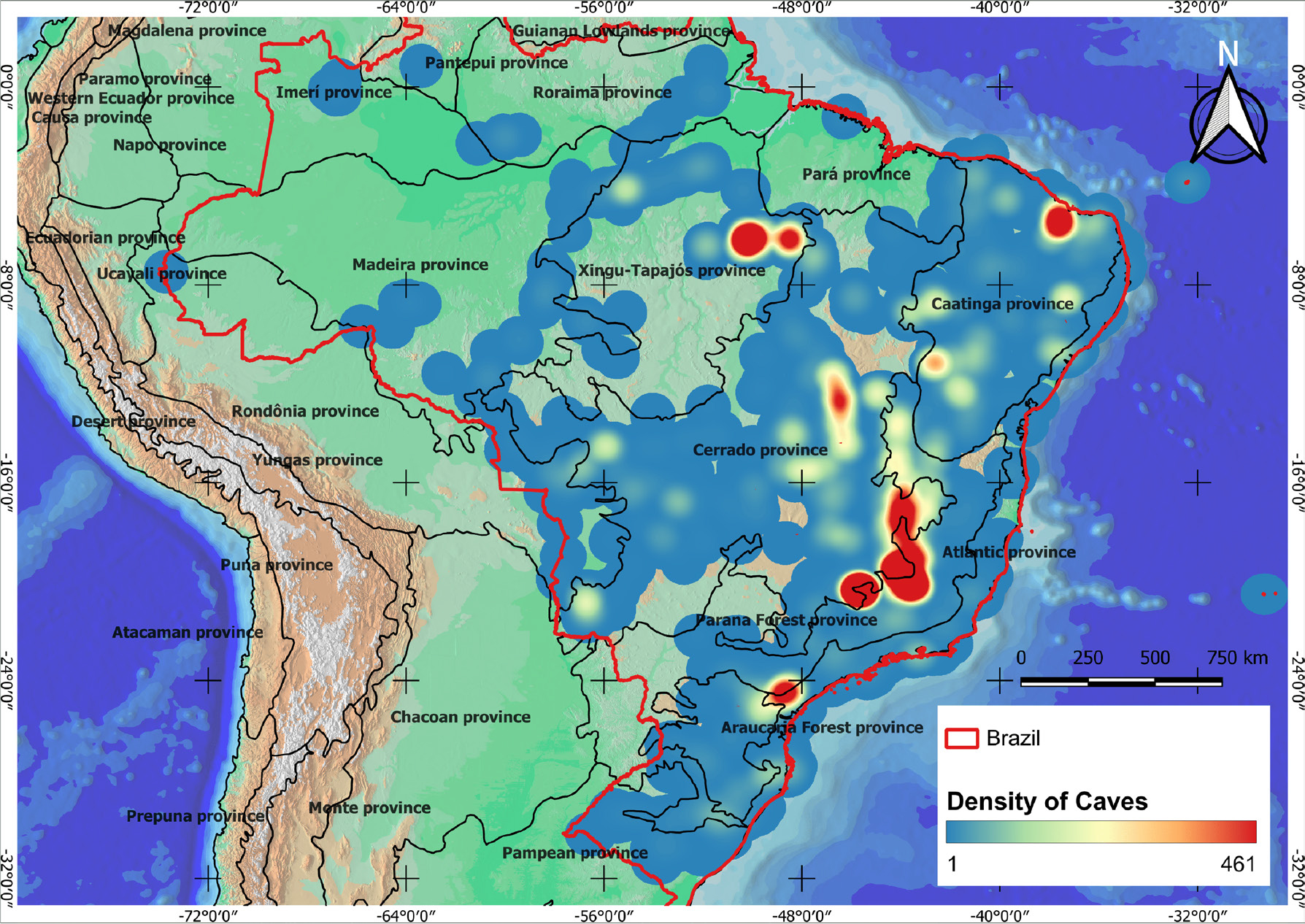
In terms of biogeographical divisions, troglophile species can be found in 10 of the 14 provinces proposed by Morrone (2014) for the Brazilian region. There are no records for the Guiana Plains Province, Pantepui Province, Imerí Province and Madeira Province. The highest concentrations of species are found in the Paraná Dominion, mainly in the southeast of the country in the Ribeira Valley, on the border between the Paraná Forest Province, the Atlantic Province and the Araucaria Forest Province. Noteworthy areas also include the central region of the Paraná Forest Province, near the Iron Quadrangle in Minas Gerais, and the Cerrado Provinces in the Chacoan Dominion and Xingu-Tapajós, which is part of the Southeastern Amazon Dominion and includes the Carajás mineral exploration region in Pará. The distribution of the largest concentrations of troglophilic species (Figure 9) is similar to the distribution pattern of caves in Brazil (Figure 10). However, despite this correlation, many areas with large concentrations of caves have few or no records of troglophiles.

Kernel heat map for Brazilian troglophilic species in the biogeographic provinces proposed by Morrone (2014).

Kernel heat map for caves in Brazil, the data of occurrence of caves were taken from CECAV’s CANIE system (https://www.gov.br/icmbio/pt-br/assuntos/centros-de-pesquisa/cavernas/publicacoes/Area%20de%20Ocorrencia%20de%20Cavernas).
3. Distribution by taxonomic class
3.1. Class Rhabditophora
The troglophilic species of this class, which includes flatworms of the platyhelminth group, are found exclusively in the Chacoan Subregion. They are distributed among the Cerrado Province (two species: Girardia pierremartini Souza & Leal-Zanchet, 2016 and G. asymmetrica Hellman & Leal-Zanchet, 2020) within the Chacoan Dominion, Paraná Forest Province (two species: G. ibitipoca Hellman & Leal-Zanchet, 2020 and the possibly troglophilic Difroehlichia elenaeLeal-Zanchet & Marques, 2018) within the Paraná Dominion, and the Xingu-Tapajós Province (G. paramensis Fuhrmann, 1912) in the Southeastern Amazonian Dominion.
3.2. Class Gastropoda
The majority of troglophilic mollusk with spiral shells are found in the Cerrado Province, including Happia vitrina (J. A. Wagner, 1827); Allopeas micra (d’Orbigny, 1835); Pseudoguppya semenlini (Moricand, 1846); Leptinaria unilamellata concentrica (Reeve, 1849); Euconulus martinezi (Hidalgo, 1869); Scolodonta interrupta (Suter, 1900); Alcadia iheringi A. J. Wagner, 1911; and Dysopeas muibum Marcus & Marcus, 1968. An exception is Potamolithus karsticus Simone & Moracchioli, 1994, which occurs in the Paraná Forest Province, specifically in the Ribeira Valley region in the Southeast. Many of these species co-occur within the same cavity or in adjacent cavities.
3.3. Class Clitellata
This group, which includes annelids or cylindrical worms, has the highest concentration of species in the Paraná Dominion, particularly along the border between the Paraná Forest Province and the Atlantic Province in the southeast of the country. The recorded species include Pontoscolex corethrurus (Muller, 1856); Fridericia bulbosa (Rosa, 1887); Amynthas hawayanus (Rosa, 1891); A. morrisi (Beddard, 1892); Pristina (Pristina) proboscidea Beddard, 1896; Fimoscolex sporadochaetus Michaelsen, 1918; Guaranidrilus mboi Righi, 1975; and the possibly troglophilic A. gracilis (Kinberg, 1866). Additionally, P. corethrurus is also found in the Cerrado Province within the Chacoan Dominion, and Dichogaster gracilis (Michaelsen, 1892) and D. (Diplothecodrilus) saliens (Beddard, 1893) are present in both the Paraná Forest Province and the Cerrado Province.
3.4. Subclass Acari (Class Arachnida)
Two formally described troglophilic species of the order Sarcoptiformes have been recorded in the Cerrado Province: Aphelacarus acarinus (Berlese, 1910) and Sphaerochthonius phyllophorus Balogh & Mahunka, 1969. Four additional possibly troglophilic species are found in the Paraná Forest Province, including two from the Order Mesostigmata (Uroseius subterraneusConceição & Repato, 2021 and Oplitis apicalis Lopes, Oliveira, Delabie and Klompen, 2015) and two from the Order Trombidiformes (Charletonia rocciai Treat & Fletchmann, 1979 and Lasioerythraeus jessicaeCosta et al., 2019).
3.5. Order Araneae (Class Arachnida, Figure 11)

Some representatives of troglophilic arachnids. Containing (A) a spider of the Family Ctenidae, (B) a spider of the Family Pisauridae, (C) a harvestman of the species Flirtea batman (Pinto-da-Rocha & Yamaguti, 2013), (D) an amblypygian, (E) a spider of the Family Pholcidae, (F) a brown spider (Family Sicariidae, Genus Loxosceles), respectively. Photographs: Jonas Eduardo Gallão and Maria Elina Bichuette.
The distribution of Sicariidae includes the Cerrado Province (Loxosceles variegata Simon, 1897; L. similis Moenkhaus, 1898; L. gaucho Gertsch, 1967; L. amazonica Gertsch, 1967; and L. planetaria Bertani & Gallão, 2023), the north of the Paraná Forest Province (L. similis; L. karstica Bertani, von Schimonsky & Gallão, 2018; L. carinhanha Bertani, von Schimonsky & Gallão, 2018; L. cardosoi Bertani, von Schimonsky & Gallão, 2018; and L. ericsoni Bertani, von Schimonsky & Gallão, 2018), north of the Atlantic Province (L. similis), the north of the Pampean Province of the Chacoan Dominion (L. intermedia Mello-Leitão, 1934) and in the southeast of the country on the borders between the Paraná Forest, Araucaria Forest and Atlantic Provinces (L. gaucho and L. adelaida Gertsch, 1967).
For Theridiidae, Nesticodes rufipes (Lucas, 1846) is found in the Caatinga and Cerrado Province within Chacoan Dominion. Latrodectus geometricus C. L. Koch, 1841; Cryptachaea parana (Levi, 1963); and Dipoena santaritadopassaquatrensis Rodrigues, 2013, are also present in the Cerrado Province. Additionally, there are representatives in the Paraná Forest Province (N. rufipes and Theridion bergi Levi, 1963) and the Atlantic Province (T. bergi), both in the Paraná Dominion.
For Theridiosomatidae Plato ferriferus Prete, Cizauskas & Brescovit, 2018 is found in the Xingu-Tapajós Province and Pará Province (Brazilian Boreal Domain), also three species (P. striatus Prete, Cizauskas & Brescovit, 2018; P. novalima Prete, Cizauskas & Brescovit, 2018; and Cuacuba mariana Prete, Cizauskas & Brescovit, 2018) are present in Cerrado Province, three species (P. novalima, C. mariana and C. morrodopilar Prete, Cizauskas & Brescovit, 2018) presents in Paraná Forest Province and the species C. ribeiraPrete & Brescovit, 2020 only occurs in the Ribeira Valley region, on the border between the Araucaria Forest, Paraná Forest and Atlantic Provinces.
For Ctenidae, there is an occurrence in the Xingu-Tapajós Province (Parabatinga danielae Brescovit, Cizauskas & Polotow, 2022), in the Cerrado Province, with the species: Ancylometes concolor (Perty, 1833); Enoploctenus cyclothorax (Bertkau, 1880); and Isoctenus griseolus (Mello-Leitão, 1936). In the Paraná Forest Province, there is one species (A. concolor), in the Atlantic Province there is also one species (E. cyclothorax) and in the Pampenan Province there is also one species (E. cyclothorax). In addition, the species Ctenus fasciatus Mello-Leitão, 1943, considered by many authors to be one of the model organisms in the classification of troglophiles, has a similar distribution to Cuacuba ribeira (Theridiosomatidae) in the region that encompasses the three biogeographical provinces that make up the Ribeira Valley, and has so far been recorded in 67 caves in the region.
For Ochyroceratidae, Ochyrocera ibitipoca Baptista, González & Tourinho, 2008, O. brumadinhoBrescovit & Cizauskas, 2018, O. magali Brescovit, Zampaulo, Pedroso & Cizauskas, 2021 and O. monica Brescovit, Zampaulo, Pedroso & Cizauskas, 2021 are found in Paraná Forest Province within Paraná Dominion. And the Xingu-Tapajós Province within the Southeastern Amazonian Dominion, with O. varys Brescovit, Cizauskas & Mota, 2018; O. atlachnacha Brescovit, Cizauskas & Mota, 2018; O. laracna Brescovit, Cizauskas & Mota, 2018; O. aragogue Brescovit, Cizauskas & Mota, 2018; O. misspider Brescovit, Cizauskas & Mota, 2018; O. charlotte Brescovit, Cizauskas & Mota, 2018; and O. ungoliant Brescovit, Cizauskas & Mota, 2018, recorded.
For the other Families of the Order Araneae, the distribution is among the Cerrado Province, with five species distributed among Oonopidae with Triaeris stenaspis Simon, 1892; Araneidae with Trichonephila clavipes (Linnaeus, 1767); Pholcidae with Mesabolivar difficilis (Mello-Leitão, 1918); and Linyphiidae with Scolecura parilis Millidge, 1991 and Vesicapalpus simplex Millidge, 1991. The Paraná Forest Province also has a Pholcidae species, Mesabolivar kaingang Huber, 2018. And the Caatinga Province also has a species of Pholcidae, Smeringopus pallidus (Blackwall, 1858).
For Theraphosidae, which represent the large spiders of the Infraorder Mygalomorphae, the Xingu-Tapajós Province has the species Hapalopus aymara Perdomo, Panzera & Pérez-Miles, 2009; Guyruita metallophila Fonseca-Ferreira, Zampaulo & Guadanucci, 2017; and the possibly troglophilic Cyrtogrammomma monticolaPocock, 1895). Also, in this same Infraorder, the Paraná Forest Province has the species from Dipluridae, Trechona diamantina Guadanucci, Fonseca-Ferreira, Baptista & Pedroso, 2016.
3.6. Order Amblypygi (Class Arachnida, Figure 11)
The species are distributed in six Provinces and four different Domains within Morrone’s (2014) proposal. In the Province of Roraima, from the Southern Brazilian Domain, with the possibly troglophilic species Charinus ricardoi Giupponi & Miranda, 2016. In the Southeastern Amazonian Dominion, the Xingu-Tapajós Province has the species: Heterophrynus longicornis (Butler, 1873); C. orientalis Giupponi & Miranda, 2016; and C. carajas Giupponi & Miranda, 2016. From the Chacoan Dominion the Provinces of Caatinga (H. longicornis; Trichodamon princeps Mello-Leitão, 1935; and C. diamantinus Miranda, Giupponi, Prendini & Scharff, 2021) and Cerrado, with H. longicornis. And in the Paraná Dominion, the Atlantic Province (C. acaraje Pinto-da-Rocha, Machado & Weygoldt, 2002 and the possibly troglophilic C. apiaca Miranda, Giupponi, Prendini & Scharff, 2021) and the Paraná Forest Province (T. princeps and the possibly troglophilic C. santanensis Vasconcelos & Ferreira, 2017).
3.7. Order Opiliones (Class Arachnida, Figure 11)
This group are also well distributed, occurring in six Provinces and three biogeographic Domains, with Verrucastygnus caliginosus (Pinto-da-Rocha, 1990) and the possibly troglophilic Eusarcus xambioa Santos Júnior, Ázara & Ferreira, 2021, occurring in the Xingu-Tapajós Province. In the Cerrado Province: Discocyrtanus goyazius Roewer, 1929; E. aduncus (Mello-Leitão, 1942); E. cavernicola Pinto-da-Rocha & Hara, 2010; Flirtea batman (Pinto-da-Rocha & Yamaguti, 2013); and the possibly troglophilic E. capixaba Santos Júnior, Ázara & Ferreira, 2021. One species (E. aduncus) is found in the northern region of the Paraná Forest. Two possibly troglophilic species (E. capixaba and E. marmoreus Santos Júnior, Ázara & Ferreira, 2021) in the central region of the Atlantic Province. Two species co-occur in the Alto do Ribeira region covering three provinces of the Paraná Dominion, where Pararezendesius luridus Soares, 1972, in Paraná Forest and Atlantic Provinces, and Khazaddum inerme (Soares & Soares, 1947) in these and in the Araucaria Forest Province. Finally, a possibly troglophilic species (E. elinae Kury, 2008) is registered in the Caatinga Province.
3.8. Order Scorpiones (Class Arachnida)
The species are distributed in five Provinces and four different biogeographic Domains, with Tityus blaseri Mello-Leitão, 1931, T. confluens bodoquena Lourenço, Cabral & Bruehmueller Ramos, 2004, and T. spelaeusMoreno-Gonzalez, Pinto-da-Rocha & Gallão, 2021, occurring in the Cerrado Province. In the Xingu-Tapajós Province T. obscurus (Gervais, 1983) is registered. The subspecies T. confluens confluens Borelli, 1899, is found in the Rondônia Province within the South Brazilian biogeographic Domain. Finally, the species T. stigmurus (Thorell, 1876) occour in the Northeastern region from Brazil, distributed in two Provinces: Caatinga and Atlantic.
3.9. Class Arachnida, other Orders
The other Orders of the arachnid class is found in the Cerrado Province with the species of the Order Pseudoscorpiones, Pseudochthonius lundiVon Schimonsky, 2024, and the invasive species of the Order Schizomida, Stenochrus portoricensis Chamberlin, 1922. The Caatinga Province has the pseudoscorpions Maxchernes kapinawai Bedoya-Roqueme, Tizo-Pedroso, Barbier & Lira, 2021 and the possibly troglophilic Cheiridium brasilienseMahnert, 2001. Additionally, on the border between the Atlantic and Paraná Forest Provinces has the pseudoscorpions Heterolophus guttiger Tömösváry, 1884 and the possibly troglophilic Ideoroncus setosus Mahnert, 1984.
3.10. Class Malacostraca
The Order Isopoda, popularly called “woodlices”, has species distributed in the Xingu-Tapajós Provinces (Ctenorillo ferraraiCampos-Filho, Araujo & Taiti, 2014; C. peladoCardoso & Ferreira, 2024; and the possibly troglophilic Androdeloscia akuanduba Campos-Filho, Cardoso & Taiti, 2020). The Cerrado Province, with the species Venezillo congener (Budde-Lund, 1904) recorded. The Paraná Forest Province there are the species: Benthana picta (Brandt, 1833); B. longicornis Verhoeff, 1941; and the possibly troglophilic B. taeniata Araujo & Buckup, 1994. Additionally, three species (B. taeniata, B. picta and Dubioniscus marmoratus Lemos de Castro, 1970) are found in Atlantic Province.
The other Orders (Amphipoda and Decapoda) have their species distributed, so far, only in the region covering the Ribeira Valley, with two species (Aegla paulensis Schmitt, 1942 and A. schmitti Hobbs III, 1978) registered in the Araucaria Forest Province, three species (A. schmitti, A. strinatii Türkay, 1972 and A. marginata Bond-Buckup & Buckup, 1994) in Atlantic Province, and three species in the Paraná Forest Province: A. schmitti, A. marginata and Hyalella pernix (Moreira, 1903).
3.11. Class Chilopoda
For this group, that includes the centipedes, the main species with a distribution in several locations in the country is Sphendononema guildingii Newport G. (1845), which has been recorded in five provinces and three different biogeographic domains. Additionally, the possibly troglophilic Thereuoquima admirabilis Bücherl, 1949 is found in Atlantic Province and the also possibly troglophilic Otostigmus (Parotostigmus) tibialis Brölemann, 1902 occurs in the region bordering the Paraná Forest. Finally, two more species are registered exclusively in the Paraná Forest Province: Cryptops (Trigonocryptops) hephaestus Ázara & Ferreira, 2013 and the possibly troglophilic O. (Parotostigmus) muticus Karsch, 1888.
3.12. Class Diplopoda
The troglophilic species of this group have been recorded in the Cerrado Province with 10 species: Obiricodesmus rupestris Schubart, 1956; Pseudonannolene tricolor Brölemann, 1902; P. microzoporus Mauriès, 1987; P. tocaiensis Fontanetti, 1996; P. imbirensis Fontanetti, 1996; P. ambuatinga Iniesta & Ferreira, 2013; P. xavieri Iniesta & Ferreira, 2014; P. robsoni Iniesta & Ferreira, 2014; P. leopoldoi Iniesta & Ferreira, 2014; and P. erikae Iniesta & Ferreira, 2014. In the Atlantic Province with four species: P. tricolor; P. longicornis (Porat, 1888); P. leucocephalus Schubart, 1944; and P. strinatii Mauriès, 1974. The Paraná Forest Province has the species: P. microzoporus; P. rolamossa Iniesta & Ferreira, 2013; and P. fontanettiae Iniesta & Ferreira, 2014. The Caatinga Province with the species: P. microzoporus; P. anapophysis Fontanetti, 1996; and P. caatinga Iniesta & Ferreira, 2014. Finally, the Araucaria Forest Province also has the presence of the species P. strinatii.
3.13. Order Collembola (Class Entognatha)
The main representative of this group, in terms of the number of troglophilic species, is the Suborder Entomobryomorpha. It has species spread across three Provinces and three biogeographic Domains, but its greatest concentration is in the Paraná Forest Province with 10 species recorded in caves: Cyphoderus caetetus Zeppelini & Oliveira, 2016; Pseudosinella acantholabrata Cipola, 2020; P. macrolignicephalaOliveira, Lima & Cipola, 2020; P. marianensis Bellini, Cipola & Souza, 2020; P. parambiguaOliveira, Lima & Cipola, 2020; P. spurimarianensis Bellini, Cipola & Souza, 2020; P. unimacrochaetosaCipola, 2020; C. pataxoOliveira, Brito & Zeppelini, 2021; and Trogolaphysa mariecurieae Ferreira, Oliveira & Zeppelini, 2021. The other species are found in the Cerrado Province (C. palaciosiOliveira, Brito & Zeppelini, 2021) and Xingu-Tapajós (C. mucrominimus Oliveira, Alves & Zeppelini, 2017 and C. mucrostrimenus Oliveira, Alves & Zeppelini, 2017).
The other suborders of troglophilic Collembola have only two representative species, Pararrhopalites queiroziBrito, Lima & Zeppelini, 2019, from the Symphypleona Suborder with occurrence in the Cerrado and Paraná Forest Province, and Acherontides serrasapoensisLima, Stievano & Zeppelini, 2019, from the Poduromorpha Suborder with records only in the Paraná Forest Province.
3.14. Order Orthoptera (Class Insecta)
This group, which includes crickets, grasshoppers and hoppers, presents its troglophilic species distributed among the Cerrado Province, with the species: Endecous (Endecous) aguassay Mews, 2008; Endecous (Endecous) alejomesai Zefa, 2010; Eidmanacris scopula Campos, 2017; and Endecous (Pedroecous) didymus Castro-Souza, Zefa & Lopes Ferreira, 2020. The Paraná Forest Province has the species Eidmanacris dissimilis Desutter-Grandcolas, 1995 and Endecous (Notendecous) bahiensis Castro-Souza, Zefa & Ferreira, 2017. The Atlantic Province with Endecous (Endecous) itatibensis Rehn, 1918 and Eidmanacris alboannulata (Piza Jr., 1960). On the border between the Paraná Forest Province and the Atlantic Province by Strinatia brevipennis Chopard, 1970 and Endecous (Endecous) betariensis de Mello & Pellegatti-Franco, 1998, and on the border between the Paraná Forest and the Cerrado Province by E. (Endecous) aguassay, E. (Endecous) itatibensis and E. alboannulata. Finally, the Caatinga Province within the Chacoan Dominion has the species E. (Notendecous) bahiensis and Erebonyx potiguarMerlo et al., 2022.
3.15. Order Coleoptera (Class Insecta)
The group of beetles is distributed in four biogeographical provinces and Dominions, with a greater concentration in the Ribeira Valley region. The Paraná Forest Province has the species: Dyscolus (Dyscolus) subviolaceus (Chaudoir, 1842); Dissochaetus murrayi Reitter, 1884; Dissochaetus hetschkoi Reitter, 1884; Dissochaetus villosus Szymczakowski, 1961; Dissochaetus vanini Gnaspini, 1991; Adelopsis leo Gnaspini, 1993; Syrbatus moustacheAsenjo & Valois, 2024; S. obsidianAsenjo & Valois, 2024; S. superciliataAsenjo & Valois, 2024. The Atlantic Province has the species: D. (Dyscolus) subviolaceus; D. murrayi; D. villosus; D. vanini; A. leo. The Araucaria Forest with: D. murrayi; D. villosus; and D. vanini. Additionally, three species occur in the Cerrado Province: D. murrayi; D. vanini; and Adelopsis asperoides Szymczakowski, 1963. Furthermore, two species, Polynoncus gemmingeri (Harold, 1872) and Omorgus (Haroldomorgus) batesi (Harold, 1872), are found in one or more caves in the states of Minas Gerais and Pará, respectively, but the cavities and recorded cities have not been disclosed (see Correa et al. 2022) it was not possible to state how biogeographic provinces those species occur.
3.16. Order Hemiptera (Class Insecta)
This group, which includes bedbugs, barbers, water cockroaches, cicadas, leafhoppers, aphids and mealybugs, has seven recorded troglophilic species: Zelurus travassosi (Lima, 1940), is found only in the Ribeira Valley region; Z. festivus (Stål, 1859) registered in Xingu-Tapajós Province; Z. gerevatinga Grave Ferreira et al., 2016, registered in Paraná Forest Province; Z. variegatus Lima, 1940, found in Caatinga and Cerrado Provinces; and the other species, Z. circumcinctus (Hahn, 1835), Z. zikani (Lima, 1940), Z. tambejua Grave Ferreira et al., 2016, Z. diasi (Lima, 1940) and Emesa mourei Wygodzinsky, 1946, occur in the Cerrado Province.
3.17. Class Insecta, other orders
The other groups of the Insecta (Orders Blattodea, Diptera and Hymenoptera) are found in three biogeographic provinces. The Xingu-Tapajós has records of three troglophilic species: the fly (Order Diptera) Drosophila (Drosophila) eleonorae Tosi, Martins, Vilela & Pereira, 1990; the cockroach (Order Blattodea) Blaberus parabolicus Walker, 1868; and also the cockroach Eublaberus distanti (Kirby, 1903). The Cerrado Province has D. (Drosophila) eleonorae and the hymenopteran Pachycondyla crassinoda (Latreille, 1802). And the Paraná Forest Province has D. (Drosophila) eleonorae and the possibly troglophilic Tamanduamyia bichuettae Lamas, Mendes, Falaschi & Evenhuis, 2023.
3.18. Order Characiformes (Class Actinopterygii)
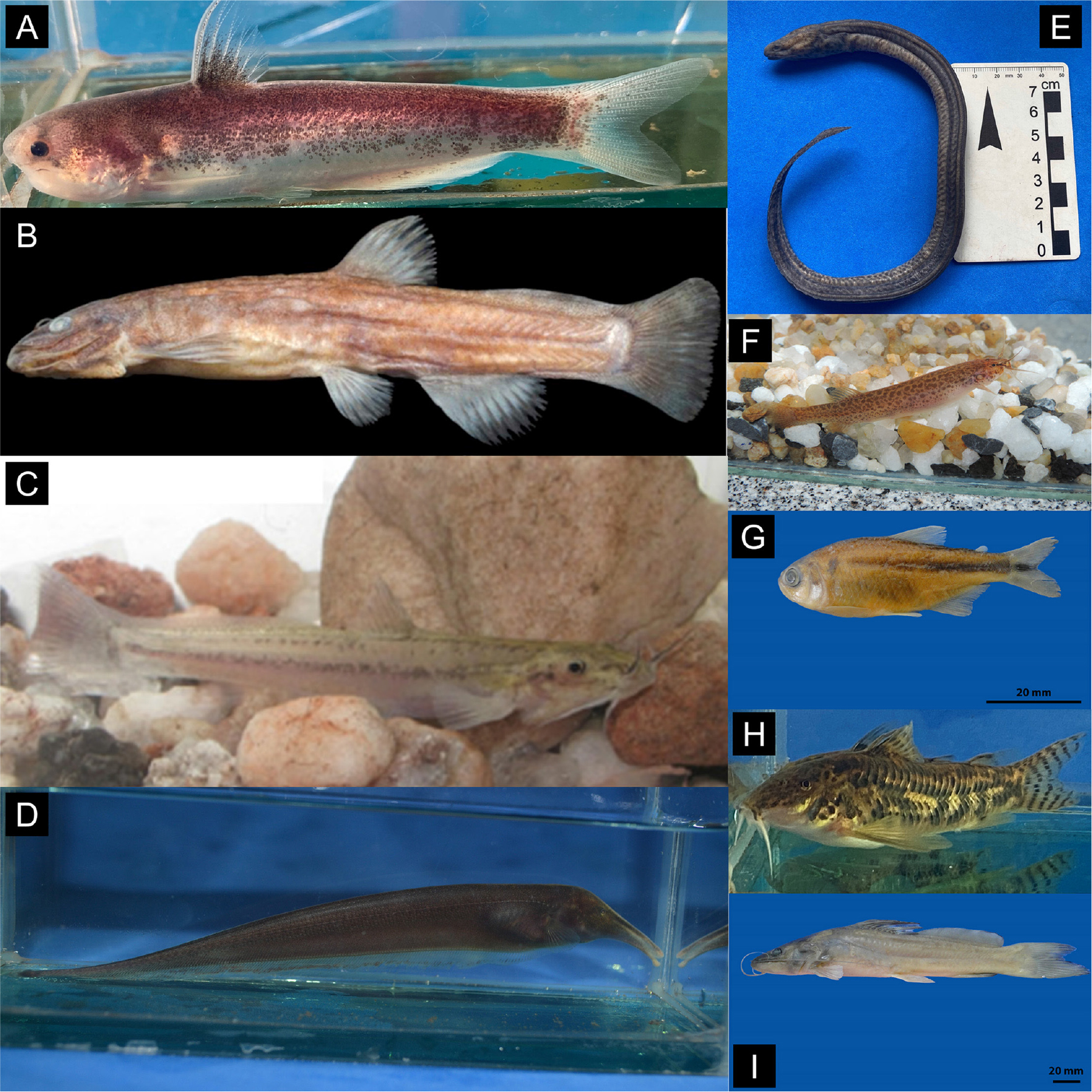
Finally, the last class with records of troglophilic species is Actinopterygii (Figure 12), which represents the bony fish with striped fins. The Characiformes Order, known as lambarís, is distributed in the Cerrado Province with the species Hoplerythrinus unitaeniatus (Spix & Agassiz, 1829), Psalidodon rivularis (Lütken, 1875) and Hyphessobrycon santae (Eigenmann, 1907), and in the Paraná Forest Province with Astyanax lacustris (Lütken, 1875) and Hemigrammus marginatus Ellis, 1911.

Some Brazilian troglophilic populations of fish. Containing (A) a catfish of the family Cetopsidae (Order Siluriformes) from caves in Goiás, (B) Copionodon lianae Campanario & de Pinna, 2000 (Order Siluriformes, Family Trychomicteridae), (C) C. pecten de Pinna, 1992 (Order Siluriformes, Family Trychomicteridae), (D) electric fish (Order Gymnotiformes) from caves in Goiás, (E) Synbranchus cf. marmoratus (Order Synbranchiformes, Family Synbranchidae), (F) Ituglanis sp. (Order Siluriformes, Family Trychomicteridae) from Nobres-MT caves, (G) Psalidodon rivularis (Order Characiformes, Family Characidae), (H) Aspidoras cf. albater (Order Siluriformes, Family Callichthyidae), (I) Rhamdia cf. quelen (Order Siluriformes, Family Heptapteridae).
3.19. Order Siluriformes (Class Actinopterygii)
Represented by catfish and plecos, is found in the Paraná Forest Province with Imparfinis minutus (Lütken, 1874) and Pseudopimelodus charus (Valenciennes, 1840). On the border between the Paraná and Atlantic Forest Provinces with Isbrueckerichthys alipionis (Gosline, 1947) and Pimelodella transitoria Miranda Ribeiro, 1907, with long-standing records in rivers and caves in the Parque Estadual Turístico do Alto Ribeira (PETAR) within the Ribeira Valley region. And in the Cerrado Province with the species: I. minutus; Rhamdia quelen (Quoy & Gaimard, 1824); Trichomycterus brasiliensis Lütken, 1874; Cetopsis plumbea Steindachner, 1882; Imparfinis hollandi Haseman, 1911; Phenacorhamdia tenebrosa (Schubart, 1964); Aspidoras poecilus Nijssen & Isbrücker, 1976; and Ancistrus cryptophthalmus Reis, 1987.
3.20. Order Gymnotiformes (Class Actinopterygii)
Popularly called as “electric fish”, have distribution in the Cerrado Province with species: Apteronotus albifrons (Linnaeus, 1766); Apteronotus ellisi (Alonso de Arámburu, 1957); Eigenmannia trilineata López & Castello, 1966; Eigenmannia vicentespelaea Triques, 1996; Sternarchorhynchus curvirostris (Boulenger, 1887); and Archolaemus blax Korringa, 1970.
3.21. Order Cichliformes (Class Actinopterygii)
The only recorded troglophilic species of this group is Cichlasoma araguaiense Kullander, 1983, that is found in the Cerrado Province.
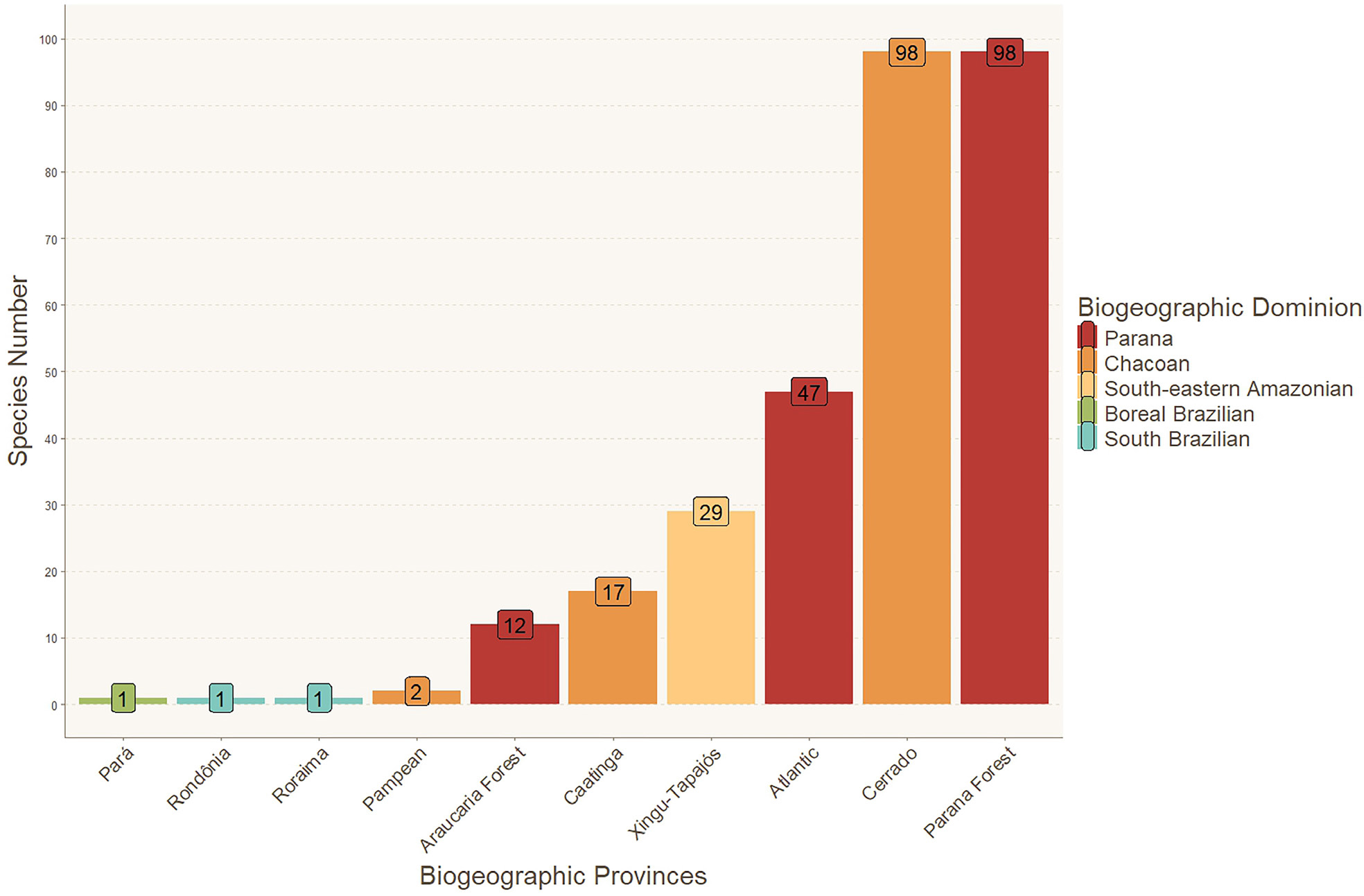
As a result, the biogeographic provinces with the most trogophile species are the Paraná Forest and the Cerrado with 98 species, followed by the Atlantic Province with 47 species. Thus, the Paraná Dominion has the highest occurrence of troglophiles, followed by the Chacoan Dominion and the Southeastern Amazonian Dominion. The provinces of Pará in the Brazilian Boreal Domain, and Rondônia and Roraima in the Brazilian Southern Domain are the provinces with the fewest species, with only one record each (Figure 13).

Distribution of troglophile species in the biogeographic provinces proposed by Morrone (2014).
Kruskal-Wallis analyses, considering only the 10 biogeographic provinces with troglophile records out of the 14 proposed by Morrone (2014) for Brazil, show significant differences in troglophile records both between provinces (chi-squared = 54.081, df = 9, p-value = 1.822e-8) and between biogeographic dominions (chi-squared = 26.248, df = 4, p-value = 2.821e-05).
Dunn’s tests for Provinces found significant differences between some of them (p.adjust < 0.05, Table 3 and Figure 13). For Domains, significant differences were found between the Boreal Brazilian and Paraná Dominion (with p.adjust = 0.00342, Figure 14), between the South Brazilian and Chacoan Dominion (with p.adjust = 0.0353, Figure 14), and between the South Brazilian and Paraná Dominion (with p. adjust = 6.97e-5, Figure 14).

Boxplot comparing the number of records of troglophile species between the biogeographic provinces proposed by Morrone (2014). The diamond represents the average of the records.
4. Neglect of troglophiles on publications
Evaluating the return on searches in the databases mentioned in the methodology, with and without the use of keywords or filters on “troglophile” and/or “troglophilics”, the discrepancy in the return of works was noticeable. For example, on the “Periódicos CAPES” platform, searching for terms such as “caves”, “inventory”, “hypogean” and “Brazil” returned 527 results. When the troglophile filters were applied, the returns dropped to 101 papers (approximately 19% of the initial result). By reading and analyzing these results and combining them with those from other databases, only 62 bibliographies could be used (around 11% of the search without filters and 60% of the search with filters).
Discussion
1. The Linnean shortfall and its consequences
The lack of knowledge about specific biodiversity, often resulting from the Linnean shortfall, which indicates taxonomic and descriptive impediments to new species, leads to discrepancies between the number of species formally described and the actual number existing (Limolino 2004). This issue always been considered a problem for the design of environmental reserves (Polasky et al. 2000, Gaston & Rodrigues 2003, Brooks et al. 2004b, Fagan et al. 2005, Brito 2010). This problem has become increasingly acute, as biodiversity itself is currently facing a crisis, with extinctions occurring at rates as high as the five mass extinctions in Earths’s history (Pimm et al. 1995, Brito 2010), largely due to anthropogenic actions that have accelerated these rates by approximately a thousand times (Pimm et al. 2014, Moreira 2015).
Considering an optimistic scenario, to date, around half of all existing biota in the world has been cataloged and described (Costello et al. 2013, Moreira 2015). Consequently, scientists have been working with incomplete and/or unrepresentative data, which compromises the ability to describe biodiversity and, in turn, predict the changes that may occur in the future (Hortal et al. 2015).
Furthermore, in relation to species conservation, the responsible organization for assessing and categorizing animals at risk of extinction is the International Union for Conservation of Nature (IUCN). However, the IUCN only has enough data to categorize risk levels for just over 3% of terrestrial species and 2% of aquatic species already described (Moreira 2015). Considering that these percentages refer to only 50% of what actually exists in nature, it is evident how much the Linnean deficit has been an obstacle to species conservation policies. Not only is there a shortage of data on species available to the IUCN, but it can only assess species with a formal scientific description (Mace & Lande 1991, Brito 2010).
As shown in the results of this study, the Linnean shortfall has historically affected the troglophile group (Figure 5, 6, 7), especially the insect group belonging to the Orders Diptera, Coleoptera and Orthoptera (Figure 3 and 4). This is explained by the fact that this shortfall is usually more pronounced for invertebrate organisms, making the number of species yet to be describe much greater than for vertebrates (Raven & Yeates 2007, Moreira 2015). This is concerning, as it means that arthropod groups are not fully represented in estimates of extinction risk. For example, as shown in Mateus Atadeu Moreira’s 2015 dissertation, only 80 arthropod species were recorded as extinct by the IUCN between 1500 and 2015, less than 25% of the 338 vertebrate species recorded in the same period. The arthropod group has much higher estimates of abundance and richness.
This is possibly related to three main factors:1) The greater number of systematists dedicated to studying and describing vertebrates species in comparison to invertebrates; 2) The number of extant vertebrate species is much smaller than the number of invertebrates; 3) Species with larger body size (such as vertebrates) are expected to be more easily discovered and formally described by science, making the Linnean deficit more impactful on organisms that are smaller in size, have smaller distribution ranges, and/or are less phenotypically complex (Hortal et al. 2015). Regarding the latter, it follows that species that have not yet been found and/or have incomplete identification/description are often rare or endemic species and are certainly threatened (Moreira 2015).
Taxonomic impediments can lead to misinterpretations regarding the main Orders representing troglophiles (Figure 8), as many important insect orders for this group have few described species but numerous different morphospecies distributed throughout Brazil. This study found that Orthoptera, Diptera and Coleoptera, despite having only ten, two and twelve troglophilic species, respectively, are the three largest representatives when considered as morphospecies, evidencing the lack of taxonomists specialized in these groups in Brazil and the major taxonomic impediments hindering species description. On the other hand, some groups, such as amblypygids and opilionids (Class Arachnida), appear as main representatives based on described species but fall in rank when morphospecies are counted, demonstrating that for these groups, there are possibly fewer taxonomic impediments and more systematists working with them in caves. Finally, some taxa, such as spiders, diplopods of the Order Spirostrepida, and Collembola, maintain their status as main troglophilic representatives in both described species and morphospecies evaluations, highlighting their significant representativeness in Brazilian troglophilic biodiversity.
Our data show that the Linnean shortfall significantly impacts our understanding of troglophiles and, consequently, the definition of caves to be conserved. Scientists and conservation agencies often base their decisions on incomplete knowledge of the biodiversity present, which may include endemic and/or threatened species (Brito 2010, Moreira 2015). To address this, comprehensive research is needed to create more complete inventories of cave-dwelling animals, particularly focusing on the troglophile group. Accurate and thorough data will enable more effective conservation strategies and the protection of these ecologically significant habitats.
Currently, two main approaches address the deficit in biodiversity knowledge during conservation discussions. The first involves using environmental proxies for biodiversity, such as assemblage diversity, environmental diversity, and environmental clusters (Araújo et al. 2004, Bonn & Gaston 2005, Trakhtenbrot & Kadmon 2005). While useful, these proxies do not fully represent environmental diversity and have limitations, as biodiversity is rarely evenly distributed across environmental space (Brooks et al. 2004a, Ferrier et al. 2004, Rodrigues et al. 2004, Brito 2010). The second approach prioritizes increasing field studies to collect species data (Brooks et al. 2004b, Brito 2010), alongside investment from governmental and non-governmental agencies in high-quality biodiversity inventories before designing protected area networks (Brito 2010). Although more laborious and requiring greater investment, this option ensures that voucher specimens, especially cave specimens, are properly collected, identified, and deposited in scientific collections that guarantee universal access, making it more consistent and effective in addressing both Linnean and Wallacean shortfalls.
Additionally, taxonomy as a biological science discipline is fundamental in combating the deficit discussed here and should receive investment and incentives to attract more young scientists. Our ignorance about species is directly linked to the lack of investment and, consequently, capacity in this field (Hortal et al. 2015). According to Moreira’s dissertation (2015):
“...it is important to develop ways of attracting more young people to work in taxonomy, to invest resources in their training and to continue creating and investing in research programs such as PPBio (Biodiversity Research Program) and Protax (Taxonomy Training Program), biodiversity research programs that have been helping to describe new species for years.”
But not only that, fostering and developing other aspects surrounding taxonomic activity is essential, including:
-
- Support for infrastructure for natural science collections;
-
- Promotion of cybertaxonomy platforms;
-
- Elimination of barriers to taxonomic exchange between scientists, institutions, and countries;
-
- Addressing excessive or overly protectionist bureaucratic impediments to taxonomic research and fieldwork;
-
- Implementation of ethical and equitable collaboration rules to avoid scientific colonialism.
Furthermore, it is also interesting to propose studies that uses integrative taxonomy, combining morphological analysis with genetic and molecular analysis to break down the barriers imposed by the taxonomic impediment and overcome the deficit. For example, the study by Jiang-Ni Li et al. (2021), in which they used a mixture of molecular and morphological data to identify seven new and 16 putative species of the spider genus Ectatosticta, which, since 2008, had only one species recorded. This type of work, however, require the implementation of different methods of collection and storage of material that aim at the preservation of tissues for molecular studies.
Additionally, current tools such as databases (e.g. the Catalogue of Life, the Brazilian Biodiversity Information System and the Global Biodiversity Information Facility) have proved useful in combating and minimizing taxonomic biases not only for troglophiles, but for biodiversity data in general. They also have the potential to considerably increase tropical biodiversity data (Collen et al. 2008, Hortal et al. 2015). Therefore, the use of such tools and technologies, combined with the consensual practice of clearly indicating in the works which taxonomic authorities are responsible for the identifications (i.e., who carried out the identification), and of photographing morphotypes (morphospecies) in standardized views and depositing these images on accessible web platforms, in order to facilitate identification and allow morphospecies correspondences between different studies, can be essential allies in scientific research and in the academic sphere to combat shortfalls.
By implementing such measures, the scientific community, funding organizations, and decision-makers can work together to overcome the Linnean deficit and ensure that both new and existing conservation areas are effectively represented and appropriately managed to preserve biodiversity (Moreira 2015).
2. Wallacean shortfall and the consequences of discrepancies in knowledge of species distribution
To create effective protected areas, it is crucial not only to catalog as many living species as possible but also to understand and record their geographic and biogeographic distributions (Brito 2010, Moreira 2015). Knowledge of faunal composition, together with species distribution and ecological niches, is fundamental to form biogeographic and macroecological hypotheses that are sufficiently robust to support conservation actions for genetic diversity and, consequently, ensure species survival (Hortal et al. 2015). Gaps and biases in knowledge about species distributions, known as the Wallacean shortfall (Limolino 2004, Hortal et al. 2015), impede the application of adequate protection policies, leading to distorted spatial patterns of biodiversity (Hortal et al. 2007, Boakes et al. 2010, Ballesteros-Mejia et al. 2013, Yang et al. 2013).
Differences in scientific capacity and accessibility between regions (Rodrigues et al. 2010, Hortal et al. 2015) make some areas better sampled than others. This is particularly pronounced in tropical forests due to their high biodiversity, lack of taxonomic investment, and rapid habitat destruction (Kier et al. 2005, Collen et al. 2008, Oliveira et al. 2016). In Brazil, some regions are well-documented, while others, especially caves, have limited species records (Trajano & Bichuette 2006; Gallão & Bichuette 2018; Bichuette et al. 2019).
Among the federative states and biogeographic provinces, significant differences exist in the distribution of troglophiles (Figure 9, 13 and 14). For instance, the provinces of Pará and Roraima have few records due to accessibility challenges, particularly in the Amazon, where 40% remains unsurveyed (Bush & Lovejoy 2007, Hortal et al. 2015). This lack of data is concerning given the Amazon’s status as a biodiversity hotspot, supporting around 50% of global biological diversity (Collen et al. 2008).
In the Caatinga province, the scarcity of records is due to historical neglect by taxonomists and biogeographers (Santos et al. 2011, Oliveira et al. 2016). Increased investment in research in biospeleology, taxonomy, and biogeography is essential for these regions. Conversely, the southeast of Brazil shows high troglophile richness, particularly in the Paraná Forest, Atlantic, and Araucaria Forest provinces. This region includes the well-studied Upper Ribeira Valley, which has many caves and a historical context that has fostered extensive biospeleological research (Trajano & Bichuette 2006).
Regions with significant mining activities, such as the Paraná Forest Province and the Xingu-Tapajós Province, also show high species richness. The overlap between troglophile concentrations and mining areas highlights the need for robust cave protection measures. Reducing the Wallacean shortfall requires investment in taxonomic studies and research in under-sampled regions, along with the use of online databases to facilitate biodiversity analysis (Yang et al. 2013). However, caution is needed to avoid biases that can lead to inaccurate macroecological conclusions (Yang et al. 2013, Oliveira et al. 2016).
3. A new addition to the Racovitizian shortfall (Ficetola et al. 2019)
Trajano & Bessi (2017) highlight that misclassifications of subterranean organisms directly jeopardize the preservation policies of speleological heritage. Therefore, it is essential to apply a judicious and reliable classification for these organisms, following the Schiner-Racovitza (1907) proposal and using robust comparative methodologies.
Historically, troglophiles have been neglected in surveys and faunal lists due to the difficulty of identifying organisms in this group. The distinction between troglophiles and trogloxenes is ecological (unlike the evolutionary basis that separates them from troglobites) and is closely related to food availability and the ability to obtain it (Trajano & Bessi 2017). Many organisms with trogloxene populations in caves with scarce food resources can become troglophiles when the energy supply improves. Consequently, many species are not inherently troglophiles but can form troglophile populations under favorable conditions (Trajano & Bessi 2017). Additionally, species’ relationship with subterranean habitats regarding reproduction, use as refuge, and niche preference throughout their life cycle are crucial factors in this categorization, which are not easily observed in a few field expeditions.
To achive a bias-free classification, long-term population studies or bionomic studies, along with extensive collections from both hypogean and epigean environments, are necessary to identify individuals in all life stages. These efforts require substantial financial investment for inventories and robust laboratory analyses (Trajano & Bessi 2017).
Another factor contributing to the neglect of troglophiles is Decree 6.640 of 2008, which grants maximum protection status only to troglobitic organisms and high relevance status to obligate trogloxenes (Trajano & Bessi 2017). This policy creates the false impression that troglophiles are not important components in underground habitats, leading biospeleologists and systematists to focus their efforts on recording and describing only troglobitic species. This reinforces the Linnean shortfall regarding troglophile groups as often results in the exclusion of some troglophile species from faunal lists, ultimately impacting cave conservation efforts.
Studies on the origin of troglobites suggest that they often derive from troglophilic populations that became isolated in subterranean environments (Trajano & Bessi 2017). Therefore, preserving and understanding these populations is crucial. Troglophiles are essential for maintaining gene flow between epigean and hypogean environments and play a key role in preserving species whose epigean meta-populations are low in abundance or threatened. They may act as future recolonizers of the surface environment if these meta-populations disappear (Trajano & Bessi 2017).
Furthermore, troglophiles can serve as excellent bioindicators for monitoring cave ecosystems. Their relatively stable populations and larger numbers (compared to troglobites, which are often rare or have small populations in accessible cave areas) make them valuable for early detection of disturbances in cave communities. The results of this study confirmed the historical neglect of troglophiles in faunal inventories, suggesting a potential new shortfall in subterranean fauna studies. We therefore suggest this deficit as a complement of the Racovitzan impediment, proposed by Ficetola and collaborators (2019), which deals with the neglect of the subterranean environment due to these being places that are often unexplored and unmapped. Our complement addresses the fact that, in addition to the difficulty of accessing the subterranean habitats, there is a lack of proper organism categorization within the Schiner-Racovitza (1907) system due to the classification challenges. The Racovitizan shortfall may hinder biodiversity knowledge for caves and negatively impact conservation efforts. Long-term studies are needed to assess the impact of this neglect on niche analyses and ecological modeling for underground environments.
Conclusion
Based on this study and the results obtained, we conclude that troglophilic populations exhibit considerable richness and abundance throughout Brazil and are vital components of subterranean communities. The primary representatives of these populations are arachnids (Class Arachnida), particularly spiders (Order Araneae), and insects (Class Insecta). In addition, we confirmed that shortfalls related to species classification (Linnean) and distribution (Wallacean) significantly impact studies on troglophile species and consequently affect our understanding of their diversity.
We observed a gradual increase in the species records over the years, particularly from the 2000’’ years to the present. This rise is likely associated with the emergence and expansion of laboratories and scientific research centers in Brazil, particularly in the fields of taxonomy and biospeleology. Moreover, we found that current technological tools, such as online databases, have helped mitigate these shortfalls and are essential for taxonomic and ecological studies. Additionally, we discussed a possible new complement for the Racovtzian shortfall (icetole et al. 2019), which arises from the challenges of classifying cave organisms within the Schiner-Racovitza system. The neglect of troglophiles in faunal inventories could have significant implications for future studies of subterranean fauna. Long-term population ecology studies are therefore necessary to verify their occurrence and assess the potential impacts of this new shortfall.
Finally, as Brito (2010) suggests, it is crucial for scientists to direct research efforts toward regions with known data deficiencies. This strategy will likely lead to new scientific discoveries, as these areas may harbor organisms that have yet to be identified or recognized in the scientific community.
Supplementary Material
The following online material is available for this article:
Supplementary Material S1 - Faunistic List of Troglophiles.
Supplementary Material S2 - Subtitles of Faunistic List.
Acknowledgments
We are grateful to the Fundação de Amparo à Pesquisa do Estado de São Paulo (FAPESP, 2019/19520-0) for the research assistance granted to MEB. We are grateful to the Conselho Nacional de Desenvolvimento Científico e Tecnológico (CNPq) for the scientific initiation grant (ICT/ProPq - Notice 002/2022) granted to MVSAD for the research productivity grant granted to MEB (Protocol 310378/2017-6), as well as the postdoctoral fellowship for JEG (process 175461/2023-6). We are grateful to the Instituto Brasileiro de Desenvolvimento e Sustentabilidade for managing the project granted via agreement Instituto Chico Mendes de Conservação da Biodiversidade (ICMBio) and Vale S.A. (TCCE ICMBio/Vale, Notice 02/2020) for granting a scientific initiation scholarship to MVSAD that began the development of this work, and for the researcher scholarship to JEG. We are grateful to Adriano Augusto Gambarini for the authorization and use of part of the photographs in Figure 1. We are also grateful for all researchers in the field of biospeleology for their efforts and research in the country that enabled the development of the area and the preservation of the speleological heritage, and to the team at the Laboratório de Estudos Subterrâneos for all their help and intellectual support belong this work.
Data Availability
The entire dataset supporting the results of this study was made available in SciELO Data and can be accessed at https://doi.org/10.48331/scielodata.4WTTON.
References
- ALMEIDA, M.D., RODRIGUES, J.M. dos S., MOREIRA, F.F.F. & JURBERG, J. 2014. Lista dos exemplares-tipo de Heteroptera (Insecta) da Coleção Costa Lima, Instituto Oswaldo Cruz, Rio de Janeiro, Brasil. EntomoBrasilis 7(2):151–158.
- ARAÚJO, M.B., DENSHAM, P.J. & WILLIAMS, P.H. 2004. Special Paper: Representing Species in Reserves from Patterns of Assemblage Diversity. J Biogeogr 31(7):1037–1050.
- ASENJO, A., VALOIS, M., ZAMPAULO, R. de A., MOLINA, M., OLIVEIRA, R.R.M., OLIVEIRA, G. & VASCONCELOS, S. 2024. New taxonomic insights for Brazilian Syrbatus Reitter (Coleoptera: Staphylinidae: Pselaphinae), including three new species and their mitochondrial genomes. PeerJ 12e17783.
- ÁZARA, L.N. & FERREIRA, R.L. 2018. Annotated checklist of Gonyleptoidea (Opiliones: Laniatores) associated with Brazilian caves. Zootaxa 4439(1).
- BALLESTEROS-MEJIA, L., KITCHING, I.J., JETZ, W., NAGEL, P. & BECK, J. 2013. Mapping the biodiversity of tropical insects: species richness and inventory completeness of African sphingid moths. Global Ecology and Biogeography 22(5):586–595.
- BARR, T.C. 1968. Cave Ecology and the Evolution of Troglobites. In Evolutionary Biology Springer US, Boston, MA, p.35–102.
- BASSINI-SILVA, R., ZAMPAULO, R.A., WELBOURN, C., OCHOA, R., BRESCOVIT, A.D., BARROS-BATTESTI, D.M. & JACINAVICIUS, F.C. 2022. A new genus and two new species of chigger mites (Trombidiformes: Leeuwenhoekiidae) from Brazilian caves with notes about the genus Whartonia Ewing, 1944. J Nat Hist 56(29–32):1297–1313.
- BEDOYA-ROQUEME, E., TIZO-PEDROSO, E., BARBIER, E. & DE ARAUJO LIRA, A.F. 2021. A new cave-dwelling Maxchernes Feio, 1960 (Pseudoscorpiones: Chernetidae) from Brazil. Stud Neotrop Fauna Environ.
- BEDOYA-ROQUEME, E., TIZO-PEDROSO, E., BARBIER, E. & LIRA, A.F. de A. 2023. Two new cave-dwelling pseudoscorpion species (Arachnida: Pseudoscorpiones) from Northeastern Brazil. Zootaxa 5293(2):317–332.
- BERNARD, E., PENNA, L.A.O. & ARAÚJO, E. 2014. Downgrading, Downsizing, Degazettement, and Reclassification of Protected Areas in Brazil. Conservation Biology 28(4):939–950.
- BERTANI, R.; BICHUETTE, M. E.; CORDEIRO, L. M.; GALLÃO, J. E. 2024. Three new species of Loxosceles Heinecken & Lowe, 1832 (Araneae, Sicariidae) from Brazilian caves. European Journal of Taxonomy, v. 921, 5 fev.
- BERTANI, R., VON SCHIMONSKY, D.M., GALLÃO, J.E. & BICHUETTE, M.E. 2018. Four new troglophilic species of Loxosceles Heinecken & Lowe, 1832: Contributions to the knowledge of recluse spiders from Brazilian caves (Araneae, Sicariidae). Zookeys 2018(806):47–72.
- BICHUETTE, M.E., NASCIMENTO, A.R., VON SCHIMONSKY, D.M., GALLÃO, J.E., RESENDE, L.P.A. & ZEPON, T. 2017. Fauna terrestre da maior cavidade em granito do Hemisfério Sul, sudeste do Brasil: Um habitat negligenciado. Neotropical Biology and Conservation 12(2):75–90.
- BICHUETTE, M.E., SIMÕES, L.B., ZEPON, T., VON SCHIMONSKY, D.M. & GALLÃO, J.E. 2019. Richness and taxonomic distinctness of cave invertebrates from the northeastern state of Goiás, central Brazil: A vulnerable and singular area. Subterr Biol 291–33.
- BICHUETTE, M.E. & TRAJANO, E. 2003. Epigean and subterranean ichthyofauna from the São Domingos karst area, Upper Tocantins River basin, Central Brazil. J Fish Biol 63(5):1100–1121.
- BICHUETTE, M.E. & TRAJANO, E. 2018. Diversity of Potamolithus (Littorinimorpha, Truncatelloidea) in a high-diversity spot for troglobites in southeastern Brazil: Role of habitat fragmentation in the origin of subterranean fauna, and conservation status. Subterr Biol 2561–88.
- BINI, L.M., DINIZ-FILHO, J.A.F., RANGEL, T.F.L.V.B., BASTOS, R.P. & PINTO, M.P. 2006. Challenging Wallacean and Linnean shortfalls: knowledge gradients and conservation planning in a biodiversity hotspot. Divers Distrib 12(5):475–482.
- BOAKES, E.H., MCGOWAN, P.J.K., FULLER, R.A., CHANG-QING, D., CLARK, N.E., O’CONNOR, K. & MACE, G.M. 2010. Distorted Views of Biodiversity: Spatial and Temporal Bias in Species Occurrence Data. PLoS Biol 8(6):e1000385.
- BONN, A. & GASTON, K.J. 2005. Capturing biodiversity: selecting priority areas for conservation using different criteria. Biodivers Conserv 14(5):1083–1100.
- BRESCOVIT, A.D. & CIZAUSKAS, I. 2018. A New Species of Ochyrocera (Araneae: Ochyroceratidae) from Caves in the State of Minas Gerais, Brazil, with Notes on O. ibitipoca. Arachnology 17(9):441–448.
- BRESCOVIT, A.D., CIZAUSKAS, I. & MOTA, L.P. 2018. Seven new species of the spider genus Ochyrocera from caves in floresta nacional de carajás, PA, Brazil (araneae, ochyroceratidae). Zookeys 2018(726):87–130.
- BRESCOVIT, A.D., CIZAUSKAS, I. & POLOTOW, D. 2022. A New Species of the Spider Genus Parabatinga Polotow and Brescovit, 2009 (Araneae: Ctenidae), from the Brazilian Amazonia. Taxonomy 2(2):244–254.
- BRESCOVIT, A.D., ZAMPAULO, R. de A., PEDROSO, L.M. & CIZAUSKAS, I. 2021. Four new species of the genus Ochyrocera (Araneae, Ochyroceratidae) from iron caves of the state of Minas Gerais, with the description of the third anophtalmic species from Brazil. Subterr Biol 4143–68.
- BRITO, D. 2010. Overcoming the Linnean shortfall: Data deficiency and biological survey priorities. Basic Appl Ecol 11(8):709–713.
- BRITO, R.A., LIMA, E.C.A. & ZEPPELINI, D. 2019. Three new species of Collembola (Arthropoda: Hexapoda) from Brazil. Zootaxa 4700(4):401–430.
- BROOKS, T., DA FONSECA, G.A.B. & RODRIGUES, A.S.L. 2004a. Species, Data, and Conservation Planning. Conservation Biology 18(6):1682–1688.
- BROOKS, T.M., DA FONSECA, G.A.B. & RODRIGUES, A.S.L. 2004b. Protected Areas and Species. Conservation Biology 18(3):616–618.
- BROOKS, T.M., MITTERMEIER, R.A., DA FONSECA, G.A.B., GERLACH, J., HOFFMANN, M., LAMOREUX, J.F., MITTERMEIER, C.G., PILGRIM, J.D. & RODRIGUES, A.S.L. 2006. Global Biodiversity Conservation Priorities. Science (1979) 313(5783):58–61.
- BUSH, M. & LOVEJOY, T.E. 2007. Amazonian conservation: pushing the limits of biogeographical knowledge. J Biogeogr 34(8):1291–1293.
- CAMPOS, F.S., BRITO, D. & SOLE, M. 2014. Diversity patterns, research trends and mismatches of the investigative efforts to amphibian conservation in Brazil. An Acad Bras Cienc 86(4):1873–1886.
- CAMPOS-FILHO, I.S., ARAUJO, P.B., BICHUETTE, M.E., TRAJANO, E. & TAITI, S. 2014. Terrestrial isopods (Crustacea: Isopoda: Oniscidea) from Brazilian caves. Zool J Linn Soc 172(2):360–425.
- CAMPOS-FILHO, I.S., FERNANDES, C.S., CARDOSO, G.M., BICHUETTE, M.E., AGUIAR, J.O. & TAITI, S. 2020. New species and new records of terrestrial isopods (Crustacea, isopoda, oniscidea) of the families philosciidae and scleropactidae from Brazilian caves. Eur J Taxon 2020(606):1–38.
- CARDOSO, G.M., BENTO, D. de M. & FERREIRA, R.L. 2024. Unveiling a hidden diversity: descriptions of nine new species of Ctenorillo Verhoeff, 1942 (Isopoda, Armadillidae) discovered in Brazilian caves and their importance for conservation. Zoosystema 46(5).
- CASTRO-SOUZA, R.A., ZEFA, E. & FERREIRA, R.L. 2020. New troglobitic and troglophilic syntopic species of Endecous (Orthoptera, Grylloidea, Phalangopsidae) from a Brazilian cave: A case of sympatric speciation? Zootaxa 4810(2):271–304.
- CECAV. 2021. Planilha de Dados: Anuário Espéleo de 2021.
- CECAV. 2022. Relatório Anual 2021.
- CHAGAS, A. & BICHUETTE, M.E. 2018. A synopsis of centipedes in Brazilian caves: Hidden species diversity that needs conservation (Myriapoda, Chilopoda). Zookeys 2018(737):13–56.
- CIPOLA, N.G., OLIVEIRA, J.V.L.C., BELLINI, B.C., FERREIRA, A.S., LIMA, E.C.A., BRITO, R.A., STIEVANO, L.C., SOUZA, P.G.C. & ZEPPELINI, D. 2020. Review of eyeless Pseudosinella Schäffer (Collembola, entomobryidae, and lepidocyrtinae) from Brazilian caves. Insects 11(3).
- CIZAUSKAS, I. 2017. Análise da diversidade funcional e dos padrões de riqueza de aranhas cavernícolas do Brasil e um modelo de mapeamento. Mestrado em Zoologia. Universidade de São Paulo, São Paulo.
- COLLEN, B., RAM, M., ZAMIN, T. & MCRAE, L. 2008. The Tropical Biodiversity Data Gap: Addressing Disparity in Global Monitoring. Trop Conserv Sci 1(2):75–88.
- CONCEIÇÃO, P.H.S. & REPATO, A.R. 2021. New species and occurrences of uropodina mites (MESOSTIGMATA) from brazilian caves. Acarina 29(2):247–256.
- CORREA, C.M.A., RABELO, L.M., AUDINO, L.D., FERREIRA, R.L., MELLO, F.Z.V. & GROSSI, P.C. 2022. Scarabs in the dark: occurrence of Scarabaeoidea beetles (Insecta: Coleoptera) in Brazilian caves. Rev Bras Entomol 66(4).
- COSTELLO, M.J., MAY, R.M. & STORK, N.E. 2013. Can We Name Earth’s Species Before They Go Extinct? Science (1979) 339(6118):413–416.
- DENNIS, R.L.H. & THOMAS, C.D. 2000. Bias in Butterfly Distribution Maps: The Influence of Hot Spots and Recorder’s Home Range. J Insect Conserv 4(2):73–77.
- DOS SANTOS COSTA, S.G., KLOPEN, H., DE OLIVEIRA BERNARDI, L.F., GONÇALVES, L.C., RIBEIRO, D.B. & REPATO, A.R. 2019. Multi-instar descriptions of cave dwelling Erythraeidae (Trombidiformes: Parasitengona) employing an integrative approach. Zootaxa 4717(1).
- FAGAN, W.F., KENNEDY, C.M. & UNMACK, P.J. 2005. Quantifying rarity, losses, and risks for native fishes of the lower Colorado river basin: Implications for conservation listing. Conservation Biology 19(6):1872–1882.
- FERNANDES, C.S. 2011. Morfometria geométrica de populações subterrâneas e epígeas dos caranguejos de água doce do gênero Aegla Leach 1820, (Crustacea: Anomura: Aeglidae) no Vale do Ribeira, Iporanga, SP. Dissertação (Mestrado). Universidade Federal de São Carlos (UFSCar), São Carlos.
- FERNANDES, C.S., BATALHA, M.A. & BICHUETTE, M.E. 2016. Does the Cave Environment Reduce Functional Diversity? PLoS One 11(3):e0151958.
- FERNANDES, C.S. & BICHUETTE, M.E. 2013. Levantamento preliminar de invertebrados em três cavernas areníticas do Rio Grande do Sul, Brasil. Espeleo-Tema 21(1):41–47.
- FERNANDES, C.S., BICHUETTE, M.E. & BUENO, S.L. de S. 2013. Distribution of cave-dwelling Aegla spp. (Decapoda: Anomura: Aeglidae) from the Alto Ribeira karstic area in southeastern Brazil based on geomorphological evidence. Journal of Crustacean Biology 33(4):567–575.
- FERREIRA, M.I.G., FERREIRA, R.L. & GIL-SANTANA, H.R. 2016. The genus Zelurus Hahn, 1826, in Brazilian caves: description of new species and comments on the potential distribution of the genus in South America. Zootaxa 4170(2).
- FERREIRA, R.L., MARTINS, R.P. & YANEGA, D. 2000. Ecology of Bat Guano Arthropod Communities in a Brazilian Dry Cave. Ecotropica 6105–116.
- FERRIER, S. et al. 2004. Mapping More of Terrestrial Biodiversity for Global Conservation Assessment. Bioscience 54(12).
- FICETOLA, G.F., CANEDOLI, C. & STOCH, F. 2019. The Racovitzan impediment and the hidden biodiversity of unexplored environments. Conservation Biology 33(1):214–216.
- FONSECA-FERREIRA, R., ZAMPAULO, R. de A. & GUADANUCCI, J.P.L. 2017. Diversity of iron cave-dwelling mygalomorph spiders from Pará, Brazil, with description of three new species (Araneae). Tropical Zoology 30(4):178–199.
- FRANCO, L.J. de A. 2013. O conceito de biodiversidade e a história da biologia da conservação: da preservação da wilderness à conservação da biodiversidade. História (São Paulo) 32(2):21–48.
- GALLÃO, J.E. & BICHUETTE, M.E. 2015. Taxonomic distinctness and conservation of a new high biodiversity subterranean area in Brazil. An Acad Bras Cienc 87(1):209–217.
- GALLÃO, J.E. & BICHUETTE, M.E. 2018. Brazilian obligatory subterranean fauna and threats to the hypogean environment. Zookeys 7461–23.
- GALLO, J.S. & BICHUETTE, M.E. 2019. O que mudou na distribuição dos diplópodes Pseudonannolene SILVESTRI, 1895 nas cavernas do Brasil 18 anos após da sinopse de Trajano e colaboradores (2000)? Espeleo-Tema 29(1):41–55.
- GASTON, K.J. & RODRIGUES, A.S.L. 2003. Reserve Selection in Regions with Poor Biological Data. Conservation Biology 17(1):188–195.
- GIBERT, J. & DEHARVENG, L. 2002. Subterranean Ecosystems: A Truncated Functional Biodiversity. Bioscience 56(6):473–481.
- GLEASON, H.A. 1926. The Individualistic Concept of the Plant Association. Bulletin of the Torrey Botanical Club 53(1):7.
- GONZALEZ-FILHO, H.M.O., FONSECA-FERREIRA, R., BRESCOVIT, A.D. & GUADANUCCI, J.P.L. 2022. Taxonomy of the genus Cyrtogrammomma Pocock, 1895 (Araneae, Mygalomorphae, Theraphosidae) with a description of a new species from Brazil. Zoosystematics and Evolution 98(2):181–199.
- GUADANUCCI, J.P.L., FONSECA-FERREIRA, R., BAPTISTA, R.L.C. & PEDROSO, D.R. 2016. An unusual new species of Trechona (Araneae: Mygalomorphae: Dipluridae), from quartzitic caves of the Diamantina Plateau, Minas Gerais, Brazil, with a key to the known species. J Nat Hist 50(39–40):2487–2497.
- HORTAL, J., DE BELLO, F., DINIZ-FILHO, J.A.F., LEWINSOHN, T.M., LOBO, J.M. & LADLE, R.J. 2015. Seven Shortfalls that Beset Large-Scale Knowledge of Biodiversity. Annu Rev Ecol Evol Syst 46523–549.
- HORTAL, J., LOBO, J.M. & JIMENEZ-VALVERDE, A. 2007. Limitations of Biodiversity Databases: Case Study on Seed‐Plant Diversity in Tenerife, Canary Islands. Conservation Biology 21(3):853–863.
- HOWARTH, F.G. 1983. Ecology of Cave Arthropods. Annu Rev Entomol 28(1):365–389.
- JUBERTHIE, C. 2000. The diversity of the karstic and pseudokarstic hypogean habitats in the world. In Ecosystems of the World, Subterranean Ecosystems (H. Wilkens, D. C. Culver, & W. F. Humphreys, eds) Elsevier Academic Press, Amsterdam, p.17–39.
-
KASSAMBARA, A. 2023. rstatix: Pipe-Friendly Framework for Basic Statistical Tests. R package version 0.7.2, https://CRAN.R-project.org/package=rstatix.
» https://CRAN.R-project.org/package=rstatix. - KIER, G., MUTKE, J., DINERSTEIN, E., RICKETTS, T.H., KÜPER, W., KREFT, H. & BARTHLOTT, W. 2005. Global patterns of plant diversity and floristic knowledge. J Biogeogr 32(7):1107–1116.
- KLINK, C.A. & MOREIRA, A.G. 2002. Past and current human occupation, and land use. In The Cerrado of Brazil: Ecology and Natural History of a Neotropical Savanna (P. S. Oliveira & R. J. Marques, eds) Columbia University Press, New York, p.69–88.
- LAMAS, C.J.E., MENDES, L.L., FALASCHI, R.L. & EVENHUIS, N.L. 2023. A Second New Species of Tamanduamyia Rafael and Limeira-de-Oliveira (Diptera, Mythicomyiidae, Mythicomyiinae) from Brazil, with Discussion of the Possible First Cave Dwelling Record of a Micro-bee fly. Neotrop Entomol 52(4):560–570.
- LAURANCE, W.F. 2005. When bigger is better: the need for Amazonian mega-reserves. Trends Ecol Evol 20(12):645–648.
- LEAL-ZANCHET, A.M. & MARQUES, A.D. 2018. Coming out in a harsh environment: A new genus and species for a land flatworm (Platyhelminthes: Tricladida) occurring in a ferruginous cave from the Brazilian savanna. PeerJ 2018(12).
- LI, J.-N., YAN, X.-Y., LIN, Y.-J., LI, S.-Q. & CHEN, H.-F. 2021. Challenging Wallacean and Linnean shortfalls: Ectatosticta spiders (Araneae, Hypochilidae) from China. Zool Res 42(6):792–795.
- LIMOLINO, M. V. 2004. Conservation biogeography. In Frontiers of Biogeography: New Directions in the Geography of Nature (M. V. Limolino & L. R. Heaney, eds) Sinauer, Sunderland, p.293–296.
- MACE, G.M. & LANDE, R. 1991. Assessing Extinction Threats: Toward a Reevaluation of IUCN Threatened Species Categories. Conservation Biology 5(2):148–157.
- MAHNERT, V. 2001. Cave-dwelling pseudoscorpions (Arachnida, Pseudoscorpiones) from Brazil. Revue Suisse de Zoologie 108(1):95–148.
- MATTOX, G.M.T., BICHUETTE, M.E., SECUTTI, S. & TRAJANO, E. 2008. Surface and subterranean ichthyofauna in the Serra do Ramalho karst area, northeastern Brazil, with updated lists of Brazilian troglobitic and troglophilic fishes. Biota Neotrop 8(4):0–000.
- MAYR, E. 1998. O Desenvolvimento do Pensamento Biológico. UnB, Brasília.
- MERLO, R.L.S., CASTRO-SOUZA, R.A., BENTO, D. de M. & FERREIRA, R.L. 2022. A new troglophilic species of Erebonyx (Orthoptera: Grylloidea: Phalangopsidae) from Brazilian caves. Zootaxa 5222(1):83–93.
- MIRANDA, G.S. de, GIUPPONI, A.P.L., PRENDINI, L. & SCHARFF, N. 2021. Systematic revision of the pantropical whip spider family Charinidae Quintero, 1986 (Arachnida, Amblypygi). Eur J Taxon 7721–409.
- MOERMAN, D.E. & ESTABROOK, G.F. 2006. The botanist effect: counties with maximal species richness tend to be home to universities and botanists. J Biogeogr 33(11):1969–1974.
- MONTE, B.G.O. & BICHUETTE, M.E. 2020. Taxonomic distinctness of the subterranean fauna from Peruaçu Caves National Park, state of Minas Gerais, Eastern Brazil. Biota Neotropica 20(1).
- MOORE, G.W. & SULLIVAN, N. 1997. Speleology, Caves and the Environment. Cave Books, Saint Louis.
- MORAIS, A.L., BICHUETTE, M.E., CHAGAS-JÚNIOR, A. & LEAL-ZANCHET, A. 2021. Under threat: Two new troglobitic species of Girardia (Platyhelminthes: Tricladida) from sandstone and limestone caves in Brazil. Zool Anz 293292–302.
- MOREIRA, M.A. 2015. A importância de se levar em conta a lacuna Linneana no planejamento de conservação dos anfíbios no Brasil. Mestrado em Ecologia e Evolução. Universidade Federal de Goiás, Goiânia.
- MORENO-GONZÁLEZ, J.A., PINTO-DA-ROCHA, R. & GALLÃO, J.E. 2021. Bringing order to a complex system: phenotypic and genotypic evidence contribute to the taxonomy of Tityus (Scorpiones, Buthidae) and support the description of a new species. Zookeys 107533–75.
- MORRONE, J.J. 2011. América do Sul e Geografia da Vida: Comparação de Algumas Propostas de Regionalização. In Biogeografia da América do Sul: padrões e processos (C. J. B. Carvalho & E. A. B. Almeida, eds) Editora Roca, p.14–40.
- MORRONE, J.J. 2014. Biogeographical regionalisation of the neotropical region. Zootaxa 3782(1):1–110.
- MYERS, N., MITTERMEIER, R.A., MITTERMEIER, C.G., DA FONSECA, G.A.B. & KENT, J. 2000. Biodiversity hotspots for conservation priorities. Nature 403(6772):853–858.
- OLIVEIRA, J.V.L.C. de, BRITO, N.P. & ZEPPELINI, D. 2021. Two New Cyphoderus Nicolet (Collembola: Paronellidae) of the “bidenticulati-group” with Dental Plurichaetosis from Brazil. Neotrop Entomol 50(4):579–592.
- OLIVEIRA, U., PAGLIA, A.P., BRESCOVIT, A.D., CARVALHO, C.J.B., SILVA, D.P., REZENDE, D.T., LEITE, F.S.F., BATISTA, J.A.N., BARBOSA, J.P.P.P., STEHMANN, J.R., ASCHER, J.S., VASCONCELOS, M.F., DE MARCO, P., LÖWENBERG-NETO, P., DIAS, P.G., FERRO, V.G. & SANTOS, A.J. 2016. The strong influence of collection bias on biodiversity knowledge shortfalls of Brazilian terrestrial biodiversity. Divers Distrib 22(12):1232–1244.
- PELLEGRINI, T.G. & FERREIRA, R.L. 2016. Are inner cave communities more stable than entrance communities in Lapa Nova show cave? Subterranean Biology 20(1):15–37.
- PIMM, S.L., JENKINS, C.N., ABELL, R., BROOKS, T.M., GITTLEMAN, J.L., JOPPA, L.N., RAVEN, P.H., ROBERTS, C.M. & SEXTON, J.O. 2014. The biodiversity of species and their rates of extinction, distribution, and protection. Science (1979) 344(6187).
- PIMM, S.L., JENKINS, C.N., JOPPA, L.N., ROBERTS, D.L. & RUSSELL, G.J. 2010. How Many Endangered Species Remain to be Discovered in Brazil? Natureza & Conservação 08(01):71–77.
- PIMM, S.L., RUSSELL, G.J., GITTLEMAN, J.L. & BROOKS, T.M. 1995. The Future of Biodiversity. Science (1979) 269(5222):347–350.
- PINTO-DA-ROCHA, R. 1995. Sinopse da fauna cavernícola do Brasil (1907-1994). Pap Avulsos Zool 39(6):61–173.
- POLASKY, S., CAMM, J.D., SOLOW, A.R., CSUTI, B., WHITE, D. & DING, R. 2000. Choosing reserve networks with incomplete species information. Biol Conserv 94(1):1–10.
- PRETE, P.H. & BRESCOVIT, A.D. 2020. A new species of Cuacuba (Araneae, Theridiosomatidae) from Brazilian caves. Stud Neotrop Fauna Environ 55(2):109–115.
- PRETE, P.H., CIZAUSKAS, I. & BRESCOVIT, A.D. 2018. Three new species of the spider genus Plato and the new genus Cuacuba from caves of the states of Pará and Minas Gerais, Brazil (Araneae, Theridiosomatidae). Zookeys 2018(753):107–162.
- RABELLO, G.C. 2021. Ictiofauna da região da Serra da Canastra, Minas Gerais: cavernas são filtros ambientais considerando-se riqueza, diversidade e comportamento alimentar? Dissertação (Mestrado em Ecologia e Recursos Naturais). Universidade Federal de São Carlos, São Carlos.
- RATTON, P., FERREIRA, R.L. & POMPEU, P.S. 2018. Fish community of a small karstic Neotropical drainage and its relationship with the physical habitat. Mar Freshw Res 69(8):1312–1320.
- RAVEN, P.H. & YEATES, D.K. 2007. Australian biodiversity: threats for the present, opportunities for the future. Aust J Entomol 46(3):177–187.
-
R CORE TEAM. 2024. R: A Language and Environment for Statistical Computing. R Foundation for Statistical Computing, Vienna, Austria. https://www.R-project.org.
» https://www.R-project.org. - RODRIGUES, A.S.L. et al. 2004. Effectiveness of the global protected area network in representing species diversity. Nature 428(6983):640–643.
- RODRIGUES, A.S.L., GRAY, C.L., CROWTER, B.J., EWERS, R.M., STUART, S.N., WHITTEN, T. & MANICA, A. 2010. A Global Assessment of Amphibian Taxonomic Effort and Expertise. Bioscience 60(10):798–806.
- ROSEN, R. 1996. On the limitations of scientific knowledge. In Boundaries and Barriers: On the Limits to Scientific Knowledge (J. L. Casti & A. Karlqvist, eds) p.188–214.
- SANTOS, J.C., LEAL, I.R., ALMEIDA-CORTEZ, J.S., FERNANDES, G.W. & TABARELLI, M. 2011. Caatinga: The Scientific Negligence Experienced by a Dry Tropical Forest. Trop Conserv Sci 4(3):276–286.
- SANTOS JÚNIOR, G.A. dos, ÁZARA, L.N. de & FERREIRA, R.L. 2021. Three new species of Eusarcus perty, 1833 (Opiliones, gonyleptidae) from Brazilian caves. Eur J Taxon 2021(740):36–54.
- SASTRE, P. & LOBO, J.M. 2009. Taxonomist survey biases and the unveiling of biodiversity patterns. Biol Conserv 142(2):462–467.
- SCHIMONSKY, D.M. Von & BICHUETTE, M.E. 2019. Distribution of cave-dwelling pseudoscorpions (Arachnida) in Brazil. Journal of Arachnology 47(1):110–123.
- SCHIMONSKY, D.M. 2024. Two new cavernicolous species of Pseudochthonius Balzan, 1892 (Pseudoscorpiones, Chthoniidae) from Lagoa Santa karst, Minas Gerais, Brazil. Zootaxa 5433 (1): 107–120.
- SECUTTI, S. & BICHUETTE, M. 2013. Ictiofauna da área cárstica de Presidente Olegário, estado de Minas Gerais, com ênfase nas espécies subterrâneas. Revista da Biologia 10(2):13–20.
- SOUZA-DIAS, P.G.B., VALENTE, R.M., BOLFARINI, M.P. & RUIZ, G.R.S. 2022. On the Amazonian cricket Phalangopsis Serville, 1831 (Orthoptera: Grylloidea: Phalangopsidae): biology, morphology, and a new species. Zootaxa 5194(4):540–560.
- TRAJANO, E. 2012. Ecological classification of subterranean organisms. In Encyclopedia of Caves (W. B. White & D. C. Culver, eds) Elsevier.
- TRAJANO, E. & BESSI, R. 2017. A Classificação Schiner-Racovitza dos organismos subterrâneos: uma análise crítica, dificuldades para aplicação e implicações para conservação. Espeleo-Tema 28(1):87–102.
- TRAJANO, E. & BICHUETTE, M.E. 2006. Biologia Subterrânea: introdução. Redespeleo Brasil, São Paulo.
- TRAJANO, E., GOLOVATCH, S.I., GEOFFROY, J.-J., ROCHA, R.P. & FONTANETTI, C.S. 2000. Synopsis of brazilian cave millipides (Diplopoda). Pap Avulsos Zool 41(18):259–287.
- TRAJANO, E. & MOREIRA, J.R. de A. 1991. Estudo da fauna de cavernas da Província Espeleológica Arenítica Altamira-Itaituba, Pará. Rev Bras Biol 51(1):13–29.
- TRAJANO, E., SECUTTI, S., MENDES, G. & MATTOX, T. 2009. Epigean and subterranean ichthyofauna in Cordisburgo karst area, eastern Brazil. Biota Neotropical 9(3).
- TRAKHTENBROT, A. & KADMON, R. 2005. Environmental Cluster Analysis as a Tool for Selecting Complementary Networks of Conservation Sites. Ecological Applications 15(1):335–345.
- WALKER, B. & STEFFEN, W. 1997. An Overview of the Implications of Global Change for Natural and Managed Terrestrial Ecosystems. Conservation Ecology 1(2):art2.
-
WICKHAM, H.; AVERICK, M.; BRYAN, J.; CHANG, W.; MCGOWAN, L.D.; FRANÇOIS, R.; GROLEMUND, G.; HAYES, A.; HENRY, L.; HESTER, J.; KUHN, M.; PEDERSEN, T.L.; MILLER, E.; BACHE, S.M.; MÜLLER, K.; OOMS, J. ROBINSON, D. SEIDEL, D.P.; SPINU, V.; TAKAHASHI, K.; VAUGHAN, D.; WILKE, C.; WOO, K.; YUTANI, H. 2019. “Welcome to the tidyverse.” Journal of Open Source Software, v.4(43), 1686. doi:10.21105/joss.01686.
» https://doi.org/10.21105/joss.01686 - WILLEMART, R.H. & GNASPINI, P. 2004. Spatial distribution, mobility, gregariousness, and defensive behaviour in a Brazilian cave harvestman Goniosoma albiscriptum (Arachnida, Opiliones, Gonyleptidae). Animal Biology 54(3):221–235.
- YANG, W., MA, K. & KREFT, H. 2013. Geographical sampling bias in a large distributional database and its effects on species richness-environment models. J Biogeogr 40(8):1415–1426.
- ZAMPAULO, R. de A. & PROUS, X. 2022. Fauna Cavernícola do Brasil. 1 ed. Editora Rupestre, Belo Horizonte.
- ZEPON, T. & BICHUETTE, M.E. 2017. Influence of substrate on the richness and composition of neotropical cave fauna. An Acad Bras Cienc 89(3):1615–1628.
- ZEPON, T., GALLÃO, J.E., CAMARGO, A.L. & BICHUETTE, M.E. 2019. Primeiros registros da fauna de duas cavernas da região de Bulha D’água, Parque Estadual Turístico do Alto Ribeira (PETAR), São Paulo. Espeleo-Tema 29(1):29–39.
- ZEPPELINI, D., OLIVEIRA, J.V.L.C., DE LIMA, E.C.A., BRITO, R.A., FERREIRA, A.S., STIEVANO, L.C., BRITO, N.P., OLIVEIRA-NETO, M.A. & LOPES, B.C.H. 2022. Hotspot in ferruginous rock may have serious implications in Brazilian conservation policy. Sci Rep 12(1).