
 A Theoretical Framework Based on Toulmin’s and Perelman’s Perspectives for the Production and Analysis of Argumentation in Mathematics Education
Abstract
Research in Mathematics Education has highlighted the contributions of using argumentation as a teaching approach and as a tool for assessing the arguments of both teachers and students. Studies also point to the need for further investigation into the potential of argumentation-based approaches to promote argumentation and analyze the integration of argument models. However, studies on this topic in undergraduate mathematics courses remain relatively scarce, especially in the Brazilian context. This article presents a theoretical study aimed at constructing a theoretical-argumentative model to be used as a framework in the teaching of a mathematics teacher education course and as an instrument for analyzing students’ arguments. The theoretical contributions of Toulmin and Perelman, along with articles from the field of Mathematics Education that investigate argumentation in undergraduate settings, served as data sources for the construction of the model. The model proposes argumentative strategies applicable in undergraduate mathematics courses: the construction of justificatory arguments in line with an argumentative structure, the recognition of types of arguments, and the use of techniques that foster discussion and persuasion regarding mathematical topics. Moreover, it may serve as an analytical framework for studies on students’ arguments in this educational context. The model enables the categorization of arguments at different levels of quality, based on criteria that integrate elements from both logical and rhetorical perspectives. The findings suggest that the model has the potential for deepening the analysis of argumentation in undergraduate Mathematics Education.
Keywords:
Argumentation; Higher Education; Analytical Framework; Theoretical-Argumentative Model; Mathematics Education
Resumo
Pesquisas na Educação Matemática têm destacado as contribuições do uso da argumentação como abordagem de ensino e como instrumento para avaliar argumentos de estudantes e professores. Elas apontam também a necessidade de mais investigações para avaliar o potencial que abordagens com esse foco têm para promover a argumentação e para analisar a integração entre modelos de argumentos. No entanto, estudos sobre essa temática, em aulas de matemática no Ensino Superior, são relativamente escassos, especialmente no contexto da educação brasileira. Este artigo apresenta um estudo teórico que tem como objetivo construir um modelo teórico-argumentativo a ser aplicado como guia na abordagem de ensino de uma disciplina de formação de professores de matemática e como instrumento para analisar argumentos de estudantes. Como fonte de dados para a construção do modelo, foram utilizados os aportes teóricos de Toulmin e Perelman, além de artigos da área de Educação Matemática que investigam a argumentação no contexto do Ensino Superior. O modelo propõe estratégias argumentativas aplicáveis durante aulas de matemática no Ensino Superior: construção de argumentos justificatórios conforme uma estrutura argumentativa, reconhecimento de tipos de argumentos e uso de técnicas que favoreçam discussão e convencimento em temas matemáticos. Além disso, pode servir como quadro analítico para estudos sobre argumentos de estudantes nesse contexto educacional. O modelo permite categorizar argumentos produzidos em diferentes estágios de qualidade, com base em critérios que integram elementos das perspectivas lógica e retórica. Os resultados sugerem que o modelo tem potencial para aprofundar a análise da argumentação no Ensino Superior em Matemática.
Palavras-chave:
Argumentação; Ensino Superior; Quadro Analítico; Modelo Teórico Argumentativo; Educação Matemática
1 Introduction
Argumentation is a central practice in the study of Mathematics. It can be contextualized to serve different purposes. In higher education, argumentation is not only employed as a teaching approach but also used as a theoretical instrument for evaluating the arguments of students and teachers (Carneiro; Teixeira; Oliveira, 2023; Simpson, 2015). We understand argumentation as a communicative process in which a claim is put forward on the basis of one or more premises, and justifications are sought to validate that claim within a given context of use. The process aims to secure an audience's adherence to the claim, both intellectually and emotionally (Perelman, 1993). Thus, argumentation requires a logical chain among the arguments presented.
From the late twentieth century onward, argumentation became a multidisciplinary field, attracting growing academic interest (Ribeiro, 2009). In Rhetoric and Argumentation in the Beginning of the XX Century, Ribeiro highlights that, although Toulmin (2006) and Perelman (1993) did not originate informal logic, their works contributed significantly to the enrichment of the field. Perelman, who focused on the situatedness of arguments and the role of the audience, and Toulmin, with his model of argumentation, challenged the view that valid arguments must be exclusively deductive, thereby broadening the scope of argumentation as a field.
In the context of the mathematics classroom, we understand that an argumentative approach enables students to engage more actively in discussions, fostering a deeper construction of mathematical knowledge. Although argumentation is considered essential to this process (Metaxas; Potari; Zachariades, 2016), undergraduate students in both Mathematics Teacher Education and Bachelor of Mathematics programs face difficulties in constructing justifications within mathematical arguments, as well as in conjecturing and arguing about explanations of mathematical results, particularly in discussions centered on proofs (Uygun-Eryurt, 2020; Zazkis; Weber; Mejía-Ramos, 2016). Studies indicate that the activities proposed, especially those embedded in traditional teaching models, do not favor the development of argumentation skills or the ability to construct conjectures (Silva Júnior, 2019). In turn, research has pointed to alternatives grounded in methodologies that employ an argumentative teaching approach, as these promote students' active participation (Can; Isleyen, 2020; Solar; Deulofeu, 2016). Through this teaching perspective, students may develop the capacity to persuade others by expressing and defending their ideas, as well as by refuting claims put forward by peers (Can; Isleyen, 2020).
The incorporation of argumentation into Mathematics Education is of the utmost importance, as it is essential to equip students with the ability to reason and argue about Mathematics. Thus, grounded in a commitment to a form of teaching that adopts an argumentative perspective in undergraduate Mathematics Teacher Education courses, we maintain that it is fundamental for students — future teachers — to engage with and appropriate argumentative theories. In this regard, such incorporation may provide students with argumentative activities and promote learning through discussion.
Furthermore, research indicates that further investigation is needed into argumentation-focused approaches within higher education across various courses in Mathematics programs, particularly those concerned with the teaching of mathematical proofs. In addition, there are gaps yet to be explored regarding: the effect of an argumentation-oriented approach in this educational context; the relationship between argumentative activities and the quality of argumentation; the argumentative aspects relevant to evaluating the teaching of proofs; and the assessment of integration of argumentative models (Fukawa-Conelly, 2014; Gabel; Dreyfus, 2017; Metaxas; Potari; Zachariades, 2016).
In this article, we draw on two theoretical frameworks – those of Toulmin (2006) and Perelman (1993) – to present a theoretical-argumentative model. Whereas Toulmin (2006) followed the logical strand of argumentation, Perelman (1993) adopted the rhetorical strand1. Both sought to advance informal logic2, as, in their view, rational thought is not confined to logical calculation. As argued by Carneiro, Teixeira, and Oliveira (2023) and Metaxas, Potari, and Zachariades (2016), combining two perspectives is valuable both for guiding a teaching approach and for evaluating the arguments of students and teachers, since it offers a broader range of argumentative dimensions. Where one perspective encounters a limitation, the other may offer a solution.
Based on the context presented, this article aims to construct a theoretical-argumentative model that may serve both as a guide for teaching approaches in Mathematics Teacher Education courses and as a tool for analyzing arguments produced by students. This study is characterized predominantly as theoretical research grounded in a specialized bibliography comprising books and scientific articles, as proposed by Demo (1985). The objective is to develop a theoretical-argumentative model by bringing the perspectives of Toulmin and Perelman into dialogue with the Mathematics Education literature. We consider the theoretical method appropriate as it allows for in-depth analysis and the critical articulation of different frameworks, which is a fundamental condition for constructing an argumentative model that integrates the structural and rhetorical dimensions of argumentation in the teaching of Mathematics. Thus, the choice of a theoretical approach aligns with the purpose of the study.
Although the proposed model has been illustrated with argumentative situations inspired by teaching practices and prior research, such examples do not constitute a systematized empirical investigation; rather, they are representations constructed from pedagogical experience and specialized literature. These illustrative situations were selected for their didactic relevance and for their representation of recurrent argumentative patterns in undergraduate Mathematics classes. They serve as representative problem-situations, enabling the application and discussion of the proposed model in plausible teaching contexts, even in the absence of empirical data collection and analysis.
Therefore, the study concentrates primarily on the theoretical construction and grounding of the model. In line with Barbosa (2018), we adopted the bibliography as both a methodological and conceptual tool, serving both to structure the proposed analytical framework and to underpin the argumentation developed. The analytical framework developed in this study was constructed through the integration of Toulmin's (2006) argumentative structure and Perelman's (1993) typology of justifications, with the aim of offering descriptive criteria for evaluating the quality of arguments produced by students. Its application is illustrative and exploratory in nature, intended to exemplify the potential of the model rather than at its statistical or empirical validation.
In the following sections, we present the theoretical contributions of Toulmin (2006) and Perelman (1993), propose a theoretical-argumentative model grounded in the integration of these perspectives, and discuss the implications of this research.
2 Toulmin's Argumentative Perspective
By breaking with formal logic and focusing on the practical application of arguments, Toulmin (2006) introduced a model that allows for the evaluation of the soundness, force, and conclusiveness of arguments across different contexts. His model distances itself from purely formal approaches and offers a structure applicable to various domains, such as Mathematics, Physics, and others. However, as noted by Van der Pluijm and Visser (2011) in Arguing on the Toulmin Model, contemporary research inspired by Toulmin's work reveals a diversity of approaches that extend beyond his original proposal. The volume presents a range of essays that, while grounded in Toulmin's model, explore new ways of understanding argumentation and its application. This multiplicity of perspectives and approaches within the field of argumentation demonstrates how Toulmin's model continues to influence the analysis of arguments in diverse contexts, such as the teaching of Mathematics.
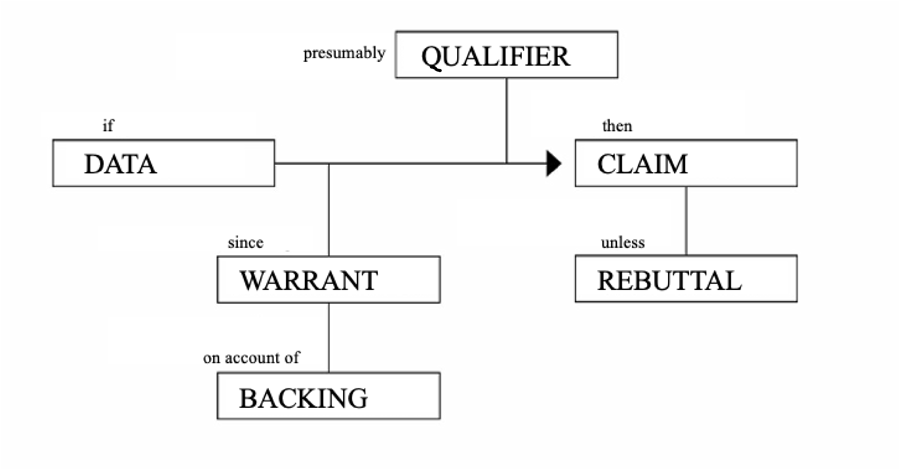
Toulmin's layout enables the evaluation of justificatory arguments. This model allows for the analysis of arguments by identifying the basic elements that compose them, as well as the relationships among those elements – relationships that are determined by their respective functions within the argumentative structure as a whole. The complete representation of an argument layout is presented in Figure 1.
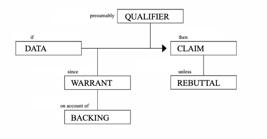
The basic elements required for the composition of an argument are identified as: data (the evidence supporting a claim), claim (the statement made based on the data), and warrant (the statement that authorizes the connection between data and claim). For Toulmin (2006), an argument presented along the data–warrant–claim axis is considered a minimally consistent argument, which we understand as the reduced form of the layout. The remaining elements that compose an argument are: backing (the field-shared knowledge that supports the warrant), modal qualifier (indicating the degree of confidence in a claim), and rebuttal (the statement that refutes the warrant and thereby invalidates the claim). When an argument presents all elements, we refer to it as the complete layout.
According to Carneiro, Teixeira, and Oliveira (2023) and Simpson (2015), the use of Toulmin's (2006) layout has been recurrent in the Mathematics Education literature in higher education, both for the analysis of arguments produced in the classroom by students (Uygun-Eryurt, 2020; Wawro, 2015) and by teachers (Fukawa-Connelly, 2014). In addition to employing the layout for investigations into the arguments of students and teachers, the teaching of argumentation from Toulmin's (2006) perspective has been promoted through didactic interventions (Can; Isleyen, 2020; Uygun-Eryurt, 2020).
Studies have shown that the layout has been an important methodological instrument for investigating argumentation in Mathematics contexts in higher education as it evaluates: the process of justification; argumentative structures in mathematical proof processes; the quality of argumentation; and undergraduate Mathematics teaching (Fukawa-Conelly, 2014; Uygun-Eryurt, 2020; Wawro, 2015). Furthermore, these studies highlight beneficial effects of the argumentative approach in teaching, such as advances in the quality of argumentation, improved development of proof construction, and increased academic performance. In this regard, Toulmin's work and the contributions discussed by Van der Pluijm and Visser (2011) underscore the flexibility of the model, rendering it a useful tool both for argumentative analysis and for the development of argumentation skills across different disciplines. This versatility allows the model to be adapted to diverse contexts, from legal argumentation to fields such as Mathematics and Science.
3 Perelman's Argumentative Perspective
For Perelman (1993), the role of argumentation is linked to practical reason. It is fundamental in all domains in which this reason operates, even when dealing with the resolution of theoretical problems. Therefore, rational thought is not merely calculation. The purpose of argumentation theory is "the study of the discursive techniques allowing us to induce or increase the mind’s adherence to theses presented for its assent" (Perelman; Olbrechts-Tyteca, 2005, p. 4). This argumentative theory aims to secure adherence – both intellectual and emotional – from an audience and to complement the theory of demonstration.
According to Perelman (1993, p. 33), the audience is conceived as the "ensemble of those whom the speaker wishes to influence by his argumentation." The speaker is responsible for analyzing those who constitute the audience of their discourses, whether spoken or written. Within this perspective, the speaker must attend carefully to the data selected and to the form chosen to create presence3, so as to persuade the audience and lead it to adhere to the argument being proposed. The speaker must also know the audience and adapt their argumentation accordingly. If we bring this situation into the dynamics of a Mathematics classroom, we can identify the importance of the teacher, as the speaker addressing that audience, knowing their class, seeking appropriate tools and strategies to foster an environment of discussion and the valuing of opinions, and securing students' adherence to the proposed activities. The teacher may complement the study of argumentation with specialized methodologies suited to the type of audience and the nature of the discipline, taking into account the theses and methods that are admitted within each of them.
Within the scope of the argument types defined by Perelman and Olbrechts-Tyteca (2005), we find those processed through association and those through dissociation. For these authors, arguments that employ the technique of association aim to bring distinct elements closer together, thereby establishing a bond of solidarity among them. Arguments by dissociation, in turn, aim to separate elements that have been regarded as a whole, or at least, as a solidary set within a single system, thereby undoing the links the speaker had previously established. Our attention here is focused on arguments by association (Table 1), which are classified as quasi-logical arguments, arguments based on the structure of reality, and arguments that establish the structure of reality.
Quasi-logical arguments are well suited to the practice of Mathematics Education, occurring during the presentation of content or problem-solving. For Perelman (1993), these arguments are understood by approximating them to formal thought of a logical or mathematical nature. Among quasi-logical arguments, there are those that appeal to logical structures, such as contradiction, identity, and transitivity; and those that appeal to mathematical relations, such as the relation of the part to the whole, from the lesser to the greater, and relation of frequency (Perelman; Olbrechts-Tyteca, 2005).
As for arguments based on the structure of reality, they arise from links that exist between elements of reality (Perelman; Olbrechts-Tyteca, 2005). Argumentation develops through agreement regarding these links. Among these arguments is the argument from authority, which is used in teaching contexts in general and, in particular, in Mathematics classes. An argument from authority is one in which an expert is cited – an authority on a given subject – to justify a claim.
Finally, among the arguments that establish the structure of reality, we find examples, illustrations, and analogies, which are also employed in Mathematics classes. We understand these arguments as establishing connections between something already known and the reality one seeks to come to know. An example is a particular case, or sequence of cases, that makes generalization possible. Through an example, one may find another particular case and thereby ground the rule.
An illustration, according to Perelman (1993), reinforces adherence to a known and accepted rule by reminding the audience of what has been established. Analogy, in turn, occurs when a relation of similarity exists between different objects or facts. Thus, when employing reasoning by analogy, we draw on a fact or object that bears an analogical relation to the main conclusion or thesis as a premise.
We consider the discussion of argument types and the ways in which they interact, as brought forth by Perelman's (1993) theory, to be pertinent, as knowledge of these argument types and of how discursive exchange unfolds between students – and between students and the teacher – when conveying and securing adherence to the teacher's ideas is valuable in Mathematics teaching. In this regard, argumentation is not content with comprehension alone, but also with conviction.
Perelman's (1993) argumentative perspective has been employed as a theoretical framework in studies investigating the flow of mathematical proofs, as well as in interventions in undergraduate Mathematics classes (Carneiro; Teixeira; Oliveira, 2023; Gabel; Dreyfus, 2017). Studies highlight that this framework holds significant analytical potential for evaluating the arguments of teachers and students, and that it may also be used as a teaching approach through its rhetorical elements, which can yield advances in the understanding of the construction of mathematical proofs (Gabel; Dreyfus, 2017).
Having presented the perspectives of Toulmin (2006) and Perelman (1993), we now introduce an argumentative model integrating both theories. We consider the use of both approaches necessary, as neither approach, in isolation, is sufficient for the type of production and analysis of argumentation we propose to develop.
In this regard, both theories converge toward a practical analysis of argumentation, while presenting distinct aspects. Both Toulmin's and Perelman's argumentative theories seek to complement the reasoning of formal logic. According to Ribeiro (2009), despite their differing approaches, Toulmin and Perelman share a central concern: argumentation cannot be reduced to a strict logical-deductive model.
In a teaching approach that adopts an argumentative perspective, it is fundamental to consider the context, the audience, and the criteria for the acceptance of arguments. In the context of undergraduate Mathematics education, argumentation plays a crucial role in the demonstration of theorems, in the justification of solutions, and in the dialogue among different forms of reasoning.
Therefore, we recognize the need to draw on both perspectives and to propose argumentative strategies applicable to the teaching of Mathematics in higher education: the construction of justificatory arguments in line with an argumentative structure (Toulmin's perspective), the recognition of argument types present in the discursive practice of the classroom, and the use of argumentative techniques employed to secure students' adherence and conviction regarding mathematical topics (Perelman's perspective). Furthermore, by bringing together these two perspectives, we provide greater depth to the analysis of student arguments, as we draw on different elements of argumentative discourse. Thus, we propose a model integrating both perspectives, because in addition to the structural dimension of the argument, we are concerned with the types of justifications that may be employed in the process of convincing students of mathematical topics.
4 Toulmin-Perelman Argumentative Model (TPAM)
For the theoretical argumentation model, we will adopt the argumentative theoretical contributions of Toulmin (T) (2006) and Perelman (P) (1993) as our guide. From Toulmin (2006), we will draw on the elementary characteristics that allow for the definition of an argument's structure. With regard to the justifications within the argument, we will employ a typology of arguments processed through association, following Perelman's (1993) perspective, as proposed in Table 1. Thus, the TPAM will follow two strands: logical and rhetorical. The TPAM may be applied as a guide to a teaching approach in Mathematics Teacher Education courses and may serve as an instrument for analyzing student arguments in undergraduate settings.
Ribeiro (2009) emphasizes that both Toulmin and Perelman revolutionized argumentation theory by demonstrating that the validity of an argument depends not only on its logical structure, but also on context and adaptation to the audience. In the context of undergraduate Mathematics, this perspective is particularly relevant, as Mathematics demands not only the logical construction of arguments, but also a form of communication that takes the target audience – that is, the students – into account. By drawing on Toulmin’s and Perelman’s concepts, it is possible to construct a model that values both the logical structure of mathematical reasoning and its communication. The integration of Toulmin's logical model with Perelman's emphasis on the typology of arguments enables students not only to organize their reasoning in a clear and structured manner, but also to consider the impact of rhetorical elements, which may foster advances in their understanding of mathematical arguments.
4.1 Argumentative Teaching Approach
In this model, we employ a teaching approach with an argumentative focus that encourages students' active participation, prompting them to debate their ideas with one another (Can; Isleyen, 2020). This approach creates space for positioning and group discussion, with activities developed through a discursive process. To promote this interaction, it is necessary to establish a flexible structure (Kwon; Bae; Oh, 2015; Solar; Deulofeu, 2016). Teaching is guided by pro-argumentative actions that foster interaction between students and teachers, aiming at the production of arguments on the topic at hand. According to Solar and Deulofeu (2016), these actions promote communication in the classroom.
In the context of undergraduate Mathematics, studies employing this approach (Gabel; Dreyfus, 2017; Metaxas; Potari; Zachariades, 2016; Uygun-Eryurt, 2020) have underscored its potential to promote students' active participation, improve the quality of both written and spoken argumentation, and enhance academic performance. We draw particular attention to studies that promoted the teaching of central concepts from Toulmin's argumentative perspective (Can; Isleyen, 2020; Uygun-Eryurt, 2020).
The argumentative teaching approach may be explicit or implicit. In the explicit approach, argumentation is taught directly. Students are provided with information about the concept of argumentation, the definition of an argument, the construction of arguments and counterarguments, as well as argument types. They engage in discussion about the process of justifying ideas and refuting them, argumentative techniques, and other topics that depend on the argumentative theoretical perspective adopted by the teacher. In other words, an argumentation theory, chosen by the teacher, is taught overtly, serving as an explicit object of instruction so that students may learn to argue by acquiring knowledge of an argumentation theory.
In the implicit approach, by contrast, teaching is guided by strategies that promote argumentation even when the central concepts of a given argumentative perspective are not explicitly taught. In this case, argumentation is not made an overt object of instruction, and it is assumed that students will learn to argue implicitly once exposed to activities that require argumentative engagement.
In the present study, and from the perspective of the TPAM, we do not believe that implicit approaches are effective in fostering students' argumentative skills. Therefore, we adopt explicit instruction based on the view that it is more appropriate to develop students' critical awareness and greater attentiveness to the production and quality of their own arguments. In the TPAM, our interest extends beyond the construction of arguments through an argumentative structure; we seek aspects of argumentation that improve adaptation to the audience and promote adherence to mathematical results.
By bringing together the logical and rhetorical perspectives, we aim to enable students to develop the skills to justify mathematical ideas, concepts, theories, and proofs, fostering adherence through forms of reasoning recognized within the field of Mathematics. By incorporating Perelman's typology of justifications, we emphasize the use of rhetorical resources, such as examples, counterexamples, illustrations, and analogies, which support the understanding of mathematical topics and deepen the ideas presented. The integration of these approaches may not only facilitate the comprehension of abstract concepts, but also encourage students to think critically and to articulate their own justifications in a clear and convincing manner. In a Mathematics teaching approach that integrates rhetoric, students may make content more meaningful, thereby developing essential skills for problem-solving and the construction of arguments within the mathematical field.
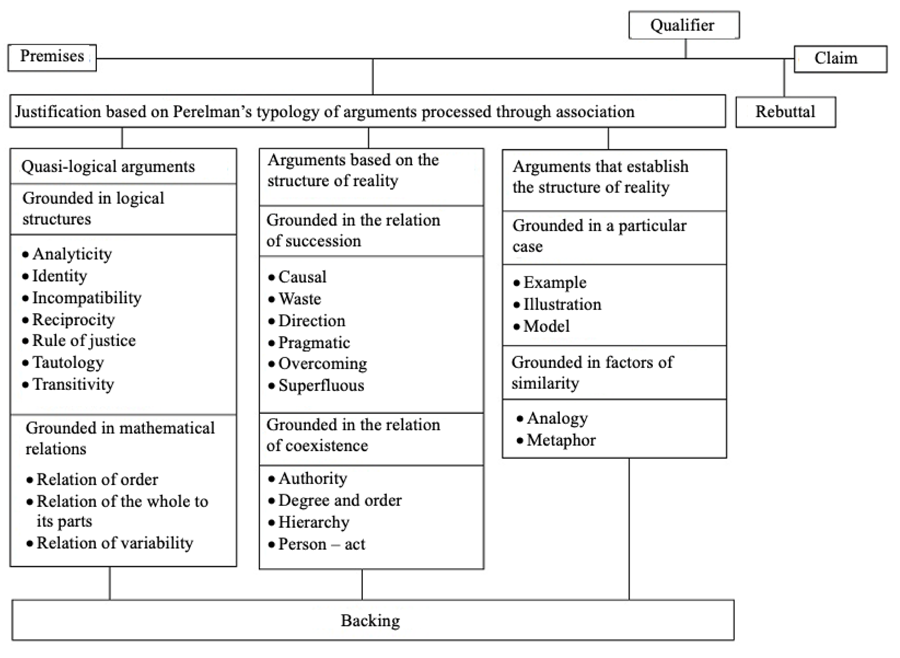
Regarding the argumentative structure of the TPAM (Figure 2), we articulate elements of Toulmin's (T) layout (Figure 1) with Perelman's (P) typology of arguments (Table 1). In these terms, the premise, that is, the information that promotes initial agreement in (P), corresponds to the data in (T)'s perspective. The main thesis in (P) corresponds to the claim in (T). The nature of the justification is grounded in (P)'s typology of arguments, and the backing is the field-shared knowledge that supports the warrant. The remaining components are added to the scheme when the object of the argument requires them. The rebuttal is added to the scheme when likely exceptions arise, presented by means of a counterexample, thereby demonstrating disagreement regarding the plausibility or likelihood of the claim. The qualifier, in turn, is added to the scheme when there is a need to reach agreement regarding the thesis under discussion and to address the degree of certainty attached to it, assigning it an appropriate level of confidence.
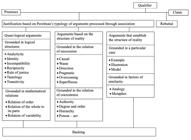
In the explicit argumentative teaching approach adopted in this model, we aim to introduce the concepts of argumentation and argument, bringing together Toulmin's (2006) and Perelman's (1993) perspectives. The TPAM will be discussed in detail, with the identification of the main components present in arguments and a differentiation of the role of each component, as shown in Figure 2. Perelman's typology of justifications will then be presented, discussed, and examples will be given. Subsequently, arguments from subfields of Mathematics will be constructed in line with the TPAM scheme.
Furthermore, students will be encouraged to draw inferences through Toulmin's argumentative perspective in conjunction with Perelman's concepts. For example, students will be expected to express their ideas on the basis of given premises, and then to provide a valid warrant connecting those premises to the thesis being defended. They may offer explanations as to why the warrant is valid by means of the backing, thereby lending it legitimacy. Depending on the idea proposed, they may also present possible exceptions by introducing a counterexample – thus making limitations explicit – and address their degree of certainty regarding the claim, assigning it a certain level of confidence.
The activities proposed in the course to which the model will be applied aim to develop discursive techniques that are specific to Mathematics, enabling teachers and students to adapt to their audience and secure adherence to the claims through interaction among participants in the argumentative process and through the confrontation of arguments. Both may draw on different argument types to justify their theses. The teacher may also adapt textbook questions to the TPAM, helping students recognize the relationship between the argumentative model and the content under study. For instance, the teacher may design questions asking students to classify propositions as true or false, providing justifications and their respective backings, as well as identifying possible exceptions.
In order to develop students' argumentative skills in both their logical and rhetorical dimensions, we will employ the TPAM scheme, which can be applied to subfields of Mathematics such as Algebra, Calculus, Geometry, and others. Next, we present argumentative situations that exemplify the adopted methodology, highlighting the use of the model with selected justifications – drawn from Perelman's typology – that may be applied in undergraduate Mathematics classes.
4.2 Argumentative Situations and TPAM examples
The argumentative situations that illustrate the application of the TPAM were developed based on three main sources: (i) the authors’ pedagogical experiences in Mathematics Teacher Education courses; (ii) adaptations of examples drawn from the specialized literature, with particular reference to the study conducted by Carneiro, Teixeira, and Oliveira (2024); and (iii) constructions inspired by research on argumentation in Mathematics teaching.
To evaluate the quality of arguments, we draw on an analytical framework grounded in the articulation between Toulmin's (2006) layout and Perelman's (1993) typology of justifications. Within this model, the analytical framework explains the role of each component present in argumentative dialogues – namely, premises, justifications, qualifications, backings, rebuttals, and claims. We examine whether students construct arguments in line with the scheme proposed in the TPAM (Figure 2), and whether they demonstrate command of discursive techniques drawn from the typology of arguments to support the discussion of mathematical results.
The quality of argumentation will be evaluated in terms of the consistency of the justification and the backing, alongside any other elements required to validate the argument. The argumentative situation determines the necessary presence of components, as well as the quantity and nature of the justifications needed to validate the claim. An argument will be characterized as high-quality if it addresses its object in a well-structured and adequately justified way, and if it succeeds in validating the claim.
We understand a simpler yet acceptable argument structure as one centered on the premises–warrant–claim axis. From a Toulminian perspective, an argument composed on the data–warrant–claim axis is minimally acceptable, as the data can be used to support the claim and the warrant can validate it, offering a connection between data and claim. We consider this a minimal-quality argument (Stage A), provided it does not present all the justifications necessary to validate the claim.
Depending on the argumentative situation, arguments that present the justification – or justifications – necessary to validate the claim are considered to be of intermediate quality (Stage B1). If, in addition to the elements present in Stage B1, the argument includes complementary justification(s) to further support the claim, it is considered to be of upper intermediate quality (Stage B2). As for the nature of the justification, the analysis will be conducted based on Perelman's (1993) argumentative techniques. Examining this nature makes it possible to assess the quality of argumentation, as analytical frameworks designed for the investigation of arguments tend to focus on justification in some form. For these authors, strong arguments are characterized by the presentation of relevant justifications that support the claim, whereas weak arguments fail to present pertinent justifications.
In this regard, we understand that the quality of argumentation increases when the justification offers stronger support for the claim or, in cases where it indicates a lesser degree of certainty, qualifies it according to possible rebuttals. If, in addition to these three components, the argument includes more than one justification – depending on the object of the argument – and presents backings, it will be classified as Stage C1. We consider the presentation of backings important in the argumentative process, particularly in higher education, as it lends credibility to the justification. Furthermore, depending on the nature of the object being argued, the presence of the qualifier and/or rebuttal components may be required. Should these components be necessary for the composition and validity of the argument, it will be understood as corresponding to Stage C2 in terms of quality.
Within this framework, we propose an analytical table integrating Toulmin's (2006) structural model with Perelman's (1993) theoretical perspective (Table 2).
In light of the guidelines presented, we now share argumentative situations that exemplify the application of the TPAM model, both as a didactic strategy and as an instrument for analyzing the quality of students' argumentation. These situations were drawn from pedagogical experiences, adaptations of teaching activities, and a didactic intervention conducted in a Linear Algebra course (Carneiro; Teixeira; Oliveira, 2024). Each one includes justifications grounded in Perelman's perspective and makes explicit the role played by the backing and/or other argumentative components required by the situation. It should be noted that, for analytical purposes, adaptations were made to the theoretical references employed, as some follow Toulmin's approach and others Perelman's. The central aim is to apply the TPAM as model integrating these two approaches. The situations are organized explicitly in terms of their components – Premises, Justification, Backing, Qualifier, Rebuttal, and Claim – accompanied by the identification of the type of justification and the evaluation of argumentative quality, as proposed in Analytical Table 2.
Argumentative Situation 1 – Justification by example (example inspired by Laamena et al. (2018) and by the authors' pedagogical practice).
In a Linear Algebra class, the teacher presents a 2×2 matrix A and asks students to determine its inverse. Following a discussion, the class conjectures about the result of the inverse of a 2×2 square matrix based on worked examples. The class uses particular cases to test the conjectured rule, observing that the results obtained confirm the hypothesis proposed.
Premises: results of specific matrices with non-zero determinants.
Justification: examples confirm the proposed rule.
Backing: properties of matrix inverses.
Claim: the inverse formula holds for other 2×2 matrices.
Type of Justification: example (Class conjectures, 2024).
Stage of argumentative quality: B1 (empirical examples not directly connected to the formal backing); C1 (when aligned with the formal properties of 2×2 matrix inverses (determinant ≠ 0)).
Argumentative Situation 2 – Justification by counterexample (example from a study by Carneiro, Teixeira, and Oliveira (2024).
During an assessment, students were asked to classify propositions about matrix properties as true or false. One proposition stated: if A and B are symmetric matrices, then AB is symmetric. To refute the generalization, some students presented a counterexample using two symmetric matrices whose product is not symmetric.
Premises: A and B are symmetric matrices.
Justification: the product of two symmetric matrices does not always result in a symmetric matrix.
Backing: presentation of symmetric matrices A and B whose product AB ≠ (AB)ᵀ, invalidating the generalization.
Claim: the proposition is false.
Type of Justification: exemplum in contrarium [counterexample] (Student conjectures, 2024).
Stage of argumentative quality: B1 (adequate justification, but without formal theoretical backing).
Argumentative Situation 3 – Justification by definition and quasi-logical argument (example from a study by Carneiro, Teixeira, and Oliveira (2024).
In a class on homogeneous linear systems, students discussed whether the solution set forms a vector subspace. With the mediation of the teacher and the researcher, students drew on the formal definition of a subspace and properties of matrix algebra to justify that the set is closed under addition and scalar multiplication. They ultimately recognized that this conclusion applies specifically to homogeneous systems and does not hold for non-homogeneous systems.
Premises: Ax = 0 is a homogeneous system; x₁ and x₂ are solutions.
Justification: x₁ + x₂ and αx₁ are also solutions, as they preserve Ax = 0 (formal definition combined with deductive reasoning – quasi-logical argument).
Backing: properties of matrix multiplication and the definition of a subspace.
Qualifier: the conclusion holds provided the system is homogeneous.
Rebuttal: the conclusion does not hold for systems with a non-zero right-hand side (non-homogeneous systems).
Claim: the solution set is a vector subspace.
Type of Justification: definition and quasi-logical argument (Student conjectures, 2024).
Stage of argumentative quality: C2
Argumentative Situation 4 – Justification by illustration (graphical representation)
Adapted from Zazkis, Weber, and Mejía-Ramos (2016), Kaplan, Gulkilik, and Emul (2019), and the authors' pedagogical practice.
During Calculus classes, students analyzed the graphical behavior of functions such as sin(3x) and their integrals, as well as derivatives of even functions. Some students used graphs to justify observed symmetries, drawing on visual representations to validate conclusions about the properties of functions.
Premises: properties observed in graphs of trigonometric or even functions.
Justification: the graphs suggest properties such as symmetry, periodicity, or differentiability.
Backing: correspondence between visual representation and the analytical properties of the functions.
Claim: conclusion regarding the validity of formal properties observed in the graphs, such as symmetry or differentiability.
Type of Justification: illustration [graphical representation] (Student conjectures, 2024).
Stage of argumentative quality: B1 (when no explicit backing is present); C1 (when aligned with the formal concept).
Argumentative Situation 5 – Mixed justification: relational and by illustration (adapted from Sales (2010) and the authors' pedagogical practice).
During a Plane Geometry class, students analyzed a triangle in which the altitude coincided with the angle bisector. Through guided discussion and illustrations on the board, they argued that, given these conditions, the triangle must be isosceles. The analysis combined conceptual relationships with the visual representation of the geometric figure.
Premises: a triangle whose altitude coincides with the angle bisector.
Justifications: two corresponding angles are congruent, and one side is common (relational justification); a drawing of the triangle that makes the coincidence between the altitude and the angle bisector explicit (justification by illustration).
Backing: geometric properties of the angle bisector and the altitude; relationships between angles and sides.
Claim: therefore, the triangle is isosceles.
Type of Justification: relational (conceptual) combined with illustrative representation (Student conjectures, 2024)
Stage of argumentative quality: C1.
Examples play a fundamental role in the teaching of Linear Algebra, as in other fields of Mathematics. In addition to their use in the situations described above, they may serve as motivation, provide meaning and create context, as evidenced in the investigation proposed by Strong (2018). In the TPAM, justification based on examples is used to secure adherence to a result, and students may seek counterexamples to test the validity of a conjecture. Even when the teacher subsequently presents a mathematical proof to establish the result, examples can clarify the relationship between the premise and the claim. In this regard, Gabel and Dreyfus (2017) argue that the use of examples can highlight mathematical elements and foster discussion, drawing on Perelman's perspective to create presence and engagement in mathematical proofs. This reinforces the importance of examples in the construction of mathematical knowledge.
Counterexamples also play a prominent role in Mathematics classes. From Perelman's (1993) perspective, the exemplum in contrarium prevents undue generalization by making explicit an incompatibility with the justification applied, thereby invalidating the generalization. From Toulmin's (2006) theoretical perspective, a counterexample functions as a rebuttal to the claim.
Thus, counterexamples are essential for refuting improper generalizations, demonstrating that a statement or conjecture may not hold in all cases. This prevents mistaken conclusions and makes argumentation more rigorous. Furthermore, counterexamples stimulate students' critical thinking by encouraging them to question the validity of mathematical statements. When grounded in properties or theorems, counterexamples not only refute the statement but also legitimize its falsity based on well-founded concepts, enhancing students' understanding of mathematical principles.
The use of illustrations through diagrams or graphs also plays a relevant role in Mathematics classes, particularly in supporting adherence to previously known rules or conjectures. Such illustrations do not aim to replace abstract reasoning with concrete representations but can serve as justifications by supporting the thesis or claim being defended. They also contribute to making certain properties more visible, generating situations that favor the understanding of the content under discussion.
Graphical representation – referred to as a graphical argument – can favor the elaboration and validation of conjectures. In Kaplan, Gulkilik, and Emul's (2019) study, the authors highlight the importance of students interacting with visual representations and connecting them with algebraic representations throughout this process. Justifications and backings supported by illustrations contribute to the exploration of ideas while simultaneously functioning as mediation tools in group discussions, fostering a more collaborative environment that favors active learning.
In research conducted by Carneiro, Teixeira, and Oliveira (2024), for example, when validating sets as vector subspaces or otherwise, some students reported that geometric visualization aided their understanding of the concept. Zazkis, Weber, and Mejía-Ramos's (2016) study complements this perspective by emphasizing the relevance of visual representations in the teaching of Mathematics, highlighting the importance of transitioning between visual and algebraic representations in the construction of conjectures and arguments.
Although this section has emphasized the typology of justifications, it is essential to highlight the role of the backing component. For Perelman and Olbrechts-Tyteca (2005, p. 352, our translation), backing is linked to competence: "One seeks it in the rules of conditioning, of the acquisition of aptitudes, in the rules for verifying aptitudes and in the rules for confirming competence." We understand this competence as the teacher's word or the citation of a reliable source such as a textbook or academic article that addresses the specific subject matter. From Toulmin's (2006) perspective, the backing supports the warrant and lends it credibility. In the context of Mathematics teaching, it is common for students to ground their arguments in laws, properties, and theorems previously demonstrated and shared in the classroom. Thus, the backing legitimizes the warrant and strengthens its argumentative force.
The qualifier and rebuttal components may also arise depending on the structure of the argumentative situation. The qualifier expresses the degree of certainty of the claim, indicating whether it is probable, necessary, or limited to certain cases. The rebuttal, in turn, introduces conditions under which the claim would not hold, anticipating possible objections or exceptions. Both components contribute to making argumentation more attentive to the limitations of the mathematical context under discussion.
We also recognize the importance of formal logic in Mathematics teaching, particularly through its deductive processes as an essential part of the construction of scientific knowledge. In the everyday reality of the classroom, however, formal and informal arguments4 coexist. Therefore, we emphasize the need to value both types of argumentation so as to favor the understanding of mathematical topics and the articulation of different forms of reasoning.
This analytical model enables us to investigate argumentative skills within a logical and a rhetorical framework. In this direction, drawing on the aforementioned criteria, we examine whether students construct structured arguments, present justifications and ground them consistently, and verify whether they have acquired argumentative techniques to support the persuasive force of their ideas (Carneiro; Teixeira; Oliveira, 2024). It is also possible to evaluate the quality of argumentation by considering the different components involved in the process.
The situations presented demonstrate how the TPAM can be used both to promote the construction of arguments in the classroom and to rigorously analyze the argumentative quality of students' work. By integrating structural components such as premises, justifications, backings, qualifiers, rebuttals, and claims along with different types of justification, these experiences reveal the model's potential to foster more reflective and discursively grounded pedagogical practices in undergraduate Mathematics. In the next section, we present some implications of this study for both practice and research.
5 Implications for Practice and Research
In this study, we constructed a Toulmin-Perelman Argumentative Model – TPAM – to be employed as a teaching strategy in a Mathematics Teacher Education course and to serve as an analytical framework for evaluating student arguments. We hope this model contributes to the production on argumentation in Mathematics Education in Higher Education. We present a proposal for explicit instruction on argumentation, particularly through argumentative situations in which the methodology adopted in this model can be used to specify the structure of arguments. Furthermore, we propose an analytical framework that seeks to evaluate both the logical and rhetorical dimensions of student arguments in Higher Education Mathematics settings. Moreover, the model's flexibility means that, with appropriate adaptations to the context of the course, it may also be applied to Science Education. Thus, the model can give rise to new studies.
By presenting an original argumentative model grounded in the perspectives of Toulmin (2006) and Perelman (1993) and supported by a literature specifically oriented toward Mathematics in Higher Education, we point to the need for its application in Mathematics Teacher Education programs. The model has already been applied in a study by Carneiro, Teixeira, and Oliveira (2024), but we emphasize the importance of its implementation in further research. Such diversification allows for a more comprehensive evaluation of its uses and may yield meaningful insights for the field of Mathematics Education. We also encourage Mathematics Education and Science Education researchers to conduct investigations that analyze, critique, and revise the model, thereby contributing to its refinement.
We also consider it relevant that the model be applied in teacher education programs, as these professionals will be able to provide their students with activities focused on argumentation and promote learning through discussion. In this regard, by making argumentation more accessible to teachers, we believe they will be better positioned to encourage students to justify their results, foster an environment that favors discussion and work toward a well-grounded analysis of the topics addressed in the classroom, aiming at the construction of consistent argumentation. Therefore, we point to the need for research oriented toward the intersection of teacher education and argumentation, particularly in Mathematics and Science Education.
References
-
BARBOSA, J. C. Abordagens teóricas e metodológicas na Educação Matemática: aproximações e distanciamentos. In: Oliveira, M. P.; ORTIGÃO, M. I. R. (org.). Abordagens teóricas e metodológicas nas pesquisas em educação matemática Brasília: Sociedade Brasileira de Educação Matemática, 2018. p. 17-57 (Coleção SBEM, Vol. 13). Disponível em: https://www.sbembrasil.org.br/files/ebook_.pdf Acesso em: 16 mar. 2026.
» https://www.sbembrasil.org.br/files/ebook_.pdf -
CAN, O. S.; ISLEYEN, T. The effect of probability instruction through argumentation approach on the achievement of preservice teachers and the permanence of their knowledge. African Education Research Journal, Port Harcourt, v. 8. p. 540-553, 2020. Disponível em: https://www.netjournals.org/z_AERJ_S_20_072.html Acesso em: 17 mar. 2026.
» https://www.netjournals.org/z_AERJ_S_20_072.html -
CARNEIRO, J. S.; TEIXEIRA, E. S.; OLIVEIRA, A. M. P. de. Usos da argumentação na educação matemática: uma revisão sistemática da literatura no Ensino Superior. Educação Matemática Pesquisa Revista do Programa de Estudos Pós-Graduados em Educação Matemática, v. 3, pág. 111-141, 2023. Disponível em: https://revistas.pucsp.br/index.php/emp Acesso em: 16 mar. 2026.
» https://revistas.pucsp.br/index.php/emp -
CARNEIRO, J. S.; TEIXEIRA, E. S.; OLIVEIRA, A. M. P. de. Qualidade da argumentação de estudantes da licenciatura em matemática na disciplina álgebra linear. Alexandria: Revista de Educação em Ciência e Tecnologia, v. 17, n.1 p. 1-29, 2024. Doi: 10.5007/1982-5153.2024.e97963
» https://doi.org/10.5007/1982-5153.2024.e97963 - DEMO, P. Introdução da metodologia. São Paulo: Atlas, 1985.
-
FUKAWA-CONNELLY, T. Using Toulmin analize to analysis an instructor's proof presentation in abstract algebra. International Journal of Mathematical Education in Science and Technology, London, v. 45, n. 1, p. 75-88, 2014. Disponível em: https://doi.org/10.1080/0020739X.2013.790509 Acesso em: 16 mar. 2026.
» https://doi.org/10.1080/0020739X.2013.790509 -
GABEL, M.; DREYFUS, T. Affecting the flow a proof by creating presence - a case study in Number Theory. Educational Studies em Mathematics, Dordrecht, v. 96, n. 2, p. 187-205, 2017. Disponível em: https://doi.org/10.1007/s10649-016-9746-z Acesso em: 16 mar. 2026.
» https://doi.org/10.1007/s10649-016-9746-z -
KAPLAN, A. H.; GULKILIK, H.; EMUL, N. Investigating the Relationship between Argumentation and Proof a Representation Perspective. International Journal for Mathematics Teaching and Learning, Plymouth, v. 20, n. 2, p. 131-148, 2019. DOI: https://doi.org/10.4256/ijmtl.v20i2.211 Acesso em: 16 mar. 2026.
» https://doi.org/10.4256/ijmtl.v20i2.211 -
KWON, N.; BAE, Y.; OH, K. H. Design research on inquiry-based multivariable calculus: focusing on students' argumentation and instructional design. ZDM Mathematics Education, Berlim, v. 47, n. 6, p. 997-1011, out. 2015. Disponível em: https://doi.org/10.1007/s11858-015-0726-z Acesso em: 16 mar. 2026.
» https://doi.org/10.1007/s11858-015-0726-z -
LAAMENA, M. et al. How do the Undergraduate Students Use an Example in Mathematical Proof Construction: A Study based on Argumentation and Proving Activity. International Eletronic Journal of Mathematics Education, London, v. 13, n. 3, p. 185-198, jul. 2018. Doi: https://doi.org/10.12973/iejme/3836 Acesso em: 16 mar. 2026.
» https://doi.org/10.12973/iejme/3836 -
MENDONÇA, P. C. C.; JUSTI, R. S. Ensino-aprendizagem de ciências e argumentação: discussões e questões atuais. Revista Brasileira de Pesquisa em Educação em Ciências, Belo Horizonte, v. 13, n. 1, p. 187-216, jan./abr. 2013. Disponível em: https://periodicos.ufmg.br/index.php/rbpec/article/view/4257 Acesso em: 18 mar. 2026.
» https://periodicos.ufmg.br/index.php/rbpec/article/view/4257 -
METAXAS, N.; POTARI, D.; ZACHARIADES, T. Analysis of a Teacher's pedagogical arguments using Toulmin's model and argumentation schemes. Educational Studies in Mathematics, Dordrecht, v. 93, n. 3, p. 383-397, 2016. Disponível em: https://doi.org/10.1007/s10649-016-9701-z Acesso em: 18 mar. 2026.
» https://doi.org/10.1007/s10649-016-9701-z - PERELMAN, C. O império retórico: Retórica e argumentação. Porto: Edições Asa, 1993.
- PERELMAN, C.; OLBRECHTS-TYTECA, L. Tratado da argumentação: A nova retórica. São Paulo: Martins Fontes, 2005.
- RIBEIRO, H. J. (ed.). Rhetoric and Argumentation in the Beginning of the XX Century. Coimbra: Imprensa da Universidade de Coimbra, 2009.
- SALES, A. Práticas argumentativas no estudo da geometria por acadêmicos de licenciatura em matemática. 2010. 243 f. Tese (Doutorado em Educação Matemática) -Universidade Federal do Mato Grosso do Sul, Campo Grande, 2010.
- SILVA JÚNIOR, G. A. da. Elementos de exploração argumentativa docente na sala de aula: uma proposta de análise à luz de teoria de Perelman e Olbrechts-Tyteca. 2019. 84 f. Tese (Doutorado em Ensino de Ciências Exatas e da Terra) - Universidade Federal do Rio Grande do Norte, Natal, 2019.
-
SIMPSON, A. The anatomy of a mathematical proof: implications for analyses with Toulmin's scheme. Educational Studies in Mathematics, Dordrecht, v. 90, n. 1, p. 1-17, 11 jul., 2015. Disponível em: https://doi.org/10.1007/s10649-015-9616-0 Acesso em: 18 mar. 2026.
» https://doi.org/10.1007/s10649-015-9616-0 -
SOLAR, H.; DEULOFEU, J. Condiciones para promover el desarrollo de la competencia de argumentación en el aula de matemáticas. Bolema, Rio Claro, v. 30, n. 56, p. 1092-1113, 2016. Disponível em: https://www.scielo.br/j/bolema/a/LRQCNDLqMwwbtcHfhyf5LDs/?format=pdf⟨=es Acesso em: 13 fev. 2026.
» https://www.scielo.br/j/bolema/a/LRQCNDLqMwwbtcHfhyf5LDs/?format=pdf⟨=es - STRONG, D. Motivating Examples, Meaning and Context in Teaching Linear Algebra. In: DORIER, J.-L. (ed.). Challenges and strategies in teaching linear algebra. Cham: Springer, 2018. p. 337-351.
- TOULMIN, S. E. Os Usos do Argumento Tradução de Reinaldo Guarany. São Paulo: Martins Fontes, 2006.
-
UYGUN-ERYURT, T. Conception and Development of Inductive Reasoning and Mathematical Induction in the Context of Written Argumentations. Acta Didactica Napocensia, Cluj Napoca, v. 13, n. 2, p. 65-79, 2020. Disponível em: https://doi.org/10.24193/adn.13.2.5 Acesso em: 18 mar. 2026.
» https://doi.org/10.24193/adn.13.2.5 -
VAN DER PLUIJM, L. C.; VISSER, J. C. David Hitchcock and Bart Verheij (eds): Arguing on the Toulmin Model: New Essays in Argument Analysis and Evaluation. Argumentation, v. 25, n. 4, p. 527-539, 2011. Disponível em: https://doi.org/10.1007/s10503-011-9214-y Acesso em: 16 mar. 2026.
» https://doi.org/10.1007/s10503-011-9214-y -
WAWRO, M. Reasoning About Solutions in Linear Algebra: the case of abraham and the invertible matrix theorem. International Journal of Research in Undergraduate Mathematics Education, Cham, v. 1, n. 3, p. 315-338, set. 2015. Disponível em: https://doi.org/10.1007/s40753-015-0017-7 Acesso em: 16 mar. 2026.
» https://doi.org/10.1007/s40753-015-0017-7 -
ZAZKIS, D.; WEBER, K.; MEJÍA-RAMOS, J. P. Bridging the gap between graphical arguments and verbal-symbolic proofs in a real analysis context. Educational Studies in Mathematics, Dordrecht, v. 93, n. 2, v. 93, p. 155-173, out. 2016. Disponível em: https://doi.org/10.1007/s10649-016-9698-3 Acesso em: 16 mar. 2026.
» https://doi.org/10.1007/s10649-016-9698-3
-
Data Availability:
The data generated or analyzed during this study are included in the published article.
-
1
In Perelman’s rhetoric, the argumentative process involves an interaction among arguments aimed at reaching agreement (Perelman, 1993). In contrast, argumentation in the logical strand is oriented toward identifying and verifying the function of the constitutive elements present in an argument, as well as the relationships among them, through an analysis of the argument's formal structure (Mendonça; Justi, 2013).
-
2
In formal logic, the validity of arguments depends solely on the form of the statements: the premises precede the conclusion, which follows as a consequence of those premises. Informal logic, which we understand as synonymous with argumentation theory, aims to develop procedures for the analysis, interpretation, evaluation, critique, and construction of argumentation in everyday discourse (Mendonça; Justi, 2013).
-
3
In the construction of an argument, the speaker may select elements upon which particular attention is directed, endowing them with presence. Among the rhetorical figures employed in Perelman's theory to create presence are: repetition of ideas; accumulation of accounts; use of illustrations; and evocation of details (Gabel; Dreyfus, 2017).
-
4
Arguments are formal when the justifications are based on definitions, axioms, and theorems. Informal arguments, by contrast, are those whose justifications are grounded in concrete interpretations of mathematical concepts, such as visual representations and other illustrative representations (Knipping, 2003 apud Laamena et al., 2018).
-
Editor-in-Chief:
Prof. Dr. Roger Miarka
-
Associate Editor:
Profa. Dra. Ana Paula dos Santos Malheiros
The data generated or analyzed during this study are included in the published article.

 Source: Adapted from
  Source: Created by the authors (2024)