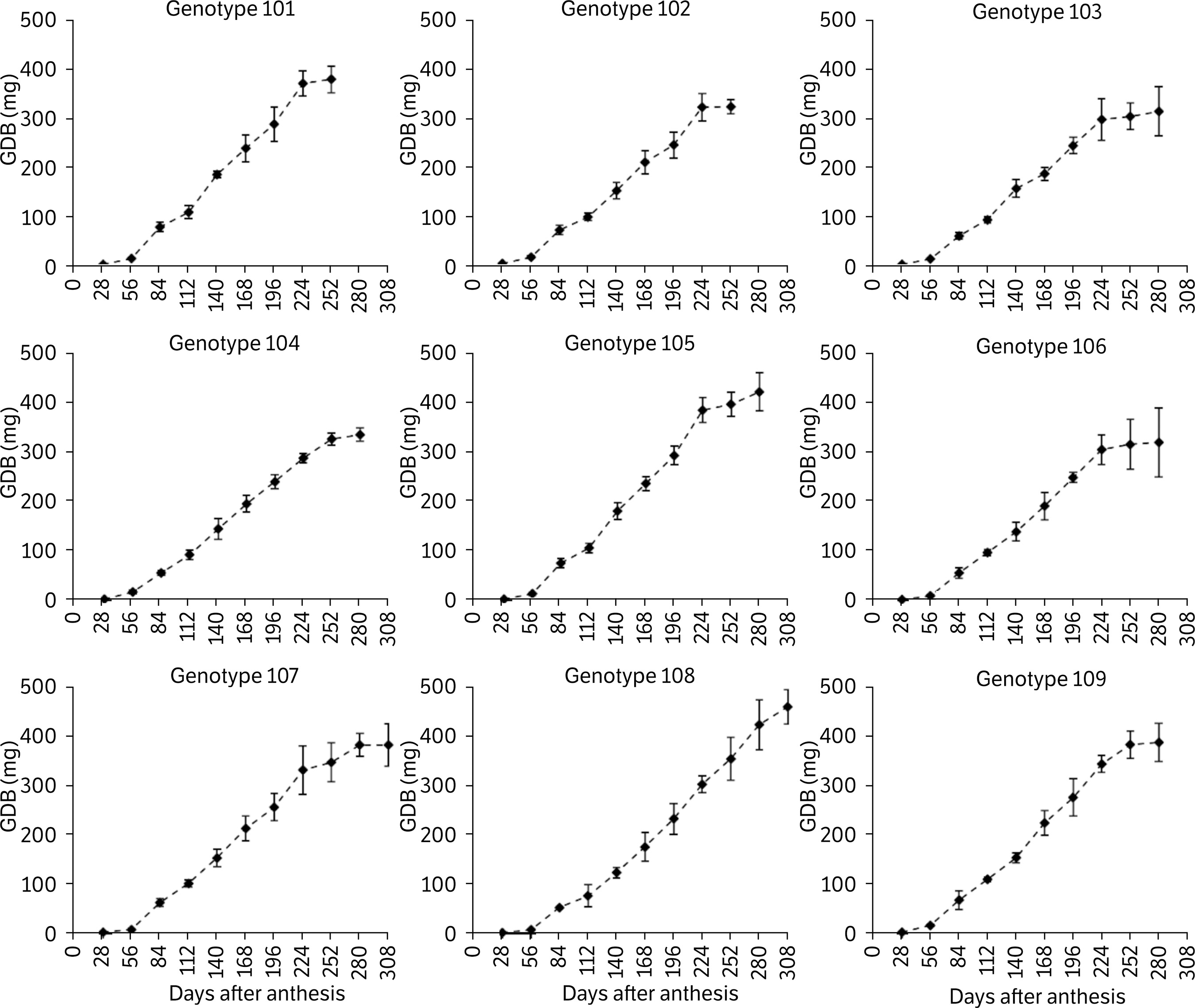
 From anthesis to harvest: evolution of the fructification of Conilon coffee genotypes grown at a transitional altitude
ABSTRACT
Beginning with anthesis, this study aimed to evaluate the growth evolution of fruits of nine genotypes of Conilon coffee with an early cycle of maturation that were cultivated at a transitional altitude. The experiment was conducted in a competition field with Coffea canephora genotypes at a 647-m altitude, following a randomized block design with nine treatments, four replicates, and the genotypes making up the cultivar “Diamante ES8112” (101, 102, 103, 104, 105, 106, 107, 108, and 109). From the anthesis day, evaluations were made every 28 days, ending with the harvest, at which time the characteristics of growth and biomass accumulation of flowers and fruits of each genotype were evaluated. All analyzed characteristics of the flowers and fruits cultivated at a transitional altitude showed differentiation between the nine early-maturing Conilon genotypes. Altitude cultivation increased the duration of fruit development phases, averaging from 252 to 308 days among genotypes, from anthesis to harvest. Genotype 106 stood out for the fewest flowers and fruits per reproductive node and lowest fruit holding rates and dry biomass, whereas genotype 108 stood out for the most flowers and fruits per reproductive node, largest flower diameter, highest fruit holding rate, and greatest dry biomass.
Key words
Coffea canephora
; coffee fruits; flowering; marginal altitude; variability
INTRODUCTION
Brazil is the largest producer of coffee in the world, averaging about 54.2 million benefited sacks in 2024 (Conab 2025) and being its second largest consumer worldwide (ICO 2019). Coffee is one of the products Brazil exports the most, accumulating US$ 10.14 billion from August 2023 to July 2024 (Cecafé 2024).
The Coffea canephora and Coffea arabica species encompass almost all traded coffee in the world. In the 1960s, Brazil began to significantly produce C. canephora, especially in Espírito Santo state (Matiello and Almeida 1997). This growing interest in Conilon coffee (C. canephora) cultivation entailed the development of genetic improvement programs for the species, especially due to its higher productive potential and greater rusticity than Arabica coffee (C. arabica) (Ferrão et al. 2019).
As Arabica coffee, Conilon has a phenological cycle in which flowering and maturation occur at varying times, influenced by environmental conditions and genetic variability. Altitude configures an important extrinsic factor that can condition the phenological cycle of coffee. Agricultural zoning considers it to determine the suitability of coffee-growing areas as it influences climatic variables, especially temperatures. Altitude variation can morphologically and physiologically change plants and may influence their vegetative and reproductive cycle since high altitudes can expose plants to lower temperatures, higher relative humidity, and greater irradiance (Chanishvili et al. 2007).
After flowering, the fructification phase begins, setting, developing, and maturing coffee fruits. As in Arabica coffee, the development of Conilon fruits is usually divided into five phases: small-green berries, rapid expansion, endosperm formation, endosperm filling, and fruit ripening (Ronchi and DaMatta 2019). However, cultivation conditions and genotypes may influence the duration of each phase, and further studies are needed to better elucidate these effects.
Most commercial Conilon coffee crops are formed by clonal cultivars with a certain number of genotypes. These can vary the ripening period of fruits depending on their precocity (Bragança et al. 2001). Coffea canephora is a gregarious flowering species, i.e., the plants in a region tend to bloom simultaneously. However, the number of annual blooms may vary. A large number of blooms is generally undesirable as it decreases maturation uniformity; hinders harvesting and pest and disease control; and may decrease grain quality (Rena and Maestri 1986).
The study of the reproductive growth of Conilon coffee at transitional altitudes gains importance in this context due to the scarce knowledge about the influence of altitude and its conditioning factors on the different genetic materials of C. canephora. Thus, this study aimed to evaluate the growth evolution of fruits of nine early-maturing Conilon genotypes grown at a transitional altitude.
MATERIAL AND METHODS
Local characterization
The experiment was conducted in a genotype competition field in Lagoa Seca, in the municipality of Alegre, Espírito Santo state, Southeastern Brazil, at a 647-m altitude and at 20°52’06”S and 41°28’45”W. The area is zoned as marginally suitable for crops of C. canephora Pierre ex Froehner (Taques and Dadalto 2019). From September 2019 to August 2020, the average annual precipitation was 1,611.88 mm, and the average annual temperature was 21.18°C, monitored by an automatic weather station installed nearby the experimental field (Irriplus, model E5000).
According to the Köppen-Geiger’s climate classification, the climate is classified as Cwa (humid subtropical) and characterized by rainy summers and dry winters (Peel et al. 2007). The soil is classified as a yellow-red latosol (Oxisol) (Embrapa 2013, USDA 1999), with clayey texture and wavy-rugged relief.
Plantation management
The plants of Conilon coffee were implanted in 3 × 1-m spaces in February 2015. Each plant was installed with three orthotropic stem and the scheduled pruning cycle for Conilon coffee (Verdin Filho et al. 2014).
The experimental field was managed by drip irrigation. Soil water was monitored by three tensiometers to sample the upper 25 cm of the soil. Irrigation was carried out every time the water retention tension in the soil corresponded to 60–70% of the available water (46-34 kPa, respectively), returning soil water to field capacity. The other management practices (e.g., nutritional, phytosanitary, cultural) were carried out following the current recommendations for Conilon coffee cultivation in Espírito Santo state (Ferrão et al. 2019). This study was carried out in the fourth reproductive cycle of the plants.
Experimental design
The experiment followed a randomized block design with nine treatments and four replicates. Treatments consisted of nine genotypes of Conilon coffee. Each experimental plot consisted of three plants.
The nine genotypes of Conilon coffee are components of a clonal cultivar certified in Brazil by Serviço Nacional de Proteção de Cultivares (SNPC), denominated “Diamante ES8112” (SNPC Certification number: 20140103), presenting an early-stage ripening cycle. The genotypes were referred to as 101, 102, 103, 104, 105, 106, 107, 108, and 109. This clonal cultivar was developed and registered by the Instituto Capixaba de Pesquisa, Assistência Técnica e Extensão Rural, and is characterized by high-crop yield and significant beverage quality.
Evaluated traits
In the central plant of each plot, four plagiotropic branches were marked and used for evaluations (plagiotropic branches of first production and median from the canopy of an orthotropic stem of the plant). The predominant moment of anthesis of the plants in the experimental plots was found by daily monitoring. A median reproductive node was also marked in each of these branches. The average number of flowers (ANF; units) emitted on each marked reproductive node was counted on the day of anthesis. Additionally, 10 flowers of adjacent reproductive nodes to those marked were collected to determine flower fresh biomass (FFB; mg), flower dry biomass (FDB; mg), flower water content (FWC; % – obtained by the ratio between FFB and FDB), and average flower diameter (AFD; mm – obtained by a digital caliper).
After anthesis (flowering on October 2nd, 2019), evaluations were performed every 28 days, ending with the harvest of the fruits of each genotype. The average number of fruits per marked reproductive node (NFR; units) was measured in these evaluations. In each evaluation, 10 fruits were collected from reproductive nodes adjacent to those marked. The fresh (GFB; mg) and dry biomass (GDB; mg) and the water content (GWC; %) of fruits (obtained by the ratio between GFB and GDB) were measured in each evaluation of these fruit samples. To obtain the dry biomass of flowers and fruits, the samples were allocated in an oven with forced air circulation at 65 ± 2°C until a constant mass was obtained. The dry masses were determined with a precision analytical balance (0.0001 g).
The last evaluation for each genotype was performed at harvest, which was determined to be the moment in which at least 80% of the fruits reached their stage of “cherry”, according to Fonseca et al. (2019). In this evaluation, the average number of fruits per marked reproductive node (NFR; units) and the fruit holding rate (FHR; % – obtained by the ratio between ANF and NFR on the day of harvest) were counted. Estimates of the fresh (GFB; mg) and dry biomass (GDB; mg) and water content (GWC; %) of the fruits were also performed. The moment of fruit harvest varied among genotypes, occurring between June 10th and August 5th, 2020.
Data analyses
Means and standard deviations were used to study the evolution of NFR, GDB, and GWC for each genotype from anthesis to harvest. Data on the flowers (ANF, FFB, FDB, FWC, and AFD) and fruits on the day of harvest (NFR, GFB, GDB, GWC, and FHR) were subjected to analysis of variance by the F-test at 5% probability. When a significant effect for the source of variance (genotypes) was observed, the Scott-Knott’s criterion (p ≤ 0.05) was used to group genotype means. Genetic parameters were estimated by an individual model (Eq. 1):
where: Yij: the phenotypic value of the ij-th observation; μ: the overall mean; Gi: the fixed effect of the i-th genotype; Bj: the effect of the j-th plot; εij: the experimental error.
The methods in Cruz and Carneiro (2003) were used to estimate genetic parameters. All statistical analyses were performed on “Genes” (Cruz 2013).
RESULTS AND DISCUSSION
Early-maturing genotypes of Conilon coffee showed significant differentiation in all analyzed characteristics according to the F-test. Most analyzed variables showed a coefficient of experimental variation (CVe) below 10%, except ANF, NFR, and FHR (Table 1). These results are considered adequate for experiments with Conilon coffee (Ferrão et al. 2008).
Analysis of variance and estimation of the genetic parameters of flower and fruit characteristics of nine early-maturing genotypes of Conilon coffee (clonal cultivar “Diamante ES8112”) that were cultivated at a transitional altitude (647 m, Alegre, ES, Brazil).
The determination of variance for all evaluated fructification traits showed that the contribution of genetic variance (CVg) predominated over experimental variance (CVe). This implies higher variance rates (CVg/CVe), in which all characteristics showed indices above 1 (Table 1), configuring a favorable condition for studies of genetic diversity (Vasconcelos et al. 2012, Leite et al. 2016).
All studied characteristics showed coefficients of genotypic determination (H2) above 80%, with a higher proportion of phenotypic variance (σ^p2) associated with the contribution of the quadratic component of genotypic variance (ϕ^g), especially for ANF, AFD, FFB, FDB, and NFR, whose values exceeded 90% (Table 1). Higher coefficients of genotypic determination indicated that genetic variance predominated over environmental variance, configuring a favorable condition for obtaining gains with possible selections involving the studied traits (Ferrão et al. 2008, Dalcomo et al. 2015, Silva et al. 2015, Carias et al. 2016).
The variance expression in this study was essential to expand the knowledge on how genetics control the quantitative characteristics of Conilon coffee fructification, especially since the characteristics with high genotypic variance estimates indicate greater heterogeneity between genotypes for several flower and fruit parameters. This result can aid genetic improvement programs for the species to select materials with specific goals (Ferrão et al. 2008, Rodrigues et al. 2012).
Traits related to the formation of coffee fruits are influenced by the fertilization of flowers. Cilas and Bouharmont (2005), in their study of a group of genotypes in Cameroon, identified an apparent genetic component that determines coffee yield. They also observed a correlation with the peaberry rate, which is a trait associated with grain formation.
Environmental factors, such as temperature and water availability, which are influenced by altitude, impact the processes of flowering and fruit development. Sarmiento-Soler et al. (2022), in their study of smallholder coffee systems in Uganda, emphasize the importance of adapting management practices to enhance the resilience of coffee crops. Their research highlights the potential benefits of leveraging mitigative environmental factors, such as altitude and shading, to improve the sustainability of coffee cultivation.
Comparing genotypes by the characteristics of their flowers showed four AFD and FFB groups, three ANF and FDB groups; and FWC groups (Table 2).
Comparison of the means of flower characteristics for nine (101 to 109) early-maturing genotypes of Conilon coffee (clonal cultivar “Diamante ES8112”) cultivated at a transitional altitude (647 m, Alegre, ES, Brazil)*.
Genotype 108 stood out for the highest ANF and AFD, whereas genotypes 105, 106, 107, and 109 emitted the least ANF and genotype 104 showed the lowest AFD (Table 2). The number of emitted flowers per reproductive node is an important indicator for the amount of fruit that can develop in a reproductive node. Early-maturing genotypes of Conilon coffee average 24 flowers per reproductive node when cultivated in low altitudes with irrigation (Ronchi and DaMatta 2019). This study found an average of 26.36 flowers per reproductive node in nine early-maturing genotypes cultivated and irrigated in a transitional altitude. However, genotypes showed considerable variance, ranging from 19.13 (genotype 106) to 42.75 flowers (genotype 108) (Table 2).
Genotype 109 showed the highest means of FFB and FDB, whereas genotypes 103, 104, and 106 belonged to the group with the lowest FDB means. However, genotypes 104 and 106 showed the lowest FWC (Table 2).
Even with a group of improved genotypes and components of the same early-maturing clonal cultivar, this study found considerable variance in flower characteristics (number of emissions per reproductive node and morphological and biomass aspects) between genotypes. These data reinforce the wide heterogeneity among Conilon genotypes (Fonseca et al. 2006). A number of studies have demonstrated this high variability among genotypes of Conilon coffee grown in transitional altitude, e.g., in relation to sprout growth (Rodrigues et al. 2017), nutritional content (Salles et al. 2021), sensory attributes of the beverage (Machado et al. 2021) and physicochemical characteristics of grains (Souza et al. 2022).
Our analysis of the time (days) between anthesis and harvest (more than 80% of fruits in the cherry phase) of the nine genotypes of Conilon coffee cultivated at a transitional altitude (647 m) showed a 56-day difference between the earliest (101 and 102) and least early (107 and 108) genotypes. Most (103, 104, 105, 106, and 109) showed a 280-day reproductive cycle (Fig. 1).

Evolution in fruit development of nine early-maturing genotypes of Conilon coffee (clonal cultivar “Diamante ES8112”) as a function of time (days) from anthesis to harvest due to cultivation at a transitional altitude (647 m, Alegre, ES, Brazil).
It is worth mentioning that the cultivation of genotypes of Conilon coffee at a transitional altitude increased the duration of their reproductive cycles (ranging from 252 to 308 days) as cultivation in low altitudes and higher temperatures usually cause early-maturation genotypes to complete their reproductive cycle from 216 to 238 days (Bragança et al. 2001, Partelli et al. 2014).
Some studies have reported that the duration of each phase (and thus the total development of coffee fruits) depends on genetic material and the interaction of the genotype with environmental factors, such as altitude, temperature, thermal time, and water availability (Laviola et al. 2007, Petek et al. 2009). This study attested to this.
Ferrão et al. (2019) suggest that harvesting Conilon coffee fruits after they have fully ripened is the optimal period, since early harvesting may decrease grain quality. Our analysis of fruit characteristics showed significant differences among the nine genotypes, forming four groups of means for NFR; three groups for GDB; and two groups for GFB, GWC, and FHR (Table 3).
Comparison of the means of fruit characteristics for nine (101 to 109) early-maturing genotypes of Conilon coffee (clonal cultivar “Diamante ES8112”), cultivated at a transitional altitude (647 m, Alegre, ES, Brazil)*.
Genotype 108 showed the highest mean NFR, whereas genotypes 102 and 106, the lowest. Genotypes 101, 105, 108, and 109 belonged to the group with the highest GFB averages, whereas the other genotypes formed the group with the lowest averages. However, when analyzing GDB, only genotypes 105 and 108 remained in the group with the highest averages, whereas genotypes 102, 103, 104, and 106 comprised the group with the lowest averages. Moreover, genotypes 101, 102, 103, 106, and 109 showed the highest fruit water content since these materials belonged to the group with the highest GWC means (Table 3).
Fruit and grain biomass are deemed an important physical parameter related to quality. Reports suggest that grains with greater biomass received better nourishment during their development (Mendonça et al. 2009). However, as in this study, genotypic differences can cause variations in the biometric and morphological characteristics of fruits and grains between genotypes, even under standardized cultivation and management.
The FHR ranged from 29.29 (genotype 102) to 53.35% (genotype 104) (Table 3). Genotypes 104, 105, 107, 108, and 109 belonged to the group with the highest means, whereas the other genotypes composed the group with the lowest FHR. It is worth mentioning that genotypes 105, 107, and 109 showed higher fruit holding rates even with fewer flowers in their reproductive nodes.
Generally, results showed that genotype 106 may have fewer flowers and fruits per reproductive node and lower fruit holding rates and fruit dry biomass than the other components of the cultivar under the growing conditions in transitional altitudes. On the other hand, genotype 108 stands out for its greater number of flowers and fruits per reproductive node, larger flower diameter, higher fruit holding rate, and greater dry biomass allocated to its fruits.
Our analysis of the evolution of the average NFR from anthesis to harvest of nine genotypes of Conilon coffee showed a marked decrease in NFR up to 84 days after anthesis in genotypes 101, 106, and 108, tending to stabilize after this period. Genotype 102 showed a marked decrease up to 112 days after anthesis, whereas genotype 105 showed relative stability after 56 days. Genotypes 103 and 107 seemed to stabilize their NFR after 168 days, whereas genotype 104, after 140 days. For genotype 109, NFR continuously decreased up to fruit harvesting 280 days after anthesis (Fig. 2).

Evolution of the number of fruits per reproductive node (NFR; units) from anthesis to harvest (days) of nine early-maturing genotypes of Conilon coffee (Cultivar “Diamante ES8112”) cultivated at a transitional altitude (647 m, Alegre, ES, Brazil) (mean ± standard deviation, n = 16).
According to the literature, the most pronounced decrease in the number of fruits per Conilon coffee reproductive node occurs up to the end of the rapid expansion of its fruits regardless of irrigation. The growth of the fruits of two-early maturing Conilon genotypes in low altitude (Sooretama, ES, Brazil) can be divided into five phases: small-green berries lasts from flowering until the sixth week after it; fast growing, from the sixth to the 16th week; suspended growth, from the 16th to the 18th week; filling, from the 18th to the 28th week; and fruit ripening from the 28th to the 36th week after anthesis (Ronchi and DaMatta 2019). Ronchi and DaMatta (2019) describe an average of 24 small-green berries per reproductive node after flowering, averaging 15 coffee cherries per reproductive node during maturation and evincing a 38% loss of the initial fruits for each reproductive node.
In our study, the nine early-maturing genotypes of Conilon coffee cultivated at a transitional altitude (647 m) widely varied in their initial number of small-green berries after anthesis and that of cherry fruits at maturation, ranging from 16 (genotype 105) to 39.25 small-green berries (genotype 108) and reaching from 7.38 (genotypes 102 and 106) to 18.50 coffee cherries (genotype 108) (Fig. 2).
Our analysis of the evolution of GDB from anthesis to harvest showed a sharp increase in GDB 56 days after anthesis for all genotypes. This increase occurred up to 224 days for the genotypes 101, 102, 103 and 106, whose biomass tended to stabilize after this period. Genotypes 104 and 109 showed the same process after 252 days. Fruit biomass accumulation tended to stabilize for genotype 107 280 days after anthesis, whereas genotypes 105 and 108 more markedly accumulated fruit dry biomass up to harvest (280 and 308 days, respectively) without a stabilization trend (Fig. 3).
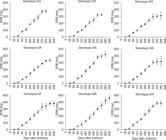
Evolution of fruit dry biomass (GDB; mg) from anthesis to harvest (days) for nine early-maturing genotypes of Conilon coffee (Cultivar “Diamante ES8112”) cultivated at a transitional altitude (647 m, Alegre, ES, Brazil) (mean ± standard deviation, n = 16).
During the small-green berries phase (apparently up to 56 days after anthesis), the dry biomass of the fruits of the nine genotypes of Conilon coffee showed no significant gains, as in Ronchi and DaMatta (2019).
Our analysis of the evolution of the GWC from anthesis to harvest of nine genotypes of Conilon coffee showed a sharp growth of GWC up to the rapid growth phase, reaching maximum values 84 or 112 days after anthesis, which decreased from this period onward and tended toward stability 224 days after anthesis (Fig. 4).

Evolution of fruit water content (GWC; %) from anthesis to harvest (days) of nine early-maturing genotypes of Conilon coffee (Cultivar “Diamante ES8112”) cultivated at a transitional altitude (647 m, Alegre, ES, Brazil) (mean ± standard deviation, n = 16).
We highlight the importance of studies on the pattern of growth and development of fruits of different genotypes of Conilon coffee, especially on cultivation at transitional altitudes as this information enables inferences about the phases with more or less intense water and nutrient demands to form fruits, which can contribute to optimizing water management and fertilization, as per Ronchi and DaMatta (2019). Collecting information on flower and fruit characteristics of different genotypes can also contribute to the study of variance, which can be explored by genetic improvement programs.
CONCLUSION
The nine early-maturing genotypes of Conilon coffee show differentiated flower and fruit characteristics under cultivation in transitional altitude and great contributions from genotypic variance to determine phenotypic variances and high coefficients of genotypic determination for all evaluated traits.
FFB, AFD and NFR were the characteristics that enabled the greatest differentiation of behavior and grouping of the evaluated genotypes of Conilon coffee at a transitional altitude. The duration of the development phases of Conilon fruits increases as a function of cultivation at a transitional altitude as the nine early-maturing genotypes averaged from 252 to 308 days from anthesis to harvest.
Genotype 106 stands out for the fewest flowers and fruits per reproductive node, lowest fruit holding rate, and lowest fruit dry biomass of all early-maturing genotypes cultivated in a transitional altitude. On the other hand, genotype 108 stands out for the most flowers and fruits per reproductive node, largest flower diameter, highest fruit holding rate, and greatest dry biomass allocated to its fruits.
ACKNOWLEDGMENTS
The authors would like to thank José Augusto Demartini Landi and his family for granting access to the plantation, as well as the Centro de Ciências Agrárias e Engenharias of the Universidade Federal do Espírito Santo for providing access to the necessary facilities and laboratories.
-
How to cite: Colodetti, T. V., Tomaz, M. A., Sartori, L., Salles, R. A., Souza, I. V., Senra, J. F. B. and Rodrigues, W. N. (2025). From anthesis to harvest: evolution of the fructification of Conilon coffee genotypes grown at a transitional altitude. Bragantia, 84, e20250028. https://doi.org/10.1590/1678-4499.20250028
-
FUNDING
Conselho Nacional de Desenvolvimento Científico e TecnológicoGrant No. 316070/2021-1Fundação de Amparo à Pesquisa e Inovação do Espírito SantoGrant No. 2022-4V1GJ
DATA AVAILABILITY STATEMENT
All dataset were generated and analyzed in the current study.
REFERENCES
-
Bragança, S. M., Carvalho, C. H. S., Fonseca, A. F. A. and Ferrão, R. G. (2001). Variedades clonais de café Conilon para o Estado do Espírito Santo. Pesquisa Agropecuária Brasileira, 36, 765-770. https://doi.org/10.1590/S0100-204X2001000500006
» https://doi.org/10.1590/S0100-204X2001000500006 - Carias, C. M. O. M., Gravina, G. A., Ferrão, M. A. G., Fonseca, A. F. A., Ferrão, R. G., Vivas, M. and Viana, A. P. (2016). Predição de ganhos genéticos via modelos mistos em progênies de café Conilon. Coffee Science, 11, 39-45.
-
[Cecafé] Conselho dos Exportadores de Café do Brasil (2024). Relatório mensal julho 2024. Cecafé. Available at: http://www.consorciopesquisacafe.com.br/images/stories/noticias/2021/2024/Julho/CECAFE_Relatorio_Mensal_JULHO_2024.pdf Accessed on: Jan. 18, 2025.
» http://www.consorciopesquisacafe.com.br/images/stories/noticias/2021/2024/Julho/CECAFE_Relatorio_Mensal_JULHO_2024.pdf -
Chanishvili, S., Badridze, G., Rapava, L. and Janukashvili, N. (2007). Effect of altitude on the contents of antioxidants in leaves of some herbaceous plants. Russian Journal of Ecology, 38, 367-373. https://doi.org/10.1134/S1067413607050128
» https://doi.org/10.1134/S1067413607050128 -
Cilas, C. and Bouharmont, P. (2005). Genetic studies on several bean traits of Coffea canephora coffee in Cameroon. Journal of the Science of Food and Agriculture, 85, 2369-2374. https://doi.org/10.1002/jsfa.2245
» https://doi.org/10.1002/jsfa.2245 -
[Conab] Companhia Nacional de Abastecimento (2025). Acompanhamento de safra brasileira de Café. Primeiro levantamento. Brasília: Conab. Available at: https://www.conab.gov.br/component/k2/item/download/56677_79e87a15fa32943d3bf036a3691ed924 Accessed on: Jan. 18, 2025.
» https://www.conab.gov.br/component/k2/item/download/56677_79e87a15fa32943d3bf036a3691ed924 -
Cruz, C. D. (2013). Genes: a software package for analysis in experimental statistics and quantitative genetics. Acta Scientiarum. Agronomy, 35, 271-276. https://doi.org/10.4025/actasciagron.v35i3.21251
» https://doi.org/10.4025/actasciagron.v35i3.21251 - Cruz, C. D. and Carneiro, P. C. S. (2003). Modelos biométricos aplicados ao melhoramento genético. 2. ed. Viçosa: Editora UFV.
-
Dalcomo, J. M., Vieira, H. D., Ferreira, A., Lima, W. L., Ferrão, R. G., Fonseca, A. F. A., Ferrão, M. A. G. and Partelli, F. L. (2015). Evaluation of genetic divergence among clones of Conilon coffee after scheduled cycle pruning. Genetics and Molecular Research, 14, 15417-15426. Retrieved from https://biblioteca.incaper.es.gov.br/digital/bitstream/item/2812/1/BRT-Evaluation-of-genetic-divergence-ferrao-2015.pdf
» https://biblioteca.incaper.es.gov.br/digital/bitstream/item/2812/1/BRT-Evaluation-of-genetic-divergence-ferrao-2015.pdf - [Embrapa] Empresa Brasileira de Pesquisa Agropecuária (2013). Sistema brasileiro de classificação de solos. Brasília: Embrapa.
-
Ferrão, R. G., Cruz, C. D., Ferreira, A., Cecon, P. R., Ferrão, M. A. G., Fonseca, A. F. A., Carneiro, P. C. S. and Silva, M. F. (2008). Parâmetros genéticos em café Conilon. Pesquisa Agropecuária Brasileira, 43, 61-69. https://doi.org/10.1590/S0100-204X2008000100009
» https://doi.org/10.1590/S0100-204X2008000100009 - Ferrão, R. G., Fonseca, A. F. A., Ferrão, M. A. G. and DeMuner, L. H. (2019). Conilon Coffee. 3. ed. Vitória: Incaper.
-
Fonseca, A. F. A., Sediyama, T., Cruz, C. D., Sakaiyama, N. S., Ferrão, M. A. G., Ferrão, R. G. and Bragança, S. M. (2006). Genetic divergence in Conilon coffee. Pesquisa Agropecuária Brasileira, 41, 599-605. https://doi.org/10.1590/S0100-204X2006000400008
» https://doi.org/10.1590/S0100-204X2006000400008 - Fonseca, A. F. A., Verdin Filho, A. C., Ronchi, C. P., Volpi, P. S., Lani, J. A., Martins, A. G., Ferrão, M. A. G. and Ferrão, R. G. (2019). Management of Conilon coffee cultivation: planting, spacing, pruning and pinching. In R. G. Ferrão, A. F. A. Fonseca, M. A. G. Ferrão and L. H. DeMuner (Eds.). Conilon Coffee (p. 327-359). 3. ed. Vitória: Incaper.
-
[ICO] International Coffee Organization (2019). Dados Históricos. ICO. Available at: http://www.ico.org/prices/po-production.pdf Accessed on: Jan. 20, 2025.
» http://www.ico.org/prices/po-production.pdf -
Laviola, B. G., Martinez, H. E. P., Salomão, L. C. C., Cruz, C. D. and Mendonça, S. M. (2007). Acúmulo de nutrientes em frutos de cafeeiro em quatro altitudes de cultivo: cálcio, magnésio e enxofre. Revista Brasileira de Ciência do Solo, 31, 1451-1462. https://doi.org/10.1590/S0100-06832007000600022
» https://doi.org/10.1590/S0100-06832007000600022 -
Leite, W. S., Pavan, B. E., Matos Filho, C. H. A., Alcantara Neto, F., Oliveira, C. B. and Feitosa, F. S. (2016). Estimativas de parâmetros genéticos, correlações e índices de seleção para seis caracteres agronômicos em linhagens F8 de soja. Comunicata Scientiae, 7, 302-310. https://doi.org/10.14295/CS.v7i3.1176
» https://doi.org/10.14295/CS.v7i3.1176 -
Machado, J. L., Tomaz, M. A., Luz, J. M. R., Osório, V. M., Costa, A. V., Colodetti, T. V., Debona, D. G. and Pereira, L. L. (2021). Evaluation of genetic divergence of coffee genotypes using the volatile compounds and sensory attributes profile. Journal of food Science, 87, 383-395. https://doi.org/10.1111/1750-3841.15986
» https://doi.org/10.1111/1750-3841.15986 - Matiello, J. B. and Almeida, S. R. (1997). Variedades de café: como escolher, como plantar. Rio de Janeiro: MAA SDR Procafé PNFC.
-
Mendonça, J. C. F., Franca A. S. and Oliveira, L. S. (2009). Physical characterization of non-defective and defective Arabica and Robusta coffees before and after roasting. Journal of Food Engineering, 92, 474-479. https://doi.org/10.1016/j.jfoodeng.2008.12.023
» https://doi.org/10.1016/j.jfoodeng.2008.12.023 -
Partelli, F. L., Espindula, M. C., Marré, W. B. and Vieira, H. D. (2014). Dry matter and macronutrient accumulation in fruits of Conilon coffee with different ripening cycles. Revista Brasileira de Ciência do Solo, 38, 214-222. https://doi.org/10.1590/S0100-06832014000100021
» https://doi.org/10.1590/S0100-06832014000100021 -
Peel, M. C., Finlayson, B. L. and McMahon, T. A. (2007). Updated world map of the Köppen-Geiger climate classification. Hydrology and Earth System Sciences, 11, 1633-1644. https://doi.org/10.5194/hess-11-1633-2007
» https://doi.org/10.5194/hess-11-1633-2007 -
Petek, M. R., Sera, T. and Fonseca, I. C. B. (2009). Exigências climáticas para o desenvolvimento e maturação dos frutos de cultivares de Coffea arabica Bragantia, 68, 169-181. https://doi.org/10.1590/S0006-87052009000100018
» https://doi.org/10.1590/S0006-87052009000100018 - Rena, A. B. and Maestri, M. (1986). Fisiologia do cafeeiro. In A. B. Rena, E. Malavolta, M. Rocha and T. Yamada (Eds.). Cultura do cafeeiro: fatores que afetam a produtividade (p. 13-106). Piracicaba: Associação Brasileira para Pesquisa da Potassa e do Fosfato.
-
Rodrigues, W. N., Colodetti, T. V., Brinate, S. V. B., Martins, L. D. and Tomaz, M. A. (2017). Genetic variability for sprout growth among genotypes of Coffea canephora led by bending of orthotropic stems. Genetics and Molecular Research, 16, gmr16039813. Retrieved from https://biblioteca.incaper.es.gov.br/digital/bitstream/item/2812/1/BRT-Evaluation-of-genetic-divergence-ferrao-2015.pdf
» https://biblioteca.incaper.es.gov.br/digital/bitstream/item/2812/1/BRT-Evaluation-of-genetic-divergence-ferrao-2015.pdf - Rodrigues, W. N., Tomaz, M. A., Ferrão, R. G., Ferrão, M. A. G., Fonseca, A. F. A. and Miranda, F. D. (2012). Estimativa de parâmetros genéticos de grupos de clones de café Conilon. Coffee Science, 7, 177-186.
- Ronchi, C. P. and DaMatta, F. M. (2019). Physiological aspects of Conilon coffee. In R. G. Ferrão, A. F. A. Fonseca, M. A. G. Ferrão and L. H. DeMuner (Eds.). Conilon Coffee (p. 111-143). 3. ed. Vitória: Incaper.
-
Salles, R. A., Jordaim, R. B., Colodetti, T. V., Rodrigues, W. N., Amaral, J. F. T. and Tomaz, M. A. (2021). Nutritional characteristics of conilon coffee genotypes grown in transition altitude with water management in soil. Ciência e Agrotecnologia, 45, e013721. https://doi.org/10.1590/1413-7054202145013721
» https://doi.org/10.1590/1413-7054202145013721 -
Sarmiento-Soler, A., Rötter, R. P., Hoffmann, M. P., Jassogne, L., Van Asten, P., Graefe, S. and Vaast, P. (2022). Disentangling effects of altitude and shade cover on coffee fruit dynamics and vegetative growth in smallholder coffee systems. Agriculture, Ecosystems & Environment, 326, 107786. https://doi.org/10.1016/j.agee.2021.107786
» https://doi.org/10.1016/j.agee.2021.107786 - Silva, F. L., Baffa, D. C. F., Rezende, J. C., Oliveira, A. C. B., Pereira, A. A. and Cruz, C. D. (2015). Variabilidade genética entre genótipos de café robusta no estado de Minas Gerais. Coffee Science, 10, 20-27.
- Souza, I. V., Colodetti, T. V., Jordaim, R. B., Salles, R. A., Sartori, L., Rodrigues, W. N. and Tomaz, M. A. (2022). Caracterização físico-química de grãos de genótipos de cafeeiro conilon em altitude de transição. Pensar Acadêmico, 20, 16-31.
- Taques, R. C. and Dadalto, G. G. (2019). Agroclimatic zoning for conilon coffee culture in the state of Espírito Santo. In R. G. Ferrão, A. F. A. Fonseca, M. A. G. Ferrão and L. H. DeMuner (Eds.). Conilon Coffee (p. 70-83). 3. ed. Vitória: Incaper.
- [USDA] United States Department of Agriculture (1999). Soil taxonomy: A basic system of soil classification for making and interpreting soil surveys. Washington, D.C.: USDA.
-
Vasconcelos, E. S., Reis, M. S., Sediyama, T. and Cruz, C. D. (2012). Estimativas de parâmetros genéticos da qualidade fisiológica de sementes de genótipos de soja produzidas em diferentes regiões de Minas Gerais. Semina: Ciências Agrárias, 33, 65-76. https://doi.org/10.5433/1679-0359.2012v33n1p65
» https://doi.org/10.5433/1679-0359.2012v33n1p65 - Verdin Filho, A. C., Tomaz, M. A., Ferrão, R. G., Ferrão, M. A. G., Fonseca, A. F. A. and Rodrigues, W. N. (2014). Conilon coffee yield using the programmed pruning cycle and different cultivation densities. Coffee Science, 9, 489-494.
Edited by
-
Section Editor:
Christian Cilas https://orcid.org/0000-0001-7658-1866