
 How do the components used in chemical seed treatment affect physiological quality over the storage period?
ABSTRACT
In the soybean crop, seed treatment is widespread, often with the use of several products. The aim of this study was to evaluate the effect of phytosanitary and functional products used in such treatments on the quality of stored soybean seeds. The seeds were treated with combinations of fungicide, insecticide, polymer, finishing powder, graphite, cobalt-molybdenum (CM), and inoculant. Quality evaluations were made at 0, 15, 30, 60, and 90 days of storage after the treatment by means of the following tests: germination, seedling emergence, modified accelerated aging in substrate, primary root length, as well as quantification of dust-off of the seeds. A completely randomized experimental design was used in a 10 × 5 factorial arrangement, involving 10 seed treatment compositions and five storage periods. To avoid harmful effects on physiological quality, CM and graphite added to the phytosanitary products should be used nearer to sowing, in a period of less than 15 days. Seeds with the basic industrial seed treatment used as a technological package in most seed production companies (fungicide, insecticides, and polymer) maintained physiological quality up to 60 days of storage. An excessive number of products use as seed treatment in this study, consisting of more than five, can negatively affect seed quality, even in a short storage period of 15 days. The composition of the treatment directly affects the dust-off of the seeds, especially combinations that include finishing powder and graphite.
Key words
storage; phytotoxicity; Glycine max L. Merrill; phytosanitary products
INTRODUCTION
Soybean is an important commodity in the world agricultural scenario, and Brazil is the largest producer of the crop (CONAB 2024). High yields and production levels are directly related to the use of technologies, and many of them are delivered through seeds (Reis et al. 2022).
Among the diverse technological advances that aim at increasing soybean yield, chemical seed treatment stands out. Treating seeds with phytosanitary products protects and favors initial development of soybean seedlings, especially under adverse growing conditions, such as water deficit (Carvalho et al. 2021), and it allows for combinations among insecticides, fungicides, polymers, and finishing powders (França-Neto et al. 2016).
Nevertheless, the combination of these phytosanitary products and the volume of the slurry used can affect the physiological quality of the seeds, above all when they are stored (Carvalho et al. 2021, Pereira et al. 2021a). Given the possibilities of composition and volumes of slurries for seed treatment, studies are necessary regarding their relationship to seed physiological quality (Santos et al. 2018).
In addition to phytosanitary products, companies have been using functional products, such as finishing powder, in conjunction with seed treatment with phytosanitary products, aiming at drying the phytosanitary products quickly and evenly (Abati et al. 2018). Investments have been also made in the sale of technological packages with a combination of micronutrients (Pereira et al. 2021b), as well as other functional products, such as polymers and biological inoculants.
A cobalt and molybdenum (CM) treatment is important for assisting the process of biological nitrogen fixation in the soybean crop, and, although it is common in on-farm treatments, the use of these micronutrients is not yet widespread in the industrial seed treatment (IST) process (Pereira et al. 2021b).
With the concept of selling industrially treated seeds in an “open and sow” system, which indicates that the farmer does not need to add any component before sowing, it is necessary to use CM, inoculants, and graphite, as well as the already traditional fungicides, insecticides, polymers, and finishing powders. Thus, studies to understand the interactions among these components and the quality of the stored seeds are indispensable.
The interaction of other products with the IST has been studied by authors, such as Abati et al. (2018), who observed reduction in the physiological quality of soybean seeds with the use of finishing powder together with the insecticide treatment, and Oliveira et al. (2021), who observed reduction in the development of soybean seedlings upon mixing fungicides + insecticides + CM in the seed treatment.
However, due to the diverse possibilities for composition of slurries for soybean seed treatment, studies that analyze the isolated effects and the interaction effects of these molecules on the physiological quality of seeds are still few. We hypothesized that the use of several products in the final slurry may have adverse effects on physiological quality.
Thus, the aim of this study was to evaluate the effect of the compositions of chemical seed treatments involving phytosanitary, polymer, finishing powder, micronutrient, inoculant, and graphite products on the quality of soybean seeds over storage and on dust-off effects of the seeds.
MATERIALS AND METHODS
The present study was conducted in the central seed research laboratory (LCPS) of the Departamento de Agricultura, Escola de Ciências Agrárias de Lavras of the Universidade Federal de Lavras, Lavras, MG, Brazil.
Soybean seeds of the cultivar Foco Brasmax, primarily produced in the Center-West of Brazil with indeterminate growth and maturity group 7.2, were weighed and separated in 2.5-kg portions for later treatments. The treatments were processed in the LCPS, with a Momesso company Arktos Laboratório L5K device to simulate IST in batch processing.
In the IST, we used phytosanitary chemical products (insecticide + fungicide), polymer, and finishing powder as follows: Fungicide (F) – Maxim Advanced (a.i. fludioxonil 25 g.L-1 + metalaxyl-M 20 g.L-1 + tiabendazole 150 g.L-1). For the other combinations, the seeds were treated with recipe Fortenza Duo, involving fungicide (Maxim Advanced), the insecticide Cruiser 350 FS (CI) (a.i. thiamethoxam 350 g.L-1), the insecticide Fortenza 600 (FI) (a.i. cyantraniliprole 600 g.L-1), and the polymer (P) Biocroma Vermelho (density of 1.10 g.m-3). The other components used in the compositions of the treatment slurry were CM [Class A organic mineral fertilizer, density = 1.25 g.mL-1, a compound of sulfur 0.55% – (6.875 g.L-1), cobalt 1% – (12.5 g.L-1), total organic carbon 20% (250 g.L-1), and molybdenum 10% – (125 g.L-1), with the sources of cobalt sulfate, sodium molybdate, saccharides, and EDTA (6.6)], the inoculant Bioma Brady (IN) [Bradyrhizobium japonicum (SEMIA 5,079 and 5,080), density = 7.2.109 cells.mL-1]; the finishing powder (FP) Biogloss biogrow (the chemical nature of slurries of mineral fillers, density = 2.8–3.2 g.m-1, white in color, water insoluble and of light odor); and graphite (G) (compound of natural graphite 70–100%, quartz 0.01–25.0). Water (W) was used only when fungicide (F) alone was used. The final volume of the slurry was a result of the sum of the volumes of each product. Details on the combinations of products in the treatment are shown in Table 1.
After the seeds treatments were applied, the seeds were placed in Kraft type paper bags and stored in a ventilated shed without climate control. Seed quality was evaluated at 0, 15, 30, 60, and 90 days of storage after the treatments through the following tests:
-
Germination in a rolled paper: four replications of 50 seeds were sown, with the aid of a seed counter, above one damped paper towel, afterwards covered with a second damped paper towel, and rolled into a cylinder. The amount of water in the paper towels was 2.5 g of water per g of paper towel. The rolls were kept in a Mangelsdorf germinator at 25 ± 2°C. Evaluations were made at eight days after sowing, to determine the percentage of normal seedlings (ISTA 2024);
-
Germination in a rolled paper plus vermiculite (RP+V): four replicates of 50 seeds were sown, with the aid of a seed counter, above one paper towel damped with a 100 mL of a fine and uniform layer of medium vermiculite (55 to 95% of the particles > 2.4 mm) applied above the paper toweling, afterwards covered with a second damped paper towel, and rolled into a cylinder. The amount of distilled water in the paper towels was 3 g of distilled water per g of paper towel and in the vermiculite g of distilled water per g of vermiculite. The rolls were kept in a Mangelsdorf germinator at 25 ± 2°C (Carvalho et al. 2024). Evaluations were made eight days after sowing, considering the percentage of normal seedlings;
-
Seedling emergence: four replicates of 50 seeds per treatment were placed on a substrate composed of a mixture of sand + soil (2:1 for volume proportion), placed in plastic trays, irrigated at 60% of water-holding capacity at sowing and then irrigated uniformly, when necessary. The trays were kept in a greenhouse at the temperature of 25 ± 2°C in an alternating (12 h) light and dark regime (Krzyzanowski et al. 2020). Evaluations were made five days after sowing, considering the percentage of emergence seedlings;
-
Modified accelerated aging in substrate (AAS): plastic boxes fitted with suspended aluminum screens were used. A layer of seeds was placed over the entire screen, followed by the addition of 40 mL of water. Subsequently, seeds were placed in a chamber at 41 ± 0.3°C for 48 hours (ISTA 2024). After that period, seeds were sown in a substrate placed in a plastic tray containing sand + soil in a 2:1 proportion and moistened to 60% of water-holding capacity. After sowing, the trays were kept in a plant growth chamber at 25 ± 2°C in an alternating (12 h) light and dark regime. Evaluations were made eight days after sowing, considering the percentage of emergence seedlings;
-
Seedling length by means of high-resolution images: this was measured with four replications of 20 seeds, following the methodologies described for the germination test. At four days after sowing, seedling images were captured. Evaluations were made using the GroundEye device, version S120, manufactured by Tbit, Lavras, MG, Brazil. The seedlings were inserted in the tray of the image capture module to obtain high-resolution images. Subsequently, background color was calibrated using the CIEL*a*b color model with a luminosity index from 0 to 100, dimension “a” from -13.9 to 46.1 and dimension “b” from -57.1 to -40.6. After calibration of the background color, image analysis was performed automatically through extraction of the mean values of the primary root size (Reis et al. 2022);
-
Detachment of particles/dust from the seeds (dust-off): before the test, the samples were kept for 48 hours at 20°C and 50% relative humidity. After that period, the Heubach D.38679 dustmeter (Langelsheim, Germany) was used, following the methodology of the European Seed Association as described in Reis et al. (2023). For evaluation of the seed samples, the established parameters were equipment operation time (120 seconds), the size of the analyzed sample (100 grams of seed), and the airflow (20 liters per minute). A 6-cm diameter microfiber filter was placed in the filter carrier, and the set was weighed, then proceeding to the dust-off operation. The drum was loaded with the seed sample, and, with the rotating movement of the set, the seeds in friction through the deflectors installed in the drum resulted in detachment of the dust particles. At the end of the established movement time, the filter and filter carrier set were weighed once more, and the weight of the detached particles was estimated by difference in weight. The results were presented in g.100 kg-1 of seeds (Reis et al. 2023).
A completely randomized statistical design was used with four replications in a 10 × 5 factorial arrangement, involving 10 compositions of seed treatments and five evaluation times throughout storage. Statistical analyses were made by means of analysis of variance with the RStudio software (R Core Team 2022) at p < 0.05 significance by the F-test. When necessary, the mean values were analyzed with the use of the Scott-Knott’s test at p < 0.05 significance, or with analyses of polynomial regressions and choice of the significant model with the greatest coefficient of determination.
RESULTS AND DISCUSSION
Seed storage conditions remained stable throughout the analyzed period, with an average daily temperature range of 10°C and relative humidity of around 40% (Fig. 1). These moderate temperature fluctuations did not represent a significant risk to seed quality, since the average maximum temperature recorded was 28.5°C. Therefore, the conditions observed can be considered safe for proper seed storage.
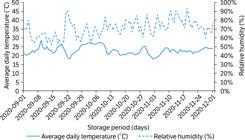
Average daily temperature (°C) and relative humidity (%) during the storage period between September and December. Datalogger at the Seed Conditioning and Treatment Plant of the Universidade Federal de Lavras, Lavras, MG, Brazil.
In the results of the first germination count at the beginning of storage, higher values of normal seedlings were observed in the compositions of seed treatments F, F+I, and B+G (Table 2).
First germination count (%) of soybean seeds treated with different compositions of products as a function of storage time*.
These compositions had a reduced number of components; the others, with a larger number of products, exhibited lower values, even at the beginning of storage when evaluated in the germination methodology with the use of only rolled paper. Harmful effects with an excessive number of products in the seed treatment were clear at the end of the 90 days of storage, in which inclusion of the insecticides reduced quality in relation to the fungicide, and especially in the compositions with five or more components (B+FP+CM, B+FP+IN, B+FP+CM+IN, and B+FP+CM+IN+G).
Rocha et al. (2020) reported that treatments with insecticide molecules affect the germination of soybean seeds, with greater phytotoxicity than fungicide treatments. Santos et al. (2023) studied the effects of the combination of chemical products on the quality of soybean seeds and observed a reduction in seed germination potential when finishing powder was used in the composition of the treatment. The composition of the finishing powder, which often contains titanium dioxide and natural talc chlorite, may be one of the factors that affect seed germination, because, despite having a hydrophilic nature, there are reports that finishing powders may cause damage related to soaking (Santos et al. 2023).
Over the storage period, there was reduction in normal seedlings in the first germination count for all the seed treatment compositions (Fig. 2). The treatment with only fungicide had higher levels of quality than the treatments with a larger number of products. Especially for the composition with all the products, a greater reduction was seen at 90 days of storage, with only 53% normal seedlings. This reinforces the importance of knowing the length of the storage period to maintain the quality of treated seeds, the seed safety period, especially when a larger number of products are used in the composition, an increasingly common situation in IST.

First germination count (%) of soybean seeds in rolled paper substrate, with seeds treated with different compositions of products, as a function of storage period.
In the initial evaluation of germination, there was no difference among the treatments with different compositions (Table 3). Nevertheless, after 15 days of storage, a harmful effect was observed on germination, especially for the treatments with five or more components or those in which finishing powder was included.
Percentage of germination in rolled paper substrate for soybean seeds treated with different compositions of products as a function of storage period*.
Just as observed in the first germination count, there was a reduction in final seed germination after 90 days of storage, intensified in the combinations with a larger number of products in the final composition of the seed treatment, such as B+FP+CM, B+FP+CM+IN, and B+FP+CM+IN+G (Fig. 3). In their supplemental constitution, all these treatments had the basic treatment in IST, the finishing powder, and CM. This requires greater attention because farmers often apply what is known as a “retreatment”, which includes several functional products on seeds that have already been industrially treated with fungicide, insecticide, polymer, and, at times, finishing powder.

Germination (%) in rolled paper substrate of soybean seeds treated with different compositions of products as a function of storage.
Pereira et al. (2021b) studied the impact of the composition (micronutrient + bioregulator + polymer + finishing powder) of the soybean seed treatment on soybean physiological quality during storage (0, 15, 30, 45, 60, and 90 days) and concluded that the combination of these four components in the seed treatment and the volume of the slurry, along with the storage periods (15 days after the treatment), have a harmful effect on seed physiological quality. However, the study did not evaluate a combination with insecticides and fungicides.
In the RP+V test, differences did not occur among the compositions up to 15 days of storage (Table 4). At 30 days, there was reduction in germination of seeds treated with the compositions B+FP, B+FP+G, B+FP+CM+IN, and B+FP+CM+IN+G, all containing finishing powder. Nevertheless, at 60 days, only the composition with the largest number of components showed reduction in germination, reconfirming the necessary attention to a shorter storage period for seeds with many products, greater than five.
Germination (%) in rolled paper + vermiculite substrate of soybean seeds treated with different compositions of products as a function of storage period*.
Alves et al. (2017) affirmed that the interaction between products and/or certain a.i. may cause reduction in seed quality, with consequent reduction in seedling establishment in the field, due to the phytotoxicity brought about by this interaction. This situation was also observed in this study.
Ludwig et al. (2011) observed that in soybean seeds treated with a combination of products with different a.i. and modes of action, even with the same slurry volume of 600 mL.100 kg-1, there was a negative effect on the quality of the seeds stored for 60 days after the treatment, with evaluations made at 0, 60, 120, and 180 days, without control of temperature and relative humidity. The authors also observed that there are differences among cultivars and among product combinations.
Throughout storage, there was reduction in germination in the RP+V substrate, regardless of the composition of the seed treatment (Fig. 4). This result was also observed in the standard germination test in rolled paper (Fig. 3). However, the mean values of the germination using the RP+V testing were generally concentrated at a higher level. Thus, it is possible that the substrate used attenuated the phytotoxic effect associated with its ability to adsorb phytosanitary products (Carvalho et al. 2024).

Germination (%) in rolled paper + vermiculite substrate of soybean seeds treated with different compositions of products as a function of storage period.
In the emergence test, an isolated effect of the composition and of the storage period was observed. In evaluation, lower values were observed as of the B+FP composition, in which the number of products was greater than or equal to four (Table 5). In other words, the larger the combination of products in the seed treatment, as in the B+FP+CM+IN+G treatment, the greater the reduction in their quality, especially when comparing the treatments composed with only fungicide (F); and the slurry of fungicide + insecticides and polymer (F+I and B), with the other treatments.
In addition, there was reduction in the quality of seeds after storage, regardless of the composition of products used in IST, a result that was also observed in the germination test in rolled paper and RP+V. Every 10 days, a reduction of 1.6% in the percentage of emerged seedlings was observed at five days after sowing (Fig. 5).

Abati et al. (2020) reported that the physiological potential of soybean seeds generally decreased with the increase in the volume of slurry used in the industrial treatment and as the storage period advances.
Oliveira et al. (2021) studied the phytotoxicity of the chemical treatment of soybean seeds by means of computerized analysis and also observed that the slurry of fungicides + insecticides + micronutrients (CM) in the seed treatment gave rise to seedlings with lower vigor indices, growth, and uniformity. This result corroborates what was observed in this study for most of the physiological tests performed, which reinforces the benefits of using these products as close as possible to sowing.
Carvalho et al. (2021) reported that the soybean seed treatment using a combination of insecticides + nematicides and then storage for six months led to a reduction in vigor and initial seedling development, with different intensities as a function of the a.i. Carvalho et al. (2022) observed a reduction in soybean seed germination after treatment with a predominantly aqueous slurry and the use of systemic insecticide molecules, together with fungicides and polymer. The same authors affirmed that these harmful effects are greater as the storage period proceeds.
Analysis of the effects of seed treatment composition on the emergence values after accelerated aging as a function of the storage period shows that, in most of the compositions, the effect was quadratic, with a tendency toward decline in the final half of the storage period (Fig. 6). Nevertheless, for most compositions, the coefficients of determination were low; from the beginning of storage, the vigor for B+FP+CM+IN+G was lower than for the other treatments, reconfirming that the excess number of products through seed treatments, in this case seven products, can affect vigor even during short storage periods.

Percentage of emerged seedlings after accelerated aging in treatments with different compositions of products as a function of storage period.
In general, for evaluation of primary root length of the seedlings up to 30 days of storage, the compositions with only the slurry of fungicides or with fungicides + insecticides (F and F+I) were always in the group of the greatest root development (Table 6). In contrast, over the storage period in general, compositions B+FP+CM+IN and B+FP+CM+IN+G, with the largest numbers of products, six and seven, respectively, had values always in the group of shortest root length; and the lowest general value was in the seeds treated with the B+FP+CM+IN+G composition and stored for 90 days. This reconfirms the harmful effect of the combination of an excessive number of products in seed treatment together with storage time.
Primary root length (cm) of seedlings originating from soybean seeds treated with different compositions of products as a function of storage period.
Carvalho et al. (2020) observed that treating soybean seeds early can affect the initial development of the plants, but it did not affect yield. The phytotoxicity caused by treating soybean seeds was observable by the root length trait.
In evaluation of dust-off, higher values were observed for the compositions B+G, B+FP+G, and B+FP+CM+IN+G, all with addition of graphite in the seed treatment process (Fig. 7). In other compositions, such as B+FP and B+FP+IN, values of 4.34 and 3.95 g of dust were observed per 100 kg-1 of seeds; these values are near the maximum safe limit advocated by the European Seed Treatment Assurance for treated soybean seeds, which is 4 g of dust per 100 kg-1 of seeds (Reis et al. 2023).

Dust-off (g of dust.100 kg-1 of seeds) in soybean seeds treated with different compositions of products.
Lower values of dust-off after seed treatment are desirable because this is related to smaller loss of the a.i. and greater environmental safety during agricultural operations (Nuyttens et al. 2013). Reis et al. (2023) observed lower dust-off values in the treatments performed in an industrial manner than the values of seeds treated on-farm.
Dust formation on treated seeds is directly related to adherence of the products, indicating possible incompatibility between the formulations and the loss of a.i. after the treatment and, consequently, ineffective protection (Avelar et al. 2012). For that reason, it is important to study the products used in the treatment process, as well as their interactions, so that they are used with environmental safety and maintenance of the a.i. together with the seed, ensuring its effectiveness.
Therefore, the results obtained reinforce the importance of understanding the interaction of the phytosanitary products used in a seed treatment slurry so as to establish the best combinations that do not affect seed physiological quality, especially during storage. Furthermore, these results may better guide companies and growers regarding the right time for application of some products such as cobalt, molybdenum, and graphite, aiming at maximum potential of the seeds in the field.
CONCLUSIONS
To prevent harmful effects on physiological quality, CM and graphite added to phytosanitary products should be applied as near as possible to sowing time, in a period of less than 15 days.
Seeds with the basic IST (fungicide, insecticide, and polymer) treatment used as a technological package by most seed production companies maintain physiological quality for up to 60 days of storage.
An excessive number of products through seed treatment, in this study greater than five, can negatively affect seed quality, even with a short storage period of 15 days.
The composition of the treatment directly affects the dust-off of the seeds, and inclusion of finishing powder and graphite is most relevant in this respect.
ACKNOWLEDGMENTS
Special thanks also to Seedcare Insitute for their support throughout the project.
-
How to cite: Rocha, D. K., Reis, V. U. V., Carvalho, E. R., Nardelli, A. C. P., Morais, G. M. and Reis, L. V. (2025). How do the components used in chemical seed treatment affect physiological quality over the storage period? Bragantia, 84, e20240131. https://doi.org/10.1590/1678-4499.20240131
-
FUNDING
Conselho Nacional de Desenvolvimento Científico e TecnológicoGrant No.: 314408/2021-5Fundação de Amparo à Pesquisa do Estado de Minas GeraisGrant No.: APQ-01869-18Coordenação de Aperfeicoamento de Pessoal de Nível SuperiorFinance code 001
DATA AVAILABILITY STATEMENT
All dataset were generated and analyzed in the current study.
REFERENCES
-
Abati, J., Brzezinski, C. R., Bertuzzi, E. C., Henning, F. A. and Zucareli, C. (2020). Physiological response of soybean seeds to spray volumes of industrial chemical treatment and storage in different environments. Journal of Seed Science, 42, e202042002. https://doi.org/10.1590/2317-1545v42221062
» https://doi.org/10.1590/2317-1545v42221062 -
Abati, J., Brzezinski, C. R., Zucareli, C., Costa, D. S., Henning, A. A. and Henning, F. A. (2018). Physiological potential of soybean seeds treated in the industry with and without the application of dry powder. Journal of Seed Science, 40, 179-184. https://doi.org/10.1590/2317-1545v40n2190927
» https://doi.org/10.1590/2317-1545v40n2190927 -
Alves, E., Aguiar, E., Pereira, C., Moreira, I., Lopes Filho, L. C. and Santini, J. M. K. (2017). Efeito do tratamento químico com inseticida/fungicida e polímero na qualidade fisiológica da semente de soja. Científic@-Multidisciplinary Journal, 4, 12-18. https://doi.org/10.29247/2358-260X.2017v4i1.p12-18
» https://doi.org/10.29247/2358-260X.2017v4i1.p12-18 -
Avelar, S. A. G., Sousa, F. V. D., Fiss, G., Baudet, L. and Peske, S. T. (2012). The use of film coating on the performance of treated corn seed. Revista Brasileira de Sementes, 34, 186-192. https://doi.org/10.1590/S0101-31222012000200001
» https://doi.org/10.1590/S0101-31222012000200001 -
Carvalho, E. R., Penido, A. C., Rocha, D. K., Reis, L. V., Santos, S. F., and Santos, H. O. (2022). Physiological and enzymatic monitoring of treated seeds of cultivars soybean during storage. Revista Brasileira de Ciências Agrárias, 17, e2077. https://doi.org/10.5039/agraria.v17i3a2077
» https://doi.org/10.5039/agraria.v17i3a2077 -
Carvalho, E. R., Reis, V. U. V., Carvalho, M. L. M., Rocha, D. K., Caetano, C. C. and Fernandes, N. (2024). Validation of the methodology of the germination test using a rolled paper plus vermiculite for treated soybean seeds. Journal of Seed Science, 46, e202446020. https://doi.org/10.1590/2317-1545v46282001
» https://doi.org/10.1590/2317-1545v46282001 -
Carvalho, E. R., Rocha, D. K., Andrade, D. B. D., Pires, R. M. D. O., Penido, A. C. and Reis, L. V. (2020). Phytotoxicity in soybean seeds treated with phytosanitary products at different application times. Journal of Seed Science, 42. https://doi.org/10.1590/2317-1545v42237847
» https://doi.org/10.1590/2317-1545v42237847 -
Carvalho, E. R., Rocha, D. K., Fraga, E. F., Pires, R. M. D. O., Oliveira, T. F. and Penido, A. C. (2021). Soil water restriction and performance of soybean seeds treated with phytosanitary products. Revista Brasileira de Engenharia Agrícola e Ambiental, 26, 59-66. Available at: https://www.scielo.br/j/rbeaa/a/t3Z5KnV5QGmWbjZzW7Cq8VR/ Accessed on: Dec. 10, 2024.
» https://www.scielo.br/j/rbeaa/a/t3Z5KnV5QGmWbjZzW7Cq8VR/ -
[CONAB] Companhia Nacional de Abastecimento (2024). Acompanhamento da safra brasileira de grãos. CONAB. Available at: https://www.conab.gov.br/info-agro/safras/graos/boletim-da-safra-de-graos Accessed on: Jun. 13, 2024.
» https://www.conab.gov.br/info-agro/safras/graos/boletim-da-safra-de-graos -
França-Neto, J. de B., Krzyzanowski, F. C., Henning, A. A., de Pádua, G. P., Lorini, I. and Henning, F. A. (2016). Tecnologia da produção de semente de soja de alta qualidade. Embrapa Soja. Available at: https://www.embrapa.br/busca-de-publicacoes/-/publicacao/1057882/tecnologia-da-producao-de-semente-de-soja-de-alta-qualidade Accessed on: Jun. 10, 2024.
» https://www.embrapa.br/busca-de-publicacoes/-/publicacao/1057882/tecnologia-da-producao-de-semente-de-soja-de-alta-qualidade -
[ISTA] International Seed Testing Association (2024). International Rules for Seed Testing. ISTA. https://doi.org/10.15258/istarules.2024.F
» https://doi.org/10.15258/istarules.2024.F - Krzyzanowski, F. C., França-Neto, J. B., Gomes-Junior, F. G. and Nakagawa, J. (2020). Testes de vigor baseados em desempenho de plântulas. In F. C. Krzyzanowski, R. D. Vieira, J. B. França-Neto and J. Marcos-Filho (Eds.), Vigor de sementes: conceitos e testes (p. 89-132). Londrina: Abrates.
-
Ludwig, M. P., Lucca Filho, O. A., Baudet, L., Dutra, L. M. C., Avelar, S. A. G. and Crizel, R. L. (2011). Qualidade de sementes de soja armazenadas após recobrimento com aminoácido, polímero, fungicida e inseticida. Revista Brasileira de Sementes, 33, 395-406. https://doi.org/10.1590/S0101-31222011000300002
» https://doi.org/10.1590/S0101-31222011000300002 -
Nuyttens, D., Devarrewaere, W., Verboven, P. and Foqué, D. (2013). Pesticide‐laden dust emission and drift from treated seeds during seed drilling: a review. Pest Management Science, 69, 564-575. https://doi.org/10.1002/ps.3485
» https://doi.org/10.1002/ps.3485 -
Oliveira, G. R. F. D., Cicero, S. M., Gomes-Junior, F. G., Batista, T. B., Krzyzanowski, F. C. and França-Neto, J. D. B. (2021). Computerized analysis of seedling performance in evaluating the phytotoxicity of chemical treatment of soybean seeds. Journal of Seed Science, 43, e202143032. https://doi.org/10.1590/2317-1545v43248996
» https://doi.org/10.1590/2317-1545v43248996 -
Pereira, R. C., Pereira, L. C., Braccini, A. L., Correia, L. V., Pelloso, M. F., Matera, T. C., Silva, B. G., Borges, Y. M., Coppo, C. and Santos, R. F. (2021a). Physiological quality of soybean seeds stored after industrial treatments with different chemicals. Research, Society and Development, 10, e6310212279. https://doi.org/10.33448/rsd-v10i2.12279
» https://doi.org/10.33448/rsd-v10i2.12279 -
Pereira, R. C., Pereira, L. C., Braccini, A. L., da Silva, B. G., Pelloso, M. F., Correia, L. V., Gonzaga, D. E. R., Cruz, R. M. S., Coppo, A., Rizzo, N. M. and Borges, Y. M. (2021b). Potencial fisiológico de sementes de soja submetidas ao tratamento industrial com bioestimulante antes e após armazenamento. Brazilian Journal of Development, 7, 40078-40093. https://doi.org/10.34117/bjdv7n4-461
» https://doi.org/10.34117/bjdv7n4-461 -
R Core Team (2022). R: A language and environment for statistical computing. R Foundation for Statistical Computing. Available at: https://www.R-project.org/ Accessed on: Nov. 2024.
» https://www.R-project.org/ -
Reis, L. V., Carvalho, E. R., Reis, V. U. V., Nardelli, A. C. P., Andrade, D. B. D. and Oliveira, A. (2023). Treatment technologies for soybean seeds: Dose effectiveness, mechanical damage and seed coating. Ciência e Agrotecnologia, 47, e013622. https://doi.org/10.1590/1413-7054202347013622
» https://doi.org/10.1590/1413-7054202347013622 -
Reis, V. U. V., Penido, A. C., Carvalho, E. R., Rocha, D. K., Reis, L. V. and Semolini, P. H. Z. (2022). Vigor of maize seeds and its effects on plant stand establishment, crop development and grain yield. Journal of Seed Science, 44, e202244020. https://doi.org/10.1590/2317-1545v44257527
» https://doi.org/10.1590/2317-1545v44257527 -
Rocha, D. K., Carvalho, E. R., Pires, R. M. D. O., Santos, H. O. D., Penido, A. C. and Andrade, D. B. D. (2020). Does the substrate affect the germination of soybean seeds treated with phytosanitary products? Ciência e Agrotecnologia, 44. https://doi.org/10.1590/1413-7054202044020119
» https://doi.org/10.1590/1413-7054202044020119 -
Santos, R. F. D., Placido, H. F., Lara, L. M., Zeni Neto, H., Henning, F. A. and Braccini, A. L. (2023). Physiological potential of soybean seeds treated and stored under uncontrolled conditions. Journal of Seed Science, 45, e202345005. https://doi.org/10.1590/2317-1545v45262942
» https://doi.org/10.1590/2317-1545v45262942 -
Santos, S. F. D., Carvalho, E. R., Rocha, D. K. and Nascimento, R. M. (2018). Composition and volumes of slurry in soybean seeds treatment in the industry and physiological quality during storage. Journal of Seed Science, 40, 67-74. https://doi.org/10.1590/2317-1545v40n1185370
» https://doi.org/10.1590/2317-1545v40n1185370
Edited by
-
Section Editor:
Hector Valenzuela https://orcid.org/0000-0001-8415-5453


