 Identification and mapping of glyphosate-resistant sourgrass with low-level resistance to clethodim and haloxyfop
ABSTRACT
Mapping resistant populations makes it possible to identify the evolution and dispersal of resistance cases, providing important information for control-related decision making. This study aimed to identify and map herbicide-resistant sourgrass (Digitaria insularis) populations in Brazilian regions. The results showed no glufosinate resistance, with 485 samples (96.6%) classified as putative resistant to glyphosate, while nine (1.8%) and five (1%) were considered putative resistant to haloxyfop and clethodim, respectively. Two samples were deemed putative resistant to three herbicides (glyphosate, haloxyfop, and clethodim). One of the samples characterized as a control failure for all three herbicides was used on the dose-response curve. This biotype was identified as glyphosate-resistant, with low-level resistance to clethodim and haloxyfop. Based on C50, resistance factors of 10.96, 3.26, and 3.15 were identified for glyphosate, clethodim, and haloxyfop, respectively. Mapping sourgrass resistance is vital to understand and ensure the early identification and quantification of the frequency of these plants.
Key words
Digitaria insularis (L.) Mez ex Ekman; herbicides; ACCase inhibitors; EPSP inhibitors; monitoring; weeds
INTRODUCTION
Sourgrass (Digitaria insularis [L.] Mez ex Ekman) is a perennial plant native to tropical and subtropical regions of the Americas, found from the southern United States to the Pampas in Northern Argentina. In Brazil, it occurs in the Southeast, Center-West and Northeast (Veldman and Putz 2011, Lorenzi 2014, Albrecht, L. P. et al. 2020), in cultivated areas, pastures, vacant lots and on roadsides. Its ecophysiology is typical of tropical plants, influenced by the seasons and photoperiod conditions. In general, sourgrass that germinates in spring has slow initial growth, with high dry matter accumulation due to its clump-forming nature (Machado et al. 2006, Machado et al. 2008, Gazola et al. 2019). Following the introduction of the no-till system, the species became more important in Brazilian agriculture because it forms clumps, rhizomes, and propagules, making control difficult (Gemelli et al. 2012).
The first case of herbicide resistance in sourgrass was to glyphosate, reported in Paraguay in 2005. In Brazil, glyphosate-resistant sourgrass was first reported in 2008 in Paraná state (Heap 2024), followed by another case (5-enolpyruvylshikimate-3-phosphate synthase–EPSPs) in 2009 in São Paulo state (Carvalho et al. 2011). In an analysis of these cases, Takano et al. (2018) concluded that the Paraguay and Paraná populations shared a similar genetic base, whereas the São Paulo population was likely selected independently.
In 2016, sourgrass resistance to the acetyl-CoA carboxylase (ACCase) inhibitors fenoxaprop and haloxyfop was recorded in the Brazilian Center-West region (Heap 2024), followed by a biotype resistant to haloxyfop and pinoxaden in Mato Grosso state (Takano et al. 2020), as well as a biotype with multiple resistance to glyphosate and ACCase inhibitors (haloxyfop and fenoxaprop) (Heap 2024).
As such, resistance mapping studies are important in understanding the frequency and dispersal of weeds in agricultural areas and implementing integrated management studies (Schultz et al. 2015). A study that monitored glyphosate-resistant sourgrass in Brazil indicated a 9% resistance frequency in 2012 and 57% in 2015. Resistant biotypes disperse over large areas and have been found more than 3,000 km from the first location reported in Paraná (Lopez Ovejero et al. 2017). The gene flow of glyphosate-resistant sourgrass is linked to the movement of agricultural machinery, although local selection pressure is also important in the evolution of resistance across the country (Gonçalves Netto et al. 2021).
ACCase inhibitors are important in managing grasses, and their use in glyphosate-resistant sourgrass has increased. However, cases of resistance to these herbicides or reduced efficacy have been reported, often in conjunction with glyphosate resistance. The ecophysiological and reproductive traits of sourgrass, combined with cases of resistance, make it one of the most complex weeds in Latin America. In this context, mapping resistant populations makes it possible to identify the evolution and dispersal of resistance cases, providing important information for control-related decision making. Thus, the present study aimed to identify and map herbicide-resistant sourgrass populations in the Brazilian regions.
MATERIAL AND METHODS
Screening
Between 2017 and 2020, 685 sourgrass samples were collected in Mato Grosso do Sul, Paraná, and São Paulo states (Fig. 1). Collections were carried out according to the methodology described by Burgos et al. (2013), whereby the seeds of one or more plants with similar characteristics were collected from points designated as control failures after herbicide application. Some samples were also collected in areas with little herbicide use in order to locate susceptible plants. The field materials were cleaned and cold stored until the experiments.
Map of the geographic distribution of the 685 collection sites of sourgrass seeds in the 2017-2018 (blue dots), 2018-2019 (orange dots) and 2019-2020 growing seasons (yellow dots).
The study was conducted in a greenhouse under a controlled temperature of 25°C, irrigation of 5 mm·day-1 and a 12-hour photoperiod. The seeds collected from each population were sown in 0.8-L plastic pots filled with substrate for germination. The seedlings were transplanted to pots with the same characteristics 20 days after germination, with two plants per pot. None of the plants showed signs of transplant shock. A completely randomized design was used, with five treatments and eight repetitions.
When plants displayed two or three tillers, glyphosate (Roundup Original), clethodim (Select 240 EC), haloxyfop (Verdict R) and glufosinate (Finale) were applied at doses of 720 g of acid equivalent (ae)·ha-1, 96 g of active ingredient (ai)·ha-1, and 62 and 400 g ai·ha-1, respectively. The doses were chosen from the recommended range on the herbicide labels (Rodrigues and Almeida 2018), according to what farmers in the region typically use. For haloxyfop, clethodim, and glufosinate application, the adjuvants Joint Oil (0.5% v:v), Lanzar (0.5% v:v), and Aureo (0.2% v:v) were used, respectively.
Applications were performed in a controlled environment, using a CO2 pressurized backpack sprayer equipped with a boom containing four AIXR 110.015 spray nozzles (TeeJet Technologies, Wheaton, IL, United States of America), positioned 0.50 m from the target, at a constant pressure of 2 kgf·cm-2 and speed of 1 m·s-1, administering a total spray volume of 150 L·ha-1.
Sourgrass control was assessed 28 days after application (DAA), using a visual scale from 0 to 100%, in which 0 denotes no control and 100% plant death (Velini et al. 1995). The control scores were used to classify the samples, with values < 80% indicating possible resistance.
Dose-response curve
Biotype collected in Missal, PR, Brazil (25°01’39.5”S; 54°14’18.6”W) was classified as putative resistant (< 80% control) to glyphosate, clethodim, and haloxyfop. The susceptible biotype was also collected in Missal (25°09’54.9”S; 54°11’23.8”W). Seeds of these biotypes were sown in pots. The plants were grown in pots until the production of seeds that were used for the dose-response curve (F2 generation).
The same methodology described in the screening section was used for sowing and transplanting, with the same conditions in terms of location, environment, pots, substrate, experimental design, and number of repetitions. It should be noted that control > 80% for glufosinate was observed in all the samples and, as such, this herbicide was not used in the dose-response curve.
The doses of each herbicide corresponded to 0, 1/4x, 1/2x, 1x, 2x, 4x, 8x, and 16x the dose used in screening. Glyphosate (0, 90, 180, 360, 720, 1,440, 2,880, and 5,760 g ae·ha-1), clethodim (0, 12, 24, 48, 96, 192, 384, and 768 g ai·ha-1) and haloxyfop (0, 7.75, 15.5, 31, 62, 124, 248, 496 g ai·ha-1) were applied, with the adjuvants Lanzar (0.5% v:v) and Joint Oil (0.5% v:v) for clethodim and haloxyfop, respectively.
Control was assessed at 28 DAA, based on the same methodology applied in screening. Shoots were collected at 28 DAA to determine dry mass. The plant material was dried in a forced-air oven at 60ºC until constant mass, measured on a precision balance. The data were submitted to regression analysis (p < 0.05) and adjusted to the proposed nonlinear logistic regression model (Streibig 1988) (Eq. 1).
The nonlinear logistic regression model provides an estimate of C50 or GR50. Thus, the inverse equation of Streibig (1988) was used to calculate C50, as proposed by Souza et al. (2000) (Eq. 2).
where: y: the response variable (percentage control or dry mass); x: the herbicide dose; a: the range between the minimum and maximum of the variable; b: the dose that provides a 50% response; c: the slope of the curve.
Nonlinear logistic regression estimates the dose needed to obtain 50% control (C50) or 50% growth (dry mass) reduction (GR50). The resistance factor (RF) was determined based on the C50 and GR50 values, as a ratio between the parameters of the resistant and susceptible biotype (Burgos 2015, Takano et al. 2017, Albrecht et al. 2020b).
RESULTS AND DISCUSSION
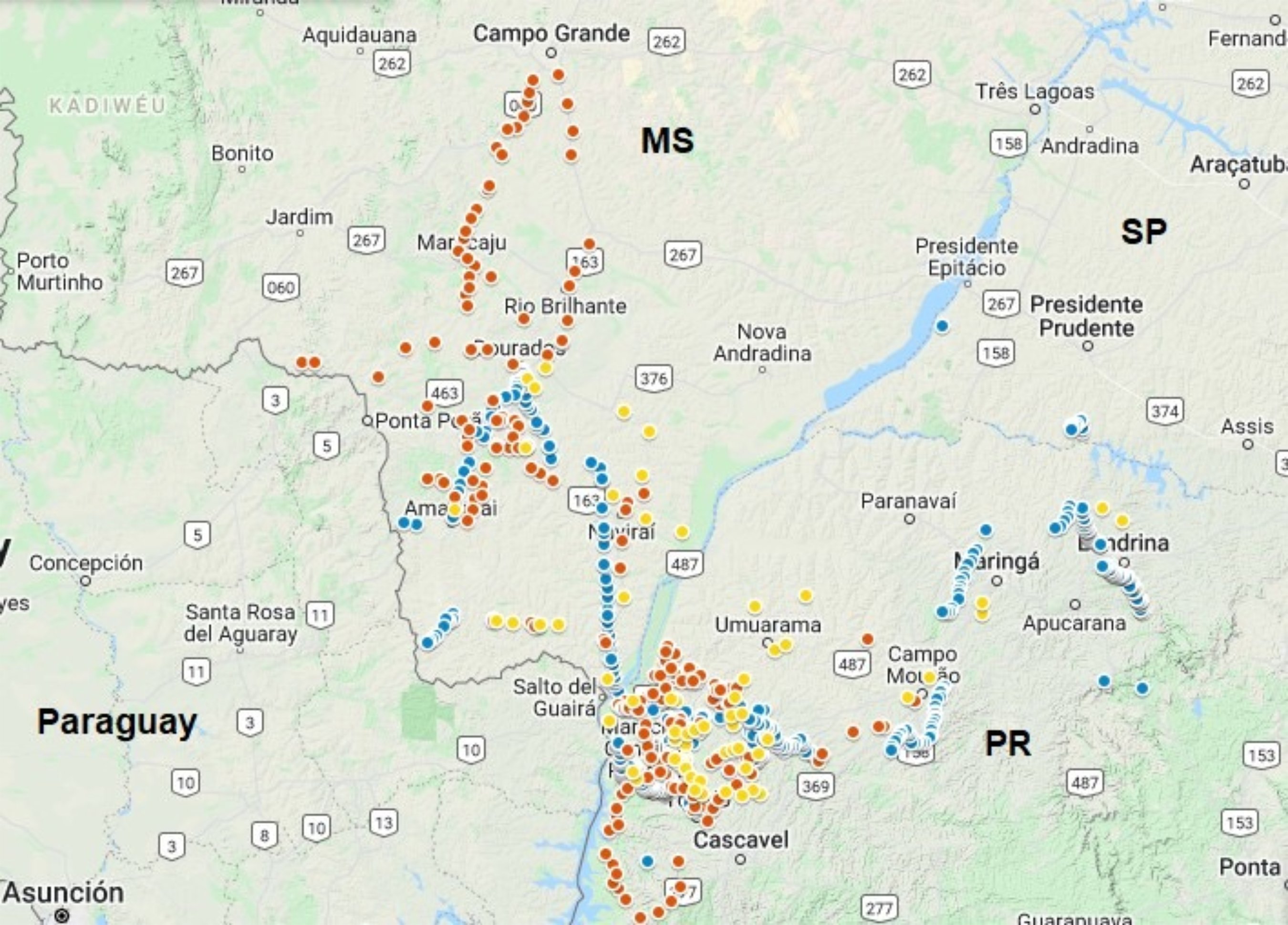
Out of the 685 samples collected, 502 were analyzed due to germination failure, with the results indicating no glufosinate resistance at > 80% control for all samples. For glyphosate, 485 samples (96.6%) were classified as putative resistant (< 80% control), demonstrating considerable propagation and the problem of resistance to this important herbicide, while nine (1.8%) and five (1%) were considered putative resistant to haloxyfop and clethodim, respectively. Figure 2 illustrates the distribution of the collection sites of the samples putative resistant to haloxyfop and clethodim. Of these, two samples were deemed putative resistant to all three herbicides (glyphosate, haloxyfop, and clethodim). One of these samples, collected in Missal and exhibiting control failure for all three herbicides, was used in the dose-response curve.

Geographic distribution of the sourgrass samples putative resistant to haloxyfop (green dot), haloxyfop and glyphosate (blue dots), clethodim and glyphosate (orange dots), haloxyfop, clethodim and glyphosate (yellow dots). The yellow dot with the letter R indicates the sample used for the dose-response curve.
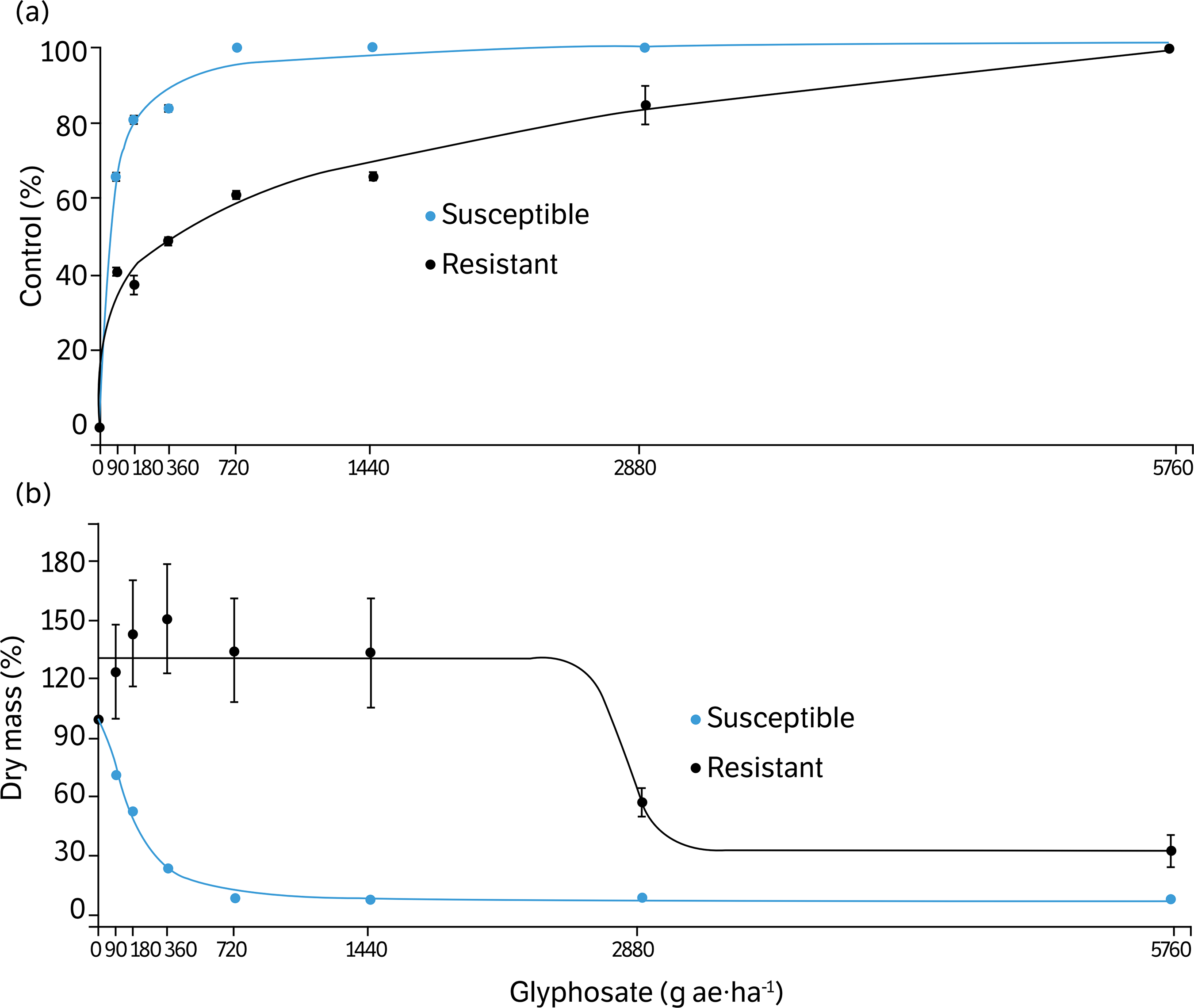
For haloxyfop, the susceptible biotype obtained C50 of 10.05 and GR50 of 75.8, with respective values of 31.7 and 202.18 for its resistant counterpart, indicating resistance factors (RF) values of 3.15 for C50 and 2.67 for GR50. For clethodim, the respective C50 and GR50 values were 15.48 and 138.5 for the susceptible biotype and 50.4 and 354.5 for the resistant biotype, resulting in RFs of 3.26 and 2.56 for C50 and GR50, respectively. In regard to glyphosate, a C50 of 98 and GR50 of 324 were recorded for the resistant biotype and 1.075 and 5.572, respectively, for its resistant counterpart, with RFs of 10.96 for C50 and 17.2 for GR50 (Table 1). The dose-response curves for each herbicide are shown in Figs. 3 to 5.
Herbicide dose needed for C50 (50% control) or GR50 (50% dry mass reduction) and resistance factor for sourgrass.

Dose-response curve for (a) control and (b) dry mass reduction of sourgrass susceptible and resistant at 28 days after glyphosate application.

Dose-response curve for (a) control and (b) dry mass reduction of sourgrass susceptible and resistant (low level) at 28 days after clethodim application.

Dose-response curve for (a) control and (b) dry mass reduction of sourgrass susceptible and resistant (low level) at 28 days after haloxyfop application.
For the RF based on C50, values higher than 3 were recorded for the ACCase inhibitors, that is, a three-fold higher dose is needed to control 50% of sourgrass when compared with the susceptible biotype; however, this dose is smaller than the maximum recommended on the herbicide label. When this problem occurs in the field, using high doses to control a weed may accelerate the selection of biotypes with greater resistance, exacerbating the situation.
In addition to the procedure previously described in the methodology (Burgos et al. 2013), the concept of resistance based on the dose needed to provide at least 80% control of a suspected biotype was used, which combines the concepts of scientific and agronomic resistance. In summary, for a biotype to be considered resistant, the RF must be > 1 and C80 > than the recommended herbicide dose (Santos et al. 2014, Takano et al. 2017). In the present study, the C80 values of the biotype resistant to glyphosate, haloxyfop, and clethodim were 5,257 g ae·ha-1, 84.17 and 125.4 g ai·ha-1, respectively, with values of 366.66 g ae·ha-1, 25.27 and 41.62 g ai·ha-1 for the susceptible biotype. In other words, doses were almost three times higher than necessary in the susceptible biotype.
Even at RF > 1, C80 did not exceed the maximum recommended dose for haloxyfop (189 g ai·ha-1) and clethodim (240 g ai·ha-1) (Rodrigues and Almeida 2018, MAPA 2024). This does not indicate agronomic resistance, but a low level of resistance between biotypes, and has considerable implications in the field, which could lead to a more than three-fold increase in haloxyfop and clethodim doses. Low-level resistance is the need for different herbicide doses to control a species, the dose being lower than that recommended on the product label (Barroso et al. 2014b). In this respect, some authors suggest that low-level resistance can be overcome by increasing the herbicide dose (Owen et al. 2011).
According to Heap (2005), the selection of resistant biotypes reflects the evolution of low-level resistance. Vargas et al. (2013) warns that higher doses may increase selection pressure and biotypes could therefore develop resistance over a short time. Research conducted in Brazil demonstrates the importance of low-level resistance. Barroso et al. (2014a) identified tall windmill grass (Chloris elata) with low-level glyphosate resistance, subsequently confirmed as resistant (Brunharo et al. 2016).
Other studies detected low-level resistance in goosegrass (Eleusine indica) (Vargas et al. 2013) and wild poinsettia (Euphorbia heterophylla) (Ulguim et al. 2017), later confirmed as cases of resistance. However, there are no records in the literature of low-level resistance in sourgrass, demonstrating once again the importance of these results. In 2009, a study on glyphosate-resistant sourgrass in São Paulo found RF values of 2.3 to 3.9 for GR50 (Carvalho et al. 2011). There was a subsequent increase in glyphosate doses needed for control, with other investigations and the present study recording far higher RFs for glyphosate-resistant sourgrass.
The maximum recommended dose for sourgrass control according to the product labels of clethodim and haloxyfop has increased in recent years. A dose of 108 g ai·ha-1 was recommended for Select 240 EC (clethodim) in 2006 and 240 g ai·ha-1 in 2014, while the maximum dose for Haloxifop Alta 108 EC (haloxyfop) in 2016 was 62 g ai·ha-1, and in 2023 the label for Verdict Max (haloxyfop) suggested a maximum dose of 189 g ai ha-1 (Rodrigues and Almeida 2018, MAPA 2024).
The glyphosate-resistant biotype with low-level resistance to haloxyfop and clethodim and the sample classified in screening as putative resistant were collected near the Brazil-Paraguay border. A biotype resistant to glyphosate, haloxyfop, and clethodim was reported in Paraguay in 2020 (Krzyzaniak et al. 2023). This is similar to the first report of glyphosate-resistant sour grass in Paraguay in 2005, and another three years later in the Brazilian municipality of Guaíra, PR (Heap 2024), both agricultural regions. However, it is noteworthy that no glufosinate-resistant biotypes were found, thus characterizing this herbicide as an alternative for sourgrass control. Research has demonstrated the efficacy of glufosinate in sourgrass control (Silva et al. 2017, Albrecht et al. 2020a), with the herbicide becoming increasingly important in Brazil after paraquat was banned (Albrecht et al. 2022).
Clethodim and haloxyfop can be also considered for control in locations with no identified cases of resistance, but not as the only alternatives. These herbicides are generally effective in the early stages of sourgrass development (Presoto et al. 2020). However, it is important to emphasize that, given the species’ ability to resprout, a single herbicide application, even at high doses, is insufficient to effectively control perennial plants, but requires sequential applications (Zobiole et al. 2016, Mendes et al. 2020), regardless of known cases of resistance.
Cassol et al. (2019) reported equivalent efficacy for clethodim and haloxyfop mixed with glyphosate. Other studies highlight the efficacy of clethodim and/or haloxyfop in sourgrass control when mixed with other herbicides (Barroso et al. 2014a, Bianchi et al. 2021). This makes it impossible to determine which of these is most effective in each situation, and the choice must be based on a series of factors, including the history of use of these herbicides in the area, which reinforces the importance of mapping studies such as this one.
It should be noted that preemergent herbicides have been used to control resistant sourgrass, particularly s-metolachlor, flumioxazin, imazethapyr, sulfentrazone, clomazone, diclosulam (Drehmer et al. 2015), with effective control in cover crop management systems (Marochi et al. 2018) and when mixed with imazapic and imazapyr (Albrecht et al. 2020a). Combining chemical control with mowing is also effective in sourgrass, especially in perennial plants (Raimondi et al. 2020).
The sourgrass mapping results obtained here provided a better understanding of problems, distinguishing resistance cases from other situations in which control was insufficient. Many of the control failures reported were caused by herbicide application under unfavorable conditions or in perennial plants on clumps and rhizomes (Cassol et al. 2019, Bauer et al. 2021), a stage outside application recommendations. In some cases, the use of low doses or antagonistic herbicide mixtures under the same application conditions resulted in control failure. These scenarios accelerate selection pressure, evident in cases of low-level resistance, in which plants can only be controlled by high doses, potentially leading to multiple resistance.
Mapping sourgrass resistance is therefore essential to understand and ensure the early identification and quantification of the frequency of these plants (Lucio et al. 2019), proposing better management strategies before possible losses of important herbicides in the control of resistant or tolerant plants. This analysis indicates a high risk of sourgrass selection at the level of multiple and agronomic cross-resistance to glyphosate, haloxyfop, and clethodim, resulting in the loss of effective control by the main herbicides used in glyphosate-resistant soybean cultivation.
Glyphosate resistance is widespread, with 96.6% of the samples that germinated in the present study classified as putative resistant. Lopez Ovejero et al. (2017) monitored sourgrass in Brazil and reported 9% frequency of glyphosate resistance in 2012 and 57% in 2015. Resistant biotypes disperse over large areas and have been found more than 3,000 km from the first location reported. The gene flow of glyphosate-resistant sourgrass is linked to the movement of agricultural machinery and local selection pressure (Gonçalves Netto et al. 2021).
Although doses of ACCase inhibitors remain below the maximum recommended, an approximate three-fold increase has been observed. As such, novel control and management strategies and different ways of preventing new herbicide resistance cases in weeds are important. This study warns of glyphosate resistance and low-level resistance to haloxyfop and clethodim.
CONCLUSION
Glyphosate-resistant sourgrass is a problem in all the regions mapped in this study, with 96.6% of samples considered putative resistant, and nine (1.8%) and five (1%) putative resistant to haloxyfop and clethodim, respectively. Two samples were deemed putative resistant to three herbicides (glyphosate, haloxyfop, and clethodim). For glufosinate, no resistance was identified in any of the sourgrass samples, classifying this herbicide as important in control.
A sourgrass biotype that exhibited resistance to glyphosate (EPSPs inhibitor) and low-level resistance to clethodim and haloxyfop (ACCase inhibitors) was identified. Based on C50, RF values of 10.96, 3.26, and 3.15 were identified for glyphosate, clethodim, and haloxyfop, respectively.
ACKNOWLEDGMENTS
The authors would like to thank the Supra Pesquisa team at Universidade Federal do Paraná and the C. Vale agro-industrial cooperative for their support.
-
How to cite: Danilussi, M. T. Y., Albrecht, A. J. P., Lorenzetti, J. B., Albrecht, L. P., Silva, A. F. M., Dazzi, F. O., Colombari, C. and Barroso, A. A. M. (2025). Identification and mapping of glyphosate-resistant sourgrass with low-level resistance to clethodim and haloxyfop. Bragantia, 84, e20240048. https://doi.org/10.1590/1678-4499.20240048
-
FUNDING
Coordenação de Aperfeiçoamento de Pessoal de Nível SuperiorFinance Code 001.
DATA AVAILABILITY STATEMENT
The data that support the findings of this study are available on request from the corresponding author.
REFERENCES
-
Albrecht, L. P., Albrecht, A. J. P. and Silva, A. F. M. (2020). Manejo de capim-amargoso (Digitaria insularis (L.) Mez ex Ekman). Paulínia: HRAC-BR. https://doi.org/10.13140/RG.2.2.12880.12806
» https://doi.org/10.13140/RG.2.2.12880.12806 -
Albrecht, A. J. P., Albrecht, L. P., Silva, A. F. M., Ramos, R. A., Zeny, E. P., Lorenzetti, J. B., Danilussi, M. T. Y. and Barroso, A. A. M. (2020a). Efficacy of imazapic/imazapyr and other herbicides in mixtures for the control of Digitaria insularis prior to soybean sowing. Agronomía Colombiana, 38, 350-356. https://doi.org/10.15446/agron.colomb.v38n3.83046
» https://doi.org/10.15446/agron.colomb.v38n3.83046 -
Albrecht, A. J. P., Thomazini, G., Albrecht, L. P., Pires, A., Lorenzetti, J. B., Danilussi, M. T. Y., Silva, A. F. M., and Adegas, F. S. (2020b). Conyza sumatrensis resistant to paraquat, glyphosate and chlorimuron: Confirmation and monitoring the first case of multiple resistance in Paraguay. Agriculture, 10, 582. https://doi.org/10.3390/agriculture10120582
» https://doi.org/10.3390/agriculture10120582 -
Albrecht, A. J. P., Albrecht, L. P. and Silva, A. F. M. (2022). Agronomic implications of paraquat ban in Brazil. Advances in Weed Science, 40, e020220040. https://doi.org/10.51694/AdvWeedSci/2022;40:seventy-five009
» https://doi.org/10.51694/AdvWeedSci/2022;40:seventy-five009 -
Barroso, A. A. M., Albrecht, A. J. P., Reis, F. C. and Victoria Filho R. (2014a). ACCase and glyphosate different formulations herbicides association interactions on sourgrass control. Planta Daninha, 32, 619-627. https://doi.org/10.1590/S0100-83582014000300018
» https://doi.org/10.1590/S0100-83582014000300018 -
Barroso, A. A. M., Albrecht, A. J. P., Reis, F. C., Placido, H. F., Toledo, R. E., Albrecht, L. P. and Victoria Filho, V. (2014b). Different glyphosate susceptibility in Chloris polydactyla accessions. Weed Technology, 28, 587-591. https://doi.org/10.1614/WT-D-14-00039.1
» https://doi.org/10.1614/WT-D-14-00039.1 -
Bauer, F. E., Albrecht, A. J. P., Albrecht, L. P., Silva, A. F. M., Barroso, A. A. M. and Danilussi, M. T. Y. (2021). Digitaria insularis control by using herbicide mixtures application in soybean pre-emergence. Revista Facultad Nacional de Agronomía Medellín, 74, 9403-9411. https://doi.org/10.15446/rfnam.v74n1.89032
» https://doi.org/10.15446/rfnam.v74n1.89032 -
Bianchi, L., Anunciato, V. M., Gazola, T., Perissato, S. M., Dias, R. C., Tropaldi, L., Carbonari, C. A. and Velini, E. D. (2021). Effects of glyphosate and clethodim alone and in mixture in sourgrass (Digitaria insularis). Crop Protection, 138, 105322. https://doi.org/10.1016/j.cropro.2020.105322
» https://doi.org/10.1016/j.cropro.2020.105322 -
Brunharo, C. A., Patterson, E. L., Carrijo, D. R., Melo, M. S., Nicolai, M., Gaines, T. A. and Christoffoleti, P. J. (2016). Confirmation and mechanism of glyphosate resistance in tall windmill grass (Chloris elata) from Brazil. Pest Management Science, 72, 1758-1764. https://doi.org/10.1002/ps.4205
» https://doi.org/10.1002/ps.4205 -
Burgos, N. R. (2015). Whole-plant and seed bioassays for resistance confirmation. Weed Science, 63, 152-165. https://doi.org/10.1614/WS-D-14-00019.1
» https://doi.org/10.1614/WS-D-14-00019.1 -
Burgos, N. R., Tranel, P. J., Streibig, J. C., Davis, V. M., Shaner, D., Norsworthy, J. K. and Ritz, C. (2013). Confirmation of resistance to herbicides and evaluation of resistance levels. Weed Science, 61, 4-20. https://doi.org/10.1614/WS-D-12-00032.1
» https://doi.org/10.1614/WS-D-12-00032.1 -
Carvalho, L. B., Cruz-Hipolito, H., González-Torralva, F., Alves, P. L. C. A., Christoffoleti, P. J. and De Prado, R. (2011). Detection of sourgrass (Digitaria insularis) biotypes resistant to glyphosate in Brazil. Weed Science, 59, 171-176. https://doi.org/10.1614/WS-D-10-00113.1
» https://doi.org/10.1614/WS-D-10-00113.1 -
Cassol, M., Mattiuzzi, M. D., Albrecht, A. J. P., Albrecht, L. P., Baccin, L. C. and Souza, C. N. Z. (2019). Efficiency of isolated and associated herbicides to control glyphosate-resistant sourgrass. Planta Daninha, 37, e019190671. https://doi.org/10.1590/S0100-83582019370100060
» https://doi.org/10.1590/S0100-83582019370100060 -
Drehmer, M. H., Zagonel, J., Ferreira, C. and Senger, M. (2015). Eficiência de herbicidas aplicados em pré-emergência para o controle de Digitaria insularis na cultura do feijão. Revista Brasileira de Herbicidas, 14, 141-147. https://doi.org/10.7824/rbh.v14i2.395
» https://doi.org/10.7824/rbh.v14i2.395 -
Gazola, T., Dias, M. F., Bonatto, V. M., Belapart, D., Carbonari, C. A. and Velini, E. D. (2019). Growth and development of sourgrass plants from vegetative parts of clumps. Planta Daninha, 37, e019210585. https://doi.org/10.1590/S0100-83582019370100122
» https://doi.org/10.1590/S0100-83582019370100122 -
Gemelli, A., Oliveira Júnior, R. S., Constantin, J., Braz, G. B. P., Jumes, T. M. C., Oliveira Neto, A. M., Dan, H. A. and Biffe, D. F. (2012). Aspectos da biologia de Digitaria insularis resistente ao glyphosate e implicações para o seu controle. Revista Brasileira de Herbicidas, 11, 231-240. https://doi.org/10.7824/rbh.v11i2.186
» https://doi.org/10.7824/rbh.v11i2.186 -
Gonçalves Netto, A., Cordeiro, E. M., Nicolai, M., Carvalho, S. J., Lopez-Ovejero, R. F., Brunharo, C. A., Zucchi, M. I. and Christoffoleti, P. J. (2021). Population genomics of Digitaria insularis from soybean areas in Brazil. Pest Management Science, 77, 5375-5381. https://doi.org/10.1002/ps.6577
» https://doi.org/10.1002/ps.6577 - Heap, I. (2005). Criteria for confirmation of herbicide-resistant weeds. HRAC.
-
Heap, I. (2024). International herbicide-resistant weed database. Available at: www.weedscience.org Accessed on: July 3, 2024.
» www.weedscience.org -
Krzyzaniak, F., Albrecht, L. P. and Albrecht, A. J. P. (2023). Digitaria insularis: cross-resistance between ACCase inhibitors and multiple resistance to glyphosate. Australian Journal of Crop Science, 17, 556-562. https://doi.org/10.21475/ajcs.23.17.06.p3849
» https://doi.org/10.21475/ajcs.23.17.06.p3849 -
Lopez Ovejero, R. F., Takano, H. K., Nicolai, M., Ferreira, A., Melo, M. S., Cavenaghi, A. L., Christoffoleti, P. J. and Oliveira Júnior, R. S. (2017). Frequency and dispersal of glyphosate-resistant sourgrass (Digitaria insularis) populations across Brazilian agricultural production areas. Weed Science, 65, 285-294. https://doi.org/10.1017/wsc.2016.31
» https://doi.org/10.1017/wsc.2016.31 - Lorenzi, H. (2014). Manual de identificação e controle de plantas daninhas: plantio direto e convencional. 7ª ed. Nova Odessal: Instituto Plantarum.
-
Lucio, F. R., Kalsing, A., Adegas, F. S., Rossi, C. V. S., Correia, N. M., Gazziero, D. L. P. and Silva, A. F. (2019). Dispersal and frequency of glyphosate-resistant and glyphosate-tolerant weeds in soybean-producing edaphoclimatic microregions in Brazil. Weed Technology, 33, 217-231. https://doi.org/10.1017/wet.2018.97
» https://doi.org/10.1017/wet.2018.97 -
Machado, A. F. L., Ferreira, L. R., Ferreira, F. A., Fialho, C. M. T., Tuffi Santos, L. D. and Machado, M. S. (2006). Growth analysis of Digitaria insularis Planta Daninha, 24, 641-647. https://doi.org/10.1590/S0100-83582006000400004
» https://doi.org/10.1590/S0100-83582006000400004 -
Machado, A. F. L., Meira, R. M. S., Ferreira, L. R., Ferreira, F. A., Tuffi-Santos, L. D., Fialho, C. M. T. and Machado, M. S. (2008). Anatomical characterization of the leaf, stem and rhizome of Digitaria insularis Planta Daninha, 26, 1-8. https://doi.org/10.1590/S0100-83582008000100001
» https://doi.org/10.1590/S0100-83582008000100001 -
[MAPA] Ministério da Agricultura, Pecuária e Abastecimento (2024). Agrofit - Sistema de agrotóxicos fitossanitários. Brazil: Ministério da Agricultura, Pecuária e Abastecimento. Available at: http://agrofit.agricultura.gov.br/agrofit_cons/principal_agrofit_cons Accessed on: July 3, 2024.
» http://agrofit.agricultura.gov.br/agrofit_cons/principal_agrofit_cons -
Marochi, A., Ferreira, A., Takano, H. K., Oliveira Júnior, R. S. and Lopez-Ovejero, R. F. (2018). Managing glyphosate-resistant weeds with cover crop associated with herbicide rotation and mixture. Ciência e Agrotecnologia, 42, 381-394. https://doi.org/10.1590/1413-70542018424017918
» https://doi.org/10.1590/1413-70542018424017918 -
Mendes, R. R., Takano, H. K., Biffe, D. F., Constantin, J. and Oliveira Junior, R. S. (2020). Interval between sequential herbicide treatments for sourgrass management. Revista Caatinga, 33, 579-590. https://doi.org/10.1590/1983-21252020v33n301rc
» https://doi.org/10.1590/1983-21252020v33n301rc -
Owen, M. D. K., Young, B. G., Shaw, D. R., Wilson, R. G., Jordan D. L., Dixon, P. M. and Weller, S. C. (2011). Benchmark study on glyphosate-resistant crop systems in the United States. Parte 2: Perspectives. Pest Management Science, 67, 747-757. https://doi.org/10.1002/ps.2159
» https://doi.org/10.1002/ps.2159 -
Presoto, J. C., Andrade, J. F., Souza, L. A., Teixeira, L. S. and Carvalho, S. J. P. (2020). Sourgrass phenological stage and efficacy of ACCase-inhibiting herbicides. Planta Daninha, 38, e020223617. https://doi.org/10.1590/S0100-83582020380100089
» https://doi.org/10.1590/S0100-83582020380100089 -
Raimondi, R. T., Constantin, J., Mendes, R. R., Oliveira Júnior, R. S and Rios, F. A. (2020). Glyphosate-resistant sourgrass management programs associating mowing and herbicides. Planta Daninha, 38, e020215928. https://doi.org/10.1590/s0100-83582020380100033
» https://doi.org/10.1590/s0100-83582020380100033 - Rodrigues, B. N. and Almeida, F. S. (2018). Guia de herbicidas. 7ª ed. Londrina: authors.
-
Santos, G., Oliveira Júnior. R. S., Constantin, J., Francischini, A. C. and Osipe, J. B. (2014). Multiple resistance of Conyza sumatrensis to chlorimuron-ethyl and to glyphosate. Planta Daninha, 32, 409-416. https://doi.org/10.1590/S0100-83582014000200019
» https://doi.org/10.1590/S0100-83582014000200019 -
Schultz, J. L., Chatham, L. A., Riggins, C. W., Tranel, P. J. and Bradley, K. W. (2015). Distribution of herbicide resistances and molecular mechanisms conferring resistance in Missouri waterhemp (Amaranthus rudis Sauer) populations. Weed Science, 63, 336-345. https://doi.org/10.1614/WS-D-14-00102.1
» https://doi.org/10.1614/WS-D-14-00102.1 -
Silva, W. T., Karam, D., Vargas, L. and Silva, A. F. (2017). Alternatives of chemical control for sourgrass (Digitaria insularis) on maize crop. Revista Brasileira de Milho e Sorgo, 16, 578-586. https://doi.org/10.18512/1980-6477/rbms.v16n3p578-586
» https://doi.org/10.18512/1980-6477/rbms.v16n3p578-586 -
Souza, A. P., Ferreira, F. A., Silva, A. A., Cardoso, A. A. and Ruiz, H. A. (2000). Logistic equation use in studying the dose-response of glyphosate and imazapyr by using bioassays. Planta Daninha, 18, 17-28. https://doi.org/10.1590/S0100-83582000000100002
» https://doi.org/10.1590/S0100-83582000000100002 -
Streibig, J. C. (1988). Herbicide bioassay. Weed Research, 28, 479-484. https://doi.org/10.1111/j.1365-3180.1988.tb00831.x
» https://doi.org/10.1111/j.1365-3180.1988.tb00831.x -
Takano, H. K., Melo, M. S., Lopez-Ovejero, R. F., Westra, P. H., Gaines, T. A. and Dayan, F. E. (2020). Trp2027Cys mutation evolves in Digitaria insularis with cross-resistance to ACCase inhibitors. Pesticide Biochemistry and Physiology, 164, 1-6. https://doi.org/10.1016/j.pestbp.2019.12.011
» https://doi.org/10.1016/j.pestbp.2019.12.011 -
Takano, H. K., Oliveira Junior, R. S., Constantin, J., Braz, G. B. P. and Gheno, E. A. (2017). Goosegrass resistant to glyphosate in Brazil. Planta Daninha, 35, e017163071. https://doi.org/10.1590/S0100-83582017350100013
» https://doi.org/10.1590/S0100-83582017350100013 -
Takano, H. K., Oliveira Junior, R. S., Constantin, J., Mangolim, C. A., Machado, M. D. F. and Bevilaqua, M. R. (2018). Spread of glyphosate‐resistant sourgrass (Digitaria insularis): Independent selections or merely propagule dissemination? Weed Biology and Management, 18, 50-59. https://doi.org/10.1111/wbm.12143
» https://doi.org/10.1111/wbm.12143 -
Ulguim, A. R., Agostinetto, D., Vargas, L.; Silva, J. G., Silva, B. M. and Westendorff, N. R. (2017). Agronomic factors involved in low-level wild poinsettia resistance to glyphosate. Revista Brasileira de Ciências Agrárias, 12, 51-59. https://doi.org/10.5039/agraria.v12i1a5423
» https://doi.org/10.5039/agraria.v12i1a5423 -
Vargas, L., Ulguim, A. R., Agostinetto, D., Magro, T. D. and Thürmer, L. (2013). Low level resistance of goosegrass (Eleusine indica) to glyphosate in Rio Grande do Sul-Brazil. Planta Daninha, 31, 677-686. https://doi.org/10.1590/S0100-83582013000300019
» https://doi.org/10.1590/S0100-83582013000300019 -
Veldman, J. W. and Putz, F. E. (2011). Grass-dominated vegetation, not species-diverse natural savanna, replaces degraded tropical forests on the southern edge of the Amazon Basin. Biological Conservation, 144, 1419-1429. https://doi.org/10.1016/j.biocon.2011.01.011
» https://doi.org/10.1016/j.biocon.2011.01.011 - Velini, D. E., Osipe, R. and Gazziero, D. L. P. (1995). Procedimentos para instalação, avaliação e análise de experimentos com herbicidas. Londrina: SBCPD.
-
Zobiole, L. H. S., Krenchinski, F. H., Albrecht, A. J. P., Pereira, G., Lucio, F. R., Rossi, C. and Rubin, R. S. (2016). Controle de capim-amargoso perenizado em pleno florescimento. Revista Brasileira de Herbicidas, 15, 157-164. https://doi.org/10.7824/rbh.v15i2.474
» https://doi.org/10.7824/rbh.v15i2.474
Edited by
-
Section Editor:
Gabriel Constantino Blain https://orcid.org/0000-0001-8832-7734

 Source: ©2023 Google.
 Source: ©2023 Google.