
 Ultrasound guided pulsed radiofrequency ablation of axillary nerve for quadrilateral space syndrome. Case report
ABSTRACT
BACKGROUND AND OBJECTIVES Pulsed radiofrequency (PRF) neuromodulation of the axillary nerve offers a promising alternative to surgical decompression for managing Quadrilateral Space Syndrome (QSS), a rare but debilitating cause of chronic shoulder pain. QSS, characterized by axillary nerve and posterior circumflex humeral artery compression, presents with nonspecific symptoms, complicating diagnosis.
CASE REPORT This case report details a 57-year-old male with refractory QSS who achieved significant and sustained pain relief following ultrasound-guided PRF neuromodulation. Initial diagnostic axillary nerve block confirmed QSS, but pain recurred after temporary relief. PRF neuromodulation provided immediate pain relief, allowing early mobilization and sustained symptom resolution over six months. This minimally invasive technique was performed under ultrasound guidance, avoiding vascular complications and facilitating precise targeting of the axillary nerve.
CONCLUSION The report underscores PRF’s potential as a safe, effective treatment modality for refractory QSS, offering a viable alternative to invasive surgery while enabling improved patient compliance and outcomes.
Keywords:
Interventional ultrasound; Nerve compression syndromes; Pulsed radiofrequency treatment; Radiofrequency ablation; Shoulder pain; Shoulder impingement syndrome; Ultrasonography
HIGHLIGHTS
First documented use of pulsed radiofrequency (PRF) for Quadrilateral Space Syndrome (QSS): This case report introduces PRF neuromodulation of the axillary nerve as a novel, minimally invasive treatment for refractory QSS, offering an alternative to surgical decompression
Pulsed radiofrequency neuromodulation provided long-term pain relief in refractory QSS: PRF was successfully applied to the axillary nerve in a patient with chronic, treatment-resistant QSS, resulting in complete symptom resolution at a 6-month follow-up without the need for surgical decompression
MSK Ultrasound surpassed MRI in detecting clinically relevant features of QSS: While MRI findings were unremarkable, MSK ultrasound allowed real-time visualization of the quadrilateral space and neurovascular structures, enabling both diagnosis and treatment planning - demonstrating its superiority in functional assessment over static imaging
RESUMO
JUSTIFICATIVA E OBJETIVOS A neuromodulação por radiofrequência pulsada (PRF) do nervo axilar oferece uma alternativa promissora à descompressão cirúrgica para o tratamento da Síndrome do Espaço Quadrilateral (QSS), uma causa rara, mas debilitante, de dor crônica no ombro. A QSS, caracterizada por compressão do nervo axilar e da artéria circunflexa posterior do úmero, apresenta sintomas inespecíficos, dificultando o diagnóstico.
RELATO DO CASO Paciente do sexo masculino, 57 anos com QSS refratária que obteve alívio significativo e sustentado da dor após neuromodulação PRF guiada por ultrassom. O bloqueio diagnóstico inicial do nervo axilar confirmou QSS, mas a dor recorreu após alívio temporário. A neuromodulação PRF proporcionou alívio imediato da dor, permitindo a mobilização precoce e a resolução sustentada dos sintomas ao longo de seis meses. Essa técnica minimamente invasiva foi realizada sob orientação ultrassonográfica, evitando complicações vasculares e facilitando o direcionamento preciso do nervo axilar.
CONCLUSÃO O caso sublinha o potencial do PRF como uma modalidade de tratamento segura e eficaz para QSS refratária, oferecendo uma alternativa viável à cirurgia invasiva, ao mesmo tempo que permite melhor adesão e resultados do paciente.
Descritores:
Ablação por radiofrequência; Dor de ombro; Síndromes de compressão nervosa; Tratamento por radiofrequência pulsada; Síndrome do impacto do ombro; Ultrassonografia de intervenção
DESTAQUES
Primeiro uso documentado de radiofrequência pulsada (PRF) para a Síndrome do Espaço Quadrilateral (QSS): Este relato de caso apresenta a neuromodulação por PRF do nervo axilar como um tratamento novo e minimamente invasivo para a QSS refratária, oferecendo uma alternativa à descompressão cirúrgica
A neuromodulação por radiofrequência pulsada proporcionou alívio da dor em longo prazo na QSS refratária: a PRF foi aplicada com sucesso ao nervo axilar em um paciente com QSS crônica e resistente ao tratamento, resultando na resolução completa dos sintomas em um acompanhamento de 6 meses sem a necessidade de descompressão cirúrgica
O ultrassom MSK superou a ressonância magnética na detecção de características clinicamente relevantes da QSS: embora os achados da ressonância magnética não tenham sido notáveis, o ultrassom MSK permitiu a visualização em tempo real do espaço quadrilateral e das estruturas neurovasculares, possibilitando o diagnóstico e o planejamento do tratamento - demonstrando sua superioridade na avaliação funcional em relação à imagem estática
INTRODUCTION
Shoulder pain is a common musculoskeletal complaint comprising of one-third of all the musculoskeletal conditions1. Chronic shoulder pain leads to high health-care expenses and a significant impact on afflicted individuals' health, including absence from work and disability.
The treating clinician formulates the best course of treatment based on the clinical assessment and looks for possible prognostic features pointing towards a definitive diagnosis2. Treatment options include exercise with or without mobilization, with or without pharmacotherapy, with shoulder injections, and referral for a pain management specialist3.
Common causes of shoulder pain include rotator cuff disorders, bursitis, tendinopathies, glenohumeral disorders, and acromioclavicular joint dysfunction3. However, a pain physician may encounter some rare conditions causing shoulder pain such as quadrilateral space syndrome (QSS), which has been a shoulder disease conundrum4,5.
QSS is a rare disorder characterized by axillary nerve or posterior humeral circumflex artery (PHCA) compression within the quadrilateral space5,6. It was first described by Cahill and Palmer in 1983 as an uncommon syndrome caused by compression of the posterior humeral circumflex artery and axillary nerve or one of its major branches in the quadrilateral space5. QSS has been most commonly documented in overhead or "throwing" athletes in sports that heavily involve abduction and external rotation, such as volleyball, baseball, and swimming7.
QSS has less conventional clinical signs, making the diagnosis more difficult. The use of various modalities to diagnose the condition, such as imaging, angiography, EMG techniques and MSK ultrasound can help to point towards a probable diagnosis8. However, in the absence of any specific physical manoeuvres and diagnostic studies, the diagnostic block of the axillary nerve in the quadrilateral space still remains the gold standard for QSS diagnosis. For chronic QSS that requires repeat blocks, pulsed radiofrequency neuromodulation of the axillary nerve can be considered as an alternative to decompression surgery, which was considered the last resort for QSS with good results9. This case report, first of its kind, highlights the importance of pulsed radiofrequency neuromodulation as a treatment modality for refractory QSS with long term pain relief.
RELEVANT ANATOMY
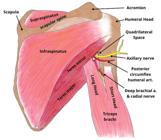
The quadrilateral space is bounded superiorly by the teres minor muscle, inferiorly by the teres major muscle, medially by the long head of the triceps, and laterally by the humeral shaft (Figure 1). The distal branch of the axillary nerve and posterior circumflex humeral artery (PCHA) traverse the quadrilateral space. The axillary nerve arises from the posterior cord of the brachial plexus at the C5 and C6 levels, with some contribution from C42. Within the quadrangular space, the axillary nerve divides—the posterior branch innervates the teres minor and the posterior third of the deltoid and terminates as the superior lateral brachial cutaneous nerve. The teres minor and deltoid muscles, which are primarily responsible for abduction and external rotation, are supplied by the axillary nerve.
CASE REPORT
A 57-year-old male, a retired army personal, presented progressive dull pain in his left shoulder over the posterolateral aspect for the last six months. The pain was described as dull, diffused over the left shoulder which was non radiating to the arm or the chest wall and was documented to be 8/10 on the numerical rating scale (NRS). The pain was exacerbated on abduction and external rotation of the shoulder, barring which no other shoulder movement was painful. There were no specific relieving factors, nor did he have any numbness or subjective weakness in the ipsilateral shoulder or arm.
He gave a history of lifting a heavy weight on his left shoulder 6 months back, which was a routine practice for him. He denied any history of a systemic disease. Physical examination was insignificant with free shoulder range of motion present. There was no weakness in shoulder abduction, external/internal rotation, or elbow flexion. The impingement tests were negative.
The patient was apprehensive on presentation in the pain clinic as he had already undergone extensive physical therapy sessions, acupuncture therapy and even gleno-humeral joint intra-articular injections in the past, with no relief whatsoever. He held his hand in a sling brace for flexion and adduction, with minimal relief.
Sensory testing was done and the results were also normal. The nerve conduction velocities (NCV) of median, ulnar, and radial nerves of the left arm were unremarkable. MRI of the left shoulder was unremarkable and was even compared to the contralateral shoulder.
A provisional diagnosis of QSS was made, and an ultrasound guided diagnostic axillary nerve block with lignocaine 1% was performed at the quadrilateral space. The patient had 100% pain relief immediately post procedure, which confirmed the diagnosis of QSS. The patient was advised to follow physical therapy which included friction massage and active release soft tissue massage techniques to the quadrilateral space. He was also advised to perform active shoulder range of motion and scapular stabilization exercises. The use of nonsteroidal anti-inflammatory drugs was kept limited to pain score of more than 4/10 on the NRS scale.
The patient had complete relief for 5 days, and the pain returned to pre-procedure levels over a period of 20 days. The patient was then suggested for a pulsed radiofrequency neuromodulation of the left axillary nerve in the quadrilateral space, as he was unwilling for a decompression surgery for QSS.
Ultrasound guided pulsed radiofrequency neuromodulation of the axillary nerve in the quadrilateral space provided 90 percent pain relief immediately post procedure. The pharmacological treatment stopped, and physical therapy was continued. The patient reported sustained pain relief on a 3-month and 6-month follow up (NRS 0/10) and was fully comfortable in performing all shoulder activities with ease with full range of motion. The study was approved by an Investigational Review Board - Institutional Ethics Committee for Biomedical and Health Research (IEC-BHR).
PULSED RADIOFREQUENCY NEUROMODULATION OF AXILLARY NERVE-TECHNIQUE
After informed written consent, the patient was placed in a prone position with both upper extremities at the side. After sterile draping of the left shoulder under all aseptic precautions, ultrasound scanning of the quadrilateral space was performed. A high frequency (6-13MHz) linear transducer (M-Turbo ultrasound system, SonoSite Inc, Bothell, WA, USA), covered in a sterile sheath was placed on the dorsal aspect of the arm, slightly posterior-medial to the glenohumeral joint in an orientation parallel to the long axis of the humerus shaft (Figure 1). The long head of triceps in longitudinal view and teres minor in cross-sectional view were visualized at the myotendinous junction, with the deltoid muscle fibers superiorly.
The probe was then traced distally until the posterior circumflex humeral artery along with the axillary nerve was visualized in the quadrilateral space at the level of the myotendinous junction. Doppler function was used to enhance the visualization of the posterior circumflex humeral artery pulsations (Figure 2), which was utilized to avoid any inadvertent intra-arterial placement of the needle.

Ultrasound image of the quadrilateral space with doppler showing the posterior circumflex humeral artery.
For the diagnostic block, after subcutaneous local infiltration with 1% lidocaine, a 22G Quincke needle was advanced “in-plane” under live ultrasound guidance to reach the quadrilateral space, and after negative aspiration for blood, 2 mL of 1% lidocaine was given around the axillary nerve. Pain relief 10 minutes after the procedure was assessed. 100% pain relief post procedure confirmed the diagnosis of QSS.
Pulsed radiofrequency was performed using the 20G 10cm radiofrequency needle, insulated with a 5-mm active tip. After subcutaneous local infiltration with 1% lidocaine, the RF needle was advanced under live ultrasound guidance, constantly visualizing and avoiding the PCHA. With the needle tip in final position just above the axillary nerve, proper needle position was checked through sensory stimulation with 50 Hz, 0.5 V and motor stimulation with 2 Hz, 1 V (Figure 3). He felt paresthesia over the posterolateral aspect of the shoulder and contractions were seen in the deltoid muscle. On confirmation of the needle position, 1% lignocaine 1ml was given and PRF lesioning was done at 42OC for 120 seconds. Lesioning was done 3 times so that the total effective time of PRF was 360 seconds (6 min). After the lesioning was done, 20mg triamcinolone with 1ml 1% lignocaine was given and the needle removed. The NRS score assessed 10 minutes post procedure was 2/10 and was 0/10 at 1-month follow-up. The pain relief (NRS 0/10) was sustained at a 3-month and 6-month follow-up.

Ultrasound guided pulsed radiofrequency needle placement “in-plane” in the quadrilateral space just below the axillary nerve (star) confirmed by sensory and motor stimulation.
DISCUSSION
The QSS is a rare cause of shoulder pain, generally presenting as diffuse pain over the shoulder, more specifically involving the posterior aspect of the shoulder5,6. Cahill first described QSS having four distinct features: (1) diffuse pain around the shoulder; (2) paresthesia in a non-dermatomal distribution; (3) point tenderness above the quadrilateral space; and (4) positive angiogram finding in provocative positioning. Any one of these is sufficient to point towards a possibility of QSS. Usually, it occurs in athletes involved in repetitive overhead activity (baseball, volleyball, javelin, etc.), but may even occur due to labral cyst, hematomas, or lipomas. The Mayo Clinic created a new classification system for QSS which suggested that it is a rare neurovascular entrapment syndrome that results either due to the compression of axillary nerve (Neurogenic QSS) and/or PCHA (Vascular QSS) in the quadrilateral space8.
QSS is referred to as a “diagnosis of exclusion,” due to its unusual presentation that often mimics other diseases. Case reports in previous years frequently describe various associated differential diagnoses, including suprascapular nerve entrapment, cervical disc disease, Parsonage-Turner syndrome, and thoracic outlet syndrome10. A thorough workup is required to rule out rotator cuff injuries, referred pain syndromes, cervical spine diseases, and labral injuries11.
Poorly localized shoulder pain, predominantly on the posterior aspect is the most consistent and typical feature of QSS and is usually exacerbated by overhead activities. Weaknesses have been seen in severe cases with minor and deltoid muscle atrophy. Paresthesia may be present but is an inconsistent finding12. The patient had presented pain on overhead abduction and extension of the arm but did not complaint of paresthesia. There was no atrophy of teres minor or the deltoid muscle on the affected side which was compared to unaffected side as well.
Electrodiagnostic evaluation may show abnormal nerve conduction velocities of nerves of the arm, with needle electromyographic (EMG) findings for left deltoid, biceps, and brachioradialis muscles, but highly variable results which have poor sensitivity and high false-negative rates. In the absence of any “gold standard” diagnostic test for QSS, magnetic resonance imaging (MRI) is typically the first choice of investigation. MRI often demonstrates focal atrophy of the teres minor muscle and can exclude other pathological causes of shoulder pain8. The EMG findings were normal in this case and the MRI findings were insignificant.
Digital subtraction angiography, computed tomography angiography, and magnetic resonance angiography have all been used to visualize PHCA occlusion as a cause of QSS7. MRI arteriography of the bilateral upper limbs is useful in establishing the patient’s baseline healthy anatomy, as compared to the pathological shoulder. Decreased outflow from the PHCA would indicate compression of the adjacent axillary nerve leading to QSS13. The test has a low specificity as shown in one controlled study, 80% of asymptomatic controls demonstrating PHCA occlusion in arteriography14.
In view of the limited information available on the management of QSS, conservative management has always been considered the initial treatment. Conservative management includes pharmacotherapy, mobilization of the glenohumeral joint, manual therapy to the quadrilateral space, and strengthening of the rotator cuff muscles15. In cases which do not respond to conservative therapy, single or repeated injections in the quadrilateral space are given and surgical decompression is considered in refractory cases16,17.
Ultrasound guided axillary nerve block with 1% lidocaine in the quadrilateral space remains the “Gold Standard” test with very high specificity for the diagnosis of QSS9. Previous literature even mentions the use of fluoroscopic guided quadrilateral space block18, but the dynamic ultrasound is a superior modality due to live assessment of the axillary nerve and the PCHA in the quadrilateral space and avoid vascular complications during interventions2.
Up until now, refractory cases of QSS were subjected to surgical decompression of the QS as the last resort16. Several other treatment modalities have been reported in the past including thrombolysis in the setting of thrombus, thrombectomy in case of distal emboli formation, and aneurysm resection and endovascular treatment with coiling8. In rare instances, quadrilateral space syndrome may be resolved spontaneously.
The patient was a retired army personnel and was regularly lifting heavy weights over his shoulders which required abduction and lifting of her arms frequently. This maneuver can cause the axillary nerve to impinge frequently with the muscles in the quadrilateral space. This in turn can cause pressure on the neurovascular space and subsequent neuritis and pain.
In cases of refractory QSS, after the confirmatory QSS lignocaine block and physical therapy, a period of 4-6 months of the treatment has been mandated which may include repeat injections along with pharmacotherapy and physical therapy, before deciding a surgical decompression for QSS10. Though pulsed radiofrequency neuromodulation is a well-documented modality for chronic shoulder pains refractory to conservative therapies, it has not been previously used in QSS19. Considering the fact that the patient had complete pain relief with the diagnostic block, and the pain reached pre-procedure levels in 20 days post procedure, we decided to address the pain via PRF neuromodulation of the axillary nerve in the QS.
Pulsed radiofrequency (PRF), technology related to continuous radiofrequency, uses radiofrequency current in short (20ms), high-voltage bursts. The “silent” phase (480 ms) of PRF allows time for heat elimination, generally keeping the target tissue below 42° C. PRF causes only transient endoneurial edema which is in contrast with the Wallerian degeneration effected by PRF at 80°C20. Therefore, PRF is unique such that it provides pain relief without significant damage to nervous tissue. PRF has been widely used in interventional pain medicine in the past with excellent results in trigeminal neuralgias, facet joint pains, sacroiliac joint pains, cervicogenic headaches, etc.19,20. The proposed mechanism of action of pain relief via PRF is poorly understood as inhibition of excitatory C-fiber responses and the enhancement of noradrenergic and serotonergic descending pain inhibitory pathway19.
Ultrasound guided PRF of the axillary nerve in the quadrilateral space can be an excellent alternative to surgical decompression. Surgery aims to remove the fibrous bands in the region of the quadrilateral space which is believed to be the cause of nerve and artery compression in most patients with quadrilateral space syndrome and focuses on the post-surgical graded physical therapy17. PRF would achieve immediate pain relief and can be used to start physical mobilization early and lead to higher compliance for the patient.
After PRF of axillary nerve in the QS, the patient had immediate relief in pain, and the shoulder mobilization and physical therapy was initiated, and he could comfortably perform all exercises. At 1 month, 3-month and 6-month follow-up the patient had no pain in the left shoulder (0/10 on NRS scale).
CONCLUSION
QSS is a rare entity causing debilitating chronic shoulder pain with significant morbidity. The highly non-specific symptoms, insufficient practitioner awareness and inaccurate diagnosis leads to delayed treatment and poor compliance in such patients. Careful analysis of imaging studies with EMG, MRI and dynamic ultrasound imaging could lead to a probable diagnosis. Surgical decompression can be avoided with the advent of PRF neuromodulation for QSS, and physical therapy is mandated to be followed strictly afterwards. Detailed and robust studies are required to better understand the clinical findings, differential diagnosis, prognosis, and the various treatment modalities that have been used over the years and integrate newer technology for better patient outcomes.
Sponsoring sources:
References
- 1 Van Der Windt DAWM, Koes BW, Boeke AJP, Devillé W, De Jong BA, Bouter LM. Shoulder disorders in general practice: prognostic indicators of outcome. Br J Gen Pract. 1996;46(410):519-23. PMid:8917870.
-
2 Zhang J, Zhang T, Wang RH, Wang T. Musculoskeletal ultrasound diagnosis of quadrilateral space syndrome: a case report. Medicine (Baltimore). 2021;100(10):e24976. http://doi.org/10.1097/MD.0000000000024976 PMid:33725866.
» http://doi.org/10.1097/MD.0000000000024976 -
3 Menon D, Onida S, Davies AH. Overview of arterial pathology related to repetitive trauma in athletes. J Vasc Surg. 2019;70(2):641-50. http://doi.org/10.1016/j.jvs.2019.02.002 PMid:31113722.
» http://doi.org/10.1016/j.jvs.2019.02.002 -
4 Kemp TD, Kaye TR, Scali F. Quadrangular space syndrome: a narrative overview. J Chiropr Med. 2021;20(1):16-22. http://doi.org/10.1016/j.jcm.2021.01.002 PMid:34025301.
» http://doi.org/10.1016/j.jcm.2021.01.002 -
5 Cahill BR, Palmer RE. Quadrilateral space syndrome. J Hand Surg Am. 1983;8(1):65-9. http://doi.org/10.1016/S0363-5023(83)80056-2 PMid:6827057.
» http://doi.org/10.1016/S0363-5023(83)80056-2 -
6 Hangge PT, Breen I, Albadawi H, Knuttinen M, Naidu S, Oklu R. Quadrilateral space syndrome: diagnosis and clinical management. J Clin Med. 2018;7(4):86. http://doi.org/10.3390/jcm7040086 PMid:29690525.
» http://doi.org/10.3390/jcm7040086 -
7 Redler MR, Ruland LJ 3rd, Mccue FC 3rd. Quadrilateral space syndrome in a throwing athlete. Am J Sports Med. 1986;14(6):511-3. http://doi.org/10.1177/036354658601400615 PMid:3799880.
» http://doi.org/10.1177/036354658601400615 -
8 Brown SAN, Doolittle DA, Bohanon CJ, Jayaraj A, Naidu SG, Huettl EA, Renfree KJ, Oderich GS, Bjarnason H, Gloviczki P, Wysokinski WE, McPhail IR. Quadrilateral space syndrome: the mayo clinic experience with a new classification system and case series. Mayo Clin Proc. 2015;90(3):382-94. http://doi.org/10.1016/j.mayocp.2014.12.012 PMid:25649966.
» http://doi.org/10.1016/j.mayocp.2014.12.012 -
9 Chen H, Narvaez VR. Ultrasound-guided quadrilateral space block for the diagnosis of quadrilateral syndrome. Case Rep Orthop. 2015;2015:1-4. http://doi.org/10.1155/2015/378627 PMid:25685573.
» http://doi.org/10.1155/2015/378627 -
10 Feng S-H, Hsiao M-Y, Wu C-H, Özçakar L. Ultrasound-guided diagnosis and management for quadrilateral space syndrome. Pain Med. 2017;18(1):184-6. http://doi.org/10.1093/pm/pnw256 PMid:27744402.
» http://doi.org/10.1093/pm/pnw256 -
11 Seroyer ST, Nho SJ, Bach BR Jr, Bush-Joseph CA, Nicholson GP, Romeo AA. Shoulder pain in the overhead throwing athlete. Sports Health. 2009;1(2):108-20. http://doi.org/10.1177/1941738108331199 PMid:23015861.
» http://doi.org/10.1177/1941738108331199 -
12 Dalagiannis N, Tranovich M, Ebraheim N. Teres minor and quadrilateral space syndrome: a review. J Orthop. 2020;20:144-6. http://doi.org/10.1016/j.jor.2020.01.021 PMid:32025138.
» http://doi.org/10.1016/j.jor.2020.01.021 -
13 Chen H, Onishi K, Zhao X, Chang EY. Neuromuscular ultrasound application to the electrodiagnostic evaluation of quadrilateral space syndrome. PM R. 2014;6(9):845-8. http://doi.org/10.1016/j.pmrj.2014.01.017 PMid:24486920.
» http://doi.org/10.1016/j.pmrj.2014.01.017 -
14 Mochizuki T, Isoda H, Masui T, Ohkawa Y, Takahashi M, Takehara Y, Ichijo K, Kodaira N, Kitanaka H. Occlusion of the posterior humeral circumflex artery: detection with MR angiography in healthy volunteers and in a patient with quadrilateral space syndrome. AJR Am J Roentgenol. 1994;163(3):625-7. http://doi.org/10.2214/ajr.163.3.8079857 PMid:8079857.
» http://doi.org/10.2214/ajr.163.3.8079857 -
15 Hoskins WT, Pollard HP, McDonald AJ. Quadrilateral space syndrome: a case study and review of the literature. Br J Sports Med. 2005;39(2):e9. http://doi.org/10.1136/bjsm.2004.013367 PMid:15665194.
» http://doi.org/10.1136/bjsm.2004.013367 -
16 Meyer LE, Blevins KM, Long JS, Lau BC. Quadrangular Space Decompression. Video Journal of Sports Medicine. 2022;2(2):263502542110710. http://doi.org/10.1177/26350254211071085 PMid:40308468.
» http://doi.org/10.1177/26350254211071085 -
17 McAdams TR, Dillingham MF. Surgical decompression of the quadrilateral space in overhead athletes. Am J Sports Med. 2008;36(3):528-32. http://doi.org/10.1177/0363546507309675 PMid:18055916.
» http://doi.org/10.1177/0363546507309675 -
18 Bourget-Murray J, Davison E, Frizzell B, LeBlanc J. Fluoroscopic-guided quadrilateral space block for the treatment of quadrilateral space syndrome - A case report. J Clin Orthop Trauma. 2019;10(4):655-8. http://doi.org/10.1016/j.jcot.2019.03.011 PMid:31316234.
» http://doi.org/10.1016/j.jcot.2019.03.011 -
19 Kim JS, Nahm FS, Choi EJ, Lee PB, Lee GY. Pulsed radiofrequency lesioning of the axillary and suprascapular nerve in calcific tendinitis. Korean J Pain. 2012;25(1):60-4. http://doi.org/10.3344/kjp.2012.25.1.60 PMid:22259720.
» http://doi.org/10.3344/kjp.2012.25.1.60 -
20 Gofeld M, Restrepo-Garces CE, Theodore BR, Faclier G. Pulsed radiofrequency of suprascapular nerve for chronic shoulder pain: a randomized double-blind active placebo-controlled study. Pain Pract. 2013;13(2):96-103. http://doi.org/10.1111/j.1533-2500.2012.00560.x PMid:22554345.
» http://doi.org/10.1111/j.1533-2500.2012.00560.x
Correspondence to
: Akhil Bhalla bhalla.aura@gmail.comConflict of interests:
Associate editor in charge:


