 The use of the Front Plateau anterior partial interocclusal device in the management of temporomandibular disorders: a pilot study
ABSTRACT
BACKGROUND AND OBJECTIVES The partial occlusal splints, such as the Front Plateau, a device that involves the anterior teeth (from canine to canine), have been used by some professionals as an alternative to the full-coverage rigid occlusal splints due to the ease and time involved in their manufacturing. However, there is little evidence of its mechanism of action. Therefore, the aim of this study was to evaluate the effectiveness of the Front Plateau associated with the counseling therapy in controlling chronic myalgia associated with Temporomandibular Disorders (TMDs).
METHODS This pilot study conducted with 10 patients with chronic myalgia related to TMDs. Two groups were assessed (G1: Front Plateau with the counseling therapy; G2: the counseling therapy only) with a follow-up of 3 months. Pain levels, quality of life and stress were assessed. A p<0.05 was considered statistically significant.
RESULTS Among the 10 patients assessed, 80% (n=8) were female. None of the variables evaluated showed statistically significant results (p<0.05). However, the numerical pain assessment scale of the group that received the Front Plateau with the counseling therapy (G1) showed relevant clinical results, going from 8.00±1.22 (Mean±SD) at baseline to 4.2±1.79 (Mean±SD) after 3 months.
CONCLUSION The Front Plateau with the counseling therapy seems to be a clinically viable alternative for controlling chronic myalgias related to TMDs. However, future clinical trials are needed to assess its applicability by professionals in the field.
Keywords:
Myalgia; Occlusal splints; Temporomandibular joint disorders; Conservative treatment
HIGHLIGHTS
Minimally invasive techniques for controlling TMDs, such as the Front Plateau associated with the counseling therapy, have shown good results
Since it is easy to fabricate, the Front Plateau reduces clinical time and can be made in a single session
This study highlights the importance of evaluating clinical research beyond the p-value
RESUMO
JUSTIFICATIVA E OBJETIVOS As placas oclusais parciais, como o Front Plateau, dispositivo que envolve os dentes anteriores (de canino a canino), têm sido utilizadas por alguns profissionais como alternativa às placas oclusais rígidas de cobertura total, devido à facilidade e ao tempo envolvido na sua confecção. Apesar disso, existem poucas evidências sobre o seu mecanismo de ação. Assim, o objetivo desse estudo foi avaliar a eficácia do Front Plateau associado a orientações no controle de mialgias crônicas associadas às Disfunções Temporomandibulares (DTMs).
MÉTODOS Estudo piloto realizado com 10 pacientes com mialgias crônicas relacionadas às DTMs. Foram avaliados dois grupos (G1: Front Plateau com orientações; G2: apenas orientações) por um período de 3 meses. Foram avaliados os níveis de dor, a qualidade de vida e o estresse. Um valor de p<0,05 foi considerado estatisticamente significativo.
RESULTADOS Dos 10 pacientes avaliados, 80% (n=8) eram do sexo feminino. Nenhuma das variáveis avaliadas apresentou resultados estatisticamente significativos (p<0,05). No entanto, a escala numérica de avaliação da dor do grupo que recebeu o Front Plateau associado às orientações (G1) apresentou resultados clínicos relevantes, passando de 8,00±1,22 (Média±DP) no Baseline para 4,2±1,79 (Média±DP) após 3 meses.
CONCLUSÃO O Front Plateau associado às orientações parece ser uma alternativa clinicamente viável para o controle das mialgias crônicas relacionadas com as DTMs. No entanto, são necessários futuros ensaios clínicos para avaliar a sua aplicabilidade pelos profissionais da área.
Descritores
: Mialgia; Placas oclusais; Transtornos da articulação temporomandibular; Tratamento conservador.
DESTAQUES
As técnicas minimamente invasivas para controle das DTMs, como o caso do Front Plateau associado às orientações, têm demonstrado bons resultados
Devido a sua facilidade de confecção, o Front Plateau reduz o tempo clínico, podendo ser confeccionado em uma única sessão
Este estudo destaca a importância da avaliação de uma pesquisa clínica para além do valor de p
INTRODUCTION
Temporomandibular Disorders (TMDs) represent a set of muscular and/or articular conditions that can result in orofacial pain, involving the masticatory muscles, the Temporomandibular Joint (TMJ), bone tissues and adjacent soft tissues1,2 . The etiology of TMDs is complex and multifactorial, involving physical (axis I) and/or psychological (axis II) factors that can modulate the intensity and perception of pain by the patient, making its diagnosis challenging3-5 .
These alterations affect approximately 5% to 12% of the world's population, mainly adult women between the ages of 30 and 40 and are considered a public health problem6-8 . The main signs and symptoms include pain on palpation, joint noises, headaches, otalgia, facial pain, muscle fatigue, spasms and mandibular deviations9 . The treatment of TMDs is generally aimed at identifying and intervening in the main causal factors. Therapeutic approaches include total or partial occlusal splints, acupuncture, laser therapy, patient counseling, physiotherapy, pharmacotherapy and arthrocentesis, which can be combined according to clinical need10,11 . Priority is given to non-invasive and reversible interventions and, if they are not effective, more invasive procedures are used, with the aim of achieving the patient's functional, emotional and orthopedic balance12 .
The full-coverage rigid occlusal splint is a non-invasive and effective intervention in the management of TMDs, providing both short- and long-term muscle relief. Its benefits go beyond the placebo effect, providing pain relief, psychological well-being and patient satisfaction13 . However, their fabrication can involve multiple clinical steps and often requires a laboratory phase, which can increase the cost for the patient11,13,14 . In this context, partial occlusal devices, such as the Nociceptive Trigeminal Inhibition Tension Suppression System (NTI-tss), have been developed as an alternative to the full-coverage occlusal splints15,16 . The NTI-tss is a prefabricated material that covers only the incisors and offers disocclusion of the posterior teeth, providing muscle relaxation. However, due to their small size, there have been reports in the literature of these devices being aspirated and swallowed, posing a risk to patients' lives17 .
Some professionals suggest the use of a partial interocclusal device that covers the 6 anterior teeth, called a Front Plateau, made from self-curing colorless acrylic resin, presenting a low-cost alternative. The device can be made in a single session, directly in the patient's arch, helping to control orofacial pain and the differential diagnosis of TMDs18,19 . Another widely used approach, associated with occlusal splints or not, is Counseling Therapy (CT), based on personalized oral and written guidance to prevent and eliminate parafunctional habits related to TMDs, promoting patients' well-being through an adaptable and daily approach20-22 .
Although several scientific studies have evaluated the effectiveness of various treatment modalities for TMDs, research into interocclusal devices, such as the Front Plateau, is still limited. In this sense, well-designed studies are essential to identify effective interventions that can be adopted by various professionals11,17,23 . Given this, the aim of the present study was to evaluate the effectiveness of the Front Plateau associated with CT, on the level of pain, quality of life and stress, with a follow-up of 3 months, in patients with chronic myalgias related to TMDs. A control group that only received CT was used as a comparative.
METHODS
This study was conducted in accordance with the Consolidated Standards of Reporting Trials (CONSORT)24 and was approved by the Research Ethics Committee (REC), number CAAE 70486823.0.0000 in full compliance with the Declaration of Helsinki, revised in 2013. After explaining the research, the individuals who agreed to take part signed the Free Informed Consent Term (FICT).
Study design
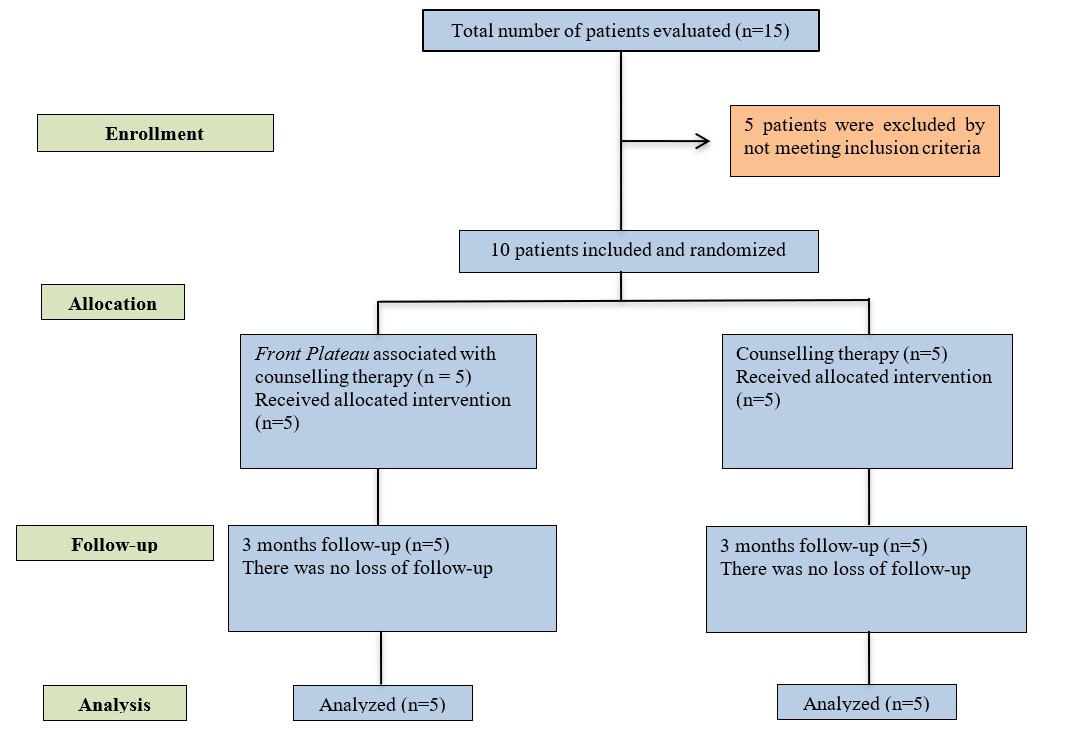
This research was conducted from January to July 2024 with patients diagnosed with chronic myalgias related to TMDs. As this was a pilot study, it was not based on any hypothesis, ruling out the feasibility of a sample calculation based on statistical power25 . An n=5 per group was adopted as sufficient to assess the feasibility of a randomized clinical trial with the same interventions. A detailed description of the patients who completed the study can be found in Figure 1.
Eligibility criteria
The inclusion criteria were patients aged 18 or over, with TMDs-related myalgia for more than 6 months, located in the temporal region, accompanied or not by other facial myalgias. A numerical pain assessment scale from 0 to 10 was used to collect the patients’ data, and those who reported pain equal to or greater than 7 were included. Patients who were undergoing any treatment for TMDs, including physiotherapy, follow-up with a speech therapist, laser therapy and botulinum toxin-A application (in the last 6 months) were excluded. Patients with other types of headaches that were not associated with the stomatognathic system, such as migraine, were also excluded. In addition, individuals with full dentures, undergoing orthodontic treatment, undergoing Selective Serotonin Reuptake Inhibitors (SSRIs) treatment or who had a cognitive impairment that made it difficult to participate in the study were not included in the sample.
Interventions
Front Plateau
It is a rigid partial plate that covers the anterior region, from canine to canine, respecting the movements of protrusion and laterality. The procedure was performed by a professional duly calibrated by a TMD specialist following a standardized protocol18,19 . The following materials were used to make the Front Plateau: self-curing colorless acrylic resin liquid and powder, dosing cup, kit of cutters and polishing tips, carbon paper, Muller tweezers, No. 31 spatula, brush, paladon pot, water tank and procedure gloves.
After organizing the materials, the acrylic resin powder was mixed with the liquid in the paladon pot for handling. Once a homogeneous mixture had been obtained, the paladon pot was closed and the acrylic resin was allowed to lose its shine and reach its plastic phase.
Next, the patient's teeth and the operator's fingers were insulated with liquid petroleum jelly to prevent the resin from sticking. The resin was manipulated with the operator's fingers until it took the shape of a stick, which was adapted to the area of the patient's upper front teeth. The patient was instructed to always bite down with the tongue on the palate to ensure that the Front Plateau acted in centric relation. During the setting time, due to the acrylic resin heating up, the Front Plateau was removed from the patient's mouth and placed to rest in a tub of water. The material was then returned to the patient's mouth. After the setting time, occlusal adjustments were made, ensuring that all anterior teeth were touching, and that protrusion and laterality movements were present.
At the end, the Front Plateau was finished and polished with a kit of cutters and abrasive tips for delivery to the patient. The patients were advised to wear the device at night, when they went to sleep, and to remove it when they woke up in the morning.
Counseling therapy
These include guidance on exercises for muscle relaxation, diet, sleep hygiene and ways to prevent and/or control the symptoms associated with TMDs. The instructions were given by a single professional, calibrated by a TMD specialist. During the 1- and 3-month meetings, patients were asked if they were following the CT and if they had any questions, they would be answered by the same calibrated professional.
Randomization, allocation concealment and masking
The randomization process was carried out using a block system by an independent researcher who was unaware of the patients, the intervention and the procedure for the control group. A total of 5 blocks were defined with 2 patients each. Each patient was randomly represented by a number from 1 to 10, the representation of which was unknown to the team directly involved in the research. Then, for each block, a number was placed in an opaque envelope along with a letter (A or B). These envelopes were sealed and only revealed on the day of the interventions. It was only at this point that the professionals responsible for each intervention found out which patient was going to receive which procedure. At the end of the session, the patients were instructed not to reveal the treatment they had received on the evaluation days after 1 month and 3 months, respectively.
Data collection
A clinical form adapted from the Diagnostic Criteria for Temporomandibular Disorders (DC/TMD) and a numerical pain assessment scale (1 to 10) were used for data collection at baseline and after 1 and 3 months. The Oral Heath Impact Profile (OHIP-14) and Lipp's Inventory of Stress Symptoms for Adults (ISSL) were only applied at baseline and at the 3-month evaluation.
Statistical analysis
Were carried out using SPSS® for Windows® (Statistical Package for the Social Sciences Inc.) version 26. Exploratory data analysis provided frequencies, means and standard deviations. Normality was assessed using the Shapiro-Wilk test. Quantitative data was subjected to the Mann-Whitney test. Categorical data was analysed using the Chi-square test. Confidence intervals of 95% and a significance level of 5% were used.
RESULTS
Characterization of the sample
A total of 10 patients took part in the study, 5 of whom were allocated to G1 (Front Plateau and CT) with a mean age of 25.4±7.77 (mean ± SD) and 5 to G2 (CT) with a mean age of 26.2±5.67 (mean ± SD). Most patients were female, representing 80% (n=8) of the total sample. Among the diagnostic impressions, Myalgia and TMJ Disc Displacement with Reduction (DDwR) was present in all patients and hypermobility was identified in 60% of the sample (n=6). In addition, all the patients reported clenching their teeth, 30% (n=3) of which were accompanied by teeth grinding and 10% (n=1) onychophagia. No adverse effects were reported by patients.
Numerical pain assessment scale
The results of the numerical pain assessment scale used at baseline and after 1 and 3 months can be seen in Table 1. There were no statistically significant differences (p<0.05), but it was possible to observe a clinical difference in G1 after 1 and 3 months.
Quality of life (Oral Health Impact Profile-14) and stress (ISSL)
The results for quality of life and stress after the treatments were summarized in Tables 2 and 3, respectively. For both variables, there were no statistically significant results.
Pain during active movement and pain on palpation
The assessment of pain during active movement considered the movements of maximum mandibular opening, protrusion and laterality on the right and left sides. On the other hand, pain on palpation was recorded in all the main masticatory muscles, especially the masseter and temporal muscles, as defined by the DC/TMD (Tables 4 and 5). None of these variables showed statistically significant results.
DISCUSSION
The effectiveness of occlusal devices in controlling symptoms associated with TMDs is still controversial in the literature26 . From the results of this pilot, the Front Plateau associated with CT, despite not presenting statistically significant data, obtained better clinical performance than the group that only received CT. These findings corroborate some studies in which the Front Plateau helped control pain, as well as identifying possible etiological factors18,19 . In clinical trials comparing a device like the Front Plateau, called NTI-tss with CT, both groups had a reduction in pain levels27,28 . The same result was found when compared with full-coverage rigid occlusal splints21,29,30 . Nevertheless, therapy with occlusal splints seems to promote an earlier improvement in symptoms, as found in the evaluation of the numerical pain assessment scale in this and other studies27,31 .
The variety of diagnostic criteria, types of devices and protocols used in randomized clinical trials in the field of TMDs make it difficult to assess the level of evidence found32 . The use of occlusal splints is indicated by some professionals because they are more conservative approaches, presenting fewer risks and side effects, and are most often associated with exercises and CT for TMD patients33 . When used in isolation, in other words, without CT and compared to a group that only received CT for TMDs, occlusal splints performed less well than control group34 .
The fact that most patients were female reaffirms epidemiological findings in the field of TMDs, since these conditions are more common in women3,35 . Regarding parafunctional habits that can predispose to TMDs, dental clenching associated or not with teeth grinding and onychophagy were identified. These habits associated with psychological factors such as anxiety and stress, present in most of the patients in this study, can trigger or amplify TMDs36,37 .
In addition, conditions such as hypermobility were identified in some of the patients in the present study. According to a Randomized Clinical Trial (RCT) that evaluated the relationship between hypermobility and TMDs, it was possible to observe a significant association between the two conditions, especially in adult patients with disorders involving the articular disc38 . A considerable number of the patients assessed in this pilot had hypermobility and DDwR. Despite this, some authors report that it cannot be said that there is a causal relationship between DDwR and hypermobility39,40 . This is because the presence of DdwR does not necessarily seem to depend on the existence of hypermobility, but rather on biomechanical factors that occur during adolescence41,42 . In the case of DDwR, it is only of concern and will require intervention if it interferes with TMJ function42 .
When looking at the quality of life and stress assessment data, no statistically significant results were identified. However, it was possible to observe that in the group that received Front Plateau and CT there was a greater migration of patients to the resistance phase when stress was assessed after 3 months. In the group that only received CT, 2 patients moved from the stress-free and resistance phases to near-exhaustion and exhaustion, respectively. Significant results of improved quality of life and stress due to the use of occlusal splints have been found in studies with an evaluation time of at least 6 months11,43 . When comparing the results of studies with short evaluation times with studies that evaluated patients for up to 12 months, it was identified that a longer evaluation time provides more relevant and, consequently, statistically significant results44 .
As this is a pilot study, the results of the research should be evaluated with caution. It is worth noting that the primary aim of a pilot is to assess the feasibility of a clinical trial, allowing for adaptations of protocols, sample calculation and results to be evaluated45 . The absence of statistically significant results does not make the study unfeasible, as the p-value can mask relevant clinical changes not identified in the statistical analysis46 . In such cases, a critical interpretation of the results beyond the p-value is suggested, as in the case of recording the level of pain observed in the patients in this study. It is believed that an RCT with a larger sample and an evaluation time of more than 3 months could show more significant results27,31 .
CONCLUSION
The Front Plateau, when associated with CT for TMD patients, appears to be a clinically viable alternative for controlling chronic myalgia. Future clinical studies with greater methodological rigor, sample size and follow-up time are needed to assess the applicability of the device by professionals in the field.
ACKNOWLEDGEMENTS
The authors are grateful to the following Brazilian fostering agencies for the support to academic and professional development: Conselho Nacional de Desenvolvimento Científico e Tecnológico (CNPq [National Council for Scientific and Technological Development]) and the Coordenação de Aperfeiçoamento de Pessoal de Nível Superior (CAPES [Coordination for the Advancement of Higher Education Personnel]). The authors would also like to thank Roberto de Souza Teodoro Júnior, a postgraduate student, for his contributions during the preparation of the study's methodology.
-
Sponsoring sources:
none.
References
- 1 De Leeuw R, Klasser GD, editores. Orofacial pain: guidelines for assessment, diagnosis, and management. Hanover Park, IL: Quintessence Publishing Company; 2018.
-
2 Melchior MO, Mazzetto MO, Magri LV. Relation of painful TMD with the speech function: what are the possible characteristics of mandibular movements, and the main symptoms reported? CoDAS. 2019;31(2):e20180161. http://doi.org/10.1590/2317-1782/20182018161 PMid:30942291.
» http://doi.org/10.1590/2317-1782/20182018161 -
3 Blanco-Hungría A, Blanco-Aguilera A, Blanco-Aguilera E, Serrano-del-Rosal R, Biedma-Velázquez L, Rodríguez-Torronteras A, Segura-Saint-Gerons R. Prevalence of the different Axis I clinical subtypes in a sample of patients with orofacial pain and temporomandibular disorders in the Andalusian Healthcare Service. Med Oral Patol Oral Cir Bucal. 2016;21(2):e169-77. http://doi.org/10.4317/medoral.20854 PMid:26615508.
» http://doi.org/10.4317/medoral.20854 -
4 Cruz JHA, Sousa LX, Oliveira BF Jr, Alves FPA, Oliveira MASG Fo. Disfunção temporomandibular: revisão sistematizada. Arch Health Invest. 2020;9(6):570-5. http://doi.org/10.21270/archi.v9i6.3011
» http://doi.org/10.21270/archi.v9i6.3011 -
5 Da-Cas CD, Valesan LF, Nascimento LPD, Denardin ACS, Januzzi E, Fernandes G, Stuginski-Barbosa J, Mendes de Souza BDM. Risk factors for temporomandibular disorders: a systematic review of cohort studies. Oral Surg Oral Med Oral Pathol Oral Radiol. 2024;138(4):502-15. http://doi.org/10.1016/j.oooo.2024.06.007 PMid:39079850.
» http://doi.org/10.1016/j.oooo.2024.06.007 -
6 Iodice G, Cimino R, Vollaro S, Lobbezoo F, Michelotti A. Prevalence of temporomandibular disorder pain, jaw noises and oral behaviours in an adult Italian population sample. J Oral Rehabil. 2019;46(8):691-8. http://doi.org/10.1111/joor.12803 PMid:30993737.
» http://doi.org/10.1111/joor.12803 -
7 Valesan LF, Da-Cas CD, Réus JC, Denardin ACS, Garanhani RR, Bonotto D, Januzzi E, de Souza BDM. Prevalence of temporomandibular joint disorders: a systematic review and meta-analysis. Clin Oral Investig. 2021;25(2):441-53. http://doi.org/10.1007/s00784-020-03710-w PMid:33409693.
» http://doi.org/10.1007/s00784-020-03710-w -
8 Zieliński G, Pająk-Zielińska B, Ginszt M. A meta-analysis of the global prevalence of temporomandibular disorders. J Clin Med. 2024;13(5):1365. http://doi.org/10.3390/jcm13051365 PMid:38592227.
» http://doi.org/10.3390/jcm13051365 -
9 List T, Jensen RH. Temporomandibular disorders: old ideas and new concepts. Cephalalgia. 2017;37(7):692-704. http://doi.org/10.1177/0333102416686302 PMid:28068790.
» http://doi.org/10.1177/0333102416686302 -
10 Reid KI, Greene CS. Diagnosis and treatment of temporomandibular disorders: an ethical analysis of current practices. J Oral Rehabil. 2013;40(7):546-61. http://doi.org/10.1111/joor.12067 PMid:23691977.
» http://doi.org/10.1111/joor.12067 -
11 Al-Moraissi EA, Farea R, Qasem KA, Al-Wadeai MS, Al-Sabahi ME, Al-Iryani GM. Effectiveness of occlusal splint therapy in the management of temporomandibular disorders: network meta-analysis of randomized controlled trials. Int J Oral Maxillofac Implants. 2020;49(8):1042-56. http://doi.org/10.1016/j.ijom.2020.01.004 PMid:31982236.
» http://doi.org/10.1016/j.ijom.2020.01.004 - 12 Fonseca J, Paço M. DTM: subgrupo dos distúrbios musculares. In: Almeida AM, Fonseca J, Félix S, editores. Dor orofacial e disfunções temporomandibulares: tratamento farmacológico. 1. ed. Porto: Sociedade Portuguesa de Disfunção Temporomandibular e Dor Orofacial; 2016. p. 39-42.
-
13 Alkhutari AS, Alyahya A, Rodrigues Conti PC, Christidis N, Al-Moraissi EA. Is the therapeutic effect of occlusal stabilization appliances more than just placebo effect in the management of painful temporomandibular disorders? A network meta-analysis of randomized clinical trials. J Prosthet Dent. 2021;126(1):24-32. http://doi.org/10.1016/j.prosdent.2020.08.015 PMid:33070972.
» http://doi.org/10.1016/j.prosdent.2020.08.015 - 14 Januzzi E, Alves BM, Grossmann E, Leite FM, Vieira PS, Dumont FO. Occlusion and temporomandibular disorders: a critical analysis of the literature. Rev Dor. 2010;11(4):329-33.
-
15 Stapelmann H, Türp JC. The NTI-tss device for the therapy of bruxism, temporomandibular disorders, and headache - where do we stand? A qualitative systematic review of the literature. BMC Oral Health. 2008;8(1):22. http://doi.org/10.1186/1472-6831-8-22 PMid:18662411.
» http://doi.org/10.1186/1472-6831-8-22 -
16 Jokstad A. The NTI-tss device may be used successfully in the management of bruxism and TMD. Evid Based Dent. 2009;10(1):23. http://doi.org/10.1038/sj.ebd.6400635 PMid:19322228.
» http://doi.org/10.1038/sj.ebd.6400635 -
17 Al-Moraissi EA, Conti PCR, Alyahya A, Alkebsi K, Elsharkawy A, Christidis N. The hierarchy of different treatments for myogenous temporomandibular disorders: a systematic review and network meta-analysis of randomized clinical trials. Oral Maxillofac Surg. 2022;26(4):519-33. http://doi.org/10.1007/s10006-021-01009-y PMid:34674093.
» http://doi.org/10.1007/s10006-021-01009-y - 18 Belchior IFA, Gloria JCR, Gonçalves PF, Douglas de-Oliveira DW, Flecha OD. Uso de Front Plateau inferior no diagnóstico diferencial em DTM: relato de caso. Full Dent Sci. 2021;12(48):64-7.
-
19 Gomes GR, Souza NA, Santos YN, Gonçalves PF, Douglas de-Oliveira DW, Flecha OD. Uso temporário do Front Plateau em disfunção temporomandibular: relato de caso. Full Dent Sci. 2018;10(38):86-9. http://doi.org/10.24077/2019;1038-8689
» http://doi.org/10.24077/2019;1038-8689 - 20 Dutra LC, Seabra EJG, Dutra GRSF, Silva AP, Martins YVM, Barbosa GAS. Métodos de tratamento da disfunção temporomandibular: revisão sistemática. RAS. 2016;14(50):85-95.
-
21 Resende CMBM, Oliveira Medeiros FGL, Figueiredo Rêgo CR, Bispo ASL, Barbosa GAS, Almeida EO. Short-term effectiveness of conservative therapies in pain, quality of life, and sleep in patients with temporomandibular disorders: a randomized clinical trial. Cranio. 2021;39(4):335-43. http://doi.org/10.1080/08869634.2019.1627068 PMid:31204605.
» http://doi.org/10.1080/08869634.2019.1627068 -
22 Oliveira LK, Almeida GA, Lelis ER, Tavares M, Fernandes AJ No. Temporomandibular disorder and anxiety, quality of sleep, and quality of life in nursing professionals. Braz Oral Res. 2015;29(1):1-7. http://doi.org/10.1590/1807-3107BOR-2015.vol29.0070 PMid:26039910.
» http://doi.org/10.1590/1807-3107BOR-2015.vol29.0070 -
23 Flecha OD, Douglas de-Oliveira DW, Marques LS, Gonçalves PF. A commentary on randomized clinical trials: how to produce them with a good level of evidence. Perspect Clin Res. 2016;7(2):75-80. http://doi.org/10.4103/2229-3485.179432 PMid:27141473.
» http://doi.org/10.4103/2229-3485.179432 - 24 Schulz KF, Altman DG, Moher D. CONSORT 2010 Statement: updated guidelines for reporting parallel group randomised trials. BMC Med. 2010;8(18):18. PMid:20334633.
-
25 Kunselman AR. A brief overview of pilot studies and their sample size justification. Fertil Steril. 2024;121(6):899-901. http://doi.org/10.1016/j.fertnstert.2024.01.040 PMid:38331310.
» http://doi.org/10.1016/j.fertnstert.2024.01.040 -
26 Orzeszek S, Waliszewska-Prosol M, Ettlin D, Seweryn P, Straburzynski M, Martelletti P, Jenca A Jr, Wieckiewicz M. Efficiency of occlusal splint therapy on orofacial muscle pain reduction: a systematic review. BMC Oral Health. 2023;23(1):180. http://doi.org/10.1186/s12903-023-02897-0 PMid:36978070.
» http://doi.org/10.1186/s12903-023-02897-0 -
27 Conti PC, de Alencar EN, da Mota Corrêa AS, Lauris JR, Porporatti AL, Costa YM. Behavioural changes and occlusal splints are effective in the management of masticatory myofascial pain: a short-term evaluation. J Oral Rehabil. 2012;39(10):754-60. http://doi.org/10.1111/j.1365-2842.2012.02327.x PMid:22672361.
» http://doi.org/10.1111/j.1365-2842.2012.02327.x -
28 Hasanoglu Erbasar GN, Alpaslan C, Eroglu Inan G. Can an NTI-tss device be effective as a first-line therapy in patients with TMD myofascial pain? J Oral Rehabil. 2017;44(8):589-93. http://doi.org/10.1111/joor.12524 PMid:28593734.
» http://doi.org/10.1111/joor.12524 -
29 Niemelä K, Korpela M, Raustia A, Ylöstalo P, Sipilä K. Efficacy of stabilisation splint treatment on temporomandibular disorders. J Oral Rehabil. 2012;39(11):799-804. http://doi.org/10.1111/j.1365-2842.2012.02335.x PMid:22809314.
» http://doi.org/10.1111/j.1365-2842.2012.02335.x -
30 Melo RA, de Resende CMBM, Rêgo CRF, Bispo ASL, Barbosa GAS, de Almeida EO. Conservative therapies to treat pain and anxiety associated with temporomandibular disorders: a randomized clinical trial. Int Dent J. 2020;70(4):245-53. http://doi.org/10.1111/idj.12546 PMid:32153038.
» http://doi.org/10.1111/idj.12546 -
31 Conti PC, Corrêa AS, Lauris JR, Stuginski-Barbosa J. Management of painful temporomandibular joint clicking with different intraoral devices and counseling: a controlled study. J Appl Oral Sci. 2015;23(5):529-35. http://doi.org/10.1590/1678-775720140438 PMid:26200526.
» http://doi.org/10.1590/1678-775720140438 -
32 Riley P, Glenny AM, Worthington HV, Jacobsen E, Robertson C, Durham J, Davies S, Petersen S, Boyers D. Oral splints for patients with temporomandibular disorders or bruxism: a systematic review and economic evaluation. Health Technol Assess. 2020;24(7):1-224. http://doi.org/10.3310/hta24070 PMid:32065109.
» http://doi.org/10.3310/hta24070 -
33 Wieckiewicz M, Boening K, Wiland P, Shiau YY, Paradowska-Stolarz A. Reported concepts for the treatment modalities and pain management of temporomandibular disorders. J Headache Pain. 2015;16(1):106. http://doi.org/10.1186/s10194-015-0586-5 PMid:26644030.
» http://doi.org/10.1186/s10194-015-0586-5 -
34 Michelotti A, Iodice G, Vollaro S, Steenks MH, Farella M. Evaluation of the short-term effectiveness of education versus an occlusal splint for the treatment of myofascial pain of the jaw muscles. J Am Dent Assoc. 2012;143(1):47-53. http://doi.org/10.14219/jada.archive.2012.0018 PMid:22207667.
» http://doi.org/10.14219/jada.archive.2012.0018 - 35 Medeiros SP, Batista AUD, Forte FDS. Prevalência de sintomas de disfunção temporomandibular e hábitos parafuncionais em estudantes universitários. Rev Gaucha Odontol. 2011;59(2):201-8.
-
36 Meloto CB, Slade GD, Lichtenwalter RN, Bair E, Rathnayaka N, Diatchenko L, Greenspan JD, Maixner W, Fillingim RB, Ohrbach R. Clinical predictors of persistent temporomandibular disorder in people with first-onset temporomandibular disorder: a prospective case-control study. J Am Dent Assoc. 2019;150(7):572-81.e10. http://doi.org/10.1016/j.adaj.2019.03.023 PMid:31248483.
» http://doi.org/10.1016/j.adaj.2019.03.023 -
37 Schiffman E, Ohrbach R. Executive summary of the Diagnostic Criteria for Temporomandibular Disorders for clinical and research applications. J Am Dent Assoc. 2016;147(6):438-45. http://doi.org/10.1016/j.adaj.2016.01.007 PMid:26922248.
» http://doi.org/10.1016/j.adaj.2016.01.007 -
38 Chang TH, Yuh DY, Wu YT, Cheng WC, Lin FG, Shieh YS, Fu E, Huang RY. The association between temporomandibular disorders and joint hypermobility syndrome: a nationwide population-based study. Clin Oral Investig. 2015;19(8):2123-32. http://doi.org/10.1007/s00784-015-1422-7 PMid:25687768.
» http://doi.org/10.1007/s00784-015-1422-7 - 39 Ávila ET Jr, Flecha OD, Oliveira PM Fo. Prevalência de sintomatologia para a Disfunção Temporomandibular (DTM) em estudantes de odontologia e sua associação com a Hipermobilidade Condilar da Articulação Temporomandibular (ATM). Arq Odontol. 2009;45(1):16-21.
- 40 Huddleston Slater JJ, Lobbezoo F, Onland-Moret NC, Naeije M. Anterior disc displacement with reduction and symptomatic hypermobility in the human temporomandibular joint: prevalence rates and risk factors in children and teenagers. J Orofac Pain. 2007;21(1):55-62. PMid:17312642.
- 41 Kalaykova SI, Lobbezoo F, Naeije M. Risk factors for anterior disc displacement with reduction and intermittent locking in adolescents. J Orofac Pain. 2011;25(2):153-60. PMid:21528122.
-
42 Marpaung CM, Kalaykova SI, Lobbezoo F, Naeije M. Validity of functional diagnostic examination for temporomandibular joint disc displacement with reduction. J Oral Rehabil. 2014;41(4):243-9. http://doi.org/10.1111/joor.12130 PMid:24533784.
» http://doi.org/10.1111/joor.12130 -
43 Izzetti R, Carli E, Gennai S, Giuca MR, Graziani F, Nisi M. Treatment outcomes in patients with muscular temporomandibular joint disorders: a prospective case-control study. Dent J. 2024;12(5):129. http://doi.org/10.3390/dj12050129 PMid:38786527.
» http://doi.org/10.3390/dj12050129 -
44 Sutinen S, Lahti S, Nuttall NM, Sanders AE, Steele JG, Allen PF, Slade GD. Effect of a 1-month vs. a 12-month referenceperiodon responses to the 14-item Oral Health Impact Profile. Eur J Oral Sci. 2007;115(3):246-9. http://doi.org/10.1111/j.1600-0722.2007.00442.x PMid:17587301.
» http://doi.org/10.1111/j.1600-0722.2007.00442.x -
45 Thabane L, Ma J, Chu R, Cheng J, Ismaila A, Rios LP, Robson R, Thabane M, Giangregorio L, Goldsmith CH. A tutorial on pilot studies: what, why and how. BMC Med Res Methodol. 2010;10(1):1. http://doi.org/10.1186/1471-2288-10-1
» http://doi.org/10.1186/1471-2288-10-1 -
46 Douglas de-Oliveira DW. How clinically important is the p-value? Rev Estomatol Salud. 2019;26(1):8-9. http://doi.org/10.25100/re.v26i1.7069
» http://doi.org/10.25100/re.v26i1.7069
Edited by
-
Associate editor in charge:
Eduardo Grossmann https://orcid.org/0000-0002-1238-1707