
 Nordic musculoskeletal questionnaire: assessment of the factor structure in a population of Brazilian adults
ABSTRACT
BACKGROUND AND OBJECTIVES The increasing presence of musculoskeletal symptoms in the general population emphasizes the importance of the study. The objective of this study is to evaluate the factorial structure of the Nordic Musculoskeletal Questionnaire (NMQ) in a sample of Brazilian adults.
METHODS A validation study was carried out with a cross-sectional sample, which is part of a larger project with a prospective cohort design (n=571). Exploratory factor analysis (EFA) and confirmatory factor analysis (CFA) of the tool were performed.
RESULTS The EFA showed a similar adjustment in solutions with one or two factors in all indicators. The fit values in the CFA for both models showed Chi-square p<0.001 and Standardized Root Mean Square Residual and Root Mean Square Error Approximation values indicating good fit.
CONCLUSION The results of the exploratory and confirmatory analysis demonstrated that the tool can be used as a single factor or in a two-factor solution (upper region and lower region).
Keywords:
Cross-sectional studies; Musculoskeletal pain; Validation study
HIGHLIGHTS
Validation study in a population-based sample
An exploratory factor analysis was carried out
A confirmatory factor analysis was carried out
RESUMO
JUSTIFICATIVA E OBJETIVOS A crescente presença de sintomas osteomusculares na população em geral enfatiza a importância do estudo. O objetivo deste estudo foi avaliar a estrutura fatorial do Questionário Nórdico de Sintomas Osteomusculares (QNSO) em uma amostra de adultos brasileiros.
MÉTODOS Estudo de validação realizado com uma amostra de cunho transversal. Este estudo faz parte de um projeto maior com desenho de coorte prospectiva (n=571). Foram realizadas a análise fatorial exploratória (AFE) e a análise fatorial confirmatória (AFC) do instrumento.
RESULTADOS A AFE apresentou ajustamento semelhante nas soluções com um ou dois fatores em todos os indicadores. Os valores de ajustamento na AFC para ambos os modelos apresentaram Qui-quadrado p<0,001 e valores de Standardized Root Mean Square Residual e Root Mean Square Error Approximation indicando bom ajustamento.
CONCLUSÃO Os resultados das análises exploratória e confirmatória demonstraram que o instrumento pode ser utilizado como um único fator ou na solução de dois fatores (região superior e região inferior).
Descritores:
Dor musculoesquelética; Estudo de validação; Estudos transversais
DESTAQUES
Estudo de validação em amostra de base populacional
Realizada análise fatorial exploratória
Realizada análise fatorial confirmatória
INTRODUCTION
Musculoskeletal disorders (MSD) associated with musculoskeletal pain (MP) are among the leading causes of disease worldwide. According to estimates from the latest Burden of Disease Study, in 2020 there were almost half a billion people with MSD across the globe, making it the sixth leading cause of Disability Adjusted Life Years (DALY) lost, as well as being associated with more than 80000 deaths. There is also a projection that this number will increase by 115% by 20501 .
In low- and middle-income countries, the prevalence of MP in the adult population is as high as 26% (95% CI: 19-33)2 . In Brazil, there are no precise estimates of the prevalence of MP in the population, nevertheless, according to a systematic review, the average prevalence of chronic pain is 45.59% (95% CI: 39.44-51.74) in the Brazilian population3 . Pain can have a major functional impact on people's lives, causing damage to activities of daily living, work, recreation and family and interpersonal relationships4 .
Among the various tools used to assess MP, the Nordic Questionnaire of Musculoskeletal Symptoms (NMQ) stands out, mainly because of its format, which is easy-to-apply, and interpretation of the results, which covers nine anatomical regions5 . Its creation was focused on the ergonomic and occupational health context, but it is currently used in a wide variety of health contexts.
The NMQ was developed as a way of standardizing the measurement of musculoskeletal symptoms, facilitating comparability between studies. The tool has had its version translated and adapted for Brazil, as well as cross-cultural validation6,7 .
In its validation, the reference authors6 applied the tool to 90 bank workers and used the concurrent validity index between the report of musculoskeletal symptoms described in the tool and the symptoms in the individuals' clinical history. On the other hand, other authors7 evaluated the reliability of the tool using the test-retest procedure, using the Kappa coefficient, on 40 individuals linked to a university.
With the growing number of studies using the NMQ as a way of measuring musculoskeletal symptoms in the country, in different contexts, it is necessary to examine how the items in the questionnaire are grouped together, i.e. the factor structure of the tool. Since its use can be linked to clinical practice in health services, helping in the diagnosis and treatment of pain, as well as its use in epidemiological investigations of the population. Therefore, the present study’s objective was to evaluate the factor structure of the NMQ in a sample of Brazilian adults.
METHODS
Study design
This validation study was carried out with a cross-sectional sample, which is part of a larger project with a prospective cohort design, of adults from the municipality of São Leopoldo, Rio Grande do Sul, Brazil. The municipality is located in the Rio dos Sinos Valley, in the metropolitan area of Porto Alegre and according to the 2010 census, its population was 214087 inhabitants8 .
Data collection/participants
The data used refers to the second wave carried out between 2013/2018, collected from structured interviews, using a standardized and pre-tested questionnaire responded by the person responsible for the household. The sample consisted of 571 interviewees, aged 18 or over. The inclusion criterion adopted for participation in the study was that the individual had taken part in the first stage of the study (baseline). Individuals who had moved to other cities were excluded.
Evaluators
The group of recruiters was made up of scientific initiation fellows and master's students who took part in training to standardize the interviews. The questionnaire consisted of sociodemographic, mental health, oral health, physical activity and quality of life questions, as well as a pain assessment. The average duration of the interview was 40 minutes. Further methodological details of the prospective cohort can be found in other studies9,10 .
Tools
Demographic variables included gender (male and female), age (in years), color/race (white and yellow/black/brown/indigenous) and marital status (with a partner and without a partner). The individual socioeconomic variables were: schooling (complete years of education), family income (in minimum wages) and economic class (according to the Associação Brasileira de Empresas de Pesquisa [ABEP - Brazilian Association of Research Companies]: A/B; C; D/E)11 .
The NMQ’s objective is to measure the presence of musculoskeletal symptoms in various anatomical areas of the body. These regions form three large groups, identified as the spine (neck, upper back and lower back), upper limbs (shoulders, elbows, wrists/hands) and lower limbs (hips, knees, ankles/feet), making up 9 items.
The questionnaire consisted of four questions which took into account the occurrence of symptoms in the last 7 days, the last 12 months, absence from work and leisure activities and consultation with a health professional in the last 12 months due to symptoms. The answers were dichotomous (yes/no) for each of the nine anatomical areas5,6 . For this validation, data referring to the presence of symptoms in the last 7 days was used.
Ethical factors
All participants in the study were assured confidentiality and all signed the Free and Informed Consent Term (FICT) in two copies, keeping one of the copies for themselves. The project's research protocol was approved by the UNISINOS research ethics committee (CEP 075/2010).
Statistical analysis
The MPLUS software, version 8.4, was used to analyze the data. Exploratory factor analysis (EFA) and confirmatory factor analysis (CFA) were carried out. The Chi-square (χ2), Comparative Fit Index (CFI), Tucker-Lewis Index (TLI), Root Mean Square Error Approximation (RMSEA) and Standardized Root Mean Square Residual (SRMR) were used to assess the fit of the exploratory and confirmatory models. The Chi-square test was used to test whether the predicted covariance matrix fits the sample covariance matrix. For an acceptable fit, the χ2 value must accept the null hypothesis (p-value not significant>0.05)
The CFI and TLI’s objective, on the other hand, are to calculate the relative fit of the observed model and compare it with a base model; values above 0.90 indicate an adequate fit. The RMSEA aims to demonstrate whether the factorial model satisfactorily reproduces the sample covariance matrix, where measures of good fit are those with RMSEA ≤ 0.06. Finally, the SRMR, which expresses the average of the discrepancies between the modeled matrix and the observed one, has acceptable values of ≤ 0.08.
RESULTS
The majority of the sample was female (75.7%) and white (83.4%), the mean age was 54 and most of them had a partner (59.7%). As for socioeconomic status, most of the individuals belonged to class C (49.7%) with an average of 8.1 years of schooling and an average income of 6.1 minimum wages (Table 1).
Distribution of individual-level demographic, socioeconomic and behavioral variables in adults from southern Brazil. 2013-2018, n=571.
Regarding the presence of pain, 42.1% of individuals reported symptoms in the last 7 days, while 71.1% reported symptoms in the last 12 months. The anatomical areas with the greatest presence of pain in the last 7 days were lower back (18.8%), knees (16.1%) and ankles/feet (16.0%), while in the last 12 months they were lower back (33.1%), ankles/feet (26.1%) and knees (25.8%) (Table 2).
Distribution of the prevalence of pain in the last 7 days and in the last 12 months, overall and according to pain site in adults. São Leopoldo, Rio Grande do Sul, Brazil, 2018. (n=571).
Exploratory analysis
The EFA showed similar adjustment in the one- and two-factor solutions for all indicators. In the two-factor solution, factor 1 included questions related to symptoms in the following body areas: neck, shoulders, upper back, elbows and wrists/hands. It was therefore decided to call the factor "upper region". In the second factor, the items relating to the lower back, hips, knees and ankles/feet remained and were called the "lower region" (Table 3).
Exploratory factor analysis with the 9 items of the Nordic Questionnaire of Musculoskeletal Symptoms in Brazilian adults. 2018, n=571.
The solutions with one or two factors showed adequate and within expectations CFI and TLI values, while the RMSEA values were 0.159 and 0.140 and the SRMR was 0.218 and 0.143, respectively. In both solutions the factor loadings were above 0.3 (Table 3).
Confirmatory analysis
For the CFA in both solutions, covariances were included between certain items in order to improve the fitness, based on their theoretical plausibility, using the MODINDICES command. There were covariances for the one-factor solution between the items "shoulders" and "upper back", "elbows" and "wrists/hands", "lower back" and "hips" and between the items "knees" and "ankles/feet". For the two-factor solution, the same covariances were included.
The adjustment values in the CFA for the one-factor model were: Chi-square p<0.001, CFI = 0.993, TLI = 0.989, SRMR = 0.061 and RMSEA = 0.063 (90% CI 0.047-0.079) (Figure 1). The adjustment of the two-factor solution showed similar values, including the significant chi-square, with the following results: chi-square p<0.001, CFI = 0.993, TLI = 0.989, SRMR = 0.056 and RMSEA = 0.063 (IC90% 0.048-0.080) (Figure 2). All factor loadings in both models were above 0.4.
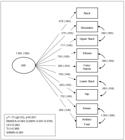
Confirmatory factor analysis for the single-factor solution of the NMQ in Brazilian adults. 2018, n=571. MS = musculoskeletal symptoms; RMSEA = Root Mean Square Error Approximation; CFI = Comparative Fit Index, TLI = Tucker-Lewis Index, SRMR = Standardized Root Mean Square Residual.

Two-factor confirmatory factor analysis of the NMQ in Brazilian adults. 2018, n=571. SO = sintomas osteomusculares. RMSEA = Root Mean Square Error Approximation; CFI = Comparative Fit Index; TLI = Tucker-Lewis Index; SRMR = Standardized Root Mean Square Residual.
DISCUSSION
This study found adequate fit values for the factor structure of the NMQ. The results of the exploratory factor analysis and confirmatory factor analysis showed that the tool can be used as a single factor or in a two-factor solution (upper and lower regions).
The chi-square values for both factorial solutions were significant, although these results do not indicate a good fit. Currently, it is argued that the use of chi-square is not a good indicator of fit due to its high sensitivity to sample size, and is subject to type I error12 .
Although the RMSEA and SRMR indicators showed poor fit in the exploratory factor analysis in both solutions, in the Confirmatory Factor Analysis the RMSEA values were similar and represented good fit for one factor (0.06) and two factors (0.06). The same was true for the SRMR values, with close values indicating good fit in both solutions.
The two-factor solution is supported by the theoretical framework since musculoskeletal symptoms can be directly or indirectly affected by disabilities in adjacent joints13 .
A randomized controlled study of individuals with unspecified low back pain showed that when there is concomitant pain in the lumbar and hip regions, exercises and stretches focused on the hip region reduced pain in the lumbar area (lower back), highlighting the association between these anatomical regions13 . In addition, individuals with low back pain commonly report pain that radiates to the lower limbs, with two thirds of patients seeking care in primary and secondary care for low back pain having associated pain in the lower limbs14 .
Other anatomical areas where there is a correlation with pain are the cervical spine (upper back) and shoulders. This relationship increases substantially with increasing age and can be explained by the fact that the nociceptive pathways coming from the cervical spine are close to each other, with pain often radiating to the shoulder region15 .
In a study of 600 individuals with injuries or isolated conditions in the hand or forearm, the authors found concomitant musculoskeletal complaints in the elbow, shoulder and neck in 40% of the sample16 . These data may be partly caused by peripheral and central sensitization, which makes early treatment of pain necessary to prevent progression to other sites.
Due to the structures of the shoulder and cervical spine being anatomically, neurologically and functionally related, pain and shoulder dysfunction are common in patients with cervical spine dysfunction17 .
A prospective observational study carried out in the United States found that ankle pain with and without foot pain was associated with increased knee pain in individuals aged between 50 and 79 years18 . These findings corroborate the covariance found in the present study between the knee and ankle/foot regions.
In order to study the epidemiological data of MP, the NMQ has undergone a process of cross-cultural adaptation and validation in different countries, such as the USA, UK, Turkey, Iran, Thailand, Denmark and Brazil19,20 .
In a systematic literature review on the validity and reliability of the NMQ, a reference author (2017) pointed out that of the 15 studies found, 4 were carried out in Brazil20 . The Brazilian studies carried out cross-cultural validation and assessed test-retest reliability, criterion validity and concurrent validity. It should be noted that none of these studies used a population-based sample.
In the present study, the answers referring to the presence of MP in the last 7 days were used to analyze the factor structure of the NMQ, as the results were consistent with the theoretical findings and with the objective of removing memory bias.
Another point is that this validation used a sample from a population-based study, providing support for new studies in which the tool can be used by health professionals and researchers in similar studies.
It should be noted that the tool has some limitations, such as the absence of a measure of symptom severity, as well as not indicating the origin of the injury. On the other hand, it is practical and easy to fill in.
CONCLUSION
This study provided evidence of the construct validity of the NMQ. Furthermore, the authors indicate its use in its original format with only one factor or its use in two factors (upper and lower region) thus supporting future research into pain in the country, presenting a new alternative use of the NMQ for the Brazilian population.
-
Sponsoring sources: This work was supported by the Conselho Nacional de Desenvolvimento Científico e Tecnológico (CNPq - National Council for Scientific and Technological Development, processes no. 478503/2004-0, no. 481410/2009-0 and no. 431329/2016-8), and by the Fundação de Amparo à Pesquisa do Estado do Rio Grande do Sul (FAPERGS - Research Support Foundation of the State of Rio Grande do Sul, processes no. 0415621 and no. 11/2177-4).
References
-
1 Gill TK, Mittinty MM, March LM, Steinmetz JD, Culbreth GT, Cross M, Vasankari TJ, GBD 2021 Other Musculoskeletal Disorders Collaborators. Global, regional, and national burden of other musculoskeletal disorders, 1990–2020, and projections to 2050: a systematic analysis of the Global Burden of Disease Study 2021. Lancet Rheumatol. 2023;5(11):e670-82. http://doi.org/10.1016/S2665-9913(23)00232-1 PMid:37927903.
» http://doi.org/10.1016/S2665-9913(23)00232-1 -
2 Jackson T, Thomas S, Stabile V, Han X, Shotwell M, McQueen K. Prevalence of chronic pain in low-income and middle-income countries: a systematic review and meta-analysis. Lancet. 2015;385(Suppl 2):S10. http://doi.org/10.1016/S0140-6736(15)60805-4 PMid:26313056.
» http://doi.org/10.1016/S0140-6736(15)60805-4 -
3 Aguiar DP, Souza CP, Barbosa WJ, Santos-Júnior FF, Oliveira AS. Prevalence of chronic pain in Brazil: systematic review. BrJP. 2021;4(3):257-67. http://doi.org/10.5935/2595-0118.20210041
» http://doi.org/10.5935/2595-0118.20210041 - 4 Mota PHDS, Lima TAD, Berach FR, Schmitt ACB. Impacto da dor musculoesquelética na incapacidade funcional. Braz J Phys Ther. 2020;27:85-92.
-
5 Kuorinka I, Jonsson B, Kilbom A, Vinterberg H, Biering-Sørensen F, Andersson G, Jørgensen K. Standardised Nordic questionnaires for the analysis of musculoskeletal symptoms. Appl Ergon. 1987;18(3):233-7. http://doi.org/10.1016/0003-6870(87)90010-X PMid:15676628.
» http://doi.org/10.1016/0003-6870(87)90010-X -
6 Pinheiro FA, Tróccoli BT, Carvalho CV. Validação do Questionário Nórdico de Sintomas Osteomusculares como medida de morbidade. Rev Saude Publica. 2002;36(3):307-12. http://doi.org/10.1590/S0034-89102002000300008 PMid:12131969.
» http://doi.org/10.1590/S0034-89102002000300008 -
7 Barros ENC, Alexandre NMC. Cross‐cultural adaptation of the Nordic musculoskeletal questionnaire. Int Nurs Rev. 2003;50(2):101-8. http://doi.org/10.1046/j.1466-7657.2003.00188.x PMid:12752909.
» http://doi.org/10.1046/j.1466-7657.2003.00188.x - 8 Instituto Brasileiro de Geografia e Estatística. Censo Demográfico 2010. Brasília: IBGE; 2010.
-
9 Mattos CNB, Bairros FS, Pattussi MP. Aspectos contextuais e individuais relacionados à dor osteomuscular em adultos do sul do Brasil. BrJP. 2024;7:e20240011. http://doi.org/10.5935/2595-0118.20240011-pt
» http://doi.org/10.5935/2595-0118.20240011-pt -
10 Romero SS, Gonçalves TR, Mattos CNB, Bairros FS, Pattussi MP. Validade e confiabilidade do EUROHIS-QOL 8-item para avaliar a qualidade de vida em adultos brasileiros. Cad Saude Publica. 2022;38(11):e00200921. http://doi.org/10.1590/0102-311xpt200921 PMid:36541965.
» http://doi.org/10.1590/0102-311xpt200921 - 11 Associação Brasileira de Empresas de Pesquisa. Critério de classificação econômica do Brasil. São Paulo: ABEP; 2013.
- 12 DeVellis RF. Reliability. In: DeVellis RF, editor. Scale development theory and applications. Los Angeles: Sage; 2017. p. 49-85.
-
13 Kim B, Yim J. Core stability and hip exercises improve physical function and activity in patients with non-specific low back pain: a randomized controlled trial. Tohoku J Exp Med. 2020;251(3):193-206. http://doi.org/10.1620/tjem.251.193 PMid:32669487.
» http://doi.org/10.1620/tjem.251.193 -
14 Fourré A, Monnier F, Ris L, Telliez F, Michielsen J, Roussel N, Hage R. Low-back related leg pain: is the nerve guilty? How to differentiate the underlying pain mechanism. J Man Manip Ther. 2023;31(2):57-63. http://doi.org/10.1080/10669817.2022.2092266 PMid:35735104.
» http://doi.org/10.1080/10669817.2022.2092266 -
15 Zhang AL, Theologis AA, Tay B, Feeley BT. The association between cervical spine pathology and rotator cuff dysfunction. J Spinal Disord Tech. 2015;28(4):E206-11. http://doi.org/10.1097/BSD.0000000000000223 PMid:25393668.
» http://doi.org/10.1097/BSD.0000000000000223 -
16 Winiarski LM, Livoni JD, Madsen PV, Rathleff MS, Larsen P. Concurrent musculoskeletal complaints in elbows, shoulders, and necks after common hand and forearm injuries or conditions: a cross-sectional study among 600 patients. J Hand Ther. 2021;34(4):543-8. http://doi.org/10.1016/j.jht.2020.05.002 PMid:32893097.
» http://doi.org/10.1016/j.jht.2020.05.002 -
17 Libardoni TC, Armijo-Olivo S, Bevilaqua-Grossi D, Oliveira AS. Relationship between intensity of neck pain and disability and shoulder pain and disability in individuals with subacromial impingement symptoms: a cross-sectional study. J Manipulative Physiol Ther. 2020;43(7):691-9. http://doi.org/10.1016/j.jmpt.2019.01.005 PMid:32861520.
» http://doi.org/10.1016/j.jmpt.2019.01.005 -
18 Perry TA, Segal NA, Bowen C, Gates L, Arden N, Nevitt MC. Foot and ankle pain and risk of incident knee osteoarthritis and knee pain: Data from the Multicentre Osteoarthritis Study. Osteoarthr Cartil Open. 2021;3(4):100210. http://doi.org/10.1016/j.ocarto.2021.100210 PMid:34977597.
» http://doi.org/10.1016/j.ocarto.2021.100210 -
19 Kahraman T, Genç A, Göz E. The Nordic Musculoskeletal Questionnaire: cross-cultural adaptation into Turkish assessing its psychometric properties. Disabil Rehabil. 2016;38(21):2153-60. http://doi.org/10.3109/09638288.2015.1114034 PMid:26726840.
» http://doi.org/10.3109/09638288.2015.1114034 - 20 Alves IB. Validade e confiabilidade do questionário nórdico de sintomas musculoesqueléticos: uma revisão sistemática de literatura [dissertação]. Salvador: Programa de Pós-Graduação em Saúde, Ambiente e Trabalho, Universidade Federal da Bahia; 2017.
Edited by
-
Associate editor in charge:
Maíra Junkes Cunha https://orcid.org/0000-0002-1706-4129


