 Virtual reality and digital technologies for pain management: scope review
ABSTRACT
BACKGROUND AND OBJECTIVES Pain management is admittedly complex, and many efforts have been made to develop new non-pharmacological therapies, including the application of digital technologies in the care process, but there are still some gaps as to which digital technologies can contribute to non-pharmacological pain management and how they can do this. The aim of this study was to map out in scientific literature how digital technologies (virtual reality, augmented reality, apps and digital games) can be used to contribute to pain management.
CONTENTS The scoping review of the literature was carried out in April 2023 on the portals and/or databases SCOPUS, Web of Science, LILACS, the journal portal of the Coordination for the Improvement of Higher Education Personnel (Coordenação de Aperfeiçoamento de Pessoal de Nível Superior - CAPES) and the National Library of Medicine (Pubmed), and was updated in April 2024, in English, Portuguese and Spanish; the search period was between April and May 2023; research terms adopted: “Virtual Reality” AND “Pain”; “Augmented Reality” AND “Pain”; “Digital Game” AND “Pain”; “App” AND “Pain”, and their variations in English and Spanish. Two hundred of the 2437 scientific articles found were included in this research. The analysis of these studies showed virtual reality to be the most widely used technology for pain management, due to its immersive properties, which favor cognitive distraction during its use, consequently reducing the need for pharmacological approaches.
CONCLUSION According to this scoping review, digital technologies have the potential to facilitate cognitive distraction and reduce the risks of overuse of analgesics, with virtual reality being the most prominent technology in various contexts for pain management due to the integration of the senses and greater capture of attention, thus transcending the environmental stress associated with pain sensations. This research has provided a perspective for updating health care, considering that, through digital technologies, pain can be managed with low-complexity strategies and in different age groups.
Keywords:
Digital health technology; Pain management; Pain measurement; Pain perception
HIGHLIGHTS
Virtual reality as the most prominent digital technology in various contexts for pain management
Cognitive distraction as a way of relieving, with the intention of changing the way pain is perceived by the subjects
The adoption of digital technologies contributes to increasing pharmacological safety in pain management, with the understanding that pain treatment needs to be multidimensional
RESUMO
JUSTIFICATIVA E OBJETIVOS O manejo da dor é reconhecidamente complexo e muitos esforços têm sido empregados para que novas terapias não farmacológicas sejam desenvolvidas, dentre esses a aplicação das tecnologias digitais no processo de cuidar, mas permanecem algumas lacunas sobre quais as tecnologias digitais que podem contribuir para o manejo não farmacológico da dor e como elas podem fazer isso. O objetivo deste estudo foi mapear na literatura científica como as tecnologias digitais (realidade virtual, realidade aumentada, aplicativos e jogos digitais) podem ser utilizadas para contribuir com o manejo da dor.
CONTEÚDO A revisão de escopo da literatura foi realizada em abril de 2023 nos portais e/ou bases de dados: SCOPUS, Web of Science, LILACS, portal de periódico da Coordenação de Aperfeiçoamento de Pessoal de Nível Superior (CAPES) e National Library of Medicine (Pubmed), e foi atualizada em abril de 2024, nos idiomas inglês, português e espanhol; o período de busca se deu entre abril e maio de 2023; termos de investigação adotados: “Realidade virtual” E “Dor”; “Realidade aumentada” E “Dor”; “Jogo Digital” E “Dor”; “Aplicativo” E “Dor”, e suas variações em língua inglesa e espanhola. Duzentos, dos 2437 artigos científicos encontrados, foram incluídos nesta pesquisa. A análise desses estudos evidenciou a realidade virtual como a tecnologia mais utilizada para o manejo da dor, frente às suas propriedades imersivas, que favorecem a distração cognitiva durante a sua utilização, consequentemente reduzindo a necessidade de abordagens farmacológicas.
CONCLUSÃO De acordo com esta revisão de escopo, as tecnologias digitais têm potencial para facilitar a distração cognitiva e reduzir riscos do uso excessivo de analgésicos, sendo a realidade virtual a tecnologia mais proeminente nos diversos contextos para controle da dor devido à integração dos sentidos e maior captação de atenções, transcendendo assim o estresse ambiental associado às sensações álgicas. Esta pesquisa proporcionou uma perspectiva de atualização em saúde, considerando que, por meio de tecnologias digitais, a dor pode ser também manejada com estratégias de baixa complexidade e em diferentes faixas etárias.
Descritores:
Manejo da dor; Medição da dor; Percepção da dor; Tecnologia digital para saúde
DESTAQUES
Realidade virtual como a tecnologia digital mais proeminente nos diversos contextos para controle da dor
Distração cognitiva como forma de aliviar a dor, com a intenção de mudança do modo como a dor é percebida pelo sujeito
A adoção de tecnologias digitais contribui para aumentar a segurança farmacológica no manejo da dor, compreendendo-se que o tratamento da dor precisa ser multidimensional
INTRODUCTION
Pain management is a complex issue, and many efforts have been made to develop new non-pharmacological therapies, realizing that pain treatment needs to be multidimensional. In this context, cognitive distraction has been studied as a way of relieving pain in various situations, with the intention of changing the way pain is perceived by the subject1. In other words, changing the focus of attention to other situations may be pleasant. This practice helps to shift the cognitive focus of the subject with pain to another topic that is not related to their main complaint2.
In view of life in a highly technological society, which offers highly immersive experiences, more research is needed into how these technologies can contribute to achieving cognitive distraction in pain management. Technological immersion has been applied in various sectors, such as education, health, entertainment and industry, with the potential to transform the way people interact with the world3. By manipulating sensory elements such as sight, hearing and touch, digital technology provides increasingly immersive experiences4. Virtual reality, for example, creates simulated environments that engage the user on multiple perceptual levels, promoting a sense of presence and immersion5.
Brazil is currently 5th in the ranking of countries with the highest number of active smartphones, totaling 127.3 million6. Thus, there is an opportunity to expand strategies for adequate pain control based on the technologies present in people's daily lives. However, just like the pain experience, responses to therapeutic approaches can vary between individuals depending on conditions such as age, gender, type of technology used, among others7. Therefore, the aim of this study was to carry out a scoping review of how digital technologies such as virtual reality (VR), augmented reality (AR), apps and digital games can be used in the non-pharmacological management of acute and chronic pain.
CONTENTS
This was a scoping review focused on mapping, identifying, evaluating and understanding the available evidence on a field of knowledge8. This review was guided by the recommendations of the Joanna Briggs Institute Reviewer's Manual (JBI)8. The protocol for this study is duly registered with the Open Science Framework (OSF)9. Data was extracted using a checklist adapted from PRISMA-ScR10.
The mnemonic strategy Population, Context and Concept (PCC), as proposed by JBI, was used to guide the formulation of the guiding question. Thus, the following determinants of interest in this study were defined: Population - digital technologies; Concept - therapeutic use; Context - non-pharmacological pain management. Then, the following guiding question was defined: “How are digital technologies being used to assist in the non-pharmacological management of acute and chronic pain”?
To operationalise this research, the following search descriptors were defined: “Pain”, “Virtual Reality”, “Augmented Reality”, “Digital Game” and “Application”. Descriptors were used in Portuguese, English and Spanish. The search terms followed the standards defined by each information source, taking into account their different forms of indexing and respective vocabularies - Medical Subject Headings (MeSH) and Health Sciences Descriptors (Descritores em Ciências da Saúde - DeCS).
The search was carried out in the following databases: SciVerse Scopus (SCOPUS), Web of Science and LILACS, through the journal portal of the Coordination for the Improvement of Higher Education Personnel (CAPES) and the National Library of Medicine (Pubmed), in April 2023, and was updated in April 2024. The time frame was 2018 to 2022, to map the latest technological advances in the field of pain management.
Primary quantitative or qualitative studies were included, which addressed the use of digital technologies related to the non-pharmacological management of pain in human beings, publications with reports of experiences on the subject studied, written in English, Spanish and Portuguese. Exclusion criteria were: studies that did not address the topic of interest; articles that were unavailable in their entirety; studies that did not use validated scales or that addressed digital technologies for pain management but did not present results linked to the intervention with the proposed target audience; and publications by the same author that address similar issues.
The Boolean operators AND and OR were used to select the articles. The search expressions were used in titles, abstracts and keywords (Table 1).
The studies were selected in three stages: analysing the titles of the articles, analysing the abstracts and reading them in full. The entire process of analysis and selection was carried out manually, without the use of software. The essential elements found in each publication were extracted and synthesized using a structured instrument designed for this study and adapted from the form recommended by JBI, in order to facilitate the synthesis of information and the practice of recommendations. The data extracted included: year the study was carried out, country of origin, language, population involved, digital technology used, objective, methodological design, context in which the technologies were applied, intervention carried out, outcomes found, and limitations highlighted.
The analysis was carried out by two independent reviewers. At first, after organizing the search, the selection was made by reading the titles and abstracts and applying the eligibility criteria. The first reviewer then read the articles in full, applied the eligibility criteria and extracted the data, which was checked by the second reviewer.
The methodological quality of the search sources was not analyzed because this was a scoping review. The results were entered into spreadsheets and analyzed using descriptive statistics, using absolute and relative frequencies to characterise them.
RESULTS
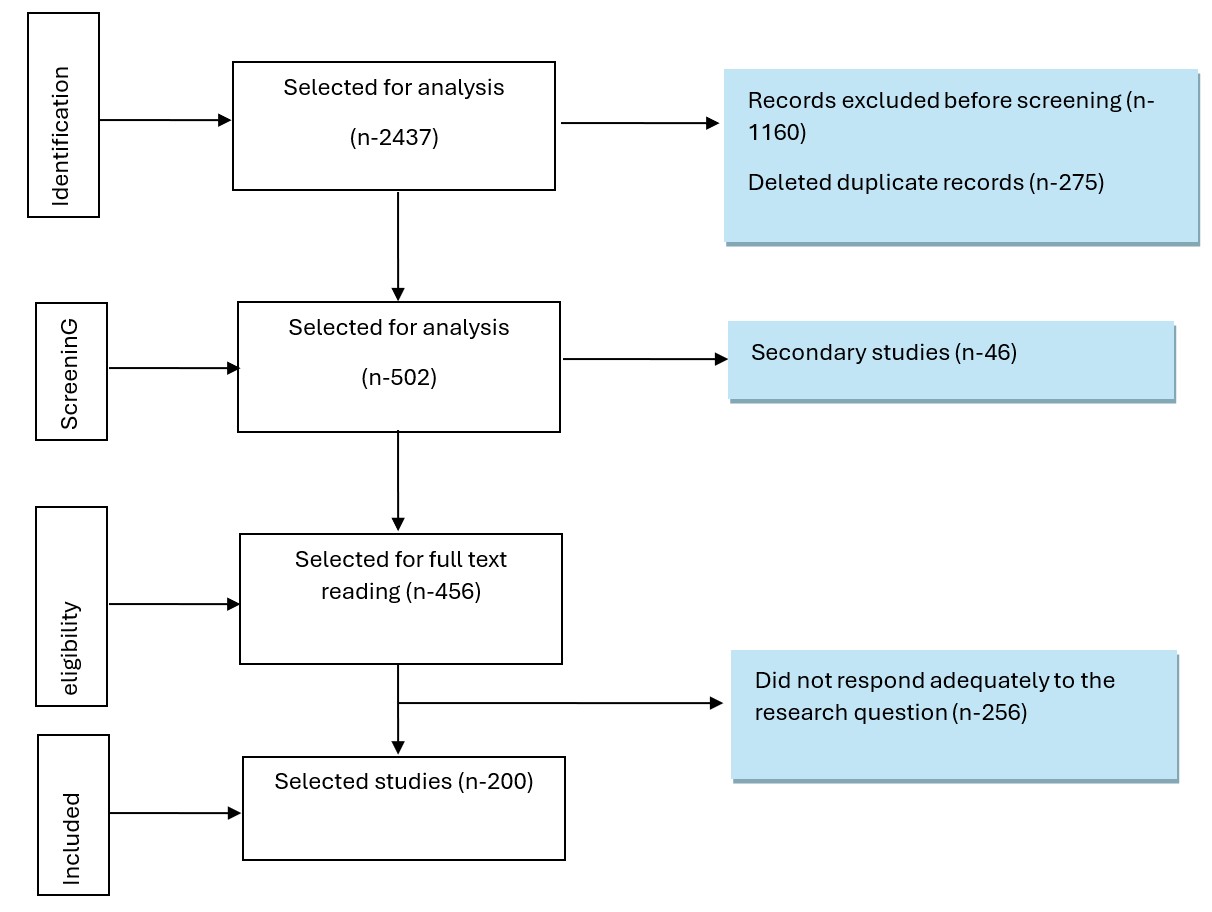
The search resulted in a total of 2,437 studies, of which 36 were found in LILACS, 291 in Pubmed, 858 in Web of Science and 1252 in SCOPUS. After analysing the titles, 1,660 publications were excluded because they did not adequately meet the inclusion criteria; 275 duplicates were then removed, 46 secondary studies because they did not meet the research inclusion criteria and 256 studies because they did not adequately answer the research question. In the end, a total of 200 articles were obtained. The selection stages are shown below in Figure 1.

Of the 200 publications selected, 4 (2%) were found in LILACS, 61 (30.5%) in Pubmed, 76 (38%) in Web of Science and 59 (29.5%) in SCOPUS. Regarding the year of publication, there was a higher frequency of scientific production in the years 2020 (n=44), 2021 (n=55) and 2022 (n=64). This can be directly linked to the pandemic scenario due to COVID-19, a period in which the need for new strategies to adapt services to deal with the reality of social distancing became apparent, and new perspectives on assistance began to be explored11. Regarding the countries of origin of the publications, the United States (n=38), Germany (n=15), Australia (n=10), China (n=10) and Spain (n=10) stood out in terms of scientific production. It is worth noting that 31 studies did not inform their place of origin and two were conducted in two countries at the same time.
As for the digital technologies used, VR was favoured in 125 studies (62.5%) and apps (both web-based and mobile) in 47 studies (23.5%). It's worth noting that one study used both AR and VR in its intervention. Of the 23 studies that used digital games, 14 were based on VR.
As for the methodological design, 147 articles (73.5%) used a mixed approach, being classified as qualitative and quantitative, using scales and questionnaires to measure pain and other related subjective variables (fear, anxiety, activity of daily living, etc.); 52 articles (26%) used a purely quantitative approach, focusing only on the validated scales used to measure pain; 1 study (0.5%) used a purely qualitative approach, focusing only on the validated scales used to measure pain; 52 articles (26%) used a purely quantitative approach, focusing only on the validated scales used to measure pain; and 1 study (0.5%) used a purely qualitative approach, in which, although a pain scale was used, mostly subjective factors were investigated through the reports of the population involved.
Qualitative and quantitative studies made up more than half of the sample, which may be justified by the subjective and complex nature of pain. Some authors have suggested that in addition to the pain experienced, it is essential to obtain and analyze the participants' individual characteristics, anxieties, fears, thoughts and feelings, with the aim of outlining the best possible experience when they come into contact with the technology chosen for the intervention. That way provides an immersion that is favorable to reducing the pain processed and perceived1.
With regard to the professional categories that use technologies for pain management, a considerable variety was observed, including specialist doctors, nurses when carrying out procedures such as venipunctures and dressings, and in post-operative pain management, physiotherapists in a rehabilitation context, dentists in a surgical setting, as well as multi-professional approaches that included the participation of occupational therapists and psychologists.
Regarding the population involved in the interventions, adults made up 115 (57.5%) studies. In 29 studies (14.5%) the sample was made up of adults and elderly, in 25 (12.5%) only children were included and in 20 (10%) both children and adolescents, as shown in Table 2.
With regard to pain measurement scales, the most notable were the Visual Analogue Scale, in which pain can be classified between ‘no pain’ and ‘the worst possible pain’ on a 10 cm line, and the numerical assessment scale, which is a verbal descriptor in which the individual classifies their pain within predetermined parameters. In addition to these, the studies involving children also used the Face, Leg, Activity, Cry and Consolability (FLACC), a scale used in pre-verbal children, and the Wong-Baker and Faces Rating Scales, both illustrative scales in which pain can be communicated through expressions on the faces of characters or drawings.
In the utilitarian context, digital technologies have been used for pain management in invasive and/or painful procedures, chronic pain therapy, acute pain therapy and pain self-management, as can be seen in Table 3.
Analysing the table above, it is noted that virtual reality was the most exploited technology in three contexts (invasive and/or painful procedures, therapy for acute and/or chronic pain and pain caused by laboratory conditions). It is also noteworthy that digital games came next in two contexts (invasive and/or painful procedures and therapy for acute and/or chronic pain). However, apps were the main choice when it came to self-management of pain.
DISCUSSION
Based on the studies analyzed, the use of digital technologies in the management of acute and chronic pain is based on immersion and the achievement of cognitive distraction, a phenomenon in which there is greater attentional capture through technology, transcending all the environmental stress associated with pain sensations12. Among the technologies researched (VR, AR, apps and digital games), VR has been mostly explored in pain management in the context of invasive and/or painful procedures, therapy for acute and/or chronic pain and pain caused under controlled conditions, as well as for a diverse audience of children, adolescents, adults and older adults.
VR consists of reproducing elements of the real world in a three-dimensional virtual environment using computer devices. Its resources seek to get as close as possible to real representations through interactions, exploiting the use of hardware (virtual reality glasses, movement sensors, helmets, gloves, etc.) to promote a high degree of immersion through stimuli, thus modulating the senses of sight and hearing, distancing the individual's attention from the pain experienced or potential13. It is through this integration of the senses that VR favors cognitive distraction.
With regard to the means used to apply VR, virtual reality goggles and smartphones have stood out during painful procedures, such as peripheral access puncture, insertion of a fully implanted venous catheter, changing a central venous catheter dressing, as well as pain control in intensive care patients14,15. The preference for this hardware is directly associated with its low cost and the less frequent occurrence of adverse events linked to its use, such as nausea, headache and dizziness1.
With regard to the distraction strategies adopted when using VR, both passive and active cognitive distraction have been implemented. In passive distraction, there is no user interaction, only immersion16, such as exposing children to VR-based 3D animations through glasses during the vaccination process15. In active distraction, the user's interaction is directly dependent17, as in the exposure of children and adolescent burn victims to a VR headset (a combination of virtual reality glasses + headphones + smartphone), interacting with a game during dressing changes. Those involved reported less pain throughout the study, with a reduction between the first and subsequent dressing changes18.
Invasive and/or painful procedures can be perceived as threatening, both physically and psychologically, regardless of the individual's age; therefore, these results point to the relevance of using VR as another strategy for pain management in the face of invasive procedures, in order to make the event as less traumatic as possible19.
With regard to the context of therapy for acute and/or chronic pain, it was observed that the findings are significantly similar to those found with painful invasive procedures, i.e. they reinforce the properties of VR for promoting cognitive distraction, including the rehabilitation of patients living with pain. For example, a study of adults living with chronic low back pain used a computer connected to movement sensors positioned on the patient's sternum and hips, a television displaying virtual scenarios and a software to process the movement data. Most of the participants reported an improvement in their pain sensations20.
An exploratory study is in line with these findings, having validated the properties of VR for the rehabilitation of individuals with neuropathic pain associated with spinal injury using electroencephalograms, i.e. by investigating the neuronal changes caused during exposure to natural environments in 3D, using virtual reality glasses and headphones, or the same simulation version, but in 2D, using a laptop. The results showed a significant reduction in pain in both scenarios and less activation of the brain region responsible for receiving and interpreting pain sensations21. Regardless of whether the pain is acute or chronic, VR can promote cognitive distraction and modulate nociception (pain perception) by activating the descending pain inhibitory systems in the brain. However, the effect of distraction varies depending on the type of distraction and the specific brain processes involved.
Studies involving pain provoked in controlled laboratory conditions have also used digital technologies, especially VR, to carry out experiments to induce pain in healthy individuals by applying pressure to limbs or borderline temperature variations (cold or hot). The findings reinforced cognitive distraction as the main device used. In the study that used a VR-based game to carry out four randomized experimental sessions, each separated by at least 24 hours, participants had their pain thresholds collected and calculated using a specific scale 15 minutes before and after exposure to VR, showing a statistically significant reduction after the implementation of the research protocols22.
As well as virtual reality, apps have also made a name for themselves in pain self-management. Mobile applications (or “apps”) are small pieces of software installed on the operating systems of mobile devices (smartphones and tablets) that allow access to online and offline content23. This technology has stood out in pain management because it promotes autonomy for self-care through the content contained in the apps, such as exercise guidelines, information on the type of pain experienced and contact with the care teams responsible in order to resolve doubts or change the therapy24. A study that sought to evaluate cognitive-behavioural therapy using an app to provide self-management of fibromyalgia symptoms is an example of this context. In addition to pain intensity questionnaires, the research protocol included aspects such as sleep quality, fatigue, anxiety and symptoms of depression, which are important variables when it comes to chronic pain processes. Also included was information on fibromyalgia, its treatment and coping strategies, tools for stress modulation and relaxation, as well as data on safe and responsible pharmacological therapies25.
Another study worked from the same perspective, with adult patients with non-specific low back pain, with an average pain intensity ≥ 4 on the numerical pain scale, allocated to interact with the Kaia app and encouraged by the clinical investigator to use it via smartphone or tablet at least four times a week for a period of 3 months. The app consists of three therapy modules: (1) specific education for back pain, (2) physiotherapy/physical exercise and (3) mindfulness and relaxation techniques. There was a decrease in the levels of pain reported by the participants26.
Apps make it possible to manage care autonomously, placing the individual as an active player in their care process, and end up boosting habits that are compatible with their ability to intervene through health education27. It's worth highlighting that health professionals should not be excluded from the proposed interventions, given that they are the ones with specific knowledge of clinical reasoning for managing pain and possible associated diseases.
This scoping review also identified a concern with the adoption of digital technologies in order to contribute to pharmacological safety in pain management. One example is the study that used the SMART app, which was installed on participants' mobile devices to monitor daily pain due to sickle cell disease, with notifications being sent to patients twice a day using a digital version of the visual analogue scale that quantifies pain from 0 to 10. The location of the pain also was collected. In this way, a list of pharmacological analgesic interventions (opioid or not) used was generated from the current drugs listed in the medical records so that doses could be adjusted safely28.
Digital games also where investigated as strategies for pain management. Games are playful activities shaped by actions and decisions limited by a set of rules governed by a software29. One study used a digital adventure game in which patients take on the role of an avatar during a virtual journey around the world, with the aim of investigating the impacts on the physical and emotional functioning of adult and elderly participants living with chronic musculoskeletal pain. The interaction took place using a tablet and lasted an average of 2.5 hours. The protocol also included an intensive 16-week multidisciplinary biopsychosocial rehabilitation program (rehabilitation doctors, psychologists and physiotherapists), with a focus on well-being and social participation. As a result, it was observed that patients with low back pain, mainly with psychosocial problems, adhered well to the game during the multidisciplinary rehabilitation, with a reduction in physical (pain) and emotional (depressive symptoms) symptoms. However, the authors pointed out that the effects of the game alone are not statistically relevant and that a multidisciplinary approach is needed, as a complementary factor to achieve success30.
Digital games for acute and/or chronic pain management are also associated with VR for greater immersion and disconnection from the physical environment and pain. The findings again involve cognitive distraction as the main gain in terms of analgesia, such as the study that investigated the impacts of a VR-based game on pain control and time spent thinking about pain in adult subjects with chronic non-specific low back pain. The subjects had VR sensors installed along their spinal column and were positioned in front of a TV to interact with games in which caterpillars or fish were guided by the movement of the pelvis. The results indicated that the participants obtained a significantly greater reduction in pain intensity during and after the exercises, as well as spending less time thinking about the pain31.
This research also looked at pain management through an educational role, as in the case of the study in which children were introduced, before intervention, to an educational game on the steps that would be part of an orthodontic surgical intervention, using a smartphone or tablet. So that the participants knew a little about the environment in which they would be inserted, which professionals they would meet and how the procedure would be carried out. The findings indicated less post-operative pain in the intervention group, as well as less anxiety before and during the procedure32.
The digital technologies surveyed in this review have shown positive results in terms of pain management in different contexts, but it is extremely necessary to discuss the problems associated with their accessibility and the prospects for their real application in the day-to-day provision of care. Virtual reality, although it can be adapted and used on smartphones, depends directly on other devices that require considerable audio and video quality for immersion to be a truly unique and effective experience to promote cognitive distraction. In addition to financial costs, another aspect to consider as a barrier is the ability of the population and health professionals to interact with such digital technologies. The concept of “mHealth” (mobile health) has become increasingly present as technologies develop at a rapid pace, which draws attention to digital literacy and digital literacy in health. There is therefore an urgent need to reflect on whether both the user of the health system and the health professional who will provide care have the necessary skills and competences to manipulate and apply these technologies to promote health33.
CONCLUSION
The use of digital technologies, especially virtual reality, has proved effective as another strategy for managing acute and chronic pain in individuals of different age groups. In none of the studies surveyed there was any worsening of pain associated with interventions using digital technologies. In order to effectively mediate digital technologies, it is necessary to invest in the digital health literacy of professionals and individuals who live with pain.
This scoping review highlights the low level of scientific production in Brazil regarding the use of digital technologies for pain management. This observation sheds light on the need for investment in research in this area, given that it is a field that needs to be explored because it offers simple, relatively low-cost methods and, so far, no evidence that they may cause adverse effects.
However, more studies are needed to establish scientific evidence for the inclusion of digital technologies in safe pain management, as many of the studies analysed are not associated with the technologies themselves, but rather with the research protocols adopted by the study authors. It can be seen that there is still no consensus on the ideal exposure or immersion time for pain to be effectively reduced. Furthermore, in a significant number of studies, neither the participants nor the researchers were blinded, which can lead to biases in the results. Another observation refers to the number of participants in each study, and there is no ideal number in the literature, which compromises the generalisability of the results obtained.
The findings presented in this study demonstrate practical alternatives for pain management that exploit the various technological potentialities, thus transcending their primary property, communication, and becoming an important tool for health promotion.
Sponsoring sources:
References
-
1 Freitas DMO, Spadoni VS. Is virtual reality useful for pain management in patients who undergo medicais procedures? Einstein. 2019;17(2):eMD4837. http://doi.org/10.31744/einstein_journal/2019MD4837 PMid:31116237.
» http://doi.org/10.31744/einstein_journal/2019MD4837 - 2 Bezerra Costa, I, Vieira Dantas, D, Neves Dantas, RA, Porfírio de Oliveira, S, Miranda Aiquoc, K, Gurgel Sarmento, SD. Terapias não-farmacológicas para o manejo da dor em vítima de queimaduras: uma revisão sistemática. Rev Inspirar Mov Saúde. 2019;19(2):1.
- 3 Liu J, Huang X, Benbasat I. Virtual reality for business process management: a systematic literature review. Inf Syst Front. 2020;22(1):1-26.
-
4 Steuer J. Defining virtual reality: dimensions determining telepresence. J Commun. 1992;42(4):73-93. http://doi.org/10.1111/j.1460-2466.1992.tb00812.x
» http://doi.org/10.1111/j.1460-2466.1992.tb00812.x -
5 Slater M, Wilbur S. A framework for immersive virtual environments. Presence. 1999;8(6):603-16. http://doi.org/10.1162/pres.1997.6.6.603
» http://doi.org/10.1162/pres.1997.6.6.603 -
6 Newzoo. Global mobile market report. 2020 [citado 2024 set 13]. https://newzoo.com/resources/trend-reports/newzoo-global-mobile-market-report-2020-free-version
» https://newzoo.com/resources/trend-reports/newzoo-global-mobile-market-report-2020-free-version -
7 Lisboa IF, Carmo ACN, Rocha PRS, Funez MI. Aromatherapy with oil of Lavandula angustifolia for pain in women: scoping review. Br J Pain. 2023;6(2):208-14. http://doi.org/10.5935/2595-0118.20230035-pt
» http://doi.org/10.5935/2595-0118.20230035-pt -
8 Joanna Briggs Institute – JBI. JBI manual for evidence synthesis. Adelaide: JBI; 2024 [citado 2024 set 13]. Disponível em: https://jbi-global-wiki.refined.site/space/MANUAL
» https://jbi-global-wiki.refined.site/space/MANUAL -
9 Suzart LC, Ferreira SC. Protocolo de pesquisa “Tecnologias digitais aplicadas ao manejo da dor: uma revisão de escopo”. Open Science Framework; 2024 [citado 2024 set 13]. Disponível em: osf.io/mn3tv
» osf.io/mn3tv -
10 Tricco AC, Lillie E, Zarin W, O’Brien KK, Colquhoun H, Levac D, Moher D, Peters MDJ, Horsley T, Weeks L, Hempel S, Akl EA, Chang C, McGowan J, Stewart L, Hartling L, Aldcroft A, Wilson MG, Garritty C, Lewin S, Godfrey CM, Macdonald MT, Langlois EV, Soares-Weiser K, Moriarty J, Clifford T, Tunçalp Ö, Straus SE. PRISMA extension for scoping reviews (PRISMA-ScR): checklist and explanation. Ann Intern Med. 2018;169(7):467-73. http://doi.org/10.7326/M18-0850 PMid:30178033.
» http://doi.org/10.7326/M18-0850 -
11 Celuppi IC, Lima GS, Rossi E, Wazlawick RS, Dalmarco EM. Uma análise sobre o desenvolvimento de tecnologias digitais em saúde para o enfrentamento da COVID-19 no Brasil e no mundo. Cad Saude Publica. 2021;37(3):e00243220. http://doi.org/10.1590/0102-311x00243220 PMid:33729283.
» http://doi.org/10.1590/0102-311x00243220 -
12 Goergen DI, Freitas DMO. Virtual reality as a distraction therapy during cystoscopy: a clinical trial. Rev Col Bras Cir. 2022;49:e20223138. http://doi.org/10.1590/0100-6991e-20223138 PMid:35584530.
» http://doi.org/10.1590/0100-6991e-20223138 - 13 Kirner C, Siscoutto R. Realidade virtual e aumentada: conceitos, projeto e aplicações. Petrópolis: Sociedade Brasileira de Computação; 2007. p. 4-10.
-
14 Hoag JA, Karst J, Bingen K, Palou-Torres A, Yan K. Distracting through procedural pain and distress using virtual reality and guided imagery in pediatric, adolescent, and young adult patients: randomized controlled trial. J Med Internet Res. 2022;24(4):e30260. http://doi.org/10.2196/30260 PMid:35436209.
» http://doi.org/10.2196/30260 -
15 Esumi R, Yokochi A, Shimaoka M, Kawamoto E. Virtual reality as a non-pharmacologic analgesic for fasciotomy wound infections in acute compartment syndrome: a case report. J Med Case Rep. 2020;14(1):46. http://doi.org/10.1186/s13256-020-02370-4 PMid:32290865.
» http://doi.org/10.1186/s13256-020-02370-4 -
16 Althumairi A, Sahwan M Jr, Alsaleh S, Alabduljobar Z, Aljabri D. Virtual reality: is it helping children cope with fear and pain during vaccination? J Multidiscip Healthc. 2021;14:2625-32. http://doi.org/10.2147/JMDH.S327349 PMid:34584419.
» http://doi.org/10.2147/JMDH.S327349 -
17 Armstrong M, Lun J, Groner JI, Thakkar RK, Fabia R, Noffsinger D, Ni A, Keesari R, Xiang H. Mobile phone virtual reality game for pediatric home burn dressing pain management: a randomized feasibility clinical trial. Pilot Feasibility Stud. 2022;8(1):186. http://doi.org/10.1186/s40814-022-01150-9 PMid:35982492.
» http://doi.org/10.1186/s40814-022-01150-9 -
18 Ferraz-Torres M, San Martin-Rodriguez L, Garcia-Vivar C, Soto-Ruiz N, Escalada-Hernandez P. Passive or interactive virtual reality? The effectiveness for pain and anxiety reduction in pediatric patients. Virtual Real. 2022;26(4):1307-16. http://doi.org/10.1007/s10055-022-00633-7
» http://doi.org/10.1007/s10055-022-00633-7 -
19 Furtado KR, Dias TL, Marchett A, Nunes EPS. O uso do jogo digital “Hospital Mirim” como estratégia de enfrentamento à procedimento invasivo. Estud Pesqui Psicol. 2020;20(1):251-67. http://doi.org/10.12957/epp.2020.50831
» http://doi.org/10.12957/epp.2020.50831 -
20 Alemanno F, Houdayer E, Emedoli D, Locatelli M, Mortini P, Mandelli C, Raggi A, Iannaccone S. Efficacy of virtual reality to reduce chronic low back pain: proof-of-concept of a non-pharmacological approach on pain, quality of life, neuropsychological and functional outcome. PLoS One. 2019;14(5):e0216858. http://doi.org/10.1371/journal.pone.0216858 PMid:31120892.
» http://doi.org/10.1371/journal.pone.0216858 -
21 Tran Y, Austin P, Lo C, Craig A, Middleton JW, Wrigley PJ, Siddall P. An exploratory EEG analysis on the effects of virtual reality in people with neuropathic pain following spinal cord injury. Sensors. 2022;22(7):2629. http://doi.org/10.3390/s22072629 PMid:35408245.
» http://doi.org/10.3390/s22072629 -
22 Evans E, Naugle KE, Ovispo A, Kaleth AS, Arnold B, Naugle KM. Active virtual reality games reduce pain sensitivity in young, healthy adults. Front Virtual Real. 2021;2:1-9. http://doi.org/10.3389/frvir.2021.772293
» http://doi.org/10.3389/frvir.2021.772293 - 23 Nonnenmacher RF. Estudo do comportamento do consumidor de aplicativos móveis [trabalho de conclusão de curso]. Porto Alegre: Universidade Federal do Rio Grande do Sul; 2012. 17 p.
- 24 Montenegro CPD. Aplicativo para alívio da dor crônica na coluna lombar em pessoas idosas [dissertação]. João Pessoa: Universidade Federal da Paraíba; 2020. 94 p.
-
25 Miró J, Lleixà-Daga M, de la Vega R, Llorens-Vernet P, Jensen MP. A Mobile application to help self-manage pain severity, anxiety, and depressive symptoms in patients with fibromyalgia syndrome: a pilot study. Int J Environ Res Public Health. 2022;19(19):12026. http://doi.org/10.3390/ijerph191912026 PMid:36231327.
» http://doi.org/10.3390/ijerph191912026 -
26 Toelle TR, Utpadel-Fischler DA, Haas KK, Priebe JA. App-based multidisciplinary back pain treatment versus combined physiotherapy plus online education: a randomized controlled trial. NPJ Digit Med. 2019;2(1):34. http://doi.org/10.1038/s41746-019-0109-x PMid:31304380.
» http://doi.org/10.1038/s41746-019-0109-x - 27 Gomes MLF, Fernandes CS, Sousa MG, Silva RLB, Silva IJMC, Barros LM. Aplicativos móveis direcionados aos idosos para autogerenciamento do cuidado: revisão de escopo. Rev Cuidarte. 2023;14(1):e2594.
-
28 Jonassaint CR, Kang C, Abrams DM, Li JJ, Mao J, Jia Y, Long Q, Sanger M, Jonassaint JC, Castro L, Shah N. Understanding patterns and correlates of daily pain using the sickle cell disease mobile application to record Symptoms via Technology. Br J Haematol. 2018;183(2):306-8. http://doi.org/10.1111/bjh.14956 PMid:29076140.
» http://doi.org/10.1111/bjh.14956 - 29 Schuytema P. Design de games: uma abordagem prática. São Paulo: Cengage Learning; 2008. 447 p.
-
30 Vugts MAP, Joosen MCW, Mert A, Zedlitz AME, Vrijhoef HJM. Effectiveness of serious gaming during the multidisciplinary rehabilitation of patients with complex chronic pain or fatigue: natural quasi-experiment. J Med Internet Res. 2018;20(8):e250. http://doi.org/10.2196/jmir.9739 PMid:30111527.
» http://doi.org/10.2196/jmir.9739 -
31 Matheve T, Bogaerts K, Timmermans A. Virtual reality distraction induces hypoalgesia in patients with chronic low back pain: a randomized controlled trial. J Neuroeng Rehabil. 2020;17(1):55. http://doi.org/10.1186/s12984-020-00688-0 PMid:32321516.
» http://doi.org/10.1186/s12984-020-00688-0 -
32 Buffel C, Van Aalst J, Bangels AM, Toelen J, Allegaert K, Verschueren S, Vander Stichele G. A web-based serious game for health to reduce perioperative anxiety and pain in children (CliniPup): pilot randomized controlled trial. JMIR Serious Games. 2019;7(2):e12431. http://doi.org/10.2196/12431 PMid:31199324.
» http://doi.org/10.2196/12431 -
33 Oliveira HM, Carvalho S, Anjos F. Interação humano-computador e Letramento digital em saúde utilizando aplicações móveis: revisão sistemática. J Health Inform. 2023;15(spe):15. http://doi.org/10.59681/2175-4411.v15.iEspecial.2023.1102
» http://doi.org/10.59681/2175-4411.v15.iEspecial.2023.1102
Correspondence to:
Larissa Carlos Suzart larisuzart2014@gmail.comConflict of interests:
Associate editor in charge: