
 Probability of risk in recommending white oat cultivars in Brazil
Abstract
White oats are considered one of the main winter cereals, due to their diverse purposes and nutritional quality, and accurate recommendation of cultivars is essential to maximize crop yield. The objective of the study was to position white oat genotypes based on estimates of probability of risk in the recommendation. The study was carried out in 23 environments in Brazil between 2014 and 2023, with 44 white oat cultivars. Soil and climate variables were used together with grain yield data to recommend cultivars. Recommendation risk estimates were made. IPR Artemis cultivar showed a higher probability of superior performance for grain yield and FAEM 007 showed greater stability.
Keywords:
Sustainability; yield; stability
INTRODUCTION
White oat (Avena sativa L.) is one of the most cultivated cereals during the winter season, considered a temperate climate crop. It is a crop characterized by having grains of high nutritional quality and rich in proteins, fibers and lipids intended mainly for human consumption (Hawerroth et al. 2014, Maximino et al. 2021). According to a survey by the National Supply Company, Brazil in 2023 sowed more than 494 thousand hectares, with production exceeding one million tons and yield exceeding 2.1 tons of grains per hectare (CONAB 2023). Brazil is the fifth largest producer of oats in the world along with Canada, Russia, Australia and Poland, being responsible for 48.5% of the total grains produced in South America (FAOSTAT 2022).
White oats are cultivated under different environmental conditions, with more than 57 cultivars registered in Brazil, in the last two decades of research based on agronomic recommendations. Many techniques have already been used to better position cultivars in environments in the most reliable way possible, employing simple and complex methods, based on analysis of variance and decomposition of deviations from linear, non-linear and segmented regression (Carvalho et al. 2016), as well as those based on factorial regressions and reaction norms (Schmidt et al. 2023, Loro et al. 2023), all of these supported by the construction of an environmental index. This, in turn, can be used to stratify environments, estimate stability or predictability, and adaptability to favorable and unfavorable environments (Berlezi et al. 2023, Pradebon et al. 2024).
Accuracy in cultivar positioning is essential to ensure the best agronomic performance of genotypes. Inadequate positioning of a genotype causes losses for the cultivar breeder and especially for the producer who will use this cultivar. Emerging methodologies have been used to improve the accuracy of genotype positioning, such as methodologies based on Bayesian probability (Dias et al. 2022). This methodology has been efficiently applied in the selection of corn (Loro et al. 2024) and Tahiti acid lime (Malikouski et al. 2024) genotypes.
When contrasting linear, random, mixed and Bayesian models in recommending cultivars, the great effectiveness obtained is evident, as well as favorable results for plant genetic improvement (Schneider et al. 2021, Azevedo et al. 2023). Effectiveness is observed when using linear methods, which include analysis of variance, linear regression, nonlinear regression, bisegmented regression, harmonic mean and the best linear unbiased prediction, as well as methods based on multivariate analysis Additive Main Effects and Multiplicative Interaction Analysis (AMMI), Genotype and Genotypes by Environments Interaction (GGE), and probabilistic methods such as the Bayesian approach.
The Bayesian approach can be applied to recommend global and specific cultivars in the target population of environments. Concepts developed by Dias et al. (2022) define that Bayesian probability models can assist in the selection of favorable, stable cultivars with satisfactory performance in contrasting environments. In addition, this methodology offers the advantage of presenting specific information, enabling the identification of high-performance and plastic genotypes in specific improvement regions. The joint use of complementary methodologies maximizes the reliability of genotype positioning. This minimizes wasted time and financial resources, increases the reliability of choosing the environment and cultivars, and minimizes the inflations of coefficients focused on the interactions genotypes x environments and genotypes x environments x agricultural years, in addition to enhancing crop grain yield (Chaves et al. 2024).
Based on the agricultural, social and economic importance of white oats in Brazil and given the availability of few genotypes, it is important to define which genetic constitutions were superior over the decades and which environments are strategic for the white oat production chain. In this context, the objective of this work was to position white oat genotypes based on risk probability estimates in the recommendation.
MATERIAL AND METHODS
The study was carried out in 23 environments in Brazil between 2014 and 2023 (Figure 1S, Table 1). In each environment, 44 cultivars of white oat were cultivated (Table 2): FAEM Albasul, FAEM Barbarasul, FAEM Brisasul, FAEM 006, FAEM 007, FAEM Carlasul, FAEM Chiarasul, Louise (FAPA4), FAPA5, FAPA6, URS Guapa, IAC 007, IPR Afrodite, IPR Andrômeda, IPR Artêmis, UFRGS 14 Amiga, UFRGS 19, UPF 15, UPF 16, UPF 18, UPFA Gaudéria, UPFA Ouro, UPFA 20 Teixeirinha, UPFA 22 Temprana, UPFA Fuerza, UPFPS Farroupilha, URS 21, URS 22 Londrina, URS Altaneira, URS Altiva, URS Brava, URS Torena, URS Corona, URS Estampa, URS Fapa Slava, URS Guará, URS Guria, URS Monarca, URS Olada, URS Penca, URS Poente, URS Tarimba and URS Taura.
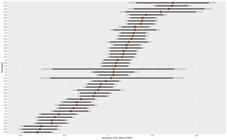
Main genotypic effects (HPD), with estimated confidence interval for each genotype tested. Main Genotypic Effects of Each Cultivar (G41) URS Penca, (G15) IPR Artêmis, (G29) URS 22 Londrina, (G39) URS Monarca, (G25) UPFA 22 Temprana, (G33) URS Torena, (G31) URS Altiva, (G13) IPR Afrodite, (G26) UPFA Fuerza, (G14) IPR Andrômeda, (G6) FAEM Carlasul, (G37) URS Guará, (G32) URS Brava, (G38) URS Guria, (G36) URS Fapa Slava, (G30) URS Altaneira, (G27) UPFPS Farroupilha, (G3) FAEM Brisasul, (G21) UPFA Gaudéria, (G2) FAEM Barbarasul, (G22) UPFA Ouro, (G43) URS Tarimba, (G9) FAPA5, (G5) FAEM 007, (G4) FAEM 006, (G10) FAPA6, (G42) URS Poente, (G7) FAEM Chiarasul, (G11) URS Guapa, (G40) URS Olada, (G34) URS Corona, (G44) URS Taura, (G35) URS Estampa, (G24) Teixeirinha, (G16) UFRGS 14 Amiga, (G8) Louise (FAPA4), (G1) FAEM Albasul, (G17) UFRGS 19, (G18) UPF 15, (G12) IAC 007, (G28) URS 21, (G19) UPF 16, (G23) UPFA 20 Teixeirinha, (G20) UPF 18.
The experiments were carried out using the protocol of the Brazilian Oat Research Commission. With 23 environments and 10 years, 44 genotypes, trials were laid out as incomplete block designs, with three replications (one replication in each block). The experimental units were composed of five sowing rows measuring five meters in length, spaced 0.17 meters apart, totaling 4.25 m2. The absolute population density used for this test network was 300 viable seeds per square meter, and basal fertilization and cultural practices were defined in accordance with the standards of the Brazilian Oat Research Commission.
The target variable for the estimates was grain yield per hectare (kg ha-1), corrected to 13% moisture. In order to better understand the variability between cultivation environments, information related to soil characteristics of each environment was used, from which the following parameters were inferred: organic carbon in the soil (g kg-1), total nitrogen accumulated in the soil (g kg-1), cation exchange capacity (cmolc kg-1) and clay content (g 100g-1); these data were obtained through the Soil Grid platform. The meteorological data (from 2014 to 2023) used were: mean air temperature (Tmean, ºC), minimum air temperature (Tmin, ºC), maximum air temperature (Tmax, ºC) and average monthly precipitation (mm), obtained through the NASA Power platform (Nasa Power 2024), as well as the geographic information altitude, longitude and latitude, obtained from the Google Earth platform (Google Earth 2024), expressed in order to better understand the results obtained.
The data matrix obtained was organized jointly using the agricultural year variation factor, cultivation environment, cultivar used, block and the grain yield variable, being subjected to descriptive analyses to understand the upper and lower limits, as well as the coefficients of variation obtained in each test, after extracting the outliers when necessary. Descriptive analyses were also carried out using central tendency statistics for soil and climate variables, which were expressed in a heatmap. Based on the available data matrix, estimates of the risk of recommending cultivars in multi-environment trials were carried out, using the model that combines agricultural years, regions of recommendation and cultivation environments proposed by Dias et al. (2022):
Where: : corresponds to the phenotypic effect of the j-th genotype, allocated in the p-th block, in the q-th years; is the overall mean; : effect of the k-th environments; : interaction between the q-th year and the k-th environments; : effect of the p-th block in interaction between q-th year and the environments; : effect of the j-th genotype; : interaction between the j-th genotype and the k-th environments; : experimental error associated whith the j-th genotype, k-th environments, q-th year, and p-th block.
The field data were determined as a priori information, after which it was subjected to Markov Chain Monte Carlo (MCMC) algorithms, and several re-samplings were carried out, obtaining several chains with more than a million comparisons. Under these conditions, a known a priori information matrix, random effects for the genotypes, 1000000 iterations and a burn-in of 100000 were considered. Based on this model, it was possible to obtain the decomposition of the effects of variances, stratified by the effects of environment (l), effects of the agricultural year (m), effects of the cultivar (g), and effects of the interactions g x l and g x m, highlighting the variance (var), standard deviation (sd), error attributed to the Naive algorithm (naive.se), the higher probability density (HPD) and confidence intervals between 5% (HPD 0.05) and 95% (HPD 0.95). The diagnosis of Markov chains was obtained based on the parameters maximum, minimum and mean probability, standard deviation of the probability, Akaike information criterion (WAIC), convergence function and effective sample size. In these precepts, up to four chains were estimated, and the most representative and correlated with the a priori data were used for the estimates. Afterwards, the distribution of the effects of each variance component, HPD by cultivar, the general, marginal and conditional probability, performance and stability of genotypes were estimated. All analyses were carried out in R software using the packages metan (Olivoto and Lúcio 2020), EnvRtype (Costa Neto et al. 2021), SoilType, rnaturalearth (South et al. 2017), ggplot2 (Wickham 2016) and ProbBreed (R Core Team 2015, Chaves et al. 2024).
RESULTS AND DISCUSSION
White oats have the characteristic of adapting to different types of soil. Acidity does not become a limiting factor for plant growth. The reference pH for optimal crop development is around 5.0 to 6.0, being responsive to 2.0 to 3.0% of organic nitrogen in the soil (Santos and Lima 2020). High fertility was observed in Cascavel - PR, Guarapuava - PR Pinhão - PR and Santa Tereza - PR. Considering all the environments studied, the state of Paraná has all high fertility environments (Figure 2S).

Joint probability for superior grain yield performance, marginal and joint stability based on posterior distributions. Joint Probability of Superior Performance and Superior Stability of Cultivars (G1) FAEM Albasul, (G10) FAPA6, (G11) URS Guapa, (G12) IAC 007, (G13) IPR Afrodite, (G14) IPR Andrômeda, (G15) IPR Artêmis, (G16) UFRGS 14 Amiga, (G17) UFRGS 19, (G18) UPF 15, (G19) UPF 16, (G2) FAEM Barbarasul, (G20) UPF 18, (G21) UPFA Gaudéria, (G22) UPFA Ouro, (G23) UPFA 20 Teixeirinha, (G24) Teixeirinha (G25) UPFA 22 Temprana, (G26) UPFA Fuerza, (G27) UPFPS Farroupilha, (G28) URS 21, (G29) URS 22 Londrina, (G3) FAEM Brisasul, (G30) URS Altaneira, (G31) URS Altiva, (G32) URS Brava, (G33) URS Torena, (G34) URS Corona, (G35) URS Estampa, (G36) URS Fapa Slava, (G37) URS Guará, (G38) URS Guria, (G39) URS Monarca, (G4) FAEM 006, (G40) URS Olada, (G41) URS Penca, (G42) URS Poente, (G43) URS Tarimba, (G44) URS Taura, (G5) FAEM 007, (G6) FAEM Carlasul, (G7) FAEM Chiarasul, (G8) Louise (FAPA4), (G9) FAPA5.
For the development of the white oat crop, it is essential that meteorological conditions are favorable, especially precipitation and air temperature. Variations in temperature and precipitation were observed between different growing environments (Figure 3S). The ideal temperature is between 20 °C and 25 °C, the lower basal temperature of oats is 4 ºC and the upper basal temperature is 30 ºC, that is, temperatures outside this range are harmful to the development of the crop, resulting in a decrease in yield and quality of the grains produced. In this context, from May to October there were maximum air temperatures of up to 33 °C and minimum temperatures of 7 °C, revealing large amplitudes that could lead to a reduction in crop performance. Between June and July, air temperatures often approached the lower and upper limits. For September and October, which coincide with the physiological maturity of the crop, some environments were challenging, such as São Carlos - SP and Capão Bonito - SP, mainly in relation to maximum air temperatures.
Based on the general a posteriori diagnosis, the variance and diagnostic probability components were estimated for the 44 oat cultivars grown in 23 environments (Table 3). The phenotypic magnitude is related to the effects of the growing environment, with a fraction resulting from genetic variation. Thus, by obtaining a relationship between phenotypic variance and genotypic variance, it becomes possible to demonstrate that for grain yield the environmental effect had a contribution of 13.73%, genotypic effect had a contribution of 13.20%, with 12.50% for the effects of the interaction between genotypes and environments. The year effect had the largest contribution to the total variance, with 33.80%. According to Loro et al. (2022), higher minimum air temperature and lower average temperature and relative air humidity improve the production performance of white oat genotypes, that is, a fact that justifies the greater contribution of the year to the expression of grain yield of white oats, due to the great meteorological variability. The triple interaction of genotypes x environments x years resulted in a contribution of 20%, while the residual component reveals only 6.70%.
The probability diagnosis provides a model fit; the maximum probability was 0.55 and the minimum was 0.00, with an average of 0.49. The standard deviation of the probability was also 0.49, indicating significance in the variability of predicted probabilities. The number of effective parameters was 47.57, with Akaike's criterion (WAIC) of 255906.14 being used to confirm the statistical models.
A posteriori information is generated through the actual distribution of a priori information. The prediction of four chains (1, 2, 3 and 4) was observed. Bayesian models are used to analyze individual differences between study subjects, where each subject may have a unique set of parameters that characterize their responses. A value of ^R close to 1 indicates strong convergence of the parameters. This indicates the effectiveness of the model in replicating the data distribution. The density of the generated data follows the trend of the real density, thus indicating the effectiveness of the model in replicating the distribution of the data that is observed, through the generated data (Figure S4).
In the analysis of Bayesian chains, it was possible through the six density graphs (Figure S4) to represent the predictions of the dependent variable grain yield in graph (a), which shows a normal distribution centered approximately around zero, graph (b), which represented the distribution of data from one (environment), with a tendency for positive values to right and also with a large part of values concentrated close to zero, graph (c) g (genotype), from which an asymmetric normal distribution was inferred, with values centered on zero or close to zero in the four chains, graph (d), which is the gl interaction between genotype × environment, graph (e) m (year), which represented an asymmetric normal distribution, with values centered on zero or close to zero in the four chains, and graph (f) gm, which represents the interaction between (genotype) and (year), presents values located exactly on the zero line or values very close to zero.
In the Bayesian chain analysis, the formation of six histograms was observed (Figure S5), which represent the distribution of genetic effects in relation to different components. Histogram (a) shows the distribution of sampled_y (grain yield), which shows us a normal distribution, centered approximately around zero. In histogram (b), the distribution of g (genotype) is observed, also appearing normal, close to zero, and can obtain a variance of -1000 to 1000. Histogram (c), which contains the distribution of values for the environments, shows an asymmetric distribution, concentrating values close to zero, but with a tendency of some values indicating high positive values to the right, which refer to one (year).
Note in histogram (d) the interaction between two components gl (interaction genotype × environment), where the distribution is extremely concentrated at zero, indicating that the values are at zero or very close to zero. In histogram (e), we obtain the values of m (year), with a normal distribution close to zero, which may show a variance from -1500 to 2000, varying in greater proportion to the negative left side. Finally, histogram (f), with the interaction between gm genotype and year, presents its distribution centered on zero or with values very close to zero.
According to the conditional probability between environments and cultivars (Table 4), it was observed that in the Pinhão-PR (E6) environment, no cultivar was recommended. However, in the Pato Branco-PR environment (E8), the cultivars URS Taura (G44) and URS Estampa (G35) both showed a conditional probability of 23.52%. FAPA 4 (G8) showed a higher probability in 16 environments, which indicates that this cultivar has potential for recommendation in the most diverse oat-producing environments in Brazil. The percentage indicates the variation of cultivars within each environment, showing the difference in response and adaptation in the environments. Understanding the genetic and environmental effects on the expression of oat production traits is essential to increase the response to selection of well-adapted, high-yielding cultivars (Mazurkievicz et al. 2019).
Cultivars IPR Artêmis (G15), URS Penca (G41), URS 22 Londrina (G29), URS Monarca (G39), UPFA 22 Temprana (G25), URS Torena (G33) and URS Altiva (G31) showed a higher probability (> 75%) of marginal superior performance compared to the others, highlighting the importance of carefully selecting cultivars to maximize performance (Figure 1). These findings corroborate those observed by Rother et al. (2019), who report that grain yield is controlled by a high number of genes and this characteristic is highly influenced by the environment, justifying the discrepancy in grain yield between different environments and growing seasons.
The height of the bars gradually increases from right to left, showing the difference between the cultivars (Figure 2), so the cultivars with the best stability are FAEM 007 (G5) and IPR Afrodite (G13). The cultivars with the highest joint probability were IPR Artêmis (G15), UPFA 22 Temprana (G25), URS 22 Londrina (G29), URS Altiva (G31), URS Torena (G33), URS Monarca (G39) and URS Penca (G41). Loro et al. (2022), when evaluating 26 white oat genotypes in 20 environments, found that the IPR Artêmis cultivar showed high performance in a large number of environments. This indicates that these cultivars were the most stable and best performing. However, all cultivars had a combined probability of less than 25%, that is, they all have less than a 25% probability of being among the cultivars with the highest performance and stability.
Risk probability analysis when recommending white oat cultivars has become important. With modern agriculture and to keep up with all the advances in technology, this component becomes essential to help make decisions with better information. Assessing the risks associated with different types of factors allows producers to have greater assurance that they choose cultivars that are responsive to their environment, aiming at the productivity and sustainability of the system. The adoption of risk analysis methods contributes to agricultural resilience, mitigating losses and promoting more efficient use of available resources, which is important for the continued development of agriculture in Brazil.
CONCLUSION
FAPA 4 cultivar showed the highest conditional probability of success in 16 environments. IPR Artemis cultivar showed the highest probability of superior performance. FAEM 007 and IPR Afrodite cultivars are the most stable.
These genetic bases will be responsible for building future blocks of crosses to build lines with potential for high genetic response and stability for grain yield in Brazil.
Data Availability
The datasets generated and/or analyzed during the current research are available from the corresponding author upon reasonable request.
REFERENCES
- Azevedo CF, Barreto CAV, Nascimento M, Carvalho IR, Cruz CD, Nascimento CC2023 Genotype-by-environment interaction of wheat using Bayesian factor analytic models and environmental covariates. Euphytica 219:95
- Berlezi JD, Carvalho IR, Silva JAG, Loro MV, Sfalcin IC, Pradebon LP, Ourique RS, Roza JPD2023 Selection of white oat genotypes for contrasting fungicide management conditions. Brazilian Agricultural Research 58:e03084
- Carvalho IR, Nardino M, Demari GH, Bahry CA, Szareski VJ, Pelissari G, Pelegrin AJ, Oliveira AC, Maia LC, Souza VQ2016 Bi-segmented regression, factor analysis and AMMI applied to the analysis of adaptability and stability of soybean. Australian Journal of Crop Science 10:1410-1416
- Chaves SFS, Krause MD, Dias LAS, Garcia AAF, Dias KOG2024 ProbBreed: a novel tool for calculating the risk of cultivar recommendation in multienvironment trials. G3: Genes, Genomes, Genetics 14: jkae013.
-
CONAB - Companhia Nacional de Abastecimento2022 Vintage historical series. Available at <Available at https://www.conab.gov.br/info-agro/safras/serie-historica-das-safras#gr%C3%A3os-2 >. Accessed on March 20, 2022.
» https://www.conab.gov.br/info-agro/safras/serie-historica-das-safras#gr%C3%A3os-2 - Costa Neto G, Galli G, Carvalho HF, Crossa J, Frtsche Frtsche, Neto R2021 EnvRtype: a software to interplay enviromics and quantitative genomics in agriculture. G3: Genes, Genomes, Genetics 11: jkab040.
- Dias KOG, Santos JPR, Krause MD, Piepho HP, Guimarães LJM, Pastina MM, Garcia AAF2022 Leveraging probability concepts for cultivar recommendation in multi-environment trials. Theoretical and Applied Genetics 135:1385-1399
-
FAOSTAT2022 Global area and Production of oats. Available at <Available at https://www.fao.org/faostat/en/#data/QCL >. Accessed on February 28, 2023.
» https://www.fao.org/faostat/en/#data/QCL -
Google Earth2024 Available at <Available at http://earth.google.com/ >. Accessed on July 10, 2024.
» http://earth.google.com/ - Hawerroth MC, Barbieri RL, Silva JAG, Carvalho FIF, Oliveira AC2014 Importância e dinâmica de caracteres na aveia produtora de grãos. Embrapa Documents 376:1-56
- Loro MV, Cargnelutti Filho A, Ortiz VM, Andretta JA, Reis MB2024 Adaptability and stability of open-pollinated corn varieties in Santa Maria, state of Rio Grande do Sul. Caderno Pedagógico Journal 21:e4211
- Loro MV, Carvalho IR, Cargnelutti Filho A, Hoffmann JF, Kehl K2023 Wheat grain biofortification for essential amino acids. Brazilian Agricultural Research 58:e02860
- Loro MV, Carvalho IR, Silva JAG, Sfalcin IC, Pradebon LC2022 Decomposition of white oat phenotypic variability by environmental covariates. Brazilian Journal of Agriculture 97:279-302
- Malikouski RG, Ferreira FM, Chaves SFDS, Couto EGDO, Dias KOG, Bhering LL2024 Recommendation of Tahiti acid lime cultivars through Bayesian probability models. Plos ONE 19:e0299290
- Maximino JV, Barros LM, Pereira RM, Santi II, Aranha BC, Busanello C, Viana VE, Freitag RA, Batista BL, Oliveira AC, Pegoraro C2021 Mineral and fatty acid content variation in white oat genotypes grown in Brazil. Biological Trace Element Research 199:1194-1206
- Mazurkievicz G, Ubert IP, Krause FA, Nava IC2019 Phenotypic variation and heritability of heading date in hexaploid oat. Crop Breeding and Applied Biotechnology 19:436-443
-
Nasa Power - National Aeronautics, Space Administration2023 Prediction of worldwide energy resources. Available at <Available at https://power.larc.nasa.gov />. Accessed on July 15, 2024.
» https://power.larc.nasa.gov - Olivoto T, Lúcio AD2020 Metan: An R package for multi-environment trial analysis. Methods in Ecology and Evolution 11:783-789
- Pradebon LC, Carvalho IR, Silva JAG, Loro MV, Pettenon AL, Roza JPD, Schulz AD, Silva TB2024 Selection based on the phenomenic approach and agronomic ideotic of white oat. Agronomy Journal 116:1275-1289
-
R Core Team2015 R: A language and environment for statistical computing. R Foundation for Statistical Computing. Available at <https://www.R-project.org>.
» https://www.R-project.org - Rother V, Verdi CA, Thurow LB, Carvalho IR, Oliveira VF, Maia LC, Venski E, Pegoraro C, Oliveira AC2019 Uni-and multivariate methods applied to the study of the adaptability and stability of white oat. Pesquisa Agropecuária Brasileira 54:e00656
- Santos MD, Lima L2020 Oat Culture: Adaptation and Development in Different Soils. Agronomy Journal 34:45-56
- Schmidt AL, Carvalho IR, Silva JAG, Lângaro NC, Oliveira AC, Pradebon LC, Loro MV, Roza JP, Bruinsma GM2023 Decomposition of phenotypic variation of white oats by meteorological and geographic covariables. Agronomy Journal 115:2239-2259
- Schneider RO, Carvalho IR, Szareski VJ, Kehl K, Levien AM, Silva JAG, Hutra DJ, Souza VQ, Lautenchleger F, Loro MV2021 Bayesian inference and prediction applied to the positioning of wheat yield grown in Southern Brazil. Functional Plant Breeding Journal 3:15-32
-
South A2017 Rnaturalearth: World map data from natural earth. R package version 0.1.0. Available at <Available at https://cran.r-project.org/package=rnaturalearth >. Accessed on July 15, 2024.
» https://cran.r-project.org/package=rnaturalearth -
Wickham H2016 Ggplot2: Elegant Graphics for Data Analysis. Available at <Available at https://ggplot2.tidyverse.org >. Accessed on July 10, 2024
» https://ggplot2.tidyverse.org


