
 Global guidelines, local realities: toward equitable neurocritical care, local data generation and practice patterns in low- and middle-income countries
Spending a night on call in a busy intensive care unit in Kathmandu or Kampala teaches you two things fast. First, the physiology of critical illness does not respect borders. Second, the information systems that support our decisions still do. While clinical guidelines are easily accessible online, the granular data that reveal how those guidelines play out on the ground are often missing. Bridging that gap is among the most important and achievable projects in global critical care.
Recent narrative work demonstrates that the weakest links in many low- and middle-income countries’ (LMICs) critical care systems are not ventilators or vasopressors but reproducible processes for collecting and using local information.(1) Without timely data, it is difficult to plan staffing, justify budgets, or persuade policymakers. Yet the technical hurdles to basic data capture have never been lower.
Variation in practice underlines the urgency. The global WEAN SAFE study, enrolling nearly 6,000 ventilated patients across 50 countries, revealed striking differences in weaning strategies, extubation failure, and intensive care unit (ICU) length of stay across income groups.(2) A cross-sectional survey from Malawi painted an equally vivid picture of constraints: only one ventilator bed per 1.3 million citizens and frequent stock-outs of basic consumables.(3) These studies resonate because they rely on data rather than anecdotes.
Intensive care unit registries provide a workable template. Nepal's national registry now aggregates information from 20 hospitals, cataloguing case-mix, organ support, and outcomes in near real time.(4) A 5-year review from Tanzania highlighted a growing burden of non-communicable disease among ICU admissions.(5)
Additional disease-specific cohorts, such as the VENTILOMICS survey on traumatic brain injury ventilation,(6) the CREVICE protocol trial in Bolivia and Ecuador,(7) and the ENIO study on acute brain injury(8) illustrate how registries and cohort efforts can illuminate disparities and generate actionable knowledge in LMICs.
The coronavirus disease 2019 (COVID-19) pandemic further demonstrated the adaptability of registries. Networks already capturing routine ICU data rapidly pivoted to track ventilator allocation, steroid uptake, and vaccine status, providing early effectiveness signals in resource-limited settings.(9) These datasets informed national oxygen policies and procurement decisions faster than traditional trials could.
Local data also keeps us honest about predictive tools: a global individual participant data meta-analysis reported that models derived in high-income settings showed good discrimination but poor calibration when exported to LMICs.(10) There is also a broader justice angle: calls to decolonize critical-care publishing and bridge applications across income levels emphasize equitable authorship and open data sharing as part of the solution.(11,12)
Bridging the translation gap from high-income country guidelines
Guidelines have undoubtedly advanced critical care. However, protocols developed in high-income countries (HICs) are not always directly applicable in LMICs, where infrastructure gaps - advanced ventilators, neuromonitoring tools, and adequately trained personnel - limit feasibility.(13,14) The VENTILOMICS study - spanning 28 countries - demonstrated the potential of collaborative networks to generate geographically representative data and underscored inequities such as the limited availability of intracranial pressure monitoring and continuous electroencephalogram.(6) Addressing these inequities requires both adapted recommendations and targeted investments. Table 1 outlines the International Initiative for Research recommendations across three domains -infrastructure, training, and collaboration
The importance of specialized neurocritical care units
One under-discussed dimension is the role of specialized ICU care, including neurocritical care and stroke units. Even in resource-limited settings, trained personnel working in organized units can meaningfully improve outcomes for patients with severe neurological conditions. Data from LMICs suggest substantial variation in the availability of dedicated neurointensive care units, with lower access in low-income settings compared to lower-middle-income settings.(15)
Evidence-based implementation strategies
Transforming evidence into action requires adaptation to local realities. The CREVICE protocol offers a model of noninvasive neuromonitoring that is feasible in settings with computed tomography access and bedside neurological monitoring, allowing quality care despite the absence of invasive intracranial pressure monitoring.(7) Low-cost strategies - such as affordable ventilators, portable ultrasound, smartphone-based pupillometry, intermediate units, tele-neurocritical care, and disease-specific protocols - have demonstrated potential to reduce costs and improve outcomes.(16,17)
Barriers and facilitators to implementation
Barriers include limited infrastructure, a shortage of trained personnel, and inconsistent access to essential consumables. Facilitators include collaborative research networks, open-access tools, innovative care models, and locally tailored protocols. Figure 1, summarizing these elements in two columns ("Facilitators" versus "Barriers"), can enhance readability and visual impact.
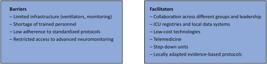
Facilitators and barriers to neurocritical care implementation in low- and middle-income countries.
Equity in authorship and data sharing
Equity in authorship and data ownership is essential. Practical steps include LMIC co-leadership in multicenter projects, transparent data-sharing agreements, capacity building in study design, analysis, and writing, and prioritizing venues that privilege locally generated data.(11,12)
Conclusion
Strengthening epidemiological research in LMICs is not only a matter of justice but a strategic necessity for global medicine. By expanding specialized units, investing in registries and cohort efforts, promoting equitable authorship, and adapting protocols to resource constraints, we can move toward a more inclusive, practical, and effective neurocritical care system worldwide.
REFERENCES
- 1 Spencer SA, Adipa FE, Baker T, Crawford AM, Dark P, Dula D, et al. A health-systems approach to critical care delivery in low-resource settings: a narrative review. Intensive Care Med. 2023;49(7):772-84.
- 2 Pham T, Heunks L, Bellani G, Madotto F, Aragao I, Beduneau G, et al.; WEAN SAFE Investigators. Weaning from mechanical ventilation in intensive care units across 50 countries (WEAN SAFE): a multicenter, prospective, observational cohort study. Lancet Respir Med. 2023;11(5):465-76.
- 3 Sonenthal PD, Kasomekera N, Connolly E, Wroe EB, Katete M, Minyaliwa T, et al. Critical care units in Malawi: a cross-sectional study. Ann Glob Health. 2023;89(1):51.
- 4 Aryal D, Thakur A, Gauli B, Paneru HR, Koirala K, Khanal K, et al. Epidemiology of critically ill patients in intensive care units in Nepal: a retrospective observational study. Wellcome Open Res. 2023;8:180.
- 5 Kassam N, Adebayo PB, Matei IM, Aghan E, Somji S, Kadelya SP, et al. The pattern of admission, clinical characteristics, and outcomes among patients admitted to the intensive care unit of a tertiary hospital in Tanzania: a 5-year retrospective review. Patient Relat Outcome Meas. 2023;14:383-92.
- 6 Prabhakar H, Mahajan C, Kapoor I, Shrestha GS, Picetti E, Robba C, et al. VENTIlatory strategies for patients with severe traumatic brain injury in the LOw- and Middle-Income CountrieS. The VENTILOMICS survey. Cri Care Sci. 2025;37:e20250062.
- 7 Chesnut RM, Temkin N, Videtta W, Petroni G, Lujan S, Pridgeon J, et al. Consensus-Based Management Protocol (CREVICE Protocol) for the treatment of severe traumatic brain injury based on imaging and clinical examination for use when intracranial pressure monitoring is not employed. J Neurotrauma. 2020;37(11):1291-9.
- 8 Feng SN, Diaz-Cruz C, Cinotti R, Asehnoune K, Schultz MJ, Shrestha GS, et al.; ENIO collaborators. Impact of country income level on outcomes in patients with acute brain injury requiring invasive mechanical ventilation: a secondary analysis of the ENIO study. Neurocrit Care. 2025;43(1):243-53.
- 9 Dongelmans DA, Quintairos A, Buanes EA, Aryal D, Bagshaw S, Bendel S, et al. Worldwide clinical intensive care registries response to the pandemic: an international survey. J Crit Care. 2022;71:154111.
- 10 Damen JA, Arshi B, van Smeden M, Bertagnolio S, Diaz JV, Silva R, et al. Validation of prognostic models predicting mortality or ICU admission in patients with COVID-19 in low- and middle-income countries: a global individual participant data meta-analysis. Diagn Progn Res. 2024;8(1):17.
- 11 Salluh JIF, Nassar AP Jr, Estenssoro E, González-Dambrauskas S, Ferreira JC. Decolonise publishing to reduce inequalities in critical care. Lancet. 2025;405(10481):780-1.
- 12 Pisani L, Siika WW, Hashmi M. Editorial: Critical care applications: bridging high, medium and low-income settings. Front Med (Lausanne). 2024;11:1376791.
- 13 GBD 2016 Neurology Collaborators. Global, regional, and national burden of neurological disorders, 1990-2016: a systematic analysis for the Global Burden of Disease Study 2016. Lancet Neurol. 2019;18(5):459-80.
- 14 Shrestha GS, Nepal G, Prabhakar H, Prust ML. Cost-effectiveness of neurocritical care in settings with limited resources. Lancet Glob Health. 2023;11(9):e1343.
- 15 Prabhakar H, Lele AV, Kapoor I, Mahajan C, Shrestha GS, Rao CV, et al. Neurocritical care organization in the low-income and middle-income countries. Neurocrit Care. 2025;43(1):141-56.
- 16 Shrestha GS, Lamsal R. Neurocritical care in resource-limited settings. J Neurosurg Anesthesiol. 2020;32(4):285-6.
- 17 Shrestha GS, Nepal G, Brasil S. Low-cost strategies for the development of neurocritical care in resource-limited settings. Neurocrit Care. 2025;42(3):1087-98.
Edited by
-
Responsible editor:
Ary Serpa-Neto https://orcid.org/0000-0003-1520-9387

