Analysis of submicrometric hydroxyapatite powder as obtained by drilling and milling pork bones
Abstract
Hydroxyapatite is a commonly used biomaterial in medical and dental implants. While it can be synthesized, it is often extracted from bovine bone. However, challenges persist in the extraction process, such as ensuring reproducibility in particle size and distribution, crystallinity, and cost-effective large-scale production. This study employs porcine bone drilling for the first time, complemented by mechanical milling and calcination, and aims to determine the route that allows obtaining submicrometric HA powders with high crystallinity and the smallest possible particle size. Characterization of the obtained powders was performed using X-ray diffraction (XRD), energy-dispersive X-ray spectroscopy (EDS), scanning electron microscopy (SEM), and Fourier-transform infrared analysis (FTIR). The resulting material in the sequence drilling-milling-calcination shows high crystallinity and purity, although larger particle sizes were observed compared to those reported in the literature. Additionally, highly pure HA with particle sizes ranging from 160 to 510 nm (mean: 277.3 nm) was obtained via the drilling-calcination-milling sequence. This particle size range represents a significant improvement in size reduction compared to other mechanical methods reported in the literature.
Keywords:
Hydroxyapatite; drilling; milling; XRD - SEM - FTIR; porcine bone
INTRODUCTION
Hydroxyapatite (HA), the essential mineral constituent of hard biological tissues such as teeth and bones, is a ceramic biomaterial known for its biocompatibility, bioactivity, and osteophilic nature, making it widely used in medical applications for bone repair, such as filling bone cavities, coating surfaces for implants, and tissue engineering 1)-(6. HA can be derived from natural sources or synthesized chemically. Through both approaches, materials with comparable physicochemical and morphological properties are obtained, whereby their application in various areas is enabled 2)-(4. Among the natural sources used for obtaining HA are animal bones, with bovine and porcine bones being the most employed, along with other materials such as oyster shells, chicken eggshells, and fish scales 4),(7)-(9. On the other hand, the production of HA involves various methodologies, which are generally classified into wet and dry processes. Although effective, wet processes are complex and costly due to the need for precise control of chemical reactions. Several studies have synthesized HA through these processes, achieving particles of micrometric, submicrometric, and nanometric sizes 10), (11. In contrast, dry methods, such as mechanical milling and calcination processes, have emerged as viable alternatives for obtaining HA from biological sources. However, ensuring reproducibility in terms of particle size, size distribution, and crystallinity remains a significant challenge.
Mechanical milling is an effective processing method to produce micro- and nanostructured materials. By mechanically activating the material, this process reduces both reaction times and calcination temperatures, resulting in unique properties such as metastable crystalline and amorphous phases, as well as nanostructured materials. This cost-effective method has proven successful in obtaining HA powder from animal sources due to its short manufacturing times 1),(7), (12. However, the efficiency of the process largely depends on the characteristics of the precursor material, which must have sufficiently small particle sizes to ensure effective interaction during milling. Therefore, the present study proposes an innovative approach that includes drilling porcine bone to obtain HA precursor material. This method aims to improve the results in subsequent milling and calcination stages.
Drilling is a machining process used to create circular holes in solids. Typically, a cylindrical drill bit with two cutting edges at its ends is employed, which rotates to perforate the material. When this process is carried out on ceramic materials, fine powders are obtained due to the detachment of particles from the perforated space 13. This study employs porcine bone drilling for the first time, complemented by mechanical milling and calcination, and aims to determine the route that allows obtaining submicrometric HA powders with high crystallinity and the smallest possible particle size.
EXPERIMENTAL
Figure 1 illustrates the experimental process for producing biologically sourced hydroxyapatite powders, encompassing drilling, mechanical milling, and calcination. Starting with deproteinized bone fragments as HA precursors, the process involves two sequences of drilling, milling, and calcination to obtain crystalline HA powders. Subsequently, samples are characterized using X-ray diffraction (XRD), energy-dispersive X-ray spectroscopy (EDS), scanning electron microscopy (SEM), and Fourier-transform infrared analysis (FTIR).

Experimental process for producing hydroxyapatite powders flowchart, with drilling, mechanical milling and calcination.
Deproteinized bone fragments were prepared using the method outlined by Khoo et al. 7, involving boiling bone fragments in water to remove macroscopic impurities. After discarding joints, spinal cord, tendons, and soft tissues, bones undergo conventional washing and a 1-hour acetone immersion for thorough fat and impurity removal.
An innovative method was used to obtain pork bone powder as a precursor to HA, which involves dry drilling of the bone and capturing the powder released. Figure 2 presents the system that simultaneously holds the bone and prevents powder volatilization during drilling. The designed system consists of a box made up of the following components: a PLA base, two rubber plates, a sliding acrylic cover with holes, and rubber caps. The bone is placed inside the base and held with a press, with two rubber plates between the press and the bone that help distribute the pressure, preventing bone fracture and contamination, and escape of the produced powder. The drill bit is inserted through one of the holes in the sliding plate to drill the bone, while the other holes remain sealed with rubber cups. This configuration only allows the powder to exit through the bottom of the box, where a bag can be placed to collect the precursor material.

Components of the system for securing pork bone and setting up for the drilling process and smooth capture.
The milling of precursor powder utilized a Fritsch Pulverisette 6 mill with stainless steel balls and a jar. A ball-to-powder mass ratio of 20:1 was maintained at 300 rpm, with milling times of 2 and 4 hours, alternating rotation direction every hour, and 10-minute pauses between intervals.
Powder calcination was performed in an MF-202 muffle furnace, with a heating rate of 15 °C/min, ramping from 500 °C to 700 °C for 3 h.
Two sequences were employed for hydroxyapatite powder production post-deproteinization. The first involved drilling and powder capture, followed by milling for particle size reduction and subsequent calcination (drilling-milling-calcination). The second sequence initiated with drilling, followed by calcination, and concluded with milling (drilling-calcination-milling).
Characterization of powders using XRD employed a Bruker D2 PHASER diffractometer with Cu Kα radiation operated in the continuous-scan mode. The voltage and current of the operation were 30 kV and 10 mA, respectively. Data were collected at 2-s intervals, using a step size of 0.02°. Rietveld refinement of the XRD profiles using the Profex software was performed on the sample with a smaller particle size.
Morphological and EDS analyses for the drilling-milling-calcination sequence were conducted using a TESCAN VEGA 3 scanning electron microscope at 1000x and 5000x magnifications. For the drilling-calcination-milling sequence, a Zeiss Evo scanning electron microscope was used at 5000x and 10000x magnifications. For the particle size histogram acquisition, the intercept method was used, and 100 particles were measured using the Fiji software.
To perform the FTIR characterization of the HA samples under different thermal treatments, a Thermo Scientific Nicolet iS10 was used by the KBr pellet method in a range of 400 - 4000 cm-1 with a spectrum resolution of 4 cm-1.
RESULTS AND DISCUSSION
Using the drilling method described earlier, fine powders from porcine bone were obtained, sieved through a 325-mesh (45 µm) sieve. To further reduce particle size, the powders underwent a milling process in a mono-planetary mill at 300 rpm for 2 h (sample DM2H). Subsequently, different calcination temperatures (500, 600, 650, and 700 °C) were evaluated to determine the suitable thermal treatment for HA crystallization. X-ray diffraction patterns in Figure 3 show that crystalline HA peaks became well-defined at 700 °C for 3 h, indicating successful crystallization. These results indicate that calcination at 700 °C for 3 h achieved HA crystallization at a lower temperature and shorter duration than reported by Bui X. V. et al. 14.

X-ray diffraction patterns of DM2H samples obtained by the drilling-milling-calcination process with a milling time of 2 h, a rotation speed of 300 rpm, and calcination temperatures of 500, 600, and 700 °C, compared with the uncalcined sample and reference HA ICSD 082289.
Infrared spectroscopy (FTIR) for DM2H calcinated samples at 500, 600, 650, and 700 °C are shown in Figure 4. In every sample, the presence of OH- (at 1094 and 630 cm-1) and PO4 3- groups (at 1638, 1087, 1032, 962, 600, and 561 cm-1) are confirmed 6),(7. The observed bands aligned with those of typical HA, indicating the correct chemical composition. On the other hand, the bands observed at the crystallization temperature of HA (700 °C) are identical to those in the sample calcined at 500 °C. This suggests that at 500 °C, only the HA components are present, but in an amorphous phase. Furthermore, organic compounds are eliminated at temperatures below 500 °C.

FTIR spectra of DM2H samples obtained by the drilling-milling-calcination process with a milling time of 2 h, a rotation speed of 300 rpm, and calcination temperatures of 500, 600, and 700 °C.
The sample obtained through drilling, milled for 2 hours, and calcined at 700 °C for 3 h is referred to as DM2H-C700. Evaluating the impact of milling time on hydroxyapatite powder characteristics, porcine bone powders obtained through drilling were milled for 4 hours at the same rotation speed. For comparison, these powders were also calcined at 700 °C for 3 h, labeled as DM4H-C700. X-ray diffraction patterns in Figure 5 show crystalline HA formation in both samples, without significant differences in the profiles.

Comparison of X-ray diffraction patterns of samples obtained in the drilling-milling-calcination sequence, calcined at 700 °C for 3 h, and milled for 2 h (DM2H-C700), and for 4 hours (DM4HC700), concerning HA ICSD 082289.
Figure 6 displays the outcomes of scanning electron microscopy for drilled, milled, and calcined samples at 700 °C for 3 hours, namely DM2H-C700 and DM4H-C700, at different magnifications (1000x and 5000x). Figures 6a and 6b correspond to sample DM2H-C700, while Figures 6c and 6d correspond to sample DM4H-C700. Particle size distribution histograms for these samples, derived from SEM images, are presented in Figure 7, and the main results are detailed in Table 1. From the data obtained, it can be observed that both samples exhibit a similar particle size distribution, characterized by comparable minimum and maximum sizes. However, for the DM4H-C700 sample, a slightly smaller mean particle size and a higher standard deviation were observed. The reduction of particle size was not found to be significantly affected by increasing the milling time. However, this result represents an improvement over the findings reported by Khoo et al. 7 and the patent by Betancur et al. 15, where crystalline hydroxyapatite was reported with particle sizes of 125 µm and 140 µm, respectively.

SEM micrographs of samples a) DM2H-C700 at 1000x, b) DM2H-C700 at 5000x, c) DM4H-C700 at 1000x, and d) DM4H-C700 at 5000x obtained in the drilling-milling-calcination sequence, with calcination temperature of 700 °C for 3 h.

Particle size distribution histograms derived from the SEM micrograph at 1000x of the samples DM2HC700and DM4H-C700.
Data on particle size distribution from the histograms in samples obtained by drilling, milling, and calcination at 700 °C for 3 h, with milling times of 2h (DM2H-C700) and 4h (DM4H-C700).
Additionally, chemical analysis using energy-dispersive X-ray spectroscopy (EDS) was performed on these samples, and the results are presented in Table 2 and Figure 8. Elements O, Ca, and P, characteristic of hydroxyapatite (Ca10(PO4)6(OH)2), were detected in each sample, with the percentage corresponding to the stoichiometry of this compound. Besides typical HA elements, a considerable amount of carbon was also observed. However, this can be attributed to the carbon tape used for microscope sample preparation. Traces of Na, commonly found in biological materials, were also identified, consistent with reports in the literature 15), (16.
Atomic percentage of quantified elements by EDS in samples obtained by drilling, milling, and calcination at 700°C for 3 h, with milling times of 2h (DM2H-C700) and 4h (DM4H-C700).

Element quantification graph by EDS of the samples obtained through drilling and milling, andcalcined at 700 °C for 3 h, with milling times of a) 2h (DM2H-C700) and b) 3h (DM4H-C700).
Material characterization results indicate the successful production of highly crystalline stoichiometric HA without foreign elements or impurities. The employed methodology enabled a reduction in calcination temperature and time compared to the work of Bui X. V. et al. 14. Nonetheless, the achieved particle size remains significantly larger than that reported by the mentioned author.
This hydroxyapatite powder production sequence allowed for a reduction in calcination temperature and time while maintaining high crystallinity. However, achieving submicron particle size was challenging, likely due to organic compounds in the drilled powder providing mechanical strength against the milling impact. This led to a modification of the process sequence by performing calcination before milling, as described in the next section.
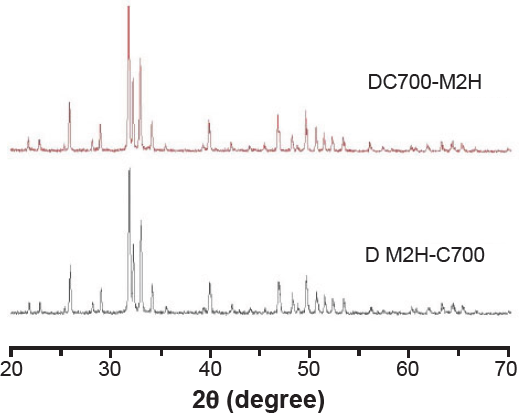
Porcine bone powders obtained through drilling were subjected to calcination before milling. For comparison with the previous sequence, thermal treatment was performed at 700°C for 3 h and milling for 2 h. The resulting sample is denoted as DC700-M2H. X-ray diffraction in Figure 9 compares DC700-M2H with DM2H-C700, revealing characteristic HA peaks. It is shown that in the calcined sample before milling, crystalline HA is also obtained at 700 °C.
Comparison of X-ray diffraction patterns of samples obtained in the drilling-milling-calcination sequence (DM2H-C700) and the drilling-calcination-milling sequence (DC700-M2H), milled for 2 h and calcined at 700 °C for 3 h.
SEM results in Figure 10 show that the DC700 sample, which was milled for 2 h (DC700-M2H), displays a substantial reduction in particle size compared to the DM2H-C700 sample. The particle size distribution histogram is presented in Figure 11, which was derived from the SEM image shown in Figure 10b. A Gaussian distribution can be observed, with a calculated mean particle size of 277.3 nm, a standard deviation of 79.4 nm, a minimum value of 157 nm, and a maximum value of 510 nm. This achievement surpassed the particle size reduction reported in previous studies 14), (17.
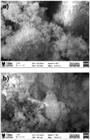
SEM micrographs of samples DC700-M2H a) at 5000x and b) at 10000x obtained in the drillingcalcination-milling sequence, with calcination temperature of 700 °C for 3 h and milling for 2 h at 300 rpm.

Particle size distribution histogram derived from the SEM micrograph at 10000x of the sample DC700-M2H, obtained in the drilling-calcination-milling sequence, with calcination temperature of 700 °C for 3 h and milling for 2 h at 300 rpm.
These results indicate that pre-calcination is a suitable option for decreasing the final HA powder particle size. Additionally, it can be observed that there is no adverse effect on the crystallization of the sample with calcination at 700°C, despite not having performed milling before calcination 16), (18), (19.
Given that the smallest particle size and high crystallinity were exhibited by the DC700-M2H sample, the XRD profiles were subjected to Rietveld structure refinement using Profex software 20. The comparison between observed and calculated profiles is shown in Figure 12. The refinement parameters were χ2 = 1.11, Gof = 1.05, RwP = 19.67, and Rexp = 19.70. These parameters were obtained considering the HA phase as the only crystalline phase. The calculated crystallite size was 141 nm ± 4 nm. This is in accordance with the SEM results, where particles of a minimum value of 157 nm were observed.

Comparative diffractogram between the experimental function and the calculated Rietveld function with PROFEX of the sample DC700-M2H obtained in the drilling calcination-milling sequence, with calcination temperature of 700 °C for 3 h and milling for 2 h at 300 rpm.
Regarding the elements present in the DC700-M2H sample, the results of the EDS analysis are presented in Figure 13 and Table 3. A similar outcome was obtained for the DM2H-C700 and DM4H-C700 samples, where elements characteristic of hydroxyapatite and traces of Na were identified. However, in this case, traces of Mg were also detected. These elements, along with carbon, are attributable to the containers used for SEM analysis.

EDS elemental quantification results for sample DC700 -M2H, obtained via the drilling-calcination-millingsequence (calcination: 700 °C for 3 h; milling: 300 rpm for 2 h).

Infrared spectroscopy (FTIR) in Figure 6 for DC700-M2H once again confirmed the correct chemical composition of hydroxyapatite. The observed bands aligned with those of typical HA. These results are similar to those obtained for the DM2H samples, indicating that only components characteristic of natural HA are present. Additionally, based on this result, together with the Rietveld refinement and EDS analysis, it is suggested that highly pure HA powders were obtained.
CONCLUSIONS
It has been demonstrated by this study that hydroxyapatite can be reproducibly and cost-effectively derived from porcine bone. This process represents a more viable alternative compared to conventional methods. Porcine bone powder with particles smaller than 45 µm is obtained through the combination of drilling and mechanical milling. Furthermore, crystallization of HA was achieved through calcination (700°C, 3 h) within the drilling-milling-calcination sequence. Increasing the milling time from 2 to 4 h did not significantly affect particle size reduction, with a mean particle size of approximately 6 µm obtained in both cases. The resulting material exhibits high crystallinity and purity, although larger particle sizes were observed compared to those reported in the literature. Highly pure HA with particle sizes ranging from 160 to 510 nm (mean: 277.3 nm) was obtained via the drilling-calcination-milling sequence. This particle size range represents a significant improvement in size reduction compared to other mechanical methods reported in the literature. Future work could focus on completing milling studies for this sequence, automating the process of obtaining porcine bone powders, and conducting biological studies on the obtained material.
ACKNOWLEDGMENTS
The authors thank Antonio Nariño University for supporting this work under internal project code 2019211. This article stems from this project, which carries the product code PI/UAN-2025-730GIBIO. Additionally, the authors thank the laboratory staff of the Faculty of Mechanical, Electronic, and Biomedical Engineering, Universidad Antonio Nariño (Bogotá South campus). Operational contributions were provided by Dr. Vicente Benavidez for supporting the Rietveld refinement analysis and particle size determination, Daniel Llamosa (Faculty of Sciences, Universidad Antonio Nariño, Bogotá), and Diego Mauricio Sandoval (Department of Physics, Faculty of Natural, Exact and Educational Sciences, University of Cauca).
DATA AVAILABILITY STATEMENT
Research data are only available upon request.
REFERENCES
-
1 J. K. Odusote, Y. Danyuo, A. D. Baruwa, and A. A. Azeez. Synthesis and characterization of hydroxyapatite from bovine bone for production of dental implants. J. Appl. Biomater. Funct. Mater. 2019;17:1-7. doi:10.1177/2280800019836829.
» https://doi.org/10.1177/2280800019836829 -
2 J. I. González et al. Osteoblast responses to injectable bone substitutes of κ-carrageenan and nano hydroxyapatite. Acta Biomaterialia. 2019;83:425-434. doi:10.1016/j.actbio.2018.10.023.
» https://doi.org/10.1016/j.actbio.2018.10.023 -
3 A. Villani, A. Millán, and G. González. Caracterización físico-química y cerámica de hidroxiapatitas producidas por distintos métodos de síntesis: Parte II: Efectos del tratamiento térmico TT. Rev. la Fac. Ing. Univ. Cent. Venez. 2015;30:201-210. doi:10.56152/stevianafacenv6a5_2014.
» https://doi.org/10.56152/stevianafacenv6a5_2014 -
4 S. C. Wu, H. C. Hsu, S. K. Hsu, C. P. Tseng, and W. F. Ho. Preparation and characterization of hydroxyapatite synthesized from oyster shell powders. Adv. Powder Technol. 2017;28:1154-1158. doi:10.1016/j.apt.2017.02.001.
» https://doi.org/10.1016/j.apt.2017.02.001 -
5 S. J. Ahn et al. Characterization of hydroxyapatite-coated bacterial cellulose scaffold for bone tissue engineering. Biotechnol. Bioprocess Eng. 2015;20:948-955. doi:10.1007/s12257-015-0176-z.
» https://doi.org/10.1007/s12257-015-0176-z -
6 J. I. González, D. M. Escobar, and C. P. Ossa. Porous bodies of hydroxyapatite produced by a combination of the gel-casting and polymer sponge methods. J. Adv. Res. 2016;7:297-304. doi:10.1016/j.jare.2015.06.006.
» https://doi.org/10.1016/j.jare.2015.06.006 -
7 W. Khoo, F. M. Nor, H. Ardhyananta, and D. Kurniawan. Preparation of natural hydroxyapatite from bovine femur bones using calcination at various temperatures. Procedia Manuf. 2015;2:196-201. doi:10.1016/j.promfg.2015.07.034.
» https://doi.org/10.1016/j.promfg.2015.07.034 -
8 O. Ojeda, C. Blanco, C. Daza, and J. Salcedo. High temperature CO₂ capture of hydroxyapatite extracted from tilapia scales. Univ. Sci. 2017;22:3. doi:10.11144/javeriana.sc22-2.htcc.
» https://doi.org/10.11144/javeriana.sc22-2.htcc -
9 S. Sathiskumar, X. Xin, L. Chengyu, and P. Xinsheng. Ultrasonic-assisted green synthesis and characterization of nano-hydroxyapatite from Cirrhinus molitorella fish scales bio-waste for biomedical applications. Ceram. Int. 2025;(online):215. doi:10.1016/j.ceramint.2025.02.215.
» https://doi.org/10.1016/j.ceramint.2025.02.215 -
10 A. V. Paduraru, O. Oprea, A. M. Musuc, B. S. Vasile, F. Iordache, and E. Andronescu. Influence of terbium ions and their concentration on the photoluminescence properties of hydroxyapatite for biomedical applications. Nanomaterials. 2021;11:2442. doi:10.3390/nano11092442.
» https://doi.org/10.3390/nano11092442 -
11 A. V. Paduraru, A. M. Musuc, O. C. Oprea, R. Trusca, F. Iordache, B. S. Vasile, and E. Andronescu. Synthesis and characterization of photoluminescent Ce(III) and Ce(IV) substituted hydroxyapatite nanomaterials by co-precipitation method: cytotoxicity and biocompatibility evaluation. Nanomaterials. 2021;11:1911. doi:10.3390/nano11081911.
» https://doi.org/10.3390/nano11081911 -
12 T. Mandal, B. K. Mishra, A. Garg, and D. Chaira. Optimization of milling parameters for the mechanosynthesis of nanocrystalline hydroxyapatite. Powder Technol. 2014;253:650-656. doi:10.1016/j.powtec.2013.12.026.
» https://doi.org/10.1016/j.powtec.2013.12.026 - 13 M. Groover. Introducción a los Procesos de Manufactura. Mc Graw Hill, Mexico; 2014.
-
14 X. V. Bui and H. L. Truong. Extraction of pure hydroxyapatite from porcine bone by thermal process. Metall. Mater. Eng. 2019;25:47-58. doi:10.30544/410.
» https://doi.org/10.30544/410 -
15 A. L. G. Betancur, M. E. R. García, and S. J. J. Sandoval. Method for obtaining hydroxyapatite from bone. WO 2015/162589 A2;2015. doi:10.1016/B978-1-78242-033-0.00012-2.
» https://doi.org/10.1016/B978-1-78242-033-0.00012-2 -
16 J. Park and R. S. Lakes. Biomaterials: An Introduction, 3rd ed. Iowa: Springer; 2007. p. 515. doi:10.1007/978-1-4757-2156-0_1.
» https://doi.org/10.1007/978-1-4757-2156-0_1 - 17 L. B. Bonilla. Estudio de la influencia que tiene la molienda mecánica a altas energías en la morfología y la formación de fases en polvos de hueso de cerdo con el propósito de obtener hidroxiapatita sin fases espurias. Tesis, Universidad Antonio Nariño, Bogotá DC-Colombia; 2021.
-
18 T. Kokubo. Bioceramics and Their Clinical Applications. Cambridge: Woodhead Publishing Limited; 2008. p. 760. doi:10.1533/9781845694227.
» https://doi.org/10.1533/9781845694227 -
19 J. Park and R. S. Lakes. Bioceramics: Properties, Characterizations and Applications. Iowa: Springer ; 2008. p. 359. doi:10.1007/978-0-387-09545-5.
» https://doi.org/10.1007/978-0-387-09545-5 -
20 N. Döbelin and R. Kleeberg. Profex: a graphical user interface for the Rietveld refinement program BGMN. J. Appl. Crystallogr. 2015;48:1573-1580. doi:10.1107/S1600576715014685.
» https://doi.org/10.1107/S1600576715014685