
 Unveiling the role of identity-based and calculative networks to foster an entrepreneurial ecosystem in an emerging economy
Abstract
The Entrepreneurial Ecosystem [EE] approach has become a trend among practitioners and policymakers but without the necessary theoretical depth. In contrast, the relational approach to EEs is a way of understanding EEs through their network of relationships. This study analyzes how entrepreneurs employ networks to develop their businesses and their role in forming and consolidating local EEs. This qualitative research employed a comparative case study of entrepreneurs and entrepreneurship support programs. The research methods included content analysis and exploratory social network analysis. The study revealed that identity-based networks and calculative networks, which are formed after interacting with relevant EE actors, play a crucial role in the development of companies and the ecosystem. Two contributions are highlighted: (i) the demonstration of how brokers may not be effectively brokering, as in the access to investments by the companies studied, and (ii) the presence of particular actors from identity networks when developing calculative networks, such as family and friends, which may affect the full development of companies and can be characterized as a specific aspect of EE in emerging economies. Practical contributions to public policymakers are also discussed.
Keywords:
Local entrepreneurial ecosystem; Network Theory; Developing economy; Orchestration
Resumo
A abordagem do Ecossistema Empreendedor [EE] tornou-se uma tendência entre praticantes e formadores de políticas públicas, mas sem o necessário aprofundamento teórico. A abordagem relacional dos EE, por sua vez, é uma forma de se compreender os EE por meio de sua rede de relações. Assim, este estudo teve como objetivo analisar como os empreendedores utilizam as redes para o desenvolvimento de seus negócios, e por conseguinte, qual é o papel das redes na formação e consolidação do EE local. A pesquisa possui caráter qualitativo, utilizando-se estudo de caso comparado entre empreendedores e programas de fomento ao empreendedorismo. Foram utilizadas análise de conteúdo e também análise de redes sociais em formato exploratório. Os resultados demonstraram que as redes identitárias e as redes calculativas, formadas após a interação com atores relevantes do EE são importantes para o desenvolvimento das empresas e também do ecossistema. Duas contribuições são apontadas: (i) a demonstração de como brokers podem não realizar efetivamente brokering, como no acesso a investimentos pelas empresas estudadas e (ii) a presença de atores particulares das redes identitárias no momento de desenvolvimento de redes calculativas, como familiares e amigos, fato que pode impactar o pleno desenvolvimento das empresas e caracterizar-se como um aspecto específico de EE em economias emergentes. Contribuições práticas aos formuladores de políticas públicas também são debatidas.
Palavras-chave:
Ecossistema empreendedor local; Teoria de redes; Economia emergente; Orquestração
Resumen
El enfoque de los ecosistemas emprendedores (EE) se ha convertido en una tendencia entre los profesionales y los formuladores de políticas públicas, pero sin la profundidad teórica necesaria. En cambio, el enfoque relacional de los EE es una forma de entenderlos a través de su red de relaciones. El objetivo de este estudio fue analizar cómo los emprendedores utilizan las redes para desarrollar sus negocios y el papel que desempeñan las redes en la formación y consolidación de los EE locales. La investigación fue cualitativa y empleó un estudio comparativo de casos de emprendedores y programas de fomento al emprendimiento. Los métodos de investigación incluyeron el análisis de contenido y el análisis exploratorio de redes sociales. El estudio reveló que las redes identitarias y las redes calculadoras, que se forman tras interactuar con actores relevantes del EE, desempeñan un papel crucial en el desarrollo de las empresas y del ecosistema. Se destacan dos contribuciones: (i) la demostración de cómo los intermediarios pueden no intermediar eficazmente, como en el acceso a las inversiones por parte de las empresas estudiadas y (ii) la presencia de determinados actores de las redes identitarias a la hora de desarrollar redes calculadoras, como familiares y amigos, un hecho que puede afectar al pleno desarrollo de las empresas y caracterizarse como un aspecto específico del EE en las economías emergentes. También se discuten las contribuciones prácticas para los formuladores de políticas públicas.
Palabras clave:
Ecosistema emprendedor local; Teoría de redes; Economía en desarrollo; Orquestación
INTRODUCTION
Companies establish relationships with other organizations to acquire critical resources for the establishment and consolidation of their business (Aldrich & Auster, 1986). Furthermore, the demand for these resources is subject to variation and change over time, requiring the acquisition of new contacts (Elfring & Hulsink, 2007; Hite & Hesterly, 2001). Such networks include actors who are in the proximity (Funk, 2014) and particularly those who participate in the same ecosystem, as exemplified by an Entrepreneurial Ecosystem [EE] (Spigel, 2017).
However, the literature on EE has not always recognized and discussed the role of contacts and interactions in the networks of entrepreneurs, a key actor in the entrepreneurial process (Gimenez et al., 2022; Spigel & Harrison, 2018). Therefore, a gap remains in understanding the dynamics of networks in the development of new ventures in EE and in the performance of the ecosystems themselves (Knox & Arshed, 2022; Prokop & Thompson, 2023). The most recent studies in the field, despite advancing the discussion on networks, do not clearly debate the inherent properties of networks in the context of EEs (e.g., Knox & Arshed, 2022) or address the interconnection of actors in the same local ecosystem (e.g., Prokop & Thompson, 2023).
Our article aims to clarify the gap in relational dynamics and network properties in regional EEs by analyzing how entrepreneurs use networks to develop their businesses. Therefore, the primary objective of this study is to examine the ways in which entrepreneurs utilize their networks to facilitate the growth of their companies within a local EE. Moreover, this study aims to elucidate the potential relationship between entrepreneurial networks development and the evolution of the EE. The role of networks in the formation and consolidation of local EE were analyzed to achieve these goals. We understand local EE as a place that is not limited to the physical aspect of spatial geography, but is immersed in a contingent and shared cultural and historical understanding of a given region (Muñoz et al., 2022).
We conducted a qualitative study using a comparative case study to investigate the organizational networks resulting from two entrepreneurship promotion programs developed by teaching and research institutions in the state of Minas Gerais. The study investigated the creation of networks by companies linked to the programs, specifically identity-based networks, and the subsequent acquisition of economically valuable contacts, known as calculative networks (Hite & Hesterly, 2011). Subsequently, social network analysis was used to define the network under study. The interpretation was based on relational interactions, such as the orchestration of networks by the programs surveyed (Prokop & Thompson, 2023; Ritala et al., 2023).
Our study uncovered two main findings that enhance the understanding of EE as a subject in the literature. The first finding highlights the importance of continuous action by programs, which act as brokers connecting entrepreneurs, companies, and ecosystem actors in the pursuit of critical resources for ventures. The second point highlights a characteristic of companies located in developing economies, specifically the maintenance of identity-based contacts, such as family members, even after the development of calculative networks. This supplants the work of external contacts who have not become connected to the network. Both pieces of evidence have shown an impact on the development of companies as well as on EE.
In section 2, the article presents the theoretical framework, which includes the analytical themes of EE and networks and their properties. Section 3 presents the methodology employed in the study. The data analysis and the result discussion with the theoretical and practical contributions of the study are presented in sections 4 and 5, respectively. Section 6 presents the final considerations of the study.
THEORETICAL BACKGROUND
This section presents the principal theoretical constructs that served as a prism through which the study’s data were analyzed. The following subsection discusses the EE approach evolution. Initially, the EE approach involved a collection of actors who should interrelate in search of local development. However, as this approach developed, a relational and direct notion of the actors emerged, at which point the network perspective became an important aspect for ecosystems.
The second subsection outlines the main concepts that arise from organizational networks, including their specific properties and conditions, such as the nature of ties, network structure, brokering, and structural holes. It also discusses the ways in which they can be visualized, including identity-based and calculative networks, which are a key aspect for this study. Finally, it addresses network management through orchestration. The fundamental assumption is that the manner in which actors manage identity-based and calculative networks in an EE can directly influence the evolution of the ecosystem.
Entrepreneurial ecosystems: from a few connected actors to relationships among them
The concept of EE is based on the actions of entrepreneurs and key institutions in articulating and integrating elements that generate entrepreneurial initiatives in a territory (Wurth et al., 2022). The concept has points of contact with approaches to innovation and regional economic geography (Cao & Shi, 2021; Gimenez et al., 2022; Inácio Júnior et al., 2016), but establishes the entrepreneur as the key actor in the entrepreneurial process (Gimenez et al., 2022).
Despite the interest in contextual aspects, discussions among practitioners and public policy have permeated the field (Stam, 2015). The EE approach has been criticized for its lack of theoretical depth, including the absence of causal flows and uncertainty about the relationships between actors (Muñoz et al., 2022).
Although networks are considered a relevant aspect that generates systemic impact in an EE, there is still a lack of development and understanding of their dynamic performance in the local ecosystem (Stam, 2015). According to Scott et al. (2022, p. 162): “networks can be considered the glue that enables and unlocks the power of entrepreneurial ecosystem, and its essential elements require further examination”.
It is worth noting that social networks in EE have gained renewed interest in recent years (Neumeyer et al., 2019; Spigel & Harrison, 2018; Wurth et al., 2022). Neumeyer et al. (2019) demonstrated how entrepreneurial networks in each EE can generate segregated actors, distinguishing between technology-based entrepreneurs and other entrepreneurs, groups with different needs and modes of governance. Scheidgen (2021) investigated the formation of multiple entrepreneurial communities within the same EE, challenging the idea of a fully integrated EE with complete connectivity among its actors (Autio & Thomas, 2022; Stam, 2015). Participants can unilaterally choose to discontinue their involvement or sever ties within the EE’s network, leading to relationship difficulties (Knox & Arshed, 2022).
Thus, a relational approach is considered a complementary way to analyze an entrepreneurial ecosystem, in addition to the approach focused on entrepreneurial narratives (Gimenez et al., 2022). According to Knox and Arshed (2022, p. 1162) the EE is viewed as “a complex network of formal public and private sector institutions (government bodies and ESOs) and informal organizations (entrepreneur networks, role models and advisors) which create and maintain governing structures located within a geopolitical boundary”.
It is important to acknowledge that a relational perspective, which is linked to benefits at the systemic level, is not new in organizational studies (Dyer & Singh, 1998). However, the properties of networks and their impact on the performance and survival of organizations are still not well understood (Dhanaraj & Parkhe, 2006). It is important to acknowledge that the modern discussion of social networks includes many unknown aspects that make it difficult to understand their performance in EE (Knox & Arshed, 2022; Prokop & Thompson, 2023).
The role of coordination/orchestration in networks to promote local EE
Social networks are acknowledged as critical factors in the emergence and growth of different companies (Hollow, 2020; Milanov & Shepherd, 2013). These networks are dynamic and can be activated based on the needs of entrepreneurs and companies. Typically, social actors close to entrepreneurs, such as family or friends, are the initial supporters of a new company, whether as a source of funding or first customers (Greco et al., 2023). However, during the entrepreneurial process, the entrepreneur’s network and accessed resources often undergo changes, becoming more formal and including actors who were previously unconnected to the entrepreneur’s core personal relationships (Elfring & Hulsink, 2007; Hite & Hesterly, 2001).
One of the most well-known properties of networks is the nature of the ties between actors, known as weak and strong ties, which are defined by the combination of time, emotional intensity, intimacy, and reciprocity between actors (M. S. Granovetter, 1973). Weak ties are characterized by lower levels of participation in the factors mentioned above, while strong ties indicate greater intensity and bonding between actors. The structure of the network can be defined by the quality of the ties, which can make it more or less dense (Burt, 1992, 2019). This, in turn, can influence the degree of circulation of similar norms and knowledge. Efficient networks with frequent communication and a strong focus on the group are useful for processing larger volumes of information and external knowledge. Inefficient networks, on the other hand, are characterized by low connectivity between actors and slower dissemination of information (Funk, 2014).
Excessive strong ties can have negative effects, such as network lock-in (Uzzi, 1997). Immersion in a particular group can make it difficult to obtain differentiated information that can contribute to the organization’s competitiveness. Therefore, it is necessary to exploit structural holes, which are relationships of non-redundancy between two contacts. Entrepreneurs can access strategic contacts in the network and reduce redundant information (Burt, 1992). A specific actor, known as a broker, serves as an intermediary between entrepreneurs who have no prior connection. The broker can facilitate access to resources at various stages of the entrepreneurial process (Elfring & Hulsink, 2007). However, the existence of a broker does not necessarily imply practical application. Ritala et al. (2023) argue that the position of a broker, as a connector between structural holes in the social network, differs from its performance, i.e. brokering, which refers to the individual behavior of a broker that organizes and shapes relationships between other actors in the network (Funk, 2014).
Another important element is the concept of path dependence. The premise is that companies require resources to overcome the challenges at the beginning of the entrepreneurial process (Aldrich & Auster, 1986). However, for their expansion or consolidation, new and different resources will be necessary (Elfring & Hulsink, 2007; Hite & Hesterly, 2001). This will result in a new configuration of the network, which will be influenced by the way it was initially established (Milanov & Shepherd, 2013). Hite and Hesterly (2001) classify two distinct moments in the evolution of networks and their relationship with companies. The first moment is characterized by identity-based networks, where personal or social identification influences economic actions, such as the initial networks of the entrepreneurial process. The second moment is characterized by calculative networks, where the intentions and functions of the actors in the network become predominant, especially in relation to social and personal functions, filled by less redundant actors. Milanov and Shepherd (2013, p. 727) argue that the initial attributes of a network will act as “socio-relational imprints”, shaping the future status of companies. The reputation of the first partners can influence the future recognition of the companies, impacting the perception of third parties over time.
Additionally, newly created companies can receive assistance from various actors to access resources and integrate into the local entrepreneurial ecosystem. These actors include educational and research institutions (Prokop & Thompson, 2023; Silva et al., 2021) and can be identified as central organizations, or hub firms, that possess power and prominence in the network. Hub firms can exercise leadership in bringing together dispersed resources (Dhanaraj & Parkhe, 2006). However, network coordination, also known as orchestration, is essential for this to occur (Scott et al., 2022).
Ritala et al. (2023, p. 1143) define network orchestration as “a set of activities and roles performed by a hub actor (individual, team, or organization) to coordinate independent network members’ interactions within a loosely coupled context”. Giudici et al. (2018) identifies two distinct types of network orchestration: (i) Closed-system orchestration; (ii) Open-system orchestration. Closed-system orchestration involves deliberate actions defined by a central actor to coordinate dispersed network resources and capacities, usually guided by self-interest, central control, and explicit agreements (Giudici et al., 2018). The second approach, however, is more aligned with the EE approach (Ritala et al., 2023). In this approach, activities are decentralized and independent, and participation in the network is not dependent on formal contracts. Admission of participants is linked to attributes of the network itself, such as the potential of the companies, and actors engage with the network voluntarily. Examples of orchestrators in this format include accelerators and incubators (Giudici et al., 2018).
It is worth noting that without deliberate orchestration “the network is likely to degenerate into ad hoc meetings with varying levels and quality of actor input and participation” (Ritala et al., 2023, p. 22). In the case of EE, it is recognized that the relationships of a given ecosystem “require careful orchestration or else be left to happenstance or chance” (Scott et al., 2022, p. 162).
METHODOLOGICAL APPROACH
The study employed a qualitative approach. The motivations were essentially twofold: (i) the recognition of the EE approach as a new field of study (Wurth et al., 2022), a fact that allows the conduct of qualitative research for the advancement of theoretical knowledge in the field of research (Edmondson & Mcmanus, 2007); (ii) the need to capture holistic and in-depth aspects (Yin, 2001), derived from a contextualized entrepreneurial process, specific to emerging economies.
Regarding the method, we employed a case study, a research strategy that aims to study a contemporary phenomenon in its real context, in a multiple case format (Yin, 2001). Two cases were analyzed, allowing their comparison and a more robust data analysis, and following a replication logic in an analytical and non-sampling format, a method recommended for the study of organizational networks (Halinen & Törnroos, 2005).
The cases were selected based on the concepts of network orchestration by hub firms (Dhanaraj & Parkhe, 2006; Ritala et al., 2023) and the perspective of universities and research institutions as a micro-level representation of a local EE (Prokop & Thompson, 2023). The local EE is widely acknowledged as a significant incubator for technology-based startups with a collaborative culture and high impact. Some of these companies have reached a market value of more than $1 billion or have gone through the IPO process.
The cases were initially chosen based on accessibility. The researchers involved had access to the group of entrepreneurs in the acceleration program managed by a prestigious private university in the state of Minas Gerais, referred to here as Program 01 [P1]. After collecting extensive data from the P1 participants, the researchers initiated the process of interviewing other acceleration programs managed by organizations that could be observed as a counterpoint to the first case. Upon contacting the key informant responsible for establishing Program 02 [P2], the program was considered appropriate for the proposed research, given its scope and area of operation, leading to the establishment of the second case for analysis.
With a focus on data triangulation (Yin, 2001), various data collection instruments were used, with the main one being semi-structured interviews. A total of 17 interviews were conducted with participants, coordinators, and managers of P1 and P2, lasting an average of 52 minutes (Table 1). Data collection occurred between January 2022 and February 2023. The purpose of the interviews was to gain insight into the organization’s history, from its establishment to its involvement in various programs. This includes examining significant events, as well as the organization’s relationships with key players in the local EE and the resources accessed through these relationships. After the interview, the entrepreneurs were given a questionnaire of name-generator items (Burt, 1992). The purpose of the questionnaire was to identify the key players in their network who had been relevant or had hindered their entrepreneurial process up to that point. Only six entrepreneurs returned the completed questionnaire, three from each program.
Other methods were used to gather evidence, such as participant observation (visits to the programs’ facilities, including meetings with the coordinators), non-participant observation (attendance at lectures and presentations by the entrepreneurs interviewed, as well as institutional events), and documentary research (an extensive survey of corporate documents relating to the programs and startups researched).
The research data underwent two stages of analysis: (i) content analysis and (ii) descriptive social network analysis. In the first stage, the interviews were transcribed and condensed with other files, such as documents and notes, to form the initial corpus. Once the material was complete, exploratory reading was conducted (Bardin, 2011), to establish the initial relationships between the data. The authors utilized NVivo 10 software to organize and analyze the data according to the study’s objectives. The content was coded into nodes with representative categories, which were then refined to draw up a report presenting and analyzing the data. Following the exploratory analysis, the data was grouped into 10 representative nodes with the following titles: (i) critical moments; (ii) product/service offered; (iii) program & ecosystem; (iv) resources & program; (v) relations with customers; (vi) relations with suppliers; (vii) relations with employees; (viii) relations with investors; (ix) relations with other organizations; and finally, (x) relations between partners. The report employed inference and interpretation, leading to the emergence of important themes. These included the relationship between partners and programs in the generation of identity-based networks, as well as the maintenance of close relatives after the generation of calculative networks.
To analyze social networks, we organized the data collected through the questionnaire (Burt, 1992) and input it into Gephi 0.10.1 software. We used binary relationships, meaning relationships were either absent or present (Hanneman & Riddle, 2005). Additionally, we personalized nodes and edges by assigning weights to each actor in the network. The software enables the creation of a graphical representation of the local network, consisting of the surveyed startups and their connected key actors, to support the exploratory analysis of the material.
Case descriptions and relevance
The cases studied are derived from the networks of two local hub firms, an accelerator associated with a well-known university in Minas Gerais and an innovation hub operating in the city of Belo Horizonte and the Metropolitan Region.
The university is widely recognized as one of the top private universities in Brazil and is also the largest Catholic university in the world, with over 56,000 students. Currently, the university offers P1, a newly-structured acceleration program that aims to “integrate and catalyze actions, particularly in courses and units” (INTVW15). The program has provided access to infrastructure and technical support, including mentoring, for over 40 technology-based companies. Currently, at least 20 companies have received financial support or economic benefits, with the university as an investor.
P2 is an innovation hub that aims to develop companies, products, and businesses in the biotechnology and life sciences sectors. It is a partnership between the Research Development Foundation [FUNDEP] and the Minas Gerais Development Company [CODEMGE]. The organization provides infrastructure and an environment conducive to entrepreneurship to companies of different sizes, “always thinking about connections with the players in the ecosystem” (INTVW17). The companies associated with P2 operate in the biological sciences or health sectors and exhibit a higher level of stability. Table 2 illustrates the broad range of activities of the companies participating in both programs.
RESULTS
The development of identity-based networks
All surveyed companies were founded through personal relationships between partner-entrepreneurs, where at least one type of pre-existing interpersonal relationship existed prior to the company’s formation. Regarding P1, the initial relationships were established through contacts between professors who were work partners at the university or had related areas, and students and professors who had built relationships through subjects or projects, such as undergraduate and postgraduate final projects. Although some projects were already in operation, the announcement of the P1 call for proposals was the triggering event for setting up the organization among the partner-entrepreneurs.
The partner-entrepreneurs’ need to form a qualified team for the program led them to search for additional individuals to join the company. However, both the recruitment and retention of these individuals proved problematic, resulting in conflicts and major team changes.
Regarding P2, the partner-entrepreneurs initially made contact through classmates or work colleagues who were all involved in a university or research institution environment. In contrast to P1, the projects associated with P2 were already in progress at the beginning of the acceleration process, but were not formally registered. The partner-entrepreneurs had prior experience with the developed products/services, which is a common characteristic in the entrepreneurs’ field of training and high level of education, as well as experience with events and/or participation in calls for proposals to promote scientific/technological entrepreneurship.
A further aspect that has now diverged is the maintenance of the company’s structure. Despite an increase in the number of employees and partners, the founding team remains intact, with only minor exceptions. In the case of P2, greater unity is observed, which seems to be related to the partner-entrepreneurs’ ideals. Terms such as “our specific vision for the health area” (INTVW11) and “a tight-knit group” (INTVW10), as well as intrinsic motivations such as personal values and the desire for social impact, are repeatedly cited as symbols of unity among the founding partners.
The development of calculative networks: the performance of local programs
Regarding calculative networks, the startups associated with P1 exhibited similar traits. They had low connectivity with the local EE, as many of them only had formal relationships with the university that implemented the program; lack of knowledge about EE agents that could help them access important resources - such as financial capital; and low market insertion, which led to difficulties in contacting potential suppliers, customers, and partners. Some institutional relationships, such as associations and local councils, were specific and had not yet produced effective results for the companies. The companies acquired intangible resources, such as knowledge and notions about entrepreneurial activity, through interaction with P1, which were considered valuable.
Access to financial resources was the most emblematic aspect. Many entrepreneurs interviewed cited the lack of financial resources from P1 as a hindrance to their business operations. One reflection was the absence of communication between entrepreneurs and a local “pool of investors” or “companies that could be interested in working with investment” (INTVW02). Regarding the only company from P1 that received financial investment throughout its trajectory, the interviewee emphasized the transaction’s prosaic and personal nature: “He believed in the idea all the time [...] he was a very nice person that we found along the way” (INTVW09).
On the other hand, companies associated with P2 have more extensive connections with other local EE actors. Specifically, Companies K and L were able to broaden their network of contacts by participating in various events and programs throughout the entrepreneurial process, giving them privileged access to other organizations that could provide critical resources to the companies. In regards to intangible resources available to entrepreneurs, such as mentoring and preparatory activities for interacting with potential investors and other players, these are cited as important resources accessed through P2. This highlights the program’s competence in providing such resources.
Regarding access to financial resources for companies linked to P2, it is important to note that all of them received some form of investment during the entrepreneurial process. However, this financial support was often insufficient to fully establish the organization’s operations or “enter the market” (INTVW12). In addition, contingency aspects such as contractual problems and even cultural barriers - prejudice against new technology-based companies run by female entrepreneurs - were cited as barriers to business development: “you look around, you look at everyone, it’s all men [...] sometimes we’re in the middle of something and we say ‘hello’ to everyone and they say ‘oh, is that you?’” (INTVW12).
After attempting to establish contacts with external actors, most of the companies associated with the two programs studied indicated that the post-program situation was the most critical moment in the entrepreneurial process thus far: “We still spend a lot of time putting out fires and dealing with related issues” (INTVW10). This highlights the significance of the programs in promoting entrepreneurship, as their absence is felt once the connection is interrupted.
Properties and morphology of networks
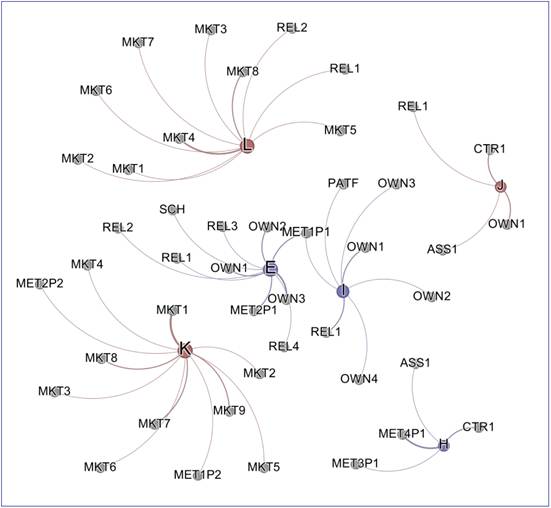
The specificity of the connections linked to the network of programs and startups studied can be seen in Figure 1. The blue nodes represent the companies connected to P1- E, H and I - and the red nodes represent the companies connected to P2 - J, K and L. The strength of the connections is symbolized by the thickness of the edges. The network was built using the ForceAtlas2 distribution, which is versatile and recommended for a wide range of networks, avoiding the hairball effect where the tangle of nodes makes the graph unreadable (Cherven, 2015).

The number of contacts linked to companies K and L is remarkable, indicating the considerable number of key connections that the entrepreneurs have gained through their participation in P2. On the other hand, the number of family members who are still considered important actors in the development and operation of the enterprises is also significant, especially in relation to the enterprises linked to P1 - E, H and I. Also, in relation to the enterprises linked to P1, there was a low number of external actors in the identity-based networks, such as contractors, contacts, or partner enterprises. There was also no mention of links between the entrepreneurs participating in the programs studied. The only connection is recorded by one of the P1 mentors - MET1P1 - between startups E and I. This shows low connectivity or inefficient networks, meaning low transfer of information and/or resources (Funk, 2014), which could, for example, hinder the dissemination of relevant new information/techniques to the companies (Cherven, 2015).
Table 3 presents an overview of the network using statistical parameters proposed by Cherven (2015). The average degree indicates that each node in the studied network has, on average, 1.8 connections. The network diameter measures the maximum distance between any two nodes in the network, depending on its size and topology. Thus, it can be considered that value 4 is influenced by the study’s context due to the fragmented network, indicating a less complex network.
Graph density is a measure of the proportion of existing ties to all possible ties in the network, ranging from 0 to 1. The value of 0.036 indicates a sparse network. Modularity measures how disjointed or overlapping the communities in the network are, with values ranging from -1 to 1. The value of 0.793 indicates that the networks are clearly distinguishable. The previous values are related to the average clustering coefficient, which indicates the degree to which nodes in a network tend to cluster together. A clustering coefficient of zero suggests that nodes are connected randomly throughout the network, without any clear groupings.
DISCUSSION
The discussions will be supported by Table 4 and Table 5. Table 4 presents emblematic testimonies that illustrate the formation of identity-based networks and calculative networks, respectively (Hite & Hesterly, 2001). This highlights the openness to new contacts and connections that were enabled for the companies as a result of their access to the Programs studied.
In terms of the formation of identity-based networks (Hite & Hesterly, 2001), or the first personal contacts made by the entrepreneur (Elfring & Hulsink, 2007; Hollow, 2020), P1 had a direct impact on the companies by imposing the need to formally structure the company during the program, creating groups of founding partners made up of students and professors who maintained close relationships (see INTVW5 in Table 4). In some instances, P1, represented by the sponsoring university, serves as the initial point of contact with external companies (see INTVW3 in Table 4), or a structural hole (Burt, 1992). On the other hand, P2 hosted start-ups with more cohesive groups of founding partners who shared values and perspectives in relation to their careers and field of activity (see INTVW10 in Table 4). Such results demonstrate the sociocultural aspects of EE networks and corroborates the findings of Scott et al. (2022) regarding the contingent nature of access to resources based on network behavior (Ritala et al., 2023).
Having come into contact with the programs, the companies received resources expected from the formation of a calculative network (Elfring & Hulsink, 2007; Hite & Hesterly, 2001), such as access to specific business knowledge and access to labor. The programs’ role as brokers - connectors between structural holes in the network (Ritala et al., 2023) - to facilitate access to financial resources, on the other hand, should be highlighted. Regarding P1, there was no activity to facilitate connections between actors (see INTVW2 in Table 5). In P2, although the connection between actors was observed, the facilitation of initial relationships was not enough for the full operation of the companies studied (see INTVW10 in Table 5). According to the analysis, the role of the programs in acting as brokers and facilitating access to investment was considered more relevant for the local companies. However, entrepreneurs who gained access to financial resources through the Program considered the contribution insufficient. They had to seek new financing outside the program (see INTVW11 in Table 5). The occurrence of one-off and ad hoc relationships was present, as previously noted by Ritala et al. (2023), suggesting a greater need for stability and renewal of contacts that can effectively connect companies with local investments in EE.
In summary, the programs studied exhibit imperfections in network orchestration due to a lack of connection with investors and insufficient investments for full operation of the businesses. The programs’ actions, which involve brokering to facilitate access to specific investments, can be seen as ad hoc initiatives (Ritala et al., 2023), rather than deliberate, systemic, and permanent intermediation. In other words, despite the fact that the programs studied institutionally have projects that deal with a form of open orchestration - more decentralized and independent (Giudici et al., 2018) - their actions as connectors of actors in the network are less deliberate, leading to connections that occur by chance or are left to chance (Scott et al., 2022). This applies to the post-program scenario, such as when companies operate independently and without assistance, which can result in challenges after the institutional relationship with the programs has ended.
The analysis of the networks and their systemic relationship with the EE, the low connectivity between actors and the high dispersion of the networks studied suggest that most companies are immersed in dispersed and inefficient relationships. Such an arrangement can impede access to vital resources and disseminate information at a slower pace, thereby corroborating Burt (1992) and Funk (2014) regarding the adverse consequences of an organization establishing itself in a dispersed network with suboptimal connections. From this observation, two scenarios emerge: (i) dispersed and inefficient networks, composed of relationships built in an ad hoc manner, will not generate differentials for the startups, making it difficult to establish relationships with regional players (Dyer & Singh, 1998); (ii) The relationship between different startups and the rest of the EE has been shown to be complex, with an emphasis on elements of identity-based networks that persist throughout the entrepreneurial process and can act as socio-relational imprints (Milanov & Shepherd, 2013), a distinctive feature that may be specific to EE in developing economies (Cao & Shi, 2021).
Regarding the first argument, it is assumed that dispersed and inefficient networks ultimately negatively affect the performance of new firms in the local EE. The establishment of ad hoc relationships (Ritala et al., 2023) could impede the creation of value at a systemic level for the EE (Autio & Thomas, 2022). This is because companies encounter obstacles in generating relational gains, i.e. significant benefits from network connections (Dyer & Singh, 1998), and mostly operate with access to resources that originate from specific connections or are acquired in their own way.
Regarding the second argument, it is suggested that the initial connections of entrepreneurs become more relevant in EE in emerging economies. The elements of identity-based networks (Hite & Hesterly, 2001), such as family, friends, and partners (Greco et al., 2023), remain relevant throughout the entrepreneurial process, even after establishing relationships with external actors. For entrepreneurs in emerging economies, this finding suggests that personal connections will continue to have a positive impact even after the start of the entrepreneurial process. However, this finding raises concerns. The initial and closest contacts may find it difficult to provide critical resources to companies in the stages of business consolidation or expansion. Additionally, they may represent a socio-relational imprint (Milanov & Shepherd, 2013), which could make it difficult to access new relationships with key contacts. Thus, this fact may also affect other relational aspects of EEs, such as increasing actions that segregate actors (Neumeyer et al., 2019) or facilitate the division of the EE into specific clusters (Scheidgen, 2021).
FINAL REMARKS, CONTRIBUTIONS, AND FUTURE VENUES
This study suggests the importance of examining EEs in a relational manner (Gimenez et al., 2022; Spigel & Harrison, 2018). Understanding networks as the amalgam that enables and unlocks the potential of local EE (Scott et al., 2022), the networks of programs and companies studied showed that not only is the formation of networks at the local level complex and multifaceted, but so are the ways in which they are used.
The study contributes to the literature on EE and networks in two major ways. Firstly, it demonstrates that brokers, such as the programs studied, may not actually carry out brokering (Ritala et al., 2023). This highlights how some aspects of networks differ from their a priori considerations (Dhanaraj & Parkhe, 2006; Funk, 2014). Secondly, the critical resource that emerged from the data was access to investments, which showed how some connections were not effectively made. Furthermore, the study demonstrated that obtaining investments through a single connection is insufficient for companies to operate effectively. Therefore, it is necessary to establish new and successive connections to acquire this resource, particularly in emerging economies (Inácio Júnior et al., 2016).
The second contribution refers to the relational dynamics of EE. The companies that were studied are part of a dispersed network. Even after the establishment of calculative networks, actors from identity-based networks remained critical for the companies studied. Therefore, initial contacts, such as family and friends, can act as a socio-relational imprint (Milanov & Shepherd, 2013) for companies, negatively influencing later network formation and access. It is argued that this may be a natural property of EE in emerging economies, already identified by the numerous barriers to the entrepreneurial process (Cao & Shi, 2021), with an additional strictly relational barrier.
This study has practical contributions for managers of entrepreneurship promotion programs. It is important to highlight the need for systemic and open action (Prokop & Thompson, 2023; Ritala et al., 2023), rather than just fostering contact between network actors. The programs’ dynamic action is crucial, particularly in the context of limited financial resources for new companies and the need for frequent interventions. Conducting a comprehensive mapping of potential financial resources appears to be an objective and feasible activity for program managers to undertake in the short term.
It is important to consider the performance of programs after companies become independent. The departure from the program could mean a break in the network of the companies, since the program could be the only external actor in the developed network. This fact could potentially amplify the effect found in the studied network. Once they no longer participate in the programs to generate contacts with a greater economic bias, greater importance could fall on identity-based actors, making it even more difficult to access critical resources that are natural to more advanced stages of the entrepreneurial process (Elfring & Hulsink, 2007; Hite & Hesterly, 2001).
Thus, there are public policy alternatives to promote entrepreneurship in the local EE, such as a systematic orchestration at the state level to strengthen various programs and actions. This orchestration could intensify the relationships between calculative networks, as long as it is carried out by a multidisciplinary broker - an organization with representatives from different actors in the ecosystem, including the market, academia, and civil society.
This study has limitations. Firstly, it was conducted in a specific location, and contextual aspects closely linked to the case being researched were not measured. Therefore, cultural, and subjective factors may have contributed to the relational dynamics described and analyzed here. Furthermore, although the study aimed to trace the historical development of the companies and used triangulation with other sources of evidence, the cross-sectional design of the study does not allow for long-term considerations.
As a suggestion for future studies, it is necessary to elucidate the impact of the presence of identity-based actors during the evolution of networks in companies located in EE in emerging economies. It is important to determine whether this phenomenon is specific to certain types of companies or organizations. Further studies are required to clarify access to financial resources in these EEs. Can an “optimal network” be established, consisting of actors who regularly connect companies to investors? Would this “optimal network” be located within the same local EE or would it be necessary to cross geographical boundaries? What impact does access to financial resources have on the permanence of companies in a local EE?
ACKNOWLEDGMENTS
This study was financed in part by the Coordenação de Aperfeiçoamento de Pessoal de Nível Superior - Brasil (CAPES) and Conselho Nacional de Desenvolvimento Científico e Tecnológico (CNPQ).
REFERENCES
-
Aldrich, H., & Auster, E. R. (1986). Even dwarfs started small: Liabilities of age and size and their strategic implications. Research in Organizational Behavior, 8. https://psycnet.apa.org/record/1988-12412-001
» https://psycnet.apa.org/record/1988-12412-001 -
Autio, E., & Thomas, L. D. W. (2022). Researching ecosystems in innovation contexts. Innovation & Management Review, 19(1), 12-25. https://doi.org/10.1108/INMR-08-2021-0151
» https://doi.org/10.1108/INMR-08-2021-0151 - Bardin, L. (2011). Análise de Conteúdo(1st ed., Vol. 3). Edições 70.
- Burt, R. S. (1992). Structural Holes: The Social Structure of Competition Harvard University Press.
-
Burt, R. S. (2019). Network Disadvantaged Entrepreneurs: Density, Hierarchy, and Success in China and the West. Entrepreneurship: Theory and Practice, 43(1), 19-50. https://doi.org/10.1177/1042258718783514
» https://doi.org/10.1177/1042258718783514 -
Cao, Z., & Shi, X. (2021). A systematic literature review of entrepreneurial ecosystems in advanced and emerging economies. Small Business Economics, 57(1), 75-110. https://doi.org/10.1007/s11187-020-00326-y
» https://doi.org/10.1007/s11187-020-00326-y - Cherven, K. (2015). Mastering Gephi Network Visualization Packt Publishing.
-
Dhanaraj, C., & Parkhe, A. (2006). Orchestrating Innovation Networks. Academy of Management Review, 31(3), 659-669. https://doi.org/10.5465/amr.2006.21318923
» https://doi.org/10.5465/amr.2006.21318923 - Dyer, J. H., & Singh, H. (1998). The relational view: cooperative strategy and sources of interorganizational competitive advantage. Academy of Management Journal, 23(4), 660-679.
-
Edmondson, A. C., & Mcmanus, S. E. (2007). Methodological fit in management field research. Academy of Management Review, 32(4), 1246-1264. https://doi.org/10.5465/amr.2007.26586086
» https://doi.org/10.5465/amr.2007.26586086 -
Elfring, T., & Hulsink, W. (2007). Networking by entrepreneurs: Patterns of tie-formation in emerging organizations. Organization Studies, 28(12), 1849-1872. https://doi.org/10.1177/0170840607078719
» https://doi.org/10.1177/0170840607078719 -
Funk, R. J. (2014). Making the Most of Where You Are: Geography, Networks, and Innovation in Organizations. Academy of Management Journal, 57(1), 193-222. https://doi.org/10.5465/amj.2012.0585
» https://doi.org/10.5465/amj.2012.0585 - Gimenez, F. A. P., Setefenon, R., & Inácio Júnior, E. (2022). Ecossistemas Empreendedores: o que são e para que servem?PUCPress.
-
Giudici, A., Reinmoeller, P., & Ravasi, D. (2018). Open-System Orchestration as a Relational Source of Sensing Capabilities: Evidence from a Venture Association. Academy of Management Journal, 61(4), 1369-1402. https://doi.org/10.5465/amj.2015.0573
» https://doi.org/10.5465/amj.2015.0573 -
Granovetter, M. (2005). The Impact of Social Structure on Economic Outcomes. Journal of Economic Perspectives, 19 (1), 33-50. https://doi.org/10.1257/0895330053147958
» https://doi.org/10.1257/0895330053147958 -
Granovetter, M. S. (1973). The Strength of Weak Ties. American Journal of Sociology, 78(6), 1360-1380. https://doi.org/10.1086/225469
» https://doi.org/10.1086/225469 -
Greco, S. M. de S. S., Lima, E. de O., Inácio Júnior, E., Machado, J. P., Guimarães, L. de O., Bastos Júnior, P. A., Lopes, R. M. A., & Souza, V. L. de. (2023). Global Entrepreneurship Monitor: empreendedorismo no Brasil 2022. In: Pesquisa GEM - Global Entrepreneurship Monitor https://datasebrae.com.br/wp-content/uploads/2023/11/GEM-BR-2022-2023-Livro-Final.pdf
» https://datasebrae.com.br/wp-content/uploads/2023/11/GEM-BR-2022-2023-Livro-Final.pdf -
Halinen, A., & Törnroos, J.-Å. (2005). Using case methods in the study of contemporary business networks. Journal of Business Research, 58(9), 1285-1297. https://doi.org/10.1016/j.jbusres.2004.02.001
» https://doi.org/10.1016/j.jbusres.2004.02.001 -
Hanneman, R. A., & Riddle, M. (2005). Introduction to Social Network Methods: Table of Contents http://faculty.ucr.edu/~hanneman/nettext/
» http://faculty.ucr.edu/~hanneman/nettext/ - Hite, J. M., & Hesterly, W. S. (2001). The evolution of firm networks: from emergence to early growth of the firm. Strategic Management Journal, 22, 275-286.
-
Hollow, M. (2020). Historicizing entrepreneurial networks. Strategic Entrepreneurship Journal, 14(1), 66-88. https://doi.org/10.1002/sej.1345
» https://doi.org/10.1002/sej.1345 -
Inácio Júnior, E., Autio, E., Morini, C., Gimenez, F. A. P., & Dionisio, E. A. (2016). Analysis of the Brazilian Entrepreneurial Ecosystem. Desenvolvimento Em Questão, 14(37), 5. https://doi.org/10.21527/2237-6453.2016.37.5-36
» https://doi.org/10.21527/2237-6453.2016.37.5-36 -
Knox, S., & Arshed, N. (2022). Network governance and coordination of a regional entrepreneurial ecosystem. Regional Studies, 56(7), 1161-1175. https://doi.org/10.1080/00343404.2021.1988067
» https://doi.org/10.1080/00343404.2021.1988067 -
Milanov, H., & Shepherd, D. A. (2013). The importance of the first relationship: The ongoing influence of initial network on future status. Strategic Management Journal, 34(6), 727-750. https://doi.org/10.1002/smj.2109
» https://doi.org/10.1002/smj.2109 -
Muñoz, P., Kibler, E., Mandakovic, V., & Amorós, J. E. (2022). Local entrepreneurial ecosystems as configural narratives: A new way of seeing and evaluating antecedents and outcomes. Research Policy, 51(9), 104065. https://doi.org/10.1016/j.respol.2020.104065
» https://doi.org/10.1016/j.respol.2020.104065 -
Neumeyer, X., Santos, S. C., & Morris, M. H. (2019). Who is left out: exploring social boundaries in entrepreneurial ecosystems. Journal of Technology Transfer, 44(2), 462-484. https://doi.org/10.1007/s10961-018-9694-0
» https://doi.org/10.1007/s10961-018-9694-0 -
Prokop, D., & Thompson, P. (2023). Defining networks in entrepreneurial ecosystems: the openness of ecosystems. Small Business Economics, 61(2), 517-538. https://doi.org/10.1007/s11187-022-00710-w
» https://doi.org/10.1007/s11187-022-00710-w -
Ritala, P., De Kort, C., & Gailly, B. (2023). Orchestrating Knowledge Networks: Alter-Oriented Brokering. Journal of Management, 49(3), 1140-1178. https://doi.org/10.1177/01492063221086247
» https://doi.org/10.1177/01492063221086247 -
Scheidgen, K. (2021). Degrees of integration: how a fragmented entrepreneurial ecosystem promotes different types of entrepreneurs. Entrepreneurship & Regional Development, 33(1-2), 54-79. https://doi.org/10.1080/08985626.2020.1734263
» https://doi.org/10.1080/08985626.2020.1734263 -
Scott, S., Hughes, M., & Ribeiro-Soriano, D. (2022). Towards a network-based view of effective entrepreneurial ecosystems. Review of Managerial Science, 16(1), 157-187. https://doi.org/10.1007/s11846-021-00440-5
» https://doi.org/10.1007/s11846-021-00440-5 -
Silva, J. P. M., Guimarães, L. de O., Inácio Júnior, E., & Castro, J. M. de. (2021). Entrepreneurial ecosystem: Analysis of the contribution of universities in the creation of technology-based firms. Contextus - Revista Contemporânea de Economia e Gestão, 19, 160-175. https://doi.org/10.19094/contextus.2021.68011
» https://doi.org/10.19094/contextus.2021.68011 -
Spigel, B. (2017). The Relational Organization of Entrepreneurial Ecosystems. Entrepreneurship: Theory and Practice, 41(1), 49-72. https://doi.org/10.1111/etap.12167
» https://doi.org/10.1111/etap.12167 -
Spigel, B., & Harrison, R. (2018). Toward a process theory of entrepreneurial ecosystems. Strategic Entrepreneurship Journal, 12(1), 151-168. https://doi.org/10.1002/sej.1268
» https://doi.org/10.1002/sej.1268 -
Stam, E. (2015). Entrepreneurial Ecosystems and Regional Policy: A Sympathetic Critique. European Planning Studies, 23(9), 1759-1769. https://doi.org/10.1080/09654313.2015.1061484
» https://doi.org/10.1080/09654313.2015.1061484 - Uzzi, B. (1997). Social Structure and Competition in Interfirm Networks: The Paradox of Embeddedness. In: Source: Administrative Science Quarterly(Vol. 42, Issue 1).
-
Wurth, B., Stam, E., & Spigel, B. (2022). Toward an Entrepreneurial Ecosystem Research Program. Entrepreneurship Theory and Practice, 46(3), 729-778. https://doi.org/10.1177/1042258721998948
» https://doi.org/10.1177/1042258721998948 - Yin, R. K. (2001). Estudo de caso: planejamento e métodos(2nd ed.). Bookman.
-
DATA AVAILABILITY
The dataset supporting the results of this study is not publicly available.
-
REVIEWERS
Ana Clara Aparecida Alves de Souza (Instituto Federal de Educação, Ciência e Tecnologia do Rio Grande do Sul, Bento Gonçalves / RS - Brazil). ORCID: https://orcid.org/0000-0001-5574-2560.
-
REVIEWERS
One of the reviewers did not authorize the disclosure of their identity.
-
PEER REVIEW REPORT
The peer review report is available at this link: https://periodicos.fgv.br/rap/article/view/93585/87501
-
7
[Original version]
Edited by
The dataset supporting the results of this study is not publicly available.

 Notes: Primary research data. ASS = Assessor; SCH = Scholarship; MKT = External market contact; CTR = Contractor personnel or contracted firm; PATF = Partner firm; REL = Relatives; MET = Mentor; PRG = Program; OWN = owner.Source: Elaborated by the authors.