| Human representation |
The person is an autopoietic and self-referential system represented by the psychic system. Essentialisms are rejected, and individuality as contingent is emphasized. |
The subject is constituted by regulatory practices. Both the idea of a subject defined within a pre-existing ontology and the notion of universalities are rejected. |
Human beings cannot be observed through universalities or essentialisms; their representation is always contingent upon organizational norms that (re)produce gender in organizations. |
| Gender |
No specific theoretical formulation. Critical of gender binarism; proposes an interdisciplinary approach to include diverse ways of living gender beyond the binary of man/woman. |
Produced and reified by the subject in everyday life through the repetition of acts, bodily gestures, movements, and enactments that allow for the gendered stylization of the self according to socio-culturally situated norms. |
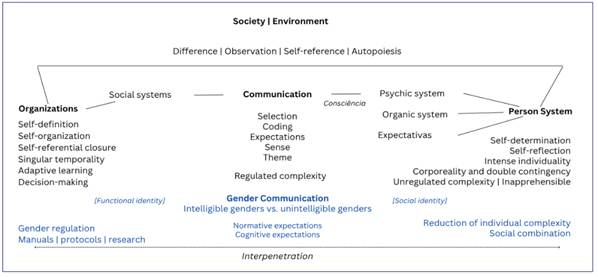
The suggestion is to conceptualize gender as a type of communication: a process through which gender-relevant information is selected and demarcated by specific codifications that establish normative/cognitive expectations and understanding at different levels (understanding, non-understanding, and misunderstanding). |
| Body |
Linked to the formation of expectations in communications and the interpenetration between the personal and social systems through double contingency. |
An active medium of gender performativity, forged by stylized bodily acts recursively repeated to perform the gender the subject is invested in, conforming to dominant social norms. |
Affects organizational communications, potentially enhancing or hindering communicative understanding. Bodily acts must be observed within the matrix of a given organization’s gender norms. |
| Organization |
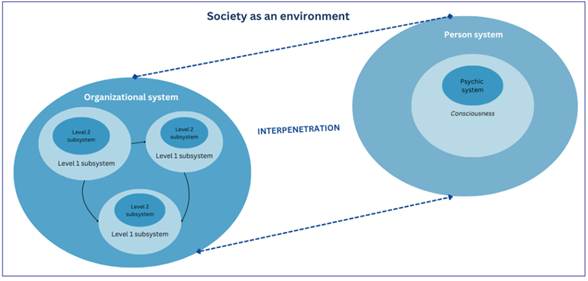
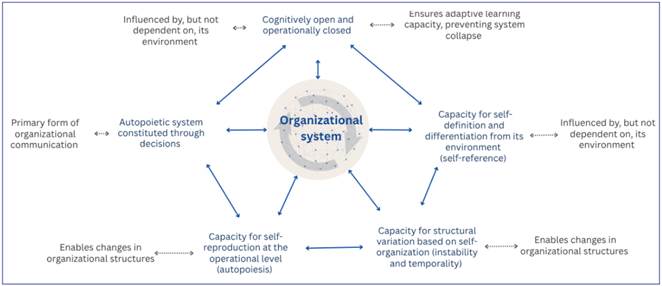
An autopoietic and self-referential system with the capacity for self-organization through decision-making. |
No specific theoretical formulation; the concept is correlated with gender regulations (laws, rules, and policies) that regulate gender in empirical instances. |
Organizational systems operate through communications and are structured by decisions, which may or may not restrict genders within their operations. |
| Regulation / norms |
Types of self-referential communication that provide feedback and sustain the system’s functioning through cognitive and behavioral expectations. |
Regulatory, prescriptive, and punitive norms forge an organized set of constraints that normalize gender. Norms do not represent subjectivity; they produce it within subjects. |
Proposes the notion of gender regulations as communications intended to stabilize the system through generalizing normative expectations, reducing identity complexity while paradoxically restricting the exercise of individuality. |
| Coding |
Modes of communication unique to each system that oscillate between a positive and negative value (legal/illegal, right/wrong), enabling systemic differentiation and complexity reduction. |
Without a specific theoretical formulation - a concept correlated with the matrix of gender norms (sex-gender-desire) that shapes the legitimizing/significant practices of identities and classifies genders as intelligible/coherent or unintelligible/incoherent, in a given social, cultural, and temporally situated space. |
The proposal involves adopting a binary gender code, intelligible/unintelligible, with the former representing the hegemonic gender pattern defined within the organization, increasing sensitivity and enhancing communication between systems, while the latter escapes communicative treatment, generating only noise in organizational communications. |
| Power |
A specialized type of communication that coordinates actions, communications, and decisions by restricting the possible selections available to the system. |
Acts restrictively in the production of subjectivities and, through norms, reifies and crystallizes socially admitted genders within a predefined matrix. |
The definition of gender within the organizational system is permeated by power, inherent to all communication, which restricts possible selections and produces the matrix regulating bodies and subjectivities. |
| Subject-organization relationship |
Possible through interpenetration, which generates the co-evolution of the organizational system and the personal system. |
Mediated by norms that determine the conditions of intelligibility and social belonging, which may secure or deny rights to subjects. |
Impacts the (re)production of gender in both personal systems (through subjection) and organizational systems, allowing for co-evolution via non-restrictive gendered norms. |

 Luhmann and Butler: observing the construction of gender in organizations
 Thumbnail
 Thumbnail
 Thumbnail
 Source: Elaborated by the authors
 Source: Elaborated by the authors.
 Source: Elaborated by the authors.