
 The characteristics of online freelance workers: are generation and gender relevant in terms of those working in the gig economy?
Abstract
Research into gig economy workers usually explores topics such as working conditions and types of work. There is a gap in the research, however, when it comes to studies involving qualified workers, especially those who living on the Global South of the world. This study characterizes and analyzes qualified online freelance workers who live in Latin America. Two surveys were carried out with a total of 2159 Brazilian individuals who are registered on two digital platforms in Latin America that connect qualified workers with organizations and projects. Logistic regressions were used that showed that young workers seek this type of work in order to learn new activities and earn better pay, while women seek flexibility. Workers with less education see platform-mediated work as being a way of achieving better pay, while older workers want to return to stable jobs.
Keywords:
gig economy; qualified gig work; digital platform; gender; age diversity
Resumo
A pesquisa sobre trabalhadores da gig economy geralmente explora temas como condições de trabalho e tipos de atividade. No entanto, há uma lacuna nos estudos que envolvem trabalhadores qualificados, especialmente aqueles que vivem no Sul Global do mundo. Este estudo caracteriza e analisa trabalhadores freelancers on-line qualificados residentes na América Latina. Foram realizadas duas pesquisas com um total de 2.159 indivíduos brasileiros registrados em duas plataformas digitais na América Latina que conectam trabalhadores qualificados a organizações e projetos. Foram utilizadas regressões logísticas que mostraram que trabalhadores jovens buscam esse tipo de trabalho para aprender novas atividades e obter melhores remunerações, enquanto as mulheres buscam maior flexibilidade. Trabalhadores com menor escolaridade veem o trabalho mediado por plataformas como uma forma de alcançar melhores salários, enquanto trabalhadores mais velhos desejam retornar a empregos estáveis.
Palavras-chave:
gig economy; trabalho qualificado de plataforma; plataforma digital; gênero; diversidade etária
Resumen
La investigación sobre trabajadores de la gig economy suele centrarse en temas como las condiciones laborales y los tipos de trabajo. Sin embargo, existe una brecha en los estudios relacionados con trabajadores calificados, especialmente aquellos que residen en Sur Global del mundo. Este estudio caracteriza y analiza a los trabajadores freelance on-line calificados que viven en América Latina. Se realizaron dos encuestas con un total de 2.159 individuos brasileños registrados en dos plataformas digitales en América Latina que conectan a trabajadores calificados con organizaciones y proyectos. Se utilizaron regresiones logísticas que mostraron que los trabajadores jóvenes buscan este tipo de empleo para aprender nuevas actividades y obtener mejores remuneraciones, mientras que las mujeres lo hacen en busca de flexibilidad. Los trabajadores con menor nivel educativo ven el trabajo mediado por plataformas como una vía para obtener mejores ingresos, mientras que los trabajadores de mayor edad desean regresar a empleos estables.
Palabras clave:
gig economy; trabajo calificado de plataforma; plataforma digital; género; diversidad etaria
INTRODUCTION
The term “gig economy” is used as a context for jobs that can be contracted via digital platforms and in accordance with the needs of the organization and worker availability (Inversi et al., 2023; Lehdonvirta, 2018; Vallas & Schor, 2020). Such work can vary in complexity, the knowledge required, the remuneration offered, and the platforms that mediate it (Bhatti et al., 2020; McKenzie, 2020; Meijerink et al., 2024). The employment status of around 40% of the workforce in Brazil is informal, with more than 32 million workers working in jobs that are mediated by online platforms (Instituto Brasileiro de Geografia e Estatística [IBGE], 2025).
Research addressing this work model usually considers it as being done by Generation Z and the Millennial generation (Berg et al., 2018; Krzywdzinski & Gerber, 2020; Kurian & Bindu Madhavi, 2024) and excludes other generations and their perceptions on the subject from the discussion. Platform-mediated work was once considered an opportunity for reducing gender inequality in the labor market (Gregg, 2011), but the apparent neutrality of technology and digitalization may serve as a means of expanding and increasing inequalities between men and women (France et al., 2019; Hunt & Samman, 2019; Van Doorn, 2017) and result in generation discrimination (Cherry, 2019).
Although previous research has focused on gig workers, their characteristics, and their relationship with gig work (De Stefano, 2016; Hein et al., 2019; Sargeant, 2017), comparatively less attention has been paid to the specific context of qualified online freelance workers. Thus, in this article we seek to characterize and analyze qualified online freelance workers in Latin America. The data were collected in a survey involving Brazilians who work on two platforms in Latin America. This study has two main objectives: first, to identify the characteristics of online freelance workers and compare them with the characteristics of the general workforce in Brazil; and second, to explore the predictors that have an impact on the perceptions of online freelance workers with regard to their reasons for working in this particular model, their future plans, and their perception of the model’s advantages and disadvantages.
This study contributes to the literature on gig work and age diversity in three keyways. First, it offers novel empirical evidence on the generational composition of online freelance workers in Latin America, showing not only the expected participation of younger workers (Generations Y and Z), but also a significant presence of middle-aged workers (40-59), expanding current understandings of age diversity in platform labor. Second, it demonstrates how age intersects with other factors, such as gender, education, and experience, to shape motivations, future expectations, and perceived advantages of gig work. Finally, it shows that age plays a central role in how workers relate to the platform model: while younger individuals associate it with autonomy and learning, older workers often engage with it as a transitional strategy, expressing a desire to return to the protections of formal employment. These findings suggest that platform work is not generationally uniform but structured by diverse trajectories and life stages.
We then provide a review of the literature that deals with the variables we used in our analysis, followed by the study’s research framework. We discuss the results of the methodology we applied and conclude the article with our final considerations and suggestions for future studies.
THE GIG ECONOMY AND ONLINE FREELANCE WORK
The term “gig”, short for “engagement”, is slang for a live musical performance, as in the case of aspiring musicians in pubs who were often invited to return if the employer approves their performance (Woodcock & Graham, 2019) but now has come to mean any short-term hiring. The development of new business models in the gig economy is combined with technology and provides the opportunity to hire people who make their work available via apps and digital platforms (Auguste et al., 2022; Vallas & Schor, 2020). These gig economy platforms (Lehdonvirta, 2018) are characterized by their ubiquity and because they make innovative forms of service delivery feasible (De Reuver et al., 2018; Hein et al., 2019; Rolland et al., 2018).
Services can be provided via digital platforms either locally or remotely (Wood et al., 2019), and workers can serve several employers, and be paid by task, and while they may have no guaranteed income (De Stefano, 2016; Sargeant, 2017), they do benefit from temporal flexibility (Corporaal & Lehdonvirta, 2017; Flanagan, 2019; Lehdonvirta, 2018). Other characteristics of platform-mediated work, however, may vary according to the platform and type of activity demanded. For example, platforms such as Amazon Mechanical Turk offer so-called micro-tasks, which are fragmented activities that can be performed quickly and offer a low return, but do not usually require any specific knowledge (Bhatti et al., 2020; Mayer et al., 2024; McKenzie, 2020). On the other hand, platforms such as Innocentive offer so-called macro-tasks (Bhatti et al., 2020; Gong et al., 2025), or complex tasks (Alacovska et al., 2025; Li et al., 2020), which offer significant financial returns, the selection of working groups that have specific knowledge, and greater involvement.
In the case of complex-task or macro-task platforms, workers look for incremental profit and can negotiate the rate paid for their work; these are called online freelance workers (Gandini, 2016; Idowu & Elabanna, 2022; Sutherland et al., 2020; Wood et al., 2019). This workforce is formed, especially, by younger generations who experience access to the labor market through internet and social network (Horowitz & Rosati, 2014), but are also seeking to act as free agents, and to have a good quality of life and control over their time (Sutherland et al., 2020; Wood et al., 2019). The activities these workers are looking for are closer to being complex, interdependent, and computerized work (Corporaal & Lehdonvirta, 2017; Frey & Osborne, 2017). This new socio-material work situation also leads to transformations in relation to the traditional factory floor (Lehdonvirta, 2018).
We observe that platform-based jobs have led to a series of transformations in the world of work, some of which have yet to be investigated. Among them, the first is of a generational nature, since it is Millennials who are involved with online freelance work, while other generations are usually left out of debates on the subject (Cherry, 2019). Recent Brazilian scholarship also cautions against directly importing generational classifications developed in other national contexts, proposing classifications that better reflect Brazil’s socio-historical specificities and their implications for work-related values (Milhome, 2022). This is since the average age of workers in this model is, in most cases, between 30 and 35 years (Berg et al., 2018; Krzywdzinski & Gerber, 2020). Nevertheless, researchers are turning their attention to the so-called silver economy and the over-50 workers, and their potential of becoming gig-workers in the future (Eager et al., 2022). The second is the issue of gender, because the online freelance work model may not progress in terms of reducing gender inequality and may even perpetuate or expand this phenomenon (France et al., 2019; Gerber, 2022; Hunt & Samman, 2019; Van Doorn, 2017).
Despite researchers in the work field making efforts to explore this topic in Brazil with a focus on app-based drivers (Franco & Ferraz, 2019; Vaclavik et al., 2021) and delivers (Diniz et al., 2024; Maciel et al., 2024) and app-based delivery mechanisms (Portes Virginio et al., 2023), we see greater attention being paid to Africa (Anwar & Graham, 2020; Anwar et al., 2022; Arubayi, 2021), while work that comes from the communication area in South America (Grohmann, 2021; Grohmann et al., 2022) still has gaps to be explored.
AGE DIVERSITY AND GENDER
The gig economy has led to transformations in the world of work that still require investigations that are related to issues of age diversity (Alcover et al., 2021; Eager et al., 2022) and gender (Hunt & Samman, 2019). The new characteristics of the workforce, which is a combination of women entering the paid labor market (Churchill et al., 2019) and demographic changes in the population (Yalenios & D’Armagnac, 2023), have extended the productive life span (Gordon, 2018). We observe, as a consequence, that those issues that relate to age diversity and gender are challenges for organizations, because the conditions, availability, motivations, and objectives of men and women with regard to work are different (Churchill & Craig, 2019; Milkman et al., 2021) and the individuals involved come from different age groups (Kollmann et al., 2019; Vignoli et al., 2021).
The differences between young and old workers are studied from different viewpoints, such as looking for work (Neumark et al., 2019), work suffering (Bravo et al., 2022; Hult et al., 2023), identity (Alacovska et al., 2025), among others. Previous research also analyzed how the stereotypes attributed to the generations of workers, however, such as Baby Boomers, Generation X, and Millenials, end up affecting labor relations (Gordon, 2018), and give rise to behaviors that can be characterized as discriminatory (von Humboldt et al., 2023; Sinclair et al., 2024). Moreover, researchers highlighted that age diversity and stereotypes can lead to conflict and be treated as obstacles to relationships in organizations (Hanrahan et al., 2023; Wu & Konrad, 2023).
With regard to studies into gender inequality and new work models that are mediated by technology, obstacles have been recognized since before work became “platformed” and include a lack of support on the part of the family and educational institutions, and a lack of trust (Hargittai & Shafer, 2006). New technologies, therefore, were seen as offering possibilities and opportunities to change this scenario, with women expanding their participation in the labor market (Gregg, 2011).
But the informal nature and apparent neutrality of technology camouflage the possibility that platform-based work might actually serves to maintain and increase inequalities between men and women in the world of work (Van Doorn, 2017; Hunt & Samman, 2019; France et al., 2019). In this sense, studies highlighted that men and women are affected differently in relation to precarization, with the latter group suffering more than the previous (Gerber, 2022), and even more in the case of married and older women (Han et al., 2024).
A study carried out in Australia showed that the types of jobs performed by men and women in the gig economy already provide evidence of segregation in the model (Churchill & Craig, 2019), and that this might be related to two factors. First, the perception that platform-based work is flexible, even though, in the case of women, it is carried out in addition to housework and looking after the family (Han, 2025; James, 2024; Milkman et al., 2021; Woodman & Cooke, 2019), and second, because it is algorithm-based work the system learns and reproduces the pre-existing unequal behaviors of the traditional labor market (Barzilay, 2018; Vyas, 2021).
In summary, studies carried out so far show that although technology is presented as a solution for reducing inequality between men and women in the labor market, differences are maintained and amplified due to the neutral character that permeates technologies and, consequently, platform-based work. But studies have focused on developed regions, such as Australia (Chesters & Wyn, 2019; Churchill & Craig, 2019), and despite recent efforts, works in Latin America still focus on homogenized groups, formed primarily by men, and on jobs that require no specific qualifications (Franco & Ferraz, 2019; Portes Virginio et al., 2023; Vaclavik et al., 2021). We believe it opportune, therefore, to investigate: the generation and gender characteristics of qualified workers who work in the online freelance work model on platforms that are predominantly active in Latin America; the impact of these characteristics on the reasons workers gives for working in this model; its advantages and disadvantages; and future plans.
RESEARCH FRAMEWORK
Using the above-cited literature as its basis this study characterizes and analyzes qualified online freelance workers in Latin America. We explore the evidence of significant variations between different generation groups that are associated with motivations and expectations related to online freelance work. The option to study online freelance work platforms that operate in South American countries, and involving Brazilian workers, was intentional. This intentionality is related to the fact that almost 40% of Brazil’s labor force works in informal situations (IBGE, 2025). Although a large part of this contingent works in areas such as domestic work and civil construction, more than 32 million workers carry out their activities via digital platforms (ILocomotiva, 2021). The subject of our research, therefore, is those who do freelance work on online platforms, who perform more complex activities, and who require specific knowledge and training.
In this descriptive-exploratory study, we try to answer the following research questions: What are the generation and gender characteristics of those who work in the online freelance model on platforms that operate predominantly in Latin America? What impact do these characteristics have on the perception of workers as to their reasons for working via this model, their future plans, and the advantages and disadvantages of doing so? We consequently formulated the four hypotheses below based on the theoretical references, and presented in Figure 1:
H1: The age and gender characteristics of the respondents of online freelance platforms are mainly those of Millennials or digital natives (Generation Z).
H2: The reasons that lead workers from different generation (and age) groups to do work that is mediated by a platform are different.
H3: The online freelance work expectations and future plans of respondents from different generations and age groups are different.
H4: The perceptions of the different generations and age groups about the advantages and disadvantages of platform-mediated work are different.
The literature review indicated that there are gaps in the research dealing with working on gig-economy platforms, especially research that addresses qualified work and age diversity. This study, therefore, combines the data from surveys carried out on two online freelance work platforms between February and October 2020.

METHOD
Sample and procedures
This descriptive-exploratory study combined data from two surveys of Brazilian online freelance platforms. The first was applied to freelance workers registered on the platform we call A, which had 433 respondents, and took place during February 2020. The second was applied to freelance workers registered on the platform we call B, which had 1726 respondents and took place in October 2020. The difference in the number of respondents was since the platforms are of different sizes. Both platforms operate in Latin America and specialize in connecting qualified workers. This means that the workers have at least a university education and some previous work experience. Platform A has more than 80,000 approved professionals on its registers and presents itself using the term “Smart Workforce Solutions”. It informs companies that they will find strategic-level professionals on the platform. Platform B, on the other hand, has more than 3 million registered professionals, and uses the term “talented professionals” and “qualified talent” when referring to these workers.
The survey instrument was developed based on prior research on gig work and platform-mediated labor. Sociodemographic variables (e.g., age, gender, education, and work experience) were adapted from established labor force and gig economy surveys (e.g., Berg et al., 2018; Kässi & Lehdonvirta, 2018), while items related to motivations, future plans, and perceived advantages and disadvantages of platform work were constructed based on recurring dimensions identified in previous qualitative and quantitative studies on online freelancing (e.g., Gandini, 2016; Sutherland et al., 2020; Wood et al., 2019). Before large-scale data collection, the questionnaire was pre-tested with 20 platform users (10 from each platform) to assess clarity, consistency, and comprehension. No discrepancies or ambiguities were identified, and no substantive changes were required. Data were collected through two independent surveys administered on distinct platforms at different points in time. To minimize the risk of duplicate responses, the surveys were distributed via platform-specific mailing lists, no personal identifiers were collected, and respondents were informed that participation was limited to one platform.
The variables relating to the reasons that led the respondents to join the gig economy were: loss of employment and a lack of prospects for being re-employed in the short term (R1); a wish to set up their own business (R2); a desire to learn new things and have different experiences (R3 ); expansion of their network of professional relationships (R4); a desire for greater autonomy at work (R5); a desire for greater flexibility in working hours (R6); a search for better remuneration (R7); and personal issues that require a flexible working arrangement ( R8).
The variables relating to the respondents’ future plans were: I intend to open my own business (FP1); I intend to consolidate my work as a full-time freelance worker (FP2); I intend to work as a part-time freelance worker (FP3); I would like to work for a company by way of a contractual relationship (FP4); and I don’t know (FP5).
The variables relating to perceptions about the advantages of the work model were flexible working hours (AD1); remuneration (AD2); autonomy (AD3); learning (AD4); the possibility of professional growth (AD5); a clearly defined work scope (AD6); security (AD7); the work resources available (AD8); and a balance between work and personal life (AD9).
The variables relating to perceptions about the disadvantages of the work model were: remuneration (DAD1); no definition as to the number of hours of work per month (DAD2); a lack of career prospects (DAD3); insecurity (DAD4); difficulty in defining the scope of work (DAD5); limited autonomy (DAD6); the work resources available (DAD7); the balance between work and personal life (DAD8); and no access to a health, and/or a private pension plan, and/or other benefits that are characteristic of having a contractual relationship with a company (DAD9).
Analysis
The data were analyzed in two distinct phases that relied on information provided by the 2158 Brazilian respondents. In the first phase data relating to the age bands and gender of the respondents were compared to data relating to the age and gender distribution of the workforce in Brazil according to the National Household Sample Survey (IBGE, 2025), which was designed to produce results for the Brazilian population as a whole and draw up public policy strategies.
The second phase was to carry out three binary logistic regressions, which would distinguish between respondents and their reasons for joining the gig economy, their future plans, and their perceptions of the advantages and disadvantages of the work model. We chose binary linear regression because of the descriptive-exploratory study characteristic of the research.
FINDINGS
The data show that 46.7% of respondents have a university degree, 23.3% have a specialization course or an MBA, and less than 6% have a master’s or a Ph.D.: 24.9% did not answer the question. Of those who responded, 51% declare themselves to be male, 49% are female, and most of the qualified professionals registered on digital platforms are either Generation Z or Millennials (see Figure 2). Some 64% of respondents are under 39 years old, with ages ranging between 25 and 39, which does not coincide with the percentages found in the workforce in Brazil (IBGE, 2025). In addition, even though 15% of the workforce in Brazil is over 60 years old, among respondents this figure is only 4%.
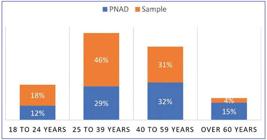
Comparison of the age percentage of the sample in relation to data for the Brazilian workforce (PNAD)
Binary logistic regression
Group 1: reasons for entering the gig economy
-
Logistic regression was performed for each of the reasons given by the respondents for entering the gig economy, as indicated in the survey. Of the reasons indicated in the survey, the variables of the logistic regression model were not statistically significant for reasons (R1), (R4), and (R8). The regression data are presented in Table 1, where we observe:
-
“The wish to set up their own business” (R2): the variables of this regression are statistically significant, X² (4, N = 2111) = 64.0, p < .05, indicating that the model was able to distinguish between respondents who indicated that this was one of the reasons for entering the gig economy and those who did not. The model explains between 2.3% (Cox and Snell R squared) and 3.2% (Nagelkerke R squared) of the variation and correctly classifies 64% of the cases.
-
“A desire to learn new things and have different experiences (R3): the variables of this regression are statistically significant, X² (4, N = 2111) = 79.3, p < .05, indicating that the model was able to distinguish between respondents who indicated that this was one of the reasons for entering the gig economy and those who did not. The model explains between 4.1% (Cox and Snell R squared) and 5.4% (Nagelkerke R squared) of the variance and correctly classifies 57.2% of the cases.
-
“A desire for greater autonomy at work” (R5): the variables of this regression are statistically significant, X² (4, N = 2111) = 79.3, p < .01, indicating that the model was able to distinguish between respondents who indicated that this was one of their reasons for entering the gig economy and those who did not. The model explains between 1% (Cox and Snell R squared) and 1.2% of the variation and correctly classifies 55.8% of the cases.
-
“A desire for greater flexibility in working hours” (R6): the variables of this regression are statistically significant, X² (4, N = 2111) = 79.3, p < .05, indicating that the model was able to distinguish between respondents that indicated that this was one of the reasons for entering the gig economy and those who did not. The model explains between 1.3% (Cox and Snell R squared) and 1.8% of the variation and correctly classifies 56.9% of the cases.
-
“A search for better remuneration” (R7): the variables of this regression are statistically significant, X² (4, N = 2111) = 57.7, p < .05, indicating that the model was able to distinguish between respondents who indicated that this was one of the reasons for entering the gig economy and those who did not. The model explains between 2.7% (Cox and Snell R squared) and 3.6% of the variation and correctly classifies 57.7% of the cases.
Group 2: future plans
Logistic regression was performed for each of the future plans presented to respondents of the survey. With regard to these future plans, the variables of the logistic regression model were not statistically significant for (FP1), (FP2), (FP3), and (FP5). The regression data are shown in Table 2, where we observe:
“I would like to work for a company by way of a contractual relationship” (FP4): the variables of this regression are statistically significant, X² (4, N = 2111) = 84.4, p > .001, indicating that the model was able to distinguish between respondents who indicated that this was one of their future plans and those who did not. The model explains between 3.1% (Cox and Snell R squared) and 5.2% (Nagelkerke R squared) of the variation and correctly classifies 84.4% of the cases.
Group 3: perception of the advantages of the work model
Logistic regression was performed for each of the advantages indicated in the survey that were perceived by the respondents with regard to online freelance work. The variables of the logistic regression model were not statistically significant for Advantages (AD3), (AD4), (AD6), (AD7), (AD8), and (AD9). The regression data are shown in Table 3, where we observe:
-
“Flexibility” (AD1): the variables of this regression are statistically significant, X² (4, N = 2111) = 68.2, p > .005, indicating that the model was able to distinguish between respondents who indicated that this was one of the advantages of this work model and those who did not. The model explains between 2.1% (Cox and Snell R squared) and 3.9% (Nagelkerke R squared) of the variation and correctly classifies 68.2% of the cases.
-
“Remuneration” (AD2): the variables of this regression are statistically significant, X² (4, N = 2111) = 60.2, p < .005, indicating that the model was able to distinguish between respondents who indicated that this was one of the advantages of this work model and those who did not. The model explains between 0.8% (Cox and Snell R squared) and 1.1% (Nagelkerke R squared) of the variation and correctly classifies 60.2% of the cases.
-
“Possibility of professional growth” (AD5): the variables of this regression are statistically significant, X² (4, N = 2111) = 61.3, p > .001, indicating that the model was able to distinguish between respondents who indicated that this was one of the advantages of this work model and those who did not. The model explains between 3.6% (Cox and Snell R squared) and 4.8% (Nagelkerke R squared) of the variation and correctly classifies 61.3% of the cases.
Group 4: perception of the disadvantages of the work model
Logistic regression was performed for each of the disadvantages perceived by the respondents and pointed out in the survey in relation to online freelance work. The variables of the logistic regression model were not statistically significant for any of the disadvantages, making it infeasible to continue with the analyses.
DISCUSSION
Although the regression models display modest explanatory power, the results are consistent with the descriptive-exploratory nature of the study and with prior research on platform work, which emphasizes the heterogeneity of workers’ trajectories and motivations (Gandini, 2016; Sutherland et al., 2020). Rather than offering strong predictive explanations, the findings highlight patterned associations between age, gender, and workers’ perceptions, enabling theoretically informed interpretations.
The article sought to answer two main research questions, both of an exploratory nature. The first research question relates to the generation characteristics and gender of workers in the gig economy, particularly those who make their work available on online freelance work platforms. We observed that the respondents in this survey mostly belong to Generations Y and Z, which is in line with what has been presented in previous studies, which state that the average age of workers who perform online activities is 30 years old (Berg et al., 2018), and most are under 35 (Krzywdzinski & Gerber, 2020). In the case of the studied platforms, however, we observed a relevant contingent of workers aged between 40 and 59 years old, thus accompanying the average age of the workforce in the country. This pattern suggests that age operates less as a strict generational boundary and more as a proxy for career stage, shaping how workers evaluate platform work in relation to learning opportunities, autonomy, and employment security.
The number of male respondents is also greater than the number of female respondents, which is not in line with data that relate to the characteristics of the workforce in Brazil, which is made up mostly of women (IBGE, 2022). In this sense, we observed that the online freelance work model maintains the segregation that occurs in traditional jobs (Van Doorn, 2017; Hunt & Samman, 2019; France et al., 2019), which is like what was observed in a previous study (Craig & Churchill, 2019).
The second question relates to how predictive the characteristics of the workers are by platform, in relation to their perceptions about the work model to which they adhered. Previous studies have shown that Brazilian workers who perform unskilled jobs, such as ridesharing app drivers, adapt to the context in which they find themselves and seek some form of livelihood (Vaclavik et al., 2021). Haitians who undertake app-based delivery work in Brazil see this situation as an opportunity in view of the labor market conditions they experienced in their home country (Portes Virginio et al., 2023). Here, we explore characteristics such as generation, gender, education, and experience, and observe that they can affect the reasons why respondents started working in the gig economy, their future plans given their current situation, and the advantages and disadvantages of this model of work.
As expected, many independent variables apparently affect the reasons why respondents choose this work model, such as their future plans, and their perceptions of the advantages of the model, but in different ways regarding each variable. The regressions extracted from the reasons that led respondents to become online freelance workers have a low predictive power that varies between 1% and 5.4%, in all the variables we analyzed. Among the independent variables that were listed as predictive factors, we observed that younger respondents point to the possibility of learning new things and seeking better remuneration as reasons for working in this model. Female respondents are also more likely to become online freelance workers to learn new things and because of the flexibility of this work model.
This finding reinforces existing arguments that platform work tends to reproduce, rather than resolve, gendered divisions of labor, as flexibility is often sought by women as a strategy to manage persistent inequalities in unpaid and care work. The female respondents’ search for flexibility is in line with studies that justify women adhering to this work model, due to the accumulation of housework and family work (James, 2024; Milkman et al., 2021; Woodman & Cooke, 2019). This data is new in studies about gig work in Latin America and shows that women see a way of monetizing and learning new activities in this type of work given their history of greater exposure to unpaid work performed at home (Amarante & Rossel, 2018).
The search for greater remuneration was also pointed out as a reason for joining the platform work model by respondents with less education and more experience in the labor market. The reason for this is that many workers who choose a gig career are seeking a borderless career (Kost et al., 2020) to provide services to contractors who offer the best financial rewards.
When the future plans of respondents who act as online freelance workers were presented, one of the options related to the search for a stable job within an organization, which usually implies less flexibility (FP4). Despite the variable’s low predictive power of between 3.21% and 5.2%, we observed that this objective is related to older, male respondents who have more experience in the job market. These workers are not looking for the same objectives as online freelance workers, such as achieving incremental profit, or constantly negotiating the value of their work (Gandini, 2016; Sutherland et al., 2020; Wood et al., 2018); they are looking to return to what they might have experienced at other times in their lives in the labor market. This preference may reflect prior exposure to institutional protections associated with formal employment, positioning online freelance work as a transitional rather than aspirational arrangement for older workers.
This fact raises two important points. First, although previous research suggested gig-work as a possibility for older workers in the future (Eager et al., 2022), the present study corroborates the idea that online freelance work ends up being an experience with which younger generations, who consider this a type of work because it aligns with their quality-of-life aspirations, become more involved (Wood et al., 2018; Sutherland et al., 2020). Second, it shows that those workers who experienced formality and its benefits, such as social security, and the guarantee of rights, such as vacations and the right to guaranteed length-of-service severance pay, especially in the 2000s (Romanello & Gonçalves, 2017), wish to return to this situation and consider gig work as a way of staying active.
Regarding the advantages of the online freelance workers’ work model, the variables explain between 0.8% and 4.8%. The flexibility of the work model is indicated as an advantage by female respondents and by those with less experience in the labor market, while the younger ones perceive remuneration and the possibility of growth as advantages of this model. We observe that the younger workers and those with less experience in the labor market are precisely the groups who look at computerized and platform work (Corporaal & Lehdonvirta, 2017; Frey & Osborne, 2017) in a more natural way, as well as at its conditions, which are different from those associated with traditional work in factories (Lehdonvirta, 2018). Once again, however, we observe female respondents attributing importance to flexibility, which is in line with the abovementioned studies with regard to the accumulation of functions by these particular workers (Churchill & Craig, 2019; Milkman et al., 2021; Woodman & Cooke, 2019), and the possibility of women to experience more negative work conditions in gig-economy than men (Gerber, 2022).
Taken together, these findings suggest that perceptions of flexibility, remuneration, and growth are not uniform across workers, but vary according to age, gender, and career positioning, reinforcing the need to understand platform work as structured by diverse life-course trajectories rather than a single generational profile.
CONCLUSION
This article investigated the characteristics of Brazilian workers who work via two online freelance work platforms where they carry out complex activities that require accurate and specific knowledge. In carrying out this study we intend to fill a gap in studies on this subject in the global South, especially in Latin America and South America.
The article makes two theoretical contributions. First, it adds to studies into online freelance work in the gig economy, which has different characteristics from microwork, ridesharing, or delivery work. We explore the characteristics of work and workers in complex activities. The second contribution is focused on studies that combine generation and gender issues in the gig economy, which are still little explored in the context of online freelance work. We should look at this model, therefore, as a specific category within the gig economy, which is characterized by workers with at least a university education. There are also significant differences between groups of workers from different generations and of different genders.
The practical contributions of the study relate to the need for this work model to be adapted to change the status quo, as represented by unequal work relations between groups of different generations and genders, a situation that has already occurred in traditional work. First, we observe that the wishes and perceptions of workers from different generations about the freelance online work model are different, with older and more experienced workers wanting to return to a traditional work situation, while the younger workers consider remuneration to be one of the main advantages of the work. Second, we observed that the respondents see flexibility as an advantage of the model, indicating that online freelance work reproduces the need that traditional work has already imposed on women for a long time, of having to combine their activity in the formal job market with their work in the home. This work, therefore, can contribute to the development of people management policies within the new reality that is constituted by online freelance work.
The limitations of this work are primarily related to its contextual focus. By examining Brazilian workers registered on two online freelance platforms, the findings reflect specific institutional and labor market conditions. About future studies, we suggest that qualitative research be carried out with workers in this model, and that it should focus on different age groups and genders, with the aim of increasing our understanding of the desires and perceptions of workers from different groups and categories.
REFERÊNCIAS
-
Alacovska, A., Bucher, E., & Fieseler, C. (2025). Multimodal identity work: The power of visual images for identity construction in the gig economy. Human Relations, 78(11), 1442-1477. https://doi.org/10.1177/00187267241304591
» https://doi.org/10.1177/00187267241304591 - Alcover, C. M., Chambel, M. J., Fernández, J. J., & Rodríguez, F. (2021). The changing nature of work and organizations: Implications for human resource management. Frontiers in Psychology, 12, 640177.
-
Amarante, V., & Rossel, C. (2018). Unfolding patterns of unpaid household work in Latin America. Feminist Economics, 24(1), 1-34. https://doi.org/10.1080/13545701.2017.1344776
» https://doi.org/10.1080/13545701.2017.1344776 -
Anwar, M. A., & Graham, M. (2020). Hidden transcripts of the gig economy: Labour agency and the new art of resistance among African gig workers. Environment and Planning A: Economy and Space, 52(7), 1269-1291. https://doi.org/10.1177/0308518X19894584
» https://doi.org/10.1177/0308518X19894584 -
Anwar, M. A., Otieno, E., & Stein, M. (2022). Locked in, logged out: Pandemic and ride-hailing in South Africa and Kenya. The Journal of Modern African Studies, 60(4), 457-478. https://doi.org/10.1017/S0022278X22000234
» https://doi.org/10.1017/S0022278X22000234 -
Arubayi, D. (2021). Documenting the everyday hidden resistance of ride-hailing platform drivers to algorithmic management in Lagos, Nigeria. South Atlantic Quarterly, 120(4), 823-838. https://doi.org/10.1215/00382876-9443378
» https://doi.org/10.1215/00382876-9443378 - Auguste, B., Lund, S., & Manyika, J. (2022). Digital platforms and the future of work: How technology is reshaping labor markets McKinsey Global Institute.
-
Auguste, D., Roll, S., & Despard, M. (2024). Democratizing the economy or introducing economic risk? Gig work during the COVID-19 pandemic. Work and Occupations, 51(4), 550-606. https://doi.org/10.1177/07308884231202032
» https://doi.org/10.1177/07308884231202032 -
Barzilay, A. R. (2018). Discrimination without discriminating: Learned gender inequality in the labor market and gig economy. Cornell Journal of Law and Public Policy, 28(3), 545-581. https://ww3.lawschool.cornell.edu/research/JLPP/upload/Renan-Barzilay-final.pdf
» https://ww3.lawschool.cornell.edu/research/JLPP/upload/Renan-Barzilay-final.pdf - Berg, J., Furrer, M., Harmon, E., Rani, U., & Silberman, M. (2018). Digital labour platforms and the future of work: Towards decent work in the online world International Labour Office.
- Bhatti, A., Akram, H., Basit, H. M., Khan, A. U., & Naqvi, S. M. R. (2020). E-commerce trends during COVID-19 pandemic. International Journal of Future Generation Communication and Networking, 13(2), 1449-1452.
-
Bravo, G., Viviani, C., Lavallière-Arezes, P., Martínez, M., Dianet, I., Bragança, S., & Castelluci, H. (2022). Do older workers suffer more workplace injuries? A systematic review. International Journal of Occupational Safety and Ergonomics, 28(1), 398-427. https://doi.org/10.1080/10803548.2020.1763609
» https://doi.org/10.1080/10803548.2020.1763609 -
Cherry, M. A. (2019). Age discrimination in the on-demand economy and crowdwork. Berkeley Journal of Employment and Labor Law, 40(1), 29-60. https://www.jstor.org/stable/26795236
» https://www.jstor.org/stable/26795236 -
Chesters, J., & Wyn, J. (2019). Chasing rainbows: How many educational qualifications do young people need to acquire meaningful, ongoing work? Journal of Sociology, 55(4), 670-688. https://doi.org/10.1177/1440783319888285
» https://doi.org/10.1177/1440783319888285 -
Churchill, B., & Craig, L. (2019). Gender in the gig economy: Men and women using digital platforms to secure work in Australia. Journal of Sociology, 55(4), 741-761. https://doi.org/10.1177/1440783319894060
» https://doi.org/10.1177/1440783319894060 -
Churchill, B., Ravn, S., & Craig, L. (2019). Gendered and generational inequalities in the gig economy era. Journal of Sociology, 55(4), 627-636. https://doi.org/10.1177/1440783319893754
» https://doi.org/10.1177/1440783319893754 - Corporaal, G. F., & Lehdonvirta, V. (2017). Platform sourcing: How Fortune 500 firms are adopting online freelancing platforms University of Oxford Press.
-
De Reuver, M., Sørensen, C., & Basole, R. C. (2018). The digital platform: A research agenda. Journal of Information Technology, 33(2), 124-135. https://doi.org/10.1057/s41265-016-0033-3
» https://doi.org/10.1057/s41265-016-0033-3 -
De Stefano, V. (2016). Crowdsourcing, the gig-economy, and the law. Labor Law Research Network, 37(3) https://labourlawresearch.net/crowdsourcing-the-gig-economy-and-the-law/
» https://labourlawresearch.net/crowdsourcing-the-gig-economy-and-the-law/ -
Diniz, D. M., Carvalho Neto, A., & Costa, G. R. (2024). O trabalho uberizado de motoboys e bikeboys de aplicativos. BASE - Revista de Administração e Contabilidade da Unisinos, 21(1), 7-33. https://doi.org/10.4013/base.2024.201.01
» https://doi.org/10.4013/base.2024.201.01 -
Eager, B., Maritz, A., & Millemann, J. (2022). The silver economy on wheels: A narrative review of the mature-aged, hypermobile gig worker phenomena. Small Enterprise Research, 29(1), 68-85. https://doi.org/10.1080/13215906.2022.2032295
» https://doi.org/10.1080/13215906.2022.2032295 -
Flanagan, F. (2019). Theorising the gig economy and home-based service work. Journal of Industrial Relations, 61(1), 57-78. https://doi.org/10.1177/0022185618800518
» https://doi.org/10.1177/0022185618800518 -
France, A., Pukepuke, T., Cowie, L., Mayeda, D., & Chetty, M. (2019). ‘Imagined futures’ in the navigation and management of uncertainty for young women in Aotearoa, New Zealand. Journal of Sociology, 55(4), 654-669. https://doi.org/10.1177/1440783319888281
» https://doi.org/10.1177/1440783319888281 -
Franco, D. S., & Ferraz, D. L. D. S. (2019). Uberization of labor and capitalist accumulation. Cadernos EBAPE.BR, 17(Especial), 844-856. https://doi.org/10.1590/1679-395176936x
» https://doi.org/10.1590/1679-395176936x -
Frey, C. B., & Osborne, M. A. (2017). The future of employment: How susceptible are jobs to computerisation? Technological Forecasting and Social Change, 114, 254-280. https://doi.org/10.1016/j.techfore.2016.08.019
» https://doi.org/10.1016/j.techfore.2016.08.019 -
Gandini, A. (2016). Digital work: Self-branding and social capital in the freelance knowledge economy. Marketing Theory, 16(1), 123-141. https://doi.org/10.1177/1470593115607942
» https://doi.org/10.1177/1470593115607942 - Gerber, C. (2022). The global platform economy: A new offshoring institution enabling emerging-economy microproviders. Journal of International Business Policy, 5, 1-19.
-
Gong, X., Song, M., Wang, S., Jiao, R. J., & Helo, P. (2025). Crowdsourced manufacturing in Industry 4.0: Implications and prospects. Systems, 13(3), 183. https://doi.org/10.3390/systems13030183
» https://doi.org/10.3390/systems13030183 -
Gordon, P. A. (2018). Age diversity in the workplace. In C. T. E. de Aquino & R. W. Robertson (Eds.), Diversity and inclusion in the global workplace (pp. 31-47). Palgrave Macmillan. https://doi.org/10.1007/978-3-319-54993-4_2
» https://doi.org/10.1007/978-3-319-54993-4_2 - Gregg, M. (2011). Work’s intimacy Polity Press.
-
Grohmann, R. (2021). Rider platforms? Building worker-owned experiences in Spain, France, and Brazil. South Atlantic Quarterly, 120(4), 839-852. https://doi.org/10.1215/00382876-9443392
» https://doi.org/10.1215/00382876-9443392 - Grohmann, R., Qiu, J. L., & Chen, J. Y. (2022). Platform labor in global perspective: Informational infrastructures and digital labor. Global Networks, 22(2), 1-18.
-
Han, J., Li, M., Li, S., & Hu, Y. (2024). The widening gender wage gap in the gig economy in China: The impact of digitalisation. Humanities and Social Sciences Communications, 11, 1639. https://doi.org/10.1057/s41599-024-04172-1
» https://doi.org/10.1057/s41599-024-04172-1 -
Han, L. (2025). Flexible choice or no choice: Navigating life course and platform flexibility among female platform-based food delivery workers in Taiwan. Gender, Work & Organization, 32(5), 2039-2050. https://doi.org/10.1111/gwao.13266
» https://doi.org/10.1111/gwao.13266 -
Hanrahan, E. A., Thomas, C. L., & Finkelstein, L. M. (2023). You’re too old for that! Ageism and prescriptive stereotypes in the workplace. Work, Aging and Retirement, 9(2), 204-220. https://doi.org/10.1093/workar/waab037
» https://doi.org/10.1093/workar/waab037 -
Hargittai, E., & Shafer, S. (2006). Differences in actual and perceived online skills: The role of gender. Social Science Quarterly, 87(2), 432-448. https://doi.org/10.1111/j.1540-6237.2006.00389.x
» https://doi.org/10.1111/j.1540-6237.2006.00389.x -
Hein, A., Schreieck, M., Riasanow, T., Setzke, D. S., Wiesche, M., Böhm, M., & Krcmar, H. (2019). Digital platform ecosystems. Electronic Markets, 30, 87-98. https://doi.org/10.1007/s12525-019-00377-4
» https://doi.org/10.1007/s12525-019-00377-4 - Horowitz, J., & Rosati, L. (2014). Managing to stay the same: The enduring nature of companies’ core values Bain & Company.
-
Hult, M., Kaarakainen, M., & De Moortel, D. (2023). Values, health and well-being of young Europeans not in employment, education or training (NEET). International Journal of Environmental Research and Public Health, 20(6), 4840. https://doi.org/10.3390/ijerph20064840
» https://doi.org/10.3390/ijerph20064840 -
Hunt, A., & Samman, E. (2019). Gender and the gig economy Overseas Development Institute. https://socialprotection-humanrights.org/wp-content/uploads/2019/01/Gender-the-Gig-Economy.pdf
» https://socialprotection-humanrights.org/wp-content/uploads/2019/01/Gender-the-Gig-Economy.pdf -
Idowu, A., & Elbanna, A. (2022). Digital platforms of work and the crafting of career path: The crowdworkers’ perspective. Information Systems Frontiers, 24, 441-457. https://doi.org/10.1007/s10796-020-10036-1
» https://doi.org/10.1007/s10796-020-10036-1 -
ILocomotiva. (2021, 12 de maio). UOL: Do WhatsApp ao Uber - 1 em cada 5 trabalhadores usa apps para ter renda https://ilocomotiva.com.br/clipping/uol-do-whatsapp-ao-uber-1-em-cada-5-trabalhadores-usa-apps-para-ter-renda/
» https://ilocomotiva.com.br/clipping/uol-do-whatsapp-ao-uber-1-em-cada-5-trabalhadores-usa-apps-para-ter-renda/ -
Instituto Brasileiro de Geografia e Estatística (2022). Censo demográfico 2022 https://www.ibge.gov.br/
» https://www.ibge.gov.br/ -
Instituto Brasileiro de Geografia e Estatística. (2025). Pesquisa Nacional por Amostra de Domicílios Contínua: 1º trimestre de 2025 - mercado de trabalho https://www.ibge.gov.br/estatisticas/sociais/saude/17270-pnad-continua.html
» https://www.ibge.gov.br/estatisticas/sociais/saude/17270-pnad-continua.html -
Inversi, C., Dundon, T., & Buckley, L. A. (2023). Work in the gig-economy: The role of the state and non-state actors ceding and seizing regulatory space. Work, Employment and Society, 37(5), 1279-1298. https://doi.org/10.1177/09500170221080387
» https://doi.org/10.1177/09500170221080387 -
James, A. (2024). Platform work-lives in the gig economy: Recentering work-family research. Gender, Work & Organization, 31(2), 513-534. https://doi.org/10.1111/gwao.13087
» https://doi.org/10.1111/gwao.13087 -
Kässi, O., & Lehdonvirta, V. (2018). Online labour index: Measuring the online gig economy for policy and research. Technological Forecasting and Social Change, 137, 241-248. https://doi.org/10.1016/j.techfore.2018.07.056
» https://doi.org/10.1016/j.techfore.2018.07.056 -
Kollmann, T., Stöckmann, C., Kensböck, J. M., & Peschel, A. O. (2019). What satisfies younger versus older employees, and why? An aging perspective on equity theory to explain interactive effects of employee age, monetary rewards, and task contributions on job satisfaction. Human Resource Management, 58(1), 101-115. https://doi.org/10.1002/hrm.21981
» https://doi.org/10.1002/hrm.21981 -
Kost, D., Fieseler, C., & Wong, S. I. (2020). Boundaryless careers in the gig economy: An oxymoron? Human Resource Management Journal, 30(1), 100-113. https://doi.org/10.1111/1748-8583.12265
» https://doi.org/10.1111/1748-8583.12265 -
Krzywdzinski, M., & Gerber, C. (2020). Varieties of platform work: Platforms and social inequality in Germany and the United States (Weizenbaum Series No. 7). Weizenbaum Institute. https://doi.org/10.34669/wi.ws/7
» https://doi.org/10.34669/wi.ws/7 -
Kurian, J. S., & Madhavi, N. B. (2024). Navigating the gig economy: Exploring challenges and motivations for the wellbeing of Gen Y and Gen Z gig workers. Cogent Psychology, 11(1), 2357458. https://doi.org/10.1080/23311908.2024.2357458
» https://doi.org/10.1080/23311908.2024.2357458 -
Lehdonvirta, V. (2018). Flexibility in the gig economy: Managing time on three online piecework platforms. New Technology, Work and Employment, 33(1), 13-29. https://doi.org/10.1111/ntwe.12102
» https://doi.org/10.1111/ntwe.12102 -
Li, X., Zhao, Y., Zhou, X., & Zheng, K. (2020). Consensus-based group task assignment with social impact in spatial crowdsourcing. Data Science and Engineering, 5, 375-390. https://doi.org/10.1007/s41019-020-00142-0
» https://doi.org/10.1007/s41019-020-00142-0 -
Maciel, M. V. M., de Lima, T. C. B., Paiva, L. E. B., & de Almeida Araújo, R. (2024). “Saiu para a entrega”: Prazer e sofrimento no trabalho de entregadores por aplicativos. Revista de Carreiras e Pessoas, 14(2), 309-328. https://doi.org/10.23925/recape.v14i2.59537
» https://doi.org/10.23925/recape.v14i2.59537 -
Mayer, A. S., Ihl, A., Grabl, S., Strunk, K., & Fiedler, M. (2024). A silver lining for the excluded: Exploring experiences that micro-task crowdsourcing affords workers with impaired work access. Information Systems Journal, 34(6), 1838-1870. https://doi.org/10.1111/isj.12511
» https://doi.org/10.1111/isj.12511 -
McKenzie, M. D. J. (2020). Micro-assets and portfolio management in the new platform economy. Distinktion: Journal of Social Theory, 23(1), 94-113. https://doi.org/10.1080/1600910X.2020.1734847
» https://doi.org/10.1080/1600910X.2020.1734847 -
Meijerink, J., Fisher, S., McDonnell, A., & Wiblen, S. (2024). Two’s company, platforms make a crowd: Talent identification in tripartite work arrangements in the gig economy. Human Resource Management Review, 34(2), 101011. https://doi.org/10.1016/j.hrmr.2024.101011
» https://doi.org/10.1016/j.hrmr.2024.101011 -
Milhome, J. C. (2022). Gerações brasileiras: Uma proposta de classificação e identificação dos valores pessoais e no trabalho Tese de doutorado, Universidade Federal da Bahia. Repositório Institucional da UFBA. https://repositorio.ufba.br/handle/ri/37082
» https://repositorio.ufba.br/handle/ri/37082 -
Milkman, R., Elliott-Negri, L., Griesbach, K., & Reich, A. (2021). Gender, class, and the gig economy: The case of platform-based food delivery. Critical Sociology, 47(3), 357-372. https://doi.org/10.1177/0896920520949631
» https://doi.org/10.1177/0896920520949631 -
Neumark, D., Burn, I., & Button, P. (2019). Is it harder for older workers to find jobs? New and improved evidence from a field experiment. Journal of Political Economy, 127(2), 922-970. https://doi.org/10.1086/701029
» https://doi.org/10.1086/701029 -
Portes Virginio, F., Stewart, P., & Garvey, B. (2023). Unpacking super-exploitation in the 21st century: The struggles of Haitian workers in Brazil. Work, Employment and Society, 37(4), 897-915. https://doi.org/10.1177/09500170211060748
» https://doi.org/10.1177/09500170211060748 -
Rolland, K. H., Mathiassen, L., & Rai, A. (2018). Managing digital platforms in user organizations: The interactions between digital options and digital debt. Information Systems Research, 29(2), 419-443. https://doi.org/10.1287/isre.2018.0788
» https://doi.org/10.1287/isre.2018.0788 -
Romanello, M., & Gonçalves, F. D. O. (2017). The transition of Brazilian workers to formality: Evidences from duration analysis. Economía, Sociedad y Territorio, 17(54), 309-335. http://dx.doi.org/10.22136/est17542017727
» https://doi.org/10.22136/est17542017727 -
Sargeant, M. (2017). The gig economy and the future of work. E-Journal of International and Comparative Labour Studies, 6(2), 1-12. https://ejcls.adapt.it/index.php/ejcls_adapt/article/view/422
» https://ejcls.adapt.it/index.php/ejcls_adapt/article/view/422 -
Sinclair, C., Joffe, T., Ginnivan, N., Parker, S. K., & Anstey, K. J. (2024). A scoping review of workplace interventions to promote positive attitudes toward older workers and reduce age-based discrimination. Work, Aging and Retirement, 10(2), 61-76. https://doi.org/10.1093/workar/waad013
» https://doi.org/10.1093/workar/waad013 -
Sutherland, W., Jarrahi, M. H., Dunn, M., & Nelson, S. B. (2020). Work precarity and gig literacies in online freelancing. Work, Employment and Society, 34(3), 457-475. https://doi.org/10.1177/0950017019886511
» https://doi.org/10.1177/0950017019886511 -
Vaclavik, M. C., Rocha-de-Oliveira, S., & Oltramari, A. P. (2021). Proteus looks around: Agency, time, and context in a gig economy career analysis. BAR - Brazilian Administration Review, 18(2), e200050. https://doi.org/10.1590/1807-7692bar2021200098
» https://doi.org/10.1590/1807-7692bar2021200098 -
Vallas, S., & Schor, J. B. (2020). What do platforms do? Understanding the gig economy. Annual Review of Sociology, 46, 273-294. https://doi.org/10.1146/annurev-soc-121919-054857
» https://doi.org/10.1146/annurev-soc-121919-054857 -
Van Doorn, N. (2017). Platform labor: On the gendered and racialized exploitation of low-income service work in the ‘on-demand’ economy. Information, Communication & Society, 20(6), 898-914. https://doi.org/10.1080/1369118X.2017.1294194
» https://doi.org/10.1080/1369118X.2017.1294194 - Vignoli, M., Nielsen, K., Guglielmi, D., & Marinelli, E. (2021). Designing healthy work: The role of job crafting, organizational support, and job demands in employee well-being. International Journal of Environmental Research and Public Health, 18(5), 2306.
-
von Humboldt, S., Miguel, I., Valentim, J. P., Costa, A., Low, G., & Leal, I. (2023). Is age an issue? Psychosocial differences in perceived older workers’ work (un) adaptability, effectiveness, and workplace age discrimination. Educational Gerontology, 49(8), 687-699. https://doi.org/10.1080/03601277.2022.2156657
» https://doi.org/10.1080/03601277.2022.2156657 -
Vyas, N. (2021). ‘Gender inequality-now available on digital platform’: An interplay between gender equality and the gig economy in the European Union. European Labour Law Journal, 12(1), 37-51. https://doi.org/10.1177/2031952520953856
» https://doi.org/10.1177/2031952520953856 -
Wood, A. J., Graham, M., Lehdonvirta, V., & Hjorth, I. (2019). Good gig, bad gig: Autonomy and algorithmic control in the global gig economy. Work, Employment and Society, 33(1), 56-75. https://doi.org/10.1177/0950017018785616
» https://doi.org/10.1177/0950017018785616 - Woodcock, J., & Graham, M. (2019). The gig economy: A critical introduction Polity Press.
-
Woodman, D., & Cook, J. (2019). The new gendered labour of synchronisation: Temporal labour in the new world of work. Journal of Sociology, 55(4), 762-777. https://doi.org/10.1177/1440783319879244
» https://doi.org/10.1177/1440783319879244 -
Wu, X., & Konrad, A. M. (2023). Does age diversity benefit team outcomes, if so, when and how? A moderated mediation model. Current Psychology, 42, 23874-23890. https://doi.org/10.1007/s12144-022-03527-8
» https://doi.org/10.1007/s12144-022-03527-8 -
Yalenios, J., & d’Armagnac, S. (2023). Work transformation and the HR ecosystem dynamics: A longitudinal case study of HRM disruption in the era of the 4th industrial revolution. Human Resource Management, 62(1), 55-77. https://doi.org/10.1002/hrm.22114
» https://doi.org/10.1002/hrm.22114
-
RESEARCH DATA AVAILABILITY
The entire dataset supporting the results of this study was published in the article itself.
-
ARTIFICIAL INTELLIGENCE USAGE
No artificial intelligence tools were used.
-
REVIEWERS
Bruno Pereira de Andrade Rebelo, Instituto Universitário de Lisboa, Lisbon, Portugal. ORCID: https://orcid.org/0000-0002-1702-0396
-
REVIEWERS
One reviewer did not authorize the disclosure of their identity.
-
PEER REVIEW REPORT
The peer review report is available at https://periodicos.fgv.br/rap/article/view/97420
-
13
[Original version]
Edited by
-
GUEST EDITORS
Diego Costa Mendes, Universidade Federal de Viçosa, Viçosa, MG, Brazil. ORCID: https://orcid.org/0000-0003-3193-7034Kely Cesar Martins de Paiva, Universidade Federal de Minas Gerais, Belo Horizonte, MG, Brazil. ORCID: https://orcid.org/0000-0002-5185-9072Darcy Mitiko Mori Hanashiro, Universidade Presbiteriana Mackenzie, São Paulo, SP, Brazil. ORCID: https://orcid.org/0000-0003-2305-4186Sónia P. Gonçalves, Universidade de Lisboa, Lisbon, Portugal. ORCID: https://orcid.org/0000-0003-3704-2995
The entire dataset supporting the results of this study was published in the article itself.

 Source: Elaborated by the authors.
 Source: IBGE (