
 Floristic-structural composition of shrub formation along an altitudinal gradient in the Ibirapuitã Biological Reserve, Rio Grande do Sul, Brazil
ABSTRACT
The aim of this study was to characterize and analyze the floristic-structural composition of the shrub formation along an altitudinal gradient in the Ibirapuitã Biological Reserve, Rio Grande do Sul, Brazil. A total of 20 plots (100 m2; 25 × 4 m) were randomly allocated along a 40 m altitudinal gradient (80–120 m a.s.l.). The plots were grouped into four altitudinal groups (I – upper slope; II – middle slope; III – lower slope; IV – plain). In each plot, floristic composition, phytosociological descriptors, species richness, and soil cover were assessed. Rarefied richness was also estimated (standardized to 250 individuals). Differences in floristic composition among groups were analyzed using NMDS (stress = 7.80%), followed by PERMANOVA (F = 1.87; p = 0.024). Soil cover data were analyzed using the Kruskal–Wallis test (p < 0.05). A total of 1,907 individuals belonging to 49 species were recorded. Differences in floristic composition were observed among groups. Altitude was associated with variations in floristic composition and species richness along the gradient, although this effect was not consistent across all groups. Soil cover did not vary significantly along the gradient. The shrub formation was characterized by the predominance of pioneer shrub species, particularly those of the genus Baccharis, reflecting natural succession in the Pampa biome in the absence of disturbances.
Keywords
Conservation Unit; Pampa; Phytosociology;
Vassoural
; Woody encroachment
RESUMO
O objetivo deste estudo foi caracterizar e analisar a composição florístico-estrutural da formação arbustiva ao longo de um gradiente altitudinal na Reserva Biológica de Ibirapuitã, Rio Grande do Sul. Foram alocadas 20 parcelas de 100 m2 (25 × 4 m), distribuídas aleatoriamente ao longo de um gradiente altitudinal de 40 m (80 a 120 m s.n.m.). As parcelas foram agrupadas em quatro grupos altitudinais (I - superior; II - médio; III - inferior; IV - planície). Em cada parcela foram avaliadas a composição florística, descritores fitossociológicos, riqueza absoluta e a cobertura do solo. A riqueza rarefeita foi estimada (padronizada para 250 indivíduos). Diferenças na composição florística entre os grupos foram analisados por meio de NMDS (stress = 7,80%), seguido de PERMANOVA (F = 1,87; p = 0,024). Dados de cobertura do solo foram submetidos ao teste de Kruskal-Wallis (p<0,05). Ao todo, foram registrados 1.907 indivíduos, pertencentes a 49 espécies. Foram observadas diferenças na composição florística entre grupos. A altitude esteve associada a variações na composição florística e na riqueza de espécies ao longo do gradiente, embora sem influência consistente entre todos os grupos. A cobertura do solo, não variou significativamente ao longo do gradiente. A formação arbustiva caracterizou-se pela predominância de espécies arbustivas e pioneiras, com destaque para o gênero Baccharis, refletindo a sucessão natural do Pampa na ausência de distúrbios.
Palavras-chave
Unidade de Conservação; Pampa; Vassoural; Fitossociologia; Invasão lenhosa
1 INTRODUCTION
The Pampa biome covers an area of 193,836 km2 of Brazilian territory, restricted to the southern half of Rio Grande do Sul, corresponding to 69% of the state's territory (IBGE, 2019). This biome is suffering from the loss of its natural areas due to the expansion of agriculture and silviculture (Veléz-Martin et al., 2015). In addition, another concerning factor is the low proportion of protected areas in the Pampa compared to other Brazilian biomes, with only 3% of its territory under protection (MapBiomas, 2022).
Although it is characterized predominantly by grassland physiognomy, the vegetation of the Pampa biome also includes forest formations, rocky outcrops, and shrub formations (Rovedder et al., 2017; Granzotto et al., 2021). Shrub formations typically occupy forest–grassland transition zones and are marked by the presence of shrubs known as “vassouras”, which give rise to the popular designation “vassoural” (Brack et al., 1998). This physiognomy generally results from a process of woody vegetation encroachment into grassland areas isolated from disturbances such as grazing and fire, leading to a reduction in the richness of herbaceous plant species in grasslands (Guido; Salengue; Dresseno, 2017).
In this context, the occurrence of frequent disturbances, such as grazing and fire, is essential for maintaining the physiognomy and biodiversity of natural grasslands (Pillar; Veléz, 2010). In their absence, shrub species tend to dominate the environment, increasing their cover and facilitating the establishment of tree species that may promote the development of denser vegetation over time (Overbeck et al., 2015). This situation is further aggravated in protected areas, where grazing management is restricted by Brazilian legislation, making the conservation of remaining grassland vegetation a major challenge (Pillar; Veléz, 2010).
Studies that evaluated vegetation dynamics in grasslands under grazing exclusion (e.g., Ferreira et al., 2020; Silva et al., 2022), highlighted the predominance of shrub and subshrub species, with a significant contribution of Baccharis in terms of both abundance and soil cover. However, in the Pampa biome, the influence of environmental factors on the establishment of shrub-tree vegetation remains poorly explored. Variables such as topography, soil type, and facilitation promoted by isolated trees are known to be among the main factors associated with the expansion of shrub-tree vegetation over grasslands (Marchiori, 2004; Fockink et al., 2025). According to Pillar and Vélez (2010), although the current climate favors forest development, several factors interact to determine whether grassland or forest will establish at a given site. Both types of vegetation may constitute stable ecosystem states, coexisting under different degrees of tension, and their physiognomy is shaped by variations in topography, soil, and climatic factors (Pillar; Vélez, 2010; Overbeck et al., 2015).
Understanding how topography influences vegetation patterns is important for supporting conservation and restoration actions at the landscape scale (Zavala; Pereira; Linê, 2024), especially in the Pampa biome, where it promotes environmental heterogeneity (Overbeck et al., 2015). Elevation gradients influence patterns of woody encroachment in grassland ecosystems worldwide, mainly because they are associated with variations in soil conditions (e.g., moisture, fertility, depth, texture), topographic features (slope), and microclimatic conditions (e.g., temperature, humidity, solar radiation) (Gxasheka et al., 2023).
Based on the above, the current study aims to investigate a grassland remnant colonized by shrub-tree species, here referred to as a “shrub formation,” for at least a decade, along an altitudinal gradient in the Ibirapuitã Biological Reserve, state of Rio Grande do Sul. The objective of this study was to characterize and analyze the floristic and structural composition of vegetation in the shrub formation along the altitudinal gradient, in order to support future management, restoration, and conservation strategies for this environment within the context of this protected area.
2 MATERIAL AND METHODS
2.1 Study area
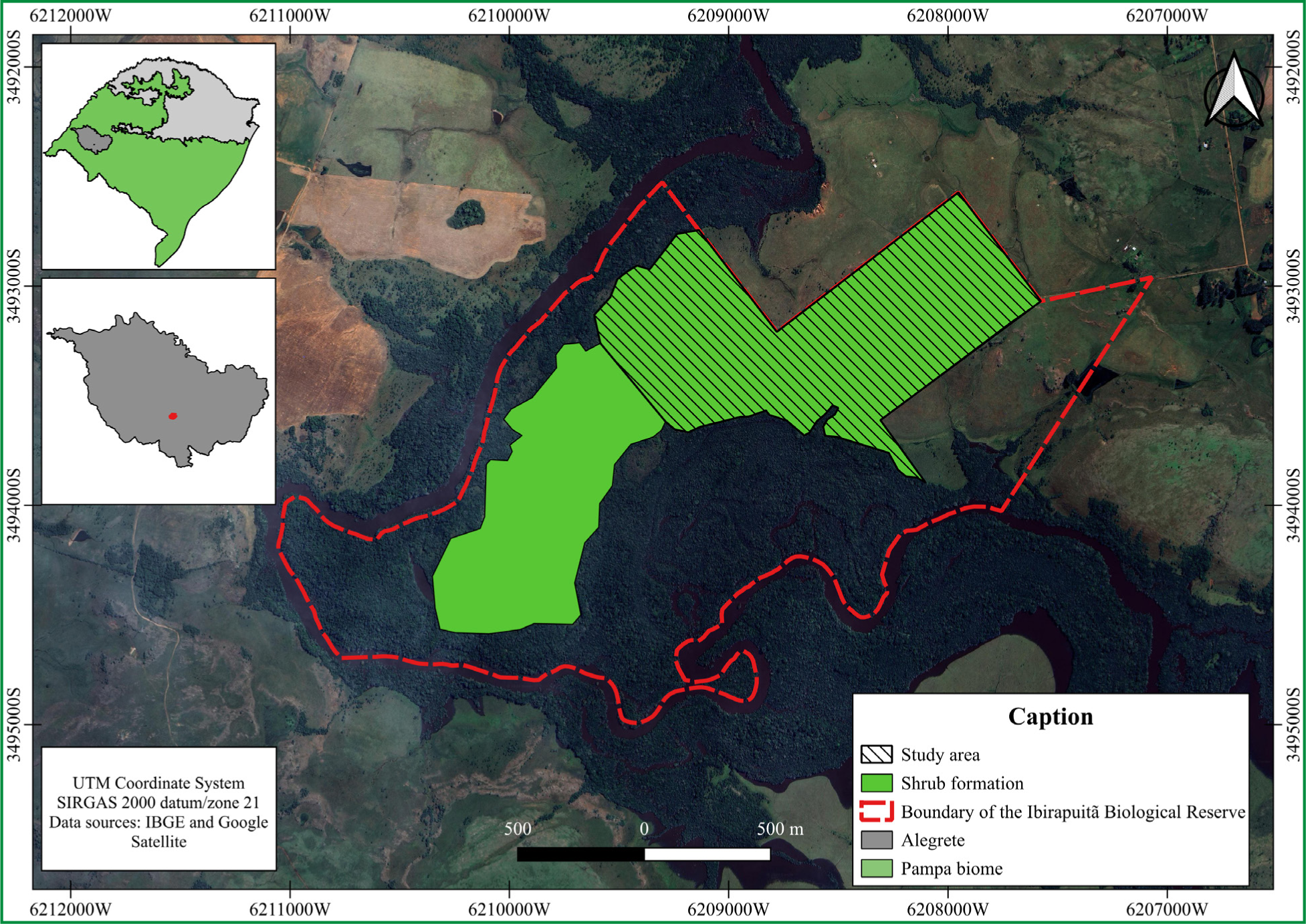
The study was conducted at the Ibirapuitã Biological Reserve, in the municipality of Alegrete, state of Rio Grande do Sul (Figure 1). The Ibirapuitã Biological Reserve is a protected area covering 342 ha, created by Decree No. 24,622 of June 10, 1976, to conserve the landscapes of the Pampa biome in the western frontier region of Rio Grande do Sul (Rio Grande do Sul, 1976). The vegetation of the Ibirapuitã Biological Reserve is composed of different physiognomies, including natural grasslands, riparian forests (Alluvial Seasonal Deciduous Forest), rocky outcrops, and shrub formations (Rovedder et al., 2025). According to the Köppen classification, the regional climate is classified as Cfa, humid mesothermal with hot summers, with a mean annual temperature of 18.6 °C and annual precipitation of 1,747 mm (Alvares et al., 2013). The predominant soils in the study area are Ultisols and Entisols at the higher elevations (Rovedder et al., 2025). The regional relief is gently undulating, with an average altitude of 115 m.

The study area comprises 144.6 hectares of shrub formations (originally grassland areas and rocky outcrops) occurring in the forest–grassland transition zone. The development of shrub-tree vegetation in this area, especially over the last 10 years, has resulted from the absence of disturbances such as cattle grazing and fire. The vegetation is mainly composed of shrubs and trees typical of early stages of ecological succession, interspersed with areas of grassland vegetation and rocky outcrops.
2.2 Sampling and data collection
For the surveys, 20 plots of 100 m2 each (25 m × 4 m) were established using simple random sampling along a 40 m altitudinal gradient (80 to 120 m a.s.l.), without prior stratification by altitude classes. Subsequently, in order to evaluate the possible effects of altitudinal gradient on species composition, the plots were grouped into four altitudinal groups (Table 1, Figure 2). The number of plots varied among groups (I–IV) (Table 1), reflecting the random allocation of sampling units along the gradient and occasional operational limitations imposed by the terrain. It should be noted that the effectively sampled area (Figure 2A) was constrained by access restrictions imposed by field conditions; nevertheless, the allocated plots are considered to adequately represent the environmental characteristics of the total study area (shrub formation).
Altitudinal gradient group and number of allocated sampling plots (n) in shrub formation at the Ibirapuitã Biological Reserve, Rio Grande do Sul, Brazil

Distribution of plots along the altitudinal gradient in the Ibirapuitã Biological Reserve, Rio Grande do Sul, Brazil
In each plot, all woody individuals (trees, shrubs, subshrubs, and lianas) with a height greater than or equal to 50 cm were recorded. This criterion was defined based on Resolution SMA 32/2014 (São Paulo, 2015), which establishes guidelines for monitoring shrub-tree vegetation in different ecosystems. Soil cover by shrub-tree and herbaceous vegetation was also measured using the line-intercept method (São Paulo, 2015). Along the central line of each plot (25 m in length), the segments covered by vegetation were measured (in meters), summed, and subsequently converted into percentage values.
The taxonomic identification of the plants was carried out based on consultations in the specialized literature, with experts, and on the SpeciesLink platform (https://specieslink.net/). Botanical nomenclature followed Angiosperm Phylogeny Group IV (Angiosperm Phylogeny Group, 2016) and Flora e Funga do Brasil (Flora e Funga do Brasil, 2025).
2.3 Data analysis
To characterize the vegetation, the phytosociological parameters of absolute density (AD), relative density (RD), absolute frequency (AF), relative frequency (RF), and importance value (IV) were calculated for each species using the FitoR function (Dal’Agnol et al., 2017). Species were classified according to life form (trees, shrubs, subshrubs, and lianas), following the classification adopted by Flora e Funga do Brasil (2025). They were also categorized by dispersal syndrome (zoochorous and non-zoochorous) and successional group (pioneer and non-pioneer), based on specific bibliographic references for the study region (e.g., Guarino et al., 2018; Negrini et al., 2012; Scipioni et al., 2013; Granzotto et al., 2021). In addition, species were classified according to their degree of extinction threat at the state level (Ordinance No. 52.109, Rio Grande do Sul, 2014) and national level (CNC Flora, 2021).
To assess vegetation variation along the altitudinal gradient, floristic-structural composition data were ordinated using Non-metric Multidimensional Scaling (NMDS). A species-by-plot abundance matrix was used, based on the Bray–Curtis dissimilarity coefficient. Rare species (fewer than five individuals) were excluded from the matrix, as they may hinder data interpretation and contribute little relevant information (Clarke, 1993). Subsequently, Permutational Multivariate Analysis of Variance (PERMANOVA) was applied to test for overall differences in floristic-structural composition among groups. Pairwise comparisons were performed using the adonis2 function in the vegan package, based on the same dissimilarity matrix. Homogeneity of multivariate dispersions was assessed using dispersion analysis (betadisper), with significance tested by permutation (permutest), in order to verify whether observed differences were driven by variation in within-group dispersion.
The percentages of soil cover by shrub-tree and herbaceous vegetation were compared among groups using the non-parametric Kruskal–Wallis test (p < 0.05). Species richness comparisons among groups were performed using rarefied richness, based on a standardized abundance of 250 individuals. All analyses were conducted in R Studio version 2.4.2 (R Core Team, 2023), using the vegan package (Oksanen et al., 2022) and the rarefy function from the iNEXT package (Hsieh; Ma; Chao, 2022).
3 RESULTS
A total of 1,907 individuals belonging to 49 species, 38 genera, and 19 botanical families were recorded. The families with the highest species richness were Asteraceae (15 species) and Myrtaceae (six species). The genus Baccharis showed the highest species richness (six species) (Table 2).
Composition of species in the shrub formation at the Ibirapuitã Biological Reserve, Rio Grande do Sul, classified according to life form, ecological group, dispersal syndrome, and conservation status
In terms of life form, shrubs predominated (19 species, 38.78%), followed by trees (18 species, 36.73%), subshrubs (nine species, 18.37%), and lianas (three species, 6.12%). Regarding ecological groups, 38 species were classified as pioneers (77.55%) and 11 as non-pioneers (22.44%). For dispersal syndrome, 37 species (75.51%) were non-zoochorous and 12 were zoochorous (24.49%). Six species were recorded as having some level of extinction threat: Blepharocalyx salicifolius, Psidium salutare, Schinus lentiscifolia, Solanum granulosoleprosum, and Eugenia hyemalis were classified as Least Concern (LC), while Discaria americana was classified as Vulnerable (VU) (Table 2).
The absolute density was 9,535 ind ha-1, with Baccharis dracunculifolia and Lithraea molleoides showing the highest relative density and frequency (Table 3). The species with the highest importance values were Baccharis dracunculifolia (53.21%), Lithraea molleoides (26.34%), Senecio brasiliensis (13.12%), and Baccharis punctulata (9.34%).
Phytosociological parameters of the 20 species with the highest Importance Value in the shrub formation at the Ibirapuitã Biological Reserve, Rio Grande do Sul
The NMDS showed a stress value of 7.80%, indicating a good ordination fit and allowing reliable inferences from the dataset (Figure 3). The floristic-structural composition of the vegetation showed a significant overall difference among altitudinal groups according to PERMANOVA (F = 1.8721; p = 0.024). However, pairwise comparisons revealed significant differences only between Group III (lower slope) and Group IV (plain) (F = 2.8706; p = 0.027), and between Group I (upper slope) and Group III (lower slope) (F = 4.8277; p = 0.006). No significant differences in multivariate dispersion were observed among groups (F = 0.4642; p = 0.731), indicating homogeneity in within-group dispersion and suggesting that the differences detected by PERMANOVA truly reflect the variation in floristic-structural composition among groups.
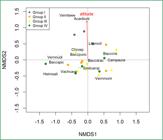
NMDS (Non-metric Multidimensional Scaling) of the floristic-structural composition of the shrub formation based on Bray–Curtis dissimilarity, with sampling plots distributed along an altitudinal gradient at the Ibirapuitã Biological Reserve, Rio Grande do Sul, Brazil
The species Vernonanthura tweedieana (Verntwee), Acanthostyles buniifolius (Acanbuni), and Lithraea molleoides (Lithmoll) showed a stronger association with the upper slope (Group I), whereas species such as Baccharis spicata (Baccspic), Heimia salicifolia (Heimsali), and Vachellia caven (Vachcave) were associated with lower altitudinal zones (Group IV – plain). The species Chromolaena sp. (Chrosp) and Baccharis punctulata (Baccpunc) were associated with the middle slope (Group II). Species such as Vernonanthura montevidensis (Vernmont) and Senecio brasiliensis (Senebras) were associated with the lower slope (Group III). The species Campomanesia aurea (Campaure) showed associations with both the middle and lower slopes. Finally, Baccharis dracunculifolia (Baccdrac) exhibited a similar correlation with all altitudinal zones.
Across all sampling plots, mean soil cover by herbaceous plants was 54.20%, while canopy cover by shrub-tree species averaged 28.63%. Neither type of soil cover differed significantly among groups according to the Kruskal–Wallis test (p < 0.05). Rarefied species richness showed differences among groups, being higher in the middle slope (Group II) and lower in the upper slope (Group I) (Table 4).
Soil cover by herbaceous and shrub-tree vegetation, absolute species richness, and rarefied species richness for the different altitudinal groups
4 DISCUSSIONS
Altitude influenced both floristic composition and species richness of shrub-tree vegetation in the studied shrub formation. However, this influence was not uniform along the entire gradient, as not all groups differed from each other. Pairwise comparisons indicated differences in floristic composition between the upper and lower slopes, as well as between the lower slope and the plain, suggesting species turnover along the altitudinal gradient. In contrast, structural variables, such as soil cover by shrub-tree and herbaceous vegetation did not vary along the gradient, possibly due to a relatively homogeneous successional stage across the study area. Variations in species richness and composition along the altitudinal gradient are likely related to other environmental factors, for example, differences in soil types, fertility, and water availability driven by topography may limit the establishment of certain species in the Pampa biome (Redin et al., 2023).
For instance, in the upper slope the terrain is characterized by the presence of rocky outcrops associated with Entisols, which tend to limit the establishment of dense vegetation. These sites are generally colonized by pioneer tree species, such as Lithraea molleoides, and shrubs from the Asteraceae family (e.g., Baccharis dracunculifolia, Acanthostyles buniifolius). In contrast, the middle and lower slope sections present more developed soil conditions (Ultisols) and are in contact with native grassland remnants, which likely contribute to higher species richness. In this environment, populations of Campomanesia aurea and Psidium salutare were recorded, both shrub species typical of the grasslands of the Pampa biome (Freitas et al., 2020).
Across all groups along the altitudinal gradient, there was a predominance of shrub and pioneer species, particularly from Asteraceae. In early stages of ecological succession, species from this family facilitate the establishment of species from more advanced successional groups (Cruz et al., 2024). In the study area, Baccharis dracunculifolia stands out in both density and frequency. In shrub formations within the Pampa biome, the prominence of this species contributes substantially to soil-level cover and abundance (Brack et al., 1998). The relatively uniform distribution of this species along the altitudinal gradient indicates its high adaptability to different environmental conditions. Species of Baccharis are typical of open areas, colonizing both grasslands and disturbed forest environments, where light availability is higher (Rech et al., 2015). Mechanisms such as effective wind dispersal (anemochory), high competitive ability, and seed germination capacity contribute to the establishment of Baccharis species across a wide range of environmental conditions (Fernandez; Oki; Barbosa, 2021).
Another highly representative species was Lithraea molleoides, a pioneer tree typical of the Pampa biome, whose occurrence has already been reported in early stages of ecological succession in this biome (Boligon et al., 2017; Procknow et al., 2021). This species showed a stronger association with the upper slope (100–110 m a.s.l.), where soils are shallower and better drained. A similar pattern was observed in montane grasslands in Argentina, where this species is associated with higher elevation areas characterized by shallow and well-drained soils (Zeballos et al., 2024). In contrast, Baccharis spicata showed an association with lower altitudinal zones (plain), in transition with native grassland remnants. Despite its ability to colonize different environments, this species is characteristic of lowland and humid sites in grasslands of southern Brazil, Argentina, and Uruguay (Troiani, 1985).
The occurrence of Campomanesia aurea and Psidium salutare indicates the presence of grassland remnants within the study area. However, the high density and soil cover of shrub-tree individuals may have a significant impact on the conservation of these remnants. According to Parera, Paullier, and Weyland (2014), among the criteria for classifying natural grasslands for management and conservation purposes, woody vegetation cover should be below 30%. Above this threshold, ecosystem services provided by grassland vegetation are impaired, and there is loss of biodiversity (Bencke, 2009). Thus, the shrub-tree soil cover values observed in the current study (>30%) could indicate a process of woody encroachment over grassland vegetation and highlight the need for management strategies.
The presence of tree and non-pioneer species, such as Matayba elaeagnoides and Blepharocalyx salicifolius, may indicate the onset of localized successional processes within the landscape, particularly in the middle and lower slope sections. In a grazing exclusion area in Uruguay, Etchebarne and Brazeiro (2016) reported a high abundance of Blepharocalyx salicifolius in natural regeneration, favored by shading and bird-mediated seed dispersal. Changes in microenvironmental conditions promoted by pioneer species, such as shading, can facilitate the establishment of species with higher environmental requirements (Chazdon, 2013). Studies conducted in the Pampa biome show that this process is mediated by facilitation, driven by natural nucleation promoted by tree and shrub species (Fockink et al., 2025; Marchiori, 2004), which is one of the main factors contributing to woody encroachment into grasslands (Schinestsck et al., 2019). On the other hand, the predominance of pioneer and non-zoochorous species in the study area indicates a successional trajectory typical of the Pampa following disturbance isolation, where regeneration tends toward shrub-dominated vegetation, with lower species richness and a dominance of shrubs from the Asteraceae family (Silva et al., 2022).
In this context, periodic monitoring is essential to understand the long-term dynamics of shrub-tree vegetation and to support appropriate management actions that prioritize the conservation of biodiversity and grassland physiognomy. In areas without livestock presence, or even in areas with low stocking rates, the adoption of management strategies such as mowing and prescribed fire may be important to control the biomass of dominant woody species and promote grassland species diversity (Guarino et al., 2023).
Integrated conservation, combined with zoning that allows different management practices by habitat, is essential in protected areas, as all physiognomies have equal value from a conservation standpoint (Ferreira et al., 2025). In this sense, shrub formations should not be overlooked, as they act as a barrier to the spread of invasive exotic species, such as lovegrass (Eragrostis plana Nees), within the protected area (Rovedder et al., 2025), and provide important floral resources for pollinators (Pinheiro et al., 2008). Thus, management should be spatially differentiated according to the altitudinal gradient, prioritizing the conservation of grassland vegetation in middle and lower slope sectors — where species such as Campomanesia aurea and Psidium salutare occur — without compromising the long-term maintenance and monitoring of shrub-tree vegetation.
Finally, it is important to highlight that the sampling design adopted imposed some limitations on the interpretation of the results. The variable number of plots among altitudinal groups implies differences in sampling effort, which may influence the detection of ecological patterns along the gradient. We acknowledge that this imbalance may impact the effectiveness of intergroup statistical analyses. Therefore, the results presented here should be interpreted with caution, particularly regarding comparisons among groups. Nevertheless, the observed patterns provide consistent evidence of the influence of the altitudinal gradient, and we recommend that future studies adopt a balanced number of plots per altitudinal group in order to reduce this potential bias and strengthen the robustness of inferences. Furthermore, we recommend that future studies include the measurement of other microenvironmental variables potentially associated with the altitudinal gradient, such as slope, light availability, and soil water availability. The incorporation of these factors may contribute to more comprehensive understanding of the mechanisms structuring species composition, allowing an integrated assessment of the combined influence of multiple environmental gradients.
5 CONCLUSION
Shrub formations in the Ibirapuitã Biological Reserve are characterized by the predominance of shrub and pioneer species, with emphasis on the genus Baccharis, indicating a process of ecological succession typical of the Pampa biome in the absence of disturbances. The altitudinal gradient influences shrub-tree vegetation patterns, especially floristic composition and species richness, but does not affect structural variables, such as ground cover by shrub-tree and herbaceous vegetation.
It is recommended that future studies monitor this physiognomy, preferably in a spatially stratified manner along the altitudinal gradient, in order to improve understanding of vegetation dynamics and support the development of management strategies that reconcile the conservation of both shrub and grassland formations across different slope sectors.
ACKNOWLEDGEMENTS
We thank the Brazilian Biodiversity Fund (FUNBIO) for financial support and the Secretariat of Environment and Infrastructure of Rio Grande do Sul (SEMA-RS) for logistical support and for granting access to the study area.
-
Evaluators in this article:
Prof. Dr. Renisson Neponuceno de Araújo Filho, Section Editor
Data Availability Statement:
Datasets related to this article will be available upon request to the corresponding author.
REFERENCES
-
ALVARES, C. A.; STAPE J. L.; SENTELHAS P. C.; GONÇALVES J. L. M.; SPAROVEK G. Köppen's Climate Classification Map for Brazil. Meteorologisghe Zeitschrift v. 22, p. 711–728, 2013. https://doi.org/10.1127/0941-2948/2013/0507
» https://doi.org/10.1127/0941-2948/2013/0507 -
APG IV - ANGIOSPERM PHYLOGENY GROUP. An update of the Angiosperm Phylogeny Group classification for the orders and families of flowering plants: APG IV. Botanical Journal of the Linnean Society v. 181, n. 2, p. 1-20, 2016. https://doi.org/10.1111/boj.12385
» https://doi.org/10.1111/boj.12385 - BENCKE, G. A. Diversidade e conservação da fauna dos Campos do Sul do Brasil. In: PILLAR, V. P.; MÜLLER, S. C.; CASTILHOS, Z. M. S.; JACQUES, A. V. A (ed.) Campos Sulinos: conservação e uso sustentável da biodiversidade. Brasília: MMA, 2009, p. 101-121.
-
BOLIGON, A. A.; CABRAL, E. N.; DOS SANTOS, D. V.; KUHN, L. S.; COSTA, L. F. S. Caracterização fitossociológica e estrutural de um fragmento florestal no bioma Pampa. Revista de Ciências Agroambientais v. 15, n. 2, p. 151-157. 2017. https://doi.org/10.5327/rcaa.v15i2.2207
» https://doi.org/10.5327/rcaa.v15i2.2207 - BRACK, P.; RODRIGUES, R. S.; SOBRAL, M.; LEITE, S. D. C. Árvores e arbustos na vegetação natural de Porto Alegre, Rio Grande do Sul, Brasil. Iheringia Série Botânica, v. 51, n. 2, 139-166, 1998.
- CHAZDON, R. L. Tropical forest regeneration. Enciclopedia of Biodiversity v. 7, p. 277-286, 2013.
-
CLARKE, K. R. Non-parametric multivariate analyses of changes in community structure. Austral Ecology, v. 18, n. 1, p. 117-143. 1993. https://doi.org/10.1111/j.1442-9993.1993.tb00438.x
» https://doi.org/10.1111/j.1442-9993.1993.tb00438.x -
CNC FLORA. Lista vermelha da flora brasileira versão 2012.2. Centro Nacional de Conservação da Flora, 2012. Available from: http://cncflora.jbrj.gov.br/portal Accessed in: 23 jun. 2025.
» http://cncflora.jbrj.gov.br/portal -
CRUZ, M. J. C.; SILVA, A. C.; HIGUCHI, P.; HASSAN, V. O. C.; RAUPP, V. G.; FORTKAMP, G. Sucessão florestal inicial em áreas Alto-Montanas no Planalto Sul Catarinense. Ciência Florestal v. 34, n. 1, e71849, 2024. https://doi.org/10.5902/1980509871849
» https://doi.org/10.5902/1980509871849 -
DAL’AGNOL, R.; CHRISTO, A. G.; HIGUCHI, P.; RODRIGUES, A. V. Função para cálculo dos descritores fitossociológicos e similaridade entre sítios 2017. Available from: https://github.com/ricds/fitoR Accessed in: 22 jun. 2025.
» https://github.com/ricds/fitoR -
ETCHEBARNE, V.; BRAZEIRO, A. Effects of livestock exclusion in forests of Uruguay: soil condition and tree regeneration. Forest Ecology and Management v. 362, p. 120-129, 2016. http://dx.doi.org/10.1016/j.foreco.2015.11.042
» http://dx.doi.org/10.1016/j.foreco.2015.11.042 -
FERNANDES, G.W.; OKI, Y.; BARBOSA, M. The Ecological and Applied Potential of Baccharis In: FERNANDES, G.W.; OKI, Y.; BARBOSA, M. (Eds). Baccharis. Springer, 2021, p. 3-21. https://doi.org/10.1007/978-3-030-83511-8_1
» https://doi.org/10.1007/978-3-030-83511-8_1 -
FERREIRA, P. M. A.; ANDRADE, B. O.; PODGAISKI, L. R.; DIAS, A. C.; PILLAR, V. P.; OVERNECK, G. E.; MENDONÇA JR, M. S.; BOLDRINI, I. I. Long-term ecological research in southern Brazil grasslands: Effects of grazing exclusion and deferred grazing on plant and arthropod communities. PLOS ONE v. 15, n. 2, e0229219, 2020. https://doi.org/10.1371/journal.pone.0227706
» https://doi.org/10.1371/journal.pone.0227706 -
FERREIRA, T. S., TETTO, A. F., KOVALSYKI, B., SANTOS, J. F. L., MARCON, A. K., BATISTA, A. C. Diversidade, estrutura e ecologia de uma comunidade arbóreo-arbustiva estabelecida em um ecótono campo-floresta excluído do fogo no sul do Brasil. Ciência Florestal 35, e68951, 2025. https://doi.org/10.5902/1980509868951
» https://doi.org/10.5902/1980509868951 -
FLORA E FUNGA DO BRASIL. Flora e Funga do Brasil. Jardim Botânico do Rio de Janeiro, Rio de Janeiro, 2025. Available from: http://floradobrasil.jbrj.gov.br/ Accessed in: 22 jun. 2025.
» http://floradobrasil.jbrj.gov.br/ -
FOCKINK, G. D.; CAMARGO, B.; PROCKNOW, D.; AGUIAR, E. T. P.; SILVA-FILHO, P. J. S.; SCHENATO, R. B. S.; ROVEDDER, A. P. M. The Role of Nurse Trees in the Plant Community of Park Grassland: A Case Study in Southern Brazil. Applied Vegetation Science v. 28, n. 2, e70027, 2025. https://doi.org/10.1111/avsc.70027
» https://doi.org/10.1111/avsc.70027 -
FREITAS, E. M.; SILVA, V. L.; LIESENFELD, V.; VIANA, A.; RODRIGUES, K. F.; BRUXEL, F.; BARZOTTO, A. C.; CORDEIRO, S. G.; TOLDI, M.; HOEHNE, L.; ETHUR, E. M.; KAUFFMANN, C.; SILVA, S. M. Why preserve the southernmost fields of Brazil? Ciência e Natura, 42, e27, 2020. https://doi.org/10.5902/2179460X40810
» https://doi.org/10.5902/2179460X40810 - GRANZOTTO, F.; SILVA JR, J. C. C.; MATIELLO, J.; SULZBACH, P.; SILVA, R. P.; ROVEDDER, A. P. M. Espécies do banco de sementes do solo, regeneração natural e componente arbóreo no Pampa brasileiro. Curitiba: CRV: 2021.
- GUARINO, E. S. G.; OVERBECK, G. E.; BOLDRINI, I. I.; MÜLLER, S. C.; ROVEDDER, A. P.; FREITAS, T. C.; GOMES, G. C.; NORONHA, A. H.; MIURA, A. K.; SOUSA, L. P.; SANT’ANNA, D. M.; CHOMENKO, L.; MOLZ, M.; MAHLER JR, J. K. F.; MOLINA, A. R.; ESPINDOLA, V. S. Espécies de plantas prioritárias para projetos de restauração ecológica em diferentes formações vegetais no bioma Pampa: primeira aproximação. Pelotas/RS: Embrapa Clima Temperado, 2018.
- GUARINO, E. S. G.; PORTO, A. B.; THOMAS, P. A.; MÜLLER, S. C.; URRUTH, L. M.; CHEMELLO, D.; NABINGER, C.; SANT’ANNA, D. M.; MARTIN, E. V.; OVERBECK, G. E.; COELHO-DE-SOUZA, G. Proposta de guia para a restauração de campos nativos no sul do Brasil Comunicado Técnico 394. Pelotas/RS: Embrapa Clima Temperado, 2023.
-
GUIDO, A.; SALENGUE, E.; DRESSENO, A. Effect of shrub encroachment on vegetation communities in Brazilian forest-grassland mosaics. Perspect Ecol Conserv v. 15, n. 1, p. 52–55, 2017. https://doi.org/10.1016/j.pecon.2016.11.002
» https://doi.org/10.1016/j.pecon.2016.11.002 -
GXASHEKA, M.; GAJANA, C.S.; DLAMINI, P. The role of topographic and soil factors on woody plant encroachment in mountainous rangelands: A mini literature review. Heliyon v. 9, n. 10, e20615, 2023. https://doi.org/10.1016/j.heliyon.2023.e20615
» https://doi.org/10.1016/j.heliyon.2023.e20615 -
HSIEH, T. C.; MA, K. H.; CHAO, A. iNEXT: Interpolation and Extrapolation for Species Diversity. R package. 2022. Available from: https://cran.r-project.org/web/packages/iNEXT/index.html Accessed in: 16 jun. 2025.
» https://cran.r-project.org/web/packages/iNEXT/index.html -
IBGE - INSTITUTO BRASILEIRO DE GEOGRAFIA E ESTATÍSTICA. Biomas e sistema costeiro-marinho do Brasil: compatível com a escala 1:250000. Rio de Janeiro, 2019. 164 p. Available from: https://www.ibge.gov.br/apps/biomas/#/home Accessed in: 20 jun. 2025.
» https://www.ibge.gov.br/apps/biomas/#/home -
MAPBIOMAS. Mapeamento Anual de Cobertura e Uso da Terra no Pampa - Coleção 7, 2022. Available from: https://brasil.mapbiomas.org/destaques-de-colecoes-anteriores/ Accessed in: 23 jun. 2025.
» https://brasil.mapbiomas.org/destaques-de-colecoes-anteriores/ - MARCHIORI, J. N. C. Fitogeografia do Rio Grande do Sul: campos sulinos. 1. Ed. Porto Alegre, RS: EST. 2004.
- NEGRINI, M.; AGUIAR, M. D.; VIEIRA, C. T.; SILVA, A. C.; HIGUCHI, P. Dispersão, distribuição espacial e estratificação vertical da comunidade arbórea em um fragmento florestal no Planalto Catarinense. Revista Árvore v. 36, n. 5, p.919-930, 2012.
-
OKSANEN, J. et al. vegan: community ecology package 2022. Available from: https://cran.r760 project.org/web/packages/vegan/index.html Accessed in: 16 jun. 2025.
» https://cran.r760 project.org/web/packages/vegan/index.html - OVERBECK, G. E.; BOLDRINI, I. I.; CARMO, M. R. B.; GARCIA, E. N.; MORO, R. S.; PINTO, C. E.; TREVISAN, R.; ZANNIN, A. Fisionomia dos Campos. In: PILLAR, V. P.; LANGE, O. (ed). Os Campos do Sul Porto Alegre: Rede Campos Sulinos - UFRGS, 2015, p. 31-42.
- PARERA, A.; PAULLIER, I.; WEYLAND, F. Índice de contribución a la conservación de pastizales naturales del Cono Sur. Una herramienta para incentivar a los productores rurales. Montevideo, Uruguay: Aves Uruguay, 2014.
-
PILLAR, V. P.; VÉLEZ. E. Extinção dos Campos Sulinos em Unidades de Conservação: um Fenômeno Natural ou um Problema Ético? Natureza e Conservação v. 8, n. 1, p. 84-86, 2010. https://doi.org/10.4322/natcon.00801014
» https://doi.org/10.4322/natcon.00801014 - PINHEIRO, M.; ABRÃO, B. E.; HARTER-MARQUES, B.; MIOTTO, S. T. S. Floral resources used by insects in a grassland community in Southern Brazil. Revista Brasil. Bot. v. 31, n. 3, p.469-489, 2008.
-
PROCKNOW, D., ROVEDDER, A. P. M.; PIAIA, B. B.; STEFANELLO, M. M.; CAMARGO, B.; FELKER, R. M.; CRODA, J. P.; GAZZOLA, M. D. Chuva de sementes como indicador ecológico de restauração florestal no bioma Pampa. Revista Brasileira De Ciências Agrárias v.15, n. 3, p. 1-8, 2021. https://doi.org/10.5039/agraria.v15i3a7220
» https://doi.org/10.5039/agraria.v15i3a7220 -
RECH, C. C. C.; SILVA, A. C.; HIGUCHI, P.; SCHIMALSKI, M. B.; PSCHEIDT, F.; SCHMIDT, A. B.; ANSOLIN, R. D.; BENTO, M. A.; MISSIO, F. DE F.; LOEBENS, R. Avaliação da Restauração Florestal de uma APP Degradada em Santa Catarina. Floresta e Ambiente v. 22, n. 2, p.194-203, 2015. https://doi.org/10.1590/2179-8087.083414
» https://doi.org/10.1590/2179-8087.083414 -
REDIN, C. V.; VALENTE, M. L.; ANDRIOLLO, D. D.; INDA JUNIOR, A. V.; ARAÚJO, E. F.; REICHERT, J. M. Soil-landscape-vegetation relationships in grassland-forest boundaries, and possible applications in ecological restoration. Journal of South American Earth Sciences, v. 132, 104684, 2023. https://doi.org/10.1016/j.jsames.2023.104684
» https://doi.org/10.1016/j.jsames.2023.104684 - RIO GRANDE DO SUL. Decreto N° 24.622, de 10 de junho de 1976 Cria a Reserva Biológica de Ibirapuitã, no município de Alegrete. Diário Oficial do Estado, Porto Alegre, RS. 1976.
- RIO GRANDE DO SUL. Decreto n° 52.109, de 19 de dezembro de 2014. Declara as espécies da flora nativa ameaçadas de extinção no Estado do Rio Grande do Sul. Diário Oficial do Estado, Porto Alegre, RS. 2014.
- ROVEDDER, A. P. M; OVERBECK, G.; PILLAR, V. P. Potencial da regeneração natural da vegetação do Pampa Brasília, DF: Ministério do Meio Ambiente – MMA, World Resources Institute – WRI Brasil, 2017.
- ROVEDDER, A. P.; FOCKINK, G. D.; PROCKNOW, D.; CAMARGO, B.; AVILA, B. B. P.; COLLARES, B. B.; GRANZOTTO, F.; BARICHELLO, H. A.; GOLÇALVES, M.; MATIELLO, J.; GAZZOLA, M. D.; SCHENATTO, R. B. Plano de Recuperação para a Reserva Biológica de Ibirapuitã Ponta Grossa: Editora Atena, 2025. 146 p.
- SÃO PAULO. Portaria CBRN 01/2015 Estabelece o protocolo de monitoramento de projetos de restauração Ecológica, considerando o disposto no § 2° do artigo 16 da Resolução SMA 32, de 3 de abril de 2014. Diário Oficial do Estado, São Paulo, SP, 2015. 10 p.
-
SCHINESTSCK, C. F.; MÜLLER, S. C.; PILLAR, V. D. Padrões espaciais da vegetação lenhosa associados ao processo de expansão da Floresta com Araucária sobre Campos excluídos de manejo. Neotropical. Biology and Conservation, n. 14: p. 411-429, 2019. https://doi.org/10.3897/neotropical.14.e47885
» https://doi.org/10.3897/neotropical.14.e47885 -
SCIPIONI, M. C., GALVÃO, F., LONGHI, S. J. Composição florística e estratégias de dispersão e regeneração de grupos florísticos em florestas estacionais deciduais no Rio Grande do Sul. Floresta v. 43, n. 2: 241-254, 2013. http://dx.doi.org/10.5380/rf.v43i2.27098
» http://dx.doi.org/10.5380/rf.v43i2.27098 - SILVA, R. D.; INDRUSIAK, C. B.; MADEIRA, M. M.; TOSCAN, K. H.; VIEIRA, M. de S.; OVERBECK, G. E.; SANT'ANNA, D. M.; FONTOURA JUNIOR, J. A.; MENTGES, M.; KOPP, M. M. Recuperação de campos nativos suprimidos no Bioma Pampa: um estudo de caso em escala de paisagem em Rosário do Sul (RS). Trajetórias, perspectivas e desafios da gestão ambiental pública v. 1, n. 3, p. 155-175, 2022.
- TROIANI, H. O. Las especies de Baccharis (Compositae) da província de La Pampa. Rev. Paco Agronomia U.N.L.Pam v. 1, n. 1-2, p. 35-79, 1985.
- VÉLEZ-MARTIN, E.; ROCHA, C. H.; BLANCO, C.; AZAMBUJA, B. O.; HASENACK, H.; PILLAR, V. P. Conservação e fragmentação. In: PILLAR, V. P.; LANGE, O. (ed). Os Campos do Sul Porto Alegre: Rede Campos Sulinos - UFRGS, 2015, p. 125-131, 2015.
-
ZAVALA, C. B. R., PEREIRA, Z. V., & LINÊ, J. D. B. Heterogeneidade florístico-estrutural de floresta tropical decídua sobre gradiente topográfico de afloramento calcário. Ciência Florestal v. 34, n. 3, e74116, 2024. https://doi.org/10.5902/1980509874116
» https://doi.org/10.5902/1980509874116 -
ZEBALLOS, S. R.; CANTERO, J. J.; GIORGIS, M. A.; ACOSTA, A. T. R.; NÚÑEZ, C. O.; PALCHETTI, M. V.; ARGIBAY, D. S.; CABIDO, M. R. Classification of montane grasslands in central Argentina. Applied Vegetation Science v. 27, n. 4, e70000, 2024. https://doi.org/10.1111/avsc.70000
» https://doi.org/10.1111/avsc.70000
-
Editorial Board:
Prof. Dr. Cristiane Pedrazzi, Editor-in-ChiefProf. Dr. Dalton Righi, Associate EditorMiguel Favila, Managing Editor

 Source: Authors (2025)
 Source: Authors (2025)In where: A) sampling points; B) sampling points overlaid on the digital elevation model (DEM); C) slope elevation profile.
 Source: Authors (2025)In where: Group I = upper slope third; Group II = middle slope third; Group III = lower slope third; Group IV = plain; Altitude = altitude (m). Acanbuni = Acanthostyles buniifolius; Bacccris = Baccharis crispa; Baccdrac = Baccharis dracunculifolia; Baccpunc = Baccharis punctulata; Baccspic = Baccharis spicata; Campaure = Campomanesia aurea; Chrosp = Chromolaena sp.; Heimsali = Heimia salicifolia; Lithmoll = Lithraea molleoides; Smilcamp = Smilax campestris; Vachcave = Vachellia caven; Vermont = Vernonanthura montevidensis; Vernnudi = Vernonanthura nudiflora; Verntwee = Vernonanthura tweediana.