
 WOMEN’S STRUGGLE TO LIVE WELL TOGETHER: COLLECTIVE MOBILIZATION AND ASSOCIATION ALONG THE BRAZIL-BOLIVIA BORDER
ABSTRACT
This article aims to understand the configuration of public arenas around issues affecting women in the municipalities of Corumbá and Ladário located in the Brazilian state of Mato Grosso do Sul along the border with Bolivia. Grounded in critical pragmatism within the social sciences, the study employs a cartographic approach to the field of practices, operationalized via the Border Social Innovation Observatory (OBISFRON) platform. The research identified public actions emerging from the experiences and collective practices of different socio-state organizations operating in the public arena focused on women in this territory. The results reinforce the importance of fostering dialogue between social innovation, public policy, and public arenas to challenge and transform traditional models of city planning, management, and governance. This is particularly relevant since the local public administration has failed to directly engage with the demands and initiatives of civil society collectives.
Keywords:
public arenas; social innovation ecosystem; public policy; gender inequality; digital platform
RESUMO
Este artigo tem como objetivo compreender como se configuram as arenas públicas em torno dos problemas públicos vivenciados pelas mulheres em Corumbá e Ladário (Mato Grosso do Sul), na fronteira Brasil-Bolívia. Partimos do conjunto de trabalhos reunidos sob o rótulo de pragmatismo crítico nas Ciências Sociais, e, por meio da cartografia do campo de práticas e operacionalizando via plataforma do Observatório de Inovação Social da Fronteira, foi possível identificar a ação pública promovida pela experiência e práticas coletivas de diferentes organizações socioestatais que atuam diretamente na arena pública das mulheres desse território. Os resultados reforçam a importância do diálogo entre inovação social, políticas públicas e arenas públicas para a promoção de rupturas no modelo de planejamento, gestão e governança das cidades, visto que as práticas da administração pública municipal não têm dialogado diretamente com as demandas e os esforços coletivos da sociedade civil.
Palavras-chave:
arenas públicas; ecossistema de inovação social; políticas públicas; desigualdade de gênero; plataforma digital.
RESUMEN
Este artículo tiene como objetivo comprender cómo se configuran los espacios públicos en torno a los problemas públicos vividos por las mujeres en Corumbá y Ladário (Mato Grosso do Sul), en la frontera entre Brasil y Bolivia. Partimos del conjunto de trabajos reunidos bajo la etiqueta de pragmatismo crítico en las ciencias sociales y, por medio de la cartografía del campo de prácticas, operacionalizada a través de la plataforma Observatorio de Innovación Social de Frontera, fue posible identificar la acción pública promovida por la experiencia y prácticas colectivas de diferentes organizaciones socioestatales que actúan directamente en la arena pública de las mujeres en este territorio. Los resultados refuerzan la importancia del diálogo entre innovación social, políticas públicas y arenas públicas para promover rupturas en el modelo de planificación, gestión y gobernanza de las ciudades, toda vez que las prácticas de la administración pública municipal no han dialogado directamente con las demandas y esfuerzos colectivos de la sociedad civil.
Palabras clave:
arenas públicas; ecosistema de innovación social; políticas públicas; desigualdad de género; plataforma digital.
INTRODUCTION
Although gender equality is a fundamental principle defined by the Brazilian Constitution, violence against women and unequal relationships between men and women (or the privileges, rights, and desires of men, which have historically taken precedence over those of women) are recurrent issues in Brazil. According to a report by Agência Patrícia Galvão (2017), women are frequently victims of harassment and violence in various forms and intensities, which can lead to feminicide, contempt, or discrimination. In 2023, 3,181 cases of violence against women were reported in Brazil, including 586 feminicides (Ferreira, 2023).
The most recent Map of Femicide in Mato Grosso do Sul (MS), prepared by the Sub-Secretariat of Public Policies for Women (Governo do Estado de Mato Grosso do Sul, 2021), reveals that the state has the highest rate of femicide in the country (3.5 per 100,000). Ninety-four percent of these cases occur in the interior of the state. In Corumbá alone, a municipality with 96,000 inhabitants located on the Brazil-Bolivia border where this research was conducted, almost 2,000 women were living under protective measures. In March 2024, the municipality registered a thousand criminal actions in the criminal court (application of the so-called “Maria da Penha” Law). The average rate of protective measures granted varies from 50 to 60 cases per month, which is considered a high demand for a population of 150,000 people (including Corumbá and Ladário, a neighboring municipality 5 km away that also participated in the research, as well as the floating population of Puerto Suárez and Puerto Quijarro on the Bolivian side).
In the words of public agents, “women [in this region] need to be strengthened to be able to escape the cycle of violence” (Tavolieri, 2023, s.p.). There is also the possibility that these numbers are higher due to unreported cases. However, this article argues that, in addition to the strength to report, the different spheres of public administration need to prioritize public governance, an experimental process through which multiple actors interact, create cooperation structures, and seek solutions for common goals (Ansell et al., 2022; Sabel & Zeitlin, 2012).
The study will demonstrate that women in situations of violence or inequality do not remain silent; on the contrary, they join together to combine forces and demands, calling on leaders to make their voices heard. “They speak out, testify, evaluate, argue, criticize, question the media and public authorities. When these do not intervene, they seek solutions on their own scale” (Cefaï, 2017a, p. 188). This is the reason for recognizing public arenas through a mapping of collective action, aiming to create a positive inventory of emerging forms of public involvement, of projects and actions created by groups to regulate or alleviate the challenges of their experiences.
Thus, the debate on social innovation in politics, academia, and the media has been ongoing. It is justified both by the need to recognize social innovation on a micro-scale based on the experience of local contexts aiming at short-term improvements (Evers & Ewert, 2020) and by the help it offers to political actors, organizations, and collective actions of civil society to find better strategies to cope with social inclusion, given the recognition of social innovation initiatives, their emanating actions and practices, and the challenges faced by communities (Wegner & Howaldt, 2024).
Escaping from a purely instrumental view, which dominates the field of social innovation (Howaldt et al., 2016), we reinforce the construction of an alternative understanding of public arenas as social reconfigurations produced by the interactions between the creativity of actions and the regularity of what is already established (Andion et al., 2020). Thus, we use a set of works gathered under the label of critical pragmatism in the social sciences, which explore the notion of public inquiry. This method aims to capture the public action promoted by the collective experiences and practices of actors in the territory in response to the public problems they face, with the goal of co-constructing responses to the various contemporary socio-environmental challenges (Andion et al., 2017, 2020; Santo & Andion, 2024).
Our objective is to understand how public arenas are configured around the public problems experienced by women on the Brazil-Bolivia border. Specifically, we demonstrate the importance of digital platforms in making visible the struggles of communities and social innovations on a local scale. This study was carried out through the Border Social Innovation Observatory (OBISFRON - https://obisfron.com.br/). This digital platform examines the developments of public action in the territory based on ecosystems. In other words, while studying the region’s main public problems in depth, including the analysis of public policies, it encourages the connection of actors (community leaders, private and non-governmental organizations, government agents, and support and financing organizations) that produce and disseminate social innovations.
This article consists of five sections. Following this introduction, we summarize the theoretical framework by discussing the mobilization and networking of women, as well as the social innovation ecosystem from a pragmatist perspective. In the third section, we outline the research methodology. Section four presents and discusses the main results, while the final section offers concluding considerations.
THEORETICAL FRAMEWORK
Despite the advances in the Brazilian political agenda regarding gender equality, materialized in laws, policies, and public programs, there is a cultural heritage in our society that places women’s bodies and minds under the dominion of men, generating abusive relationships and various types of violence (Farah, 2004). Faced with this reality, where the state is unable to deal with the problematic situations that affect women, society does not remain silent. Thus, it is important to recognize the role of social movements organized by women as they strive for equality and autonomy.
First, it is essential to acknowledge that gender issues are fundamental to addressing social inequalities worldwide. Based on this understanding, mobilizations by civil society, public authorities, academia, and the business community have been undertaken to address issues related to women.
In Brazil, women’s movements seeking their rights have always been active and present. However, according to Farah (2004), it was from the 1980s onward that social movements began to demand the co-creation of specific public policies with greater intensity and in a participatory manner, to enforce their demands and the interaction between government and civil society. The scenario of redemocratization in Brazil, which began in 1980 and became effective in 1988 with the promulgation of the Constitution of the Federative Republic of Brazil (CF-88), also represented another significant achievement for the feminist and women’s movement, particularly in terms of gender equality and suffrage. According to the CF-88, all individuals are equal before the law, and men and women are equal in rights and obligations (CF-88, 1988).
According to Dora Barrancos (2022), the discussion about feminism in Latin America differs from debates in other regions. In Latin America, feminism was not initially characterized as a mass movement but as something that continues to expand in some countries. One consequence of the movement has been an increase in empathy and women’s reactions against machismo and patriarchy, even though many do not identify as feminists.
This achievement is crucial, especially in Brazil, considering that the two most recorded and quantified types of violence against women are domestic and family violence, as women face all forms of physical, psychological, sexual, patrimonial, and moral violence daily. Given this reality, a milestone in the fight for women’s rights emerged: Law No. 11,340, of August 7, 2006 (2006), known as the “Maria da Penha” Law. The name references the case of Maria da Penha Maia Fernandes, who struggled with domestic violence and survived two murder attempts by her husband. Since then, Mrs. Maia Fernandes has committed herself to combating violence against women and domestic and family violence, championing the principles outlined in the CF-88 and the international treaties ratified by Brazil concerning gender equality (LC, 2006; Tribunal de Justiça de Mato Grosso do Sul [TJMS], 2021).
Therefore, the importance of the struggles waged by social movements and the achievements of the entire institutional apparatus lies in addressing the historical and ongoing violations and inequalities that women face in Brazil. Given that the numbers continue to grow, this suggests that, despite being an old debate, the problem remains a persistent issue in the country.
In this process, the collective engagement of women has gained space on the public agenda, and the government has addressed some issues but has yet to break through to the heart of the problem: machismo and the dominance of patriarchy. Meanwhile, many laws and public policies suffer from low operationalization and effectiveness despite their undeniable importance. This requires examining the actions of civil society to recognize how they (re)act in times of crisis (Ansell et al., 2022; Farah, 2004).
When civil society mobilizes around a problematic situation (a Deweyan concept that encompasses all disturbances affecting collective life, such as unpaved streets, violence, hunger, fires, among others), associations are formed, leaving the private sphere and becoming public. Their actions have impacts that extend beyond those directly involved in the relationship.
For Dewey (1927), “public” refers to collective associations, in the sense of connections that interact with each other to address problematic situations. Once formed, the public seeks solutions, assigns responsibilities, judges an act as unjust and dangerous, forms alliances and enemies, tries to find space in the political agenda (passes specific laws and policies), and puts forward what they want and why they want it.
The formation of the public also encompasses disputes and power relations (who will act and speak on whose behalf) and actions in territories to highlight the problem and seek solutions for a given situation. This situation is considered a “public problem” because a “public” has been formed. This public continues to recruit new individuals so that its agenda gains a societal dimension (Gusfield, 1981), as noted by Cefaï (2017a), when the public arena is institutionalized.
The public arena is a concept proposed by Daniel Cefaï (2017a, 2017b) and does not indicate the existence of a defined space; rather, it suggests that a public is formed in response to a problematic situation, which is then publicized. This publicization is not unanimous, as the public grows and is established in the absence of consensus. Civil society may both accept and object to the proposed solution.
This is because public order is organized not only as a market, where interests and opinions are negotiated (the logic of profit), nor as a field (the logic of domination between social groups), or as an agora (the logic of argumentation and deliberation). In the public arena, the different logics overlap, highlighting the modalities of ordinary citizenship and the processes of constituting public problems.
Recent studies, such as Andion et al. (2020), align with this perspective and advocate that “public arenas constitute the main locus in which collective actions as practices emerge and unfold” (p. 376). The authors connect their study to social innovation ecosystems (SIE), aiming to recognize the network of actors (ecosystem), the public problems faced, and how social innovations emerge (or do not) in this process. From this critical pragmatist perspective, social innovation results from a process of social change triggered by the actions of various collectives that interconnect and form a network around local public problems, making new solutions (collective creations) possible (Andion et al., 2017).
The study of social innovation is important because it has been presented as a possible response to problems evident in society, in addition to highlighting others that are stagnant or stabilized. This is because the effects of social innovation manifest “in the here and now” [in situ], containing “wider messages concerning values, hopes and assumptions. Social innovations are practical devices, but they can also act as larger symbols of hopes and aspirations.” (Evers & Ewert, 2020, p. 700).
From an ecosystem perspective, the aim is to identify an environment in which innovation can be stimulated by the agents that act within it in response to various causes, thereby meeting diverse social needs (Howaldt et al., 2016). However, according to Santo and Voks (2021a), rather than arguing that social innovations occur solely through the diffusion and transposition of new techniques, as is commonly discussed in the management literature, it is urgent to recognize that social innovations emerge from the convergence of varied and plural collective actions. Therefore, it is not just the existence of an ecosystem that ensures the promotion of social innovations, but also the interactions and effects generated by these ecosystems.
Wegner and Howaldt (2024) highlight the role of digital SIE, an emerging phenomenon that plays a crucial role in making social innovation initiatives visible, allowing current interactions to be demonstrated, stimulating connections among different actors, and helping social innovation to thrive in local, regional, and national contexts. They also argue that technological innovations must be accompanied by social innovation, in which digital platforms become prominent, such as the German Platform for Social Innovation & Social Enterprises (https://sozialeinnovationen.net/) and the Social Innovation Observatory of Florianópolis (OBISF - http://www.observafloripa.com.br/), which created the study of pragmatist social innovation.
The work of OBISF assumes “a particular analytical approach that allows us to enter these different public arenas, identify the actors and their interactions, retrace this reticular network, and observe the experiences in situ” (Andion et al., 2020, p. 188). Therefore, cartography and observation of SIEs are options for understanding how different audiences engage in tackling public problems, making it possible to understand the causes of interactions, discussions, publications, and the scope of solutions promoted by their actors.
Inspired by this experience, the Border Social Innovation Observatory (OBISFRON) was established as a digital platform of the Federal University of Mato Grosso do Sul, Pantanal Campus. Its objective is to promote the intersection of social innovation and public policies by empowering multiple stakeholders, with the aim of enhancing public governance in border cities.
First, it is important to clarify that when we speak of borders, we do not interpret them as the end of the national territory but as a living space formed with “the bones, sweat, and blood of border dwellers” (Santo & Voks, 2023, p. 6), the populations that live on the border and cross international boundaries with fluidity, sharing economies, sociability and, among others, public problems
Initially, OBISFRON aimed to identify and synthesize the primary public issues of this region, totaling eight, which were classified through the lens of the UN’s 17 Sustainable Development Goals (SDGs). Next, the observatory conducted a mapping of social innovation initiatives and support programs. By August 2024, the platform had identified 130 and 80, respectively. The third phase aimed to engage with public arenas to understand the implications of public action.
Finally, OBISFRON aims to prioritize actions and innovations developed by communities, focusing on recognizing how practices from these collectives are inscribed in the territory. The observatory investigates how they interact (or do not) with the actions of public authorities, and how the pursuit of social justice and the inclusion of subalternized women who experience violence takes place, which will be discussed later in this article.
METHODOLOGY
This research employs a qualitative approach. We present the results of a study conducted between 2023 and 2024, which began with bibliographic research (in books, articles, theses, and dissertations) aimed at deepening our theoretical understanding of women, gender, public arenas, and social innovation.
Subsequently, documentary research was conducted to inventory the main laws, programs, and public policies established and enacted in the Brazilian municipalities of Corumbá and Ladário. This stage involved a survey of the Official Gazette databases for each municipality, considering the information gathered during interviews with municipal superintendents working on women’s rights.
This research examines two Brazilian municipalities and two other municipalities in Bolivia which, as this study will demonstrate in the next section, share similar problems and responses, including those generated by social innovation initiatives and those provided by local governments. The Brazilian constitution (CF-88) states that migrants and refugees have social rights in Brazil; therefore, the issues concerning these populations are also addressed in the policies observed in the region.
The third phase of the work involved cartography to identify public, business, and civil society organizations engaged in this confrontation. This method enables us to document the action’s developments, network connections, and social transformations in the territory (Santo & Voks, 2021a).
This stage began by tracking the social media of organizations in the four municipalities and documenting their actions in partnership with other organizations through posts. New organizations were also identified during the interviews. For each identification, a survey of secondary sources (mainly the internet) was conducted to gather as much information as possible about the social innovation or support initiative, which was recorded in OBISFRON.
Finally, the last phase of the research involved interviews using a semi-structured script. Out of the 24 initiatives identified (15 social innovation initiatives and 9 support initiatives, all described below in Table 1), we interviewed 12 social innovation endeavors and 5 support initiatives. This allowed us to understand their origins, causes, target audiences, challenges, and the public policies and programs currently in place in that territory.
The interviews took place between July and September 2023 at the headquarters of the initiatives and/or in public agencies. All interviews were recorded, transcribed, organized, and entered into the OBISFRON platform, which facilitated the generation of a conceptual codification from the perspective of the theoretical framework based on the data. The OBISFRON platform informs the social innovation ecosystem (SIE) of the women’s public arena (Figure 1) and provides spreadsheets containing graphs and other data for each initiative, which contributed to the results of this study.

Based on this codification, the analysis of all the material relied on the critical pragmatism of the social sciences. In summary, the data examine the constitution of public problems and the democratic dynamics occurring in the territory to understand the notion of social innovation (Andion, 2023; Andion et al., 2017; Andion et al., 2020; Santo & Voks, 2021a, 2021b).
RESULTS AND DISCUSSION
The data obtained during the fieldwork allowed us to track the social innovation ecosystems (SIEs) primarily focused on meeting women’s needs. Figure 1 illustrates that the activities of social innovation initiatives overlap with other endeavors in the region that are not specifically targeted at women but share the same demand; for instance, when an organization is dedicated to defending the rights of children and adolescents, it inevitably impacts the lives of mothers in that region.
Twenty-four initiatives were identified: 15 of them are social innovation initiatives (SII) that directly address gender inequality and violence against women, and 9 are enterprises that support these initiatives (SI). Twenty of them are located in Corumbá (13 SII and 7 SI), 3 in the municipality of Ladário (2 SII and 1 SI), and 1 SI in Campo Grande (the capital of the state of Mato Grosso do Sul). Table 1 presents the SII and SI in the region, along with their respective objectives.
Having acknowledged the SIE mapping, which public arena is organized around the public problems experienced by women in this region? To answer this question, we must first understand the public problem at hand.
According to Cefaï (2011), public problems arise in different places and at different times, mobilizing numerous actors who come together in various forms of engagement. This is because a public problem is formed from the moment a particular event takes on a collective form (general interest), as occurred with the creation of the Maria da Penha Law (general interest) resulting from a particular case (a series of acts of violence suffered by Maria da Penha Maia Fernandes), but which represents several women who have been or will be victims of violence throughout Brazil.
Public authorities are not the only players responsible for addressing public problems, as illustrated in the case of Maria da Penha. Before they are addressed institutionally (such as through legislation), these issues are products of the public action of countless citizen movements occurring locally (e.g., an anti-racist demonstration in Corumbá), nationally (demonstrations over the death of João Alberto, a Black man who died in the Carrefour parking lot in 2020), and internationally (the Black Lives Matter movement represents the internationalization of the anti-racist movement). What we see in common is a certain discomfort that generates numerous mobilizations across time and space. Despite the specificities, there is a dialogue between the causes (in this example, ongoing vulnerability and racism).
For Gusfield (1981), three aspects are decisive for the constitution of public problems. Firstly, the problematic situation needs to acquire a “societal” dimension, or a certain inconvenience. It must be the subject of conflicts, controversies, and opinions (for and against) in the public space, characteristics that will corroborate the formation of collective action or, as Cefaï (2011) categorized it, the creation of an association from the affected public.
As a second aspect, Gusfield (1981) argues that the problematic situation is a “controversial and polemic” subject. The publicization of events, the act of bringing a problem into focus, denouncing it, and making it visible, is of utmost importance, as it represents an attempt to ensure that a certain cause or event is not forgotten and/or rendered invisible by society and public authorities.
This can occur through a series of posts, comments on specific social media events, and the dissemination of information to official media, culminating in the materialization of the body when a certain character becomes a “political body,” translating their cause through their own body and voice, and thereby generating discomfort. At the national (and international) level, we can mention this materialization in the figure of Marielle Franco, a Rio de Janeiro councilwoman who was murdered in 2018 and who made a series of complaints in City Council sessions about violence, poverty in the favelas, and the vulnerability of women.
At the local level, Ednir de Paulo stands out, a Black woman from Corumbá and leader of the social innovation initiative Imnegra, who was intensely attacked in her workplace. Due to her efforts, the movement for the recognition and titling of three quilombola communities in Corumbá began. Amanda de Paula, another Black woman from Corumbá, leader of the initiative Cufa Corumbá, began to raise awareness about the favelas in Corumbá and called for the need to join forces to provide a decent quality of life for this population.
As a third and final aspect, Gusfield (1981) indicates that the problem becomes the focus of public action. People come together in various organizational formats (informal collectives, associations, institutes, foundations, and research projects, among others) to work toward a solution. “Solving it” does not mean that the problem will be fully addressed and resolved, but that, within the framework of a democratic culture, the public is mobilized and will engage in a series of activities that enable the problem to be tackled.
However, not every problematic situation becomes a public problem. Some causes may not emerge in a given location at a given time and may only generate discomfort that requires the formation of an audience much later. It was only in 2022 that a social innovation initiative was established to strengthen women artists in the Pantanal (COMAP). It is common knowledge in this area that the dominant cultural movements were primarily led and executed by men. Thus, even though there have been and continue to be renowned female artists in the region, it begs the question: why did it take so long for a coordination to emerge?
For Cefaï (2011), frustration and protests always have their sources. Emotional shocks are fundamental to making demonstrations concrete in everyday life. Thus, we can analyze this experience and correlate it with the fact that several situations of exclusion provoked the feelings of these female artists, leading them to organize themselves and seek their space. This process does not arise disconnected from other feminist and women’s agendas at the national level. “These groups of relationships, more or less successful, more or less sporadic, with variable geometry, sustain the public engagements of individuals and remodel the associative landscape” (Cefaï, 2011, p. 23).
With this background, we begin the analysis to verify the existence of a public problem in the region. To begin this argument, we look at the word cloud below (Figure 2) that compiles the main causes identified in the 15 social innovation initiatives on the Brazil-Bolivia border.


Figure 2 shows that the main cause of the social innovation initiatives is to create actions to address problematic situations through the “generation of jobs and income,” aiming to combat “gender inequalities” and, in many cases, prevent “domestic violence.” This is clear, for example, in the actions of Imnegra, an initiative that offers sewing and dressmaking training to all women who wish to earn an income, in addition to making the organization’s space available for them to sell their products. Other examples are the associations that unite women from the communities to generate income from a raw material extracted from the region in which they live, such as the social innovation initiative operating in the environmental protection area Baía Negra, the Associação de Mulheres Ribeirinhas do Porto Esperança, and the Associação Corumbá Produz, which produce handicrafts from the fiber of the water hyacinth, an aquatic plant from the Pantanal, as illustrated below.
All of these initiatives seek to create job opportunities for their members. Their purpose is straightforward and easy to understand: for women to gain independence and the freedom to pursue their goals, they need autonomy, the ability to earn their own income, and the chance to live a dignified life. They must be capable of providing for their children and living free from violence - a challenge that becomes more difficult when they lack independence. As many women reported throughout the study, they often face threats from violent male partners when they are not independent.
In response to the question regarding the public arena organized around the public problems experienced by women and the need to build an in-depth understanding of these problems, our findings reveal the existence of a large arena comprising many initiatives. These endeavors do not necessarily interact with each other, yet they share a common public problem that arises from several problematic situations (Figure 2), which have assumed a “societal” dimension. These issues have become a burden for many women in this region, including violence, poverty, lack of representation, and racism.
Considering their different places, times, and realities, these women mobilized in the face of different “controversies and polemics” that needed to be publicized and addressed, such as Dona Natalina (Associação de Mulheres Ribeirinhas do Porto Esperança), who founded the initiative in 2018 to guarantee a source of income for the women in her community (Pantanal). It all started Natalina had previously run for president of the residents’ association of the Porto Esperança community but lost the election to a man who claimed that she was unfit to lead the organization because she was a woman. It was at this critical moment that she decided to organize and found an association composed exclusively of women.
Another example is Amanda de Paula, who had the activities of the social innovation initiative Cufa Corumbá belittled by the government, which referred to these activities as charitable, implying that people were acting solely out of religious devotion. This is what Cefaï (2017a) refers to as intervention dispositif, designed to persuade individuals and create conflicts within the public sphere. In all these cases, the issue became the focus of public action as these various initiatives emerged and began to advocate for their cause, specifically addressing the public problem, which can be summarized as social and racial vulnerability along with gender equality, since nearly all the initiatives aim to develop actions that generate work and income.
We also observe that these initiatives arise from proximity, which Cefaï (2011) identifies as the lived experience, the daily life of actors, residents, users, or citizens (who are often family members), who come together and play a fundamental role in public engagement. However, it is important to emphasize that this engagement is not based on rational argumentation. It is also permeated by internal conflicts (within the initiative itself, which can lead to its weakening and even dissolution) and external conflicts (among public agents, for example). This justifies, once again, the importance of identifying and exploring public arenas, especially in this case, where the majority of women in these associations are Black and poor.
However, this public arena is not formed only by the social innovation initiatives. Santo and Voks (2021a) state that the process of forming the public also depends on the actions of the state and public institutions, from guaranteeing the conditions of freedom (freedom to associate and form the public) to organizing public life through policies and laws. “Thus, recognizing the policies and laws of a problematic situation studied is a fundamental step in the process of public inquiry, since it is through this apparatus that the State will try to maintain public order” (Santo & Voks, 2021a, p. 874).
Table 2 summarizes the survey of laws and public policies specific to women, which are discussed below:
Laws and Public Policies Related to Women Causes in the Municipalities of Corumbá and Ladário (MS)
Analyzing the programs, laws, and public policies in the municipalities of Corumbá and Ladário reveals that the local administration primarily focuses on developing and implementing projects aimed at combating violence against women and supporting those who have already suffered violence. This focus is understandable, given the high rates presented in the introduction. However, it highlights a disconnect concerning the demands identified in the actions of social innovation initiatives, as most of them are dedicated to promoting job and income generation. There is a clear lack of institutional projects that support the ongoing actions of these initiatives and contribute to the professional qualification of women in terms of job and income generation.
As previously discussed, it is urgent to address violence against women stemming from the inequality between men and women, which is exactly what the social innovation initiatives have undertaken. While it is important to observe the measures taken by public authorities to combat violence (Table 2), these measures primarily intervene during or after incidents occur, failing to significantly prevent such occurrences. Consequently, promoting women’s autonomy should be a priority for the government in this region, without excluding actions to combat and prevent violence.
The Superintendence of Ladário, a municipality that lacks specific laws for women and operates only federal programs (like Bolivian municipalities), reported that most of its citizens registered in the Brazilian national database for welfare programs (Cadastro Único) are women. Although the administration of Corumbá did not provide this specific information, Bartholo et al. (2019) indicate that 92% of individuals registered in this nationwide database are women. This indicates that, in most cases, women are the primary financial providers for low-income households. This situation highlights the importance of the government’s role in generating work and income for this social group while not undermining ongoing measures against violence. Additionally, it is essential to assess the incidence and effectiveness of these initiatives.
FINAL CONSIDERATIONS
This work aimed to understand the configuration of the public arena for promoting women’s rights, as well as support and assistance, based on the practices and experiences of socio-state organizations that mobilize to address the needs of women on the Brazil-Bolivia border. We identified the struggles of various social innovation and support initiatives, which were inventoried, interviewed, and registered in the Borde Social Innovation Observatory (OBISFRON), enabling us to recognize the ecosystem.
During this research, it became clear that a public problem is constructed across various public scenes and arenas, including the mobilization of social movements and their speeches, the accountability of public authorities called to intervene in policies, the courts, unions, and associations, among others. Thus, solutions to problems lie, above all, in understanding their causes, holding competent entities accountable for their resolution, and fostering a democratic culture and strong public action.
Thus, it is essential to identify initiatives and their actions through digital platforms, as carried out by OBISFRON, since knowledge is generated and shared that can aid social innovation initiatives (by making public problems visible and prioritizing actions/responses carried out by communities) and support initiatives (by fostering closer ties between the government and social innovation efforts, as well as evaluating public policies).
This is evident in the organizations identified and presented here, which are from different spaces (urban, rural, central, peripheral, and others) in search of solutions to the same public problem: gender inequality and violence against women. It is from the actions and practices of these organizations that social innovation emerges (facilitating access to food, promoting professional training aimed at financial independence, and strengthening a professional collective in a sexist space, among others). Social innovation emerges from this capacity to respond; it emanates from varied and plural collective actions, through which initiatives attempt to problematize (question, disagree) and publicize (highlight) their causes to build responses to public problems perceived as common.
An example that illustrates this conclusion occurs when the leader of the initiative Imnegra experienced racism and misogyny and begins to look for alternatives so that other women do not experience the same verbal aggression that she did. This is how an association (Imnegra) emerges, offering sewing and dressmaking courses designed to generate income for these women. Much more than the dissemination of miracle recipes, as commonly discussed in the literature on administration, social innovation arises from the search for social change through responses to a public problem, in this case, gender vulnerability (which includes inequality between men and women and violence against women).
However, the emergence of an organization does not necessarily mean that social innovations (in the sense discussed here, as a process that enables social change and addresses public problems) will occur on a large scale. Many organizations suffer from a lack of financial resources, institutional support, and internal conflicts. The importance of the government’s role and that of other supporting actors, such as universities and companies, is evident. They can finance actions, offer technology, transfer knowledge, and engage in other activities that enable the social innovation initiatives to continue operating in the territory.
The government’s role is translated into laws and public policies that seek to address the problem. We saw that the city governments of Corumbá and Ladário created a series of policies that aim to address, mainly, violence against women. Therefore, social innovation requires changes in the traditional way of managing, creating, and implementing public policies by prioritizing experimental public governance. Therefore, digital platforms can help decision-makers interact and learn from the practices of social innovation initiatives.
Finally, at a micro level, we recommend that future work verify whether these projects/policies actually reduce the number of cases of violence, update the data on how many women are victims in this region, and investigate the correlation between domestic violence and women’s employment levels.
At a macro level, we encourage this approach to be replicated in other territories through the creation of additional digital platforms like OBISFRON. Examining social innovation through public arenas has enabled us to understand the consequences of actions in depth, make historical and urgent public problems visible, and shed light on the collective efforts of civil society, which, in the face of difficulties, carry out numerous innovations within the territory. In this context, the critical pragmatist perspective that underpins this work reinserts the notion of the public in contrast to that of the political process. It recognizes that the collective mobilization of multiple socio-state actors constitutes a process that defines problematic situations. Through public inquiry, it will be possible to understand the construction, challenges, and access to public policies and services.
-
Evaluated through a double-anonymized peer review
ACKNOWLEDGMENTS
We would like to thank the Brazilian agency CNPq for funding the research (Universal Call 10/2023) and FUNDECT for the scholarship granted to Lenita Mendes during the research.
References
-
Agência Patrícia Galvão. (2017). Cultura e raízes da violência contra as mulheres: Dossiê Violência Contra as Mulheres.https://x.gd/Z1CT5
» https://x.gd/Z1CT5 -
Andion, C. (2023). Social innovation, experimentalism and public governance: An ethnographical approach to study public arenas in the city. Brazilian Administration Review, 20(2), e220124. https://doi.org/10.1590/1807-7692bar2023220124
» https://doi.org/10.1590/1807-7692bar2023220124 -
Andion, C., Alperstedt, G., & Graeff, J. (2020). Ecossistema de inovação social, sustentabilidade e experimentação democrática: Um estudo em Florianópolis. Revista de Administração Pública, 54(1), 181-200. https://doi.org/10.1590/0034-761220180418
» https://doi.org/10.1590/0034-761220180418 -
Andion, C., Ronconi, L., Moraes, R., Gonsalves, A., & Serafim, L. (2017). Sociedade civil e inovação social na esfera pública: Uma perspectiva pragmatista. Revista de Administração Pública, 51(3), 369-387. https://doi.org/10.1590/0034-7612143195
» https://doi.org/10.1590/0034-7612143195 - Ansell, C., Sørensen, E., & Torfing, J. (2022) Co-creation for sustainability: The UN SDGs and the power of local partnership Esmerald Publishing.
- Barrancos, D. (2022). História dos feminismos na América Latina. Bazar do Tempo.
-
Bartholo, L., Passos, L., & Fontoura, N. (2019). Bolsa Família, autonomia feminina e equidade de gênero: O que indicam as pesquisas nacionais? Cadernos Pagu, 55, 1-33. https://doi.org/10.1590/18094449201900550025
» https://doi.org/10.1590/18094449201900550025 - Cefaï, D. (2011). Como uma associação nasce para o público: Vínculos locais e arena pública em torno da Associação La Bellevilleuse em Paris. In D. Cefaï, M. A. Mello, F. B. Veiga, & F. R. Mota, Arenas públicas: Por uma etnografia da vida associativa (pp. 67-102). EdUFF.
-
Cefaï, D. (2017a). Públicos, problemas públicos, arenas públicas: O que nos ensina o pragmatismo? (Parte 1). Novos Estudos Cebrap, 36(2), 187-213. https://doi.org/10.25091/S0101-3300201700010009
» https://doi.org/10.25091/S0101-3300201700010009 -
Cefaï, D. (2017b). Públicos, problemas públicos, arenas públicas… O que nos ensina o pragmatismo (Parte 2). Novos Estudos Cebrap, 36(2), 129-142. https://doi.org/10.25091/S0101-3300201700020007
» https://doi.org/10.25091/S0101-3300201700020007 -
Constituição da República Federativa do Brasil de 1988 (1988). Brasília, DF. https://www.planalto.gov.br/ccivil_03/constituicao/constituicao.html
» https://www.planalto.gov.br/ccivil_03/constituicao/constituicao.html - Dewey, J. (1927). The public and its problems. Swallow Press.
-
Evers, A., & Ewert, B. (2020). Social innovation for social cohesion: Transnational patterns and approaches from 20 European cities. Social Policy & Administration, 54(5), 688-706. https://doi.org/10.1057/9781137506801_6
» https://doi.org/10.1057/9781137506801_6 -
Farah, M. F. S. (2004). Gênero e políticas públicas. Revista Estudos Feministas, 12(1), 47-71. https://doi.org/10.1590/S0104-026X2004000100004
» https://doi.org/10.1590/S0104-026X2004000100004 -
Ferreira, F. E. (2023). No Brasil, uma mulher é vítima de violência a cada quatro horas Agência Brasil. https://x.gd/uKZlj
» https://x.gd/uKZlj -
Governo do Estado de Mato Grosso do Sul. (2021). Mapa do feminicídio https://x.gd/rf5Zk
» https://x.gd/rf5Zk - Gusfield, J. R. (1981). The culture of public problems: Drinking-driving and the symbolic order University of Chicago Press.
-
Howaldt, J., Domanski, D., & Kaletka, C. (2016). Inovação social: em direção a um novo paradigma de inovação. Revista de Administração Mackenzie, 17(6), 20-44. https://doi.org/10.1590/1678-69712016/administracao.v17n6p20-44
» https://doi.org/10.1590/1678-69712016/administracao.v17n6p20-44 -
Lei n. 11.340, de 7 de agosto de 2006 (2006). Cria mecanismos para coibir a violência doméstica e familiar contra a mulher. Brasília, DF. http://www.planalto.gov.br/ccivil_03/_ato2004-2006/2006/lei/l11340.html
» http://www.planalto.gov.br/ccivil_03/_ato2004-2006/2006/lei/l11340.html -
Observatório de Inovação Social da Fronteira. (2024). Ecossistema.https://obisfron.com.br/
» https://obisfron.com.br/ - Sabel, C. F., & Zeitlin, J. (2012). Experimentalist governance. In D. Levi-Faur (Ed.), The Oxford handbook of governance (pp. 169-184). Oxford University Press.
-
Santo, A. L., & Voks, D. (2021a). Repensando os estudos fronteiriços: Participação e inovação social no desenvolvimento das zonas de fronteira. Organizações & Sociedade, 28(99), 1-29. https://doi.org/10.1590/1984-92302021v28n9906PT
» https://doi.org/10.1590/1984-92302021v28n9906PT -
Santo, A. L., & Voks, D. (2021b). Configuração de uma experiência pública: O caso das feiras na fronteira Brasil-Bolívia. Análise Social, 56(241), 668-691. https://doi.org/10.31447/AS00032573.2021241.03
» https://doi.org/10.31447/AS00032573.2021241.03 -
Santo, A. L. E., & Andion, C. (2024). Inovação social rural: Um estudo exploratório no meio rural do Brasil. Organizações & Sociedade, 31(108), 1-36. https://doi.org/10.1590/1984-9VV0NNA
» https://doi.org/10.1590/1984-9VV0NNA -
Santo, A. L. E., & Voks, D. (2023). Governança da saúde pública: Conflitos e desafios para uma gestão compartilhada na fronteira Brasil-Bolívia. Saúde & Sociedade, 32(1), 1-14. https://doi.org/10.1590/S0104-12902023210704pt
» https://doi.org/10.1590/S0104-12902023210704pt -
Tavolieri, N. (2023). Rede de serviços busca acolher vítimas de violência doméstica em Corumbá (MS) G1MS. https://x.gd/XpX6Z
» https://x.gd/XpX6Z -
Tribunal de Justiça de Mato Grosso do Sul. (2021). Violência doméstica https://x.gd/wgR4K
» https://x.gd/wgR4K -
Wegner, D., & Howaldt, J. (2024). Developing social innovation digital ecosystems (SIDE): Recommendations for practitioners and policymakers https://x.gd/UmnkW
» https://x.gd/UmnkW
Edited by
-
Associated editor:
Andrea Leite Rodrigues

 Note:
Note: 
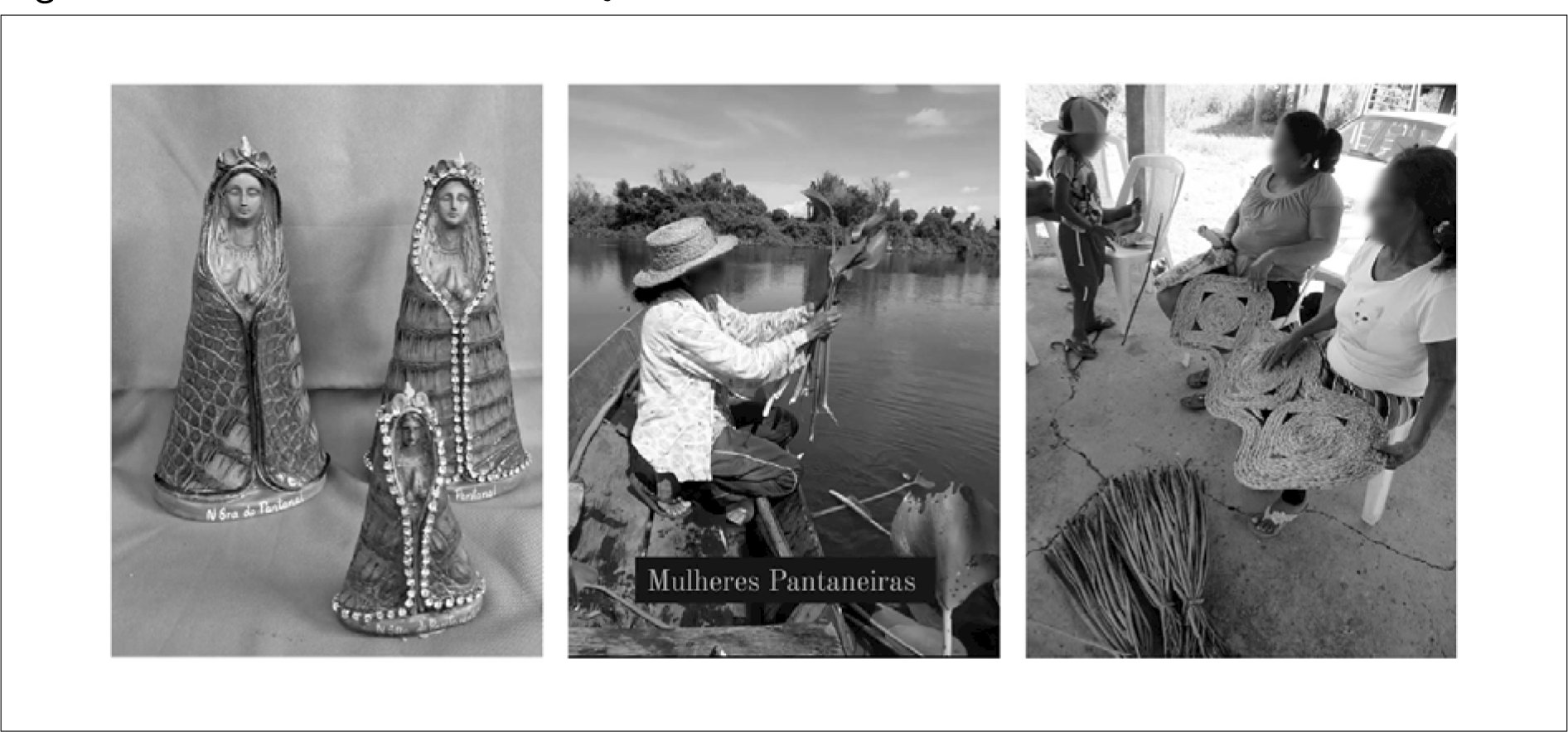 Note: From left to right - Clay figurines of Nossa Senhora do Pantanal (Our Lady of the Pantanal); women from the Pantanal collecting water hyacinth leaves (an aquatic plant native to the region); after drying, they begin crafting items such as baskets and rugs, which are sold through the Associação Corumbá Produz.