
 CO-CREATION AND SOCIAL PARTICIPATION: ANALYSIS OF THE SIX BRAZILIAN OPEN GOVERNMENT PARTNERSHIP ACTION PLANS (2011-2023)
ABSTRACT
The Open Government Partnership (OGP) proposes a new paradigm of government action and relations between government and civil society. This study seeks to understand the participation model developed in co-creating six OGP action plans in Brazil (2011-2023) under the coordination of the Comptroller General of the Union (CGU) and with the participation of hundreds of social and governmental organizations. The analysis focuses on three axes: processes and methodologies, participating actors, and results produced. A model of participation is consolidated with civil society directly involved in coordinating the process and expanding the open government agenda beyond control bodies. The study contributes to understanding the learning and innovations that occurred in the 12 years of OGP in Brazil and to improving co-creation processes involving multiple actors and public policy sectors in collaborative governance contexts
Keywords:
Open Government Partnership; Action Plan; co-creation; civil society; citizen participation
RESUMO
A Parceria para o Governo Aberto (Open Government Partnership - OGP) propõe um novo paradigma de ação governamental e de relações entre governo e sociedade civil. Este estudo busca compreender o modelo de participação desenvolvido na cocriação de seis Planos de Ação da OGP no Brasil (2011-2023) sob a coordenação da Controladoria-Geral da União (CGU) e com participação de centenas de organizações sociais e governamentais. A análise se focaliza em três eixos: processos e metodologias; atores participantes; e resultados produzidos. Consolida-se um modelo de participação com a sociedade civil diretamente atuante na coordenação do processo e com a ampliação da agenda do governo aberto para além dos órgãos de controle. O estudo contribui para a compreensão dos aprendizados e inovações ocorridos em 12 anos de OGP no Brasil e para o aprimoramento dos processos de cocriação envolvendo múltiplos atores e setores de políticas públicas em contextos de governança colaborativa.
Palavras-chave:
Parceria para o Governo Aberto; Plano de Ação; cocriação; sociedade civil; participação social
RESUMEN
La Alianza para el Gobierno Abierto (Open Government Partnership, OGP) propone un nuevo paradigma de acción gubernamental y de relaciones entre el gobierno y la sociedad civil. Este estudio busca comprender el modelo de participación desarrollado en la cocreación de seis planes de acción de la OGP en Brasil (2011-2023) bajo la coordinación de la Contraloría General Federal (CGU) y con la participación de cientos de organizaciones sociales y gubernamentales. El análisis se centra en tres ejes: procesos y metodologías; actores participantes; y resultados producidos. Se consolida un modelo de participación con la sociedad civil involucrada directamente en la coordinación del proceso y la expansión de la agenda de gobierno abierto más allá de los órganos de control. El estudio contribuye a la comprensión de los aprendizajes e innovaciones que ocurrieron en los 12 años de OGP en Brasil y a la mejora de los procesos de cocreación que involucran a múltiples actores y sectores de políticas públicas en contextos de gobernanza colaborativa.
Palabras clave:
Alianza para el Gobierno Abierto; Plan de Acción; cocreación; sociedad civil; participación social
INTRODUCTION
The Open Government Partnership (OGP) is an initiative by the United Nations (UN) and the United States government aimed at establishing a new paradigm for government action and the relationship between governments and civil society. Launched in September 2011 with eight signatory countries, including Brazil, it now comprises approximately 75 countries.
The OGP is implemented through the preparation, execution, monitoring, and evaluation of action plans that consolidate the commitments of the signatory countries. These plans are developed in a multistakeholder process, i.e., a cocreation process involving national governments and civil society, with active participation from citizens and civil society, following the standards established by the OGP (2011b, 2017).
In practice, the co-creation processes, the involvement of civil society actors, and the results regarding proposals in the action plans and their effective implementation have specific characteristics based on the context of each country or historical period (Romão, Rodrigues, Serafim, 2018; Routzouni et al., 2019). Understanding these particularities and variations, both among countries and at different times within the same country, is a topic that has received limited attention in studies of national open government experiences.
Brazil has amassed extensive participatory experience across various levels of government over the past four decades, alongside a wealth of studies on citizen engagement and socio-state interactions. These studies focus on generating knowledge about participatory institutions (PIs) such as public policy councils, conferences, and participatory budgets (PB) (Avritzer, 2008; Dagnino, 2002; Gurza Lavalle et al., 2016; Gurza Lavalle et al., 2019; Pires, 2011; Tatagiba, 2005). However, the discussion around social participation in the co-creation and collaborative governance of open government action plans established within the framework of the OGP remains underdeveloped (see the exception in Burle et al., 2017). Brazil has amassed extensive participatory experience across various levels of government over the past four decades, alongside a wealth of studies on citizen engagement and socio-state interactions. These studies focus on generating knowledge about participatory institutions (PIs) such as public policy councils, conferences, and participatory budgets (PB) (Avritzer, 2008; Dagnino, 2002; Gurza Lavalle et al., 2016; Gurza Lavalle et al., 2019; Pires, 2011; Tatagiba, 2005). However, the discussion surrounding social participation in the co-creation and collaborative governance of open government action plans established within the framework of the OGP remains underdeveloped (see the exception in Burle et al., 2017).
This article aims to explore the participation model developed during the co-creation process of the OGP action plans in Brazil. In other words, it seeks to examine the participatory practices and methodologies implemented, the actors involved in the process, and the results generated over the six editions of co-creation of the action plans from 2011 to 2023. Understanding the lessons learned and innovations produced over these 12 years of OGP in Brazil is crucial for enhancing processes and methodologies related to this specific experience, whether within the Brazilian context or beyond and can also contribute to participatory processes of various scopes and natures in different areas of public policy.
In accordance with recent developments in the theoretical debate regarding the processes of socio-state interaction and the implementation of public policies (Lascoumes & Les Galès, 2012a, 2012b; Gurza Lavalle et al., 2019), we adopted a procedural and relational perspective and viewed the action plans as instruments produced through the interaction between government and civil society. We conducted a comparative investigation of the six Brazilian action plans based on three axes of analysis: 1) the processes for preparing the action plans, which involve analyzing the methodologies used in the co-creation of each Plan comparatively; 2) the actors involved in the co-creation process, which entails identifying the profiles of civil society organizations, academic institutions, and public administration bodies in each cycle while analyzing their diversity, leadership, and changes throughout the co-creation processes of the Plans during the period; 3) the outcomes of the co-creation processes based on the established commitments, relating to the listed themes and changes over time.
This descriptive and exploratory study adopted a qualitative approach. It involved the collection and analysis of documents and bibliography, using databases such as Google Scholar, OGP repositories, and websites from the Brazilian federal government and civil society organizations. Content analysis was conducted based on the three axes described above and their respective categories, seeking to reconstruct the processes and compare the cases.
The article is organized into four sections in addition to this introduction. The second section presents the background that establishes the institutional and legal framework for the creation of the OGP in Brazil. The third section outlines the study’s analytical approach, engaging with the literature on OGP action plans. The fourth section reconstructs and analyzes the co-creation processes of each of the six Brazilian action plans based on three established axes of analysis: processes, actors, and results. At the conclusion of this section, we discuss the empirical findings from the research in a comparative manner. Finally, in the concluding section, we provide insights aimed at contributing to the broader debate on the topic and at fostering the continuation of this research agenda.
BACKGROUND - OGP IN BRAZIL
The Open Government Declaration (OGP, 2011; OGP Brasil, 2011a), of which Brazil is a signatory, establishes the following principles: (i) Transparency - primarily regarded as access to information about government activities, provided as open data (complete, primary, disaggregated, current, freely usable, and in a format that allows for reuse); (ii) Accountability or integrity - rules and mechanisms that require institutional actors to justify their actions, accept criticism and demands, and respond according to their responsibilities, including measures to combat corruption; (iii) Citizen participation - the engagement of the public in government processes to debate, collaborate, and contribute; and (iv) Technology and innovation - the implementation of new technologies to promote innovation, particularly concerning transparency and participation, facilitating the co-creation of public policy innovations through partnerships between government and civil society.
In Brazil, the principles of open government align with the tenets established in the 1988 Constitution. The foundations for access to information and transparency are outlined in Article 5, item XXXIII: “Everyone has the right to receive information of their interest or of general public interest from governmental agencies, which shall be provided within the time frame established by law, under penalty of liability, except for information whose confidentiality is essential to the security of society and the state.” However, the greatest emphasis is placed on participation, which is closely tied to the democratic management of public policies, as reflected in various articles within the chapters on the social order (Romão, 2015, p. 39). In the years following the Constitution’s promulgation, various public policy sectors established legal frameworks to implement constitutional guidelines, including councils, conferences, public hearings, and other participatory mechanisms.
With the enactment of Constitutional Amendment 19/1998, which introduced the Administrative Reform led by former Minister Bresser Pereira, a series of provisions was established to enhance public participation in administration, including complaint mechanisms and access to information. The Fiscal Responsibility Law (LRF) (Complementary Law 101/2000) sets regulations for preparing budget laws, accountability procedures, and transparency in fiscal management. In 2009, the LRF was further strengthened by the Transparency Law (Capiberibe Law), which mandates the real-time electronic disclosure of detailed information on the budgetary and financial execution of the Union, states, Federal District, and municipalities.
The anti-corruption agenda was formally introduced in 2006 with the ratification of the United Nations Convention Against Corruption, and in 2013, the Anti-Corruption Law was enacted. This law strengthens the administrative and civil liability of legal entities for participating in corrupt practices, committing fraud in public tenders, and violating public contracts.
In 2011, as Brazil integrated into the OGP, the Access to Information Law (LAI) (Law 12527/2011) was enacted. It reinforced constitutional provisions and Constitutional Amendment 19/1998, further expanding transparency and public oversight of government information - an effort that had been consolidating within the UN system and national legislations. Issued shortly before the impeachment of President Dilma Rousseff, Decree 8777/2016 (amended by Decree 9903/2021) established the principles and guidelines of the Federal Executive Branch’s Open Data Policy. This decree also clarified key terms and stipulated that all active transparency data and information produced by the Federal Executive Branch must be freely available to both the government and society as a whole.
This legislative and institutional trajectory serves as a foundation for the development of the OGP Action Plans, which will be discussed in the next section.
THE CO-CREATION OF OGP ACTION PLANS IN BRAZIL: PROCESSES, ACTORS, AND RESULTS
The concept of co-creation is central to discussions on collaborative governance within the context of a reconfiguration of public action, where the state’s central role is diminished, and the number and diversity of public policy actors and instruments increase (Lascoumes & Le Galès, 2012b). Torfing and Ansell (2021, p. 6) define co-creation as “the process through which a plethora of public and private actors are involved - ideally on equal footing - in a collaborative endeavour to define common problems and design and implement new, better, yet feasible, public solutions.” This definition emphasizes the generation of innovative solutions, the inclusion of a wider range of actors, and more horizontal power relations, thereby adding significant dimensions to the literature on multi-actor collaboration.
Although co-creation processes envision a variety of actors, more balanced power relations, and innovation potential, they can significantly differ in terms of actor inclusion, quality of participation, and outcomes. For example, the study by Routzouni et al. (2019) examines the various participatory practices and stakeholder inclusion strategies used in developing commitments within the co-creation of Open Government Action Plans across 29 countries, including Brazil. Their findings suggest that in countries with relatively advanced participatory processes, governments perceived co-creation as greatly enhancing both the content of the action plans and the fulfillment of established commitments. Key factors contributing to the effectiveness of these processes included the existence of permanent structures and mechanisms - such as government agencies dedicated to co-creation - and the presence of stakeholder forums.
While the government plays a central role in coordinating these processes, studies on the formulation of Open Government Action Plans in Brazil offer valuable insights into the role of civil society in enhancing them. Lima and Bitelli (2019) analyze the first two Action Plans of the municipality of São Paulo, emphasizing that civil society’s demands led to the early involvement of more municipal departments, as well as the inclusion of the Municipal Court of Auditors. According to the authors, these changes represented qualitative leaps that contributed to the development of more relevant commitments in the second plan compared to the first. Freitas and Dacorso (2014) focus on the first National Action Plan, examining public open innovation through three stages: understanding open innovation as transparency, transforming transparency into social participation, and generating public value through collaboration. They highlight that the commitments made during this period were primarily linked to the Policy for Increasing Public Integrity under the Federal System of Access to Information, aligning with the initial phase of transparency in the process of opening up innovation.
Mariani and Bessa (2022) analyze five of the six National Action Plans using the framework established by Lascoumes and Le Galès (2007, 2012). They examine the effects, power relations, and dynamics of legitimacy and governability generated by the instrumentation of public action from the perspective of the historical evolution of the Action Plan formulation process (Mariani & Bessa, 2022, p. 11). Their findings indicate that this instrumentation has led to new approaches in the governance of social participation within related public policies. In this context, their conclusions are consistent with those of Freitas and Dacorso (2014), especially in recognizing the legitimization of public action and the value created by policies through the inclusion of social participation.
Overall, studies on Open Government in Brazil that analyze Action Plans demonstrate the ability to legitimize commitments through social participation. They also reveal the ongoing improvement of methodologies for developing these plans, driven by interactions between government and civil society. Comparative analyses of Action Plans highlight a historical trajectory in which governments play a crucial coordinating role while civil society consistently demands more qualified and representative participation, influencing the commitments made. Thus, the process of preparing Action Plans reflects a collaborative effort - co-creation not only of the outcomes but also of the process itself.
When viewing Action Plans as public policy instruments, they can be analyzed through the lens of Lascoumes and Le Galès (2012b), who stress the significance of specific actor configurations in the creation of public policy. They define public policy as the product of social interactions that foster sociotechnical consensus, aligning with recent developments in the Brazilian discourse on state-society interactions (see Gurza Lavalle et al., 2019). This actor configuration emphasizes the necessity for coordination among values, objectives, and technical-administrative resources. Lascoumes and Le Galès propose a model for analyzing public action based on five essential elements that collectively comprise the “public policy pentagon”: actors, representations, institutions, processes, and results (Lascoumes & Le Galès, 2012b, pp. 45-46).
Actors are individuals or groups with resources and a level of autonomy who pursue material or symbolic interests through strategic decision-making. Representations refer to the cognitive and normative frameworks that shape the actions of these actors. Institutions encompass the norms, rules, routines, and procedures that govern actor interactions. The combination of these elements gives rise to processes that reflect the mobilization and interaction of actors. Ultimately, these interactions produce outcomes - the effects or consequences of public action on organizations, behaviors, and the issues being addressed. The public policy pentagon provides a valuable framework for analyzing the complex governance arrangements and coordination efforts involved in policymaking. It allows for the inclusion of multiple actors with diverse representations and interests, who engage, seek consensus, and coordinate actions across various centers of authority.
As products of co-creation involving multiple actors, Action Plans serve as public policy instruments that bring to life ideas, disputes, and representations shaped by the institutional and political contexts in which they arise (Halpern et al., 2021; Lascoumes & Le Galès, 2012a, 2012b; Gurza Lavalle et al., 2019). In addition to defining partnership goals within each context, Action Plans outline responsibilities, institutions, and governance structures for fulfilling commitments.
As technical and social devices that incorporate representations and meanings, organize relationships between public authorities and stakeholders (Lascoumes & Le Galès, 2007), and structure public action according to their specific logic, these instruments serve as analytical units that help clarify transformations in state-society relations, the diversification of public action and management strategies, and governance in highly complex contexts (Halpern et al., 2021).
Using the Lascoumes and Le Galès (2007, 2012b) model as a reference, our analytical approach focuses on three dimensions: 1) the actors involved in the co-creation process, identifying the profiles of civil society organizations, academic institutions, and public administration bodies in each cycle, analyzing their diversity, leadership, and changes throughout the co-creation process; 2) the processes of Action Plan preparation, comparing the methodologies adopted in the co-creation of each plan; and 3) the results of the co-creation processes, examining the commitments established, the themes addressed, the institutions responsible for implementation, and changes in these aspects over time.
ANALYSIS OF ACTION PLANS
Action Plan I (2011-2013)
The Action Plan I was developed shortly after the OGP was launched in September 2011. A key organizational measure in its preparation was the creation of the Interministerial Committee for Open Government (CIGA) (Presidential Decree 7567/2011). Comprising 18 ministries of the federal government and coordinated by the Office of the Chief of Staff, CIGA served as the forum for discussions on the implementation and updating of Open Government Action Plans, remaining in place until Action Plan VI, as discussed below.
CIGA established an Executive Group (GE-CIGA) consisting of five ministries: the Office of the Chief of Staff of the Presidency of the Republic, the Ministry of Finance, the Ministry of Planning, Budget and Management (MPOG), the Ministry of Foreign Affairs, and the Ministry of Justice, coordinated by the Office of the Comptroller General of the Union (CGU) (OGP Brasil, 2011). The CGU was appointed as the lead agency for Brazil’s participation in the OGP and for overseeing the development and implementation of the Action Plans from the beginning. However, CIGA did not incorporate civil society participation into its structure.
Brazil’s first Action Plan was developed with limited participation from civil society, both in terms of the number of organizations involved and their influence in co-creating the Plan. A launch event took place in the Chamber of Deputies, uniting public agencies, private entities, and civil society organizations, along with face-to-face meetings and consultations through existing civil society networks. Several public agencies of the Brazilian federal executive branch were consulted, as well as the Public Transparency and Combating Corruption Council (CTCC) - a consultative and collegiate body connected to the CGU, which was responsible for validating the Action Plan. According to the minutes of its first meeting on May 15, 2013, the CTCC included representatives from the NGO Transparência Brasil, the Brazilian Press Association, and the Ethos Institute of Business and Social Responsibility (OGP Brasil, 2011b).
In April 2012, during the first Annual Meeting of the OGP in Brazil, the Civil Society Working Group (GTSC) was established in response to demands from Brazilian civil society organizations. These organizations had mobilized around the so-called “Charter of Principles of the OGP Collective” (Burle et al., 2017) to advocate for participation in the process. The group, which consists of ten civil society organizations, supports the Executive Group in developing mechanisms for citizen involvement in the design and monitoring of Action Plan implementation. As of March 2013, the organizations in the Working Group included: Gpopai - USP; PDMA-FGV Direito RJ; Transparência Hacker and W3C; CESE and Cfemea; Artigo 19 and Amarribo; Instituto Ethos and Sinsepe.
Action Plan I established 32 commitments and involved five ministries along with the CGU, which was responsible for implementing all actions. Key highlights of the Plan included the Federal System for Access to Information, Active Transparency, and Open Data, which supported the implementation of the Access to Information Law (Law 12527, dated November 18, 2011); the restructuring of the Transparency Portal; the creation of the National Open Data Infrastructure (INDA) and the Brazilian Open Data Portal; the implementation of the Pro-Ethics Company Registry; and the mapping of Public Service Provision, Education Services, and Online Services for Citizens. Among the 32 actions in the plan, eight focused on enhancing data provision and transparency systems, eight involved training and qualifications for employees or civil society members, five addressed the development and standardization of procedures, three involved conducting studies or diagnostics, three focused on gathering information and creating catalogs, and one aimed to promote good practices in the realm of Open Government.
Action Plan II (2013-2016)
The development of Action Plan II (May 2013 - June 2016) was more dynamic and participatory than the first, involving consultations with various segments of society and the government in response to demands from the Civil Society Working Group (GTSC), which had been established during the first plan (Mariani & Bessa, 2022; OGP Brasil, 2013). The GTSC brought together ten civil society organizations: the Research Group on Public Policies for Access to Information at the University of São Paulo (Gpopai/USP); the Law and Environment Program at the Rio de Janeiro Law School of the Fundação Getulio Vargas (PDMA-FGV); Hacker Transparency; W3C-Brazil; the Ecumenical Service Coordination (CESE); the Feminist Center for Studies and Advisory (Cfemea); Artigo 19; Amigos Associados of Ribeirão Bonito (Amarribo); the Ethos Institute; and the Union of State Secretaries of Pernambuco (Sinsepe) (OGP Brasil, 2013).
In the second half of 2012, virtual dialogues were conducted through the e-Democracy platform, following four stages: assessment of Action Plan I, proposal creation, proposal drafting, and proposal prioritization. In March 2013, an in-person dialogue took place in Brasília, involving nearly 80 civil society organizations, along with representatives from government and academia. Additionally, regional initiatives known as “Government and Civil Society Dialogues” occurred in various states. Meanwhile, other government agencies developed their own proposals for commitments (OGP Brasil, 2013). This process resulted in 52 proposals, with 32 forwarded to the federal government. Federal agencies assessed the proposed commitments - submitted through both virtual and in-person dialogues - and decided whether to accept them fully, partially, or reject them. A report explaining the decisions was published on the e-Democracy platform for broader public discussion (OGP Brasil, 2013).
According to Burle et al. (2017), of the 32 proposals, only two were fully accepted, eight were partially accepted, and 20 were excluded. The authors note that the government’s feedback was not well received by civil society, as it lacked substantial explanations for rejecting proposals, which led to distrust in the co-creation process.
The proposal that garnered the most support from civil society centered on reforming Brazil’s OGP governance model by converting CIGA into a governance body with civil society representation. It detailed rules for electing representatives, determining the composition, establishing mandates, and defining decision-making procedures. However, this proposal was ultimately not adopted.
Between April and July 2013, CIGA discussed ten proposals submitted by federal agencies, and four stemmed from civil society suggestions. However, none were included in the preliminary version of Action Plan II (OGP Brasil, 2013).
A review of the plan, as required by OGP regulations, was conducted at the request of GE-CIGA and completed in July 2013, leading to the incorporation of seven additional commitments. In total, the Brazilian government adopted 52 commitments across 18 different agencies (OGP Brasil, 2013). These commitments included 13 aimed at more effective public resource management, 22 focused on increasing integrity, 11 dedicated to improving public services, 2 addressing corporate responsibility under the CGU’s supervision, and 4 promoting safer communities. Unlike Action Plan I, where only five agencies were responsible for implementation, Action Plan II diversified responsibility across multiple federal government agencies. This shift reflected an effort to incorporate actions already outlined in various ministries and expand the dissemination of the Open Government agenda across different sectors of the government.
The interaction with civil society in co-creating the plan was a critical issue, especially following the government’s feedback on whether to incorporate the submitted proposals. Burle et al. (2017) note that during the review of the plan’s preliminary version, the government failed to respond satisfactorily to criticisms and demands regarding the OGP governance model. This led to a lack of support and growing distrust among civil society organizations. Dissatisfaction escalated into public demonstrations, initially directed at the CGU. As concerns remained unaddressed, protests spread to the OGP Steering Committee through an open letter signed by 33 organizations. In response, the government announced a call for proposals to form a new working group, with representatives to be selected by the government. However, following criticism from civil society, the initiative was ultimately canceled (Burle et al., 2017).
Action Plan III
Action Plan III (2016-2018) was the first to include civil society entities in a structured manner. This occurred following the election of members to the Civil Society Working Group (GTSC), a group advising CIGA with representatives selected through an open call for proposals. The elected organizations included the Social Observatory of Brasília (OSB), the Institute of Socioeconomic Studies (INESC), the Network for Transparency and Social Participation (RETPS), the Institute of Forest and Agricultural Management and Certification (Imaflora), the Open Knowledge Foundation Brazil, the Development and Participation Collaboratory (COLAB/USP), and the workers organization “União Geral dos Trabalhadores” (UGT).
This was also the first plan to introduce commitment description sheets that outline objectives, action milestones, deadlines, and responsible parties. This aligns with what the plan refers to as a “new basis for understanding between government and civil society” (page 8 of Action Plan III), which aims to ensure clear implementation pathways and accountability for each commitment.
After the elections, CIGA and GTSC undertook a public consultation process to identify key themes, using a unique and innovative methodology developed collaboratively. Subsequently, around 27 co-creation workshops occurred between April and October 2016, involving 48 government representatives - mainly from the federal government - and 57 members of civil society organizations. This illustrates an increasing and diverse participation from both civil society entities and federal government agencies in Brazil’s open government initiatives.
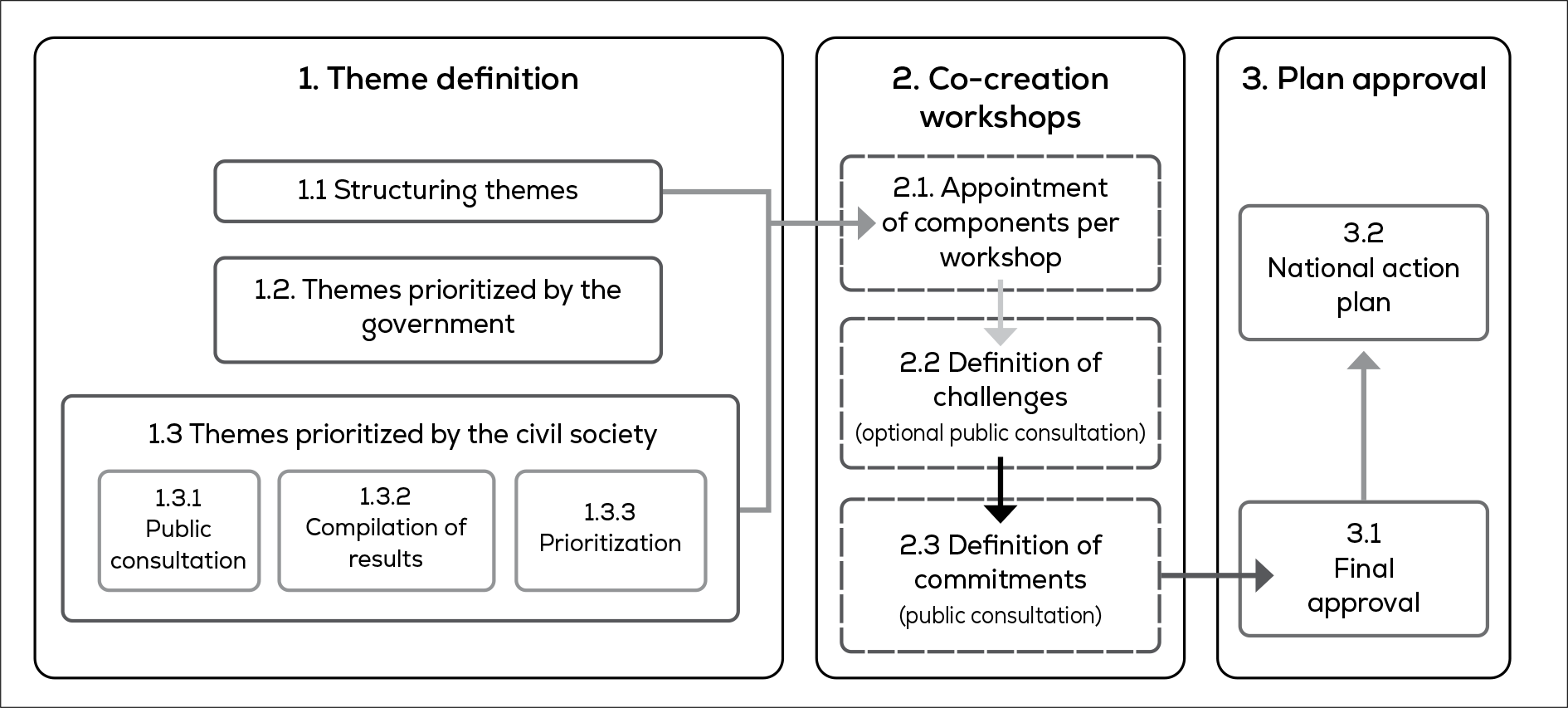
Action Plan III also introduced an innovative three-phase methodology: 1) theme definition phase, 2) co-creation workshops phase, and 3) plan approval phase. These phases, as shown in Figure 1, became the foundation for the subsequent Action Plans IV, V, and VI.

In Action Plan III, 16 commitments were created through a process that, as noted, differed significantly from Action Plans I and II. The themes were organized into three categories: 1) structural themes, which include policies on access to information, open data, and innovations aimed at enhancing public management and services, 2) government-prioritized themes - addressing subjects such as public service evaluation, open data and information governance in health, open government for culture, simplification of public services, and the prevention of cruel, inhuman, or degrading treatment within the prison system, 3) civil society-prioritized themes - chosen through public consultation, encompassing mechanisms for social participation, transparency of public resources, promotion of open government at the state and municipal levels, innovation and open government in education, and open data along with active transparency in environmental issues.
These commitments were developed with the participation of 105 individuals, including 57 representatives from civil society and 48 from government across all three levels. Additionally, the legislative and judicial branches contributed to discussions on the theme of “Promoting Open Government in States and Municipalities.” According to the plan, these innovations facilitated “the exchange of experiences,” broadened “the vision and scope of work,” and enabled “the establishment of more ambitious actions” (OGP Brasil, 2016, p. 8).
This plan also connected its themes and the UN Sustainable Development Goals (SDGs). The most significant alignment was with SDG 16, which aims to “promote peaceful and inclusive societies for sustainable development, provide access to justice for all, and build effective, accountable, and inclusive institutions at all levels” (OGP Brasil, 2016, p. 14). However, other SDGs were also incorporated as guiding principles in the discussions.
Action Plan IV
Action Plan IV (2018-2020) was developed during the politically turbulent period of President Temer’s administration and was coordinated by the Minister of Transparency and the CGU. It used the same methodology introduced in the previous plan, prepared by GE-CIGA in collaboration with the civil society working group (GTSC), following the process outlined in Figure 1. The plan also aimed to align its themes with the UN SDGs (OGP Brasil, 2018).
The plan includes 11 commitments: six aimed at enhancing the availability and management of open data and other information, three focused on increasing social participation in public policies, one dedicated to evaluating public policies, and one promoting the dissemination of Open Government practices in subnational governments. The plan involved 105 participants from 88 institutions, including 39 from civil society, 39 from federal public administration bodies, and 10 from state and municipal public administration bodies (page 20 of Action Plan IV). Notably, the legislative branch played an active role in both preparing and implementing Action Plan IV.
While it adhered to the structured approach and innovations established in Action Plan III, a significant methodological difference was the incorporation of public consultations between the first and second stages of the co-creation workshops. This addition sought to promote wider public participation in shaping Action Plan IV.
Action Plan V
The development of Action Plan V followed a methodology similar to that of previous plans, with improvements aimed at expanding the scope and diversity of the participatory process. It began in late 2020 and concluded in 2021, with commitments to be achieved by 2022 (OGP Brasil, 2021). A key innovation was the introduction of two additional consultations. Before each workshop stage, consultations were conducted to gather contributions that would serve as input for experts in the co-creation workshops, broadening societal participation. Throughout these processes, the GTSC played a crucial role in publicizing the consultations and engaging new participants (OGP Brasil, 2021). This change was particularly significant for adapting the participatory process to a virtual format, further expanding its reach and inclusivity.
The practice of presenting topics proposed by civil society and the federal executive, legislative, and judiciary branches was upheld, followed by the co-creation workshops and plan approval phases. The process continued to be coordinated by the CGU through CIGA.
Civil society prioritized five topics: agricultural supply chains and open data; environment, forests, and open data; combating public sector corruption; animal abuse and Open Government; and human rights and open data (OGP Brasil, 2021). The co-creation workshops were conducted in two stages. The first focused on defining the challenge to be addressed in the plan, while the second, which consisted of three virtual meetings, involved experts in defining commitments, establishing action strategies, assigning responsibilities, and setting timelines for implementation. In total, 72 virtual meetings were held with the participation of 141 individuals representing 79 institutions, including 41 civil society organizations and 38 public administration bodies and entities (OGP Brasil, 2021). To validate the collaborative efforts of the workshops, all commitments were submitted for evaluation by the GTSC and CIGA. The final version of Action Plan V was also shared with all government agencies for review and feedback (OGP Brasil, 2021).
A total of 12 commitments were established, placing a strong emphasis on open data. The entities responsible for these commitments included the Brazilian Institute of the Environment and Renewable Natural Resources (Ibama), which undertook two commitments; the National Health Surveillance Agency (Anvisa); the Piracicaba City Council; the General Comptroller of the Union (CGU); the Brazilian Agricultural Research Corporation (Embrapa); the Brazilian Institute of Information in Science and Technology (Ibict); the Ministry of Economy; the Ministry of Environment; the National Ombudsman for Human Rights from the Ministry of Women, Family, and Human Rights; the Attorney General’s Office of the National Treasury; and the Superior Electoral Court (TSE).
Action Plan VI
Action Plan VI also adheres to the methodology of previous plans, which includes theme definition, co-creation workshops, and plan approval phases. The process was once again coordinated by the CGU, with the GTSC appointed by the CGU minister (who serves as the CIGA coordinator). The GTSC supported the CGU team in discussions, proposal development, and the implementation of actions related to the preparation and execution of Action Plan VI. It comprises the three civil society entities that received the most votes in a selection process conducted under the scope of CIGA: Open Knowledge Brasil, the Brazilian Institute of Certification and Monitoring (Ibracem), and the Political and Socio-Environmental Observatory Institute (OGP Brasil, 2023).
Fifteen entities were registered to vote, and a total of 269 votes were counted-220 from individuals, 19 from the private sector, 18 from the non-profit sector, and 12 from the public sector. Any citizen could vote via the Participa Mais Brasil platform. Additionally, six entities from the Council for Transparency, Integrity, and Combating Corruption (CTICC) participated: the Brazilian Association of Non-Governmental Organizations (Abong), the Fiquem Sabendo Association, Transparência Brasil, the Politeia Research Group (Udesc), the Brazilian Institute of Corporate Governance (IBGC), and Transparency International (OGP Brasil, 2023).
Civil society identified four themes through a public consultation conducted in July 2023 via the Participa Mais Brasil platform, where any citizen could suggest topics for discussion in the co-creation workshops (OGP Brasil, 2023). A compilation of the 126 contributions conducted by the CGU team and the GTSC resulted in 65 proposed themes. A subsequent public consultation was held in mid-August to establish a list of priorities, gathering 1,889 votes from 541 citizens, which led to the selection of four priority themes. These were supplemented by four additional themes defined by the federal government agencies involved (OGP Brasil, 2023).
The co-creation workshops brought together 155 stakeholders from 80 institutions, which included 47 civil society organizations and 33 government agencies (OGP Brasil, 2023). Two meetings were conducted: the first focused on defining the challenges to be addressed through Open Government policies, and the second established the commitments to be implemented over the next four years, until June 2027 (OGP Brasil, 2023).
The commitments were later validated by the GTSC and CIGA, then submitted to the appropriate government agencies for review and feedback. They were also made available on the Open Government website for potential comments from civil society (OGP Brasil, 2023).
The Action Plan VI outlined eight commitments: (1) improving social participation and transparency in infrastructure policies (CGU); (2) opening and processing data to combat corruption (CGU); (3) promoting collaborative practices in science and technology (Ministry of Science, Technology, and Innovation - MCTI); (4) fostering a culture of access to information (CGU); (5) producing, processing, and providing data on ethnic-racial affirmative actions (Ministry of Racial Equality); (6) developing a curriculum framework for digital and media education for the older citizens (Ministry of Human Rights and Citizenship); (7) enhancing access to services provided by the Ministry of Agrarian Development and Family Farming (MDA); and (8) establishing a collaborative network for training territorial agents to strengthen social participation and popular education (National Secretariat for Social Participation - General Secretariat of the Presidency of the Republic - SGPR) (OGP Brasil, 2023).
COMPARATIVE ANALYSIS
Above, we present the general elements of the processes and methodologies involved in the development, stakeholder composition, and commitments of the six OGP Action Plans in Brazil, implemented between 2011 and 2023. Dialogue processes among government agencies - primarily focused on the federal executive, but also involving the legislative, judiciary, and the Public Prosecutor’s Office, as well as subnational levels and civil society organizations - have continued despite changes in the federal government. However, given the federal government’s central role in conducting these processes through the CGU, it is important to connect the periods in which the plans were developed to the administrations in power.
Action Plans I and II, along with the initial stages of Action Plan III, were developed under President Dilma Rousseff’s administration. Her impeachment in 2016 occurred in the midst of the development of Action Plan III, leading to a change in interlocutors with President Michel Temer’s arrival to power. Action Plan IV was created in 2018 under the Temer administration, Action Plan V in 2020 and 2021 during President Bolsonaro’s administration, and Action Plan VI in 2023 under President Lula’s administration.
Although these governments had different party affiliations and distinctly different perspectives on the meaning of “democracy,” it seems that especially since Action Plan III, the elaboration process has solidified a methodology that ensures at least two moments of effective civil society participation. This occurs first in the prioritization of topics by civil society and, even more significantly, in the co-creation workshops, where civil society participation is guaranteed. This practice has been strengthened in the development of the four most recent plans.
As a result, the profile of civil society organizations involved in the process has expanded and diversified. Moreover, the election of entities to form the GTSC, which advises CIGA, has centralized the role of organizations directly engaged with the Open Government agenda. In other words, there has been increasing specialization within the more limited group of entities involved, including the selection of other civil society organizations and representatives participating in the co-creation workshops.
Another noteworthy phenomenon is the gradual decrease in the number of commitments included in the Action Plans. The first and second plans contained more commitments (32 and 52, respectively). However, starting with Action Plan III, the establishment of a more structured methodology for consulting civil society, along with co-creation workshops that help define and clarify proposals, has resulted in a more coherent set of commitments with clearly assigned responsible and co-responsible entities. The number of commitments in each subsequent plan has declined (16 in Action Plan III, 11 in Action Plan IV, 12 in Action Plan V, and 8 in Action Plan VI). While this trend aligns with observations in the literature on process improvement (Lima & Bitelli, 2019; Mariani & Bessa, 2022), it might also indicate a gradual decline in the prominence of this agenda within the broader context of the federal government. Nevertheless, certain ministries that undertake specific commitments seem to be incorporating the agenda into their institutional practices.
It is also important to note that, in Action Plan VI, only federal government agencies with ministry status are tasked with coordinating the implementation of commitments. In contrast, previous plans included a wider range of institutions in this role, such as the Institute of Applied Economic Research (IPEA), Embrapa, Ibama, Anvisa, TSE, and the Chamber of Deputies.
Finally, we conducted a comparative analysis of the actors involved in the commitments of each plan, starting with Action Plan III, when civil society was formally incorporated. This comparison is presented in the table below.
Participants in the Development of Open Government Action Plans - Government and Civil Society
The data indicate a relative balance in the distribution of government and civil society actors, with a degree of parity between the two segments. Notably, the periods with the highest percentage of civil society organizations correspond to the last two action plans developed during the Bolsonaro and Lula administrations. In contrast, Action Plan IV, created under the Temer administration, witnessed the lowest level of civil society participation despite being the second plan developed after formally incorporating these actors into the process.
Over time, there has been a gradual decline in the total number of actors involved, with the most significant reduction occurring in Action Plan V, followed by a rise in Action Plan VI. However, the analysis of the Plans does not provide explicit explanations for these variations in composition methodology beyond what was discussed in the previous section. Based on the data presented in this article, future research could explore the factors underlying these changes, particularly the relationship between the federal executive branch and the organizations participating in each plan’s formulation.
Table 2 was created based on the axes of analysis considered. It illustrates that after an initial period of limited implementation by the federal government, during which government actors were predominant, the methodology was effectively solidified as a co-creation process between the government and civil society, beginning with Action Plan III. This transition was characterized by the introduction of workshops and public consultations. Consequently, the Open Government agenda seems to have become more diversified among federal agencies, despite a formal decline in the number of commitments made.
Analysis of the Methodology, Actors, Responsibility for the Commitments Made in the OGP Action Plans
FINAL CONSIDERATIONS
This article aims to present a descriptive and exploratory analysis comparing all six Open Government Action Plans produced in Brazil from 2011 to 2023. This analysis offers an overview of the processes, their adjustments, and, at times, improvements to increase social participation. This aspect is particularly important since social participation is one of the core principles of the OGP, along with transparency, accountability, and open data.
A key finding of this analysis is the evident consolidation of a social participation model that encompasses entities directly involved in coordinating the process and facilitating co-creation workshops. From the government’s perspective, there has been a gradual concentration of agencies taking on commitments under each Action Plan, signaling a narrowing of this agenda within the federal government, although it extends beyond the CGU.
From the perspective of civil society, a methodology has been established that ensures at least two opportunities for civil society participation in the last four Action Plans. Unlike government actors, civil society organizations have expanded and diversified in their areas of focus, despite the GTSC election process favoring organizations that are directly linked to the Open Government agenda.
An examination of the commitments undertaken revealed a steady quantitative decline, with the highest number in the first two plans and a decrease in the subsequent ones. In this regard, further investigation into the content of these commitments and the actual implementation of the related public policies would be a valuable direction for future research.
Ultimately, the comparison of government and civil society actors across the Plans indicates a relative balance between these groups, with slight variations over time. While this analysis emphasizes a quantitative perspective, it could be enriched through qualitative exploration, especially concerning the profiles of civil society organizations engaged in the process. As different dynamics may shape the composition of actors, targeted research in this area would offer a deeper understanding of the relationship between civil society and the federal government, especially considering the CGU’s role in leading the process. Such an approach would enhance the understanding of social participation in Open Government initiatives in Brazil.
ACKNOWLEDGMENT
The authors thank the reviewers for their comments, which greatly enhanced the final text.
References
-
Avritzer, L. (2008). Instituições participativas e desenho institucional. Opinião Pública, 14, 43-64. https://doi.org/10.1590/S0104-62762008000100002
» https://doi.org/10.1590/S0104-62762008000100002 - Burle, C., Bellix, L., Machado, J., & Marchezine, J. (2017). O caso do Governo Aberto no Brasil: O que se pode aprender com os erros e acertos. In VIII Congresso Internacional en Gobierno, Administración y Políticas Públicas - GIGAPP, Madrid, España.Dagnino, E. (Org.). (2002). Sociedade civil e espaços públicos no Brasil Paz e Terra/Unicamp.
-
Freitas, R. K. V., & Dacorso, A. L. R. (2014). Inovação aberta na gestão pública: Análise do plano de ação brasileiro para a Open Government Partnership. Revista de Administração Pública, 48(4), 869-888. https://doi.org/10.1590/0034-76121545
» https://doi.org/10.1590/0034-76121545 - Gurza Lavalle, A. G., Carlos, E., Dowbor, M., & Szwako, J. (Orgs.). (2019). Movimentos sociais e institucionalização: Políticas sociais, raça e gênero no Brasil pós-transição. Eduerj.
-
Gurza Lavalle, A. G., Voigt, J., & Serafim, L. (2016). O que fazem os conselhos e quando o fazem? Padrões decisórios e o debate dos efeitos das instituições participativas. Dados, 59(3). https://doi.org/10.1590/00115258201687
» https://doi.org/10.1590/00115258201687 - Halpern, C., Lascoumes, P. & Le Galès, P. (2021). As abordagens a partir dos Instrumentos da ação pública Porto De Oliveira, O. & Hassenteufel, P. Sociologia política da ação pública: teorias, abordagens e conceitos, Escola Nacional de Administração Pública (Brasil), pp.31-59, 9786587791173.
-
Lascoumes, P., & Les Galès, P. (2007). Special issue: Understanding public policy through its instruments. Governance, 20(1), 1-144. https://doi. org/10.1111/j.1468-0491.2007.00342.x
» https://doi. org/10.1111/j.1468-0491.2007.00342.x -
Lascoumes, P., & Le Galès, P. (2012a, julho-dezembro). A ação pública abordada pelos seus instrumentos. Revista Pós Ciências Sociais, 9(18), 19-44. https://periodicoseletronicos.ufma.br/index.php/rpcsoc/article/view/1331
» https://periodicoseletronicos.ufma.br/index.php/rpcsoc/article/view/1331 - Lascoumes, P., & Le Galès, P. (2012b). Sociologia da ação pública Editora da Ufal.
-
Lima, F. N., & Bitelli, F. M. (2019). O processo de elaboração dos planos de ação em governo aberto do município de São Paulo, SP, Brasil. Revista Gestão e Políticas Públicas, 9(1), 50-69. https://doi.org/10.11606/issn.2237-1095.v9p51-69
» https://doi.org/10.11606/issn.2237-1095.v9p51-69 -
Mariani, C. B., & Bessa, L. F. M. (2022). Governo Aberto no Brasil: Como a instrumentação da ação pública fomentou novas abordagens para a governança da participação social. Revista Estado, Gobierno y Gestión Pública, 20(38), 11-33. https://doi.org/10.5354/0717-8980.2022.67250
» https://doi.org/10.5354/0717-8980.2022.67250 -
Open Government Partnership. (2011). Open Government Declaration https://www.opengovpartnership.org/process/joining-ogp/open-government-declaration/
» https://www.opengovpartnership.org/process/joining-ogp/open-government-declaration/ -
Open Government Partnership Brasil. (2011a). Declaração de Governo Aberto.https://www.gov.br/cgu/pt-br/governo-aberto/central-de-conteudo/documentos/arquivos/declaracao-governo-aberto.pdf
» https://www.gov.br/cgu/pt-br/governo-aberto/central-de-conteudo/documentos/arquivos/declaracao-governo-aberto.pdf -
Open Government Partnership Brasil. (2011b). 1º Plano de Ação Brasileiro.https://www.gov.br/cgu/pt-br/governo-aberto/central-de-conteudo/documentos/arquivos/1planoacaobrasil201113.pdf
» https://www.gov.br/cgu/pt-br/governo-aberto/central-de-conteudo/documentos/arquivos/1planoacaobrasil201113.pdf -
Open Government Partnership Brasil. (2013). 2º Plano de Ação Brasileiro.https://repositorio.cgu.gov.br/bitstream/1/46273/5/2_plano_de_acao_portugu%c3%aas.pdf
» https://repositorio.cgu.gov.br/bitstream/1/46273/5/2_plano_de_acao_portugu%c3%aas.pdf -
Open Government Partnership Brasil. (2016). 3º Plano de Ação Brasileiro https://repositorio.cgu.gov.br/bitstream/1/46254/5/3_plano_de_acao_portugues.pdf
» https://repositorio.cgu.gov.br/bitstream/1/46254/5/3_plano_de_acao_portugues.pdf -
Open Government Partnership Brasil. (2018). 4º Plano de Ação Brasileiro https://repositorio.cgu.gov.br/bitstream/1/46277/1/4_plano_de_acao_nacional_portugues.pdf
» https://repositorio.cgu.gov.br/bitstream/1/46277/1/4_plano_de_acao_nacional_portugues.pdf -
Open Government Partnership Brasil. (2021). 5º Plano de Ação Brasileiro https://repositorio.cgu.gov.br/handle/1/67649?locale=pt_BR
» https://repositorio.cgu.gov.br/handle/1/67649?locale=pt_BR -
Open Government Partnership Brasil. (2023). 6º Plano de Ação Brasileiro https://www.gov.br/cgu/pt-br/governo-aberto/noticias/2024/01/6-plano-de-acao-nacional-ogp-final.pdf
» https://www.gov.br/cgu/pt-br/governo-aberto/noticias/2024/01/6-plano-de-acao-nacional-ogp-final.pdf -
Open Government Partnership. Participation & Co-Creation Standards (2017). https://www.opengovpartnership.org/ogp-participation-co-creation-standards-2017/
» https://www.opengovpartnership.org/ogp-participation-co-creation-standards-2017/ -
Pires, R. R. C. (Org.). (2011). Efetividade das instituições participativas no Brasil: Estratégias de avaliação (Diálogos para o Desenvolvimento, Vol. 7). IPEA.Romão, W. (2015, 2o semestre). Reflexões sobre as dificuldades da implementação da participação institucional no Brasil. Ideias - Revista do Instituto de Filosofia e Ciências Humanas (Unicamp), 6(2), 35-58. https://doi.org/10.20396/ideias.v6i2.8649462
» https://doi.org/10.20396/ideias.v6i2.8649462 - Romão, W., Rodrigues, M., Serafim, L. (2018). Estado e sociedade civil na cocriação dos Planos de Ação da Parceria para o Governo Aberto: Brasil, Colômbia e México 11º Congresso da Associação Brasileira de Ciência Política (ABCP). Curitiba, Paraná.
- Routzouni, A., Deligiannis, A. P., Peristeras, V., & Gritzalis, S. (2019). An intercountry survey of participatory practices used for open government partnership national action plan development. In I. Lindgren et al., Electronic Government EGOV 2019: Lecture notes in computer science (Vol. 11685). Springer.
-
Tatagiba, L. (2005). Conselhos gestores de políticas públicas e democracia participativa: Aprofundando o debate. Revista de Sociologia e Política, 25, 247-250. https://doi.org/10.1590/S0104-44782005000200017
» https://doi.org/10.1590/S0104-44782005000200017 -
Torfing, J., & Ansell, C. (2021). Co-creation: The new kid on the block in public governance. Policy and Politics, 49(2), 211-230. https://doi.org/10.1332/030557321x16115951196045
» https://doi.org/10.1332/030557321x16115951196045

 Source: III Plano de Ação, p. 13.