
 BRAZILIAN PORT REFORM: AN ANALYSIS OF INVESTMENTS AFTER LAW Nº 12.815/2013
ABSTRACT
Since the enactment of Law nº 12.815/2013, private agents have been allowed to build ports to mainly exploit it commercially, offering port services to anyone interested in moving cargo. This amendment to the legislation aimed to attract private investment to the sector, reducing Brazil’s existing port infrastructure deficit. This work evaluated private investments carried out during the period from 2013 to 2021 in port facilities after the new regulatory framework. The methodology was based on descriptive data analysis, using information from the regulatory agency’s administrative processes authorizing investment in port terminals. The results indicated that investments were focused especially in places where barriers to entry were lower, such as on the banks of inland waterways or, in the case of maritime facilities, where there was already waterway infrastructure managed by some public Port Authorities.
Keywords:
port sector reform; private investments; barriers to entry; of Law nº; 12.815/2013; Brazil
RESUMO
A Lei n. 12.815, de 2013, permitiu que agentes privados construíssem portos para prioritariamente explorá-los comercialmente, oferecendo serviços portuários a qualquer interessado em movimentar cargas. Essa flexibilização da legislação teve como objetivo atrair investimentos privados ao setor e, consequentemente, reduzir o déficit de infraestrutura portuária existente no País. O presente trabalho avaliou os investimentos realizados durante o período de 2013 a 2021 em instalações portuárias privadas, autorizadas pelo poder público a se expandirem ou serem construídas após o novo marco regulatório. A metodologia envolveu a análise descritiva da base de dados, catalogada e sistematizada a partir dos registros administrativos da Agência Nacional de Transportes Aquaviários (Antaq). Os resultados sugerem que os investimentos se concentraram em locais onde as barreiras de entrada eram inferiores, tais como às margens de vias interiores navegáveis ou, no caso de instalações marítimas, quando já se tem a infraestrutura de acesso aquaviário construída e sendo gerida por Autoridade Portuária de portos públicos.
Palavras-chave:
reforma do setor portuário; investimentos privados; barreiras de entrada; Lei n; 12.815/2013; Brasil
RESUMEN
La Ley n.° 12.815 de 2013 permitió a agentes privados construir puertos para explotarlos principalmente de forma comercial, ofreciendo servicios portuarios a cualquier persona interesada en mover carga. Esta flexibilización de la legislación tuvo como objetivo atraer inversión privada al sector y, en consecuencia, reducir el déficit de infraestructura portuaria existente en Brasil. Este trabajo evaluó las inversiones realizadas durante el período de 2013 a 2021 en instalaciones portuarias privadas después del nuevo marco regulatorio. La metodología implicó el análisis descriptivo de la base de datos, catalogada y sistematizada con base en los registros administrativos de la Agencia Nacional de Transporte Hidroviario (Antaq). Los resultados sugieren que las inversiones se concentraron en lugares donde las barreras de entrada eran menores, como en las orillas de vías navegables interiores o, en el caso de las instalaciones marítimas, donde ya existía infraestructura fluvial administrada por las autoridades portuarias públicas.
Palabras clave:
reforma del sector portuario; inversiones privadas; barreras de entrada; Ley 12.815/2013; Brasil
INTRODUCTION
Maritime transport is the backbone of international trade and the global economy. In 2021, 88% of Brazilian exports and 73% of imports were carried by sea (Ministério do Desenvolvimento, Indústria, Comércio e Serviços [MDIC], 2023). Brazil, one of the largest countries in the world, has a coastline of approximately seven thousand kilometers. Additionally, the country has an extensive system of navigable rivers, particularly in the Northern region. Therefore, there is significant potential for its port terminals to be used for both international and regional trade, including cabotage navigation. However, regular investment is necessary to improve services and expand capacity in this sector. Historically, the Brazilian government has been responsible for these investments, but they have been insufficient due to political, fiscal, and administrative constraints.
In the 1990s, private investors were allowed to explore port activities in Brazil under Law No. 8.630 (1993), the so-called Port Modernization Law. The new regulatory framework authorized terminals for private use, known as Private Use Terminals (PUT). In 2007, along with PUTs, Transshipment Cargo Stations (TCS) were authorized. These private terminals, located in places chosen by investors outside established public ports, were allowed to move and store cargo. However, approval from the central government was required to build and commercially exploit these terminals. Furthermore, the terminal could move and store its own cargo, representing a form of vertical integration of its trading operations.
In 2013, Law No. 12.815 (2013), known as the Port Law, changed the regulatory framework again and allowed PUTs to provide port services for other companies. As a result, they could now compete with public ports. This amendment to the legislation aimed to attract private investments to the sector, thereby contributing to reducing the country’s existing port infrastructure deficit.
Nevertheless, investments in the port sector rely on various factors. First, it is important to underscore that investors face significant barriers to entering this market, including economic, locational, and regulatory challenges. Furthermore, the decision to invest depends on market demand - both international and regional - and the availability of complementary infrastructure, such as railways and roads.
Therefore, this paper investigates the effects of this new regulatory framework on private investments, especially in widening port services’ capacity, from 2013 to 2021. The methodology involves a descriptive data analysis of private investments in PUTs and TCSs. This data was retrieved from administrative registers from the Brazilian Agency for Waterway Transportation (Antaq). The novelty of this study lies in retrieving and organizing these data and providing a comprehensive descriptive analysis, identifying types of investments (new terminal or expansion), financial amounts, localization, logistic features (vertical integration or not), and types of cargo. This information enables an initial assessment of the impact of the new regulatory framework on private investments.
Moreover, this research compares private and public investments in ports during this period. We constructed a time series for private investments from 2013 to 2021, including those carried out by private agents in public ports. The time series for public investments, covering 2008 to 2019, was retrieved from secondary sources. This information helps to understand the new role played by private agents in port operations following the enactment of the Port Law.
The paper is organized as follows: Section 2 presents a literature review, focusing on port reforms worldwide, barriers to entering the sector, and port reform in Brazil; Section 3 describes the methodology; and Section 4 presents and discusses the results. Finally, concluding remarks are provided.
LITERATURE REVIEW
Port governance reforms worldwide
Many countries have engaged in port reforms in recent decades, especially from 1980 onward. While they followed different models, the general trend was transferring port services or ownership to private agents. The aim was to delegate management duties and commercial rights to private agents or local public agencies. The main difference among these reforms was the degree of private participation in the sector (Brooks et al., 2017; Merkel & Sløk-Madsen, 2019).
The standard port typology typically considers asset ownership, including infrastructure and superstructure, and management style (Bowden & Jong, 2006). Initially, it comprised three categories: service port, tool port, and landlord port (Trujillo & Nombela, 2000). In 2001, the World Bank added the private service port (fully privatized port) category to its Port Reform Toolkit (World Bank, 2007).
The service port model represents the classic public port (Xiao et al., 2012), which prevailed until the 1980s. In the tool port model, the Port Authority remains under public management, but this model introduces some degree of private participation. Private involvement is restricted to port activities, specifically to providing services for loading and unloading cargo.
In the landlord port model, private agents, known as Port Operators and authorized by the Port Authority, are responsible for providing the superstructure and port equipment used in operations. They can use the operational areas of public ports through a cession arrangement, where the Port Authority grants a specific time frame for a company to operate and invest in a designated port area. This port governance model has been the most widely used worldwide since the 1990s (Xiao et al., 2012).
Finally, the private service port model is a fully privatized port where the ownership of the land, all investments in infrastructure, superstructure, equipment, and operation and port administration are managed by a private agent. In this model, public authorities only retain police power and sectoral regulatory controls, including customs, environmental, and sanitary regulations, among others. According to the World Bank (2007), only two countries have employed this model in their national ports: the United Kingdom and New Zealand.
In the first decade of the 21st century, several countries made efforts to adjust their port legislation and models. Following the economic crisis of 2008, steps were taken to expand the transfer of operational and investment responsibilities in ports to private agents. However, despite these ongoing efforts to increase private sector involvement, transitioning from the landlord to the private service port model remains relatively underused (Brooks et al., 2017; Galvão et al., 2017; Merkel & Sløk-Madsen, 2019).
It is important to note that the academic debate on port reform models primarily focuses on national ports - those constructed by governments and fully operated by government agencies until at least the 1980s. Since then, reforms in various countries have shifted toward privatizing these ports to varying degrees (Chen, 2009; Kent & Hochstein, 1998; Pagano et al., 2013; Villa, 2017). However, it is also essential to examine the role of private agents not only in managing existing ports through leases and concessions granted by public authorities but also in the construction of entirely private ports, represented by the fully privatized port model.
Barriers to entry and market power
In the short term, the supply of port infrastructure exhibits total inelasticity. This condition can lead to opportunistic behavior by existing market players, potentially resulting in welfare losses for society. Such behavior arises from the significant barriers to entry in the port market, which can be categorized as economic, locational, regulatory, or institutional. These barriers, taken together, impact the contestability of port markets and, consequently, the level of competition (Langen & Pallis, 2007; Merkel & Sløk-Madsen, 2019).
Economic barriers to entry include high fixed costs, the long lifespan of port infrastructure, significant economies of scale, the indivisible nature of infrastructure, the immobility of basic port infrastructure with limited alternative uses, and the occupation of prime locations (Baird, 2000; Kessides, 2004). Locational barriers arise from existing operators occupying suitable sites, which have fewer environmental constraints than new entrants. Finally, regulatory barriers imposed by governments restrict the number of terminal operators and other service providers in ports, thereby reducing competitiveness (Coutinho, 2022; Langen & Pallis, 2007).
Regarding locational barriers, land issues can obstruct the construction of new port terminals along the coast or in the hinterland (the land area over which a port extends its services and interacts with users). Furthermore, investors seek locations with established infrastructure, such as railways and roads, that connect the port with its potential markets. These factors may hinder port competition (Carvalho & Coutinho, 2015a, 2015b).
In addition, many aspects of port infrastructure can be considered public goods, such as nautical signaling and the maintenance of waterway access through dredging (Baird, 2004; Goss, 1990). Consequently, the market may either fail to provide these services or provide them in insufficient quantities to meet demand satisfactorily. In essence, ports represent a combination of public goods, which generate additional indirect benefits, and private goods, which provide direct economic benefits through their operations. This combination creates complexities when defining the roles of public and private entities in port management (Trujillo & Nombella, 2000; World Bank, 2007).
In recent history, even in developed countries where private agents dominate the operation of port facilities, public investments in goods related to waterway access (such as dredging and excavation works) remain common. However, practical experience, particularly in the United Kingdom, has demonstrated that private agents can effectively provide these services.
From the perspective of public sector planning, ports are an integral part of a productive logistics chain and should not be considered in isolation. To effectively serve societal needs, ports must be connected with other modes of transport and be in proximity to production centers. Additionally, from a competitive standpoint, the concentration of ports in a specific location or the lack of access infrastructure can affect production chains and the operation of other ports (Carvalho & Coutinho, 2015b; Garate, 2020). Thus, effective port planning by central governments is crucial.
However, Baird (2004) highlights potential government failures that can render planning and regulatory interventions ineffective or even counterproductive compared to market outcomes without such control. Everett (2005) further notes that pressure groups can influence the decision-making process regarding port locations, making these decisions more political than technical or economic.
Port reform in Brazil: Changes to the regulatory framework
Following the privatization wave in Brazil in the early 1990s, Law No. 8.630, known as the Port Modernization Law, was enacted in 1993. This regulatory framework aimed to reorganize the port system and introduce a new exploitation model for public ports, the landlord port model, which was already widely practiced in major global economies. This model replaced the service port model used in Brazilian public ports up to that point.
Law No. 8.630/1993 established two key elements within the national port system: (i) public ports, managed by public companies, which could now lease areas to private agents, and (ii) port facilities for private use (PUTs) to be built and operated by private entities under federal administrative authorization. Legally, PUTs are port facilities constructed at locations defined by the authorized entities, outside the boundaries of any public port, and used for handling or storing products or goods intended for or arriving from waterway transport.
However, the applicant seeking authorization had to have sufficient cargo to justify the construction of the port facility, reflecting a typical vertical integration of the transport chain. Furthermore, the applicant must provide the financial capital required for the entire construction, as it must be self-funded. “Own cargo” refers to goods produced by the applicant for the port’s operation, such as a terminal built by a mining company to transport its ore. Handling cargo other than that of the authorized entity could only occur on a subsidiary basis and could not be the port’s primary purpose (Antaq, 2005; Brasil, 2008).
Overall, the landlord port model in Brazil did not meet the expectations of port service users. Issues related to institutional arrangements, such as political and legal changes, including the centralization of decision-making and shifts in ministries responsible for port policies, contributed to this outcome (Galvão et al., 2017; Marques et al., 2021). In 2013, following a proposal from the Federal Executive Branch, Law No. 12.815 (the Port Law) was approved, establishing a new regulatory framework for the port sector to replace Law No. 8.630/1993. This new regulation intended to update and harmonize government responsibilities for port policies, encourage private investment by expanding its role in the port sector, and increase competitiveness (Coutinho, 2022). One of its main changes was the removal of restrictions on handling third-party cargo at private terminals, allowing them to be built and equipped to compete with public port terminals.
The new regulatory framework was designed to encourage and facilitate private investments in national port infrastructure (Frezza, 2016). However, it is important to note that, depending on how obligations and incentives are structured, the framework could also foster a speculative market for authorized port facilities that may never be built. Such unwanted situations, often referred to as “paper ports,” can undermine sectoral planning efforts by public authorities.
METHODOLOGY
The methodology of this research involves a descriptive analysis of investments in port facilities authorized for private agents, specifically PUTs and TCSs, to be constructed or expanded following the enactment of Law No. 12.815/2013. Data were collected from primary and secondary federal government sources, particularly Antaq’s database and administrative records (Antaq, 2023). The analysis covers the period from 2013 to 2021. It identifies the predominant types of investments (expansion or new installation), the financial amounts involved, the investment locations, its logistical characteristics (vertical integration or not), and the types of cargo handled.
The year 2013 serves as the starting point of the research because the proposal from the Federal Executive Branch, which became law, was submitted in December 2012. The end of the research is September 2021, as this was the deadline used by Antaq to compile the biannual report on investments made by authorized entities (Antaq, 2022). It is important to note that data on investments authorized prior to 2013 are dispersed across various administrative processes of Antaq, making their access and systematization significantly more complex.
The data were retrieved from the Private Facilities Panel on Antaq’s website, which provides access to contracts, legal documents, and administrative processes related to authorization for the construction or expansion of port terminals through the agency’s Electronic Information System (SEI). Additionally, data were collected from inspection and investment reports issued by Antaq. Specifically, data on investments for the construction of the maritime infrastructure at Porto do Açu PUT, located in the state of Rio de Janeiro, were obtained by reviewing financing information from the National Bank for Economic and Social Development (BNDES).
From the documents reviewed, information was gathered on: (i) the total investment projected by the authorized party when applying for authorization to construct or expand the port facility (ii) the investment executed by September 2021, (iii) the year of execution of the authorization contract, (iv) the federation unit and municipality of the port facility, (v) whether the authorization pertains to a new port facility or the expansion of an existing one, (vi) the year of completion of the construction/expansion, (vii) whether the terminal is situated in a region with maritime or fluvial access, (viii) the profile of authorized cargo, and (ix) whether the terminal possesses the characteristics of an intermodal structure intended for logistics vertical integration.
The cargo profiles authorized for handling at each port terminal were categorized according to the basic structure established by Decree No. 8.033/2013, which regulates Law No. 12.815/2013. These categories include solid bulk, liquid and gaseous bulk, general cargo, and containerized cargo. To better identify the economic chains served by the port terminals, those dedicated to handling goods for the offshore oil exploration sector were classified as “offshore support.” Within the solid bulk category, a distinction was made between agricultural solid bulk and minerals. Terminals handling multiple cargo profiles were classified as “multipurpose.”
The determination of whether the authorized port terminal exhibits characteristics of logistics vertical integration was based on an analysis of the documents submitted by the applicant when seeking authorization for construction or expansion. The goal was to identify whether the facility primarily handles cargo produced by itself (e.g., a terminal authorized to a mining company for shipping its extracted ore) or whether the facility handles cargo not produced by the operator but distributed by them (e.g., a terminal authorized to a fuel distributor for handling the gasoline it trades). Both scenarios represent forms of vertical integration.
The investment amounts were adjusted from December of the year in which the authorization was signed by the government until September 2021 using the General Price Index - Market (IGP-M). This index is the official measure employed by Antaq to track investments in private port facilities agreed upon with the government.
Additionally, we constructed a time series of private investments in port operations for comparison with public investments. The total investment in TUPs and ETCs, adjusted by the IGP-M, was evenly distributed across the years, starting from the year the contract was signed until the year the operation was authorized. This approach assumes that investments were made uniformly over the years. We also collected information on investments made by private agents in terminals in public ports leased to private operators following the Port Law. This data was retrieved from Antaq’s report (No. 50300.001256/2022-41) issued in December 2022.
Information on investments made by the central government in public ports was extracted from a report on the National Treasury’s website. This report details investments from 2008 to 2019 under public infrastructure investment programs, specifically the Growth Acceleration Program (PAC) and the Investment Partnerships Program (PPI). The amounts were adjusted to September 2021 using the Brazilian General Market Price Index (IGP-M). Only investments in organized ports, maritime access waterways, and the maintenance and improvement of navigable inland waterways were considered; regional cargo movement and passenger transportation data were excluded.
RESULTS AND DISCUSSION
Results
Data released by Antaq through the Private Facilities Monitoring Panel show that as of September 2021, Brazil had 247 authorized port facilities. Of these, 58 were new port terminals authorized under Law No. 12.815/2013, accounting for approximately 24% of the total. It is important to note that this figure includes facilities that have been authorized, which may be in various stages: already operational, under construction, or not yet started.
When analyzing only the number of authorizations granted for the construction of new port terminals and the expansion of existing facilities, it is difficult to evaluate the impact on the national port system. The investments projected for each authorized terminal vary significantly based on factors such as location (maritime or fluvial) and terminal size.
Therefore, this study decided to use data on the actual financial investments made by the authorized parties. This serves as an indicator of the expansion of installed capacity for cargo handling and storage in the port system. Table 1 presents consolidated investment data for authorized private port terminals, including the construction of new ports and the expansion of existing ones.
Investments in Private Port Terminals in Brazil, from 2013 to September 2021 (Constant 2021 BRL Millions)
Total investments during the period amounted to BRL 18.7 billion, with 28% (BRL 5.2 billion) allocated to new port facilities and 72% (BRL 13.4 billion) directed toward the expansion of existing facilities. Despite this discrepancy, it is worth noting that the expansion of the Porto do Açu PUT, an industrial port complex located in the state of Rio de Janeiro in the Southeast region of the country, accounted for 56% (BRL 7.5 billion) of the investments made in the expansion of port terminals. This PUT was authorized in 2010, initially planning the construction of Terminal 1 (T1), an offshore port for handling mineral bulk owned by the authorized company. The construction of Terminal 2 (T2) near T1 - in this study T2 is considered as the expansion of the Porto do Açu PUT (see Figure 1 for the location of some terminals mentioned throughout the text) - was authorized to the same company. However, the construction plan included a new waterway access, designed as an onshore channel, conceived as a port for multiple cargo types from its inception.

Investments in Private Port Terminals in Brazil, from 2013 to 2021 (Constant 2021 BRL Millions)
At the regional level, the Southeast region, the economic center of Brazil, received 61% of the investments made in private port terminals distributed across 17 port facilities, either already built or still under construction. Notably, 84% of these investments were in terminals that do not have verticalization characteristics. However, it should be highlighted that these investments include those for building T2 of the Porto do Açu PUT, specifically for the protection and waterway access infrastructure. In total, these investments represented 65% of the amount invested in the region.
Although legally considered an expansion of the Porto do Açu PUT (where T1 had already been built), the construction of T2 could be seen as a new port facility from an economic and commercial point of view. Despite being adjacent to T1, it has a separate waterway access infrastructure. Therefore, the amount of investments received in the region is not a reliable indicator for comparing investments in new ports versus expansions.
Regarding the cargo profile, 17% of all investments made in this region were allocated to terminals serving the offshore oil exploration sector. If we exclude the investments made to construct the waterway access infrastructure for T2 of the Porto do Açu, these investments account for 50% of the total.
The main port terminals that received investments were located in the state of Rio de Janeiro. Along with the construction of T2 of Porto do Açu, the following port terminals were established nearby: (i) Flexibrás Açu (BRL 1 billion), (ii) Brasil Logística Offshore (BRL 475 million), (iii) Açu Regasification Terminal (BRL 367 million), and (iv) Açu Oil Terminal - TPET (BRL 527 million). These new facilities serve the oil exploration sector.
The state of São Paulo has also received investments in two port terminals located in Santos Bay, the site of the largest port complex in Latin America. Although these terminals are not situated in public areas managed by the Port of Santos (a public port operating under the landlord model), it is important to note that the public Port Authority is responsible for maintaining and managing the common waterway access to both the public port and the private terminals in the bay. Investments were made for the expansion of the DP World Santos terminal (BRL 820 million), a non-verticalized terminal handling various cargo profiles, and for the construction of the Pipeline Logistics Base (BRL 321 million), a verticalized facility serving the offshore oil exploration sector.
The North region received 16% of the total investments. These investments were spread across 27 ports, all of which are river ports and generally lack the capacity to accommodate maritime vessels. Apart from the high concentration of investments in terminals for handling solid bulk related to the agriculture sector (67%), such as grains and fertilizers, 70% were directed toward non-verticalized terminals.
Despite its large size and low population density, the region has an extensive river system that has the potential to serve as an outlet for agricultural goods produced both locally and in the Central-west, which lacks a direct land connection to the coast. These terminals, located further inland, primarily act as intermodal hubs for cargo movement via navigable rivers, providing an alternative to roads and railways, which are either non-existent or in poor condition in the region.
In this scenario, the state of Pará received notable investments in the construction of the Vila do Conde terminal (BRL 977 million) and the Hidrovias do Brasil Miritituba terminal (BRL 344 million), both non-verticalized and designed for handling agricultural cargo, mainly vegetable bulk and fertilizers. It is worth noting that, despite being a river port, the Vila do Conde terminal accommodates ocean-going vessels. Additionally, the verticalized terminal Cargill Agrícola S.A. Miritituba (BRL 236 million) was constructed for handling agricultural cargo.
In the state of Amazonas, the following stand out: the expansion of the ATEM Manaus terminals (BRL 302 million), owned by a fuel distribution company, and thus verticalized; the expansion of Porto Chibatão (BRL 211 million), a terminal capable of receiving ocean-going ships and which, in 2021, was responsible for 82% of the gross container handling in the region; and the construction investments of the Novo Remanso Port Terminal (BRL 189 million), which is non-vertically integrated and is still under construction, is designed to handle a variety of cargo profiles.
The Northeast region accounted for 18% of total seaport investments, but these were concentrated in only three port terminals. Of the total invested in the region, 92% was allocated to the expansion of the Ponta da Madeira PUT (BRL 3.1 billion), a verticalized terminal operated by the mining company Vale S.A. and located in the state of Maranhão. Another investment was for the construction of Porto Sul (BRL 200 million), also verticalized, owned by the mining company Bahia Mineração S/A (Bamin), and planned for the state of Bahia. Additionally, there was an expansion of the Cotegipe Port Terminal (BRL 82 million), located in the state of Bahia, which is non-verticalized and intended for handling agricultural solid bulk. It is worth noting that the Cotegipe Port Terminal is situated in Aratu Bay, near the Public Port of Aratu. In 2022, the Cotegipe Port Terminal was the main port for handling this type of solid bulk in the state of Bahia, accounting for 76% of the total.
The South region of Brazil received only 3% of the total investments made during the period, with a primary focus on handling containers and general cargo. The largest investment was for the expansion of the Porto Itapoá Terminais Portuários terminal (BRL 374 million), which is dedicated to container handling and located in Babitonga Bay, in the state of Santa Catarina. This region also includes the public Port of São Francisco do Sul and other private terminals. Moreover, in the state of Rio Grande do Sul, the CMPC Guaíba terminal was expanded (BRL 256 million), a verticalized facility specialized in pulp handling.
In the Central-west region, which does not have direct access to the coast, BRL 142 million was invested in the construction of two river port terminals: Itahum Export (BRL 53 million) and Porto Eldorado (BRL 49 million). Both terminals are located in the state of Mato Grosso do Sul and have verticalization characteristics. Itahum Export handles bulk agricultural products, while Porto Eldorado handles pulp.
After examining the effective investments, which primarily resulted in the expansion of ports or the construction of new ones, it is necessary to evaluate the authorized port projects where significant investments have not yet been made. Among ten non-verticalized port projects with the highest investment commitments for expansion or the construction of new ports between 2014 and 2018, only T2 of Porto do Açu (BRL 7.5 billion) and Terminal Vila do Conde (BRL 1 billion) have been completed.
Of the ten projects mentioned, the others were still in the early stages of construction or had not yet started due to various issues, such as failure to obtain environmental licensing, financial problems of the authorized parties, and different legal challenges. In the Southeast region, these projects include: (i) Porto Central Industrial-Port Complex, (ii) Imetame Industrial Terminal, and (iii) Ponta Negra Terminals. In the Northeast region, they are: (iv) Alcântara Port Terminal and (v) São Luis Port Terminal. In the South region, the projects are: (vi) Novo Porto Terminais Multicargas, (vii) Terminal Graneleiro da Babitonga, and (viii) Porto Portal do Paraná.
When analyzing all private investments, including those in public port terminals leased to private operators, and comparing them to public investments, a shift in the central government’s public policy toward the port sector becomes evident after the introduction of the new regulatory framework (Figure 2). This led to a substantial reduction in investments in public ports. However, it is important to note that during the 2015-2016 biennium, Brazil faced one of its most severe economic crises, which worsened the fiscal outlook and severely compromised public investments.

Private and Public Investments in Ports, Brazil, 2008 to 2021 - Billions (Constant 2021 BRL)
While annual public investments ranged from BRL 1.7 billion to BRL 2.3 billion from 2009 to 2012, they decreased to between BRL 380 million and BRL 978 million from 2013 to 2019. Investments during the earlier period were made under the PAC, which aimed to increase public investment in underfunded and deteriorating infrastructure sectors. In contrast, from 2013 to 2019, public investments in the port sector accounted for approximately 20% of the total, while private agents contributed 80%.
Discussion
The new regulatory framework combined public ports operated under the landlord port model with entirely private ports under the fully privatized port model, allowing them to operate in competition with each other. This was achieved by removing a significant regulatory barrier that had previously restricted the sector: the limitation that private port facilities outside public ports should primarily handle cargo from the company authorized to operate the port terminal.
In the first eight years of Law nº 12.815/2013 (Port Law), investments were made both in constructing new ports and expanding existing ones. Compared to expansion, constructing a new port facility involves greater risks for the investor due to the complexities associated with an activity characterized by natural monopoly aspects (Kessides, 2004). In theory, these risks can be mitigated in the case of expanding an existing port facility, as the waterway access infrastructure is generally already in place (Lange & Pallis, 2007), along with an established market for handling the authorized company’s own cargo - a legal limitation that was in effect until 2013.
Notwithstanding, no recorded expansions of verticalized terminals were aimed at diversifying their activities to serve other companies. Some occasional expansions of verticalized port terminals were observed, primarily intended to increase handling capacity for their own cargo due to rising production and trading. Expansions of non-verticalized private port terminals were also noted. Despite regulatory limitations, some non-verticalized ports provided services to companies before the enactment of the Port Law, seemingly in violation of the legislation, and were occasionally supported by court decisions (Tribunal de Contas da União[TCU], 2013).
It is interesting to note that of the non-verticalized port facilities that received the largest investments for expansion during this period, DP World Santos, Porto Itapoá, and Terminal Portuário Cotegipe were located in sheltered water regions and near a public port. In these situations, the public Port Administration typically handles the maintenance and management of waterway access. This arrangement reduces the need for private operators to invest in such infrastructure, which is one of the main economic barriers to entry in the sector and is sometimes considered a type of public good (Baird, 2004). Furthermore, these new ports can take advantage of the access infrastructure already available (Carvalho & Coutinho, 2015b).
Likewise, container terminals in the North region were situated on inland waterways, often with naturally deep beds that facilitated port construction without substantial investment in excavation, dredging, and waterway protection works. Consequently, these ports had lower economic barriers to entry compared to seaports.
In the case of seaports, the T2 of the Port of Açu was the only project carried out during the period under study that involved the construction of a new waterway protection and access structure not influenced by a nearby public facility. It is important to note that the expansion of this port was already being planned by the authorized company even before the regulatory framework changed and received substantial financing from the National Bank for Economic and Social Development (BNDES).
The significant market demands were important factors in attracting financial capital to the private port sector. In the Southeast region, investments were driven by the growing offshore oil exploration market, particularly due to the initiation of exploration in the large pre-salt oil reserves off the Brazilian coast. In the North region, investments focused on facilitating the efficient transport of agricultural bulk from the interior to the coast via inland waterways, addressing the rising production in both the Central-west and the North. The private sector responded swiftly to these market demands, prioritizing investments in port terminals located in areas with lower entry costs, such as natural channels with waterway access already managed by public Port Administrations, and focusing on immediate and less uncertain demands.
It is suggested that public ports have acted as regional drivers for private port facilities. The low execution rate of the largest private investments in seaports supports this view, as these cases generally require significant expenditures on terminal access infrastructure and may not be connected to other modes of transportation.
It can be observed that the Brazilian government has aimed to attract private investment in new ports and expand existing port capacity by reducing regulatory barriers. However, economic and locational challenges continue to limit the development of new seaports. Furthermore, it is crucial to assess whether the large port projects that have been authorized are not being used for speculative purposes. Such “paper ports” could potentially prevent new entrants or further investments in public ports, thereby jeopardizing the country’s current and future port capacity needs.
There has been a significant reduction in public investments in the sector following the enactment of Law No. 12,815. This decline in public investment after 2013, coupled with substantial private investments since then, suggests a shift in the port industry’s investment balance between the public and private sectors. However, given that public ports are crucial for supporting the development of nearby private terminals, the government needs to continue investing in the sector, focusing on maintaining and enhancing maritime access to public ports and improving connection with other modes of transportation. The government should also promote the leasing of public port terminals to private operators, who would then be responsible for their enhancement. This strategy would help prevent the deterioration of existing infrastructure in public ports, which could negatively impact the entire sector, which remains heavily reliant on these ports.
CONCLUSIONS
Despite the Brazilian government’s efforts to remove regulatory barriers to private entry into the port construction and commercial operation market, economic and locational barriers continue to limit the construction of new ports that require investments in waterway protection and access infrastructure. Over the eight years since the enactment of Law No. 12.815/2013, an analysis of non-vertical port terminals revealed that private agents were primarily willing to invest in port infrastructure to serve rapidly expanding markets and to expand private terminals already situated near public ports.
In addition, given that the main maritime port complexes are located near a public port, where waterway access is managed by a Port Authority that receives public funding for dredging and other works, these public investments must continue to be carried out satisfactorily. Likewise, investment should be made to constantly improve the port terminals that integrate them, considering the importance of these ports for the national port system. Therefore, the substantial decrease in public investments following the Port Law is concerning.
As for sectoral planning issues, given that several port terminals have not yet started construction despite being authorized a few years ago, it is important that the government monitors these projects and tries to inhibit any authorizations for purely speculative purposes - the so-called ‘paper ports.’ Furthermore, the government must seek ways to encourage these projects to be carried out (see the case of Porto do Açu PUT in the state of Rio de Janeiro, which was financed by BNDES).
Finally, future research must verify the panorama of public and private investments in the port sector after a longer period of validity of the new sectorial rules. More specifically, it is important to construct a longer time series for private investments in the sector, including years prior to the enactment of the Port Law. Doing so would allow for the application of a suitable methodology to effectively measure the impact of this regulatory change. Additionally, it is suggested that subsequent works explore the identified cases where the construction of authorized port terminals has not yet started, as investigating the reasons for the delay of these new projects can further contribute to the debate.
-
The reviewers did not authorize disclosure of their identity and peer review report.
-
Evaluated through a double-anonymized peer review. Associate Editor: Andrea Leite Rodrigues
REFERENCES
- Agência Nacional De Transportes Aquaviários (2005). Resolução n° 517-Antaq, de 18 de outubro de 2005. Aprova a norma para outorga de autorização para a construção, a exploração e a ampliação de terminal portuário de uso privativo Brasília/DF
-
Agência Nacional de Transportes Aquaviários (2022). Boletim anual de movimentação de cargas: Análise da movimentação de cargas nos portos organizados e terminais de uso privativo Brasília, DF. https://www.gov.br/antaq/pt-br/central-de-conteudos/estudos-e-pesquisas-da-antaq-1/boletim-aquaviario
» https://www.gov.br/antaq/pt-br/central-de-conteudos/estudos-e-pesquisas-da-antaq-1/boletim-aquaviario -
Agência Nacional de Transportes Aquaviários (2023). Estatístico aquaviário https://web3.antaq.gov.br/ea/sense/index.html
» https://web3.antaq.gov.br/ea/sense/index.html -
Baird, A. J. (2000). Port privatisation: Objectives, extent, process, and the UK experience. International Journal of Maritime Economics, 2, 177-194. https://doi.org/10.1057/ijme.2000.16
» https://doi.org/10.1057/ijme.2000.16 -
Baird, A. J. (2004). Public goods and the public financing of major European seaports. Maritime Policy & Management: The Flagship Journal of International Shipping and Port Research, 31(4), 375-391. https://doi.org/10.1080/0308883042000304890
» https://doi.org/10.1080/0308883042000304890 -
Bowden, N., & Jong, M. De. (2006). Privatisation of seaport infrastructures: A framework for understanding the transfer of property rights. International Journal of Critical Infrastructures, 2, 294-317. https://doi.org/10.1504/IJCIS.2006.009444
» https://doi.org/10.1504/IJCIS.2006.009444 - Brasil (2008). Decreto n. 6.620, de 29 de outubro de 2008.Establishes policies and guidelines for the development and promotion of the ports and port terminals sector under the competence of the Special Secretariat of Ports of the Presidency of the Republic, disciplines the concession of ports, the concession and authorization of maritime port facilities, and makes other provisions. Brasília, DF.
-
Brooks, M. R., Cullinane, K. P. B., & Pallis, A. A. (2017). Revisiting port governance and port reform: A multi-country examination. Research in Transportation Business & Management, 22, 1-10. https://doi.org/10.1016/j.rtbm.2017.09.002
» https://doi.org/10.1016/j.rtbm.2017.09.002 - Carvalho, A. X. Y., & Coutinho, P. C. (2015a). Identificação de mercados geográficos e construção de indicadores de concorrência no setor portuário brasileiro (Textos para discussão IPEA n. 2.092). Brasília, DF.
- Carvalho, A. X. Y., & Coutinho, P. C. (2015b). Modelando o processo de seleção dos portos para movimentação das cargas no comércio exterior brasileiro (Textos para discussão IPEA n. 2.093). Brasília, DF.
-
Chen, S. (2009). Port administrative structure change worldwide: Its implication for restructuring port authorities in Taiwan. Transport Reviews, 29(2), 163-181. https://doi.org/10.1080/01441640802455728
» https://doi.org/10.1080/01441640802455728 - Coutinho, P. C. (Coord.). (2022). Barreiras regulatórias à entrada do setor portuário brasileiro: Análise da legislação. In P.C. Coutinho (Coord.), Avaliação da concorrência na prestação de serviços portuários (pp. 146-156). Editora Appris.
-
Everett, S. (2005). Policy making and planning for the port sector: Paradigms in conflict. Maritime Policy & Management: The Flagship Journal of International Shipping and Port Research, 32(4), 347-362. https://doi.org/10.1080/03088830500300745
» https://doi.org/10.1080/03088830500300745 - Frezza, C. da S. (2016). A nova lei dos portos e os modelos de concessões e de agências reguladoras: Mecanismos para a garantia do interesse público (Master’s dissertation, Universidade de Brasília, Faculdade de Tecnologia, Brasília, DF).
-
Galvão, C. B., Robles, L. T., & Guerise, L. C. (2017). 20 years of port reform in Brazil: Insights into the reform process. Research in Transportation Business & Management, 22, 153-160. https://doi.org/10.1016/j.rtbm.2017.05.004
» https://doi.org/10.1016/j.rtbm.2017.05.004 - Garate, J. L. C. (2020). Desafíos en la competencia y la regulación de infraestructuras y servicios portuarios y del sector del transporte marítimo (UNCTAD Research Paper n. 48).
-
Goss, R. O. (1990). Economic policies and seaports: Are port authorities necessary? Maritime Policy & Management: The Flagship Journal of International Shipping and Port Research, 17(4), 257-271. https://doi.org/10.1080/03088839000000040
» https://doi.org/10.1080/03088839000000040 -
Kent, P. E., & Hochstein, A. (1998). Port reform and privatization in conditions of limited competition: The experience in Colombia, Costa Rica and Nicaragua. Maritime Policy & Management, 25(4), 313-333. https://doi.org/10.1080/03088839800000040
» https://doi.org/10.1080/03088839800000040 -
Kessides, I. (2004). World Bank: Reforming infrastructure: Privatization, regulation and competition The World Bank. https://documents1.worldbank.org/curated/en/709301468779183565/310436360_20050007115940/additional/289850PAPER0reforming0infrastructure.pdf
» https://documents1.worldbank.org/curated/en/709301468779183565/310436360_20050007115940/additional/289850PAPER0reforming0infrastructure.pdf -
Lange, P. W. De, & Pallis, A. A. (2007). Entry barriers in seaports. Maritime Policy & Management, 34(5), 427-440. https://doi.org/10.1080/03088830701539023
» https://doi.org/10.1080/03088830701539023 - Lei n. 8.630, de 25 de fevereiro de 1993. (1993). Establishes the legal regime for the exploitation of organized ports and port facilities and makes other provisions. Brasília, DF.
- Lei n. 12.815, de 5 de junho de 2013 (2013). Establishes the direct and indirect exploitation by the Union of ports and port facilities and the activities performed by port operators. Brasília, DF.
- Marques, B. N., Silva, M. S, Lops, J. M., Souza, A. L. R., Araújo, M. L. V., & Aragão, I. M. (2021, July-September). Governança portuária federal brasileira e as políticas públicas para o setor: um ensaio teórico sobre os reflexos na organização do arranjo institucional. Revista do Serviço Público (RSP), 3, 583-612.
-
Merkel, A., & Sløk-Madsen, S. K. (2019). Lessons from port sector regulatory reforms in Denmark: An analysis of port governance and institutional structure outcomes. Transport Policy, 78, 31-41. https://doi.org/10.1016/j.tranpol.2019.03.005
» https://doi.org/10.1016/j.tranpol.2019.03.005 -
Ministério do Desenvolvimento, Indústria, Comércio e Serviços. (2023). Dados gerais.https://comexstat.mdic.gov.br/pt/home
» https://comexstat.mdic.gov.br/pt/home -
Pagano, A. M., Wang, G. W. Y., Sánchez, O. V., & Ungo, R. (2013). Impact of privatization on port efficiency and effectiveness: Results from Panama and US ports. Maritime Policy & Management, 40(2), 100-115. https://doi.org/10.1080/03088839.2013.765703
» https://doi.org/10.1080/03088839.2013.765703 -
Tribunal de Contas da União. (2013). Acórdão n. 402/2013 Representation. Mixed private use port terminals. Allegation by the plaintiff of irregularities in the granting of authorizations issued by the Ministry of Transport and, subsequently, by ANTAQ, and also of an offense against port legislation and respective regulations. Rapporteur: Minister Raimundo Carreiro. Session 06/03/2013. https://pesquisa.apps.tcu.gov.br/#/pesquisa/acordao-completo Brasília, DF.
» https://pesquisa.apps.tcu.gov.br/#/pesquisa/acordao-completo - Trujillo, L., & Nombela, G. (2000). Seaports. In A. Estache & G. De Rus (Eds.), Privatization and regulation of transport infrastructure: Guidelines for policymakers and regulators (pp. 113-169). The World Bank.
-
Villa, J. C. (2017). Port reform in Mexico: 1993-2015. Research in Transportation Business & Management, 22, 232-238. https://doi.org/10.1016/j.rtbm.2017.09.004
» https://doi.org/10.1016/j.rtbm.2017.09.004 -
World Bank. (2007). Port reform toolkit (2nd ed.). The World Bank. https://ppp.worldbank.org/public-private-partnership/library/port-reform-toolkit-ppiaf-world-bank-2nd-edition
» https://ppp.worldbank.org/public-private-partnership/library/port-reform-toolkit-ppiaf-world-bank-2nd-edition -
Xiao, Y., Ng, A. K. Y., Yang, H., & Fu, X. (2012). An analysis of the dynamics of ownership, capacity investments, and pricing structure of ports. Transport Reviews, 32(5), 629-652. https://doi.org/10.1080/01441647.2012.706799
» https://doi.org/10.1080/01441647.2012.706799

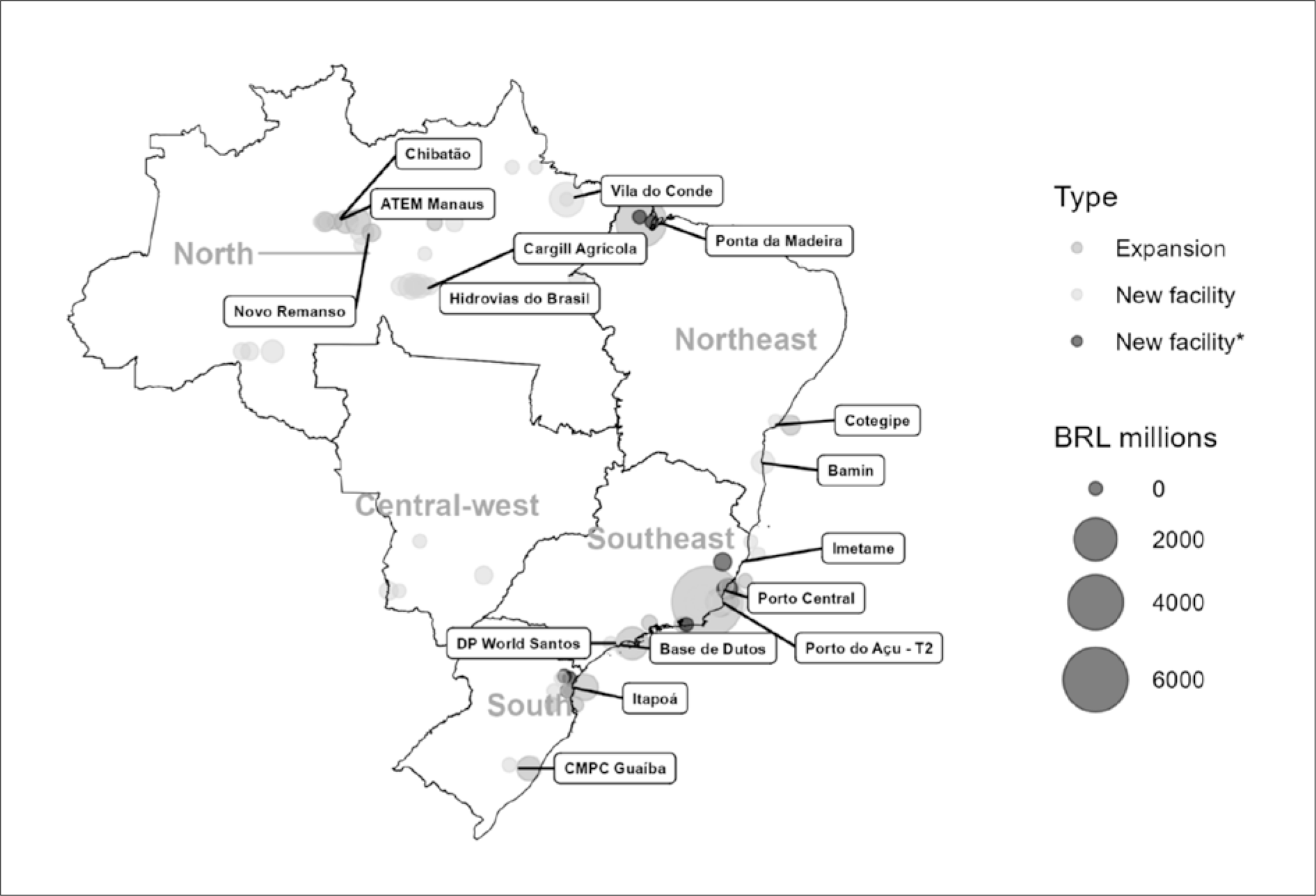 Source: Elaborated by the authors based on Antaq data. (*Main new installations authorized between 2014 and 2018, with low execution).
 Source: Elaborated by the authors based on Antaq data and the National Treasury of Brazil report.