
 FEDERATIVE ARRANGEMENTS AND FISCAL FEDERALISM: A PROPOSAL FOR MUNICIPAL MERGER IN BRAZIL
ABSTRACT
The Brazilian three-tier federative model has presented two issues that have been aggravated since the 1988 Federal Constitution: low fiscal effort in revenue collection and horizontal fiscal imbalances at the municipal level. International experience shows a relatively common approach to addressing these problems. However, it is a solution rarely discussed in Brazil: federative rearrangement through municipal amalgamations - that is, the systematic merger of municipalities. This article proposes municipal amalgamations that simultaneously increase operational self-sufficiency and reduce horizontal imbalances. The study analyzes the effects of fiscal effort on the self-sufficiency of municipalities when a merger model is applied to maximize the average municipal fiscal effort. The results point to a new scenario: a 70% reduction in the total number of municipalities, a 40% increase in collection effort, and a 36% increase in operational self-sufficiency.
Keywords:
fiscal federalism; merger of municipalities; fiscal effort; amalgamation; self-sufficiency.
RESUMO
O modelo federativo brasileiro de três camadas apresenta duas características agravadas pelo cenário pós-Constituição Federal de 1988: o baixo esforço fiscal de arrecadação e os desequilíbrios fiscais horizontais da esfera municipal. Nesse sentido, há um processo relativamente comum na experiência internacional, mas raramente discutido no Brasil: o rearranjo federativo por meio da formação de amálgamas municipais - o mesmo que fusão sistemática de municípios. Neste artigo se propõe a formação de amálgamas municipais que promovam, simultaneamente, o aumento da autossuficiência operacional e a redução dos desequilíbrios horizontais. Foram analisados os efeitos do esforço fiscal sobre a autossuficiência dos municípios quando aplicado um modelo de fusão para maximização da média municipal de esforço fiscal. Os resultados apontam para um novo cenário de redução de 70% no total de municípios, um aumento de 40% no esforço de arrecadação e de 36% a autossuficiência operacional.
Palavras-chave:
federalismo fiscal; fusão de municípios; esforço fiscal; amálgamas; autossuficiência.
RESUMEN
El modelo federativo brasileño de tres niveles tiene dos características agravadas por el escenario posterior a la Constitución Federal de 1988: el bajo esfuerzo fiscal de recaudación y los desequilibrios fiscales horizontales del ámbito municipal. En este sentido, existe un proceso relativamente común en la experiencia internacional, pero raramente discutido en Brasil: el reordenamiento federativo a través de la formación de amalgamas municipales, lo mismo que la fusión sistemática de municipios. Este artículo propone la formación de amalgamas municipales que promuevan simultáneamente el aumento de la autosuficiencia operativa y la reducción de los desequilibrios horizontales. Se analizaron los efectos del esfuerzo fiscal sobre la autosuficiencia de los municipios al aplicar un modelo de fusión para maximizar el promedio municipal del esfuerzo fiscal. Los resultados apuntan a un nuevo escenario: una reducción del 70% en el número total de municipios, un aumento del 40% en el esfuerzo recaudatorio y un aumento del 36% en la autosuficiencia operativa.
Palabras clave:
federalismo fiscal; fusión de municipios; esfuerzo fiscal; amalgamas; autosuficiencia.
INTRODUCTION
In a federated state, much of the effort focuses on balancing funding with the community’s demand for public goods and services. This foundation of fiscal harmony in federalism permeates both public revenues and expenditures, affecting the taxing powers and responsibilities of each government level.
Since fiscal imbalances can occur both vertically between government levels (vertical fiscal imbalance - VFI) and horizontally among units at the same level (horizontal fiscal imbalance - HFI), a federated system must rely on sustainable concepts in public revenue and expenditure. It should also include mechanisms capable of ensuring the fair distribution of income and responsibilities among federative entities based on the needs and demands of each locality (Bird & Tarasov, 2004; Diniz, 2012; Di Liddo et al., 2016).
In this sense, the model established by the Brazilian Federal Constitution of 1988 elevated municipalities to the status of federative entities, creating incentives that led to the proliferation of new local governments. This resulted in an increase from 3,991 municipalities in the 1980s to 5,568 in 2013, of which approximately 4,150 (74.5% of the total) were micro and small municipalities with fewer than 25,000 inhabitants (Giambiagi et al., 2017; Leite, 2014).
Although the 1988 Constitution introduced federative innovations in line with popular demands at the time, this process remains incomplete, mainly due to ongoing requests from states and municipalities for adjustments in the decentralization of public revenues that match the decentralization of responsibilities they have taken on. In practice, what has been observed is a distancing of the federal government from the autonomy of public spending, without relinquishing the centralization of revenues at the federal level (Afonso & Araújo, 2000; Rezende, 2001; Lima & Silveira Neto, 2018).
In this context, federative restructuring involves reversing the process of decentralization by systematically merging municipalities - i.e., municipal amalgamation. This approach is one of the alternatives highlighted in the international literature to address issues and imbalances caused by excessive decentralization. Municipal amalgamation refers to the process of creating a new political unit by combining two or more local governments (Reingewertz, 2012; Steiner, 2003; Denters et al., 2014; Strebel, 2019).
This article examines, from the perspective of public revenue, the potential for improving the federative system through municipal amalgamation based on levels of fiscal collection effort and criteria related to population and territory. It explores whether increasing the population size of federative units could enhance fiscal capacity, increase direct tax collection, and consequently reduce horizontal fiscal asymmetries and imbalances among federative units.
The aim is to find a situation where municipalities are small enough to achieve allocative efficiency but large enough to reach higher levels of operational self-sufficiency. The study is guided by the following research question: How does municipal amalgamation based on fiscal collection efforts affect operational self-sufficiency and levels of horizontal fiscal asymmetry in the Brazilian municipal context?
The study aims to contribute to the literature on federative restructuring, focusing on the municipal level, by partially addressing the gap concerning the fiscal effects of municipal mergers in the Brazilian context. Practically, despite encountering constitutional limitations and barriers to immediate implementation, this research operates within the realm of possibilities, providing insights for enhancing public policies designed to optimize the federal system.
The main theoretical contributions include: (i) providing a deeper understanding of how asymmetries in levels of directly collected tax revenues affect municipal operational self-sufficiency; (ii) offering insights into the significance of municipal operational self-sufficiency for the balance of the Brazilian federal system; and (iii) clarifying the horizontal fiscal effects of municipal amalgamation based on fiscal collection effort.
Although municipalities also possess spending autonomy, the primary differentials of the Brazilian federative pact emerge from the revenue dimension. Unlike countries in which local governments lack taxing authority, Brazilian municipalities are autonomous in establishing and collecting their own taxes, making the analysis of local revenue particularly relevant in the national context. Therefore, the analysis in this study focuses on municipal operating revenues, examining fiscal collection effort and its relationship to self-sufficiency. Municipal expenditures, though relevant, are addressed indirectly, as they form part of the calculation of operational self-sufficiency.
Finally, although the proposal presented here aims to provide empirical evidence to support improvements in the Brazilian federative model, it is acknowledged that its scope is limited to the economic dimension of fiscal federalism, focusing on municipal revenue capacity. While social, political, and cultural factors also influence federative performance, this study adopts an analytical approach that emphasizes municipal fiscal collection effort as the main variable, due to its objective measurability and its importance in Brazil’s federative dynamics.
THEORETICAL BACKGROUND
Theory of Federalism
In a federated state, the central government coexists with other autonomous entities, and there is a political-administrative division involving taxing powers and the provision of public goods and services. Therefore, harmony among government levels and fiscal balance in public accounts are essential conditions for the financial and operational sustainability of the federative model (Mendes, 2004; Lima & Diniz, 2016).
A fundamental question in any federative system is whether the provision of goods and services is better when decentralized. It is common for decentralization to result in an excess of public goods and services becoming the responsibility of local governments, even when they lack the fiscal capacity to finance them at appropriate standards. This imbalance between local revenues and the demand for public spending is known as the vertical fiscal gap (VFG) and, in proportional terms, varies across federative entities. Such gaps are typically addressed through intergovernmental transfers.
However, finding a balance is not easy. Especially in countries with vast territories, significant regional heterogeneity, and wide economic disparities, the challenge of aligning these characteristics within a single federal system is even greater. There is, in fact, a trade-off between centralization and decentralization - between the individual level and the goals of the overarching government (Breuss & Eller, 2004; Diniz, 2012). Figure 1 briefly illustrates this relationship.

The trade-off between the economies of scale and political coordination offered by a centralized system, and the greater responsiveness to the population’s needs provided by a more decentralized model, is a key consideration in designing a federated system. The challenge of federalism lies in identifying, for each case, an optimal degree of decentralization that balances several factors, including social participation, the costs of producing goods and services, economies of scale, and the rational allocation of resources. While decentralization tends to yield a better understanding of local needs, albeit with higher per capita costs, centralization can generate economic gains through scale effects, resulting in lower costs (Steiner, 2003; Reingewertz, 2012; Mendes, 2004; Lima & Silveira Neto, 2018).
Therefore, an ideal federal reform aims to reduce these imbalances. In this context, population size is often seen as an important factor, or at least a key driver, in municipal amalgamations. Positive effects such as economies of scale, the professionalization of technical and administrative staff, and decreases in both unit and per capita costs are natural results of mergers driven by population criteria (Oates, 2005; Reingewertz, 2012; Reingewertz & Serritzlew, 2019).
ARRANGEMENTS OF BRAZILIAN MUNICIPALITIES AND THE AMALGAMATION PROCESS
The decentralization that started in the 1980s in Brazil marked a significant milestone in reorganizing the country’s federative system, giving municipalities political and administrative autonomy similar to that of states and the federal government. For the first time in the history of federalism in the world, local governments were attributed the same level of autonomy as the central government, breaking away from the dual federalism inspired by the North American model and establishing Brazilian tripartite federalism (Lima & Silveira Neto, 2018; Giambiagi et al., 2017).
Between 1980 and 2005, over 1,500 municipalities were created, largely due to the rules of the federal fund that allocates part of the national tax revenue to municipalities, the Fundo de Participação dos Municípios (FPM) or Municipal Revenue Sharing Fund. The fund had a rule that set a minimum population threshold of 10,000 inhabitants for funding purposes, meaning that a municipality with fewer than this number received the same amount of resources as those with at least 10,000 residents. Public structures to administer these new municipalities proliferated, resulting in resources, although transferred at a higher per capita level via the FPM, being dedicated to funding administration and local legislative structures, often at the expense of other public goods and services.
Figure 2 shows the evolution of the number of municipalities in Brazil throughout this process.

The issue of territorial disharmony, although just one of the many factors to consider in federative reorganization, directly affects the implementation of government functions, the effectiveness of public policies, and the promotion of social well-being. In a context marked by significant regional heterogeneity, it is essential to seek mechanisms that mitigate the adverse effects of political-territorial decentralization on public finances and promote a greater balance between institutional autonomy and the operational capacity of subnational entities.
Advocates of municipal mergers argue that more populous municipalities tend to perform better in terms of direct revenue collection and are less dependent on intergovernmental transfers (Shah, 2007). They also tend to be more efficient in reducing service costs and achieving economies of scale (Steiner, 2003; Dollery & Fleming, 2006; Reingewertz, 2012).
Therefore, the justifications for municipal amalgamations involve both the rational consolidation of territories and economic bases, as well as the theoretical expectation that small municipalities, once unified into a single larger entity, will adopt values, management capacities, and performance levels similar to those of other municipalities of comparable size through a process of institutional mimicry. In this scenario, such unification not only generates economies of scale but also enhances the resilience of the amalgamated entity in the face of economic crises and fiscal pressures, promoting greater financial efficiency in governance and territorial management (Kushner & Siegel, 2005).
On the other hand, international experiences also document adverse effects of amalgamations, such as the emergence of new peripheral areas and distortions in public investment priorities, which can exacerbate local inequalities (Strebel, 2019). Municipalities facing incorporation may also adopt fiscally irresponsible behavior, increasing spending with the expectation that financial obligations will be shared after the merger (Blom-Hansen et al., 2016; Hansen, 2019). In some countries, public dissatisfaction with the outcomes of mergers has fueled movements to reverse amalgamations, with communities demanding the restoration of previously existing structures (Drew & Dollery, 2014; Miljan & Spicer, 2015).
This evidence emphasizes the importance of carefully considering the pros and cons of municipal amalgamation processes. As a key part of a federal system, the aim is to find a balance that helps federal restructuring efforts improve the system effectively while reducing existing asymmetries or negative effects.
RESEARCH HYPOTHESES
The self-financing capacity of subnational entities is closely linked to their fiscal collection effort, a factor that plays a central role in the horizontal asymmetries of fiscal federalism. Studies indicate that municipalities with larger populations, higher economic density, and stronger administrative structures tend to exhibit higher levels of own-source revenue and operational self-sufficiency (Bish, 2001; Holzer et al., 2009; Hansen et al., 2014; Lima & Diniz, 2016). Conversely, small municipalities, which depend disproportionately on intergovernmental transfers, not only face greater challenges in covering their current expenditures but are also prone to underutilizing their tax bases, further undermining their financial autonomy (Bird & Tarasov, 2004; Boadway & Tremblay, 2006; Oates, 2008; Diniz, 2012).
This relationship is applied here to the universe of Brazilian municipalities, using fiscal collection effort as the guiding criterion for a proposed federative rearrangement at the municipal level. Based on this premise, hypothesis H1 states that increases in fiscal collection effort have a positive and non-linear impact on the municipalities’ operational self-sufficiency.
International literature suggests that municipal amalgamations promote economies of scale, streamline administrative structures, and strengthen tax bases (Steiner, 2003; Blom-Hansen et al., 2016). In cases where tax capacity is underused, amalgamations tend to create units with higher economic density and, as a result, more potential for self-financing (Lima & Diniz, 2016).
Although the literature reports mixed findings regarding the effectiveness of these mergers in achieving operational gains and economies of scale, recent evidence suggests that fiscal rationalization through amalgamations can enhance self-financing capacity (Blom-Hansen et al., 2016; Karkin et al., 2019; Byrnes & Dollery, 2002). Thus, the hypothesis H2 proposes that municipal amalgamations based on the fiscal collection effort criterion will achieve a higher average level of operational self-sufficiency compared to the national average before the mergers.
The fiscal heterogeneity among Brazilian municipalities highlights persistent structural inequalities despite constitutional transfer mechanisms. The literature shows that, in decentralized systems, combining territorial units with small populations and limited operational capacity can help decrease intermunicipal disparities, especially when mergers are based on technical performance criteria (Reingewertz, 2012; Drew & Dollery, 2014).
Federal rearrangements guided by fiscal criteria have proven to be a promising mechanism for redistributing revenue collection capacity among local entities (Blom-Hansen et al., 2016; Karkin et al., 2019; Byrnes & Dollery, 2002). By prioritizing fiscal collection effort as the central criterion for forming municipal amalgamations, this research suggests a federative model with the potential to reduce horizontal inequalities.
Thus, hypothesis H3 states that municipal amalgamations based on the fiscal collection effort criterion reduce the horizontal fiscal imbalances of Brazilian municipalities.
METHODOLOGICAL PROCEDURES
The research collected data from 5,567 Brazilian municipalities covering the period from 2013 to 2021. Brasília (in the Federal District), the Fernando de Noronha archipelago (Pernambuco state), and the Ilhabela archipelago-municipality (São Paulo state) were excluded from the sample. Brasília was excluded because its political-administrative division differs significantly from the general pattern, while the other two were excluded because they do not border other municipalities. Accounting data were obtained from the National Treasury Secretariat (Secretaria do Tesouro Nacional - STN), and population and municipal gross domestic product (GDP) data were sourced from the Brazilian Institute of Geography and Statistics (IBGE).
However, using longitudinal data to run the amalgamation algorithm would result in multiple merger scenarios, one for each fiscal year. Furthermore, the unbalanced panel (with missing data for some municipalities in certain years) makes it impossible to run the algorithm. Given these limitations, a database was constructed using the median of the available data (Table 1).
To provide greater clarity regarding the variables used in the econometric analysis, Table 2 presents the calculation formulas where applicable and indicates the sources, including previous studies.
Therefore, while the indicators of autonomy and financial self-sufficiency are limited to the dimension of public revenues (by linking directly collected own revenues to operating revenues), OPSELF relates directly collected own revenues (excluding transfers received) to operating expenses, to capture fiscal harmony between revenues and expenses within the federated unit (Dafflon et al., 2003; Lima & Diniz, 2016).
It is worth noting, as explained by Lima and Diniz (2016), that the Brazilian 1988 Federal Constitution, in Article 158, considers tax shares as resources belonging to the municipalities. Therefore, the most accurate approach would be to record these as indirectly collected tax revenues, constituting part of the municipalities’ own revenues. However, in line with the theory of fiscal federalism, these taxes are treated here as intergovernmental transfers, since they represent revenue collected by another entity at a higher federal level and subsequently transferred to the municipality (Lima & Diniz, 2016; Shah, 2007).
For this study, FCC is defined as a jurisdiction’s ability to generate taxes and other revenues from its own sources (Bird & Tarasov, 2004; Lima & Diniz, 2016). It is measured using the municipality’s GDP per capita for the fiscal year as a proxy. GDP per capita indicates the economic development of a specific area and helps control for differences in development levels among regions and the states where the municipalities are located.
Besides the FCC, population size is the most common variable in studies on municipal amalgamations (Drew et al., 2015). As the main factor affecting other aspects of municipal mergers, population size is almost always included in analyses and serves not only as a control variable but also as a determining factor in the amalgamation process.
ANALYSIS METRICS
To analyze how the fiscal collection effort (FCE) affects operational self-sufficiency (OPSELF), the study used quantile regression, generally estimated by Equation 1, with the quantiles at level τ of Y|X estimated by Equation 2.
Where β(τ) represents the marginal effect of the explanatory variables X on the τth quantile of Y, indicating the effect that separates a proportion of τ values at the lower end of Y’s distribution from a proportion of 1-τ values at the upper end. Therefore, there are different slope coefficients (β) for each quantile τ if the effects of X vary across the distribution of Y. In other words, quantile regression allows for the investigation of asymmetric effects of explanatory variables throughout the distribution of the dependent variable.
Unlike the ordinary least squares method, quantile regression enables the analysis of how this relationship behaves across the entire distribution of the dependent variable. This approach is particularly useful for detecting patterns at different levels of OPSELF. The choice of this method is also consistent with previous studies that examine municipal fiscal inequalities across various percentiles of the distribution (Boadway & Tremblay, 2006; Di Liddo et al., 2016). Therefore, quantile regression not only improves the statistical robustness of the model but also provides a more comprehensive understanding of how fiscal effort impacts municipalities’ self-financing capacity at different levels.
Theoretically, it is expected that less populous municipalities and those in the lower quantiles of OPSELF will be more strongly affected by increases in fiscal effort after an amalgamation. Larger municipalities and those in higher quantiles are expected to benefit proportionally less. This expectation comes not only from theoretical insights highlighted in previous studies (Reingewertz & Serritzlew, 2019; Strebel, 2014) but also from the tendency of larger municipalities to diversify their revenues more, which reduces the effect of fluctuations in direct tax collection sources.
Equation 3 indicates the analysis model:
Where: OPSELF = Operational self-sufficiency of the municipality; EFA = Fiscal collection effort of the municipality; CFA = Fiscal collection capacity of the municipality; POP = Population of the municipality; u = error term.
Shankar and Shah (2003) identify the coefficient of variation (CV) of GDP per capita as one of the most common measures for assessing horizontal fiscal imbalances between regions (Bird & Tarasov, 2004; Kowalik, 2015). The higher the CV, the greater the dispersion of observations around the mean and, consequently, the greater the asymmetries. In the context of federative analysis, a higher CV indicates larger horizontal imbalances, meaning more asymmetries among units at the same level. Therefore, the analysis of horizontal fiscal imbalances among Brazilian municipalities will mainly focus on calculating the coefficient of variation for the scenarios before and after the amalgamation, as shown in Equation 4.
Complementing the CV analysis, a second measure of asymmetry will also be used in the comparative examination of the imbalances in the preand post-amalgamation scenarios. The maximum-to-minimum ratio (MMR) (Bird & Tarasov, 2004; Kowalik, 2015) measures the relationship between the largest and smallest observations in a sample. It is calculated by the following formula:
The higher this indicator, the greater the asymmetry due to disparity in that federative scenario. This research indicates how many times the OPSELF or the GDP per capita of the largest municipality in the country, state, or region exceeds that of the smallest municipality in the same area.
MODEL OF MUNICIPAL MERGER
The merger model aims to enhance the fiscal collection efforts (FCE) of Brazilian municipalities, thereby increasing their operational self-sufficiency (OPSELF) and reducing their reliance on intergovernmental transfers.
Given the relevance of this population restriction in maximizing benefits from the FCE through the merger process, all 5,107 possible combinations of population levels (based on 5,567 observations, excluding duplicates) in the sample were tested to identify the highest national mean FCE for the municipal level as the population size of participating municipalities increases.
Accordingly, the national mean FCE was compared across all possible population size scenarios, starting with Scenario 1, in which the maximum size of participating municipalities was only 771 inhabitants, the smallest observation in the sample, and extending to Scenario 5,107, which included the municipality of São Paulo, thereby expanding the maximum population limit to 12,396,443 inhabitants.
Among the 5,107 possible maximum population scenarios for mergers, the highest national mean FCE was observed in Scenario 4,836, which corresponds to a maximum population limit of 119,213 inhabitants. This figure was therefore established as both the cutoff point for the maximum population allowed to participate in the merger process and the target size for new municipal amalgamations.
Once the population parameter was identified, the limiting criteria and the logical sequence that make up the algorithm for merging municipalities were applied. The main limiting criteria are: i) municipalities eligible for merger must have a maximum of 119,213 inhabitants; ii) municipalities eligible for an amalgamation must be adjacent to each other (Steiner, 2003; Strebel, 2014); and iii) municipalities must be located within the same Brazilian state.
The population variable serves as the condition for the target limit of the aggregate population size in amalgamations: i) there is no minimum population threshold; and ii) the target size for amalgamations is 119,213 inhabitants. The FCE variable is the primary factor influencing mergers. Municipalities with lower FCE rates are merged with neighboring municipalities that have higher rates until either: i) the population reaches 119,213 residents; or ii) no more neighboring municipalities are available for merging.
The results of applying the merger algorithm to Brazilian municipalities, as well as the econometric model estimates and descriptive statistics, are presented in the next section.
RESULTS
Descriptive statistics
Table 3 presents the descriptive statistics of the research variables.
The current fiscal collection effort (FCE), a central variable in the composition of the amalgamations, averages 6.9%. In other words, the tax revenue directly collected represents, on average, less than 7% of the municipalities’ current revenues. An operational self-sufficiency (OPSELF) level of approximately 0.15 is also observed, meaning that, on average, around 15% of municipal current expenditures are covered by revenues directly collected by the municipalities.
This characteristic of local government’s low reliance on their own tax bases is not unique to the Brazilian context; however, it tends to worsen as these governments receive increasing transfers from higher levels of government.
The stratification of variables by population size reveals details about the composition of the descriptive statistics’ averages. Micro and small municipalities, with populations of up to 24,999 inhabitants, tend to fall below the national average for both the FCE and OPSELF variables. Together, these groups account for 87.8% of Brazilian municipalities.
These results support studies (Dieguez, 2011; Rezende, 2001) that identify low population size and poor administrative infrastructure as factors linked to low levels of municipal own-source revenue. They also align with previous research (Boadway, 2005; 2006; Mukhopadhyay & Das, 2003), which indicates an inverse relationship between municipalities’ own-source revenue and population size. The research highlights that closer relationships between local managers in small municipalities and their voters decrease incentives for tax collection.
In short, the descriptive statistics not only illustrate the diversity of Brazilian municipalities but also underscore the need to explore alternatives, such as municipal mergers, that incorporate fiscal effort and population scale as guiding criteria. This is because federal reforms based on technical criteria can promote efficiency gains, reduce inequalities, and enhance fiscal sustainability at the local level (Steiner, 2003; Reingewertz, 2012).
The following section explores how FCE affects the OPSELF of municipalities. Specifically, examining whether differences in FCE have varying impacts across the OPSELF distribution can offer insights to guide more strategic and efficient decisions for the municipal merger process.
RESULTS OF THE QUANTILE REGRESSION MODEL
Theoretically, less self-sufficient municipalities are expected to benefit proportionally more from increases in fiscal collection efforts (FCE) than more self-sufficient municipalities (Strebel, 2014; Reingewertz & Serritzlew, 2019), although there is no consensus regarding the linearity of these effects (Breus & Eller, 2004).
Unlike the ordinary least squares method, quantile regression allows us to examine how the relationship between FCE and OPSELF-sufficiency of municipalities develops, considering the heterogeneity within the Brazilian municipal context. Therefore, quantile regression is a useful tool for testing hypothesis H1, that increases in FCE have a positive and non-linear impact on the municipalities’ OPSELF. The quantiles divided the sample into ten groups based on the cumulative distribution of OPSELF.
The variable of interest, FCE, shows a positive and statistically significant relationship at the 1% level, as expected theoretically. However, the linearity of FCE’s effects on the distribution of OPSELF was previously unknown. It is evident that as the distribution approaches the 0.01 decile, the effects of a change in FCE become more pronounced. Conversely, moving away from the deciles representing the lowest levels of self-sufficiency, the effects of FCE decrease. This pattern indicates the non-linear nature of the marginal effect of increases in FCE on the OPSELF of municipalities, as shown in Figure 3.

While a 1% increase in FCE for the 0.99 decile generates a 0.37% increase in OPSELF, this effect rises to 0.94% in municipalities in the 0.01 decile (i.e., the less self-sufficient municipalities). It can therefore be concluded that less self-sufficient municipalities are positively and proportionally more affected by variations in levels of collection effort than more self-sufficient municipalities. The model’s explanatory power is also higher for municipalities with lower self-sufficiency: the model’s variables explain 65% of the variation in OPSELF for municipalities in the 0.01 decile, but only 36% in the 0.99 decile.
NEW MUNICIPAL AMALGAMATIONS
Of the 5,567 municipalities analyzed, 256 (4.6% of the total) did not participate in the merger process because their populations exceeded the limit of 119,213 inhabitants. Consequently, the merger algorithm was applied to the remaining 5,311 municipalities (95.4% of the total) to form municipal amalgamations, aiming to maximize fiscal collection efforts (FCE). In total, 1,400 municipal amalgamations were created, resulting in a new federative scenario composed of 1,656 municipalities (256 + 1,400), representing a 70% reduction in the total number of units. Figure 4 illustrates the proportion of municipalities within each population group.
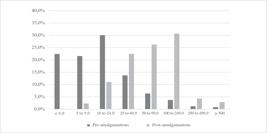
Proportion of municipalities in the scenarios before and after amalgamations, by population group
In the post-amalgamation scenario, the dominant population group is no longer those micro municipalities with fewer than 4,999 inhabitants, but rather the medium-sized group with populations between 100,000 and 249,999 inhabitants. There is a notable shift in population distribution between the small and medium-sized groups, and this increased proportion of new municipalities in the medium-sized group explains the most significant differences between the two scenarios.
In the post-amalgamation scenario, approximately 93% of municipalities are classified as small and medium-sized, with virtually no amalgamations involving populations below 5,000 inhabitants. Figure 5 shows the composition of the 1,400 new amalgamations by the number of municipalities within each amalgamation, while Figure 6 displays the population distribution along with the average FCE and OPSELF values for each population group in the new scenario.

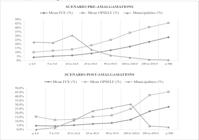
Comparison of FCE and OPSELF averages in preand post-amalgamation scenarios by population group
While the average population of municipalities has increased - to 126,922 inhabitants - and the proportion of municipalities with populations between 25,000 and 250,000 has expanded, there is a slight decrease in the mean OPSELF levels among medium-sized municipalities. This reflects a trend in the proposed model that combines municipalities with both lower and higher levels of FCE to promote a more equitable distribution of self-sufficiency within the municipal federative sphere.
Since the OPSELF index indicates the extent to which a municipality’s current expenses are covered by its directly collected tax revenues, a higher self-sufficiency index implies lower dependence on intergovernmental transfers. This, in turn, contributes to a more balanced and less asymmetrical federative structure (Bird & Tarasov, 2004; Lima & Diniz, 2016). The results of this research center around this measure, as negative variations in the index would indicate that mergers based on FCE might not be a viable alternative for the Brazilian federal context.
In view of all the analyses above and considering the theoretical hypothesis H2 - municipal amalgamations based on the FCE criterion will achieve a higher average level of OPSELF compared to the national average before the mergers - a comparison test was conducted between the averages of the two scenarios.
By integrating the descriptive and variation analyses with the results of the t-test comparing means, it was observed that municipal mergers formed based on the FCE criterion exhibit higher mean OPSELF in the post-merger scenario compared to the pre-merger average, thereby confirming hypothesis H2.
Although the hypothesis regarding an increase in mean OPSELF levels is confirmed, the theoretical expectation is that forming municipal mergers based on the FCE criterion should simultaneously lead to higher OPSELF and a reduction in horizontal fiscal imbalances among Brazilian municipalities.
This is because it would be inefficient for a merger model to increase FCE and OPSELF levels while simultaneously worsening horizontal asymmetries between units. To address this, the analysis of horizontal fiscal asymmetry was conducted using the coefficient of variation (CV) (Kowalik, 2015) along with the maximum-to-minimum ratio (MMR) (Bird & Tarasov, 2004) among the units. Figure 7 shows these asymmetries.

Comparison of the Coefficient of Variation and Maximum-to-Minimum ratio of OPSELF preand post-amalgamations (Brazilian states)
The higher the CV, the greater the dispersion of observations around the mean, indicating increased asymmetry in that context. Table 7 presents the calculation of the CV, which serves as evidence of horizontal fiscal asymmetry at the municipal level.
The mean for the preand post-amalgamation scenarios was already known, showing a positive variation of 36%. Although the standard deviation is higher in the post-amalgamation scenario, the coefficient of variation (CV), which compares these two measures, indicates a decrease of 15.4%. The Ymax/Ymin ratio measures the level of disparities or heterogeneity within a group of observations (Bird & Tarasov, 2004; Kowalik, 2015). For the research sample, the pre-amalgamation max/min ratio is 141.2, while in the post-amalgamation scenario, it drops to 38.6, a relative reduction of 72.6% in this measure.
At the national level, the Ymax/Ymin ratio decreases from 143.6 to 75.4 (-75%), a variation close to the 72.6% reduction observed in OPSELF levels. Based on the similar graphical patterns and calculated indices, there is evidence of a trend toward convergence in the post-amalgamation scenario, with observations being less spread out around the mean and showing lower disparity levels among municipalities in the member states compared to the current Brazilian scenario (pre-amalgamation).
The research results suggest that the simultaneous reduction in the coefficient of variation for both measures (OPSELF and GDP per capita) at the national level supports research hypothesis H3, which states that municipal amalgamations based on the FCE criterion decrease horizontal fiscal imbalances among Brazilian municipalities.
Regarding the research question that motivated this investigation - how does municipal amalgamation based on FCE affect operational self-sufficiency and levels of horizontal fiscal asymmetry in the Brazilian municipal context? - it can be summarized that municipal amalgamations based on FCE increase operational self-sufficiency by 36% and simultaneously reduce horizontal fiscal imbalances among Brazilian municipalities by 25.7%.
FINAL CONSIDERATIONS
The Brazilian system of municipalities is characterized by population and economic disparities, a heavy reliance on intergovernmental transfers, and significant horizontal fiscal imbalances. This research was based on the hypothesis that federative reorganization through municipal amalgamations guided by fiscal collection efforts could contribute to increasing the average operational self-sufficiency of municipalities while also reducing horizontal imbalances.
In social terms, the new federative arrangements discussed here are seen as tools for planning and implementing public policies aimed at reducing inequalities among municipalities and decreasing long-term dependence on intergovernmental transfers. In the practical and institutional sphere, the findings support the debate on enhancing the Brazilian federative pact. The proposal presented not only emphasizes municipal revenues - often overlooked in studies on municipal mergers - but also offers a model suitable for regional simulations and the development of public policies.
The main practical limitation is that the current constitutional framework does not allow for the immediate implementation of a policy of municipal amalgamations as presented here, unlike in countries where mergers between municipalities that wish to do so are possible. Nonetheless, the model can support different regional analyses or be adapted for application in more flexible legislative environments focused on enhancing the provision of municipal public goods and services.
Given the limitations of this study and the results obtained, future research could focus on five subareas: (i) assessing the impact of federative restructuring through municipal mergers on public expenditure; (ii) examining the projected effects of mergers in mediumand long-term scenarios; (iii) understanding public preferences regarding national policies for voluntary and mandatory municipal mergers; (iv) analyzing fiscal consequences in scenarios involving more decentralization than currently observed, including the possible creation of new municipalities; and (v) exploring how federative restructuring methods used in other countries could, while maintaining Brazil’s sociocultural characteristics, help improve the country’s three-tier federative system.
Finally, although debate is naturally ongoing given the current scientific literature on the subject, addressing the research gaps identified above could positively impact the development of a potential federative reform through municipal rearrangements in Brazil. Once these gaps are addressed, decision-makers will be increasingly equipped with scientific knowledge to support strategic decisions in the Brazilian federative context.
-
Evaluated through a double-anonymized peer review.
References
- Afonso, J. R. R., & Araújo, É. A. (2000). A capacidade de gastos dos municípios brasileiros: arrecadação própria e receita disponível. Cadernos Adenauer, 4, 35-55.
-
Bird, R. M., & Tarasov, A. V. (2004). Closing the gap: fiscal imbalances and intergovernmental transfers in developed federations. Environment and Planning C: Government and Policy, 22(1), 77-102. https://doi.org/10.1068/c0328
» https://doi.org/10.1068/c0328 - Bish, R. L. (2001). Local government amalgamations: discredited nineteenth century ideals alive in the twenty first. Commentary-CD Howe Institute, (150), 1.
-
Blom-Hansen, J., Houlberg, K., Serritzlew, S., & Treisman, D. (2016). Jurisdiction size and local government policy expenditure: Assessing the effect of municipal amalgamation. American Political Science Review, 110(4), 812-831. https://doi.org/10.1017/S0003055416000320
» https://doi.org/10.1017/S0003055416000320 - Breuss, F., & Eller, M. (2004). Decentralising the public sector: Fiscal Decentralisation and Economic Growth: Is there Really a Link?. CESifo DICE Report, 2(1), 3-9.
-
Byrnes, J., & Dollery, B. (2002). Do economies of scale exist in Australian Local Government? A review of the research evidence1. Urban Policy and Research, 20(4), 391-414. https://doi.org/10.1080/0811114022000032618
» https://doi.org/10.1080/0811114022000032618 - Boadway, R., & Tremblay, J. F. (2006). A theory of fiscal imbalance. FinanzArchiv/Public Finance Analysis, 1-27.
- Dafflon, B., Tóth, K., & Tóth, K. (2003). Local fiscal equalisation in Switzerland: the case of the Canton Fribourg Institute for Economic and Social Sciences.
-
Denters, B., Goldsmith, M., Ladner, A., Mouritzen, P. E., & Rose, L. E. (2014). Size and local democracy Edward Elgar Publishing. https://doi.org/10.4337/9781783478248.00006
» https://doi.org/10.4337/9781783478248.00006 -
Di Liddo, G., Longobardi, E., & Porcelli, F. (2016). Measuring horizontal fiscal imbalance: the case of Italian municipalities. Local Government Studies, 42(3), 385-419. https://doi.org/10.1080/03003930.2016.1150836
» https://doi.org/10.1080/03003930.2016.1150836 - Dieguez, R. C. (2011). Autonomia, accountability e coesão interna: uma análise políticoinstitucional de consórcios intermunicipais.
-
Diniz, J. A. (2012). Eficiência das transferências intergovernamentais para a educação fundamental de municípios brasileiros Tese de Doutorado, Faculdade de Economia, Administração e Contabilidade, Universidade de São Paulo, São Paulo. doi:10.11606/T.12.2012.tde26072012-113928.
» https://doi.org/10.11606/T.12.2012.tde26072012-113928. -
Dollery, B., & Fleming, E. (2006). A conceptual note on scale economies, size economies and scope economies in Australian local government. Urban Policy and Research, 24(2), 271282. https://doi.org/10.1080/08111140600704111
» https://doi.org/10.1080/08111140600704111 - Drew, J., & Dollery, B. (2014). Separation anxiety: an empirical evaluation of the Australian Sunshine Coast Regional Council de-amalgamation. Public Money & Management, 34(3), 213-220.
-
Drew, J., Kortt, M., & Dollery, B. (2015). What determines efficiency in local government? A DEA analysis of NSW local government. Economic Papers: A journal of applied economics and policy, 34(4), 243-256. https://doi.org/10.1111/1759-3441.12118
» https://doi.org/10.1111/1759-3441.12118 - Giambiagi, F., Além, A., & Pinto, S. G. B. (2017). Finanças públicas Elsevier Brasil.
- Hansen, S. W., Houlberg, K., & Pedersen, L. H. (2014). Do municipal mergers improve fiscal outcomes?. Scandinavian Political Studies, 37(2), 196-214.
- Holzer, M., Fry, J., Charbonneau, E., Van Ryzin, G., Wang, T., & Burnash, E. (2009). Literature review and analysis related to optimal municipal size and efficiency Rutgers-Newark, School of Public Affairs and Administration.
-
Karkin, N., Gocoglu, V., & Yavuzcehre, P. S. (2019). Municipal amalgamations in international perspective: motives addressed in scholarly research. Asia Pacific Journal of Public Administration, 41(4), 187-202. https://doi.org/10.1080/23276665.2019.1698843
» https://doi.org/10.1080/23276665.2019.1698843 -
Kowalik, P. (2015). Horizontal fiscal imbalance in Germany. Business and Economic Horizons, 11(1), 1-13. https://doi.org/10.15208/beh.2015.01
» https://doi.org/10.15208/beh.2015.01 -
Kushner, J., & Siegel, D. (2005). Are services delivered more efficiently after municipal amalgamations?. Canadian Public Administration, 48(2), 251. https://doi.org/10.1111/j.1754-7121.2005.tb02190.x
» https://doi.org/10.1111/j.1754-7121.2005.tb02190.x - Leite, F. L. B. (2014). Fusão de municípios: impactos econômicos e políticos da diminuição do número de municípios em Minas Gerais Dissertação de mestrado. Escola de Economia e Gestão. Universidade do Minho.
- Lima, S. D., & Diniz, J. A. (2016). Contabilidade pública: análise financeira governamental. São Paulo: Atlas, 576.
-
Lima, R. C. D. A., & Silveira Neto, R. D. M. (2018). Secession of municipalities and economies of scale: Evidence from Brazil. Journal of Regional Science, 58(1), 159-180. https://doi.org/10.1111/jors.12348
» https://doi.org/10.1111/jors.12348 - Mendes, M. (2004). Federalismo fiscal Economia do setor público no Brasil. Rio de Janeiro: Elsevier, 421-461.
- Miljan, L., & Spicer, Z. (2015). De-amalgamation in Canada. Breaking Up is Hard to Do, Toronto.
- Mukhopadhyay, H., & Das, K. K. (2003). Horizontal imbalances in India: Issues and determinants. Economic and Political Weekly, 1416-1420.
- Oates, W. E. (2005). Toward a second-generation theory of fiscal federalism. International tax and public finance, 12, 349-373.
-
Reingewertz, Y. (2012). Do municipal amalgamations work? Evidence from municipalities in Israel. Journal of Urban Economics, 72(2-3), 240-251. https://doi.org/10.1016/j.jue.2012.06.001
» https://doi.org/10.1016/j.jue.2012.06.001 -
Reingewertz, Y., & Serritzlew, S. (2019). Special issue on municipal amalgamations: Guest editors’ introduction. Local Government Studies, 45(5), 603-610. https://doi.org/10.1080/03003930.2019.1615465
» https://doi.org/10.1080/03003930.2019.1615465 - Rezende, F. (2001). Finanças públicas São Paulo: Atlas.
- Shankar, R.; Shah, A. Bridging the economic divide within countries: A scorecard on the performance of regional policies in reducing regional income disparities. World development, v. 31, n. 8, p. 1421-1441, 2003.
-
Shah, A. (2003). Fiscal decentralization in transition economies and developing countries. Federalism in a changing world: Learning from each other. https://doi.org/10.1515/9780773571402-030
» https://doi.org/10.1515/9780773571402-030 -
Shah, A. (2007). The practice of fiscal federalism: Comparative perspectives (Vol. 4). McGillQueen’s Press-MQUP. https://doi.org/10.1515/9780773560444
» https://doi.org/10.1515/9780773560444 -
Steiner, R. (2003). The causes, spread and effects of intermunicipal cooperation and municipal mergers in Switzerland. Public Management Review, 5(4), 551-571. https://doi.org/10.1080/1471903032000178581
» https://doi.org/10.1080/1471903032000178581 - Strebel, M. A. (2014). Launching and implementing municipal mergers: push-and pull-factors in merger processes.
-
Strebel, M. A. (2019). Why voluntary municipal merger projects fail: evidence from popular votes in Switzerland. Local Government Studies, 45(5), 654-675. https://doi.org/10.1080/03003930.2019.1584557
» https://doi.org/10.1080/03003930.2019.1584557 - Vergolino, J. R. O. (2013). Federalismo e autonomia fiscal dos governos estaduais no Brasil: notas sobre o período recente (1990-2010) (No. 1908). Texto para Discussão.
Edited by
-
Guest editors:
Ana Rita Silva Sacramento, Fabiano Maury Raupp, Cláudia Ferreira da Cruz, Ricardo Rocha de Azevedo

 Note:
Note:  Note: Brazilian Institute of Geography and Statistics (IBGE).
 Note: OPSELF = Operational self-sufficiency; FCE = Fiscal collection effort.
 Note: Population in thousands of inhabitants.

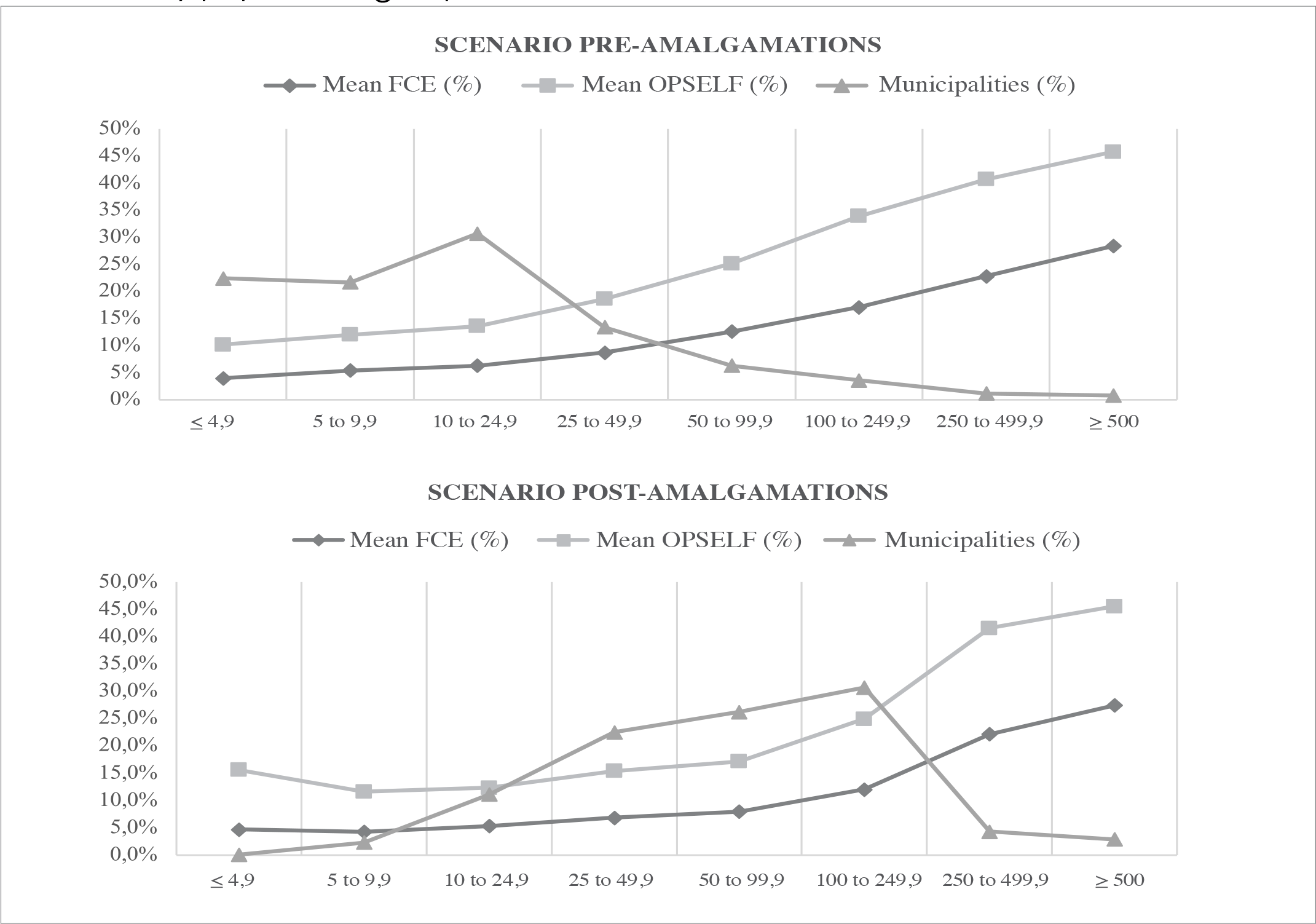 Note: OPSELF = Operation self-sufficiency; FCE = Fiscal collection effort.
 Note: OPSELF = Operational self-sufficiency.