 El Eternauta (1976): Science Fiction against Imperialism
Abstract
The science fiction genre is frequently used to depict realistic scenarios. This research aims to present an Argentinean comic book that has been adapted to the historical events of the country since its creation in 1957. El Eternauta is a graphic novel that depicts an alien invasion on Earth. The story reflects the political changes that were taking place in Argentina at the time, as the country was becoming more politically radicalised. The paper specifically discusses the 1976 edition, which was written by Héctor Germán Oesterheld, an underground militant in the armed struggle, and illustrated by Solano López. The scriptwriter and his family actively resisted the repressive military government and were harshly persecuted. This led to the disappearance of family members, including the writer himself, during the year that the analysed version of El Eternauta was published. The methodology uses comics as a primary empirical source, combined with theoretical references from the fields of international relations, history, political science, and communication to interpret the context of the military dictatorships that ravaged Latin America in the second half of the 20th century.
Keywords
dictatorships; international relations; comics; Argentina; science fiction
Resumo
O gênero de ficção científica é frequentemente usado para retratar cenários realistas. Esta pesquisa tem como objetivo apresentar uma história em quadrinhos argentina que foi adaptada aos eventos históricos do país desde sua criação em 1957. El Eternauta é uma graphic novel que retrata uma invasão alienígena na Terra. A história reflete as mudanças políticas que estavam ocorrendo na Argentina na época, quando o país estava se tornando mais radicalizado politicamente. O artigo discute especificamente a edição de 1976, que foi escrita por Héctor Germán Oesterheld, um militante clandestino da luta armada, e ilustrada por Solano López. O roteirista e sua família resistiram ativamente ao governo militar repressivo e foram duramente perseguidos. Isso levou ao desaparecimento de membros da família, incluindo o próprio roteirista, durante o ano em que a versão analisada de El Eternauta foi publicada. A metodologia utiliza os quadrinhos como fonte empírica primária, combinada com referências teóricas das áreas de relações internacionais, história, ciência política e comunicação para interpretar o contexto das ditaduras militares que assolaram a América Latina na segunda metade do século XX.
Palavras-chave
ditaduras; relações internacionais; histórias em quadrinhos; Argentina; ficção científica
Introduction
The aim of this article is to analyse the 1976 edition of the Argentinean comic book El Eternauta, created by the writer Héctor Germán Oesterheld and illustrated by Solano Lopez. Oesterheld’s innovation in the series was the creation of characters with humanistic characteristics.
Oesterheld is considered the greatest comic book scriptwriter in Argentina, the ‘most important adventure narrator of this country, and the most notable comic strip writer in Latin America’ (Montero 2013: 11, translated by the authors). Oesterheld’s fame has extended beyond Argentina, with worldwide recognition. The artist’s career is linked to the events that happened in his homeland. The tragic nature of his family’s life is also noteworthy.
El Eternauta is a science fiction series set in Argentina that has gained popularity beyond the country’s borders. The story has resonated with the local population, creating a keen sense of. The humanization of the characters made readers from all over the world identify with the plot described there, giving universal appeal to a local story. This narrative is therefore endowed with a broad dialectical form.
Another aspect is the timelessness typical of the classics. Despite re-interpretations, including posthumous ones, they have never lost their appeal due to the strength of the original script devised by Oesterheld. Even with the high degree of politicisation that has been increasingly expressed with each reworking of the character, the series seems to adapt to new interpretations and reading keys each time it is read or re-read. Creation, fantasy, and political militancy are the hallmarks of the Argentine scriptwriter’s life. In the present work, the time limit aims to account especially for the character of El Eternauta during the late 1970s, specifically from 1976 to 1978, when it was published in one of its versions.
The objective of this work is to analyse how the scriptwriter used comics to denounce the imperialism imposed in Latin America. The denunciations were made in both open publications of the left-wing press, such as Latinoamerica y El Imperialismo: 450 Años de Guerra and La Guerra de Los Antartes, and in a more specific way in El Eternauta. Imperialism is meant not only Vladimir Lenin’s ideas about the phenomenon but an expanded scope where central powers dominate peripheral nations. It would be the fierce subjugation provided by unequal forces based on the exploitation of the less powerful. The use of the expression imperialism was not endowed with greater conceptual care and theory, but rather as a resource for denunciation and practical militancy.
The quest is to follow the metamorphosis of an artist who, like many of his compatriots, became politicised as the country went through periods of political, economic, and social crisis. This journey was not a solitary one; almost the entire family participated in this new cycle, particularly his four daughters, who were also committed to the idea of justice and social transformation. In other words, it is not just part of an individual decision but corresponds to a process in a specific social context.
The research seeks to understand, from a non-moralistic nor Manichean reading, what leads a mature artist, beyond the age of 50, with a family of his own, to enter the universe of base militancy in a clandestine organization, giving up comfort and security.
In El Eternauta, culture and entertainment serve as privileged tools for analysing an era, as well as demonstrating that there are alternative ways to actively participate in the political and civic life of a given society.
The structure of the work has, besides this introduction, a section that deals with the science fiction genre and, in parallel, a brief biographical presentation of the scriptwriter. The section below analyses the historical context of the 1970s on Argentinean soil, which allowed the production of the comic book studied. The historical scope seeks to briefly highlight the nuances that also glimpse a theoretical contribution that accounts for the integration of this homeland in a broader and more complex logic of integration with the world systems. In the same section pointed out, there is the main analysis of the work and the impact of the political moment on the artistic production. Finally, the paper concludes with a synthesis of the importance of comics as a strategy of resistance and the formulation of engaged art.
The methodology adopted is based on primary sources, such as the comics themselves, as well as interviews granted by the scriptwriter and the artist. In addition, we use bibliographical data, which includes theoretical contributions from the field of Human Sciences. This involves consulting works formulated by historians, political scientists, philosophers, and specialists in the field of communication and comics.
A science fiction comic book: El Eternauta as a paradigm break
There is an intrinsic relationship between comic books and science fiction. Science fiction as a genre emerged in the first half of the 20th century and soon gained a profusion of authors and styles. The golden age of the genre was the 1940s:
It was in 1923 that the magazine Weird Tales appeared, specializing in strange tales, and promoting the launching of important writers such as Lovecraft, Bradbury, and Ackerman. Three years later, Hugo Gernsback (an editor dedicated to scientific vulgarization) created Amazing Stories magazine, designating the new literary genre of scientification, quickly christened science-fiction, or simply S-f. The first publications were channelled to an audience of technicians and scholars, but with proliferation (35 different magazines in 1937), imagination came to be worth more than scientific data. (Augusto 1977: 185, translated by the authors)
In comics, the fantastic has been the keynote of the medium since its inception. Little Nemo was one of the earliest American comic strip characters, which already had a strong fantastic and scientific tone:
Curiously, the first great creative and formative moment in comics coincided with the vogue for fantasy cartoons: Little Nemo in Slumberland, by Winsor McCay, in 1905. For many scholars of the subject, the adventures of Little Nemo in Slumberland mark the apex of the union between comics and pure fantasy, or even, according to Pierre Couperie, the discovery of science fiction in comics. (Augusto 1977: 186-187, translated by the authors)
Comics have frequently explored themes common to science fiction, including the use of technology and depictions of future scenarios. Modern inventions have been depicted in comics before they were invented:
The incredible, the fantastic, and the extraordinary were the three pillars of comics on the eve of World War II. Time travel and cultivating unimaginable relationships - chimeras from the last century - motivated two exceptional stories repertoriated on the margins of Space-Comics: Mandrake and Brucutu. Superheroes, by-products of science fiction, began to be born at the end of the 1930s, in the ballast of Superman (1938), geometric centre of three fundamental themes in S-f (end of the world = destruction of the planet Krypton, interplanetary travel and supernatural powers) and vectorial axis, at the mythological level, of a generation of abnormal beings ad nauseam: Captain Marvel, Atom. Captain America, Daredevil, Dynamo, Spider Man, The Rubber Man, Solar, Hulk, Thor, Flash, Gorth, Menthor, Nukla, Sonoman, Spectre, Miss America, etc. (Augusto 1977: 191, translated by the authors)
Argentina has made a valuable contribution to the symbiosis between comics and science fiction in Latin America. This contribution is not only reproductive but also highly creative.
Héctor Germán Oesterheld, born on 23 July 1919 in Buenos Aires, is widely regarded as the main figure responsible for the turning point of comics. Oesterheld came from a well-to-do German family, which afforded him a solid education and he developed a taste for reading at an early age.The young reader had a penchant for literary classics, especially adventure stories. His favourite authors included Robert Louis Stevenson, responsible for books such as The Doctor and the Monster and Treasure Island.
After completing his degree in geology, he married Elsa Sánchez and they had four daughters: Beatriz, Diana, Estela, and Marina. Literature has always been at the centre of Oesterheld’s life. He started as a reader, then became a reviewer and writer of short stories, and finally, until his last days, worked as a scriptwriter for comic books.
In college, he studied natural sciences to major in geology. He divided his studies with work in the area and with the task of being a proofreader, first in a publishing house and then in the newspaper La Prensa, where he published his first short story. He went on to write for Abril books of scientific dissemination. (Ramos 2016: 135, translated by the authors)
Oesterheld gained recognition for his work as a scriptwriter for comic strips such as Bull Rockett and Sergeant Kirk. He collaborated with various artists, including Alberto Breccia, Hugo Pratt, and Solano López.
The first El Eternauta was released in the 1950s in the magazine ‘Suplemento Semanal Hora Cero’, with Oesterheld’s script and art by Italian cartoonist Eugenio Colonesse. In 1955, he created Editorial Frontera in partnership with his brother Jorge following the success.
It was these books that started a turning point in his career. He and his brother, Jorge Mora, published on their own publishing label, Frontera, a series of paperback books with Bull Rocket and Sergeant Kirk stories. The first ones came out in March 1956. The two characters had nine works each. With the good repercussion and the money raised, the two brothers were advised to turn that experience into a comic book publisher. Thus, were born the magazines Frontera and Hora Cero. The first was launched in April 1957. The second, in May of the same year. (Ramos 2016: 137, translated by the authors)
Having created the time-travelling character in the late 1950s, the series was reinvented over the years, and was published, in addition to the reissues, in different versions twice more: once in 1969 and again in 1976, the latter being called El Eternauta Part 2.
One of Oesterheld’s innovative contributions was to differentiate the characters from the usual superheroes who roamed the pages of American comic books. By portraying relatable characters facing everyday challenges, readers were able to identify with the dilemmas presented, resulting in a more engaging reading experience.
And we can add another variable: the protagonists are like us. They are not conventional heroes, those produced by hundreds by the American superhero factory; but workers and students who, faced with an unexpected event, with a limiting situation, must make decisions that change them. They must join the adventure, because the adventure falls on their heads and there are no other options left. (Montero 2013: 67, translated by the authors)
The fantastic ceases to be something distant to be included in the routine. The ordinary could be filled with magic, and a stroke of fate could occur at any moment, like the tragic snowfall in Buenos Aires, which is the central idea that surrounds all versions of El Eternauta.
The plot describes the deadly effects of snowflakes on contact. The main character, El Eternauta, is characterised by his protection. In the second version analysed here, El Eternauta comes from the future to visit the comic book writer Juan Salvo. As in the other versions, the character’s diving suit would be necessary to have contact with the streets. With an emphasis on the absurd, since it does not snow in the city where the script is set.
‘The fantastic includes reality, and not only includes it, but needs it. For me, the fantastic is what arises, for example, between you and me, at this very moment, in the so-called reality. Now something can happen,’ he warned. (Montero 2013: 66, translated by the authors)
Rachel Haywood draws attention to the fact that a series of comic book science fiction stories emerged in Latin America from 1950 onwards, and this set of productions was called the ‘golden age’ (Haywood 2011: 216).
Oesterheld’s vision of the fantastic is like that of the Colombian writer Gabriel García Márquez, who is considered the main father of the genre. In an interview, García Márquez stated: ‘Here we enter into paradoxes: the unreality of Latin America is something so real and every day that it is totally mixed with what is understood as reality’ (Márquez and Llosa 2022: 78).
A consumer of fantastic literature, especially that of Julio Cortázar, Oesterheld introduced elements of this field into his stories: “Before deepening this Cortazarian parallel, it would be good to point out that Oesterheld was a reader of Julio: ‘I like it a lot. Besides because he thinks good stories, it is an intellectual pleasure to read him’” (Montero 2013: 66, translated by the authors).
The influence of literature, coupled with the popular aspect of comics, has given Oesterheld a unique place “between ‘high literature’ and ‘mass media’” (Von Sprecher and Reggiani 2010: 5, translated by the authors).
To understand Oesterheld’s work, it is important to recognise that his stories draw parallels with reality. The author describes his initial exposure to reading Cortázar as a child and refers to the experience of moving between two worlds.
‘And there appeared the little word,’ Julio emphasized. ‘That day, without being able to rationalize it, it is my ignorance as a child, I realized darkly that my notion of the fantastic had nothing to do with the notion of, for example, my sister or my mother... I discovered, and it was a little painful, that I moved naturally in the territory of the fantastic without distinguishing it too much from the real.’ (Montero 2013: 66, translated by the authors)
Regarding the science fiction genre, Oesterheld suggests that, in addition to the perception of time, a crucial aspect is a distinct understanding of what constitutes reality.
That is, in a way, the singular element of good science fiction: it is not, in short, about installing debates about prophecies of the possible, about distant futures and scientific anticipation, but about modifying the perception of the real, about analysing the tangible present from new variables, to find other images previously hidden or unnoticed. (Montero 2013: 66, translated by the authors)
The designer responsible for the drawings in El Eternauta 1 and El Eternauta 2 was Francisco Solano López. Born in Buenos Aires, the draughtsman was self-taught. He had previously collaborated with Oesterheld on characters such as Bull Rocket and Rolo. The latter served as a rehearsal for El Eternauta due to its theme involving a Martian invasion of Earth.

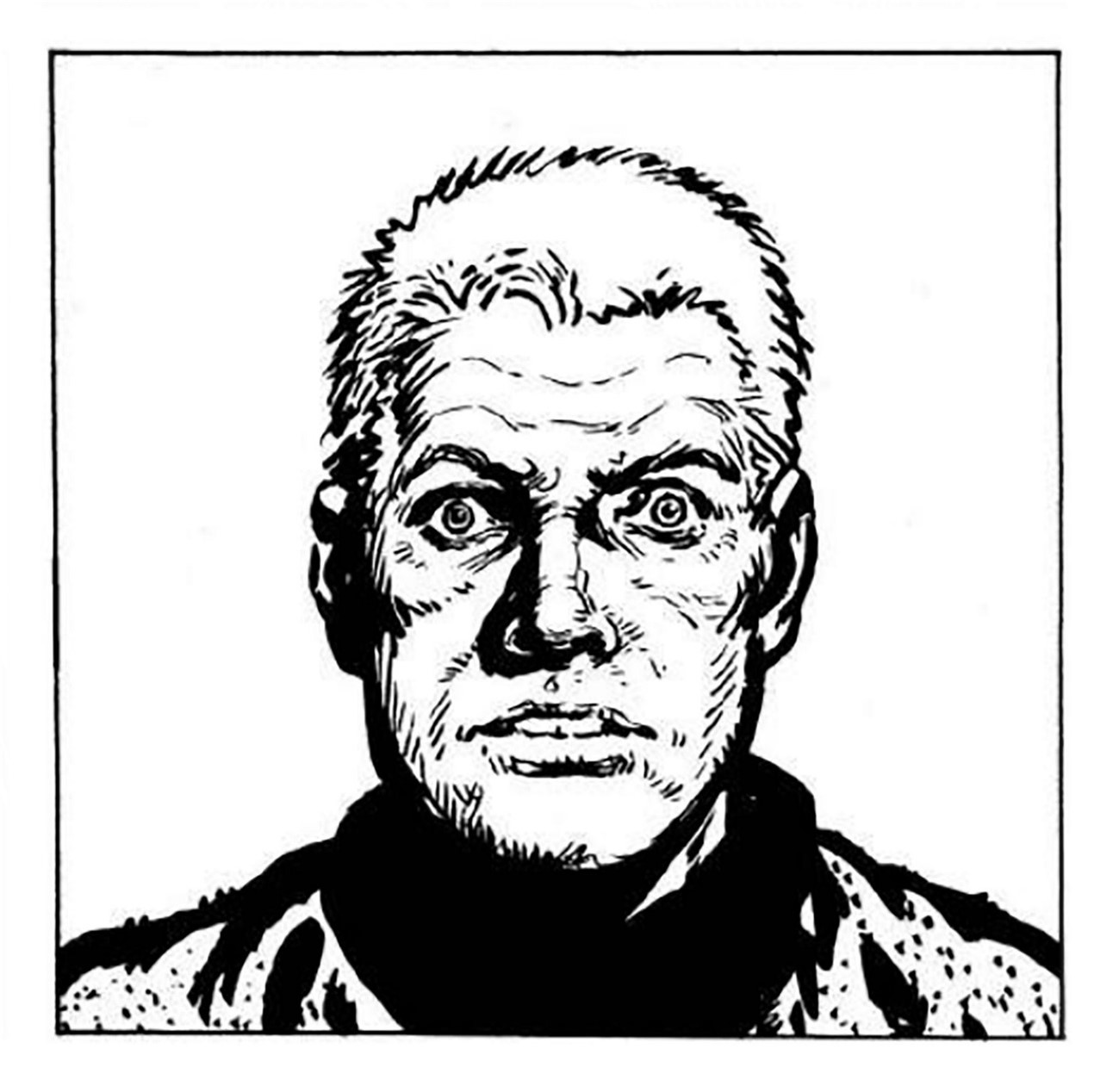
First painting of the story. Demonstration of refined technique with expressive use of contrast between black and white.
It is worth noting that López not only created the artwork but also influenced the scriptwriter’s ideas. López stated in a deposition that he specifically requested a character that was realistic and believable, without the typical superhero traits such as carrying ray guns, or those previously used by Oesterheld himself.
The key is that the person reading it establishes a deep connection with the characters, as Solano pointed out in his conversation with Oesterheld: ‘Well, Hector. Make me a science fiction one, but make it a little more realistic, more believable than Rolo, so that the reader can better identify with the characters’ (Montero 2013: 64, translated by the authors).
Oesterheld’s innovation was to create characters that readers could identify with, producing heroes that were palpable, flesh and blood. These characters had values and feelings that readers could relate to.
Hector brought us into the world of the most interesting adventure. With him there were no lonely heroes who kissed the girl and left. Hector added something that until then realistic comics had in minimal doses: human reactions, feelings that began to move the public in a new way. (Montero 2013: 142, translated by the authors)
The reader’s involvement with the story is the keynote. The characters have characteristics well defined, are not ridiculous, and could be followed just like a novel.
What I was wanting was to be able to treat the protagonists of the comic with a personality, a character, an expressiveness in their actions that would be an equivalent of what a novel is: well-studied characters, with more human and less stereotyped characteristics. (Montero 2013: 81, translated by the authors)
A tactic adopted by the creator was to include his own figure in the stories, which conferred even more credibility and the possibility of describing his feelings through the characters: ‘He had a position similar to that of the character of Germán from El Eternauta 2’ (Montero 2013: 129, translated by the authors).Although El Eternauta is not openly autobiographical, the comic flirts with this genre by transposing the author’s restlessness onto the pages. ‘There are also several examples of autobiographical comics, that is, those in which the author reconstitutes moments from his own life’ (Vilela 2016: 19, translated by the authors).
Another great contribution of Oesterheld in comics was to have set a narrative in his own country. By introducing Argentina as a setting, more precisely Buenos Aires, there was a break of paradigms. Hugo Montero also captures the creation as paradigmatic, but in the sense of the close historical link: ‘one of the paradigmatic works of a time’ (Montero 2013: 65, translated by the authors). Readers identify with the plot as soon as they recognise certain locations: ‘an effect of identification with the characters who suffer the change of scenery’ (Montero 2013: 65, translated by the authors). Instead of settings in the distant United States, those stories narrated people with common, everyday dilemmas: ‘Buenos Aires is the stage, and its protagonists are common men and women’ (Montero 2013: 73, translated by the authors).
Besides the geographical and thematic changes, another leap was a respect in relation to the construction of the scripts, possessing a plot well engineered, combined with aesthetic innovations and refinement in the trace.
In 1951, Héctor German Oesterheld made his debut as a comic book writer in the magazine Cinemisterio. Oesterheld was the main engine for the emergence of a more adult Argentine comic book, more complex in its scripts, more artistically ambitious that slowly tried to free itself from North American models. (Campos 2022: 59, translated by the authors)
A last innovation to be described is when the series gets new scripts covered with political aspects of El Eternauta, first in 1969 and then in 1976. The two politically charged versions were still interspersed with a series denouncing imperialism in Latin America:
Latinoamérica y el Imperialismo - 450 Años de Guerra was published in chapters for the weekly newspaper El Descamisado, maintained by the Peronist youth. The stories did not necessarily follow a chronological order. The first chapter appeared on the edition on 24 July 1973, accompanied by an introductory text: ‘How have the foreign invaders - first the Spanish, then the British and now the Yankees - moved and continue to move to control the puppet governments of the countries of the continent? How have they stolen our wealth?’ (Ramos 2016: 146, translated by the authors)

In El Eternauta, Oesterheld created a hybrid genre by combining science fiction elements with political commentary on the Argentinean reality of his time:
Set in a futuristic Buenos Aires in the year 2001, the comic book begins with an invasion but keeps its distance from the canonical forms of science fiction to become a political metaphor based on the development of an organized resistance against the oppressor. (Montero 2013: 132, translated by the authors)
According to comics scholar Moacy Cirne, the relationship between art and politics allows for a new way of thinking: ‘A consciousness that is critical. A transforming consciousness capable of problematising the art/politics relationship in an instigating way’ (Cirne 1982: 25, translated by the authors).
Cirne advocated what he termed the social responsibility of the comic artist living in a society dominated by peripheral capitalism.
The social responsibility of the comic strip, then, is significant among us. The comic artist, according to his possibilities, at this or that level of action (artistic and political), must participate in the struggle - ideological in the first instance - for the overthrow of an old economic, political, and social structure. (Cirne 1982: 24, translated by the authors)
In Oesterheld’s contribution, comics are not innocent pieces of humour, they become an instrument of struggle and intervention in reality:
The journey of a man who starts from the territory of fantasy and imagination and walks towards the intricate world of the political reality of the seventies, in Argentina. The journey of a maker of profoundly human adventures, who begins this transit at an age when many others decide to end it. But he does not undertake this journey alone: he is accompanied by his daughters, as a close reference of a generation of rebellious men and women who, in their militant commitment, assume themselves to be revolutionary. (Montero 2013: 11, translated by the authors)
In Oesterheld’s work there is a synthesis between the narrative of the present, which is made with a dose of the narrative of the past, and the essential, a pointing to another future. Art appears there between what has happened and what is becoming: ‘Once again, reality and fiction merge to configure a new story that walks between the desired and the suffered’. (Montero 2013: 134, translated by the authors)
Between military and astronauts: El Eternauta, part two (1976)
A particular artistic production, like any other form, is linked to a historical period. This is no different in the case of El Eternauta, but in this case we can say that the relationship between history and art is even more intertwined. The philosopher Lukács pointed out the configuration of art as an ‘individual and social manifestation’ (Lukács 2011: 34, translated by the authors). For the Hungarian thinker, the poles of the individual and society would have their own logic, but the tension inherent in them would at the same time create a contradictory unity.At this point, therefore, it is worth outlining the material conditions of the historical period of the 1970s in Argentina that fostered the elements present in the new edition of El Eternauta in 1976.
To approach the subject, it is first necessary to understand the existence of a world system much broader than national determinations. The period in question saw a series of military dictatorships in the Southern Cone, articulated directly or indirectly by the United States in the context of the Cold War.
The relationship between the local and the global has been well presented by the authors of the so-called ‘Marxist Dependency Theory’, whose canon includes Theotonio dos Santos. The perspective of including local dynamics integrated in world systems was summarised as follows:
Show the relationship between a structuring world economy and the national economies, which are a constitutive part of this world economy. So, you cannot cancel each other out, you must be able to dialectically understand both. And it is not simply a matter of national economies that encounter each other, but that are inside a world economic system. Hence the development of the idea of world system. (Santos 2009: 55, translated by the authors)
The context in which the second part of El Eternauta was written also marks the beginning of neoliberalism, which for the first time took shape in a Latin American dictatorship, in Chile, overthrown by the dictator Augusto Pinochet. This context marks a new stage of imperialism, in which individualism, integrated into the economy, is valued, with the counterpart of the emptying of the collective sense. Forms of resistance, such as workers’ organisations, were harshly attacked and repressed.
The neoliberal impetus quickly spread, reaching several countries in the region, to establish itself as a single thought:
With their efforts, Chilean technocrats had placed themselves at the crest of the neoliberal wave in the making that would shake the entire world, especially from the second half of the 1970s on. And, certainly, the renewed militant potential that neoclassical-based economic thought was beginning to acquire, gradually breaking away from Keynesianism, also provided, from the broader international scene, a major backing for the old ideas of the Southern Cone’s free-market right. (Novaro and Palermo 2007: 54, translated by the authors)
According to Frederic Jameson, neoliberalism brings with it a sense of disorientation to the individual (Jameson 2002). The individual would feel powerless and not empowered in his decisions. The context of late modernity in capitalism causes reality to be devoid of the human form. Oesterheld struggled against such a feeling of the subject not being able to draft his destiny: ‘Perhaps everything lies in the fact that we do not consider ourselves capable of being protagonists’ (Montero 2013: 68, translated by the authors).
At that time, the writer’s political participation increased, and he radicalised his organised intervention in the ‘Montoneros’ group, which in turn became illegal in May 1974, during the third government of President Juan Domingo Perón, with the intensification of social issues. After Perón’s death, his third wife, Isabel Perón – whose real name was María Estela Martínez de Perónque – who had been elected vice-president in 1973, took over the presidency. Isabel ruled from 1 July 1974 until 24 March 1976, when the military seized power in a coup.
In the first place, through the decrees signed by Isabel Perón and Italo Luder, the Armed Forces received from the constitutional government the authorization to ‘annihilate’ the guerrillas, first in Tucumán and then throughout the national territory, which meant an explicit recognition of their decisive role in the ‘fundamental conflict’ and, by extension, in the order that would result from its resolution. (...) After that, the professional and dispensable figure par excellence took over as head of the army: General Videla. (Novaro and Palermo 2007: 42, translated by the authors)
Pablo Turnes described in detail the trajectory of the ‘Montoneros’ group, and the repression suffered by the organization:
Montoneros had its origins in the Movimiento Nacionalista Revolucionario Tacuara, originally a right-wing nationalist grouping where pro-fascist, anti-Semitic and Catholic fundamentalist positions converged, and which was prone to direct action. Its period of activity was 1955-1965. Subsequently, internal divisions led to the radicalisation of left-wing revolutionary positions that converged with grassroots union Peronism. The confluence between the FAP (Peronist Armed Forces) and Montoneros led the group to propose armed struggle as the only way to revolution and the return of Peronism, banned since the 1955 coup d’état that had overthrown Juan Domingo Perón. From 1974, with the return of the exiled leader in Madrid, the break with Montoneros became explicit and the group went underground. From 1975 onwards, repressive actions by the government of Isabel Martínez de Perón (widow of the leader who died shortly after his return and vice-president in the electoral formula) marked the beginning of systematic practices of assassinations, disappearances, and torture by parapolice groups coordinated by Interior Minister José López Rega in what became known as the Triple A (Alianza Anticomunista Argentina). (Turnes 2011: 111, translated by the authors)
The political scenario in which the second part of El Eternauta was conceived and periodically published was called the ‘Process of National Reorganization’ by the military themselves and encompassed the years from 1976 to 1983. Gago characterises that Osterheld makes in his work ‘allusions to the reality of his time’ (Gago 2020: 43). The dictatorship emerged from a context of economic and institutional crisis, promising order as the solution to all national wounds.
The year 1976 began under the ominous sign of political violence, institutional crisis, and economic meltdown. The economy had remained stagnant after the initial short-lived successes of the Peronist agreement, and the outlook was not at all encouraging. The increase in the international price of oil and the devaluation of foodstuffs heralded growing imbalances in the balance of trade. Inflation was soaring, despite desperate and more or less orthodox attempts to control it. Between March 1975 and March 1976, prices rose by 566.3%, and for the following year an increase of at least 800% was predicted. (Novaro and Palermo 2007: 23, translated by the authors)
From May 1976, repression against the guerrillas intensified and the new government abandoned all vestiges of legality. The coup led to an eclipse of military interests and state administration. Military officers were appointed to the universities, historic sites of the resistance, and sergeants – a low rank in the officer corps – were appointed mayors.
The period of the so-called ‘National Reorganization’ (1976-1983), among other points, differs from the previous one by the total abandonment of legality in the fight against the guerrillas, which, from a repressive operation, turns into a ‘war of extermination’, in which the Armed Forces are engaged. (Fausto and Devoto 2004: 397, translated by the authors)
The installed dictatorship was ruthless in its persecution of the guerrillas. As we have seen, the violence against this sector had already begun under Perón’s government, and with the military takeover it would escalate to an unprecedented degree. Argentina and its opponents, including the organisation to which Oesterheld belonged, will join the list of the most violent and bloodthirsty governments:
The coup of March 1976, which launched Argentina into the darkest period of the sequence of military dictatorships, had as its main target the elimination of the armed groups - the Montoneros and the People’s Revolutionary Army (ERP), in particular. In the economic area, a meeting took place between the Armed Forces and the hardest sectors of traditional antiperonism. (Fausto and Devoto 2004: 414, translated by the authors)
The figures cited by researchers of the time give an account of the scenario of the war that was being waged on Argentine soil. Using the expedient of the ‘disappearance’ of people, the country stood out for its grim statistics:
In Argentina, however, the military experts and implementers of violence made their contribution to an anarchic reign of terror between 1975 and 1977. The number of ‘disappeared’ persons in Argentina was, in per capita terms, 32 times higher than in Uruguay and more than three hundred times higher than in Brazil. Although the regime in general terms did not have the ideological and organizational coherence of a totalitarian regime, many of the military’s statements about the need to exterminate its enemies had a totalitarian bias. The military government was in fact much more an authoritarian ‘situation’ than an institutionalised ‘regime.’ (Linz and Stepan 1999: 227, translated by the authors)
It is recurrent in Argentine historiography to impute a supposed guilt, not only of the guerrillas for the repression, but as if it were a responsibility of the left:
All this was accompanied by a no less widespread effort to distance oneself from those who, in the eyes of the fickle public opinion, were considered at that point to be the ‘real’ ones responsible for that unrest, politicians in general and, in a particular and much more unforgiving way, left-wing activists. (Novaro and Palermo 2007: 40, translated by the authors)
The synthesis of the plot and the motivations for making El Eternauta 2 have been well described by Paulo Ramos:
Record had republished the first El Eternauta at this time, with good repercussions. Oesterheld and Solano López were invited to make a sequel, which began publication in December 1976. The story picks up where it left off in 1959: Can the impending snowfall be contained? Gérman tries to contact Juan Salvo, who initially does not remember anything. In a second moment, with his memory recovered, Eternauta and the writer go through a time jump. The two migrate to the future, a devastated land. There they find survivors, cave people, and help lead the group in the violent armed struggle against the invaders. (Ramos 2016: 148, translated by the authors)
In El Eternauta 2 you can clearly see Oesterheld’s growing commitment, and it shows in the scripts:
The inclination towards political action was a process of personal change for the writer, reflected also in part of his comic narratives. Messages that were not so intentional in the first stage of his writings, inaugurated in the first half of the 1940s, became so in the years preceding his demise. (Ramos 2016: 135, translated by the authors)
The scriptwriter followed the decision of his ‘Montoneros’ chain – which was already illegal in 1975 and decided to intensify the militarisation of its militant cadres and actions – and left his home, starting to deliver the scripts secretly.
With the coup and the consequent reorganisation of the militants in the press area, Héctor was assigned to the liaison structure. A system of prearranged appointments had been established to circulate information and the task of the liaisons was to act as a courier between structures. His harmless grandfatherly appearance made him ideal for that role. He left the Delta house to his daughter Beatriz and Juan sin Tierra and rented that villa in Vicente López. (Nicolini and Beltrami 2016: 287, translated by the authors)
When El Eternauta was republished in 1976, Oesterheld was also in hiding. On receiving the increasingly politicised writings, the editor in charge of the relaunch changed most of the passages, arguing that he wanted to preserve Oesterheld, when in fact his main concern was financial, and he did not want to get in the way of his business.
Laura Fernández described in detail not only how Eternauta was republished, but also the political landscape of persecution that was faced by activists:
The panorama is more dramatic when El Eternauta 2 appears. Conceived as a continuation of the previous ones (...) this comic book began to be published in the Libro de Oro n°2 of Skorpio magazine, of Récord editions, in December 1976, and continued monthly until April 1978. After the military coup to the government of Isabel Martínez de Perón, on 24 March 1976, the confrontations, persecutions, and elimination of the ‘subversives’ that during the previous government had been persecuted by the Argentine Anticommunist Association, the ‘Triple A’ are intensified as a priority of the dictatorial government. (Fernández 2012, 81, translated by the authors)
Fernández associates the character’s loneliness with the political moment the author was living:
Oesterheld transfers to the character Germán some common elements that can be understood as metaphors of his circumstance. One of these marks is loneliness: it is never explained in the story why Germán is a loner, but we do know that he has devoted the last years of his life to spreading the story of the alien invasion of Latin America. During those years, Oesterheld lives in hiding, as well as his four daughters: all disintegrated, all militants. (Fernández 2012: 92, translated by the authors)

Another author who also looked at the same panorama, relating the publication of the second part of El Eternauta to the growth of repression was Trillo:
In 1976, a comic book publisher reprinted the original El Eternauta in a single volume of more than 350 pages in the newsstands. The success was once again surprising. Enthusiastic about the sales that did not cease, the publisher invited Oesterheld and Solano López to make a second part to be included in his monthly Skorpio. Oesterheld, by then a Montonero militant, produces a script with little disguised calls to the revolutionary struggle. The editor modified it wildly, fearful of the violence of the times. Solano draws, finally, this second Eternauta, where the scriptwriter, a simple witness of the first adventure, becomes a narrator in the almost irrational mutilations that fear forces him to make in his plot and in his writing. (Trillo 2004: 9, translated by the authors)
In addition to the editor’s, there were cuts made by the designer Solano López, who also cut parts that he considered controversial. The published result was therefore a double censorship.
Solano López saw ideological and revolutionary content in the armed rebellion imagined by Oesterheld in El Eternauta 2. The country, it is worth noting once again, was under dictatorial rule, which began the same year as the second part of the series was published. In interviews reproduced in the book ‘Wanted Alive’, the cartoonist says he showed his dissatisfaction to the publisher and his partner. The scriptwriter would have said that he had not noticed and that he would see what he could do. Something changed, says Solano López, but the general sense remained. The ending is just as he wrote it. (Ramos 2016:148, translated by the authors)
While these new stories were being published, Oesterheld was the victim of an ambush by agents of the military dictatorship, who kidnapped him in La Plata on 27 April 1977. After being transferred from one prison to another, he was allegedly murdered in Mercedes in 1978, but is officially listed as one of the thousands of missing persons, the same tragic fate as his four daughters, who were pregnant, two sons-in-law and two grandchildren.
In the absence of a corpse, of a trial or of an arrest with identified culprits, the task of accusing someone of something became extremely difficult. Faced with the absence of a loved one or a companion, a generalised and permanent fear and suffering was installed, which favoured withdrawal and immobility. But in many other cases, and this would be socially and politically relevant, disappearances produced exactly the opposite effect. (Novaro and Palermo 2007: 145, translated by the authors)
The category of ‘disappeared’ attributed to the militants who went missing brought a picture of insecurity and uncertainty, making it impossible to file formal complaints and leading to martyrdom for family members and friends.
According to data from the National Commission on the Disappearance of Persons (Conadep), in 1976 alone there were more than 3,500 cases of disappearances. To complete this picture, hundreds of people were added to the lists of detainees available to the PEN, and thousands of political activists of all kinds fled into exile. (Novaro and Palermo 2007: 98, translated by the authors)
The organisation in which Oesterheld was active was not known for its appreciation of theory. On the contrary, it emphasised an unconcerned and pragmatic voluntarism without many foundations. Julieta Pacheco analysed the current programme through documents and concluded that the main agenda was reformist, aiming for national liberation without ‘making radical modifications within the system, without proposing its transformation’ (Pacheco 2014: 5, translated by the authors).
Pacheco highlights the lack of theoretical development and the scarce production of programmatic and strategic documents by the Argentinean group, which led to contradictory positions. The organisation did not present precise definitions of the state. Following this line of reasoning, it can be said that Oesterheld’s tactic of choosing clandestinity was also based more on voluntarism than rationality. It was his way of dedicating himself to a task in which he believed, even if there was no underlying theoretical framework to justify it, but rather obedience to the conceptions outlined in a vertical manner by the leadership. Having never held a management position, Oesterheld saw himself as just another piece on the board to make his contribution:
Neither Oesterheld nor his daughters were leading cadres of the organisation in which they militated. On the contrary, they were grassroots militants. Their political work environment was the villa and the press, their dialogue was generated with the comrades who shared those universes with them, and the militant bond was often less strategic and programmatic than affective. (Montero 2013: 12, translated by the authors)
A dialectical approach is necessary. There is nothing exotic or extravagant about Oesterheld’s decision to go into battle. It was taken in a context in which many of his compatriots were making the same choice, especially those in his intellectual and artistic field. Explaining his decision, Oesterheld said he could not remain indifferent to the commitment and dedication of young people, including his daughters: ‘I cannot exclude myself from the fight in which all the youth are involved, including my daughters, which is also for a cause in which I always believed: a better country, with more social justice’ (Montero 2013: 125, translated by the authors).
One of the changes in the updated version is precisely the introduction of a female character, which biographers have pointed out is the representation of one of his daughters. Hugo Montero points out that the character of Maria is in fact based on the codename of the daughter Beatriz, who, like her father and sisters, had chosen to fight as a guerrilla. The new character is not just a subordinate, secondary figure; on the contrary, she is gifted with activism and courage.
Sirinelli puts the issue of rationality in decisions in good terms when he warns that historians should be aware of the determining factor of emotions and affections in the choices made by intellectuals:
It is a serious naivety to suppose that political engagement proceeds from lucidity, itself nourished by Reason. And it must be noted that, in this engagement, feelings and affectivity have sometimes prevailed over Reason. (Sirinelli 2003: 260, translated by the authors)
With a strong influence of Che Guevara, demonstrated when making the album in his honour in 1968, Oesterheld seems to have adhered in his life to the maxim uttered by Karl Marx that ‘every step of the real movement is more important than a dozen programs’ (Marx 2012: 20, translated by the authors).
The desire to be involved in the struggle was evident in the comic’s script. In the second version, the main character of El Eternauta is more pragmatic, without such moral contours, and justifies his detachment from life, not only his own, but also that of his comrades in battle:
Also, it is true, some epochal dilemmas linked to the avant-garde burst in. In particular, the question of torture and the conflictive problem of sacrifice, so many times revisited by Oesterheld throughout his comics. In those sequences of the suicide mission, when Juan chooses the veterans and preserves the young ones, when he decides to hand over some of his men as bait so as not to be discovered, the question of the end that seems to justify any means emerges. (Montero 2013: 154, translated by the authors)
The writer presents himself through his alter ego as someone who has been freed from the loneliness of his craft by experiencing solidarity. Page (2016) points out that in the 1976 version Oesterheld incorporates the role of narrator and protagonist.
In this second part, the protagonist, Juan Salvo, behaves like a different hero to the one in the original version. His character is more objective, pragmatic, and combative. It is a kind of reflection of the transformation that Oesterheld underwent at the time, going underground shortly afterwards and adopting all the habits that this practice entails, such as the use of disguises and the constant change of residence.
Eternauta 2 modifies the role of the hero: Juan Salvo is much tougher in his decisions and even the death of loved ones is justified if the cause is a good one. A stance that coincides with HGO’s affiliation to Montoneros. (Munõz 2004: 13, translated by the authors)
The turning point in the explicit politicisation of El Eternauta is the denunciation contained in the script that the United States and Europe, at a certain moment, signed an agreement with the invaders of the planet Earth, with the aim of delivering South America to get rid of the yoke. This feature is already present in the 1969 edition of the work and is reproduced in the 1976 version, as well as in other plots that Oesterheld wrote for the alternative press, such as the lesser known La Guerra de Los Antartes.
Due to the climate of the time, not even Oesterheld’s main graphic partner was unaffected by the political contortions. As we have seen, the most prominent artist in the series’ development was Francisco Solano López from Buenos Aires, who was responsible for the character’s appearance not only in the 1950s but also in the 1976 edition. It should be noted that the artist, despite being contrary to the political position of the scriptwriter, also suffered the drama of the arrests of militants in his family, when his son was arrested, forcing them to flee Argentina and go into exile in Madrid, Spain:
While he was making progress with El Eternauta, his son was arrested by a task force, and only the influence of a military friend and the promise to leave immediately abroad allowed him to rescue him from the genocidal clutches: So, he ended up sending the last pages of the comic book by mail, from Madrid. (Montero 2013: 147, translated by the authors)
Graphically, Solano López’s classy line adds to the story the vigour and clarity of his black and white drawings: ‘of careful craftsmanship and masterful suspense’ (Montero 2013: 65, translated by the authors). In contrast to the experimentalism seen in Breccia’s 1969-line, cleanliness, and clarity reign in Lopez’s art: ‘And Solano worked with gouache ink and dry brush’ (Montero 2013: 70, translated by the authors).
The pacing of the story, for example, has been carefully considered:
As for the graphic narrative, it is structured in accordance with the rhythms of the story: in the more descriptive excerpts, the vignettes are extended, and emphasis is placed on details that provide information to the text. In the scenes of combat or violence, the succession of frames is dynamized and, thus, the reading. (Fernández 2012: 85, translated by the authors)
The series El Eternauta is characterised by the movement of return, in the turns that are made in ways radically different from each other. A theoretical contribution that stands out in this regard is the contribution of the philosopher Gilles Deleuze, who calls attention to the subtlety of the phenomenon of repetition. Not in a mechanical or exhaustive way, but how the gesture of repetition can be creativeDeleuze calls such repetition as ‘[a] discovery, in various domains, of a consciousness proper to repetition, a power that would also be that of the unconscious, of language, of art’ (Deleuze 2021:13, translated by the authors).
Or, still, in another passage, where repetition is described by Deleuze as an unpublished element, different and creator of freedom: ‘To make of repetition itself something new’ (Deleuze 2021: 23, translated by the authors).
Repetition was to be the fate of the series, as many other editions would be produced in the following decades by a wide variety of hands, forming a solid part of Argentine culture.
Once Oesterheld disappeared due to the bloodthirsty Military Process, El Eternauta was left without its creator, but not without echoes: although the size of the original, several continuations contributed, to a greater or lesser extent, other aspects to Oesterheld’s plot. (Munõz 2004: 13, translated by the authors)
El Eternauta has a multiplicity of representations, varying according to each era and their respective uses: ‘When speaking of Héctor Germán Oesterheld and his Eternautas series of comics we are speaking of multiple and interlocking levels of icons’ (Haywood 2012: 155).
Conclusions
Oesterheld’s seminal contribution as a writer in the field of comics and science fiction was not restricted to this area. By blending art and social criticism, the author’s engagement was a legacy of active participation and remained in the imagination of the Argentineans. The imaginative description of an alien invasion in Buenos Aires had worldwide repercussions, be it for the technique used or for the horror of what it represented, a murderous persecution not only of the artist but also of his family.
The politicisation expressed in El Eternauta seeks to make people aware. Using the resource of heroes, it avoids the traditional stratagem model of the individual and relies on the colours of what Oesterheld called the collective hero, inspired by the example of the guerrilla Ernesto Che Guevara. Oesterheld countered with the French philosopher Jean-Paul Sartre, who once said that hell is other people. Oesterheld stuck instead: ‘paradise are the companions’ (Montero 2013: 155, translated by the authors).
Oesterheld’s late radicalism was influenced by his daughters’ involvement in militancy, a common behaviour of the new left in 1970s Argentina. If in the past political participation was traditionally a legacy from the elders to the next generations, in the organisations of this decade the opposite is true.
It is common among specialists who have studied the series to try to list which would be the best. But this is a vain gesture; they all complement each other. Not constituting a mere repetition, as previously highlighted, but each one endowed with its own unique potency. It would not be a sum, but a power that gains intelligibility to the extent that one sees the whole and the author’s motivations.
El Eternauta influenced a series of comic book productions after the dictatorship. Edward King (2013) demonstrates how Oesterheld’s legacy continues to influence comics and cultural production in Argentina to this day.
Beyond the field itself, El Eternauta had repercussions in other areas after re-democratisation. One of the most latent episodes was what became known as Nestornauta, the political appropriation of the character by Kirchnerists, supporters of former Argentine presidents Néstor Kirchner and his wife Cristina. Gago described the phenomenon as follows:
From September 2010 onwards, groupings partisan to the federal government used the iconography of the character as a political tool: graffiti, stencils and political posters were displayed in public thoroughfares with the classic figure of Juan Salvo, but with the face of Néstor Kirchner. The narrative of the ‘Nestornauta’ appealed to the myth of the militant and disappeared Oesterheld, seeking to extend these contestatory traces to the political past of the former president, who died in 2010. (Gago 2016: 61, translated by the authors)
The political strategy was to generate identity ties between the Kirchnerist movement and the character, thus influencing society, especially the youth sectors (Gago 2015). The same opinion is expressed by Francescutti, who identifies the attempt to produce political charisma with the use of the character (Francescutti 2015).
The memory of Oesterheld as a disappeared person represents a symbol of resistance for the leftist movements of the 1990s and for the graphic youth of the streets after the economic crisis of 2001, who expressed themselves through graffiti and stencils, making use of the iconic character (Fernández and Gago 2015). Thousands of shirts, posters, and other mechanisms were reproduced to associate the resistance to Oesterheld’s dictatorship and his creation with the Kichner family (Palacios 2020).
The use was the scene of controversy, in which conservative sectors criticized the political use of the Argentine cultural figure. However, the focus for now is to highlight the permanence and vitality contained in the imaginary of what the character means.
Capitalism is extremely dynamic, and at a time when the liberal forces opted for repression and the closure of regimes by supporting dictatorships to counter the advance of socialism during the Cold War, Oesterheld’s actions were a reaction to this state of affairs, and a decision that, far from being extreme, was in fact the way that these historical individuals saw as possible.
Oesterheld was not predicting events, as some hasty readings devoid of historical sense point out. He was, rather, gifted with a perceptive reading of the conjuncture of his time and immersed in the concrete social struggles. The artist used fantasy to counterpoint the arduous present, thus imagining a future different from the one that was set.
References
- Augusto, S. 1977. ‘Space-comics: um esboço histórico’. In A Moya (eds). Shazam. São Paulo: Perspectiva.
- Campos, R. 2022. HQ: uma pequena história dos quadrinhos para uso das novas gerações. São Paulo: Veneta e Edições Sesc.
- Cirne, M. 1982. Uma Introdução Política aos Quadrinhos. Rio de Janeiro: Angra/Achiamé.
- Deleuze, G. 2021. Diferença e repetição. Paz e Terra: Rio de Janeiro/São Paulo.
- Fausto, B and F Devoto. 2004. Brasil e Argentina: um ensaio de história comparada (1850-2002). São Paulo: Editora 34.
- Fernández, L. 2012. Historieta y resistencia: Arte y politica en Oesterheld (1968-1978). Mendoza: Universidad Nacional de Cuyo.
- Fernández, L and S. Gago. 2015. ‘La saga ‘El eternauta’ modelos de sociedad y transformaciones de su discurso’. Digilenguas 10: 58-65.
- Francescutti, P. 2015. ‘Del Eternauta al ‘Nestornauta’, la transformación de un icono cultural en un símbolo político’. CIC Cuadernos de Información y Comunicación 20: 27-43.
- Gago, S. 2016. ‘El Eternauta: as leituras de um clássico dos quadrinhos na atualidade’. Revista História, histórias.7(4): 55–70.
- Gago, S. 2015. ‘La lectura de Oesterheld antes y después del retorno democrático’. La Trama de la Comunicación 19: 131-149.
- Gago, S. 2020. ‘‘What Does a Few Lives Matter?’: Notes on Two Comic-Book Invasions of Héctor Oesterheld (1974-1977)’. International Journal of Comic Art 22 (1): 43-62.
- Haywood, R. 2012. ‘Oesterheld’s Iconic and Ironic Eternautas’. Ginway, E. and Brown, A. In: Latin American Science Fiction: Theory and Practice. New York: Palgrave Macmillan.
- Haywood, R. 2011. The Emergence of Latin American Science Fiction. Middletown: Wesleyan University Press.
- Jameson, F. 2002. Pós-Modernismo: lógica cultural do capitalismo tardio. São Paulo: Editora Ática.
- King, E. 2013. Science Fiction and Digital Technologies in Argentine and Brazilian Culture. London: Palgrave Macmillan.
- King, E and J Page. 2017. Posthumanism and the Graphic Novel in Latin America. London: UCL Press.
- Linz, J and A Stepan. 1999. A transição e consolidação da democracia – a experiência do sul da europa e da américa do sul. São Paulo: Paz e Terra.
- Lukács, G. 2011. Arte e sociedade. Rio de Janeiro: Editora UFRJ.
- Márquez, G G and M V Llosa. 2022. Duas solidões: um diálogo sobre o romance na América Latina. Rio de Janeiro: Record.
- Marx, K. 2012. Crítica do Programa de Gotha. São Paulo: Boitempo editorial.
- Montero, H. 2013. Oesterheld, la biografia: viñetas y revolución. Lomas de Zamora: Sudestada.
- Munõz, P. 2004. ‘Un poco de historia’. In Oesterheld H. e López, S. El Eternauta. Buenos Aires: Diario Clarín.
- Nicolini, F and A Beltrami. 2016. Los Oesterheld. Buenos Aires: Sudamericana.
- Novaro, M and V Palermo. 2007. A Ditadura Militar Argentina: 1976-1983: Do Golpe de Estado à Restauração Democrática. São Paulo: Editora da Universidade de São Paulo.
- Oesterheld, H and A Breccia. 2019. O Eternauta 1969. São Paulo: Comix Zone.
- Oesterheld, H and A Breccia. 2021. Che. São Paulo: Comix Zone.
- Oesterheld, H and S López. 2004. El Eternauta. Buenos Aires: Diario Clarín.
- Oesterheld, H. 2013. O Eternauta 2. São Paulo: Martins Fontes.
-
Pacheco, J. 2014. ‘Montoneros a la luz de su programa’. Revista Theomai. Número 29. [online] 13 September. At http://www.revista-theomai.unq.edu.ar/numero29
» http://www.revista-theomai.unq.edu.ar/numero29 - Page, J. 2016. Science Fiction in Argentina. Ann Arbor: University of Michigan Press.
- Palacios, C. 2020. ‘The Nestornaut or how a president becomes a comic superhero’. Scorer, J. In Comics beyond the Page in Latin America. London: UCL Press.
- Ramos, P. 2016. Bienvenido: um passeio pelos quadrinhos argentinos. Campinas: Zarabatana Books.
- Santos, T. 2009. Entrevista. Revista Ciência e Luta de Classes. Rio de Janeiro, vol.3, Nº 4, pgs. 50-67, setembro.
- Sirinelli, J. 2003. ‘Os intelectuais’. In Rémond R. Por uma história política. Rio de Janeiro: FGV.
- Turnes, P. 2014. ‘Para leer el Imperialismo: la historieta como arma discursiva en 450 años de guerra contra el Imperialismo (1973-1974) de Héctor G. Oesterheld y Leopoldo Durañona’. CuCo: Cuadernos de cómic 2: 109-136.
- Trillo, C. 2004. ‘Las muchas lecturas de un clásico’. In Oesterheld H. e López, S. El Eternauta. Buenos Aires: Diario Clarín.
- Vilela, T. 2016. ‘Aspectos (auto)biográficos nas histórias em quadrinhos’. In Vergueiro, W; P Ramos and N Chinen. Enquadrando o real. São Paulo: Criativo.
- Von Sprecher, R and F Reggiani. 2010. Héctor Germán Oesterheld: de El Eternauta a Montoneros. Córdoba: Universidad Nacional de Córdoba.

 Source: Oesterheld 2013: 9.
 Source: Oesterheld 2013: 17.
 Source: Oesterheld 2013: 70.