
 Gig economy, surveillance capitalism, and labor relations in Brazil
Abstract
The present study seeks to analyze new forms of work focusing on a debate on the Gig Economy and its implications for labor relations. It aims to provide an analysis of the subject, bringing subsidies about the evolution of work, technological changes, and the applicable regulation, in view of the visibility acquired recently by the subject due to the significant increase in the use of applications to obtain income.
Keywords:
gig economy; uberization; legislation; technology; work
Resumo
O presente estudo busca analisar a problemática das novas formas de trabalho tendo como foco um debate sobre a Gig Economy e suas implicações nas relações de trabalho. Tem como objetivo uma análise sobre o tema, trazendo elementos sobre a evolução do trabalho, mudanças tecnológicas e a discussão da regulamentação aplicável, que se tornou mais evidente nos últimos anos com um aumento expressivo de uso de aplicativos para obtenção de renda.
Palavras-chave:
gig economy; uberização; legislação; tecnologia; trabalho
Introduction
In the so-called Fourth Industrial Revolution, the work scenario is transforming and organizing itself in a globalized, less rigid way and with intense use of technology and innovation, as highlighted by (Nantal, 2018, p. 28). Terms such as "sharing economy" and "fourth industrial revolution" have emerged as attractive phenomena and symbols of flexible work and entrepreneurship. These terms are associated with ideas that lead workers to believe that they should free themselves from the constraints of a permanent career to run their own business. This perspective on work is in line with the philosophy that governs the contemporary economy, developing what is known as the Gig Economy, also known as the "Gig Economy", as pointed out by (Lisboa, 2021, p. 54).
What began as a small niche for digital crowd work has become a global phenomenon (Prassl, 2018, p. 260). The issues outlined above have culminated in the establishment of new forms of precarious work known as "gigs" (casual and fragmented work) within an economic scenario known as the "Gig Economy" (Woodcock; Graham, 2020, p. 4). We can say that the Gig Economy is the term used to describe the working relationships between workers and companies that hire these individuals to provide services without employment ties, with virtual application platforms as the main means of providing the service (Woodcock; Graham, 2020, p, p. 4).
It is important to note that "gigs" are not new, as they have existed in various sectors of the economy. However, the Gig Economy has grown rapidly through digital platforms, replacing various forms of work that do not exist on these platforms, as noted by (Woodcock and Graham, 2020, p. 2). One of the consequences of this platform economy is the way in which already precarious jobs are being reshaped, affecting the entire economy, as the authors also point out. In other words, we are living through an important historical moment in which we are witnessing an unprecedented normalization of the platform-based work model. In this context, important questions arise: What are the implications of the Gig Economy for labor relations?
In this sense, in the current post--industrial period and made possible by technological modernization, new labor formats are being developed. Thus, intermediation and crowdwork platforms have been created, making it possible for different tasks to be assigned to workers who offer their labor to companies in an autonomous way. From this context, a few questions can emerge, such as: Does labor autonomy give workers greater freedom to carry out their work? How do virtual platforms place themselves in the position of mere intermediaries, defining no employment relationship with their providers? Who benefits from these transformations and innovations, and what does this “revolution” really mean for workers?
This new format of work is accompanied by increased flexibility for workers in two dimensions: a) temporal, as work is done temporarily, on demand or for a fixed period; b) spatial, as work is done remotely or through apps (Nantal, 2018, p. 47). However, while employment relationships are not established, the labor rights of service providers are not guaranteed. In this way, the asymmetries between capital and labor become even more evident, leading to exploitative abuses, especially in times of rising unemployment, and enabling attempts to deregulate labor rights that have already been won.
There are ongoing legislative debates, such as Proposition 22 in the United States, which seeks to resolve the issue of employment in California. In Brazil, however, this legal debate seems to have just begun, and the emergence of new companies offering services through platforms is constantly growing, affecting labor relations in organizations (Dubal, 2021).
In this essay, we aim to problematize the new forms of work, focusing on the Gig Economy and its implications for labor relations in relation to data appropriation. We will begin by discussing the Gig Economy, seeking to better understand its emergence and characteristics, as well as the phenomenon of Uberization and its platforms. We will consider the data management of citizens who use the services of these platforms, as they are obliged to enter their personal data to register and use the applications. In addition, we will highlight the risks to which the population is exposed if this data is not handled responsibly and correctly by the companies involved.
Gig Economy and platformized work
The terms Gig Economy, crowd work (Loureiro; Fonseca, 2020, p. 179) or even Gig Economy (Lisboa, 2021, p. 67) are characterized by flexible salaries, autonomy in working hours, multiple forms of contracting and the possibility of providing work services through digital platforms, popularly known as apps, accessed by smartphones, tablets or computers.
The term Gig Economy derives from American musical jargon: "gig" was the term musicians used to refer to small performances in bars, paid by the night. Over time, it became synonymous with odd jobs, temporary and unstable work. This logic of short-term contracts with no guarantees and low wages spread to other sectors - and today defines a large part of platform-mediated employment relationships (De Stefano, 2015).
However, in works of Brazilian law, the most recurrent term to describe this structure is the Gig Economy, while "doing a gig" refers to the nomenclature used to denote one-off jobs, also referred to in modern times as freelancing.
In this way, this new economic format denotes a labor market resulting from the so-called Fourth Industrial Revolution. It is characterized by a network for providing services through digital platforms, made possible by the evolution of technological devices that allow the person offering his labor to be contacted by those who need his services.
However, the Gig Economy differs from the traditional model observed since the First Industrial Revolution, in which the employer owns the means of production and makes them available to workers to generate economic capital, including their remuneration and surplus value (Marx, 2013, p. 23).
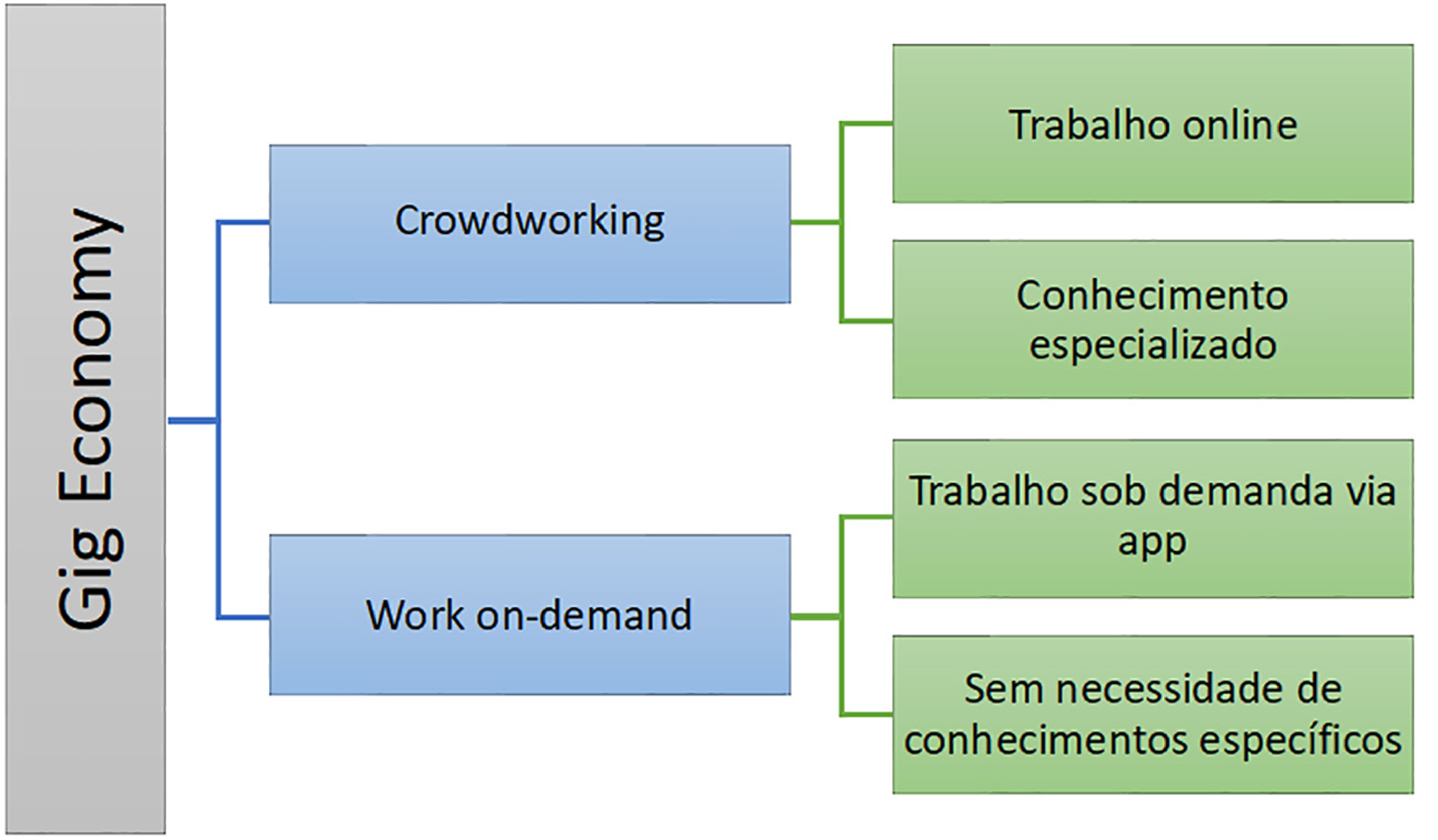
In this sense, the term Gig Economy in the literature can be understood as two main forms of work: crowdwork and on-demand work through apps. Let's look at the differences between them:
-
Crowdwork: Crowdwork, also known as collaborative work or, in other words, crowd work, is characterized by the assignment of certain tasks to a group of service providers located on a digital basis, who must perform the tasks assigned to them remotely (Loureiro; Fonseca, 2020, p. 12). Thus, the different specific demands assigned to these providers result from the fragmentation of work into increasingly smaller activities (Aloisi, 2016, p. 63).
-
Work on Demand: Originally called Work on Demand, it encompasses the work format in which a range of specific tasks, from restaurant and bar delivery, passenger transport and accommodation services to freelance services and cleaning, can be hired on demand (Lisboa, 2021, p. 28). The platforms developed by the companies that provide these services are therefore the bridge between the registered workers and the people who use these applications. These tasks are performed in a physical space, as opposed to crowdwork, which takes place in a virtual environment.
It follows that the former has a more regionalized scope, as it requires the physical presence of workers, while collaborative work allows for a global scope, as services can be performed from anywhere in the world (Nantal, 2018, p. 41).
In addition, crowdwork includes more diverse services that are ordered in advance and require the hiring of adequate workers to perform them, while on-demand work is more related to the performance of traditional tasks, such as transportation or cleaning (De Stefano, 2015, p. 3).
The inherent characteristics of each of these forms of work included in the Gig Economy, as shown in Graphic 1, raise another issue: the opposition between manual and intellectual labor, as explained by Souza (2006, p. 92):

It will be the notion of discipline, rational calculation, and control of the body and its emotions and needs that will imperceptibly differentiate social classes, genders, ethnicities, and so on. Not only will the struggle between classes and class fractions be decided by this opposition between the soul or reason – as the locus of the virtues of the dominant classes – and the body – as the locus of the dominated and ambiguous virtues of the lower classes – exemplified by the opposition between intellectual and manual labor – which, in a country like Brazil, as we all know (without ever asking why?) legitimizes earning up to a hundred times more. This proves its "naturalized" character) – but also all the other hierarchies that presuppose superiority and inferiority or the notion of better and worse, such as the opposition between man/woman and white/black, insofar as both women and blacks are perceived as repositories of the ambiguous virtues of corporeality, affectivity, and sensuality, as opposed to the unambiguous virtues of calculating intellect and the morality of self-control.
This dimension must be considered, especially when we look at the racial nature of the workforce employed by the on-demand formats of the Gig Economy. As Góes et al. (2022), manual labor is mostly performed by the black and brown Brazilian population, which contributes to the naturalization of the assumption of inferiority of these groups.
Given the negative consequences of this model of work, the racial dimension can be a plausible explanation for the legitimization of violence and the ideological construction of the existence of a natural place belonging to certain groups, ideas that are usually only acceptable when they are directed against non-white people (González, 1984, p. 152).
It should be noted that technological developments and the rise of the Gig Economy are just two of the many factors that are moving work away from the stable, bilateral employment relationships between workers and employers around which labor law developed in the last century (Prassl, 2018, p. 207). In its place, we see an increase in intermittent work, often for multiple employers and perhaps interspersed with periods of entrepreneurship.
In this sense, the concept of uberization of work is emerging in Brazil, a terminology used in relation to the growth of workers in transportation apps. The term "uberization" refers to one of the first companies to operate in Brazil with on-demand work applications, Uber. As a multinational company with operations in several countries around the world, Uber provides transportation for passengers and goods through its app, which began operating in Brazil in 2014. The company integrates passengers and drivers through this app, without entering a formal employment contract with the driver, but simply providing access to its network of consumers. Each driver must pay Uber about 25 percent of their earnings, and all maintenance is the driver's responsibility. As in other parts of the world, Uber has grown rapidly in Brazil, with many drivers signing up and increasing the supply of services.
The flexibility promoted by so-called uberization is a significant extension of the flexibility of work introduced by post-Fordist management, which has been expanding in Western companies since the 1970s and in Brazil since the 1990s. According to Aloisi (2015, apud Rauber et al., 2022, p. 4), uberization promotes a kind of neo-taylorism, since it applies to a type of temporary, short-term work consisting of small tasks.
We should also consider another feature of "uberized" work that brings it closer to "Taylorized" work: Like the latter, work under uberization undergoes a process of de-skilling, either because it consists of work with simpler content (or tasks that require a minimum of qualification), or because it leads to a significant deterioration in the wages earned even by the most qualified workers, to the extent that they are made possible by temporary employment contracts, by the replacement of formal employment contracts (popularly known as "formal contract jobs") by "legal entity" contracts, with the loss of social guarantees such as the 13th month's salary, the Guarantee Fund and paid leave, among others (Rauber et al. , 2022, p. 5).
This type of work will also form what Standing (2013, p. 34) defines as the "new precarious", which is characterized by sections of the workforce in large cities, such as young graduates, immigrants, the elderly, and women. Standing (2013, p. 34) defines as the "new precarious", which is characterized by sections of workers in large metropolitan areas, such as young graduates, immigrants, older people and women, who, due to growing unemployment in large cities, end up in precarious work situations without the social guarantees previously guaranteed to formal workers, but who, on the other hand, see this new form of employment in a "romanticized" way, since it offers greater flexibility, reduced working hours and a more volatile link to work (Standing, 2013; Rauber et al., 2022).
Uberization and suppression of rights
The terms Gig Economy, work on demand (Standing, 2013) or even Gig Economy (Lisboa, 2021, p. 67) have been used to define a set of labor relations characterized by the absence of traditional ties, flexible working hours, variations in pay and technological intermediation. These forms of work are made possible by digital platforms, usually accessed through apps on smartphones, tablets or computers, and represent a reconfiguration of the way work is organized and valued in the modern era).
Legally, this means that "every worker is a worker, but not every worker is a worker" (Vilhena, 2005, p. 30). In other words, not every working relationship is an employment relationship, although every working relationship is part of an employment relationship.
However, art. 3 of the Consolidation of Labor Laws (CLT), the legislation that defines labor obligations and rights, presents the concept of employee as "any natural person who performs services of a non-occasional nature for an employer, under the employer's dependence and in exchange for a salary" (Brasil, 1943). It should be noted that the employee who can be protected by the CLT is necessarily a natural person.
The concept of employer, in turn, is written as "the company, individual or collective, which, assuming the risks of economic activity, admits, pays and directs the personal provision of services" (Brasil, 1943).
Nevertheless, in the formats of the Gig Economy, in many cases the workers and those in charge of the applications are linked by the criteria of economic dependence and capital accumulation. However, if initially hired as a self-employed service provider, this worker can only be legally protected in the labor sphere through a long and bureaucratic judicial process to prove the employment relationship (Oliveira, 2021, p. 25).
Thus, if they don't have their employment relationship recognized, they remain without legal protections such as minimum wage, compensation for work accidents and occupational diseases, unemployment insurance, compensation for unjustified dismissal, overtime pay, and additional pay such as health and safety risks. About the latter, it should be noted that the work carried out by many of these professionals is extremely dangerous, especially in a country that is lagging in terms of public safety.
In this sense, the legislative debate on these new forms of work is taking place in several countries and is particularly evident in the context of uberization. One example is Proposition 22, a law being debated in the state of California (USA), which classifies drivers as independent contractors, contrary to previous legislation that classified them as employees (Butcher, 2020).
With the arrival of Uber in Brazil, there was a need to regulate paid private individual passenger transportation, which was done through Law n. 13,640/2018, which amended Law n. 12,587/2012, responsible for establishing the National Urban Mobility Policy. This regulation, however, led to a debate about the nature of the employment relationship between drivers and the Uber platform.
However, years later, with the advent of the Covid-19 pandemic and the resulting social isolation and loss of jobs, virtual platforms began to be used more widely, both by consumers and by new adherents in search of income. This movement has led to a significant increase in the number of workers registered on the apps.
Despite this, the counterparts of the companies responsible for the apps have not been verified, neither in terms of wages nor in terms of labor security. As a result, in 2020, the legislature took a step that led to the drafting of 40 proposals on this issue in the Chamber of Deputies (Oliveira, 2021, p. 20). An analysis of these proposals shows that the initiative came mainly from left-wing parties. Among the proposals, some focused on the pandemic situation that put the country in a state of public calamity, while others established proposals that emphasized working conditions, dealing with accidents, health, and safety at work (ibid., p. 21).
Bill of law (BL) 3354/2020, for example, aimed to oblige companies to guarantee workers access to the personal protective equipment needed to carry out the contracted service. Bill 1665/2020, on the other hand, stipulated that delivery workers should have the right to financial support if they had to take time off work due to an accident or contamination by Covid-19.
BL 3748/2020, on the other hand, established that platforms should establish an assistance protocol if a contractor suffers an accident while performing his work, without granting compensation to the worker.
Other BLs highlighted were BL 3748/2020, which aimed to ensure labor and social security rights for app delivery workers, although it provided that this contract would not be protected by the CLT, and BL 4172/2020, which established control of remuneration, protection in cases of unjustified dismissal of workers, and social security rights, proposing a new regulatory framework distinct from the CLT.
The legislative debate on the rights of Gig Economy workers should be more advanced by now. The Covid-19 pandemic has only highlighted what has long been on the horizon: millions of people working through platforms, without formal contracts, without minimum guarantees, and bearing all the costs and risks of the activity.
In Brazil, many couriers don't even have their own means of transportation. As reported by Maciel (2019), it is common for them to rent bicycles, such as "laranjinhas," to fulfill the routes required by the apps. The informality is such that the work tool also becomes an individual burden, even if the service generates direct profit for the platform.
This reality does not concern the future of work, but the present. And it requires a legal response that recognizes who these workers are and what conditions must be guaranteed to them.
In Brazil, there are bills and laws that address this issue, such as Bill n. 3,748 of 2020, which regulates on-demand work (Câmara dos Deputados, 2020), as well as Bill n. 28 of 2017, which seeks to regulate individual private paid passenger transport through digital platforms (Senado, 2017), and Law n. 13,467 of 2017, known as the Labor Reform (Brasil, 2017). Although the reform did not specifically address platform work, it introduced innovations in the recognition of self-employment, the expansion of outsourcing, and the regulation of teleworking, with the argument of fostering new forms of employment and promoting greater worker autonomy, awakening individual entrepreneurship. On the other hand, these changes have also intensified the debate on the abolition of minimum guarantees and the transition from the status of worker to that of "nano-entrepreneur", permanently available for just-in-time work.
In this way, technological advances have made it possible to develop a range of different applications offering all kinds of services, guided by the search for maximum profit. This is in addition to the competition that characterizes the free market, which puts platforms offering similar services in direct competition with each other, such as iFood, Rappi, Aiqfome and Delivery Much on the one hand, and Uber, Cabify and 99 Taxi on the other.
In any case, there are two aspects common to all these digital platforms: a) the growth in the pandemic conjuncture, due to the closure of several commercial establishments, which consequently increases the demand for services provided through apps, easily accessible in the virtual environment; b) the role played by apps as a link between customers and service providers.
As mentioned above, the first aspect has led to the expansion of labor registers. On the other hand, the rights of these workers have not expanded organically, but only when there has been state intervention in this direction. In this sense, the debate on what constitutes an employment relationship needs to be stimulated to ensure fair rights for these workers. Finally, new platforms continue to emerge and modernize, while their profits continue to grow.
At the same time, the number of workers who depend on this income to cover their basic needs is growing, especially in a context of economic crisis and unemployment, even in the face of low wages and a lack of guaranteed rights. This is not an entrepreneurial movement, but the proliferation of nano-entrepreneurs, who are often subjected to inhumane conditions to survive.
In this scenario, the so-called 4.0 revolution, with all its promises of innovation and technology, seems to be taking us backwards. During the 2019 protests in Sacramento against the uberization of work, demonstrators carried placards with the expression 'Damn New Feudalism', a phrase taken up by Dubal (2021) to describe the new forms of exploitation by digital platforms.
What emerges, then, is not a revolution in the emancipatory sense, but a reorganization of precariousness under new conditions. The rhetoric of flexibility masks the reality of a weakened workforce, individualized and increasingly distant from collective guarantees, increasingly isolated and precarious, a process that Zuboff (2021) also recognizes as part of the advance of surveillance capitalism over everyday life.
Surveillance, data and job insecurity
In the modern era, capitalism has turned to data to maintain economic growth and vitality in the face of a sluggish productive sector. In the 21st century, based on changes in digital technologies, data has become increasingly central to companies and their relationships with workers, customers, and other capitalists (Srnicek, 2017, p. 11).
For Srnicek (ibid.), platforms have emerged as a new business model, capable of extracting and controlling vast amounts of data, and this shift has led to the emergence of large monopolistic corporations. Today, capitalism in high- and middle-income economies is increasingly dominated by these companies, and the dynamics described in this book suggest that this trend will only continue.
It can be said that the legislative debate is not limited to the issue of employment, which has not been settled by the courts in Brazil. This discussion also extends to the responsibility of app companies towards their partners and the community, as there are discussions about the associations of app professionals in the context of competition law and data management.
In other words, we live in the information society, in which almost the entire globe can be connected in a matter of seconds and in which interdependence is one of the central characteristics of its countries. This society is the result of the "information revolution" that has improved the means of communication (Lisboa, 2006, p. 114). As a result, modernization has made possible collective access to information and interoperability on the Internet, allowing the evolution of existing technologies and the development of new technological tools.
According to Santos (2009, p. 46), the central element of contemporaneity is the technique of information, through information technology, cybernetics, and electronic devices. In this sense, Lisboa (2006, p. 114) reiterates that, to highlight the relevance of the information revolution, it is necessary to emphasize the scientific advances in the field of communication, "contrasting them with the evolution of the means of production that culminated in the emergence of the industrial society, which in turn is strongly influenced by the information society".
As a result, the information revolution has made it possible for the Gig Economy to develop to the extent it has today. However, this situation calls for reflection on the possible consequences of the large flow of personal data that is being shared. In other words, the provision of personal data is a condition for the virtual existence of both the provider of a given service and the service recipient (Srnicek, 2017, p. 23). New expanses of potential data have been opened and new industries have emerged to extract this data and use it to optimize production processes, provide information on consumer preferences, control workers, provide the basis for new products and services (e.g. Google Maps, autonomous cars, Siri) and sell it to advertisers (ibid., p. 24).
While this format of the economy triggers the emergence of a range of different apps with different functions and easy access, the intimacy and private life of social subjects can be put at risk by registering on a series of different platforms that do not have the same security parameters. The consequent storage of customer (and employee) data by all these applications, if not organized responsibly, can violate the principles of privacy guaranteed by Brazilian law.
Thus, the protection of privacy and intimacy, and consequently of personal security, are principles that are among the permanent clauses of the current Federal Constitution, provided for in Art. 60, § 4, II, which states that "the proposal for an amendment tending to abolish: (. ... II – the direct, secret, universal and periodic vote" (Brasil, 1988), as well as art. 5, X, which states that "the intimacy, private life, honour and image of persons are inviolable, guaranteeing the right to compensation for material or moral damage resulting from their violation".
In addition to the above-mentioned clauses, Constitutional Amendment n. 115 has recently been approved, with the aim of modifying the provisions of the Magna Carta to include the protection of personal data among the fundamental rights and guarantees, giving the Union private competence to legislate on the protection and processing of personal data.
Concerns about the collection of data, such as user profiles and preferences, predate the applications that now abound on all mobile phones and personal and business computers. In 2001, the digital TV programme recording service known as TiVo worried its users and American society (Rosen, 2004, p. 31):
Many TiVo customers were surprised to learn that the company was collecting detailed information about its subscribers. [They have a contract with Nielsen Media Research to monitor and record their customers' viewing habits. [...] They are accumulating a record of who saw what and when, down to the atomic level. Concerned about possible privacy violations, Representatives John Dingell, Edolphus Towns and Edward Markey sent a letter to the Federal Trade Commission in 2001 asking it to investigate whether TiVo was engaging in 'unfair or deceptive practices' when it claimed it did not use individually identifiable information about its customers.
In this example, TiVo's motivation for collecting data from its users and, in turn, displaying increasingly personalized suggestions has been described as egocasting: "the completely personalized and extremely narrow search for personal taste" (Rosen, 2004). Not unlike this, with today's technologies, many application and digital service companies have an enormous capacity to collect, store and process data from their users, always with the innocent idea of improving the user's experience of the service.
This data collection creates a huge mass of information that gathers all the subjectivity of the individual and becomes an asset that can be shared or traded with various other companies. One question that comes to mind is how deep and transparent this data collection, processing and use is.
As is the case with casual users, many companies, their employees, collaborators, and partners use similar technologies to monitor and control all the information that circulates through their computer network, even with legal assistance.
We can see that the control of data goes far beyond a legal and technological discussion, as it doesn't just permeate the universe of customers with technological changes, but also affects the way people work, or rather the control that companies exercise over their workers in the virtual world. Despite the many nuances of data protection law, what we can't help but notice is that employers or their managers are using technology to hold details of their employees' behavior, thereby exercising power over their employees (Zuboff, 2021, p. 20).
"Surveillance capitalism [...] dispels the illusion that the networked form has some kind of inherent moral content, that being 'connected' is somehow intrinsically pro-social and inclusive, or a natural tendency towards the democratization of knowledge. Digital connectivity is now a means to the commercial ends of a third party. At its core, surveillance capitalism is parasitic and self-referential. It revives Karl Marx's old image of capitalism as a vampire feeding on labour, but now with a twist. Instead of labour, surveillance capitalism feeds on every aspect of all human experience.
Contemporary capitalism is defined by Zuboff (ibid., p. 12) as 'surveillance capitalism', where a new economic order claims human experience as free raw material for covert commercial practices of extraction, prediction, and sale. According to the author, surveillance capitalism is not a technology, but a logic that permeates technology and directs it into action. In this sense, surveillance capitalism is a form of market that only exists in the digital environment. According to Poter and Souto, (2019, p. 33), "Surveillance capitalism is a new economic strand where the production of goods and services depends on a new global model of behavioral change, it is the looting of the pillars of human rights". As Koerner (2021) argues, surveillance capitalism transgresses privacy and enters the spaces of existence due to the accumulation dynamics of its dominant sector, platform capital, which depends on data extraction to conduct its business.
In this logic, we see a new form of industrial model: if before, in managerial capitalism, we saw mass production and control of the workforce at General Motors, now we see the control and capture of the subjectivity of workers and Google users.
According to Zuboff (2021, p. 80), "Google is to surveillance capitalism what Ford Motor Company and General Motors were to managerial capitalism based on mass production," becoming a pioneer in the practice of surveillance capitalism.
We live in a world where the need for real-time connectivity and the constant use of applications creates a scenario where the owners of technology also own our profiles, without us being fully aware of it. The Thing is, it's not always our choice.
Many companies today use social networks as a channel to reach their customers, in a communication that should ideally be between the company and its target audience. However, many employees also consume this content, either spontaneously or encouraged by their managers. As a result, the use of social networking applications ends up blurring the professional and personal spheres. In addition to the corporate use of networks, various other applications end up transforming the individual into a full-time employee, even outside the workplace and at home. With the use of email and access to corporate systems via personal devices, employees lose a clear sense of the 'end of working hours' as they remain constantly connected. There have already been cases of workers being sacked for expressing opinions on social media that don't align with company values. One example is reported by (Mergulhão and Assad, 2022) in an article published in O Globo, which describes the dismissal of a worker after he published criticism of the previous government on his social networks.
Dismissal for just cause is a recurring issue in the courts, as the CLT tries to determine what is a right of expression and what is an act damaging to the honour and good reputation of the employer:
Art. 482 – The following shall constitute just cause for the termination of an employment contract by the employer.
(...)
k) an act detrimental to the honour or good reputation of the employee, or a physical offence committed against the employer or a superior, except in the case of self-defence or defence of others.
As home office becomes more widespread, companies may have another way of collecting data, monitoring, and controlling their employees, because when they connect their personal computer to the company's private network, it is usually through a VPN (Virtual Private Network) application. This application allows the home computer to securely connect to the company's private network and, in some cases, completely captures the personal computer in use, making it an asset of the corporate network while connected.
In this way, away from the company and in the comfort of their own homes, employees can feel safe using their personal computers in the way that suits them, without realizing that they are still being monitored and watched.
Michel Foucault's book Surveillance and Punishment, originally published in 1975, remains relevant in the dialectic created by The Age of Surveillance Capitalism, according to (Zuboff, 2021), by reviving the figure of the panopticon – a term used by (Foucault 2002, p, p. 172) to define a circular prison in which the prisoner cannot see his guard, but knows that he is under constant surveillance. According to Zuboff (2021, p, p. 551), we can recognize a kind of postmodern panopticon in contemporary technological methods of observation and social surveillance of networks.
The film (The Circle Ponsoldt, 2017) presents a profound reflection on the intersection between technology, work, and surveillance. In the plot, the technology company creates a seemingly ideal working environment, but subtly dominates the lives of its employees through data collection and constant surveillance. This resembles a modern-day panopticon, a kind of prison where freedom is conditioned.
As in the film, the worker sees his subjectivity being captured by surveillance capitalism. The technologies introduced into the workplace invade their personal sphere, restricting their freedom by constantly monitoring their opinions, expressions, interests and even their tendencies, and subjecting them to the control of the employer.
This precariousness of work is not only an effect of the so-called 4.0 revolution and the degradation of the workforce through algorithmic demands, but also the result of the exploitation of the individual by technologies that should, in theory, be beneficial and productive for everyone. It is a warning of how technology, when misused, can become a tool of control that compromises workers' freedom and autonomy, exacerbating inequality and precariousness.
The use of apps and informality
It is important to note that different Gig Economy models have emerged on different online freelance platforms, which have limited control over work, while other platforms, such as transport and assistance platforms, are characterized by high levels of explicit coordination and power asymmetry, as noted by (Woodcock; Graham, 2020, p. 9). However, all Gig Economy models share a defining logic that seeks to transfer maximum risk and minimum reward to workers, as the authors also point out.
Over the last twenty-five years, surveillance capitalism has been highly effective in using technology in labour relations (Silva; Chaves, 2021). It has made the most of the opportunities offered by a sharing economy (ibid.). A striking example for a didactic analysis is on-demand work through apps, where the platform not only acts as an intermediary in the provision of services, but also carries out the selection of workers based on certain institutional standards (ibid.).
Currently we can see new platforms emerging in industries from transport to home care, from professional services to work. They are at the forefront of what is often called the 'Gig Economy', which recalls the life of the artist, where each concert or 'gig' is just a single task or transaction, with no additional commitments on either side (Prassl, 2018, p. 225).
The worker's personal data, including confidential information, is collected, and stored in a database. It is important to note that the comprehensive storage of all available information about a worker is sometimes used by cross-referencing databases between companies within an economic conglomerate to exercise surveillance and control over that individual (Carelli, 2014).
In Brazil, the use of apps has been on an upward curve since the consolidation of the so- -called Uberisation. In April 2019, platforms such as Uber, 99 Taxi, iFood and Rappi were already among the main sources of employment in the country, bringing together around 3.8 million self-employed workers. According to data from the Continuous National Household Sample Survey (Pnad Contínua) of the Brazilian Institute of Geography and Statistics (IBGE), this group accounted for 17% of the total of 23.8 million self-employed workers that year (Exame, 2022). Also in 2019, the Locomotiva Institute estimated that around 17 million Brazilians regularly used apps to generate income - including not only the self-employed, but also freelancers and people looking to supplement their monthly income (ibid.).
These platforms represent a market with great potential, with the Locomotiva Institute indicating that around 70% of adults living in metropolitan areas have already made at least one purchase through apps. These rates, observed in 2019, increased in the following year, when the Covid-19 pandemic led to the closure of several commercial establishments and consequently increased the demand for services provided through apps, which are easily accessible in the virtual environment, especially when this is the largest space where people are allowed to be. In other words, the demand for app services grew as a result of the closure of face-to-face services in bars and restaurants, leading to an increase in online orders for drinks, food and even market products, driven by the fear of contagion in public transport, which heated up the demand for individual car services (Cardoso, 2022, p. 30).
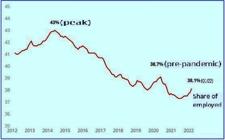
Moreover, according to Góes et al., (2022, p. 45), the number of people working for delivery apps in Brazil grew by 979.8% between 2016 and 2021. In the same period, the growth in the number of workers providing passenger transport services via private vehicles was 37%, as shown in Graphic 2. By April 2022, the authors point out, at least 1.4 million people will be transporting passengers via platforms as their main or complementary source of income.

It's important to note that the growth of the Gig Economy is linked to Brazil's high unemployment rate, with many Brazilians without formal employment. According to IBGE data, the unemployment rate will be 14.2% in 2020. Although it fell to 11.1% in 2022, this is still a high rate, especially considering that it represents 11.9 million unemployed people amid rising inflation. This puts basic necessities, such as food for personal consumption, at risk for this section of society.
According to an IBGE survey, "the number of employees without a formal contract in the private sector (12.8 million people) was the highest in the series". This contingent grew by 4.3% over the previous quarter and by 23.6% over the year. The number of self-employed (25.7 million people) remained stable compared to the previous quarter but increased by 6.4% over the year".
The difficulty of gaining access to formal jobs with a formal contract that guarantees legal labour rights has led many workers to turn to digital service platforms. In these relationships, there is no employment relationship, and, in most cases, the income is very low. In the Gig Economy universe, app drivers and taxi drivers had the highest average income in May 2022, according to IPEA data. Nevertheless, the figure of around 1,900 reais per month, as noted in Lameiras (2022, p. 3), is lower than the average recorded in the first quarter of 2016, which was 2,700 reais. This reduction is more worrying given the increase in the cost of living in recent years.
According to Góes et al. (2022), motorcycle delivery drivers will be paid an average of 1,500 reais per month by 2020, which is more than motorcycle taxi drivers, who will be paid around 900 reais. It is important to note that most of these professionals are black and brown men under the age of 50, as shown in Figure 4. This shows that the effects of unemployment and the expansion of on-demand work have deepened structural inequalities, such as those of race and class. The new forms of exploitation in this model are not limited to informality or the absence of rights. They also operate at a symbolic level, naturalizing social locations and reinforcing the roles assigned to certain bodies. As González (2020, pp. 153-154) points out, this process reflects "a more unconscious level that corresponds to the stereotyped roles and places assigned to a black man or woman".
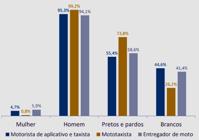
– Percentage of people in the Gig Economy in transport by gender and race/colour – by sub-group
In this case, the exceptions of workers who have risen despite the barriers imposed on them permeate Brazilian social thinking, as if it were equally possible for everyone to overcome the structural mishaps González (1984, p. 16) such as those recently observed through the new format of labour relations – not recognized as de facto relations.
In this way, as the Gig Economy consolidates itself as a precarious occupational alternative, legal questions about the real nature of these relationships are also growing. The model supported by the rhetoric of autonomy has been contested precisely because, under the discourse of flexibility, it hides labour relations that reproduce subordination, personalization and habituality, classic elements of the configuration of an employment relationship. The debate is therefore no longer merely technical but touches on the deeper contradictions of the contemporary labour market.
Structural inequality in the gig economy
Before moving on to the final considerations, it is necessary to make room for a critical reflection on a point that is often left out of the analysis of on-demand work. Although the discourse of platforms promises innovation, flexibility, and modernity, what we are witnessing is a repackaging of inequalities that Brazil has long known, now repaginated through the language of technology.
As Souza (2006, p. 92) notes, social divisions in Brazil are not limited to income. Above all, they are organized based on the opposition between body and mind: the former associated with manual labour, servitude and necessity, the latter with command, prestige, and the right to think. This logic works silently, but powerfully, by legitimizing certain types of work, such as that carried out by motorcycle couriers, delivery drivers and app drivers, which are socially accepted as naturally inferior and therefore poorly paid. Gonzalez (1984; 2020) draws attention to the way in which Brazilian structural racism constructs the image that there are places that belong to certain people. When this imaginary intersects with the algorithmic architecture of digital platforms, the result is an invisible but rigorous hierarchy that distributes risk, income, and recognition in a highly selective way.
This is not to deny that some workers benefit from flexibility. The suggestion is different: to look more closely at the fact that this freedom is often a response to a lack of alternatives. What we see in practice is a digitalized and, in many cases, more efficient version of inequalities that the country has never overcome.
Rather than breaking down historical structures of exclusion, the on-demand model of work reorganizes them. In this context, technology acts not as a tool for emancipation, but as a cog that disguises precariousness in the language of individual choice. We need to recognize that behind the rhetoric of innovation remains the age-old challenge of building working relationships that respect the dignity of all, not just those who can choose.
Concluding remarks
This article has attempted to analyze issues related to the new forms of work that have emerged with the advent of the Fourth Industrial Revolution, introducing the concepts of the Gig Economy and uberisation as new forms of work.
First, we understand that the concept of the Gig Economy encompasses aspects such as wage flexibility, autonomy in working hours, multiple forms of contracting and the possibility of providing labour services through digital platforms that are easily accessible virtually, as opposed to the suppression of workers' rights. Within the new forms of work, the terminology of the Uberisation of work refers to the growth of workers in transport apps, bringing a concept larger than the Uber company itself.
However, under the understanding that "every worker is a worker, but not every worker is a worker" (Vilhena, 2005, p. 30), we conclude that not every working relationship legally constitutes an employment relationship, as in the case of the Gig Economy, making the lack of rights and guarantees of the worker, known as a nano-entrepreneur, even clearer.
In this sense, the legislative and judicial institutions have debated the employment relationships that result from this contractual model. However, there is still a long way to go to guarantee labour justice for these workers.
It is also extremely important to legislate on the rights and obligations of these companies regarding the personal data of clients and servers, to guarantee the right to privacy and not to allow the subjectivity of the worker to be captured.
Even in the context of the expansion of the Uberisation of work in Brazil, the gap in rights has a brutal impact on the lives of the workers involved in this economic format. Most of them are black or brown men, revealing the racist nature of the Gig Economy, which has led to job insecurity and a lack of support for workers who depend on this income to survive in a country facing economic crisis, inflation, and unemployment. In this sense, technology does not bring effective autonomy to the worker, but rather an illusion of the entrepreneur, which is a throwback to a feudal era. But now the Master of Technology are the guardians of our data.
Data control is intrinsically linked to the concepts of the Gig Economy and uberisation, presenting us with a new era of capitalism, the so-called 'surveillance capitalism', a term coined by Zuboff (2021). We can see that capitalism has found in data control a new way to maintain economic growth and vitality in the face of a sluggish production sector (Srnicek, 2017, p, p. 57).
Technological advances have enabled large companies to stop collecting only objective data about their users. Today, these organizations have access to subjective aspects such as preferences, behavioral patterns, and emotions, turning all this into an asset that is traded across platforms and used to shape choices and decisions (Zuboff, 2021). Beyond the market, this process reconfigures power relations, creating a form of surveillance reminiscent of Foucault's panopticon (2002, p. 172), now adapted to digital and corporate environments.
In this context, the so-called 4.0 revolution, while representing technological innovation and productivity gains, also reveals old control mechanisms in new guises. The working day, once limited by time and physical space, is becoming diffuse and constant. The right to privacy is gradually being eroded and the boundary between the public and the personal is dissolving, making not only work but existence itself more precarious.
Finally, this work is relevant because it highlights the need for an in-depth debate on the impact of new technologies on organizations, as well as the need for effective legislation to protect workers.
References
- ALOISI, A. (2016). Commoditized crowdworkers: labour law issues in a case study research on a set of on-demand/gig economy platforms. Comparative Labor Law & Policy Journal, v. 37, n. 3, pp. 653-690.
-
ALVARENGA, D.; CAVALLINI, M. (2022). Brasil perde 2,8 milhões de trabalhadores com carteira em 8 anos. G1, 18 maio. Disponível em: https://g1.globo.com/economia/noticia/2022/05/18/brasil-perde-28-milhoes-de-trabalhadores-com-carteira-em-8-anos-informalidade-e-conta-propria-crescem.ghtml Acesso em: 6 abr 2025.
» https://g1.globo.com/economia/noticia/2022/05/18/brasil-perde-28-milhoes-de-trabalhadores-com-carteira-em-8-anos-informalidade-e-conta-propria-crescem.ghtml - ANDRÉ, R. G.; SILVA, R. O.; NASCIMENTO, R. P. (2019). "Precário não é, mas eu acho que é escravo". RECADM, v. 18, n. 1, pp. 7-34.
-
BRASIL. (1943). Decreto-Lei n. 5.452, de 1º de maio. CLT. Disponível em: http://www.planalto.gov.br/ccivil_03/decreto-lei/del5452.htm Acesso em: 6 abr 2025.
» http://www.planalto.gov.br/ccivil_03/decreto-lei/del5452.htm -
BRASIL. (1988). Constituição da República Federativa do Brasil de 1988. Disponível em: http://www.planalto.gov.br/ccivil_03/constituicao/constituicao.htm Acesso em: 6 abr 2025.
» http://www.planalto.gov.br/ccivil_03/constituicao/constituicao.htm -
BRASIL. (2017). Lei n. 13.467, de 13 de julho. Disponível em: http://www.planalto.gov.br/ccivil_03/_ato2015-2018/2017/lei/l13467.htm Acesso em: 6 abr 2025.
» http://www.planalto.gov.br/ccivil_03/_ato2015-2018/2017/lei/l13467.htm -
BRASIL. (2018). Lei n. 13.640, de 26 de março. Disponível em: http://www.planalto.gov.br/ccivil_03/_ato2015-2018/2018/lei/l13640.htm Acesso em: 6 abr 2025.
» http://www.planalto.gov.br/ccivil_03/_ato2015-2018/2018/lei/l13640.htm -
BUTCHER, I. (2020). Califórnia vota se motorista é empregado ou não. Mobile Time, 3 nov. Disponível em: https://www.mobiletime.com.br/noticias/03/11/2020/california-proposition-22 Acesso em: 27 abr 2022.
» https://www.mobiletime.com.br/noticias/03/11/2020/california-proposition-22 -
CÂMARA DOS DEPUTADOS (2020). Projeto de Lei n. 3.748. Disponível em: https://www.camara.leg.br/proposicoesWeb/fichadetramitacao?idProposicao=2257468 Acesso em: 6 abr 2025.
» https://www.camara.leg.br/proposicoesWeb/fichadetramitacao?idProposicao=2257468 -
CARDOSO, D. H. (2022). Motoristas e entregadores crescem quase 1.000% em 5 anos. Correio Braziliense, 24 abr. Disponível em: https://www.correiobraziliense.com.br/economia/2022/04/5002752-motoristas-e-entregadores-por-aplicativo-crescem-quase-1-000-em-5-anos.html Acesso em: 5 ago 2022.
» https://www.correiobraziliense.com.br/economia/2022/04/5002752-motoristas-e-entregadores-por-aplicativo-crescem-quase-1-000-em-5-anos.html - CARELLI, R. de L. (2014). Terceirização como intermediação de mão de obra São Paulo, Papyrus.
-
DE STEFANO, V. (2015). The rise of the "just-in-time workforce".... C omparative Labor Law & Policy Journal, v. 37, n. 3, pp. 471-504. Disponível em: https://papers.ssrn.com/sol3/papers.cfm?abstract_id=2682602 Acesso em: 6 abr 2025.
» https://papers.ssrn.com/sol3/papers.cfm?abstract_id=2682602 -
DUBAL, V. B. (2021). A Proposition 22 como nova regra salarial racial. Revista Rosa, n. 4. Disponível em: https://revistarosa.com/4/proposition-22 Acesso em: 4 ago 2022.
» https://revistarosa.com/4/proposition-22 -
EXAME (2022). Apps como Uber e iFood se tornam "maior empregador" do Brasil. Exame, 28 abr. Disponível em: https://exame.com/economia/apps-como-uber-e-ifood-sao-fonte-de-renda-de-quase-4-milhoes-de-pessoas/ Acesso em: 5 ago 2022.
» https://exame.com/economia/apps-como-uber-e-ifood-sao-fonte-de-renda-de-quase-4-milhoes-de-pessoas/ - FOUCAULT, M. (2002). Vigiar e punir: nascimento da prisão Petrópolis, Vozes.
- GÓES, G. et al. (2022). Painel da Gig Economy no setor de transportes do Brasil. Carta de Conjuntura - Ipea, n. 55.
- GONZÁLEZ, L. (1984). Racismo e sexismo na cultura brasileira. Ciências Sociais Hoje, p. 223-244. São Paulo, Anpocs/Cortez.
- GONZÁLEZ, L. (2020). Por um feminismo afro-latino-americano Rio de Janeiro, Zahar.
- KOERNER, A. (2021). Capitalismo e vigilância digital. Rev. Bras. de Ciências Sociais, v. 36, n. 105.
- LAMEIRAS, M. A. P. (2022). Indicadores mensais do mercado de trabalho - jun. 2022. Carta de Conjuntura - Ipea, n. 56.
- LISBOA, A. L. C. (2021). Gig economy e as (re)configurações de trabalho. Revista Manus Iuris, v. 2, n. 1.
- LISBOA, R. S. (2006). Direito na sociedade da informação. Revista dos Tribunais, v. 95, n. 847.
- LOUREIRO, U. P.; FONSECA, B. G. B. da (2020). Crowdwork e o trabalho on demand.... Argumenta Journal Law, n. 32, pp. 175-190.
-
MACIEL, M. (2019). Bikes "laranjinhas" passam a ser usadas por entregadores. O Globo, 3 nov. Disponível em: https://oglobo.globo.com/rio/bikes-laranjinhas-passam-ser-usadas-por-entregadores-ate-agentes-do-seguranca-presente-23614077 Acesso em: 10 mar 2023.
» https://oglobo.globo.com/rio/bikes-laranjinhas-passam-ser-usadas-por-entregadores-ate-agentes-do-seguranca-presente-23614077 - MARX, K. (2013). O capital: crítica da economia política - Livro I São Paulo, Boitempo.
- MERGULHÃO, A.; ASSAD, P. (2022). 'Misto de indignação...'. O Globo, 10 ago.
- NANTAL, C. P. (2018). O direito do trabalho no contexto da gig economy. Monografia. Porto Alegre, Universidade Federal do Rio Grande do Sul.
- OLIVEIRA, F. (2021). A atividade legislativa sobre gig economy. Revista Espaço Acadêmico, v. 20.
- POTER, G. B.; SOUTO, C. (2019). Capitalismo de vigilância. Seminário de Tecnologia, Gestão e Educação, v. 1, n. 2.
- PRASSL, J. (2018). Humans as a service Oxford, Oxford University Press.
- RAUBER, A. O. et al. (2022). Proposição de uma agenda de pesquisa sobre uberização. Revista Gestão e Planejamento, v. 23.
- ROSEN, C. (2004). The age of egocasting. The New Atlantis, n. 7.
- SANTOS, M. (2009). Por uma outra globalização Rio de Janeiro, Record.
-
SENADO (2017). Projeto de Lei da Câmara n. 28, de 2017. Disponível em: https://www25.senado.leg.br/web/atividade/materias/-/materia/128659 Acesso em: 6 abr 2025.
» https://www25.senado.leg.br/web/atividade/materias/-/materia/128659 - SILVA, P. P. B.; CHAVES, A. B. P. (2021). O trabalhador no capitalismo de plataforma. International Journal of Development Research, v. 11, n. 3.
- SOUZA, J. (2006). Para compreender a desigualdade brasileira. Teoria e Cultura, v. 1, n. 2.
- SRNICEK, N. (2017). Platform capitalism Cambridge, Polity Press.
- STANDING, G. (2013). O precariado: a nova classe perigosa. Belo Horizonte, Autêntica.
- THE CIRCLE. (2017). Direção: James Ponsoldt. Produção: Anthony Bregman; Gary Goetzman. Roteiro: James Ponsoldt; Dave Eggers. Elenco: Emma Watson, Tom Hanks, John Boyega. Estados Unidos, STXfilms.
- VILHENA, D. (2005). Direito do trabalho São Paulo, Atlas.
- WOODCOCK, J.; GRAHAM, M. (2020). The gig economy: a critical introduction Cambridge, Polity Press.
- ZUBOFF, S. (2021). A era do capitalismo de vigilância Rio de Janeiro, Intrínseca.

 Source: own elaboration.
 Source:
  Source:
  Source: Ipea (2022).