
 Crossing borders: uberization and logistics in the periphery of capitalism
Abstract
This article discusses urban implications of the platformization of work through direct observation of the daily work routine and political action of app-based delivery drivers in the São Paulo macro metropolis. By relating the phenomenon to the production restructuring of capitalism and financialization, it seeks to discuss new forms of informality and precarious work that are intertwined with contemporary urban dynamics and new technologies. The article shows that the connection between urban circulation spaces, logistical infrastructures, and digital platforms reorganizes the city and intensifies control over the flow of goods and bodies, transforming the relationship between the urban dimension and political subjects by multiplying the conflict and negotiation borders between the physical reality of the city and the cloud.
Keywords
logistics; uberization; urban informality; platformization; financialization
Resumo
Este artigo investiga as implicações urbanas da plataformização do trabalho, a partir da observação direta do cotidiano laboral e da atuação política de entregadores de aplicativo na macrometrópole paulistana. Ao relacionar o fenômeno com a reestruturação produtiva do capitalismo e a financeirização, busca-se discutir novas maneiras da informalidade e do trabalho precarizado, que se entrelaçam às dinâmicas urbanas contemporâneas e às novas tecnologias. Evidencia-se que a conexão entre espaços urbanos de circulação, infraestruturas logísticas e plataformas digitais reorganizam a cidade e intensificam o controle sobre os fluxos de mercadorias e corpos, transformando as relações entre o urbano e os sujeitos políticos por meio da multiplicação de fronteiras de conflito e negociação entre a concretude da cidade e a nuvem.
Palavras-chave
logística; uberização; informalidade urbana; plataformização; financeirização
Introduction
In the context of the coronavirus pandemic in 2020, the activity of app-based delivery workers gained considerable media attention. On the one hand, delivery services became extremely important for the middle and upper classes who were confined due to social isolation. On the other hand, amid the health emergency and the ensuing social crisis, working conditions were becoming increasingly unsatisfactory: in the midst of the pandemic, the number of people willing to risk their lives working for the apps was growing, which took advantage of the huge availability of "delivery partners" to reduce payments and profit from the emergency situation. In this scenario, demonstrations, stoppages and strikes by app delivery workers exploded and proliferated, revealing the contradictions inherent in the "platformized" way of working. It was then possible to directly observe and follow the proliferation of tactics of revolt that seemed to speak the language of flexible work and had a more direct impact on the logistics chain of accumulation of the app platforms: the "breques" – a kind of inverted picket line to prevent goods from leaving the collection points and entering circulation – spread to shopping malls, dark kitchens and dark stores between 2020 and 2022.
The direct observation we carried out was not originally structured methodologically based on previous theoretical research, nor was it conducted in the form of systematic ethnographic incursions. It was an experience that initially took place outside the academic sphere, as a result of following strikes and walkouts, as well as dialogues with app delivery workers with whom we established contact and trust, mainly during 2020, 2021 and early 2022. It was only at a later stage, based on questions raised by this experience, that theoretical discussions were developed and a research project was structured that was interested in the relationship between direct observation – which was systematized based on the theoretical questions we will present in this article - and new urban dynamics.
In this journey between the theoretical discussion on contemporary urban transformations and the political experience of participants, the relationship between work for applications, revolts and the city has not gone unnoticed, insofar as its realization is only possible through the ability of workers to constantly move through very different urban logics, in heterogeneous territories. It is based on issues such as these that this article seeks to outline an understanding of the new urban dynamics that are being shaped in conjunction with the processes of platformization and are found, on the periphery of capitalism, with trajectories of informality that have historically marked peripheral urban expedients and which are now being transformed, adapting and supporting the current phase of predominance of financial capital, in its urban face.
Among the results presented here, we can see that the dialectical combination of homogenizing and heterogeneous logics reveals an urban space capable of articulating multiple scales – local and global, formal and informal, virtual and concrete – diluting the binarisms of the segregated city of the industrial era. Despite the glittering urban skyline of the financial era, this trans-scalar articulation is only achieved through the performance of precarious work that ties these scales together, but remains invisible at the "back doors" of the global metropolis. The moments of revolt of these new workers, however, have the potential to open up this contradiction and reveal that the conjugation of apparently distinct universes implies a production of urban space that takes place through the incessant proliferation of frontiers of conflict and mediation. The world of flexible capital requires scales, registers and realities to be connected in an extremely controlled and calculated way – always for the benefit of capital – so that a system based on dispersion can function in an unitary way. In this sense, this article seeks to investigate "borders of tension" (Feltran, 2011), in the sense of the demarcation, division and regulation of flows that is established "precisely to regulate the channels of contact that exist between social groups, separated by them, but which necessarily relate to each other" (ibid. p. 15).
In this article, we will briefly contextualize the transformations in global capitalism that have enabled the emergence of platform companies in order to then discuss logistics as a spatialized arm of the process of financialization of capital and thus look at platformization as a form of production of urban space that multiplies the shaping of borders in many ways - which, in the struggles of app delivery workers, proved to be a major challenge to be faced.
The structure of the article differs to some extent from that of the research. While the research was based on direct experiences with app delivery workers, this article begins with a theoretical and bibliographical review that helped us read the elements observed in the urban dynamics of these new workers and then presents the concrete dimension observed in a systematized way. This concreteness emerges, starting with the item "New urban frontiers, new political subjects", in the form of small descriptive scenes that are then analyzed. This inverse movement in the organization of the text proposes a re-examination of previous concrete experiences in the light of the theoretical reflection developed.
Platformization of work
According to Harvey (1989), the productive restructuring of capital can be understood from the emergence of a regime of flexible accumulation of capital, in the face of the exhaustion of the modern industrialization project – manifested in the global crisis of 1973. This process has resulted in the progressive concentration of power in the financial sphere and, for the urban sphere, in a geographical flexibilization that has both caused production to be dispersed throughout the urban fabric and shuffled boundaries that were previously very demarcated between center and periphery (Telles, 2006a, 2006b). The process of productive restructuring that began in the 1970s continues to develop, and the arrival of digital platforms, apps and smartphones now gives it new layers of complexity – radically altering working relationships and making the trends observed at the start of the process more acute.
These processes of transformation of the economy and work cannot be understood without looking at the technological development that has accompanied them. A product of the so-called Technological Revolution, the generalization of cell phones in the early 2000s is paradigmatic of a trend towards the total elimination of the porosity of work in this new era. Embodying the hybridity between production and social reproduction – being simultaneously a means of communication, leisure and work – mobile phones make it possible for work to take place at any time and place, invading any free or rest time. In the case of motorcycle courier service – the precursor to app-based delivery – the arrival of cell phones both increased the control of work and accelerated its pace, as made it possible for companies to communicate with motoboys1 in real time and made the distribution of deliveries more efficient, so that they could be carried out in less time (Abílio, 2015), "reducing 'the pores of non- -work throughout their journey' and making the service cheaper for contractors" (um grupo de militantes na neblina, 2022, p. 44).
The advent and popularization of cell phones with GPS and smartphones at the end of the 2000s decade could further accentuate this process. The appearance of these new functionalities, it is important to note, is part of a qualitative change in social relations linked with the process of financialization of capital. What Harvey had predicted back in 1989 has taken on new dimensions and, with smartphones, it is possible to speak of a "hijacking of private time by production" (Oliveira apud Viana, 2013, translated by the authors), where "everyone must be ready for the eventualities that are the rule" (Viana, 2013, p, p. 53, translated by the authors).
It was in this context that digital platforms appeared and spread, advertising a "new business model" that was able to centralize and manage the interactions of crowds dispersed in space. Taking the form of marketplaces, service apps, streaming and subscription platforms or peer-to-peer platforms, new companies such as Airbnb, Uber, Netflix, iFood, Rappi, Taskrabbit or Quinto Andar sprang up throughout the 2010s – in Brazil and around the world.
In the center of capitalism, many of these platforms promised to connect possible community relationships that remained unrealized due to their dispersion in space. Ride-hailing apps, tool lending or the exchange of favours between neighbors were committed, in their discourse, to using technological development to mobilize collective efforts. However, by observing what he calls the "sharing economy" and looking at its main representatives, Slee (2019) denounces what he identifies as a plunge of this new business model into venture capital circuits, which would distance itself from an initial promise of strengthening exchanges not mediated by money, favoring the already large corporations. It is in the peripheries of capitalism, however, that the phenomenon of platformization shows us "what it came for" – giving a new character to our already well-known world of "shapeless work" (Oliveira, 2003) which, taking on such a platformized form, is now subsumed in a real way by capital (Abílio, 2017), in its financial phase.
The emergence of platforms, more than simple technological development, gave the capital an important way out of the limits found in companies where control and management of work was still done by humans, involving personal relationships. In the case of motorcycle courier, this can be seen clearly: even though in the old model of outsourced companies – the so-called "Express", which emerged in the 1980s (Silva, 2009) – there was a central office that could monitor motoboys on the street via cell phones, this monitoring could not be done in real time and constantly, which limited the number of motoboys the company could hire – precisely because it was carried out by people. Delivery apps made constant and real-time control possible via GPS and were able to replace these outsourced companies, which were often family-run and had a local reach in the city. This made it possible to concentrate and control motoboys more precisely and efficiently, while increasing the available workforce from dozens or hundreds to tens of thousands. Furthermore, the motoboys’ work itself became much more dispersed in space and began to be carried out just-in-time, under the immediacy of demands. The limits to the growth of companies could then be extrapolated and motorcycle courier services began to be run by large corporations, mostly linked to international capital.
On companies’ side, the transformation of social relations into the "new business model" has launched startups into venture capital circuits (Slee, 2019). On the other hand, from the point of view of work, this transformation has also reconfigured its dynamics, in a process that has been called "uberization". Antunes (2020) understands it as "a process in which labour relations are increasingly individualized and made invisible, thus taking on the appearance of 'service provision' and obliterating wage-earning relations and the exploitation of labour" p. 11, translated by the authors).
Abílio (2017) goes further, understanding uberization as the "real subsumption of viração",2 which means the seizure and control by the capital, in a phase of advancing forms of gain through relative surplus value and high turnover of capital - in the form of platformized companies - of informal jobs, gigs, “odd jobs” and other varied means with which a large part of the population, previously by itself, managed to survive. The author, characterizing the relationship between the gig economy - or sharing economy - and "viração", understands the former as the "international and globalized name" of the latter, characterizing a market driven by unstable trajectories of "paid services that barely have the form of labour, which rely on the engagement of the worker-user, with their own management and definition of personal strategies" (ibid., translated by the authors).
As such, activities linked to the sphere of social reproduction – historically associated with ways of surviving and supplementing income - could be managed by large companies through the platforms, further blurring the distinctions between free time and working time – to the extent that the worker, just-in-time, has to be constantly available to carry out "jobs" or “undertakings” that can reach them at any time through the apps (Abílio, 2020). More than ever, the workers themselves that manage the costs and risks of capital realization, and yet control over this process remains even more in the hands of the capital: with high technological refinement and the use of artificial intelligence, platforms can manage and control work with extreme precision – without bearing the burdens that formal wage relationships entail – and are able, at the same time, to connect this localized work to the flows of global financial capital.
In the midst of widespread unemployment, apps have come to offer a path, at first glance interesting, for those who find themselves without alternatives for earning an income. The possibility of working according to one's own schedule and not answering to bosses and superiors appears to be a real advantage for many who no longer see any horizons or possibilities for improving their lives in formal employment - and the fact that, in the first years that platforms installed themselves in the country, more than a few managed to increase their monthly income considerably, helps to demonstrate that the illusion produced by the "entrepreneurs of themselves" (Dardot, Laval, 2016) is not without concrete and real foundations, however illusory.
Logistics: the urban in the financial age
It is possible to see that the process of platformization radicalizes the tendencies of flexible accumulation observed by Harvey in the 1980s, redesigning the world under current financial predominance. We therefore understand that, beyond the space of fixed capital on the conveyor belt of commodity production, it is now necessary to look at the techniques of circulation – which can even blur the world of production and that of social reproduction. In this sense, it is necessary to look at logistics and its current forms of rearticulating work, the urban and struggles.
Expression of military thinking that emerged in the 18th century, logistics began to affect territories, transforming "the totality of space into logistical territory" (Cordeiro, 2022, p. 16, translated by the authors) and setting "in motion a complex system of vectors of production, transportation and destruction" (Ibid., p. 18, translated by the authors). This process would entail the "logistical homogenization of the planet, fully transparent to the gaze of the sights and traversable by the vectors of destruction" (ibid., p. 20, translated by the authors).
After being established as a military discipline after the Great Wars, logistics became a civilian discipline from the 1950s onwards, as a way of organizing social relations as a whole. After the 1970s, while the process of productive restructuring made it possible for financial and flexible capital to take the reins of accumulation, the “logistical revolution” (Peregalli, 2022) took place, reorganizing space and production in such a way as to provide the material base and physical infrastructure necessary for capital to make its leap into financial virtuality (ibid.).
A first sense of the so-called "logistical revolution" (ibidem) would have been the emergence of a capitalist sector that functions as an infrastructure for the circulation of capital – which gains importance in the midst of restructuring – moving from the strictly military sphere to the very interior of the capitalist "economic sciences". The spatial reorganization of capitalist production (Harvey, 1989) therefore relied on the development of a whole set of technical procedures and infrastructures that enabled the "science of managing the mobility of people and things to achieve economic, communication, and transport efficiencies" (Neilson, 2012, p, p. 323) to take on a global scale. This reorganization, based on the displacement of production in a system of "networks deeply connected to each other along supply chains on a global scale" (ibid., 2022, translated by the authors), has made overcoming spatial obstacles to the circulation of capital even more important, mobilizing physical and digital infrastructures as the objective supports which, organized by logistical rationality, make it possible to decentralize the production, circulation and consumption of goods and information (ibid.). Specifically, this produces new metropolitan contexts, global supply chains, platforms for micro-local trade and transport, and territorial or work reconfigurations associated with infrastructure projects – "heavy" or "light" (ibid.).
The logistical revolution, therefore, has reorganized urban space so that the points in space where raw materials are extracted, goods are produced and consumption takes place are fragmented and spread across the globe, concomitantly with an effort to reduce the connection time between them as much as possible. In this process, cities themselves are emerging as major logistical infrastructures that must serve the passage of global flows, linking different modes, scales (global and local) and registers (material and virtual). In order to do this as quickly and as frictionlessly as possible, the entire urban structure is organized based on a "logic of unimpeded circulation, leaving the possibility of indefinite expansion" (Cuppini, 2018, translated by the authors). In this sense, the movement of urbanization would take place on a planetary scale from urban fabrics that connect, through these infrastructures, "the large metropolitan centers with the places where raw materials are extracted, the continental and oceanic transport routes with the dust cloud of diffuse urbanization that, seen at night from satellites, makes ever larger areas of the earth's surface glow with artificial light" (ibid., translated by the authors).
Mezzadra and Neilson (2013) also move in this direction by focusing their analysis of the logic of contemporary capitalism on examining the intersection between finance, extraction and logistics. The authors place logistics as the science responsible for materially organizing financialization, through both the installation of a network of infrastructure spread across the world and the exploitation of various forms of work that produce "various degrees of lubrication and friction to capitalism’s smooth functioning " (ibid., p. 14). In this sense, by also placing work as an important element of analysis – observing its precariousness and indebtedness as necessary forms of spoliation - the authors draw attention to the "variegated" character that work assumes in globalization: running parallel to its intensification, forms of exploitation proliferate beyond the legal, social and power contours of wage-earning (ibid., p. 13) – and which, in turn, also produce heterogeneous territories. Understanding that, in contemporary capitalism, the possibilities of valorization are deeply linked to this multiplicity of heterogeneous forms of work – the link between which resides precisely on logistical infrastructures – seems of great importance and leads us to Tsing's argument about the permanent tension between heterogeneity and global integration.
When the American author describes "supply chain capitalism" (Tsing, 2009), she notes that if, on the one hand, the expansion of market chains is based on global integration mechanisms – which have a tendency to homogenize concrete and virtual communication and circulation infrastructures – on the other hand, it is the formation and exploitation of differentiated and fragmented niches that makes this expansion possible – with the opposite tendency of production and reproduction in the heterogeneity of production chains. If this tension is not something new, we repeat, it is the constant articulation between these two spheres – a qualitative leap made by the technological development we are witnessing – that seems to be the critical point of these supply chains. Isn't this, to some extent, what the "real subsumption of viração" (Abílio, 2017) that we observe in uberization is all about? When an application platform manages and controls odd jobs, gigs and informal jobs, capturing income flows for international chains of accumulation, isn't it performing precisely the logistical task of integrating globalization and heterogeneity?
The perception of this tension is in line with Lencioni's research into the phenomenon of metropolization, which characterizes contemporary urbanization (Lencioni, 2015). For the author, we are facing the constitution of a new urban form, consistent with the spatial needs of financial capital. Dilated, diffuse and dispersed, the urban space would extrapolate the city itself, reaching all spaces, but without constituting a form: "Like a nebula, the urban phenomenon is frayed, broken, with porosities and discontinuities in the face of a framework of permanent volatility" (ibid., p. 9, translated by the authors). Amid fragmentation, integration operations – through flows, movements, connections – become more important, as they are responsible for guaranteeing the system's unity and, thus, logistical activity becomes a structuring factor of the urban system.
Planning with logistics
Thus, by leaving the military sphere, the technique of organizing flows not only enters the economic sciences and management, but can become a new discipline of spatial planning – or at least that's what Clare Lyster's apologetic lessons suggest. For the American architect, logistics paves the way for cities to be understood in a "fluid" condition, as operational systems and procedural flows (Lyster, 2016). While the power of geography itself as an urbanizing agent is apparently losing ground to communication flows – whether these are material flows such as transport networks, or immaterial ones such as internet networks – it is the places around these infrastructure networks that can emerge as major urban catalysts, such as airports, distribution centers, data centers or logistics warehouses. What's more, the very functioning of cities could resemble the operations of companies like FeDex or Amazon. Hybrid systems of centralized and decentralized coordination or systems of precision design and flexibility, simultaneous programs in shared locations, the reduction of commuting time, or a kind of on- -demand urbanism are some of the possibilities the author suggests to guide urban design: "(...) But how do you characterize On-Demand Urbanism? Is it a physical place? Is it a website? Is it an information portal? Is it a cultural space? Is it an infrastructural system? The answer is that it’s all of these (...)" (ibid., p. 120).
In this sense, the physical fabric of the city would be organized according to logistical platforms that come to constitute the dominant public sphere of the present (ibid.). In Lyster's optimistic view, the homogenizing integration of information, technology and physical space could reveal architecture's link with external forces and part of a systemic network of flows, where the automation of processes through logistics could both free up urban design for programmatic diversity and free people from painful work processes to the point of extinguishing them altogether (ibid., p. 142). However, when homogenized as a "transfer space" for logistical flows and entirely crossed by "teleoperations", the urban becomes organized not in a creative and diverse way as the author supposes, but around the multiplication of "fortified enclaves" (Caldeira, 2011), strategic nodes for circulation, highly controlled, policed and connected by a network of circulation structures, physical or virtual (Cordeiro, 2022, p, p. 37). In this sense, the realization of such a "planetary urbanization" linking a "logistified, fluid, malleable and interwoven" urban fabric (Cuppini, 2018), would be hiding – under the apparent magic surrounding fast and frictionless circulation – not the extinction, but the intensification of precarious and painful work arrangements. Logistical urban planning would then be part of an infrastructure that would both enable globalization and productive restructuring, as well as organize the capture and direction of spoliation flows that, in the end, would be at the heart of the free circulation of financial flows.
If logistics turns out to be an eminently urban technique - which guides the production of cities and their surroundings in order to make circulation efficient and controlled - we can understand that it takes on a total aspect and, at the same time, articulates diverse arrangements. Could it be that there is a combination of increasingly standardized and homogeneous means of circulation with heterogeneous aspects – including spatial ones –mobilized to create diversified niches for exploitation?
In the city: the reverse of mirrors
Among these increasingly standardized means of circulation, the virtual space of the "cloud" emerges as yet another homogenizing technology – just like the space of the global city, with its homogenizing aesthetics and urban quality – which allows for efficient remote control of a whole dispersed reality that is part of the sphere of capital circulation and needs to conform to its logic. We intend to emphasize that the homogeneous characteristic of urban space worldwide is linked less to flashy development than to the incorporation of precarious and violent means of survival - which are multiple and varied – into the production process, the mixture of precariousness and luxury. Would the "subsumption of viração" (Abílio, 2017) be the totality that ties the whole process together?
While homogeneity in the midst of the heterogeneous seems to be the “subsumption of viração” itself, it is also possible to notice a diversity of ways in which it materializes itself. By revealing the homogeneous, we can see the unity of the contemporary urban system. However, we should now make the opposite effort: to see the heterogeneity in what seems to be identical in every corner of the world. Tsing's (2009) work draws attention to how heterogeneity plays an important role in the processes of capital globalization. The term "supply chain capitalism" – referring to "commodity chains based on subcontracting, outsourcing, and allied arrangements in which the autonomy of component enterprises is legally established even as the enterprises are disciplined within the chain as a whole" (ibid., p. 148) – is central to Tsing's definition of the dynamics of flexible and global capital, as it underlines the possibility of market chains expanding globally through the mobilization of fragmented but linked economic niches (ibid.).
Global market chains are not something new in the functioning of capitalism, but they seem to be undergoing a qualitative transformation to the extent that, while new technologies make it easier for communication and transport to gain speed, new financial agreements regulate the circulation of money around the globe, so that these chains start responding to return expectations from stokholders. In this sense, the flexible form of capital allows it to land on diverse economic territories and to appropriate social and labor forms that are often perceived as "non- -capitalist", when it seems profitable. The global expansion of supply chains is based on both global integration and the exploitation and formation of heterogeneous niches. "Capitalism here incorporates contingencies without forming a single, homogenous structure; indeed, that is the genius of its spread." (ibid., p. 152). Thus, contemporary capitalism would maintain constant relations with contingency, experimentation, negotiation and unstable agreements in these diverse territories and niches – where "gray zones" of legality are often formed in the midst of flows of opportunity – a vocabulary that Roy (2017) uses to describe "intermediate spaces" that highlight the sovereign flexibility of spaces of exception and that remain constantly managed and tolerated, but always remaining as possible threats to the order.
The greatness of contemporary capitalism needs to be thought of considering simultaneously global integration and the heterogeneity of local scales (Tsing, 2009, p. 150). In fact, this tension is also pointed out in Harvey's analysis of the extraction of monopoly rents, based on local specific features, without, however, renouncing a process of homogenization that would make it possible for these same specific features to be negotiable and interchangeable around the world.
Thus, the illusion of the homogeneity of the global city is dispelled when we take a closer look at the different places in the city where we were able to follow the mobilizations of the app delivery workers. We were able to observe that there are specific places that are spreading throughout the city in tandem with the expansion of delivery platforms. The precariousness of the work inside and outside these establishments is evident both in the uncomfortable and improvised waiting spaces outside shopping malls and centers, and in the spaces institutionalized by establishments for the collection of orders – where private security guards hired to discipline and monitor the work remain discreetly. This close observation is mainly aimed at the social relations mobilized by these spaces, in their concrete form. These relations make it possible to comprehend local specificities, however composed with the comprehension of the whole that encompasses them.
In the case of the object studied here, it can be seen, for example, that the “docks” of shopping centers located in central regions are not the same as those located in peripheral areas. In the former, where the price of land is higher and the dispute over it fiercer, delivery workers seem to be more atomized, since the large number of orders concentrates and brings together, at a frenetic pace, workers dispersed in space. On the other hand, in peripheral regions, it still seems possible to create a community dimension: where demand is lower and deliveries are made within small neighborhoods, it is more common for the same group of workers to end up waiting together at mall docks or street parking lots, which makes it possible for them to know each other and create bonds. In this sense, the spaces themselves also differ: it's no wonder that platform hubs are preferably located in luxury shopping malls or that docks are institutionalized with hired guards and security guards. Street parking lots and other informal waiting areas, on the other hand, are more common in less central establishments.
In the same way, the division of the different categories of work in the app also takes into account local elements of the urban space: it is notable that in the central regions of São Paulo there is a greater presence of Logistical Operators,3 because, to the extent that these regions seem to be of greater financial importance to the apps, control over them must be more precise, taking into account the sensitivity of human control. On the other hand, apps in medium-sized cities also have many Logistical Operators, but for other reasons: by appropriating the community relations that already exist in these smaller cities, it is possible to direct group relations and bonds towards a kind of cooperation for work, when the available workforce is uncertain.
Other spaces worthy of attention are dark kitchens and dark stores. The profile of these two new places seems to be the same: they are rental ventures for the logistics of digitally-mediated commerce. Dark kitchens are "commercial kitchens in strategic locations, combining operational ease and cutting-edge technology"4 in which restaurants rent a space in one of these kitchens from another company exclusively to take delivery orders – almost always from apps. Dark stores, similarly, are warehouses that function as distribution centers on a local scale, where orders placed online or via apps can be picked up. In the words of a Santander Bank's business management page, an enterprise like this "functions as a supply establishment, commonly installed in large urban centers, with a focus on the easy distribution of purchases made online".5
If dark kitchens and stores appear to be the most advanced connection between the circulation of capital in the digital environment and the sphere of concrete production and distribution of goods, they nevertheless have hidden faces. In addition to the obscurity of the rent regulations and the form of ownership of these "ghost businesses" – a hybrid situation that combines with the equally hybrid way of managing work and the sphere of indistinction between production and reproduction in which it is found in financial capitalism – the uncharacteristic façades that are indistinguishable from the surrounding buildings are home to the daily suffering of those who work inside them.6 It is no wonder, then, that despite being very close to the big cities, these establishments are not located on the busiest streets full of expensive stores and restaurants, nor do they have the luxurious appearance of shopping malls. Camouflaged in streets with less traffic, blending in with their generic surroundings, they materialize the meeting of the “viração” with the high-tech financial world.
Behind the camouflage of the opaque and closed form of these spaces – very different from the transparency of the glass curtains that veil the corporate buildings of the global typology – violence and the dirty world of work are nevertheless revealed. While glass buildings appear as a symbol and materialization of financial capital, but hide work (Guerreiro, 2010), the opposite seems to be true in these "ghost buildings". The masonry walls, the low stature, the small openings, the colorful signs, the somewhat abandoned appearance: none of this seems to tell the story of cutting-edge technology companies that constantly move large flows of venture capital. In this game between what is hidden and what is revealed, exploitation takes on a cynical form. It reveals violence and contradiction, while at the same time adhering to and reinforcing them. It is in this sense that dark kitchens and dark stores can call themselves dark, displaying their shady side like a trophy.
The presence of obscure establishments such as dark kitchens in the heart of the urban fabric corroborates Telles' (2006a) perception of the intersection of the transits of wealth and poverty in the global city. However, the way in which these universes meet cannot be free: the connection between these conflicting transits must be controlled and calculated so that, along with their proliferation, the borders that mark out the intertwining between these worlds also multiply. No wonder that border places and back doors are not easily noticed, disappearing from the image that the city makes of itself: from the outsourced motorcycle courier companies to the ghost establishments that proliferate in the edge areas, the hidden face of the financialized city is overshadowed by the shine of the glass façades of the gigantic mirrored buildings that appear on the city’s postcards.
New urban borders, new political subjects
We are therefore seeing that contemporary urban space seems to be shaped by the constant presence of borders – that can even be materialized in the streets themselves, as we saw above. They are responsible for determining the extent to which apparently distinct universes can connect or separate. If we perceive that the spectacular world of finance and the obscure world of survival expedients appear separate in the city, but we know that they are deeply connected and interdependent, it is possible to venture that borders, in a hidden way, operate to mediate their connection and control their permeability.
It is curious that the globalization discourse of the 1990s drew attention to the overcoming of world borders, while today we notice, instead, their proliferation – physical and virtual – as the very mechanism by which capitalism expands (Mezzadra; Neilson, 2013). In the pattern of accumulation of permanent crisis, borders emerge as central elements in a heterogeneous organization of space, insofar as they function as devices for hierarchizing, joining and separating territories (ibid.). This device is related to the spoliation mechanisms that provide the material basis for the expansion of finance as a process of extraction from the economy.
In the urban scenario of multiplying borders and the context of work relations in the midst of the process of platformization, the subjectivation of workers could not be the same, nor could their processes of struggle. In this respect, the way in which the urban participates in this process of subjectivation takes on new contours, in the midst of a multiplication of borders that are not just of class or cultural capital – as the narrative of spatial segregation defined urban conflicts in the industrial era. Nowadays, we can perceive that the formation of the political subject, which used to take place in the urban space between the factory and the self-built settlement, is now shifting to a just- -in-time immediacy in which borders no longer segregate, but mediate and connect ambivalent sides of the relationship between work and the urban, dialectically forming a totality.
Among the multiple frontiers we could list, the following were especially observed and experienced while tracking the daily lives and struggles of motoboys between 2020 and 2022 in the São Paulo macro-metropolis. The reader may see that, in the articulation between them, it is not exactly possible to draw up a specific way to categorize work, struggles and contemporary urban space. However, this approach could help us get closer to current conflicts and contradictions, seeking new forms of political intervention that articulate work and the city amid urban and financial extractivism.
Waiting borders
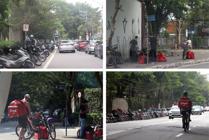
The intersection of Eusébio Matoso Avenue, Rebouças Avenue, Ibiapinópolis Street and Marginal Pinheiros surrounds the Eldorado Mall, with its 137,000 m2 of built area and 304 stores, in the center-west region of the city of São Paulo. On the other side of Rebouças Avenue – where the back and parking lot of the mall can be accessed – there are more than a dozen motorcycles parked on the corner with Içana Street. Further along the avenue, there are several motorcycles parked in what looks like the front setback of a house. Some of the vehicles have no driver in sight. Others stay for a short time, barely arrive and then leave under the direction of a courier who is carrying bags or a backpack and returns from the mall looking at his cellphone’s screen. There are also the motorcycles that remain with their drivers: some sleep sitting on top of the bike, others stay on the ground, leaning against the vehicles and talking. There are also those who, without ever taking their eyes off a delivery app on their cell phone screen, wait – sometimes anxiously, sometimes tediously – for a notification about an upcoming courier ride. Thermal backpacks scattered on the ground, or on the back of some motoboy who didn't want to take them off.
Some of the motorcycles are parked in what appear to be public spaces, reserved by the state for motorcycles to stay for a certain period of time – a time that is almost always exceeded by those who use it. Some stand in the street, where the curb is not lowered and is painted white, which also indicates permission to park. Some can be found in empty parking lots for cars – often blocked off with chains that are ignored by motorcycles – in private establishments, or on the sidewalk itself, getting in the way of pedestrians or entering and exiting the buildings that line the avenue. Once in a while, a police car may appear and then, quickly, many of those waiting parked start up and disappear – it could be that the place where they were parked was forbidden; it could be that they had been parked for longer than allowed in the public spaces; it could be that their motorcycle documents were not in order; it could be that they owed fines or had expired licenses. In short, they want to avoid problems.
The scene described seeks to draw attention to the monotony that shapes the spaces where delivery workers wait for orders for a great part of their work hours, and where we were able to approach and talk to several of them during our field research. The contrast between the rush of countless motorcycles collecting and distributing orders on the city's streets and avenues and the boredom of the waiting hours that takes place in these border spaces we're talking about seems exemplary. That's because, when they're not picking up or delivering a package, the main activity carried out by these workers consists of waiting. On the edges – around malls, restaurants, shops, dark kitchens and dark stores – a high concentration of motoboys remain on docks or in street parking lots, waiting for a notification from the delivery app announcing a new ride. This "dead time" – during which, obviously, the couriers receive nothing, despite their state of readiness and availability – is indispensable to the just-in-time way of working, since in order for deliveries to keep up with the demand for orders – more or less unpredictable – there must always be a number of them idle, waiting, available to start work immediately (Liberato, 2020).
In the new moment of capital accumulation, amidst the dissolution of wage- -earning, there is a real intensification of work. This change is accompanied by the emergence of what Arantes (2014) calls a "penal and social state of emergency" set up to govern social insecurity and manage declassified and desocialized work. If this new moment places an entire population in a state of emergency or insurgency - the "problematic poor" or the "reserve criminal army" (Feltran, 2011), that can be understood as a result of the destructuring of the industrial reserve army that occurred with the dismantling of the wage society – then this population must be processed and controlled, contained and punished. Whether through mass incarceration or a "punitive continuum" on the streets, waiting itself becomes a form of punishment. Without purpose or horizon, it serves only as a mechanism for managing work through total mobilization. All of this goes hand in hand with the emergence of a much faster temporal regime than the Fordist one, in which it is absolutely impossible to waste time.
Although, in describing the waiting zones of the contemporary world, Arantes does not specifically mention street parking lots or motorcycle docks, it is not difficult to see in these spaces the materialization of waiting as a punishment that exceeds individuals in the omnipresence of the present and becomes a discipline, "inherent to the historicity regime that characterizes the current moment of globalized accumulation" (Arantes, 2014, p. 166, translated by the authors). Waiting without a horizon acts as an intensifier of disciplinary social suffering.
However, the punitive waiting and cynical unveiling can only exist because, on the one hand, the underground buildings and edge areas remain hidden from the whole image that the city produces of itself – they may not hide the dirty world of work, but are themselves hidden in the urban tissue. This also explains the need for these spaces to always be under the surveillance of private security guards who regulate the dynamics of the background places and determine how much and how one place will spill over into the other. This means that the connections between these apparently binary pairs become just as important as their separation.
When it comes to controlling these connections and policing borders, we have already seen that private security guards play an important role, but there are also new sentries coming onto the scene, combining forms of surveillance. In other words, in a world governed by platforms, it is possible to create a surveillance regime that is closely related to constant monitoring through the sharing of "text-images" which carry information interpreted by machines, but often inaccessible to human beings (Beiguelman, 2021). The automated storage and interpretation of data shared on the net – sometimes through the actions of the subjects themselves involved in their self-surveillance, which is also cynical form of surveillance – leads to a form of surveillance that is distributed and naturalized in everyday life – which hides and shares at the same time – rather than external and total control of the modern era. In a case of a strike at a “Rappi Turbo” warehouse in the Pinheiros neighborhood, in São Paulo, for example, by not directing orders to the motoboys within a 100-meter radius of the store, the app determined where they would stay and blocked their access to that small part of the city. The street, initially public, became subject to the algorithm's domination. When the delivery drivers revolted against this management by declaring a strike, the app used a different kind of blockade: it threatened to cancel the strikers' registration if they stayed within two meters of each other.
Borders of movement
The street is another element that becomes relevant in the attempt to describe urban space and its current dynamics. To some extent, it is through the street that the worlds of finance and informality connect. Linking malls, corporate buildings, shopping centers, logistics warehouses, kitchens, commercial and residential districts, the street emerges as a unique organism that ties together distant and apparently disjointed points of the city. It is where the trajectories of those who leave their homes to go to work, those who work moving around the city, those who go to supermarkets and malls to do their shopping, those who seek leisure in their free time meet. In short, it is where the various dimensions of social life meet – generating disputes and conflicts in the midst of the incessant flow.
So, if in parking lots, docks and dark kitchens what seems to prevail is the dimension of waiting, it is the opposite that, at first glance, manifests itself on the street. While some wait for hours in these edge spaces, the city is traveled at high speed by motorcycles that cut through traffic, run red lights, drive the wrong way and circumvent any traffic law that prevents them from making as many deliveries as quickly as possible. On the flipside, the speed of the street. And it wouldn't be surprising if, at the same time as new corporate buildings and shopping centers were being built in Brazil's metropolises, large avenues and expressways were also spreading across the urban fabric. It's no coincidence that shopping centers and corporate buildings are considered "Travel Generating Hubs":7 as major traffic concentrators, they require the infrastructure of urban highways and major avenues. To Lencioni's observation that in the areas of private suburban condominiums "what matters is not so much contact with their surroundings, but access to a highway" (Lencioni, 2011, p. 140), we could add shopping malls and corporate condominiums - which are, in their own way, suburbs within the city or, in Lencioni's words, "urban islands". On these proliferating highways, the frenetic circulation of motorcycles – which move between expressways and local roads and alleys – show us that the circulation infrastructure is not enough to tie the city without the live work of connecting its distant and separate points.
However, the speed with which motorcycles cut through chaotic traffic doesn't seem to be enough for what capital demands. In this sense, the possibility of going to the limit of risk offered by the motorcycle – in the interest of speeding up circulation – also fits in with the new moment of capitalism that is being addressed. Anything can be done to avoid wasting time and slowing down. Traffic jams, advanced red lights, reverse crossing or intense acceleration bring the driver face to face with the possibility of death: life is risked over promises to connect points of the city. This situation experienced on the streets reflects, to a certain extent, a condition of social reproduction that is also bound up with the dimension of risk. When it is the worker itself who has to bear the costs of their reproduction, there is a multiplication of indebtedness related to housing, food and the cost of the means of work itself – often rented – which constantly brings them face to face with uncertainty, generating a new type of precariousness in work and social reproduction, in which it is precisely access to technology, the means of work and housing that bring insecurity, insofar as they are linked to future indebtedness.
However, on the streets, uncertainty takes on more immediate dimensions: in 2022, 70% of the patients treated in the trauma department at Hospital das Clínicas were motoboys (Fioravanti, Martins, Rizek, 2024). The glittering global city, criss-crossed by avenues and bridges that wind through its postcards, can only be so because it is sewn together by the violence of work in circulation – and it's no wonder that, beyond its wide and shiny facet, this "street organism" spreads thin tentacles that end up in those back doors, pockets, docks, warehouses and dark kitchens where the world of work opens up.
In a perverse way, the acceleration, adrenaline, recklessness and risk commonly associated with motorcycle courier show themselves to be necessary elements for carrying out this work, which the app companies implicitly rely on. This explains the "subsumption of viração", to the extent that the "job’s know-how" (Abílio, 2015) is employed at the pace dictated by the need to circulate capital. The expertise of delivery workers is used to increase productivity and the work pace – revealing that the autonomy over one's own time provided by the app is actually an autonomy to intensify one's own work. Amid the “subsumption of viração”, the subsumption of speed.
At the same time as the street can be an unifying organism that supports high speed, it also emerges as a space that immobilizes as much as lines, prisons and street parking lots. While it connects the city, the street also separates it, blocking it off. Martins describes the construction of large expressways during the 20th century as a process that damaged the public spaces around them, preventing free transit between their borders (Martins, 2017, p. 25).
In this way, the street can be understood not only in a binary way, as a connection or a barrier, but as a space of dispute between how the city is tied together or interrupted. When talking about the mediations between the peripheries of the city and what he calls the "public world", Feltran (2011) uses the notion of border to refer to the sense of demarcation, division and regulation of flows mobilized in these mediations. He believes that borders "are established precisely to regulate the channels of contact that exist between social groups that are separated by them, but which necessarily relate to each other. Where there are borders, there is communication of an unequal and controlled kind" (ibid., p. 15, translated by the authors). The street, as a public space, can emerge as a place shared by the whole of society, where the city can be disputed. As a border, it exists as a space of conflict – mobilizing new forms of control (ibid.).
Amid this conflict – in which cars, motorcycles, buses, trucks, bicycles and pedestrians compete for a space that mixes the needs of the spheres of production and social reproduction – the speed that crosses the physical spaces of circulation through the urban space takes on warlike dimensions. Thus, the city and its streets present themselves as a battlefield, embodying a war that is no longer an exclusively external phenomenon – related to territorial disputes between states – but is housed within the urban space, becoming diluted in everyday life and shaping the lives of all who find themselves in it (Graham, 2016).
Virtual borders
To the sound of horns and sirens, an avenue is crossed by motoboys wearing red windbreakers and carrying cooler bags on their backs. As the group approaches a large intersection, one of them says: "Close the square, close the square!". Another app delivery workers’ protest begins in the city. More protesters appear as time goes by, and the motoboys park their bikes at the intersection, blocking the street. Some shout: "Motoboys are people too!", "It's closed, it's closed!". Traffic on the avenue is blocked and outsiders approach, trying to understand what is going on. While some just watch, there are those who are annoyed by the protest, try to break through the blockade with their cars, or threaten the protesters with violence, shouting for them to get back to work.
Soon, the first police motorcycle arrives, and demands explanations about what is going on. A group huddles around a policewoman and, in disarray, delivery workers explain that they are protesting for their rights, that they are all working for free or paying to work, that they "have to do something" about the app's abusive payment rates, that this is the only way for them to protest. She then asks them to remove their motorcycles from the intersection and protest on the sidewalk: "You have the right to demonstrate, but you don't have the right to block the street". She then asks for reinforcements on her walkie-talkie: "The iFood8 strike is blocking all the streets here". While some are already heading to remove their motorcycles from the picket, others stand their ground and try to convince their colleagues that they must resist and continue blocking the road. Reinforcements arrive and the police alternate between offering alternatives to the blockade, seen as a riot, and threatening to take everyone to jail for disobedience if they don't unblock the intersection. A trip to City Hall or a "motorcycle demonstration" occupying just one lane of the avenue are suggested. They come up with the idea of trying to contact journalists, hoping to get visibility for their demands. Negotiations continue and soon the motoboys are all on the sidewalk. At the same time, some point to a man who had previously confronted the protesters, threatening to "shoot them" if they didn't return to work, and they ask the police to deal with him.
The traffic on the street has already returned to normal when the group agrees to go to City Hall, but the police back down and forbid it due to lack of manpower. Some decide to go anyway, but the moment of greatest tension has passed and the protest is already dismantled.
The described scene did not take place in the city of São Paulo, much less in any other Brazilian city where iFood operates, but in the fictional "Hightown" in the online video game Grand Theft Auto (GTA), of which iFood became a partner, allowing players to work virtually as delivery drivers in exchange for real discount coupons in the app. This strike didn't take place in the "real world", but it seems to condense the script followed by various app workers’ protests in various cities in the country, which have intensified since 2020.
If the “viração" theorists (Telles, 2006a, 2006b) had already announced an indistinct condition between the work sphere and other spheres of life, the partnership between the app and GTA enhances this tendency. The activity that the player carries out in the virtual city is exactly the same as the work of a real app delivery worker, in a way that the difference between the experience of leisure and the experience of work is blurred. Also, when the virtual delivery worker, by playing, converts their activity into fictitious income or real benefits, such as discounts, he is, in some way, still selling his labor power – and who knows what financial operations come into it. It seems that the virtual iFood takes the "work gamification" (Oliveira, 2021) to the extreme – including resistance to it, such as strike action. It wouldn't be surprising if those who control the virtual delivery drivers in their spare time were the same people who, on the streets, work for the apps and drive around the city collecting and delivering orders.
We therefore see that in the connection between financial expansion and the proliferation of borders, digital platforms seem to operate as another intertwining of heterogeneous and dispersed spaces of extraction and the a priori non-localized determinations of the global financial capital flow. As a sort of virtual and invisible city, the flows of assets in frenetic circulation through them reveal, from the inside out, fractions of space apparently disaggregated as something unique.
This virtual space, in the first place, functions as an element that detaches itself from reality and hides what is happening in it. In doing so it also reveals the very way it works, in which everything seems to move on its own and the origins of social relations are lost. Abstract space unifies the apparently disconnected mosaic of the city, because its logic of concealment – even if differently in each place – extends to the urban dynamics as a whole and can thus reveal their unity. In this sense, this virtual space, through platforms and apps, can be understood as another frontier capable of mediating and marking out the imbrication between concrete reality and the space of the cloud.
Back to the underground spaces, it is precisely because they are camouflaged within the global city that another form of fetish can operate in ghost buildings. When an order is placed on a delivery app, the consumer who uses the app simply orders on their cell phone and waits for the product to arrive at their home. This happens magically, at the touch of a few buttons. The work involved in production and transportation disappears. The "loss of origins" therefore doesn't cease to exist, it just takes place somewhere else. Instead of being in the architectural form, in the built space – what used to be the factory, or even the shopping malls and commercial spaces of the 1980s and 1990s – the fetish moves to the virtual sphere of the app and, in the "cloud", the whole process of circulation seems to become autonomous – hiding its violence. Is it possible to imagine a city that is a total simulation?
To some extent, Beiguelman points in this direction when she explores the relationship between image production and urban life. When cities can be understood as intersections between physical spaces, concrete reality and the informational territories of the cloud, image production participates in urban life not only as a symbolic representation, but with the power to "make things work concretely" (Beiguelman, 2021). The closer it gets to the physical world, the more technology is able to extrapolate reality. And while in the early days of the internet there may have been a perception that social relations were migrating to the world of the cloud, today the trend seems to be the opposite: the invasion of physical and concrete life by the virtual world.
When urban planners can be replaced by "big players in the IT market" (ibid.), urban space becomes a "market for intelligent surveillance technologies" – capable of predicting events and integrating space into "images made not to be seen" (Ibid., p. 103). Architecture, in turn, goes beyond its constructive purposes to take part in converting the city into a place where social life is mediated by images and information.
This aspect does not escape Augè when he notes that in what he calls non-places are established “the traffic conditions of spaces in which individuals are supposed to interact only with texts […] transmitted by the innumerable 'supports' (signboards, screens, posters) that form an integral part of the contemporary landscape” (AUGÈ, 1995, p. 96). Various forms of visual writing in space relate to subjects constantly in transit through the city. With hidden layers that can only be interpreted through the mediation of technology, images gain a new tangibility and, at the same time, blur the boundaries between real and virtual. Behind these systems, Beiguelman (2021) points to the interest of companies in creating invisible command systems capable of controlling the city – something that culminates in the increasingly widespread notion of smart cities. In this sense, operating in opaque logics, these images scattered throughout the city place themselves between "human eyes" and the "world of the cloud" – something that seems essential to reflect on the contemporary forms of fetish in urban space.
However, the streets that constantly circulate an immense amount of merchandise don't seem to contain the circulation of capital. It has already detached itself from the physical space of the city and its movement seems to take place only in the virtual sphere. The parallel movement of motoboys in an endless cycle and the insatiable cycle of money circulation is crossed by a mismatch: the circulation of capital and circulation in the street do not take place in the same space or at the same time. The movement of global financial capital operates with promises and advances that the immediacy of the circulation of goods on the street, for example in the case of app delivery drivers, does not necessarily follow – which is, perhaps, the reason why strikes that target the interruption of circulation face so many barriers, since if they manage to block the buying and selling of goods, financial capital can overcome physical barriers and continue moving. It's clear that the sphere of the "cloud" can't give up the physical world – if it did, there wouldn't be so many efforts to control it – because there lies the possibility of one day fulfilling the promises of capital appreciation to investors. However, if these spheres can appear as unconnected, is it possible to discuss the subsumption of the “street” by the “cloud”? In other words, could there be an inversion, in which the virtual space appears to determine the real one according to its specific needs? Could it be that the app reveals itself, at the very end, as an abstraction of the street? Couldn't this lead us back to Beiguelman's idea of "computational clouds that host networks" consolidating themselves as the "new citadels of the 21st century" (Beiguelman, 2021, p. 74, translated by the authors)?
Within this dynamic, Beiguelman continues, "structures of images" can function as abstractions of an entire system of capital, surveillance and control while platforms, mixing the internet, geolocation and electronic media, can be understood as "tools [of information] used to cadence the production and exchange of these dominant immaterial commodities, images and information", bringing into question a distributed territoriality between networks and the physical city, which entangles the political powers of the state and corporations" (Ibid.). Again: structures that function as virtual borders of permeability between concrete reality and the "cloud".
Conclusion
In this article, we sought to understand the process of platformization as a transformation of labour relations that profoundly alters the binary articulation between the spheres of production and social reproduction, typical of the industrial era. In this blurring, we also see a blurring of the binarities of formal/informal, legal/illegal, licit/illicit (Telles, 2006b), in a process of proliferation of "tension borders" (Feltran, 2011). Urban space is being transformed, making it necessary to review the static dynamics of spatial segregation in the direction of a polycentric and dispersed metropolization (Lencioni, 2011, 2015), 2015), in which spatial heterogeneity takes on many layers, mixing center and periphery. Logistics, in a reshaped urban environment, becomes central to managing the circulation of goods and bodies, combining the homogeneity of means of circulation with the heterogeneity of urban spaces and their social and political relations.
In the second part of the article, by following motoboys' political mobilization through the city, we were able to observe that their subjectivity as workers is shaped by multiple borders, different from the capital-labour relationship of the industrial era, in which urban relations linked to circulation are central. The city takes on new layers, including virtual ones. It was therefore to be expected that the political mobilization of these workers would not be delimited by the trade union form – and a specific reflection on this new political form deserves another article.
These transformations seem to reveal that, rather than a "new way of working", what we understand as platformization seems to characterize a deeper social process, which contaminates the various dimensions of life and shapes a sort of management by the imminence of the “doom”. In other words, to the extent that, in the midst of the present’s generalized crisis, the possibilities of a better life are restricted, what seems to be left is the uncertainty of survival: faced with the possible end of work possibilities, the term of a loan, a temporary occupation, money saved, one is confronted with the imminent end of life itself. That is, intense vulnerability allows for the flexible and arbitrary management operated by platforms (Fioravanti, Martins, Rizek, 2024). It is through permanent urgency that platforms can subsume the expedients of “viração”.
Whether in rented flats on the outskirts or in street parking lots on the edges of shopping malls, the connection between spaces on the fringes of the city and a globalized financial world announces a dynamic that seems to be extending more and more to the whole of urban space in the chapter of productive restructuring in which we now find ourselves. When we observe work or social reproduction mediated by platforms, our attention immediately shifts from the main scene of the urban spectacle to the back streets, side alleys, service entrances and working class neighborhoods. It's on the edges and on the fringes, in the connections and at the "back doors" that the luxurious space of finance meets informality and “viração”. In the two-wheeled work of app delivery drivers, which is closely linked to both the movement around the city and the movement of capital, motoboys connect malls, corporate buildings, shopping centers, logistics warehouses, kitchens, commercial and residential districts. They connect distant and disjointed points of the city, and make it possible for the logistical chain of accumulation to be completed – something that escapes us when we only look at the vector of valorization. This trans-scalar linkage is one of the elements that allows us to see the connection between economic processes and the complex network of social relations and actors that materialize in the urban and may, perhaps, reveal the role of these places in the subsumption, at a spatial level, of the forms of rotation found to make work possible.

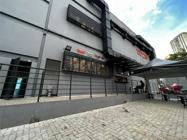

– Although it’s located in Fortaleza, the façade of this Dark Kitchen makes the term “Dark” explicit for this type of establishment

– Rappi notification on a motoboy’s cell phone advising him to keep his distance from other people in public spaces


Motorcycle demonstration in April 2025, in the city of São Paulo, in the context of a new national strike

– App strike in 2021. It is worth noting that the monotony - contrasting with the scene narrated above – is characteristic of many strikes, where the main activity consists of “guarding” the door of establishments, ensuring that no orders are taken out for delivery

References
- ABÍLIO, L. (2015). Segurando com as dez: o proletário tupiniquim e o desenvolvimento brasileiro. Relatório final de pesquisa. São Paulo, Fapesp.
-
ABÍLIO, L. (2017). Uberização do trabalho: subsunção real da viração. Disponível em: https://blogdaboitempo.com.br/2017/02/22/uberizacao-do-trabalho-subsuncao-real-da-viracao/ Acesso em: 3 jun 2024.
» https://blogdaboitempo.com.br/2017/02/22/uberizacao-do-trabalho-subsuncao-real-da-viracao/ - ABÍLIO, L. (2020). Uberização: A era do trabalhador just-in-time? Estudos Avançados São Paulo, v. 34, n. 98, pp. 111-126.
- ANTUNES, R. (2020). "Trabalho intermitente e uberização do trabalho no limiar da indústria 4.0". In: ANTUNES, R. (org.). Uberização, trabalho digital e indústria 4.0 São Paulo, Boitempo.
- ARANTES, P. (2014). O novo tempo do mundo São Paulo, Boitempo.
- AUGÉ, M. (2007). Não-lugares: introdução a uma antropologia da supermodernidade Campinas, Papirus.
- BEIGUELMAN, G. (2021). Políticas da imagem: vigilância e resistência na dadosfera São Paulo, Ubu.
- CALDEIRA, T. (2011). Cidade de muros: crime, segregação e cidadania em São Paulo São Paulo, Editora 34.
- CORDEIRO, L. (2022). Em trânsito: logística na cidade contemporânea. Dissertação de mestrado. São Paulo, Universidade de São Paulo.
- CUPPINI, N. (2018). A cidade enquanto sistema logístico. Lugar Comum Rio de Janeiro, n. 52, pp. 299-310.
- DARDOT, P.; LAVAL, C. (2016). "A fábrica do sujeito neoliberal". In: DARDOT, P.; LAVAL, C. A nova razão do mundo São Paulo, Boitempo.
-
DARK KITCHEN: cozinhas "fantasmas" com foco em delivery têm boom na pandemia e projetam crescimento (2022). Diário do Nordeste. Disponível em https://diariodonordeste.verdesmares.com.br/negocios/dark-kitchen-cozinhas-fantasmas-com-foco-em-delivery-tem-boom-na-pandemia-e-projetam-crescimento-1.3243688 Acesso em: 4 out 2024.
» https://diariodonordeste.verdesmares.com.br/negocios/dark-kitchen-cozinhas-fantasmas-com-foco-em-delivery-tem-boom-na-pandemia-e-projetam-crescimento-1.3243688 -
DARK STORE: o que é e como funcionam as lojas fechadas ao público (2024). Santander Negócios e Empresas - Programa Avançar. Disponível em: https://santandernegocioseempresas.com.br/conhecimento/gestao-de-negocios/dark-store/ Acesso em: 4 out 2024.
» https://santandernegocioseempresas.com.br/conhecimento/gestao-de-negocios/dark-store/ - FELTRAN, G. (2011). Fronteiras de tensão: política e violência nas periferias de São Paulo São Paulo, Unesp.
- FIORAVANTI, L.; MARTINS, F.; RIZEK, C. (2024). Plataformas digitais e fluxos urbanos: dispersão e controle do trabalho precário. Cadernos Metrópole São Paulo, v. 26, n. 59, pp. 69-96.
- GRAHAM, S. (2016). Cidades sitiadas: o novo urbanismo militar São Paulo, Boitempo.
-
GTA RP: como virar entregador do iFood no Cidade Alta (2022). IGN Brasil. Disponível em: https://br.ign.com/grand-theft-auto-online/96816/news/gta-rp-como-virar-entregador-do-ifood-no-cidade-alta Acesso em: 24 out 2022.
» https://br.ign.com/grand-theft-auto-online/96816/news/gta-rp-como-virar-entregador-do-ifood-no-cidade-alta - GUERREIRO, I. (2010). Arquitetura-Capital: a funcionalidade dos edifícios corporativos paulistas. Dissertação de mestrado. São Paulo, Universidade de São Paulo.
- HARVEY, D. (1989). Condição pós-moderna: uma pesquisa sobre as origens da mudança cultural São Paulo, Loyola.
-
LELLES, A. R. (2022). Dark Store é o novo varejo. Disponível em: http://www.negocioefranquia.com/dark-store-e-novo-varejo Acesso em: 12 maio 2025.
» http://www.negocioefranquia.com/dark-store-e-novo-varejo - LENCIONI, S. (2011). A metamorfose de São Paulo: o anúncio de um novo mundo de aglomerações difusas. Revista Paranaense de Desenvolvimento Curitiba, n. 120, pp. 133-148.
- LENCIONI, S. (2015). Urbanização difusa. e-metropolis. Rio de Janeiro, n. 22, pp. 6-15.
-
LIBERATO, L. (2020). Modo de espera e salário por peça nas entregas por apps. Disponível em: https://passapalavra.info/2020/11/135017 Acesso em: 3 jun 2024.
» https://passapalavra.info/2020/11/135017 - LYSTER, C. (2016). Learning from logistics: how networks change our cities. Basileia, Birkhäuser.
- MARTINS, L. (2017). A cidade em movimento: a via expressa e o pensamento urbanístico no século XX. Dissertação de mestrado. São Paulo, Universidade de São Paulo.
- MEZZADRA, S.; NEILSON, B. (2013). Extraction, logistics, finance: Global crisis and the politics of operations. Radical Philosophy Londres, n. 178, pp. 8-18.
- NEILSON, B. (2012). Five theses on understanding logistics as power. Distinktion Linköping, v. 13, n. 3, pp. 322-339.
- OLIVEIRA, F. (2003). Crítica à razão dualista: o ornitorrinco São Paulo, Boitempo.
- OLIVEIRA, F. (2021). Gamificação e trabalho uberizado nas empresas-aplicativo. Revista de Administração de Empresas São Paulo, v. 61, n. 4, pp. 1-10.
-
O QUE É UM PGV (2022). Rede Ibero-Americana de Estudos em Polos Geradores de Viagens. Disponível em: http://redpgv.coppe.ufrj.br/index.php/pt-BR/conceitos/o-que-e-um-pgv Acesso em: 24 out 2022.
» http://redpgv.coppe.ufrj.br/index.php/pt-BR/conceitos/o-que-e-um-pgv - PEREGALLI, A. (2022). IIRSA: entre integración regional y racionalidad logística. Nova York, Peter Lang.
- ROY, A. (2017). Cidades faveladas: repensando o urbanismo subalterno. e-metropolis, Rio de Janeiro, pp. 6-21.
- SILVA, R. (2009). Os motoboys no globo da morte: circulação no espaço e trabalho precário na cidade de São Paulo. Dissertação de mestrado. São Paulo, Universidade de São Paulo.
-
SILVA, V. H. (2020). Entregadores de iFood, Rappi e Uber Eats marcam nova greve para 12 de julho. Tecnoblog Disponível em: https://tecnoblog.net/noticias/entregadores-de-ifood-rappi-e-uber-eats-marcam-nova-greve-para-12-de-julho/ Acesso em: 24 out 2022.
» https://tecnoblog.net/noticias/entregadores-de-ifood-rappi-e-uber-eats-marcam-nova-greve-para-12-de-julho/ - SLEE, T. (2019). Uberização: a nova onda do trabalho precarizado São Paulo, Elefante.
- TELLES, V. (2006a). Nas tramas da cidade: trajetórias urbanas e seus territórios São Paulo, Humanitas.
- TELLES, V. (2006b). Mutações do trabalho e experiência urbana. Tempo Social São Paulo, v. 18, n. 1, pp. 173-195.
- TSING, A. (2009). Supply Chains and the Human Condition. Rethinking Marxism. Amherst, v. 21, n. 2, pp. 148-176.
- UM GRUPO DE MILITANTES NA NEBLINA (2022). Incêndio: trabalho e revolta no fim de linha brasileiro São Paulo, Contrabando Editorial.
- VIANA, S. (2013). Rituais de sofrimento São Paulo, Boitempo.
-
VIEIRA, B. M. (2022a). Entregadores de dark kitchens relatam falta de banheiro e água: "É desumano, motoboy é tratado como bicho". G1 Disponível em: https://g1.globo.com/sp/sao-paulo/noticia/2022/04/14/entregadores-de-dark-kitchens-relatam-falta-de-banheiro-e-agua-e-desumano-motoboy-e-tratado-como-bicho.ghtml Acesso em: 4 out 2024.
» https://g1.globo.com/sp/sao-paulo/noticia/2022/04/14/entregadores-de-dark-kitchens-relatam-falta-de-banheiro-e-agua-e-desumano-motoboy-e-tratado-como-bicho.ghtml -
VIEIRA, B. M. (2022b). Dark kitchens: como funcionam os galpões com dezenas de cozinhas para delivery. G1 Disponível em: https://g1.globo.com/sp/sao-paulo/noticia/2022/06/03/dark-kitchens-como-funcionam-os-galpoes-com-dezenas-de-cozinhas-para-delivery.ghtml Acesso em: 4 out 2024.
» https://g1.globo.com/sp/sao-paulo/noticia/2022/06/03/dark-kitchens-como-funcionam-os-galpoes-com-dezenas-de-cozinhas-para-delivery.ghtml
Notes
-
1
“Motoboy” is the common term used in Brazil to refer to motorcycle couriers. We have decided to keep it that way in this translation to avoid mistaken it for the literal term “motorcyle courier”, which will be used in this article to designate the activity carried out by “motoboys” (T.N.).
-
2
“Viração” is a concept used mainly by Telles (2006a, 2006b), and refers to those activities that are characterized as survival strategies in the social reproduction context. It derives from the slang “se virar”, which means “to get by”, and has been historically associated with ways of surviving and supplementing income.
-
3
It's worth clarifying: A Logistical Operator is "an intermediary company between the platform company and the deliverers, responsible for so-called sub-practices or specific sub-regions of the city". Another type of work that exists on iFood is the "cloud", in which couriers "can deliver wherever they prefer and are available to receive work, after registration approval, as soon as they log in to the app" (Fioravanti, Martins, Rizek, 2024, p. 75).
-
4
See: Lelles (2022).
-
5
See:Dark Store... (2024).
-
6
Both kitchen workers and motoboys report being unable to use the bathroom, drink water or rest in an appropriate place inside dark kitchens. See: https://g1.globo.com/sp/sao-paulo/noticia/2022/04/14/entregadores-de-dark-kitchens-relatam-falta-de-banheiro-e-agua-e-desumano-motoboy-e-tratado-como-bicho.ghtml. Accessed on 4 Oct 2024.
-
7
The Ibero-American Network for the Study of Travel Generating Hubs defines them as places that have the characteristic of "producing a significant contingent of trips, requiring large spaces for parking, loading and unloading and boarding and disembarking, consequently promoting potential impacts". See: http://redpgv.coppe.ufrj.br/index.php/pt-BR/conceitos/o-que-e-um-pgv. Accessed on October 24, 2022.
-
8
iFood is the main app delivery platform used in Brazil.
-
Editors:
Lucia BógusLuiz César de Queiroz Ribeiro
-
Dossier organizers:
Luiz César de Queiroz RibeiroNelson Diniz

 Photo: Bárbara Muniz Vieira/G1 (Vieira, 2022a).
 Source: Vieira (2022b).
 Photo: Fabiane de Paula (Dark Kitchen..., 2022).
 Photos: own authorship.
 Photo: authors.
 Source:
  Photo: author unknown.
 Photo: author unknown.
 Fonte: GTA RP... (2022).