
 Braking the platform: an analysis of the regulatory confrontation involving Uber in Colombia
Abstract
This article addresses the political constraints generated in urban mobility governance by the implementation of the Uber platform. We analyzed the case of Bogotá, Colombia, due to the tension involved in the creation of regulation. The case was explored based on the analysis of documents such as decrees, laws, bills, court decisions, and official reports. The results confirm the operating method used by the company in other countries to generate contentious compliance with regulatory models. However, the transportation governance established in Bogotá through the regulation of public transportation in the integrated system contributed to the escalation of legal confrontation until the prohibition of the company’s operations.
Keywords
Uber Bogotá; Uber Colombia; Uber regulation; smart mobility; platform economy
Resumo
O objetivo deste artigo é estabelecer as contenções políticas geradas na governança de mobilidade urbana a partir da implementação da plataforma Uber. Analisamos o caso de Bogotá, Colômbia, por se tratar de um processo de tensão na construção da regulação. O caso foi explorado a partir de uma análise documental envolvendo decretos, leis, projetos de lei, decisões judiciais e informes oficiais. Os resultados confirmam o modo de operação empregado em outros países pela empresa de gerar uma conformidade contenciosa com os modelos regulatórios. Contudo, a governança de transporte estabelecida na capital Bogotá com a regulamentação do transporte público no sistema integrado cooperou para a escalada do enfrentamento judicial até a proibição das operações da empresa.
Palavras-chave
Uber Bogotá; Uber Colômbia; regulação Uber; mobilidade inteligente; economia de plataforma
Introduction
Smartphone technology has provided the ability to communicate almost anywhere, at any time, and to represent users and vehicles as geolocated points on a city map in real time. This technology has inspired initiatives by public agents, such as tracking bus fleets through apps and monitoring the flows and routes of public transport users based on user data. The private sector has also taken advantage of these possibilities for urban mobility, offering everything from ride- -sharing services mediated by smartphones to a model similar to taxis. One of the main innovations was the incorporation of private agents – vehicle owners – in the provision of individual mobility services through service- -offering platforms and payment services.
The largest and most emblematic company exploring this dynamic as a business model is Uber, founded in 2009 in the United States as an urban mobility startup and expanding its operations globally from 2012 onwards. This company’s operations are characterized by not owning the cars used, not operating within the limitations of private vehicle permits legally required by public transport authorities for taxi services, and not providing fixed employment contracts to its drivers. Instead, the company is registered in the technology sector and operates within a flexible employment contract regime, supported by the concept of the “gig economy”. This perspective maintains that service mediation platforms based on Information and Communication Technologies (ICTs) and the Internet can connect people and enable the optimization of underutilized resources through the digital negotiation of sharing these resources, such as taking advantage of empty spaces in cars during journeys to generate extra income through monetized ride-sharing (Kenney and Zysman, 2016).
This new technological environment transforms the mobility scenario in urban contexts. The flexible nature of the platform creates ambiguity in the traditional forms of offering transportation services, generating tension with established patterns of urban governance. With Uber having been in business for just over a decade, and having reached several legal impasses regarding urban mobility legislation and very similar labor contract issues in the United States and around the world, it has become clear that the company’s operations are far from just facilitating ride-sharing through an app.
In this paper, we want to understand how these tensions are structured by reconstructing the process of the app’s implementation in the city of Bogotá, Colombia. We want to examine the negotiations between agents in the dynamics of the process of legalizing this company in the local and national legislative spheres. Based on this work, we want to link the field of studying platform economies with the literature on governance, understanding that the management of urban mobility is characterized by a process of contentious coalition between national and international public and private actors that varies in each local context. We use Valdez's (2023) concept of “contentious compliance” to understand how Uber establishes its operation in a contentious manner, combining economic and political influence with a strategy of legislative disobedience to the existing mobility model structured by city governance.
To trace this process, we first identified three time periods according to the negotiations between the agents involved, in addition to regulatory responses. We then conducted a qualitative documentary analysis, based mainly on regulations, lawsuits and press reports that were produced between October 2013 and December 2021. We consider that the results demonstrate a regulatory and oversight environment that is highly hostile to the platform and strongly favorable to the protection of the traditional taxi market. Our hypothesis is that the introduction of technological innovation implies a contentious process between different local agents. The legislative impact of Uber will be different in cities with stronger taxi regulations and where the political strength of representatives of private transport interests can veto the company than in cities where these agents have less political influence. We understand that in Bogotá, the taxi drivers' lobbying power to maintain their market proved to be stronger than Uber's, partly due to the political and economic strength of the taxi companies established in the Bogotá transport coalition and partly due to increased monitoring and combating of irregular transport with the implementation of the Integrated Public Transport System, which aimed at integrating fares.
The work is divided into three parts. The first part presents a brief bibliographic review on platform economies and Uber's forms of operation in relation to urban governance. The second part describes the methodologies used to analyze and structure the results, dividing Uber's contentious process with respect to urban governance into three periods. The third part summarizes and discusses the results.
Literature review
The first concept that we consider central to this work is that of the “gig economy”. This concept has been incorporated into the academic literature to describe the organization of companies like Uber. More than a transportation company, it has been defined as a technology application that facilitates connections between drivers willing to give rides and share space in their vehicles, and passengers willing to pay for such rides. In this arrangement, Uber would be an application that would help monetize rides. However, authors such as Rogers (2015), Pasquale (2016), and Kenney and Zysman (2016) problematize the disconnect between the concept of the gig economy and the reality of aggressive market competition which is radically averse to adapting to any local urban mobility legislation. Far from organic growth, Rogers (2015) points out that Uber has a modus operandi that combines high investment in marketing with political lobbying to operate outside the legislative dictates that transportation companies operate under.
According to Pasquale (2016), the optimism surrounding the gig economy discourse quickly proved to be naïve, since it conceals a complex capitalist market of digital platforms that is increasingly stratified and without the solid ties that would guarantee labor protection. For Collier, Dubal and Carter (2018), this is a model that offers flexibility in exchange for transferring responsibilities from the company to the workers, in addition to promoting class fragmentation and frustrating any chance of unionization. Kenney and Zysman (2016) point out that the gig economy represents a sporadic source of income, which is unlike what happens with the Airbnb and Uber platforms: a large part of those registered on such platforms seek to consistently earn a living by renting spaces and transporting people. These companies obtain advantages as guarantors of service agency and information exchange, and as producers and processors of operational data and payments. For these reasons, the authors differentiate these services from the gig economy by using the term “platform economy”.
Thus, the gig economy that Uber and several other companies based on social networking technology claimed to advance has instead produced new markets which mediate services based on digital technologies. According to Rahman and Tellen (2019), the platform economy reiterates elements that were already part of the global financial capitalist labor market, such as generating value for shareholders, financialization, seeking to make contracts more flexible, and reducing labor costs. What is new is that these services guarantee a level of dominance and market concentration as fundamental infrastructure for a sector, such as private mobility of public interest in the case of Uber. This market concentration is related to the effects of the network configuration of the platform economy: the more people use it, the more valuable the platform becomes, especially if this growth can be on a large territorial scale and users can travel to other territories in the country or in other countries and use the same service (Srnicek, 2017).
[...] In contrast to the classic model of the vertically or horizontally integrated monopolistic firm that achieves and maintains its power through mechanisms of ownership or acquisition, the platform firms—although often built through mergers and acquisitions as well—exercise market power by controlling other participants on either side of the platform. (Rahman and Tellen, 2019, p. 9)
Based on this network effect, the platform can define the rules for distributing value within its market. The investment required to achieve this scale takes time; investors accept this, and allow the company to expand without generating profits, absorbing its losses and focusing on medium- and long-term gains. The authors call these advantages of network effects “infrastructural power.” This power involves the power to control the entry and exit of freelancers to and from the platform, the power to organize and manipulate the information flows and the activity of platform users, and the power to rank drivers and users (Valdez, 2023).
In summary, the literature states that modern ICTs, such as smartphones, digital social networks, and mobile and broadband internet, have set precedents for new forms of organizing services and the workforce. The power of platform companies like Uber comes from what the authors call “infrastructural power,” which translates into the implementation of various strategies that seek to create a monopoly through the expansion and standardization of operations in the main urban centers of several countries. Among the most relevant strategies identified in the literature are the following: a) the organization of all supply and demand flows; b) the large-scale standardization of the service and the transfer of responsibilities for the physical infrastructure of the service to the cities and to drivers hired through flexible work contracts; c) the introduction of the service to a city without seeking compliance with the current legislation for taxi services, instead using marketing strategies, political lobbying and driver and customer loyalty to advocate in favor of new legislation that benefits the operation.
Thus, companies operating in the platform economy system seek to standardize their services, compete for independent workers in large cities, and comply with as little regulation as possible. However, their success depends on how strong their lobbying, marketing, and “loyalty” of drivers and customers are, as their interests clash with the complexity of collaborative governance in cities. Uber’s entry will generate potential conflicts with various agents in the different cities in which the company operates.
The second concept we address in this paper is governance. With this concept, we seek to analyze political decision-making from a more complex perspective, which incorporates other actors from the private sector, civil society, and multilateral organizations. These agents can influence decision-making and regulation of politically relevant issues (Nuissl and Reinrichs, 2011). According to Stoker (2018), governance in urban policy involves achieving collective action in state management under conditions in which the exclusivity of state authority can no longer be relied upon. In its broadest sense, “the defining feature of urban governance is that the management of cities is not the sole preserve of government or the private sector, but is the preserve of a wide variety of actors that interact with one another to govern cities” (Obeng-Odoom, 2012, p. 206).
Contemporary urban governance occurs in a context in which large cities embrace “entrepreneurial urban management”. For Brenner (2004), this management is oriented towards a new scale of global investments. It contrasts with the national and territorial equalization of the welfare state model, where significant aspects of economic regulation are devolved to subnational institutional levels and the main socioeconomic assets are concentrated in the most competitive urban regions. In this scenario of urban entrepreneurship, public management practices are impacted by the incorporation of business management models, reducing the decision- -making power of public bodies and promoting greater deregulation, greater planning flexibility and greater involvement of the private sector, but where regional policy actors still have the capacity to impose an agenda (Da Cruz, Rode and McQuarrie, 2019).
According to Le Galès and Vitale (2013), governance in large cities is related to the capacity of a political regime to provide services and to produce and maintain collective goods, thus ensuring its legitimacy. Le Galès (1998) points out that local governments seek to establish regulations around what emerges as a passive object, that which is “governable”. He also points out that regulations can be seen as governance mechanisms defined in three dimensions: the manner of coordinating various activities or relationships between actors; the allocation of resources in relation to these activities or actors; and the structuring of conflicts (prevented or resolved). This leads to three “typical” forms of regulation: (1) state regulation (often identified with hierarchical or political regulation), where the national government structures conflicts, distributes resources and coordinates activities and groups; (2) market regulation, in which supply, demand and profit values are the focus; (3) cooperative/reciprocal regulation (sometimes called regulation through social or political exchange), based on values and norms, a unique approach which expresses trust-based forms of exchange.
Specifically in the case of the sharing economy, governance takes on new contours. Valdez (2023) considers that it is necessary to observe the strategies used by companies of this type in a context characterized by flexibility and the use of technology. To this end, she uses the concept of “contentious compliance”, within which she analyzes the forms of urban governance from the perspective of the dimension of political negotiation in the platform economy. According to Valdez, the relationship between the company, the regulatory bodies and the coalition in power will always be one of contentious negotiation, until the platform achieves the legislative arrangement that best favors it, using marketing and lobbying to build support with relevant actors, such as mayors, legislators at the municipal or national level, local business community, self-employed drivers and citizens (understood as consumers of the product) to legitimize its irregular operation.
According to Valdez, companies ignore the law for as long as possible and even break it, occasionally giving in to regulatory battles when under the most pressure. This is only possible, in her words,
[...] because of the inherent flexibility of their business model. Those changes, in turn, allow the firms to offer their services with the hope of becoming ubiquitous. Still, these firms never cease to push for deregulation to be able to offer their preferred version of the service. (Valdez, 2023, p. 183)
The company will then push the limits of minimum regulation as far as possible, but will also give in to the regional arrangement to some extent, by registering as a company, operating with legally accepted categories of luxury taxis, having its own offices and workshops, etc.
Valdez identifies a great local diversity in the development of this contentious process. While cities like New York have shown room for operational freedom and company expansion due to the absence of stricter rules for entry barriers for new companies in individual transportation and the popular perception that taxi services are quite limited, in cities like Berlin and Madrid, several legislative barriers have been created against their expansion, and temporary bans have even been put in place (Valdez, 2023).
From this perspective of urban governance of shared economies, it is possible to analyze the local forms that are configured according to the power relationships between the different agents. We believe that, even with all the persuasive force it has in its favor, this does not mean that Uber will translate this effort into immediate success. It will clash with the existing coalition of urban political and business governance which structures and provides individual transportation services. The case of Bogotá offers a relevant example for understanding the dynamics of contentious negotiation that configure the provision of this type of service, in contrast to the “pacification” that has occurred in other urban contexts where Uber has managed to legalize its service, as has been the case in Brazil.
Methodology
The main methodological strategy used is documentary analysis. To this end, we identified the main arrangements that structured urban mobility in Bogotá during the period studied. We then reconstructed the process of Uber’s entry into and expulsion from Bogotá and Colombia based on documentary analysis of these arrangements. Among the official documents, we analyzed the Uber process published by the Court of Cundinamarca, legislative and legal documents including six decrees, two laws, two resolutions, one circular and one memorandum, both of the latter from the Superintendence of Ports and Transport. In addition to this material, we analyzed the management reports of the public transport company TransMilenio and the analysis of the General Comptroller’s Office regarding the operation of TransMilenio. We also analyzed 11 bills from both the Chamber of Deputies (Consejales) and the Senate that dealt with the Uber platform.
A total of 188 news articles from the Colombian newspapers El Tiempo, El Espectador and La Republica were analyzed between May 5, 2014 and December 30, 2022. Five interviews from the media outlets La Republica, El Tiempo and Radio Caracol were analyzed, as well as a speech by then presidential candidate Iván Duque on his official channel. Twelve posts from the official blog of Uber in Colombia were analyzed between November 1, 2015 and June 19, 2020. Among the official statements, five statements from the Superintendence of Transportation of Colombia and the Judiciary were selected for analysis. These works were organized using the qualitative analysis software Atlas.TI for easier access and thematic coding. An analysis methodology was used to classify the documentary sources based on the most relevant themes, reduce categories by coding these themes and subsequently identify the main points under debate regarding Uber's contentious compliance.
We procedurally structured the results into three periods. The first, between 2013 and 2015, covers Uber’s arrival in Bogotá and its first points of contention with taxi drivers and regulatory agencies, and the first legislative efforts to create a category favorable to Uber. The second period covers the years 2015 to 2019, when the Colombian national executive branch was under pressure to generate a regulatory response to Uber, structuring the minimum requirements for the company to operate legally. The third period, from 2019 to 2021, is when the municipal executive branch of Bogotá and the national executive branch of Colombia escalated the regulatory pressure on Uber for not adapting to the new individual mobility legislation, until the company was banned and returned to operating with car rental contracts.
Results
The arrival of the platform: 2013-2015
The individual public transport system at the time of Uber's arrival in Colombia (2013) was divided at the regulatory level into yellow taxis, equipped with taximeters for providing rides to destinations chosen by the customer, and white luxury and corporate taxis, regulated together with other private transport vehicles for commercial purposes, such as school bus vans and tourist minibuses. In Bogotá, these elements comprise a rigid system with strong barriers to new entrants. These individual or collective transport services of public interest in Bogotá are defined based on two national decrees: National Decree n. 172 of 2001, which defines the conventional taxi service (i.e., yellow); and National Decree n. 174 of 2001, which defines special taxi services (i.e., white) and other collective transport services.
To operate within the conventional taxi system, taxi drivers need “cupos”, taxi badges, which are issued by the Colombian National Ministry of Transportation. These cupos are obtained by taxi companies and purchased by taxi drivers to operate in their city. Drivers can also resell or “rent” their cupos to other drivers, thus creating an additional informal business around these badges. While the supervision of drivers’ operations is the responsibility of municipal and metropolitan authorities, the supervision of companies is the responsibility of the national authority. According to the Bogotá District Mobility Secretariat, between 2010 and 2015 a fixed number was maintained, with an average of 52,500 licensed taxis circulating in Bogotá (Secretaría Distrital de Movilidad, 2017). This number remained more or less fixed until the imbroglio with the entry of Uber. According to data from the National Association of Sustainable Mobility (Andemos), Bogotá had 82,719 taxis in 2022 (Andemos, 2022). The impact of both Uber and the new dynamics of transportation through apps that have been incorporated by existing taxi companies has generated an increase of more than 30,000 new cupos.
The Uber app was registered in Colombia on October 15, 2013 as a technology company (Villa, 2014). This type of company has its functions governed by National Law no. 1,341 of 2009 (Colômbia, 2009), which provides for activities related to the information society and the organization of ICTs. The app became available for download and driver registration in 2013, offering a single “luxury car” option via the app, with the only option being “Uber Black”, a service more expensive than a conventional taxi, initially only in Bogotá, with a price ranging between 30% and 50% more than the typical fare for a taxi in the Colombian capital.
In 2014, the extent of the app's impact on urban mobility began to be felt in Bogotá, based on the perception of local stakeholders that it was not a luxury mobility facilitator, but a competitive company that aimed to enter the individual mobility of cities in a way that disrupted the commercial models of taxi companies. While taxi driver protests began in May 2014 against Uber's operation in special taxis, in August 2014 Uber began offering the “UberX” service in Bogotá, at a cheaper rate in direct competition with taxis and with a contract through individuals and not with licensed taxi drivers for special vehicles, further aggravating the conflicts between taxi drivers and the platform (Villa, 2014).
Uber’s connection to luxury taxis was the first target of action by the Colombian government, with the legal change in Resolution no. 3,068 of the Ministry of Transport, which modifies a paragraph of National Decree no. 174, requiring all luxury taxi drivers to carry a document of contract with the company, called “Unified Format for Contract Extracts” (Fuec). In parallel with the responses from government, taxi drivers in Bogotá organized contentious movements through their unions, taking direct action by closing access roads to traffic, led by the union Asociación Nacional de Propietarios y Conductores de Taxi and taxi companies based and operating in the capital Bogotá, such as Táxis Libres and Táxis Imperiais (Redação El Espectador, 2014). They carried out intermittent cycles of protests against Uber between April and December 2014, with the first major national protest taking place on November 24, in line with the announcement of the legality or otherwise of the application by the authorities, with blockades of traffic lanes on the main roads of cities.
These cycles of protest not only indicated dissatisfaction among taxi drivers’ unions, but also began to reflect, from 2014 onwards, cycles of social and political pressure whenever decisions favorable to the app’s legislation came under consideration in the Legislature or were proposed by the Executive, which continued until the end of the period studied (2021). In response to the first contentious national act, on November 24, 2014, the Ministry of Transportation issued an official statement (Colômbia, 2014) declaring the mobility app illegal. According to the Ministry’s understanding, Uber constitutes a technology platform operating as a transportation company. In order for a transportation company to use a technology platform to provide public services, it would need to be previously authorized by the competent authority according to the modality for which it was established. Likewise, the vehicles would need to be authorized for each modality and their drivers legally linked to the authorized companies.
In the legislative sector, during 2014, a debate took place in the Colombian Senate between September 23 and December 8 to draft a bill to create a special category for Uber. The debate centered on the proposal by senators Oscar Arango and Andrés Zuccardi, both from the same party as then-President Juan Manuel Santos. According to the Gazette of Congress (official internal publication of the Chamber of Deputies in which initiatives, votes, dictamens and other matters of interest that are debated in the Congress are published), Bill n. 93 proposed “[i]mproving the quality of the individual transportation service using taxi-type vehicles, improving the conditions for hiring drivers, regulating a luxury taxi system and creating a technical training fund for the provision of a better service (Colômbia, 2014).” The bill focused on Uber, still considering the platform’s model as a luxury taxi service. However, it was not approved by the Senate.
The conflict surrounding individual public motor transport in Colombia ended in 2014 with the issuance on the last day of the year of “Circular 024” by the Superintendence of Ports and Transport, the national transport oversight body, authorizing the competent authorities to seize all cars providing services that did not comply with Decrees n. 172 and n. 174, whether they were white taxis that did not carry the Fuec, or were operating through the UberX service.
Creating a regulatory framework: 2015-2017
In 2015, the Uber service continued to operate despite the arrests of drivers. In March, the Ministry of Transport released a video on its official social media channels in which the Minister of Transport, Natalia Abello, announced that Uber was illegal in the country and that the government would launch a project to create a category of “luxury taxis” through apps to make yellow taxis more competitive (Redação El Tempo, 2015a).
In the first half of 2015, an investigation into irregular transportation services was begun by the Colombian Transportation Superintendence, which envisaged the possibility of blocking all transportation application platforms considered “illegal”, although the Ministry of Information and Communication Technologies from Colombia (MinTIC) itself denied the possibility of blocking the applications (Redação El Espectador, 2015b). Feeling that they were not being served by the government in restricting Uber and other platform-based mobility applications, the unions and business representatives of the taxi drivers called for a new national protest with blockades on July 29, 2015, in line with an international protest by taxi drivers against Uber on the same day (Redação El Tiempo, 2015c).
These protests continued into the second half of 2015, with access blocks being set up in important service areas, such as access roads to El Dorado International Airport. In addition to these contentious actions, there were also some acts of violence reported in the press, with taxi drivers using intimidation against drivers and passengers of services such as Uber (Redação El Tiempo, 2015d) and the announcement by taxi leaders of the creation of “search groups” to intimidate drivers and users of apps, working with the police to incriminate irregular drivers (Redação El Tiempo, 2015e).
Although the dispute with Uber occurred at the municipal level in Bogotá, the authorities responsible for regulating or prohibiting individual transportation are at the national level. In light of this scenario, the executive actor who took the lead in the process of regulating Uber and taxis, the then-Vice President of the Republic under Juan Manuel Santos, Germán Vargas Lleras, promised to structure, based on the implementation period of the National Development Plan, the regulation of a special individual transportation service via app for taxi drivers in September (Redação El Tiempo, 2015f). This is because the plan of the then--President Juan Manuel Santos Calderón, of the Partido Social de Unidad Nacional, which was implemented based on National Law no. 1,753, included the following article: “Within six (6) months after the enactment of this law, the national government must regulate luxury services in the individual passenger mode” (Congreso de la República de Colombia, 2015, authors’ translation).
Given the delay in reaching a decision, the taxi drivers' union filed a class action lawsuit on November 13 in the Administrative Court of Cundinamarca, demanding a ten-day deadline for the President of the Republic, Juan Manuel Santos, or the Ministers of Transport, Minister of ICTs or Superintendents of Ports and Transport to present a solution. Although the legal action for protection was not accepted, the Court complied with the deadline for clarification (Colombia, 2022). This pressure resulted in the drafting of National Decree n. 1,079, which signaled a legislative alignment and political commitment to the interests of taxi drivers, seeking to create a category of luxury taxis and digital applications that would require a link with the already existing model of cupos and taxi companies.
At the end of 2015, a new decree was published, National Decree n. 2,297, which reworded National Decree n. 1,079 and stipulated a six-month deadline (counting from the date of its publication, November 27) for ride-hailing companies operating in the country to adapt. Despite this deadline for Uber to operate in a manner regulated by the National Ministry of Transport, the company continued to operate irregularly according to the standards established the following year, without complying with the stipulated deadline (May 27, 2016). Taxi driver protests continued, as did search groups, with illegal raids and intimidation of drivers and passengers of the app, including widely publicized cases of an intimidating blockade of the daughter of a former vice-president Redação El Tiempo, 2015g) who used the service.
At the end of the stipulated period, on May 27, 2016, Resolution n. 2,163 of the Ministry of Transportation was issued, regulating National Decree n. 2,297. This resolution created a category of “luxury taxis”, structured ways to integrate individual mobility applications with legalized taxis, and thereby stipulated that Uber must register with the Ministry of Transportation in order to have a legal status. The company rejected the proposal and did not join, while several platform mobility companies linked to taxis were integrated into the resolution, such as Comunicación Tech y Transportes, Transportes Especiales Acar, Etaxi Colombia, Farley ETC, Cooperativa de Transportes Tax Coopebombas, Taxis Ya, Digimarketing, Widetech, Mobility Solutions, Eleinco, Mi Águila Group, Heinsohn Business Technology, Webnet, Processoft and Mega Taxi VIP Redação Portafolio, 2017).
During this period, several bills were being processed to effectively create a category for Uber, both in the House of Representatives – Bill n. 044 of 2015 (Colômbia, 2015), authored by Congressman Alfredo Deluque, of the Partido de la U, and Bill n. 204 (Colômbia, 2016), authored by Olga Lucia Velásquez Nieto, of the Partido Allianza Verde, in 2016 – and in the Senate – with Bill n. 126 of 2015 (Colômbia, 2015), and Bill n. 198 of 2016, the latter a popular initiative. Again, none of these bills received a favorable vote.
Platform prohibition
In March 2017, Uber was sentenced for the first time, with the Superintendence of Ports and Transport issuing Resolution No. 07838, which fined Uber 700 times the minimum wage, totaling 450 million pesos, and a second fine to Uber in the amount of US$344,727,000 for “facilitating and promoting, through the media and advertising, the provision of unauthorized transport services in the country” (Superintendence of Ports and Transport, 2016). Uber’s legislative limbo became part of the agenda of the presidential election campaign, and candidate Iván Duque, from the Democratic Center, adopted the agenda of regulating the app in favor of taxi drivers’ unions during his campaign (Duque, 2018). In 2019, during his term in office, more emphatic measures emerged to classify the app and the company as irregular services.
In April 2019, the Special Group for Illegality and Accidental Control (Cecis) (Bejarano, 2019) was created, an initiative of President Iván Duque and the Ministry of Transport in partnership with the police, which sought to criminalize irregular transport, citing a correlation between irregular transport and traffic accidents. Although both President Iván Duque and the Minister of Transport, Ángela Orozco, denied that the initiative was a way to combat the company Uber (Castilla, 2019), between April and June, Cecis suspended 6,408 vehicle transport licenses for irregular app-based transport and revoked 75 driver's licenses in Bogotá because drivers were using apps (Bedoya, 2019).
In this escalation of conflicts between the District (headed at the time by Mayor Enrique Peñalosa, from the Cambio Radical party) and national powers against Uber, an Uber service center was closed during an inspection by agents from the Bogotá District Mobility Secretariat due to alleged irregularities with automatic doors in July 2019 (Marenco, 2019). Regarding this incident, the company issued an official statement, on the Uber Colombia blog, regretting what happened and claiming that it had presented all legal documentation attesting that the establishment operated within the requirements mandated by law (Bell, 2019).
On December 6, 2019, the Superintendence of Ports and Transport requested a response from Uber regarding the continuation of services considered irregular, such as advertising, consulting and affiliations of non-approved vehicles for public transport, services under conditions that would have generated competitive advantages for the benefit of providers linked to the platforms, and, subsequently, on December 18, it applied a new fine of USD 414 millions (Bell, 2019).
The Superintendence of Industry and Commerce (SIC) also opened proceedings in December 2019 against the platforms Uber, Cabify and Didi for engaging in unfair competition in the individual transport sector (Bell, 2019)25. On December 20, 2019, based on Minute n. 2,383, the SIC ordered the suspension of Uber services in Colombia. Based on an unfair competition claim filed in 2016 by the company Cotech, which provided platform technology services to the Colombian taxi company Taxis Libres, the SIC determined that the companies linked to Uber engaged in unfair competition by violating rules and diverting customers (articles 8 and 18 of Law n. 256 of 1996), by irregularly providing the individual public transportation service, and thus violated the principle of fair competition enshrined in National Law n. 1,341 by competing without the same tax and legal obstacles as the transportation companies in Colombia. The SIC established that the companies linked to the Uber application provide an individual public passenger transportation service, by creating the offer and making the service available to users, thus violating the rules that regulate the market and generating a significant advantage for Uber (Colombia, 2022).
With this, the SIC ordered the immediate closure of the “Uber”, “Uber X” and “Uber VAN” services in Colombian territory. The decision to close Uber services contained in the minutes also orders the Colombian telecommunications companies Comcel (Claro), Colombia Telecomunicaciones (Movistar), the Colombian telecommunications operator Tigo and the Empresa de Telecomunicaciones de Bogotá to suspend the transmission and hosting of Uber data, effectively prohibiting the download and use of the application on smartphones (Colombia, 2022). The circular set the deadline for the closure of Uber in Colombia for February 1, 2020.
Uber’s impending exit from Colombia in early 2020 became a catalyst for the debate about the nation’s own regulation of the platform. A variety of projects emerged in the House of Representatives, such as Bills n. 174, 185, 199, 242 and 446. All of these were combined in Bill n. 003, of 2020 (Redação El Espectador, 2020).
After the issuance of Minute n. 2,383 by the Superintendence of Industry and Commerce and the determination of the closure of the activities and banning of the Uber application for February 1, 2020, the company appealed and sent a letter to then--President Iván Duque. In this letter, the fact that the SIC's decision occurred on December 20, the last day of the country's judicial calendar — creating an apparent impediment to immediate review — and simultaneously with a sanction by the Superintendence of Ports and Transport, was assessed. Taking these elements into consideration, the company asserted that this ban violated Colombia's Free Trade Agreement with the United States (Redação El Espectador, 2020).
On January 10, the Ministry of Transportation issued a press release. In this statement, the Ministry justified the decision to block the application by arguing that Internet neutrality is established by Law n. 1,450 of 2011, while the provision of passenger transportation services corresponds to Laws n. 105 of 1993 and 336 of 1996, and transportation applications are regulated by Decree n. 1,079 of 2015 (Rincón, 2020). In the face of the controversy over Uber's exit, President Iván Duque took a stand in favor of taxi drivers, stating that they pay for cupos, insurance, and inspections to the detriment of Uber's partner drivers (Arbeláez, 2020).
Although Uber drivers filed a request for legal protection and made several protests, the app was effectively taken offline on February 1, 2020, making Colombia the first country in Latin America to expel the transportation company from its territory over the issue of unfair competition. However, the exclusion was short-lived, with the app returning to Colombia on February 20, 2020. The company changed the hiring method upon its return, with a vehicle rental modality in which one person can rent their vehicle to another, through a contract. In this change, instead of the driver being a “partner” providing services with the platform, the driver creates a temporary rental contract for their own vehicle with the passenger who booked the ride. Although the return of the app in February 2020 established Uber as a transportation company, the issue of the status of self-employed drivers began to arise, since they were no longer in the limbo of illegality and remained without any labor rights; this was the case of 88,000 registered drivers in Colombia, according to data from the platform (Arbeláez, 2020). Bill n. 190 (Colômbia, 2019), Bill n. 085 (Colômbia, 2020a) and Bill n. 221 (Colômbia, 2020b) in the Senate, and Bill n. 388 (Bogotá, 2020), in the Chamber of Representatives, aimed to link Uber workers to the Public Social Security System. None of these bills were approved.
On June 18, 2020, based on Ruling n. 02106, the Superior Judicial Court of Bogotá reversed the decision to prohibit the service under the SIC action supported by the Cotech complaint. According to the Court's understanding, there was an issue around the statute of limitations, because the term of the unfair competition process was to take a maximum of two years; having started in 2012 and ended in 2016, it had already expired. Therefore, the process was closed.
Discussion of results
The results point to the confirmation of the modus operandi of contentious compliance proposed by Valdez (2023), where the company first conformed to the category of luxury taxis existing in the city of Bogotá (its preferred market due to the high concentration of population and independent labor) while waiting to introduce the UberX model, which represents its global category of services and linkage of independent drivers. What was observed, however, is that, unlike a liberal or free-market regulatory model, it was a highly political and hierarchical model of regulation of urban mobility governance, in the sense of regulation proposed by Le Galès (1998, 2013). Not only was Uber's preferred category rejected, but the possibilities of conforming the platform to local categories were also systematically blocked in favor of taxi drivers.
It is undeniable that the lobbying power of taxi drivers in Bogotá prevailed and proved to be stronger than that of Uber in its capacity to nationalize the local demands of companies and taxi unions. Individual transportation in Bogotá is structured around yellow taxis, which represent 4.9% of the 13,359,000 daily trips in the city, adding up all modes, according to the Origin–Destination survey by the Secretariat of the District of Mobility (Secretaría Distrital de Movilidad, 2019). When we remove all private vehicle options (car, motorcycle and bicycle) and foot transport, this figure rises to 9.9%, behind only the buses of the BRT TransMilenio system (with 37.3% of trips) and the buses of the Integrated Public Transportation System (36.1% of trips).
Thus, in addition to the bus system, a considerable portion of trips in Bogotá are made by private individual transport in the public interest, with taxi cooperatives having a strong presence in the transport provider coalition in Bogotá supported by strong legislation that structures the individual transport market. When Uber targeted the city of Bogotá as a potential market to introduce its strategy, it came across these two limiting factors that clashed with its operations: a movement to formalize public transport in order to combat the loss of revenue to informal transport, and the political strength and legislative robustness of the taxi system operating in Bogotá.
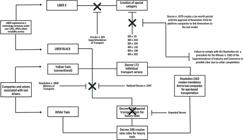
From the moment Uber entered Bogotá, it encountered strong resistance from agents in the city, but resolution of the situation came from the national executive branch. The well--established forces of taxi drivers, especially business groups such as Taxis Libres and unions that are concentrated in Bogotá, have gained political strength in the structured transport coalition to the point of mobilizing promises of support in presidential campaigns, as was the case of President Iván Duque. The transport oversight bodies of the municipal and national executive were also keen to protect current legislation for taxi drivers, and legal decisions were favorable to guaranteeing the taxi drivers’ market share, unlike cities such as São Paulo, where the legal decisions in the dispute between taxi drivers and Uber resulted in an outcome favorable to Uber and the free market (Zanatta and Kira, 2018). Figure 1 details the first year of Uber’s arrival in Bogotá, outlining all the possible obstacles to the minimum terms of a contentious compliance of Uber in conventional categories.

Mounting political pressure resulted in a joint escalation in 2019: police inspection agencies seizing vehicles, and fining Uber drivers and establishments; agencies that ensure fair regulation of commercial disputes in Colombia imposing fines and sanctions; impositions by the legislature; and incisive protests by taxi drivers and business owners. This created a scenario that led to Uber ceasing business in the country and download of its app being blocked by technology providers, an unprecedented case in Latin America. Figure 2 shows the end of the period under consideration, with the accumulation of penalties and rulings against the company.
A second important element that explains the greater rigor in monitoring irregular transportation in Bogotá, relative to other nations, is the implementation of an Integrated Public Transportation System (Sistema Integrado de Transporte Público - SITP). The local government seeks to control the expansion of individual transportation and strengthen public transportation in order to reduce the serious problems of congestion and pollution. From the 1960s, Bogotá's transportation system (Transporte Público Colectivo – TPC) was structured around private bus companies that operated under a vehicle affiliation scheme. These private vehicles owned by third parties ran on routes authorized by the District Mobility Secretariat and allocated to the affiliated companies, creating a fierce dispute over fares and service provision between these affiliates and generating not only price wars, but also serious problems with safety and quality of services, especially between the 1980s and 1990s (Amézquita, Durán-Matiz, Fajardo-Morales, 2016).
The movement for the government to once again play a central role in planning and providing transportation occurred between 1999 and 2000, with the implementation of a bus system under state control with a BRT (bus rapid transit) system inspired by the model implemented in the 1970s in Curitiba, Brazil, with exclusive lanes and stations for bus circulation (trunk network) and zonal networks connecting to the system. The BRT system was implemented during the administration of Mayor Enrique Peñalosa, then of the Liberal Party. To manage this mode of bus transportation, a mixed-economy company called Empresa de Transporte del Tercer Milenio (TransMilenio S/A) was created. Phases 1 and 2, which occurred between 2000 and 2002, involved the construction and expansion of the BRT trunk network and the concession of stations to private entities responsible for their maintenance (Montero, 2017).
Based on the Bogotá Mobility Master Plan, implemented by Municipal Decree no. 319 of 2006, a medium- and long-term plan was established for the creation of an integrated public transportation system (Bogotá Integrated Public Transportation System - SITP) integrating the BRT system with other conventional TPC buses and future mod.– es with a single fare, paid electronically. Article n. 15 of this Decree, which deals with the implementation of the SITP, determined that TransMilenio would be the manager of the entity, being responsible for integration through a process of operational, fare and institutional integration. The SITP system divided the city into 13 zones that could be served by nine operators, two of which represented existing bus owners, and bus owners could participate as shareholders in the new operating companies or be compensated by selling or leasing their buses to new operating companies until the end of the fleet's useful life. This operational design transformed some 700 routes and 16,000 urban buses from the old system into 450 routes and a fleet of around 10,000 buses, supported by 6,700 fare points with 4,600 card recharge locations, which integrated fares (Rodriguez et al., 2017).
The implementation of the SITP, which was scheduled for 2011, faced several delays involving corruption issues and suspicions about the bidding process, resulting in the removal of Mayor Samuel Rojas and his replacement by acting Mayor Clara López. The SITP had been implemented by the end of her term, in addition to the beginning of phase 3 of the expansion of TransMilenio. However, the completion of the works and the start of the system's operations only occurred during the administration of the next mayor, Gustavo Petro, between 2012 and 2015, a period that coincided with the entry of Uber (Escallon Arango, 2014).
The public and private governance of Bogotá's public transportation seeks to (re)modernize and advance the BRT system, which is already showing signs of wear and tear and limitations including high ticket prices, a collapse of supply in the face of growing demand, and accusations of corruption surrounding the hiring of private entities (Rodríguez et al., 2017). Thus, between the governments of Samuel Moreno, Gustavo Petro, Enrique Peñalosa, Cláudia López, and the current government of Carlos Galán, the objective of this coalition is to advance the integration of bus systems and the construction of new modes, such as the TransMicable cable car system, implemented in 2018; the construction of a subway system, which began in 2020; and the future construction of an urban rail system.
Based on these data, we can summarize that the capital Bogotá has a public transportation system almost entirely dependent on buses. The government, through the TransMilenio company, has structured a coalition of bus companies for a long-term project to expand the TransMilenio trunk network, formalize the routes operated in the public transport system outside of TransMilenio, and integrate the zonal and trunk networks based on the SITP project. It has also implemented a rotation system for private cars for 22 years to promote the use of the public system.
The movement for modal integration and tariff unification aims precisely at reducing gaps in the provision of urban mobility and reducing revenue losses due to irregular transport, especially vans and motorcycle taxis that operate in the city of Bogotá, filling these gaps with public transport (Rodríguez et al., 2017). The increased tax persecution of Uber, the arrest of drivers and the creation of a Special Group for the Control of Illegality and Accidents (Cuerpo Especial de Control de la Ilegalidad y la Siniestralidad) to regulate clandestine transport need to be read within the local historical context of greater efforts by the state to control urban mobility, separating more strictly legal transport (linked to the SITP or taxi legislation) from illegal transport, which does not belong to this system. Thus, one element that helps to clarify why even the non-contentious element of Uber's compliance encountered obstacles in Bogotá and Colombia is the general context of the implementation of the SITP.
Final considerations
The aim of this article is to use the governance framework to complement studies on the platform economy with elements of urban policy. There is evidence in previous studies that Uber structures its market based on various operations involving persuasion through marketing. While creating a market separate from conventional urban mobility and in defiance of current legislation, it uses lobbying to develop favorable political arrangements. In addition, Uber represents the spearhead of the platform economy, opening the way for other companies to use the same model to compete for labor from informal workers in large urban centers.
However, to consider that Uber begins and ends the process of platformization of urban mobility without obstacles and without considering the political and social context in which it occurs is to ignore the complexity of local arrangements in the management of urban mobility and the debates on the platform economy. This is far from being a homogeneous process that makes all labor relations with drivers flexible and dominates all individual transportation offers (ultimately taking over the logistics and public transportation sectors). This universalizing perspective becomes problematic to the extent that it ignores local resistance, strong legislation and lobbying against platform mobility. It is also problematic to the extent that it considers this platform economy model as a finished process and not as something that is in constant negotiation and conflict with other regional actors.
The case of Bogotá is emblematic because it represents one of the urban centers most targeted by Uber in Latin America and a perfect candidate to host the app. Bogotá currently has a dense population of almost eight million inhabitants and a large number of informal workers available. It is also a city with a limited supply of transportation modes, beyond buses and taxis, and a large presence of informal transportation, with unregulated van and motorcycle taxi services operating throughout the city to fill the gaps in Public Collective Transportation and its replacement, the Integrated Public Transportation System.
However, it was precisely these elements that caused local agents to be so resistant to the platform's entry. The coalition formed for the integration of public transportation, involving national and municipal actors, bus companies, consortiums that manage stations and managers of the unified electronic payment system, seeks to reduce the margins lost due to informal transportation by investing in the process of modal integration to cover more routes, integrate fares and increase monitoring against informal transportation.
Taxi drivers, in turn, are part of this coalition as private companies providing individual transportation. The fight against irregular transportation strengthens the group, whose lobbying has proven to be much stronger internally than Uber's. This is reflected in all the decrees and resolutions approved, which favored the public transportation coalition to the detriment of Uber's interests. Furthermore, every bill proposed since 2014 to create a special legal category for Uber has failed to be approved. Taxi drivers aligned with local and national authorities in fighting irregular transportation, and subsequently managed to have Uber cla_ssified in this irregular category.
References
- AMÉZQUITA, L.; DURÁN-MATIZ, D.; FAJARDO-MORALES, D. (2016). Matriz origen-destino y eficiencia en modos de transporte urbano: un análisis de la movilidad de Bogotá. Semestre Económico, v. 19, n. 39, pp. 91-112.
-
ARBELÁEZ, M.F. (2020). Uber vuelve a Colombia. El Tiempo Disponível em: https://www.eltiempo.com/tecnosfera/apps/uber-vuelve-a-colombia-despues-de-su-salida-el-31-de-enero-464204 Acesso em: 13 nov 2023.
» https://www.eltiempo.com/tecnosfera/apps/uber-vuelve-a-colombia-despues-de-su-salida-el-31-de-enero-464204 - ASOCIACIÓN NACIONAL DE MOVILIDAD SOSTENIBLE ANDEMOS (2022). Anuario del Sector Automotor Bogotá/Colômbia, Andemos.
-
BEDOYA, M. P. A. (2019). Autoridades cerraron la oficinas de Uber en el Centro Comercial Plaza Claro en Bogotá. La Republica Disponível em: https://www.larepublica.co/empresas/autoridades-cerraron-la-oficinas-de-uber-en-el-centro-comercial-plaza-claro-en-bogota-2881729 Acesso em: 13 nov 2023.
» https://www.larepublica.co/empresas/autoridades-cerraron-la-oficinas-de-uber-en-el-centro-comercial-plaza-claro-en-bogota-2881729 -
BEJARANO, J. M. L. (2019). Presidente Duque presentó el Cuerpo Especial Contra la Ilegalidad y la Siniestralidad. La Republica Disponível em: https://www.larepublica.co/economia/presidente-duque-presento-el-cuerpo-especial-contra-la-ilegalidad-y-la-siniestralidad-2851220 Acesso em: 13 nov 2023.
» https://www.larepublica.co/economia/presidente-duque-presento-el-cuerpo-especial-contra-la-ilegalidad-y-la-siniestralidad-2851220 -
BELL, J. G. (2019). La Superintendencia de Industria y Comercio ordenó la suspensión de Uber en Colombia La Republica. Disponível em https://www.asuntoslegales.com.co/actualidad/la-superintendencia-de-industria-y-comercio-ordeno-la-suspension-de-uber-en-colombia-2946999 Acesso em: 13 nov 2023.
» https://www.asuntoslegales.com.co/actualidad/la-superintendencia-de-industria-y-comercio-ordeno-la-suspension-de-uber-en-colombia-2946999 -
BOGOTÁ. Tribunal Superior del Distrito Judicial de Bogotá (2020). Acordão n. 02106. Disponível em: https://www.alcaldiabogota.gov.co/sisjur/normas/Norma1.jsp?i=94120&dt=S Acesso em: 3 jan 2024.
» https://www.alcaldiabogota.gov.co/sisjur/normas/Norma1.jsp?i=94120&dt=S - BRENNER, N. (2004). New state spaces: urban governance and the rescaling of statehood Oxford, Oxford University Press.
-
CASTILLA, J. D. (2019). ¿Se puede sancionar a los usuarios y conductores de Uber o Cabify? La Republica Disponível em: https://www.asuntoslegales.com.co/actualidad/se-puede-sancionar-a-los-usuarios-y-conductores-de-uber-o-cabify-2872333 Acesso em: 13 nov 2023.
» https://www.asuntoslegales.com.co/actualidad/se-puede-sancionar-a-los-usuarios-y-conductores-de-uber-o-cabify-2872333 -
COLÔMBIA (2009). Lei n. 1341, 30 de julho Por la cual se definen principios y conceptos sobre la sociedad de la información y la organización de las Tecnologías de la Información y las Comunicaciones “TIC”, se crea la Agencia Nacional de Espectro y se dictan otras disposiciones. Disponível em: https://www.funcionpublica.gov.co/eva/gestornormativo/norma.php?i=36913 Acesso em: 6 mar 2024.
» https://www.funcionpublica.gov.co/eva/gestornormativo/norma.php?i=36913 -
COLÔMBIA (2022). Tribunal Administrativo de Cundinamarca. Nulidad y restabelecimiento del derecho. Inconstitucionalidade. Recorrente: UBER S.A.S. Recorrido. Relator: Felipe Alirio Solarte Maya. 10 de novembro de 2022. Bogotá. Disponível em: https://www.ambitojuridico.com/sites/default/files/2023-02/Sent-25000234100020160178000-22.pdf Acesso em: 5 jul 2024.
» https://www.ambitojuridico.com/sites/default/files/2023-02/Sent-25000234100020160178000-22.pdf -
COLÔMBIA. Ministério dos Transportes (2014). Ministerio fija posición frente a utilización de plataformas tecnológicas para servicio de transporte. Disponível em: https://mintransporte.gov.co/publicaciones/3960/ministerio-fija-posicion-frente-a-utilizacion-de-plataformas-tecnologicas-para-servicio-de-transporte/ Acesso em: 8 mar 2024.
» https://mintransporte.gov.co/publicaciones/3960/ministerio-fija-posicion-frente-a-utilizacion-de-plataformas-tecnologicas-para-servicio-de-transporte/ -
COLÔMBIA. Ministério dos Transportes (2020). Comunicado a la Opinión Pública. Disponível em: https://mintransporte.gov.co/publicaciones/8057/comunicado-a-la-opinion-publica/ Acesso em: 2 fev 2024.
» https://mintransporte.gov.co/publicaciones/8057/comunicado-a-la-opinion-publica/ -
COLÔMBIA. Câmara de Representantes (2015). Projeto de Lei n. 044/2015. Por medio de la cual se licencia el uso de plataformas virtuales en el transporte terrestre de pasajeros Disponível em: http://consejosuperiordeltransporte.org/wp-content/uploads/2016/07/PROYECTO-DE-LEY-044-DE-2015-C%C3%81MARA.pdf Acesso em: 20 set 2023.
» http://consejosuperiordeltransporte.org/wp-content/uploads/2016/07/PROYECTO-DE-LEY-044-DE-2015-C%C3%81MARA.pdf -
COLÔMBIA. Câmara de Representantes (2016). Projeto de Lei n. 204/2016 Por medio de la cual se crea el Servicio Privado de Transporte Mediante Plataformas Tecnológicas y se dictan otras disposiciones. Disponível em: http://consejosuperiordeltransporte.org/wp-content/uploads/2016/07/PROYECTO-DE-LEY-204-DE-2016-C%C3%81MARA.pdf Acesso em: 20 set 2023.
» http://consejosuperiordeltransporte.org/wp-content/uploads/2016/07/PROYECTO-DE-LEY-204-DE-2016-C%C3%81MARA.pdf -
COLÔMBIA. Câmara de Representantes (2020a). Projeto de Lei n. 388/2020 Por la cual se estabelecen condiciones de acceso a mecanismos de protección social a las personas que prestan servicios personales através de plataformas digitales, y se dictan otras disposiciones. Disponível em: <https://www.camara.gov.co/plataformas-digitales-1> Acesso em: 20 set 2023.
» https://www.camara.gov.co/plataformas-digitales-1> -
COLÔMBIA. Câmara de Representantes (2020b). Projeto de Lei n. 003/2020. Por medio de la cual se crea la categoría del servicio público de transporte terrestre automotor individual de pasajeros en vehículo particular intermediado por plataformas tecnológicas, y se dictan otras disposiciones. Disponível em: https://www.camara.gov.co/sites/default/files/2020-07/P.L.003-2020C%20%28TRANSPORTE%20PLATAFORMAS%20TECNOL%C3%93GICAS%29.pdf Acesso em: 20 set 2023
» https://www.camara.gov.co/sites/default/files/2020-07/P.L.003-2020C%20%28TRANSPORTE%20PLATAFORMAS%20TECNOL%C3%93GICAS%29.pdf -
COLÔMBIA. Senado (2014). Projeto de lei n. 093, de 2014. Por medio de la cual se dictan medidas relacionadas con el transporte individual de pasajeros. Disponível em: https://leyes.senado.gov.co/proyectos/index.php/textos-radicados-senado/proyectos-de-ley-2014-2015/372-proyecto-de-ley-093-de-2014 Acesso em: 20 set 2023.
» https://leyes.senado.gov.co/proyectos/index.php/textos-radicados-senado/proyectos-de-ley-2014-2015/372-proyecto-de-ley-093-de-2014 -
COLÔMBIA. Senado (2015). Projeto de Lei n. 126/2015 Por medio de la cual se crea el Servicio Privado de Transporte Mediante Plataformas Tecnológicas y se dictan otras disposiciones. Disponível em: https://leyes.senado.gov.co/proyectos/index.php/textos-radicados-senado/pl-2015-2016/555-proyecto-de-ley-126-de-2015 Acesso em: 20 set 2023.
» https://leyes.senado.gov.co/proyectos/index.php/textos-radicados-senado/pl-2015-2016/555-proyecto-de-ley-126-de-2015 -
COLÔMBIA. Senado (2019). Projeto de Lei n. 190/2019 Por medio de la cual se regula el trabajo digital economicamente dependiente realizado a través de empresas de intermediación digital que hacen uso de plataformas digitales en Colombia. Disponível em: https://leyes.senado.gov.co/proyectos/index.php/textos-radicados-senado/p-ley-2019-2020/1661-proyecto-de-ley-190-de-2019 Acesso em: 20 set 2023.
» https://leyes.senado.gov.co/proyectos/index.php/textos-radicados-senado/p-ley-2019-2020/1661-proyecto-de-ley-190-de-2019 -
COLÔMBIA. Senado (2020a). Projeto de Lei n. 085/2020. Por médio de la cual se regula la contratación de personas y aportes a la seguridade social em las plataformas digitales y se dictan otras disposiciones. Disponível em: https://leyes.senado.gov.co/proyectos/index.php/textos-radicados-senado/p-ley-2020-2021/1866-proyecto-de-ley-085-de-2020 Acesso em: 20 set 2023.
» https://leyes.senado.gov.co/proyectos/index.php/textos-radicados-senado/p-ley-2020-2021/1866-proyecto-de-ley-085-de-2020 -
COLÔMBIA. Senado (2020b). Projeto de Lei n. 221/2020 Por Medio de la cual se estabelecen garantías sociales para las personas que generan ingresos mediante el uso de plataformas tecnológicas y se dictan otras disposiciones. Disponível em: https://leyes.senado.gov.co/proyectos/index.php/textos-radicados-senado/p-ley-2020-2021/2018-proyecto-de-ley-221-de-2020 Acesso em: 20 set 2023.
» https://leyes.senado.gov.co/proyectos/index.php/textos-radicados-senado/p-ley-2020-2021/2018-proyecto-de-ley-221-de-2020 - CONGRESO DE LA REPÚBLICA DE COLOMBIA (2015). Ley 1750. Por la cual se expide el Plan Nacional de Desarrollo 2014-2018.
- COLLIER, R. B.; DUBAL, V. B.; CARTER, C. L. (2018). Disrupting regulation, regulating disruption: the politics of uber in the United States. Perspectives on Politics, v. 16, n. 4, pp. 919-937.
- DA CRUZ, N. F.; RODE, P.; MCQUARRIE, M. (2019). New urban governance: A review of current themes and future priorities. Journal of Urban Affairs, v. 41, n. 1, pp. 1-19.
-
DUQUE, I. (2018). Iván Duque en encuentro con Taxistas - Iván Duque Presidente. Youtube. Disponível em: https://youtu.be/2gRMi4HhMJk Acesso em: 31 jan 2024
» https://youtu.be/2gRMi4HhMJk - ESCALLÓN ARANGO, D. (2014). Reacción del Estado colombiano frente al carrusel de la contratación en Bogotá: ¿eficacia o discurso? Revista de Derecho Público, n. 32, pp. 1-26.
- KENNEY, M.; ZYSMAN, J. (2016). The rise of the platform economy. Issues in science and technology Spring, v. 32, n. 3, pp. 61-69.
- LE GALÈS, P. (1998). Regulations and Governance in European Cities. International Journal of Urban and Regional Research, v. 22, n. 3, pp. 482-506.
- LE GALÈS, P.; VITALE, T. (2013). Governing the large metropolis. A research agenda. Working papers du Programme Cities are back in town, 2013-8. Paris, HAL Open Sciences, pp. 1-21.
-
MARENCO, N. (2019). Cierre temporal del centro de soporte a socios conductores de Uber en Plaza Claro. Uber Newsroom. Disponível em: https://www.uber.com/es-CO/newsroom/cierre-temporal-del-centro-de-soporte-a-socios-conductores-de-uber-en-plaza-claro/ Acesso em: 2 fev 2024.
» https://www.uber.com/es-CO/newsroom/cierre-temporal-del-centro-de-soporte-a-socios-conductores-de-uber-en-plaza-claro/ - MONTERO, S. (2017). Persuasive practitioners and the art of simplification: the "Bogotá Model". Novos Estudos - Cebrap, v. 36, n. 1, pp. 59-76.
- NUISSL, H.; HEINRICHS, D. (2011). Fresh wind or hot air-does the governance discourse have something to offer to spatial planning? Journal of Planning Education and Research, v. 31, n. 1, pp. 47-59.
- OBENG-ODOOM, F. (2012). On the origin, meaning, and evaluation of urban governance. Norsk Geografisk Tidsskrift - Norwegian Journal of Geography, v. 66, n. 4, pp. 204-212.
- PASQUALE, F. (2016). Two narratives of platform capitalism. Yale Law & Policy Review, v. 35, n. 1, pp. 309-319.
- RAHMAN, K. S.; THELEN, K. (2019). The Rise of the Platform Business Model and the Transformation of Twenty-First-Century Capitalism. Politics & Society, v. 47, n. 2, pp. 177-204.
-
REDAÇÃO EL ESPECTADOR (2014). Caos en movilidad de Bogotá por protestas de taxistas y estudiantes. El Espectador. Disponível em: https://www.elespectador.com/bogota/caos-en-movilidad-de-bogota-por-protestas-de-taxistas-y-estudiantes-article-490924/ Acesso em: 13 nov 2023.
» https://www.elespectador.com/bogota/caos-en-movilidad-de-bogota-por-protestas-de-taxistas-y-estudiantes-article-490924/ -
REDAÇÃO EL ESPECTADOR (2015). Gobierno prepararía bloqueo tecnológico de Uber y plataformas similares de transporte. El Espectador Disponível em: https://www.elespectador.com/colombia/mas-regiones/gobierno-prepararia-bloqueo-tecnologico-de-uber-y-plataformas-similares-de-transporte-article-573294/ Acesso em: 13 nov 2023.
» https://www.elespectador.com/colombia/mas-regiones/gobierno-prepararia-bloqueo-tecnologico-de-uber-y-plataformas-similares-de-transporte-article-573294/ -
REDAÇÃO EL ESPECTADOR (2020). Tumban fallo que suspendió el servicio de Uber en Colombia. Disponível em: https://www.elespectador.com/judicial/tumban-fallo-que-suspendio-el-servicio-de-uber-en-colomb ia-article/ Acesso em: 13 nov 2023.
» https://www.elespectador.com/judicial/tumban-fallo-que-suspendio-el-servicio-de-uber-en-colomb ia-article/ -
REDAÇÃO EL TIEMPO (2015a). 'Aplicaciones como Uber son ilegales': ministra de Transport. El Tiempo Disponível em: https://www.eltiempo.com/archivo/documento/DR-909343 Acesso em: 13 nov 2023
» https://www.eltiempo.com/archivo/documento/DR-909343 -
REDAÇÃO EL TIEMPO (2015b). Autoridades barajan tres salidas al lío de Uber. El Tiempo Disponível em: https://www.eltiempo.com/archivo/documento/CMS-16148833 Acesso em: 13 nov 2023.
» https://www.eltiempo.com/archivo/documento/CMS-16148833 -
REDAÇÃO EL TIEMPO (2015c). Taxistas agredieron a conductores y pasajeros de Uber. El Tiempo Disponível em: https://www.eltiempo.com/archivo/documento/CMS-16348875 Acesso em: 13 nov 2023.
» https://www.eltiempo.com/archivo/documento/CMS-16348875 -
REDAÇÃO EL TIEMPO (2015d). Indignación por amenaza de 'bloque de búsqueda' de taxistas a Uber. El Tiempo Disponível em: https://www.eltiempo.com/archivo/documento/CMS-16399804 Acesso em: 13 nov 2023.
» https://www.eltiempo.com/archivo/documento/CMS-16399804 -
REDAÇÃO EL TIEMPO (2015e). Servicio de taxis de lujo deberá reglamentarse. El Tiempo Disponível em: https://www.eltiempo.com/archivo/documento/CMS-16377977 Acesso em: 13 nov 2023.
» https://www.eltiempo.com/archivo/documento/CMS-16377977 -
REDAÇÃO EL TIEMPO (2015f). Pacho Santos denuncia que taxistas están haciendo redadas ilegales. El Tiempo Disponível em: https://www.eltiempo.com/archivo/documento/CMS-16507992 Acesso em: 13 nov 2023.
» https://www.eltiempo.com/archivo/documento/CMS-16507992 -
REDAÇÃO PORTAFOLIO (2017). Listas 16 plataformas para el servicio público de transporte. El Tiempo Disponível em: https://www.portafolio.co/economia/las-plataformas-para-el-servicio-publico-de-transporte-en-colombia-512843 Acesso em: 13 nov 2023.
» https://www.portafolio.co/economia/las-plataformas-para-el-servicio-publico-de-transporte-en-colombia-512843 -
RINCÓN, M. C. (2020). "No es un tema de tecnologías ni plataformas, es la igualdad" Presidente Iván Duque. La Republica Disponível em: https://www.larepublica.co/economia/no-es-un-tema-de-tecnologias-ni-plataformas-es-la-igualdad-presidente-ivan-duque-2951504 Acesso em: 13 nov 2023.
» https://www.larepublica.co/economia/no-es-un-tema-de-tecnologias-ni-plataformas-es-la-igualdad-presidente-ivan-duque-2951504 - RODRIGUEZ, C.; PERALTA-QUIRÓS, T.; GUZMAN, L.; CÁDERNAS REYES, S. (2017). Accessibility, affordability, and addressing informal services in bus reform: lessons from Bogotá, Colombia. Transportation Research Record: Journal of the Transportation Research Board, v. 2634, n. 1, pp. 35-42.
- RODRÍGUEZ, L.; PUYANA, A.; FONSECA, M. (2017). ¿Por qué TransMilenio en Bogotá está en crisis? Revista Ciudades, Estados y Política, v. 4, n. 3, pp. 103-118.
- ROGERS, B. (2015). The Social Costs of Uber. University of Chicago Law Review Online, v. 82, n. 1, pp. 85-102.
- SECRETARÍA DISTRITAL DE MOVILIDAD (2017). Observatorio de Movilidad de Bogotá D.C/2017. Bogotá.
- SECRETARÍA DISTRITAL DE MOVILIDAD (2019). Encuesta de Movilidad Bogotá. Observatorio de Movilidad de Bogotá D.C/2017. Bogotá.
- SRNICEK, N. (2017). Plataform Capitalism Cambridge, Polity Press.
- STOKER, G. (2018). Governance as theory: five propositions. International Social Science Journal, v. 68, n. 227-228, pp. 15-24.
- SUPERINTENDENCIA DE PUERTO Y TRANSPORTE (2016). Resolución n. 07838 del 2 de marzo. Bogotá, Colômbia.
- VALDEZ, J. (2023). The politics of Uber: Infrastructural power in the United States and Europe. Regulation & Governance, v. 17, n. 1, pp. 177-194.
-
VILLA, L. (2014). ¿Bogotá necesita Uber? EL Espectador Disponível em: https://www.elespectador.com/opinion/columnistas/santiago-villa/bogota-necesita-uber-column-490643/ Acesso em: 13 nov 2023.
» https://www.elespectador.com/opinion/columnistas/santiago-villa/bogota-necesita-uber-column-490643/ - ZANATTA, R. A. F.; KIRA, B. (2018). Regulation of Uber in São Paulo: from conflict to regulatory experimentation. International Journal of Private Law, v. 9, n. 1/2, pp. 83-90.

 Source: authors’ own elaboration.
 Source: authors’ own elaboration.