
 Analyzing music in the city: a methodological essay in the Catete and Glória neighborhoods, Rio de Janeiro
Abstract
This article aims to develop and apply a methodology for understanding and analyzing musical practices in both their material and immaterial facets. Two methods, soundwalk and urban ethnography, are applied in conjunction and utilize three instruments – a field sheet, sound recording, and cartography – to describe musical practices in relation to the space they occupy. The focus is on analyzing the relationships and patterns that arise precisely from the situation of music in the urban space, and they are described through the typification of musical practices found in the Cultural Environment Protection Area of the Glória and Catete neighborhoods in Rio de Janeiro.
Keywords
musical practices; soundwalk; urban ethnography; soundscape; georeferenced cartography
Resumo
Este artigo objetiva a construção e aplicação de uma metodologia que possibilite a compreensão e análise de práticas musicais em suas facetas material e imaterial. Dois métodos, o passeio sonoro e a etnografia urbana, são aplicados conjuntamente e se valem de três instrumentos – uma ficha de campo, a gravação sonora e a cartografia – para descrever as práticas musicais em relação ao espaço que ocupa. O foco é a análise das relações e padrões que surgem justamente desta situação da música no espaço urbano, que são descritos a partir da tipificação das práticas musicais encontradas na Área de Proteção de Ambiente Cultural dos bairros Glória e Catete no Rio de Janeiro.
Palavras-chave
práticas musicais; passeio sonoro; etnografia urbana; paisagem sonora; cartografia georreferenciada
Introduction
There is a construction in the popular imagination that the city of Rio de Janeiro is extremely musical. This characterization can be traced back at least to the nineteenth century, when “[...] it was indeed a city prone to the routine sonority of brass bands, theater music, operas, churches, pianos, the violas of folias, and serenade guitars” (Leme, 2006, p. 2 cited in Requião, 2008, p. 70). In the early twentieth century, this prominent role of music in Rio's life was witnessed by Rio (1908, p. 41), who reports the strong presence of gramophones, barrel organs, and, above all, itinerant musicians in the streets and taverns, attesting that: “[...] this city is essentially musical; it was impossible to get by without the itinerant musicians. Music presides over our lives, music even aids gestation.” According to Tinhorão (2013), itinerant musicians, street artists, emerged alongside the process of urbanization and social diversification in major Brazilian cities. The less affluent classes were attributed the formation of their own artists, who performed for their own peers, since they were barred from accessing elite leisure, but also extended their prowess to the wealthier classes in streets, squares, restaurants, and bars. Alongside them, serenaders, street cries, military bands, and other musicians and ensembles brought music to encounter the population in public spaces (ibid.).
While the listening of music in the streets grew with the increase of these artists, Casa Edison was founded in 1900 on Ouvidor Street, becoming responsible for the country's first mechanical recordings. These recordings initiated both the dissemination of urban popular music genres that emerged in Rio to the rest of Brazil, which solidified the city as the headquarters of the national phonographic industry (Zan, 2001) and the spread of mechanical reproduction, becoming part of Brazilians' everyday listening. During the golden age of Brazilian popular music, which began in the 1920s, this reproduction, which became electrical, expanded vertiginously with the emergence of the radio and several record companies, mainly in Rio and São Paulo (Severiano, 2017), enhancing the sonic empowerment of citizens and popularizing an increasingly schizophonic listening (Schafer, 1994), in which sounds are separated from their original context.
Since then, urban populations' access to music has changed drastically throughout the twentieth century, a period marked by the popularization of sound reproduction. Present times are characterized by the digitalization of sound and music (De Notaris and Savonardo, 2022), streaming (Maasø and Hagen, 2020), and the democratization of access to sound devices such as headphones and loudspeakers due to their affordability and portability, resulting in a virtually ubiquitous listening of music throughout the city (Kassabian, 2013). Through these devices, anyone can exercise full sonic agency (DeNora, 2004; LaBelle, 2018) without many barriers, guaranteeing an ability to express oneself sonically and, more specifically, musically, throughout cities. This sonic empowerment occurs at a moment of resignification of urban spaces, triggered both by postmodern values and technologies and by urban policies that prize the instrumental use of culture (Oliveira, 2008) as a means of spatial qualification (through processes of revitalization, requalification, renewal, restructuring, and rehabilitation), reflecting the multiterritoriality (Haesbaert, 2007) present in these spaces. Within them, there are overlapping layers of immaterial spatialities that provide metageographies for multiple urban experiences (Di Felice, 2009).
In this regard, it becomes necessary to analyze and discuss the role of musical practices1 in the construction of urban spaces, given that they not only represent immaterial spatialities that comprise the urban acoustic environment and the soundscape of its inhabitants, but also materially appropriate city spaces through their realization as a sociocultural practice (Nettl, 2005; Small, 1998). In doing so, they construct territories and places that influence the dynamics of urban space and, above all, public open spaces. In this sense, one must look beyond the aesthetic-sonic value of music to address its role in the city, also considering its relationship with the urban actors involved and affected by its practice and with the space that hosts it.
Therefore, the theme of this work encompasses the fields of music, soundscape, and urban culture, centered on the core question of how and which musical practices structure and identify urban spaces. Motivating this question is an epistemological gap regarding music within the fields of soundscape and noise control. Although both fields propose acoustic and urban interventions seeking better place quality by manipulating its sonic “resources” (Kang and Schulte-Fortkamp, 2016), they treat musical practices in space without relating them to their extra-sonic dimensions, which are fundamental to their understanding.
Within this general framework, this article takes the form of a methodological essay intended to report the processes and instruments employed during the initial exploratory field research for my doctoral thesis, conducted in 2023. Accordingly, the focus of this text is to highlight the development of a method to analyze music present in urban spaces, reserving a deeper and more comprehensive analysis of the observations for future writing. The investigated area corresponds to the Cultural Environment Protection Area (Apac)2 of the Catete and Glória neighborhoods,3 located in Rio's South Zone, which possess an extensive system of public open spaces intensely appropriated in everyday life. The objectives sought here are to inventory and structure the different types of musical practices occurring in the public open spaces of the study area and to correlate them with the types of open spaces, observing their formal and functional structure, and urban dynamics.
Methodology
In seeking to address music in its complexity as a sociocultural practice and an element of the soundscape, a methodological path is proposed to contemplate its different facets in a broad and integrated manner, centered on the experience of the researcher embedded within the study area. The need for field study is based on the premise that the role of music in social life cannot be derived solely from music – as sonic material – studied in a laboratory, thus requiring an in situ evaluation that observes its context and its relationships with the social sphere (DeNora, 2004). This establishes an approach that is essentially experiential, as it seeks to understand reality through the lived experiences within the researcher's own bounded reality. The researcher embodies the person-environment interactions produced during these lived experiences, recognizing his own non-neutrality in space, and draws upon his process of environmental perception to analyze it (Rheingantz et al., 2009).
Concurrently, the aim is to achieve a horizontal methodological framework in which the outcomes of three distinct instruments, guided by two methods, complement one another in terms of results and efficiency, provided that the application of each is balanced and coherently woven together. The two proposed methods are the soundwalk and urban ethnography, which, by utilizing sound recording, a fieldwork observation sheet, and cartographic analysis, aim to provide a reading of the complex scenario wherein musical practices are embedded in urban spaces. A brief description of each of the applied methods and instruments follows below.
The soundwalk is a flexible method traditionally used to characterize the soundscape through the researcher's movement across the study space. Derived from wandering practices for the appreciation and apprehension of the city in the nineteenth and twentieth centuries, such as the flâneur4 and the Situationist dérive,5 the soundwalk stems primarily from the method known as sensewalking, which emerged between the 1950s and 1960s to be utilized across different disciplines as a way to investigate space with a focus on the sensory information of one or more senses (Radicchi, 2017). The term soundwalk emerged within the scope of the World Soundscape Project – WSP (Schafer, 1994; Schafer, Davis, and Truax, 1977) in the 1970s as a means to investigate European and Canadian soundscapes, emphasizing the action of listening as a medium to increase perceptual and evaluative awareness of the soundscape (Radicchi, 2017). Westerkamp (1974, p, p. 18), a member of the WSP, defines soundwalks as “any excursion whose main purpose is listening to the environment” and as “exposing our ears to every sound around us no matter where we are.” The walk/route has also been proposed and utilized as a way to analyze urban space and its places. Lynch (2011) utilized walks by trained observers to map urban elements, drawing on the observers' perception (primarily visual) to verify the imageability of cities. Careri (2013, p, p. 32) traces a history of the use of walking for the apprehension and transformation of the city and proposes it as “[...] an aesthetic instrument capable of describing and modifying metropolitan spaces that often present a nature that has yet to be understood and filled with meanings, before being designed and filled with things.”
Intersecting these two perspectives, I appropriate their proposals and propose a descriptive analysis of the soundscape conducted by the researcher, but with the listening process anchored in the musical practices perceived during the walk, which correspond to its evaluation points. At these points, the segment of the soundscape where the musical practices are situated is analyzed, alongside any eventual sounds that, in some way, influence or are influenced by them. This establishes a directed listening process that, unlike the traditional soundwalk, does not involve a mode of listening-in-intent or listening-in-search, according to Truax's (1984) nomenclature, throughout the entire route, but rather a listening-in-readiness, which becomes attentive upon encountering produced or reproduced music. This indicates a semi-structured route process, predefined up to a certain point, but open to dérives if attracted by music through listening.
The second methodological procedure directly involves the employment of the ethnographic method adapted to the study of the city, which Magnani (2002) terms a look "from up close and from within" of urban ethnography, which seeks to "apprehend the behavior patterns, not of atomized individuals, but of the multiple, varied, and heterogeneous groups of social actors whose daily lives unfold within the city landscape and depend on its facilities" (ibid., p. 17). For the methodology in question, the focus is on investigating the interactions between urban actors permeated by musical practices, seeking to understand their relationships with space as guided by music. Given the exploratory nature of the research and the diversified spatial delimitation, the focus is not on a specific social group. Thus, an approach open to the different forms and situations in which music is used in the urban context is required, while simultaneously allowing for the observation of patterns and relationships among actors, musical practice, and space. The aim, therefore, as Laplantine (2003, p. 29) states, is to become “surprised by that which is most familiar to us,” referring to the immersion in everyday life where musical practices take place and the perception of details recounted by the interaction of the actors with me, with the people around them, and with the environment.
Regarding the instruments, sound recording aims to collect both a registry of musical practices for subsequent analysis and a sonic document that makes it possible to reproduce, for others to hear, the relationships between musical practice and soundscape in that specific space and moment. This documentation is certainly important from a historical perspective, as it consists of a record of the music and sonorities found, while also enabling future discussions regarding the object of research by fostering alternative perceptions through listening to the recorded material. Meanwhile, cartographic analysis was conducted through georeferenced cartography, which makes it possible to position the musical practice within the spatial delimitation to guide subsequent analyses that correlate the practices with their surroundings. This applies to patterns of practices that always occupy the same type of space or the concentration of certain practices in a specific place within the study area. This instrument also allows for the graphical representation of the analyses, highlighting the research results. During fieldwork, mobile phone applications were used to enable the manipulation of georeferenced files to mark, by means of GPS, the locations where the practices were observed. These data were subsequently processed on a computer, where the handling of geographic information is easier.
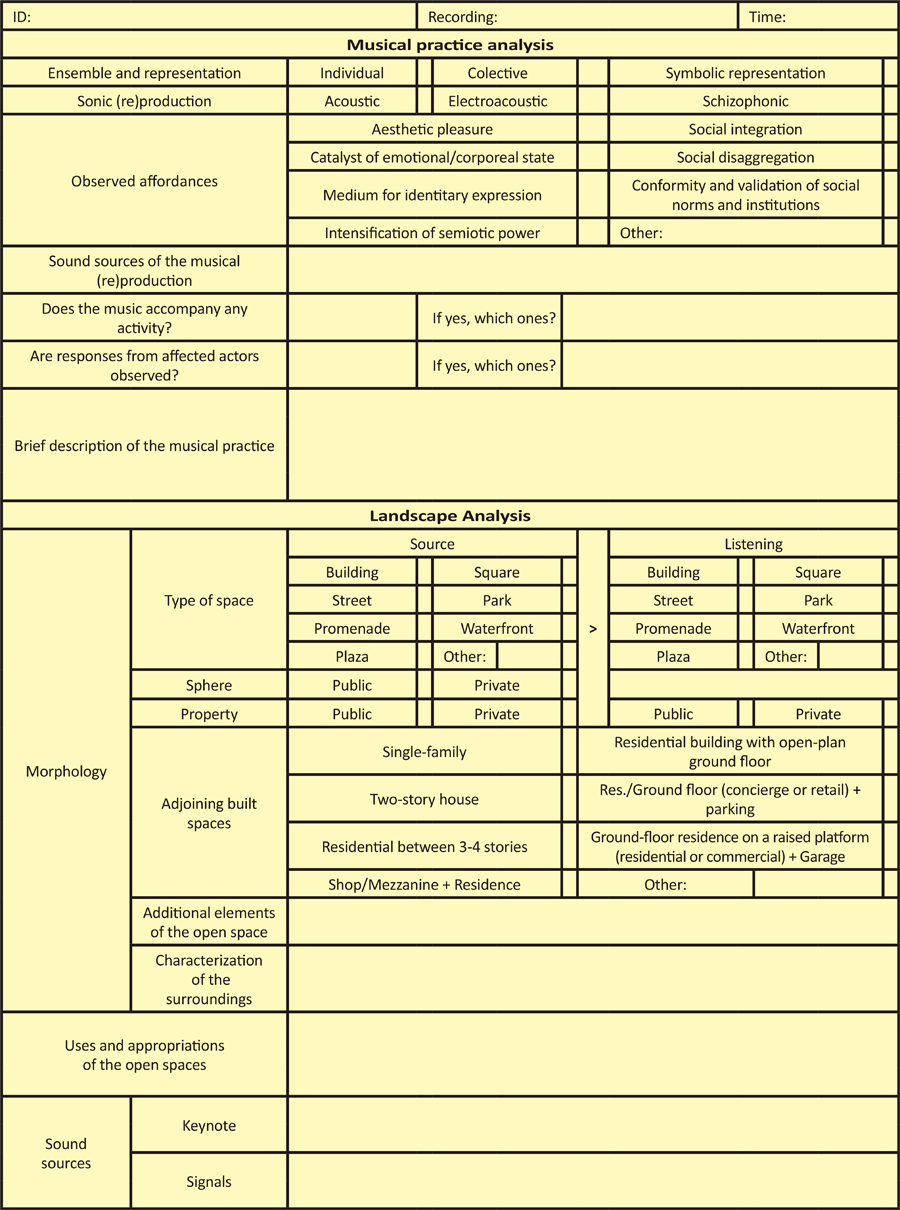
Finally, the fieldwork sheet, illustrated in Figure 1, is a descriptive instrument intended to be filled out for each observed musical practice. Its predefined items seek to facilitate the characterization of the practices and the surrounding urban space, divided into three sections: header, musical practice analysis, and landscape analysis. The header contains an identification code for the musical practice,6 the date, and the time when the route was carried out. The first two fields of the section on musical practice are categorizations of the musical actor, the one responsible for the musical (re)production, and refer to their organization and their form of (re)production, as discussed in Moriya Sampaio (2024). The field “sound sources of musical (re)production” serves to list and describe which instruments are used by the musical actors to express themselves sonically in space. Following this, there is a field intended to describe whether there are activities performed in conjunction with the musical practice and what they are, and another to indicate, if they exist, reactions and interactions of the musical practice with the actors affected by it. Lastly, a broader field serves to conduct a general characterization of the practice, mentioning perceived elements that were not covered by the previous fields and contributing to its contextualization.
Finally, the landscape analysis section presents three subsections that seek to characterize: the morphology of the surroundings of the observed practice, the uses and appropriations of the adjacent space, and the other sonic sources of the perceived soundscape. In the morphological part, the goal is to outline the type of open space, the nature of the contiguous built environment, and whether the space falls within the private or public sphere. In the soundscape analysis, the perceived sounds are also divided into background sounds (keynote sounds) and sound signals (sound signals), according to Schafer (1994).
Fieldwork experience: application and perceptions
Drawing upon the proposed methodological framework, I sought to apply it to the routes planned for the Catete-Glória Apac, indicated in Figure 2, and to the public open spaces predominantly characterized by active permanence, identified here as parks, squares, and plazas (largos). Among the routes, Route 1 presents the highest number of distinct public space appropriations, as it corresponds to the central hub of the neighborhoods and thus features a heavy pedestrian flow driven by commercial activities and connections to major transport modes. The other routes, 2 to 5, correspond to inner sections of the neighborhoods: 2 refers to the Outeiro da Glória hill; 3 to the streets of Glória that connect with the Santa Teresa neighborhood; 4 to Bento Lisboa and Pedro Américo streets; and 5 to the inner streets of Catete, situated between Routes 1 and 4. Among the open spaces of permanence, those with the highest appropriation are Largo do Machado, which hosts various commercial, leisure, and public events, and the gardens of the Museu da República, the only park within the study area, which also serves as a venue for events, particularly on weekends. Although Largo da Glória and Praça José de Alencar host events, they exhibit fewer everyday uses of permanence, serving primarily for transit. Praça do Poeta is the smallest open space of permanence within the APAC; it serves as an access point to a municipal school and is a fenced space appropriated for specific events.

Three fieldwork site visits were conducted, on September 12, 14, and 16, 2023, covering different periods of the day. Each field visit lasted between three and four hours, involving a selection of the delimited routes and open spaces of permanence. During these walks, I recorded each musical practice within the proposed instruments using a specific code, which I will list every time a practice is mentioned to maintain cohesion among the collected data. What I propose below is an account of the field experience during these three days, its repercussions on the proposed methodology, the data obtained, and the potential analyses that this approach can foster for research on music in the city.
On the first day of fieldwork, equipped with a mobile phone, a portable recorder, several printed sheets attached to a clipboard, and a pen, I entered the APAC in the mid-afternoon with the intention of completing all the routes in sequence. I began with Route 3, crossing the predominantly residential zone of Glória, where I encountered few musical practices. Only one bar on Santo Amaro Street was appropriating the sidewalk with a few tables (though without customers), while sertanejo songs bled from the interior of the establishment out into the street (230912_01_3_CG). Returning to Route 1 via Benjamin Constant Street, a motorcycle taxi driver (mototaxista) was listening to music from his mobile phone while waiting for customers at his stand (230912_02_3_CG). To these instances I owe my first recording attempts, which failed: in the first case, I lacked experience in adjusting the microphone sensitivity, and in the second, I was caught by the evanescent nature of sound, given that by the time I prepared the recorder, the musical actor in question had already stopped the music. This day also served for my initial attempts at filling out the fieldwork sheet I had prepared, which even yielded an interaction with a curious lady who wanted to know what the research was about; upon learning it concerned music, she attempted to voice her opinion by complaining about the lack of quality in today's radio music, concluding with: “I asked because, if it were about politics, I was going to speak my mind”.
Based on these initial experiences and those that followed, I began to adjust not only the methodology but also how I conducted myself in the field, the order and priority of the procedures I performed, and the way I interacted with both the studied musical actor and the surroundings, considering issues such as safety, for instance. During these three field visits, my methodological process gradually took shape. Recording became my number one priority, as I consider it important to auditorily represent practices whose primary interaction with the city occurs through listening. Next, I sought to photograph or, less frequently, video record the musical practice within its context, in order to facilitate the recognition and presentation of the typologies of practices I wished to propose. Once these capture processes were completed, I proceeded to map the practice within the georeferenced system and code it according to the system described in the methodology. Lastly, I would calmly fill out the fieldwork sheet in a nearby, less crowded spot, reflecting upon the items I had proposed to describe.
Another field-related issue was perceived immediately following this first experience. After Route 3, I decided to investigate Route 2, which corresponds to the Outeiro da Glória hill. This route was the only one I did not know in its entirety, as I had only ever walked it as far as the Outeiro, an architectural landmark in the region, whereas the proposal was a circular route through the hill's streets. Up to the familiar point, the route was progressing well, and I even encountered intense music while walking up the Glória slope, coming from the restaurant Bistrô da Casa which, despite being closed to the public, ambientated the slope with a blend of jazz and bossa nova (230912_03_2_CG). However, past the Outeiro, I noticed that the streets emptied out, and the very streets I had previously observed on satellite imagery and deemed to be ordinary streets were actually alleys walled on both sides with zero pedestrian or vehicular traffic. In short, I encountered early on the issue of not feeling safe along a portion of the route I had proposed to study, a circumstance that can occur during field explorations, particularly in areas with which I am less familiar. Ultimately, I chose to truncate the route to cover the high-traffic area, considering that the rejected segment is essentially residential and exhibited very little appropriation of public open space. It is worth noting, however, that this segment possessed an unusual silence for the region of the studied neighborhoods, which typically feature a busy and, to some extent, chaotic soundscape due to heavy pedestrian and vehicular traffic (Axelsson, Nilsson, and Berglund, 2010; Monteiro Antunes et al., 2023).
In contrast to these last two routes, I proceeded to Route 1, which encompasses Glória Street and Catete Street. I already knew from personal experience that these streets were intensely appropriated by different social practices, including many musical ones, such as music emanating from commercial establishments and street artists. Along this route, I began to notice the first patterns that I subsequently considered to be types, as I encountered several shops that placed their loudspeakers at the entrance of the building to attract customers7 (230912_04_1_CG; 230912_05_1_CG; 230912_06_1_CG; 230912_07_1_CG; 230912_08_1_CG; 230912_09_1_CG; 230912_13_1_CG), street vendors who had smaller loudspeakers hanging from their stalls (230912_10_1_CG; 230912_12_1_CG), and street musicians (230912_11_1_CG; 230912_15_1_CG) with different instruments and repertoires.
On the other hand, by having my listening confronted by many musical practices in sequence, I began to question which practices were truly significant for recording and subsequent analysis. Some musical reproductions, such as those from certain street vendors, were barely audible, even more so in contexts of intense vehicular traffic as in the case of Catete Street. Therefore, I could have disregarded them, given that their impact on the urban public sphere would be minimal. However, had I done so, I would be discounting the unique character of each practice, which, through those actors within a specific urban context, found a use for music. I concluded that it would be difficult to draw a threshold of what would be relevant or not for the research, and I decided to record all practices that reached my listening and minimally impacted, either through sound or the activity performed, the surrounding public. This leads to another issue regarding the repetitiveness of certain practices and the need to reapply the entire fieldwork methodological process to each occurrence. Along Route 1, I encountered several businesses that displayed the same sound reproduction configuration within a similar urban context, which yielded a collection of fieldwork sheets that differed very little from one another. Nonetheless, noting a few particularities of each situation subsequently helped me discern patterns that I considered distinct types. At this juncture, typologies can serve as a facilitating element of the process, as they allow for the synthesis of common characteristics. A modification to the fieldwork sheet could enable the identification of a previously cataloged type, requiring only the description of any outstanding particularity, thus avoiding the repetitiveness of the process.
Returning to the itinerary, I made a final route through Largo do Machado, one of the spaces of permanence, finding no musical practice during the early evening. Ultimately, on this first day of fieldwork, with my field sheets exhausted, I returned before completing all the planned routes, realizing that covering all of them would take more time than I had anticipated, mainly due to routes like the first one, which contain a high amount of musical activity.
The second and third days proceeded more fluidly. During the second visit, I attempted to cover the other open spaces of permanence and Routes 4 and 5, which had not yet been completed, while also revisiting Route 1. I went in the morning, encountering fewer businesses with loudspeakers than during the late afternoon period of the previous visit, observing a "quieter" Route 1 in terms of music. Midway through this route, I walked through the gardens of the Museu da República, which features explicit rules regarding sonic behavior at its entrance, indicating on a sign that loud sound (re)production is not permitted. Indeed, I did not encounter any individual (re)producing music, but there was a collective of women guided by a Black man on the southern edge of the park performing a bodily practice, which I perceived as physical exercise, with a loudspeaker reproducing, on loop, a voice and music recording (230914_02_MR_CG). This practice did not impact a large portion of the park due to its open-field condition and vegetation, but it was sufficient to attract curious glances and affect children's activities taking place in the nearby space.
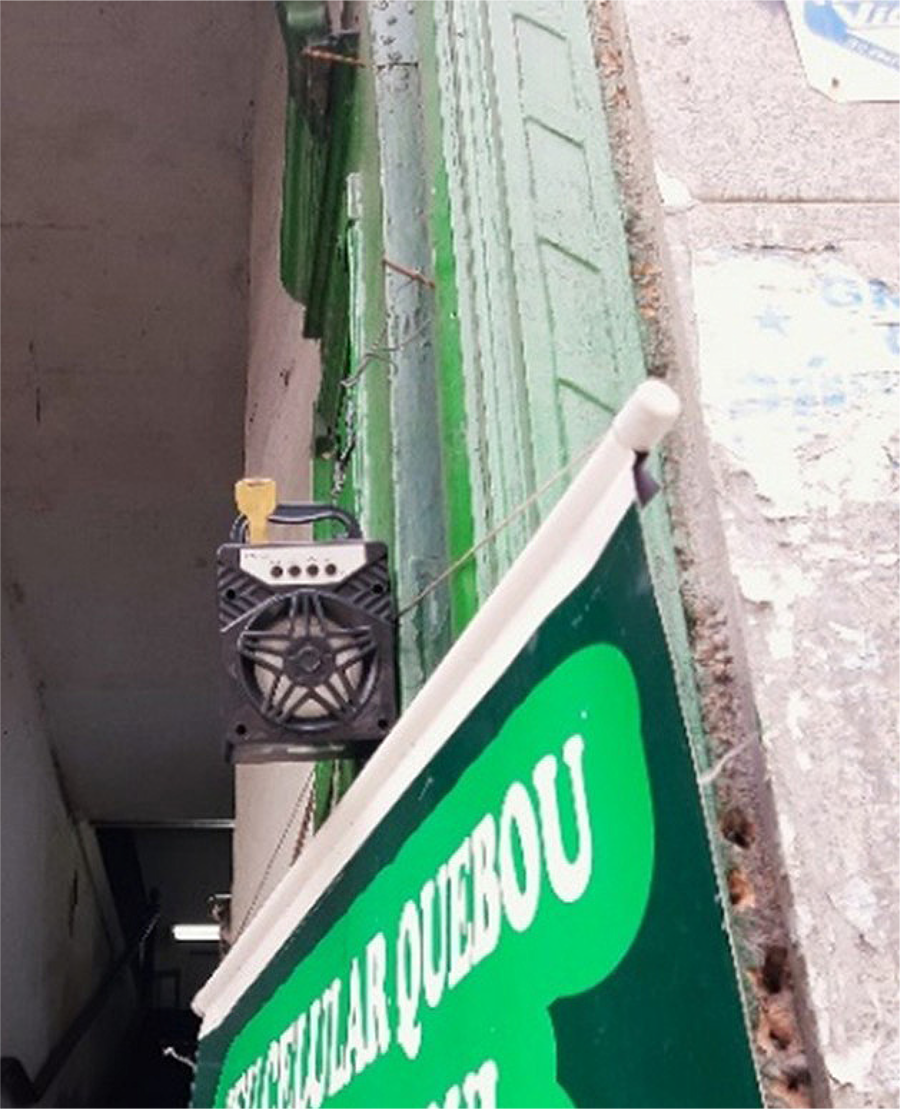
Returning to Route 1, I completed it to the end and then returned to Largo do Machado to begin Routes 4 and 5. Once again, I found it with little musical activity, only coming across an elderly White man sitting next to the flower shop, listening to music from his mobile phone (230914_07_LM_CG). Routes 4 and 5 also did not present much activity, at least during this period of the day; Route 5 was predominantly residential with its bars still showing little activity, and Route 4 had only one shop and one bar with indoor loudspeakers (230914_08_4_CG; 230914_09_4_CG). Returning to Route 1 heading toward Glória, I curiously found a small loudspeaker at the entrance of a two-story traditional townhouse (sobrado) featuring a commercial poster, advertising its services alongside a snippet of electronic music, as illustrated in Figure 3. Two facts caught my attention: the full use of reproduction as a form of communication without the need for human presence, and the attempt to induce affected people not to take the loudspeaker, which was left alone, by using a key-shaped flash drive to simulate a locking mechanism (230914_10_1_CG).
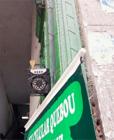
– Example of a schizophonic musical practice, with a speaker left outside a commercial building
The third field visit was the only one that took place on a weekend day and featured more diversified musical activity. Between the mid-afternoon and early evening, I covered Route 1, the open spaces of permanence, Route 4, and part of Route 5. The first musical activity I encountered at the beginning of Catete Street was the only one found that suggested the function of music for conformity to and validation of social norms and institutions, as described by Merriam (1964). I found a large group of approximately 50 people, men and women of all ages, singing religious songs (louvores) in a large choir accompanied by guitar, tambourine (pandeiro), and trumpet (230916_01_1_CG). The musical practice belonged to the Maranata Evangelical Church and was intended to evangelize people in the public space in an itinerant format. They were wearing uniforms, and the music guided the faithful in a carnival-block (bloco) formation; some fell behind to converse, mainly with passersby and street vendors.
Subsequently, another relevant musical practice was the performance of a singer (230916_04_1_CG), an elderly White man who performed with a microphone and a loudspeaker reproducing the backing tracks for his singing on the sidewalk opposite the Museu da República, a spot where, during the first field visit, I had already encountered a saxophonist performing. Certainly, this recurrence of performances was not accidental, as several factors converged there to contribute to the street musician's activity: the widened sidewalk, the high pedestrian flow, the proximity to the entrance of an important transport hub (the Catete subway station), and a tourist landmark of the city, the aforementioned museum. Additionally, I noticed that the surrounding bars and restaurants took advantage of this musical practice as entertainment, and the traffic light waiting time was relatively long, providing amusement to passersby while they waited. Another interesting fact regarding this singer's performance was the considerable sound level of his loudspeaker, which was sufficient to be heard from adjacent blocks and to mask the surrounding vehicular traffic noise, thereby representing a significant alteration in the soundscape of those in the vicinity.
Two other key points also characterized the weekend dynamics when compared to previous field visits: musical performances at events within the open spaces of permanence and the presence of musicians performing in bars. Both the gardens of the Museu da República and Largo do Machado exhibited a completely different dynamic due to the events they were hosting. In the former, the “Festival do Café” (Coffee Festival) was taking place, bringing a heavy flow of movement among stalls, as well as an intense use of the lawn for permanence. Within it, there was the “Lounge Agricultura Familiar”, which consisted of a large tent with tables, chairs, and a stage where four musicians played, using an amplified lineup of acoustic guitar, cavaquinho, pandeiro, and transverse flute (230916_06_MR_CG), performing some classic samba and bossa nova songs. The tent was located near the park's edge, and since the performance was electroacoustic and connected to a large loudspeaker, it was audible from a large portion of the park and likely from the residential buildings bordering it, contrasting with the aforementioned rule against “loud (re)production.” Closer to the museum itself, another musical practice in the form of a performance was occurring, featuring a group of elderly people singing and playing songs for a large audience seated on plastic chairs and standing (230916_05_MR_CG). This practice did not seem linked to the event, but it certainly took advantage of its audience, even while displaying a much smaller acoustic impact since it was unamplified. I later discovered that this practice corresponded to the weekly serenades (serestas) that occur in this space, reported in detail by Versiani (2020). At Largo do Machado, another event, “Aqui tem – Largo do Machado,” occupied its central portion; in addition to a structured stage featuring a performance by the ensemble Samba Delas (230916_08_LM_CG), it included a tent with chairs for the audience and several food and drink stalls around the perimeter, which served as boundaries for the performance territory. Interestingly, the practice ended up extending beyond these boundaries, as several people sat on the fountain located behind the stage to listen, and homeless individuals staying under the trees also listened intently to the music being played, occasionally standing up to enter the physical territory formed by the tents and stalls to dance.
The presence of “bar musicians” (músicos de barzinho) was especially noted along Routes 4 and 5 (230916_09_4_CG; 230916_10_5_CG; 230916_12_1_CG), which had previously shown little musical activity. Along these routes, some bars were found that hired musicians, primarily in the amplified voice-and-guitar format, to play on the appropriated portion of the sidewalk. This practice is particularly significant for areas such as the one covered by Route 5, which comprises predominantly residential streets, presenting a drastic change in the surrounding acoustic environment. It is perceptible, therefore, that the weekend urban dynamics of this Apac are structured through events linked to both the public and private spheres, serving as poles of musical territorialities.
Finally, the three completed field visits allowed for fine-tuning the structure of the methodological process and the perception of certain factors influencing the musical dynamics of the APAC. Although a deeper analysis of the study area demands a larger sample size of the practices occurring across the different open spaces and routes, the obtained data provided a dataset that enables a primary proposal for analysis aimed at the proposed objectives, which I develop below.
Spatial and musical typology: potential results
Based on the fieldwork sheets and recordings collected, I transcribed my perceptions of the musical practices and their urban environments into a single matrix, which sought to systematically arrange every factor observed in the field. Rather than merely transcribing what had already been noted during the routes, the matrix also serves as a document that links, via the code assigned to each encountered practice, the reported accounts with the georeferenced mapped points, to be used in a Geographic Information System (GIS) to structure the analyses. With this in mind, the fields filled in the matrix feature a slightly different configuration from the fieldwork sheet; fields previously marked with an “x” were replaced with “1” or “0,” corresponding to the boolean logic read by computer programs. Two additional fields seek to synthesize the date and time information, distinguishing respectively between weekday or weekend, and the time period among morning, afternoon, or night. Additionally, the captured recordings were organized, from which the best were selected, edited for clarity, and made available on the SoundCloud platform.8 The tracks correspond to the codes assigned to the practices, and listening is suggested alongside the reading of the text, as I indicate which practice I am referring to with the code in parentheses.
The first stage of analysis corresponds to identifying patterns within the types of practices encountered. This is also facilitated by the matrix structure and was conducted by examining the characteristics of the musical actors, the source of sound production, and the context of their music appropriation line by line. Considering the field experience and the noted perceptions, each practice was categorized either as a new type or as one already classified, resulting in the types shown in Chart 1. These were organized into three columns for coding, structured according to the nature of the musical actor responsible for the sound production into: individual (I), when only one actor operates upon the sound sources; collective (C), when two or more appropriate sources for sonic articulation and represent larger structures; and representative (R), when no direct agency of specific actors is observed in the practice, thereby representing an institution or organization. Below, I briefly describe and exemplify each type found during the fieldwork.
Within the individual category, four patterns were found. Type I1 corresponds to the actor who utilizes a schizophonic sound reproduction to structure a specific activity, such as amusement/entertainment during a break (230912_02_3_CG; 230914_07_LM_CG; 230916_03_1_CG) or bodily activities such as walking (230914_04_1_CG) and cycling (230916_11_1_CG). They typically employ a portable loudspeaker which, in cases involving transit, is carried by the actor themselves. It is primarily appropriated for its function as a catalyst of emotional/bodily states (Merriam, 1964). The patterns I2 and I3 correspond to the individual who performs as a street musician – that is, who offers a performance in exchange for donations and/or the sale of a product, in addition to promoting their image as a musician in public spaces not designed for their performance. In both types encountered, the individuals played melodic instruments accompanied by pre-recorded backing tracks reproduced by transportable loudspeakers. In I2, the musician played the instrument acoustically, corresponding therefore to instruments with greater acoustic projection, such as the violin (230912_11_1_CG) and the saxophone (230912_15_1_CG). In I3, the instrument used is amplified by the same loudspeaker, allowing for instruments with less projection, as in the case of the singer who sings into a microphone (230916_04_1_CG). Lastly, I4 corresponds to the individual who performs electroacoustically but is tied to a specific private space, such as a bar or restaurant. This is the case of the “bar musician” (230916_10_5_CG; 230916_12_1_CG), who frequently performs singing and accompanying themselves with a harmonic instrument such as a guitar or keyboard.
Within the category of collectives, I found seven distinct patterns throughout the fieldwork. C1 and C2 correspond to musical practices that utilize music to structure a specific activity, being similar to I1. The difference lies in the type of source used, which in the case of C1 is acoustic, as with the religious group (230916_01_1_CG); and in C2 is schizophonic, as with the bodily practice group in the park of the Museu da República (230914_02_MR_CG). Type C3, which I characterized as “in rehearsal,” refers to the case of musicians studying a repertoire within the public space. During the fieldwork, I encountered this type only once, in a trio (230916_13_1_CG) who, seated at a restaurant table on the sidewalk, were playing some choro songs acoustically, without concerning themselves with whether they were heard by passersby, yet attracting glances and comments. The C4 pattern corresponds to street musicians like I2 and I3, but in the encountered instance (230916_14_1_CG), they performed acoustically without schizophonic reinforcement, which is facilitated by the collective factor. C5 and C6 relate to collectives performing within the context of a musical event hosted in public space and belonging to the public sphere, given that it is freely accessible. Both types were found only over the weekend within the open spaces of permanence, in the cases previously described for the gardens of the Museu da República and Largo do Machado, occurring respectively in an acoustic format (230916_05_MR_CG), corresponding to C5, and an electroacoustic format (230916_06_MR_CG; 230916_08_LM_CG), corresponding to C6. Type C7 is similar to I4, referring to musicians with performances tied to a private space using electroacoustic sound sources, such as the voice/guitar and cajon musical duo found along Route 4 (230916_09_4_CG).
Lastly, four types were defined for representative actors, with R1 corresponding to a private space whose schizophonic sound source is positioned inside a building, reaching the public through its acoustic permeability—often intentionally, through the appropriation of the public by the private, as seen with the tables in the case of the bar on Santo Amaro Street (230912_01_3_CG) and Pedro Américo Street (230914_09_4_CG). Other encountered cases without the appropriation of public space have less sonic impact on this space, such as the tobacconist on Bento Lisboa Street (230914_08_4_CG), or as much impact as the closed restaurant on the Glória slope (230912_03_2_CG). The R2 and R3 patterns correspond to private spaces with schizophonic loudspeakers located on their boundary with the public space, usually positioned right at their entrance (Figure 4). These were the most frequently encountered types, primarily due to the intense commerce along Route 1, together accounting for 34% of the musical practices found. The difference between the two types is that while in R2 there is only a loudspeaker reproducing a specific playlist of a given musical genre – such as sertanejo (230912_07_1_CG), pop (230912_13_1_CG; 230914_05_1_CG), or pagode (230914_03_1_CG), or a radio station (230912_06_1_CG; 230912_14_1_CG; 230916_02_1_CG) – in R3 one finds, alongside the musical reproduction, an announcer with a microphone,9 that is, an electroacoustic source that at certain moments interacts with the music, drawing upon its rhythm or melody (230912_04_1_CG), or merely overriding it, announcing products and the business in question (230912_08_1_CG). Finally, R4 resembles the previous types but is linked to street or informal commerce, which already physically appropriates public space with collapsible stalls (230912_10_1_CG; 230912_12_1_CG) or fixed structures such as locksmith booths (230914_01_1_CG) or newsstands (230916_07_1_CG). It is observed that those who make use of a smaller, collapsible structure have a relatively small sonic impact on the public, whereas the case of the newsstand, which possesses a larger infrastructure, already presents a greater impact.

– Types R2 and R3, corresponding to private spaces with schizophonic sources on the public/private boundary, encountered along Route 1
Having categorized the different ways in which actors express themselves musically in space, it is also part of this work to perceive their relationships with the varied forms and uses of the public spaces in which they are heard, observing how these patterns of musical activity correlate with spatial patterns. The most evident variation across the studied area refers to the morphological type. Within the Catete-Glória Apac, it was possible to distinguish three types: (1) the park, corresponding solely to the gardens of the Museu da República, embedded within the urban fabric, surrounded by residences and commercial establishments, and used primarily for leisure; (2) the streets, which can be further differentiated into predominantly residential and predominantly commercial; (3) the squares and plazas, open spaces of permanence adjacent to the urban fabric, such as Largo do Machado, Largo da Glória, Praça do Poeta, and Praça José de Alencar.
Among these spaces, certain factors were found to exert a significant influence on the musical practices present within them. The first is the presence of the largest group of reproducing actors within the study area near commerce, as previously elucidated. The predominant appropriation of space and its possibilities due to the presence or absence of urban furniture is another factor. Spaces that allow for greater permanence, either because private establishments like bars and restaurants appropriate the sidewalk and street, or because they feature benches, low walls, marquees, trees, among other urban, architectural, and landscape elements that promote comfortable conditions for staying, are evidently more susceptible to the presence of musical practices involving sound production (such as street musicians or commercial announcers). Places characterized almost exclusively by transit exhibited significantly less musical activity.
Another factor heavily influencing musical practices is the proximity to a high-flow transit hub, such as a subway entrance, and proximity to an urban landscape landmark, such as the Catete Palace (Palácio do Catete) in this case, which attracts activities like tourism and events. These conditions create opportunities for street musicians, in particular, to reach a larger audience; it was observed that these actors are fully aware of these spatial conditions. The collective nature of the practices is also directly related to the collectivity suggested by the space. Spaces naturally intended for permanence, such as the park, squares, and plazas, host most of the collective practices, whereas streets host most of the individual and representative practices.
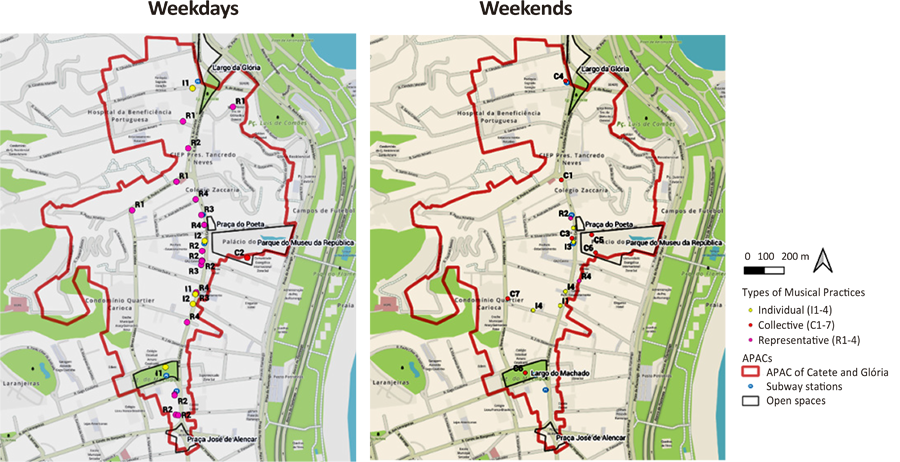
Cartographic analysis facilitates the visualization of the discussed spatial patterns. Based on the matrix and the aforementioned codes, it is possible to leverage their georeferenced locations marked during the fieldwork to produce cartographies like the one in Figure 5. Within it, the types of practices perceived on weekdays were separated from those on the weekend, allowing for the discernment of certain patterns, such as the concentration of musical practices on Catete Street compared to the other routes. This is due to its condition as a predominantly commercial street with high pedestrian flow, access to transit hubs, and its hosting of city tourist attractions. While representative manifestations are found across all routes except Route 5, certain tendencies are noted for the other types: individuals are concentrated primarily on Catete Street between the Museu da República and Largo do Machado, whereas collectives are mostly found in and around open spaces of permanence. It is also noticeable that a larger number of representative manifestations occur on weekdays compared to the weekend, which, conversely, featured a considerably higher number of collective manifestations than weekdays. Furthermore, a concentration of practices is perceptible on predominantly commercial streets, especially at points offering greater possibilities for permanence.

– Types of musical practices found on weekdays and weekends, with their respective locations mapped in GIS
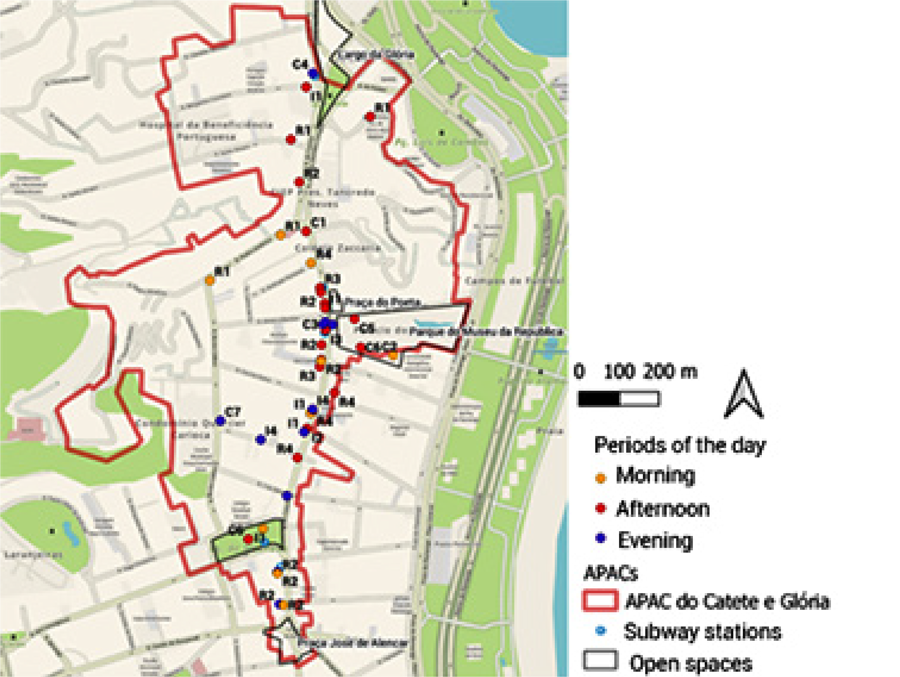
Two other analytical cartographies are shown in Figures 6 and 7, which illustrate the potential of cross-referencing data by incorporating the matrix into the GIS. In the first case, it is possible to observe which types of practice occurred during each period of the day – a correlation that, with a larger sample size, can offer interesting insights into the relationship between music and the temporal dynamics of the city. In this manner, one can cross-reference the encountered practices with other data, such as the day of the week and the sound sources used.
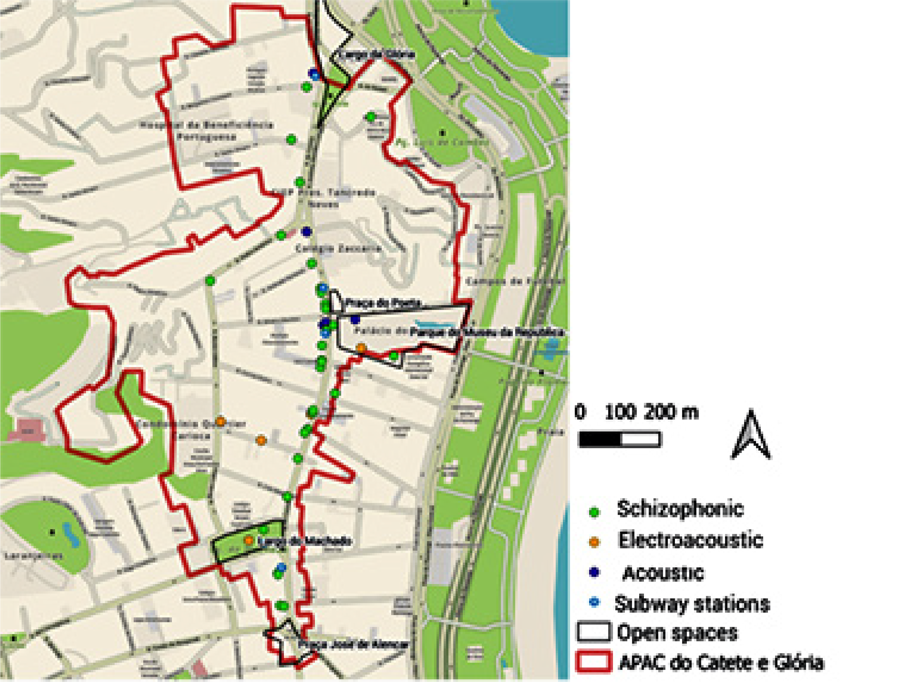
In the second case, one can verify the types of sound sources of each practice arranged on the map. The issue within this type of cartography is that a given practice may not correspond solely to one type of source, being simultaneously acoustic and schizophonic, as in the case of types I2 or I3, for instance. For this specific parameter, the sound source type, I proposed a hierarchy in the cartography, preferring to display schizophonia over electroacoustic sources, and lastly, acoustic ones. Consequently, types I2 and I3 appear as schizophonic sources rather than acoustic or electroacoustic ones.
This issue is significant because a schizophonic source does not necessarily possess a greater impact on the acoustic environment than a solo instrument, which corresponds to an acoustic or electroacoustic source. However, producing three different cartographies corresponding to each type, or creating different categories corresponding to each different combination (which, in this case, total seven), might complicate the analysis even further. At any rate, regarding the sources, a hegemony is perceptible, in which they are exclusively, or also, schizophonic, primarily along the central axis of Catete Street. Very few manifestations are essentially acoustic, and electroacoustic ones occur solely in event performances or by musicians in bars.
Other types of cartographic analysis are also possible, such as Kernel density maps, which would verify the concentration of practices in space, contributing to the subsequent identification and characterization of places with intense musical activity. Therefore, I see great potential for collaboration between a cartographic analysis, allowing a macro perspective over the territory of the Apacs, and the ethnographic observation from the fieldwork, which, once recorded, enables subsequent consultation and investigation into why certain practices concentrate in or favor specific places.
Conclusion and final remarks
Finally, it is perceptible that the Catete-Glória Apac exhibits intense musical activity, particularly along the structural axis corresponding to Route 1. This route not only encompasses the streets with the highest appropriation and the central hubs of the neighborhoods, but also the streets that connect the Apac's open space system and its main transit hubs. On one hand, this intensity of public open space appropriation for cultural practices such as music, and its relationship with built and open spaces of high value for social life and urban heritage, confirms that the choice of Apacs as a spatial delimitation is relevant for the research, as it condenses different forms and relationships of urban actors with the musical sphere and spaces. On the other hand, if we consider the urban context surrounding the Apacs, one must be aware that it borders, for instance, regions of social vulnerability, such as the favelas present in Catete. It is essential to keep in mind that the spatial delimitation is not hermetic and that, even if these adjacent territories are not physically studied, the social actors who express themselves within the addressed territory may have relationships with them, and even with other territories within the city of Rio de Janeiro. In this manner, it is important, as the research progresses, to forge these urban connections between territories that are diverse and distant (spatially, economically, culturally), yet tied together within the flows of the same municipality.
At this point in the research, I do not intend to assume that the methodological application thus far can describe the musical landscape within the Apac in question in its entirety. To achieve this, further field visits are required, featuring greater variability across different days of the week and distinct periods of the day, thereby fostering a more comprehensive reading of the musical landscape within the investigated area. Nonetheless, within the limited sample collected so far, the potential of the proposed method is evident, as it highlights certain issues, such as the absence of musical practices in traditional open spaces of permanence outside of event situations, and portions of the street that bubble with musical life, particularly in the vicinity of transit and landmarks. Deepening this type of observation is fundamental in the next steps of the research, which becomes possible through the continuous application of the method to achieve a larger sample size, as well as through its redesign to meet the research objectives. Based on this, the aim is then to establish correlations that enable a reading of the intersections between music and the city.
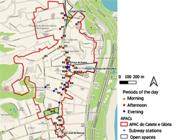
– Cross-referencing of data among types of musical practice, period of the day, and their locations.

– Types of sound sources for each perceived practice – hierarchized in the order of schizophonic (1st), electroacoustic (2nd), and acoustic (3rd)
Acknowledgments
This work was carried out with the support of the Coordination for the Improvement of Higher Education Personnel (Capes) – Financing Code 001, grant number: 88887.661461/2022-00.
References
- AXELSSON, Ö.; NILSSON, M. E.; BERGLUND, B. (2010). A principal components model of soundscape perception. The Journal of the Acoustical Society of America, v. 128, n. 5, pp. 2836-2846.
- CARERI, F. (2013). Walkscapes: o caminhar como prática estética São Paulo, G. Gili.
- CARLOS, C. A. S. L. (2008). Áreas de proteção do ambiente cultural (APAC): da idealização à banalização do patrimônio cultural carioca. Rio de Janeiro, Universidade Federal do Rio de Janeiro.
- DE NOTARIS, D.; SAVONARDO, L. (2022).The digitalization of sound: how the consumption of music changed from vinyl to hybrid experiences. Italian Sociological Review, v. 12, n. 1, pp. 159-183.
- DENORA, T. (2004). Music in everyday life Cambridge, Cambridge University Press.
- DI FELICE, M. (2009). Paisagens pós-urbanas: o fim da experiência urbana e as formas comunicativas do habitar São Paulo, Annablume.
- HAESBAERT, R. (2007). Território e multiterritorialidade: um debate. GEOgraphia, v. 9, n. 17, pp. 19-46.
-
JACQUES, P. B. (2003). Breve histórico da Internacional Situacionista - IS. Arquitextos, v. 3. Disponível em: https://vitruvius.com.br/revistas/read/arquitextos/03.035/696#:~:text=Os situacionistas chegaram a uma,a arquitetura e o urbanismo Acesso em: 6 fev 2024.
» https://vitruvius.com.br/revistas/read/arquitextos/03.035/696#:~:text=Os situacionistas chegaram a uma,a arquitetura e o urbanismo - KANG, J.; SCHULTE-FORTKAMP, B. (2016). Soundscape and the built environment. Boca Raton, CRC Press.
- KASSABIAN, A. (2013). Ubiquitous Listening: affect, attention, and distributed subjectivity. Berkeley, University of California Press.
- LABELLE, B. (2018). Sonic agency: sound and emergent forms of resistance Londres, Goldsmiths Press.
- LAPLANTINE, F. (2003). Aprender Antropologia São Paulo, Brasiliense.
-
LYNCH, K. (2011). A imagem da cidade São Paulo, Martins Fontes. Disponível em: http://www.academia.edu/download/36841750/kevin_lynch_the_image_of_the_city.pdf%0Ahttps://books.google.com/books?hl=en&lr=&id=_phRPWsSpAgC&oi=fnd&pg=PA1&dq=kevin+lynch+image+of+the+city&ots=jHD46g4ylj&sig=EmklPRW0l8o5h5hbLbL11LOEc9U#v=onepage&q=kevin lync Acesso em: 6 fev 2024.
» http://www.academia.edu/download/36841750/kevin_lynch_the_image_of_the_city.pdf%0Ahttps://books.google.com/books?hl=en&lr=&id=_phRPWsSpAgC&oi=fnd&pg=PA1&dq=kevin+lynch+image+of+the+city&ots=jHD46g4ylj&sig=EmklPRW0l8o5h5hbLbL11LOEc9U#v=onepage&q=kevin lync -
MAASØ, A.; HAGEN, A. N. (2020). Metrics and decision-making in music streaming. Popular Communication, v. 18, n. 1, pp. 18-31. DOI 10.1080/15405702.2019.1701675. Disponível em: https://www.tandfonline.com/doi/full/10.1080/15405702.2019.1701675#abstractDOI Acesso em: 30 mar 2026.
» https://doi.org/10.1080/15405702.2019.1701675» https://www.tandfonline.com/doi/full/10.1080/15405702.2019.1701675#abstractDOI - MAGNANI, J. G. C. (2002). De perto e de dentro: notas para uma etnografia urbana. Revista Brasileira de Ciências Sociais, v. 17, n. 49, pp. 11-29.
- MERRIAM, A. P. (1964). The anthropology of music Evanston, Illinois, Northwestern University Press.
- MONTEIRO ANTUNES, S. et al. (2023). A European and Brazilian cross-national investigation into the Portuguese translation of soundscape perceptual attributes within the SATP project. Applied Acoustics, v. 211.
- MORIYA SAMPAIO, L. Y. (2024). Entre atores musicais, (re)produções e disputas urbanas. Paranoá, v. 17, n. e42411, pp. 1-15.
- NETTL, B. (2005). The study of Ethnomusicology: thirty-one issues and concepts Urbana, University of Illinois Press.
- OLIVEIRA, A. L. de (2008). Música e vida urbana: encontros e confrontos na cidade do Rio de Janeiro (1990-2008) Rio de Janeiro, Universidade Federal do Rio de Janeiro.
- RADICCHI, A. (2017). A pocket guide to soundwalking. Some introductory notes on its origin, established methods and four experimental variations. Atmosphere and Perception, pp. 70-73.
- REQUIÃO, L. P. de S. (2008). "Eis aí a Lapa...": processos e relações de trabalho do músico nas casas de shows da Lapa. Universidade Federal Fluminense.
- RHEINGANTZ, P. A. et al. (2009). Observando a qualidade do lugar: procedimentos para a avaliação pós-ocupação Rio de Janeiro, Coleção Proarq.
- RIO, J. do (1908). A alma encantadora das ruas Rio de Janeiro.
- SCHAFER, R. M. (1994). The soundscape: our sonic environment and the tuning of the world Rochester, Vermont, Alfred Knopf, Inc.
- SCHAFER, R. M.; DAVIS, B.; TRUAX, B. (1977). Five village soundscapes. The Music of the environment series, n. 4, p. 84.
- SEVERIANO, J. (2017). Uma história da música popular brasileira São Paulo, Editora 34.
- SMALL, C. (1998). Musicking: the meanings of performing and listening Middletown, Wesleyan University Press.
- TINHORÃO, J. R. (2013). Os sons que vêm da rua São Paulo, Editora 34.
- TRUAX, B. (1984). Acoustic communication Norwood, Ablex Publishing Corporation.
- VERSIANI, M. H. (2020). Meu coração bate feliz: seresta do museu. Rio de Janeiro, Instituto Brasileiro de Museus.
- WESTERKAMP, H. (1974). Soundwalking. Sound Heritage, v. 3, n. 4, pp. 18-27.
- ZAN, J. R. (2001). Música popular brasileira, indústria cultural e identidade. EccoS Revista Científica, v. 3, n. 1, pp. 105-122.
Notes
-
1
I prefer to use the term "musical practice" rather than "music," as is customary in Ethnomusicology, to highlight its nature as a sociocultural practice performed by social actors, contrasting with the traditional understanding of music as an artistic work.
-
2
Apacss are urban planning legislation tools of the Municipality of Rio de Janeiro, first defined in the 1992 Master Plan, dedicated to preserving and protecting the cultural landscape, identity, and memory of the delimited territory. They were selected as the study area due to their objective of valuing their ambiance and historical relationship with those who inhabit and identify the space, in addition to encompassing different types of open spaces. For further details, see Carlos (2008).
-
3
The Catete and Glória APAC was established by Decree n. 25,693 of August 23, 2005, and its delimitation was complemented by Decree n. 28,222 of July 26, 2007.
-
4
Characterized by Rio (1908, p, pp. 2-3) as “to be a vagabond and reflect, to be a gawker and comment, to have the virus of observation linked to that of vagrancy”, “to go about, in the morning, by day, at night, to mingle in the crowds of the populace,” and “it is the distinction of roaming with intelligence. There is nothing like the useless to be artistic.”
-
5
A method employed by members of the Situationist International movement consisting of "wandering aimlessly" in order to apprehend the city, aligned with the philosophy of the movement that society and everyday life should govern architecture and urban planning, and not the contrary (Jacques, 2003).
-
6
The identification code (ID) uniquely represents each encountered musical practice to enable the organization of the produced archive and the correlation with data collected by the other instruments. Its structure follows the pattern: YYMMDD_NN_RC_AP, in which YYMMDD is year, month, and day; NN is the number of the practice found on that day, starting at 01; RC is the route code, pre-established with numbers for each segment and with acronyms for the open spaces of permanence; and AP is the predefined code of the investigated APAC.
-
7
The belief in the power of music to attract customers was unanimous among the vendors in the region, with many mentioning that they observed approval of the musical material by seeing customers “dance” to the sound of the music.
- 8
-
9
During conversations during the fieldwork, I was told that in certain businesses, when an announcer is present, it is they who control the music that plays during their announcement.
-
Declaração de disponibilidade de dados:
The dataset supporting the results of this study has been published within the article itself.
-
Editors:
Lucia Bógus andLuiz César de Queiroz Ribeiro
The dataset supporting the results of this study has been published within the article itself.

 Source: prepared by the author, in 2023.
 Source: prepared by the author, in 2023.
 Source: author’s collection, in 2023.
 Source: author’s collection, in 2023.
 Source: prepared by the author, in 2023.
 Source: prepared by the author, in 2023.
 Source: prepared by the author, in 2023.