 Intervention characteristics and speech therapy strategies in care for autistic children in health services: a scoping review
ABSTRACT
Purpose to identify and systematize speech therapy practices with autistic children in healthcare services reported as an evaluative and therapeutic strategy in Brazil.
Research strategies a scoping review following the guidelines of the Joanna Briggs Institute and PRISMA-ScR. Articles, essays, reviews, and gray literature available until July 4, 2024, were retrieved from databases such as PubMed, Scielo, Scopus, Web of Science, ProQuest Central, Embase, EBSCOhost, BVS, BDTD, and Google Scholar. Reference lists and relevant systematic reviews were also checked for additional documents.
Selection criteria based on the PCC format (Participants: autistic children aged 2 to 12 years; Concept: speech therapy assessment and treatment strategies; Context: Brazil).
Data analysis data were extracted using a pre-designed matrix considering author, type/year of publication, objective, sample, autism concept, type/strategy of intervention, setting, and conclusion. Descriptive quantitative and qualitative analyses were performed.
Results a total of 49 studies were included in the review, allowing the identification that speech therapy practices targeting autistic children in Brazilian healthcare services predominantly involve therapeutic and evaluative approaches, mainly carried out in university clinics.
Conclusion although speech therapy has advanced in the personalization of care and adaptation of therapeutic strategies, there is still a predominance of interventions focused on diagnosis and rehabilitation, with a limited number of studies addressing health promotion and social inclusion actions.
Keywords:
Autism; Autism Spectrum Disorder; Rehabilitation of Speech and Language Disorders; Speech-Language Pathology; Brazil
RESUMO
Objetivo Identificar e sistematizar a prática fonoaudiológica com crianças autistas em serviços de saúde relatadas enquanto estratégia avaliativa e terapêutica no Brasil.
Estratégia de pesquisa Revisão do tipo escopo seguindo as diretrizes do Joanna Briggs Institute e PRISMA-ScR. Artigos, ensaios, revisões e literatura cinzenta disponíveis até 4 de julho de 2024 foram recuperados em bases como PubMed, Scielo, Scopus, Web of Science, ProQuest Central, Embase, EBSCOhost, BVS, BDTD e Google Acadêmico. Listas de referências e revisões sistemáticas relevantes também foram verificadas para documentos adicionais.
Critérios de seleção Baseados no formato PCC (Participantes: crianças autistas de 2 a 12 anos; Conceito: estratégias de avaliação e terapia fonoaudiológica; Contexto: Brasil).
Análise dos dados Os dados foram extraídos com matriz previamente elaborada considerando autor, tipo/ano de publicação, objetivo, amostra, conceito de autismo, tipo/estratégia de intervenção, local e conclusão. Foram realizadas análises quantitativas descritivas e qualitativas.
Resultados Foram incluídos 49 estudos na revisão, sendo possível identificar que as práticas fonoaudiológicas direcionadas a crianças autistas em serviços de saúde brasileiros têm predominância de abordagens terapêuticas e avaliativas realizadas principalmente em clínicas-escola.
Conclusão Embora a fonoaudiologia tenha avançado na personalização do atendimento e na adaptação das estratégias terapêuticas, ainda há um predomínio de intervenções centradas no diagnóstico e reabilitação, com número reduzido de estudos sobre ações de promoção da saúde e inclusão social.
Descritores:
Autismo; Transtorno do Espectro Autista; Reabilitação dos Distúrbios da Fala e da Linguagem; Fonoaudiologia; Brasil
INTRODUCTION
The role and importance of the speech-language pathologist in the care of individuals with Autism Spectrum Disorder (ASD) is recognized as a central element in the development of communication and social skills, which are frequently impaired in individuals with this condition(1). Autism Spectrum Disorder is a developmental disorder characterized(2,3) by severe and persistent deficits in social communication and interaction, in addition to restricted and repetitive behaviors, requiring specialized and individualized interventions to address the specific needs of each individual. In this context, health services play a crucial role in organizing and providing assessment and therapeutic strategies that ensure comprehensive, continuous, and equitable care for these individuals(4,5).
Speech-language pathology, as an essential discipline in the interdisciplinary approach(5) to children diagnosed with ASD, has advanced in the planning and implementation of interventions that include the necessary understanding of the individual's overall functioning, their family, caregivers, and educators. Speech-language pathologists have expanded their access to work in different settings(6) that play a multifaceted role in the Brazilian healthcare system, such as Health Centers, Specialized Rehabilitation Centers (CER), Psychosocial Care Centers (CAPS), Community and Cooperative Centers (CECCO), Private Clinics, University Clinics, and Civil Society Organizations (OSC), among other possibilities. They may operate based on the concept of levels of complexity, depending on the services offered.
The interventions carried out in each of the aforementioned settings not only aim to develop the functional communication and social skills of these children, but also contribute to the process of expanding conditions for access to and permanence in social spaces, such as school and work, and other opportunities for development and autonomy. In working with autistic children, it is recommended(4,5) that practices be related to the personalization of care - whether through assessment to identify delayed communication skills or for individualized therapeutic planning - without, however, disregarding the individual's family and educational context. In this process, the inclusion of family members(4,5,7,8) in the therapeutic process should be carried out through guidance strategies to facilitate social engagement, communication, and interaction as fundamental elements for the success of the treatment.
In this regard, the work of the speech-language pathologist across different levels of healthcare complexity contributes both to mitigating the primary difficulties in speech and language development and to the understanding and construction of practices associated with the social processes adjacent to child development(3-5,8). Thus, the practice of the speech-language pathologist at these various levels is shaped by the specific needs and demands of each individual, family, and context, aiming to promote communication health and the comprehensiveness(9) of care.
In healthcare, especially during the early years of an individual's life(5,8,9), the role of the speech-language pathologist is strategic for strengthening the comprehensiveness of care. This allows for the early detection of developmental alterations, the implementation of preventive measures, and the effective coordination of care at other levels of the health system(6), regardless of the setting where these actions are performed. This integrated approach contributes to improving health indicators and promoting quality of life. Within this scope, the speech-language pathologist plays a fundamental role in care, health promotion, and the prevention of difficulties associated with or related to communication disorders. This includes conducting a situational diagnosis of the families and social environments that permeate the patient's life in order to promote educational actions, provide individual or group services (in daycare centers, schools, and community centers), and conduct home visits, among other possible forms of practice that can be developed by the professional.
Although the levels of complexity in healthcare are widely discussed within the scope of the settings and practices promoted by the Unified Health System (SUS)(10), this understanding is not exclusive to public services. Pervading this conceptualization is the principle of comprehensive healthcare, which includes all measures aimed at human well-being, encompassing actions and services for promotion, prevention, treatment, and rehabilitation(7) in various settings and services. This is considered in light of the complex underlying structure that constitutes the healthcare system in Brazil, and the equally complex collaborative dynamic between academic institutions, Civil Society Organizations (OSCs), and public services in health promotion(11).
Given the growing prevalence(12-14) of ASD worldwide and the complexity of its manifestations, it becomes imperative to understand how speech-language pathology has structured its therapeutic practices in different care contexts, which settings receive autistic children, their families, and caregivers, and what strategies permeate the praxis of speech-language pathology in this area of care. In view of the expanding training for speech-language pathologists, it is important that professionals are prepared to understand their practices as both being affected by and producing effects on social health policies. In doing so, they play a fundamental role in the way autism and other disorders are interpreted and addressed, reflecting the social views and perspectives on the autistic child and on autism itself.
In this vein, this study presents a systematic scoping review(15) that seeks to analyze which practices are being reported by speech-language pathologists, and to characterize how these practices can be interpreted as methods for the inclusion and retention of autistic children in health services. Specifically, the objective of this scoping review is to identify and systematize the ways in which speech-language pathology practice for autistic children in health services is reported as an assessment and therapeutic strategy in Brazil.
METHOD
This scoping review was conducted following the PRISMA-ScR(15,16) guidelines to mitigate inconsistencies in data extraction and analysis. The review was carried out between March and July 2024. The review protocol was registered on the OSF - Open Science Framework (17) platform with the identifier 9Z2VN.
The review was guided by the formulation of a research question that informed the P (Population), C (Concept), C (Context) framework, in order to establish clear, significant objectives and eligibility criteria. The question was: What are the characteristics of speech-language pathology practice with autistic children in health services in Brazil? Population: published studies on children under 12 years of age with a diagnosis of autism spectrum disorder. Concept: speech-language pathology assessment and therapy strategies; Context: Brazil. Based on this definition, inclusion and exclusion criteria for eligible documents were established.
The inclusion criteria were as follows: documents that report and/or analyze types of speech-language pathology practices (therapeutic and assessment-based) conducted in Brazil with children and families in healthcare settings; studies that present research approval from a Research Ethics Committee, when applicable; and studies that describe the research design in a way that makes it possible to classify the study design and identify the population studied, the assessment and therapy strategies, and the context in which the study was conducted. Full-text studies written in Portuguese, English, or Spanish were included, with no limit on the publication date.
The exclusion criteria were as follows: documents reporting speech-language pathology practices and strategies exclusively with adolescents, adults, and/or older adults; research not conducted by speech-language pathologists; and documents that do not report and/or analyze types of therapeutic and assessment-based speech-language pathology practices. Studies conducted in countries other than Brazil were excluded, as were those not presenting approval from a Research Ethics Committee, when applicable. Also excluded were studies that did not describe the research strategy in a way that would make it possible to classify the study design and identify the study population, the assessment and therapy strategies, and the context in which the study was conducted.
Ethical Considerations
This study comprises phase one of a research project in development, authorized by the Research Ethics Committee under CAAE number: 77227724.4.0000.5404.
Search Strategy
Once the previous stages were completed, the descriptors were defined to develop the search syntax for the studies. The controlled vocabularies DeCS (Health Sciences Descriptors), MeSH (Medical Subject Headings), CINAHL Titles (Cumulative Index to Nursing and Allied Health Literature) from EBSCOhost, and Emtree were used to find descriptors with semantic characteristics that aligned with the research objectives. A preliminary search was conducted in PubMed to identify articles on the topic and refine the search terms, including terminological variations and relevant free terms. The databases and portals used for the review included: PubMed; Scopus; Web of Science; Embase; VHL-Bireme (BVS-Bireme); EBSCOhost; Proquest Central; Scielo; Google Scholar, and the Brazilian Digital Library of Theses and Dissertations (BDTD). The search strategy (Chart 1) was defined and executed by combining descriptors and free terms, and was adapted for each database (Chart 1).
Study selection
The following stage was carried out using the Rayyan(18) software, into which the retrieved article files were imported for the removal of duplicates and subsequently screened by title and abstract. The selection and the decision for inclusion were performed by two researchers, independently and blindly, regarding the relevance of the articles for selection and inclusion in the study. Conflicts, when they arose, were resolved through the analysis of a third reviewer who determined the inclusion or exclusion of the documents. All documents available in full text that met the criteria established by the PRISMA(16) protocol were included.
Data extraction, mapping, and presentation of results
Data were obtained as specified in a previously developed extraction matrix(17) in order to record the author, type and year of publication, study objective and population sample, concept of autism, type of intervention, speech-language pathology strategies used, and the research setting. The data were analyzed quantitatively via descriptive analysis using measures of central tendency and variability. The chi-square test, at a 5% significance level, was used to verify the relationship between categorical variables. All analyses and graphs were generated using R software(19). The data extraction also involved a qualitative identification process based on the extraction matrix(17) presented in the review protocol.
RESULTS
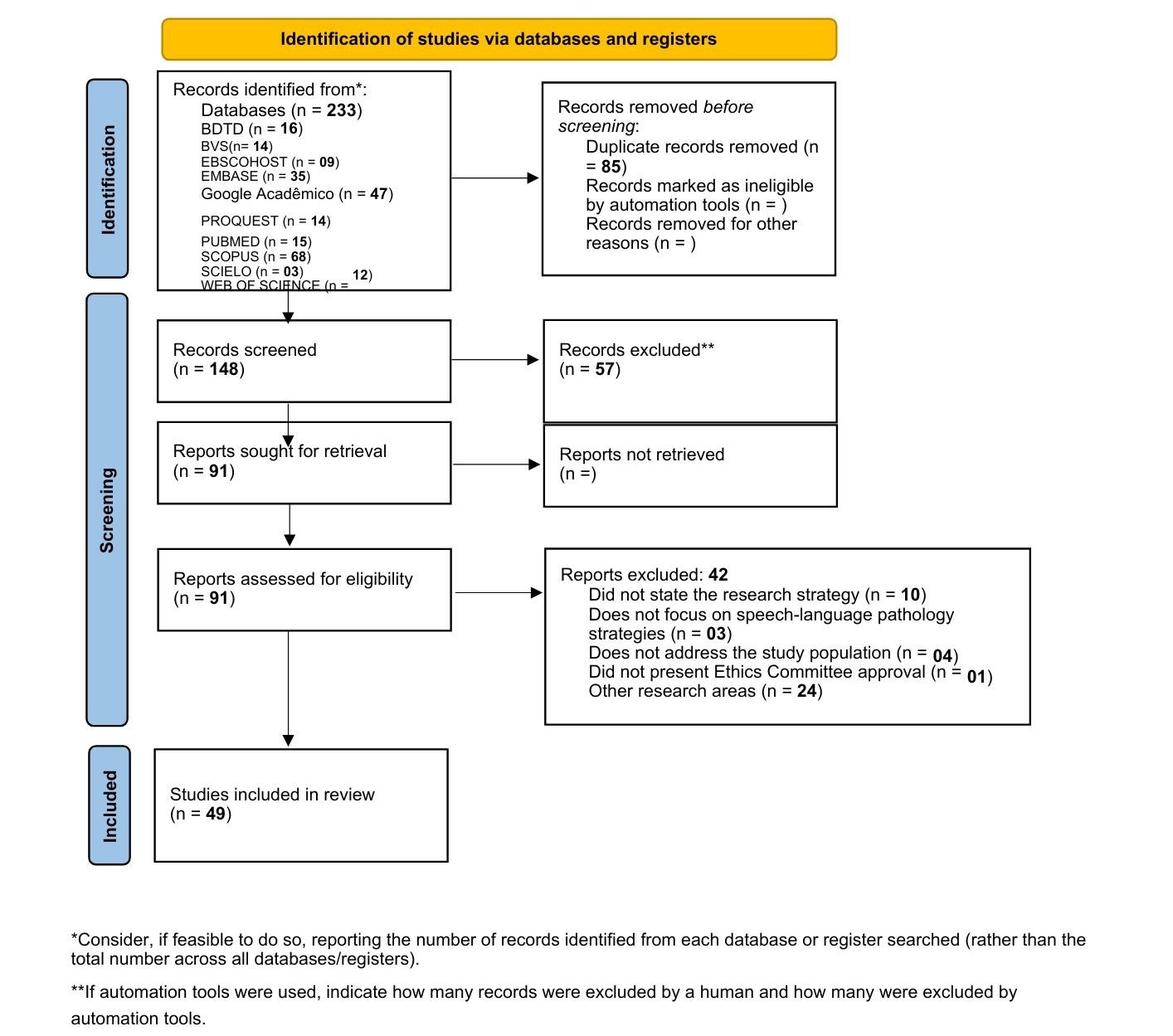
The searches yielded 233 records. After the selection of records and removal of duplicates, 149 full-text studies were read, from which 92 were deemed eligible for analysis. An additional 42 records were excluded, resulting in 49 studies included in the review for data extraction (Figure 1)(16).

The analyzed publications and the variables selected for analysis are presented in Chart 2. The scoping review reveals that the reviewed studies primarily focus on evaluating the efficacy of speech-language pathology interventions on the communication and language development of children with Autism Spectrum Disorder (ASD). The predominance of this type of research reflects the researchers' concern with validating specific therapeutic approaches, as well as understanding the impacts of the strategies used on the communicative engagement and language functionality of autistic children. Additionally, a significant number of studies seek to identify the communicative profile of these individuals, emphasizing both linguistic and pragmatic characteristics and caregivers' perceptions of the progress achieved throughout the interventions.
Study data populated from the scoping review protocol matrix to investigate the characteristics of interventions and speech-language pathology strategies in the care of autistic children in health services
The relationship between the studies' objectives and their conclusions reinforces the efficacy of various therapeutic strategies. Interventions such as the Picture Exchange Communication System (PECS) and music therapy were reported as tools that promote communicative engagement, leading to advancements in language development and social interaction. Furthermore, the studies indicate that interactive approaches and play-based therapeutic contexts play a central role in improving the children's communication skills. Also noted, although reported in a smaller number of publications, was the importance of parental guidance and clinical listening. This was evidenced by research that analyzed the impact of interventions on the daily lives of families, highlighting the need for active caregiver involvement in the therapeutic process.
Regarding “population and sample”, the studies predominantly involved children diagnosed with ASD between the ages of 02 and 12. However, some studies also included adolescents and young adults (Chart 2). In some cases, the children's caregivers were also analyzed, particularly when the research focus was on observing the impact of family guidance on the therapeutic process. Furthermore, the comparison between children and adolescents, as observed in some studies, allowed for a broader perspective on the progression of linguistic skills throughout language and communication development.
Regarding the detailed data (Table 1), it was found that of the reviewed publications, 85% are articles(20-27,29,31,33-36,38-54,56-59,61-67); 6.1% are master's theses(28,55,60); 4.1% are doctoral dissertations(32,68); and 4.1% are undergraduate final papers(30,37). The majority of the works, 65.3%, were published between 2013 and 2024(20,23,24,27,29,31,33-59,61,62,64,67,68) (Table 1), coinciding with the publication period of the updated Diagnostic and Statistical Manual of Mental Disorders (DSM-5), while 34.7% were published between 2004 and 2012(20,21,25,26,38-40,43,45,47,49-51,54,63,65,66).
Frequency distribution of “Publication Type”, “Concept of Autism”, “Intervention Type”, “Intervention Location”, and “Intervention Strategies”
The data extraction results revealed a relationship between the studies published by speech-language pathologists in Brazil and the publication and update periods of the DSM. The DSM-5 is cited in 40.8% of the publications(24,28,30,34,41,42,44,46,48,55,57,58,61,62,67,68), the DSM-IV in 28.6%(20,25-27,43,47,49-51,53,56,63,65,66), and 30.6% cite these manuals indirectly by using other publications (literature-based) to describe the symptoms of autism(20-23,29,35,37-40). The chi-square test for independence indicates that the concept of autism used is dependent on the study's publication date (p-value < 0.001) (Table 2). Between 2004 and 2012, the concept of autism in the research formulation was derived primarily from the DSM-IV, whereas from 2013 to 2024, it shifted to the DSM-5. Concepts based on existing literature (literature-based) were used similarly across both periods.
Contingency Table (Cross-Tabulations) between: “Intervention Type” vs. “Intervention Location”, “Publication Year” vs. “Concept of Autism”, and “Intervention Types” vs. “Intervention Strategies”, highlighting the p-value of the test for independence
Of the studies reviewed, the predominant “Intervention type” was the “therapeutic and evaluative” approach, highlighting a focus on the treatment and measurement of the children's progress. For this analysis, publications aiming to conduct an evaluative survey and/or analysis and associating them with therapeutic practices were included in the “therapeutic and evaluative” category; publications focusing solely on assessment procedures were included in the “evaluative” category; and publications reporting practices exclusively with parents and/or caregivers, excluding assessment practices, were included in the “parental guidance” category. Based on this, it was found that the majority of publications, 67.5%(20,22,26,31,34-36,38-40,45,46,49-52,54,55,57-59,63-68), featured a “type of intervention” associated with therapeutic and evaluative practices. In contrast, 30%(2,23,25,28,42,43,47,48,53,56,60,61) reported solely evaluative practices, and only 2.5%(69) presented practices developed with parental guidance (Table 1).
In the “intervention location” category, 78.6% of the publications(20,21,25,26,28,34-36,38-43,45,46,48-52,54,55,57,58,60,62-68) report practices conducted in the teaching clinic of public and private universities; 2.4% were conducted in a CAPSij (Psychosocial Care Center for Children and Adolescents)(23); 2.4% report multi-center studies(32); and 16.7% identify the practice location as a “health service” but without further specification(24,27,29-31,33,35,44,47,53,57,59,61). In other words, the vast majority of publications report practices associated with assessment or rehabilitation activities, which are predominantly carried out in university clinics.
Regarding the comparison of the collected data (Table 2), the independence chi-square test indicates that the intervention location does not depend on the type of intervention performed (p=.7142). That is, regardless of the intervention location, the most frequent type of intervention is “Therapeutic and Evaluative”. Conversely, the university clinic is the most frequent location, regardless of the type of intervention.
The data extracted on the “intervention strategies” employed in the studies varied widely, including standardized protocols, questionnaires, focus groups, language workshops, and play-based methods. There were also reports of interactive approaches, such as the use of narrative stories and computer games. Studies that investigated the influence of the therapeutic environment indicated that the physical structure and organization of spaces can affect children's responsiveness and performance in communicative interactions. The most frequently reported “therapeutic strategy” in the publications was (Table 1) “play-based therapeutic context”(22,25,26,35,49-52,63-66), with a frequency of 30%, equal to the use of “protocols and questionnaires”(20,21,28,32,42,43,47,48,53,60,67,68). A “multimodal approach with the use of PECS”(31,34,41,58) appeared in 10% of studies, followed by the “Prompt method”(36,59) at 5%, and “teletherapy”(55,61) also at 5%. The following strategies each accounted for 2.5% of the total: “behavioral approach”(45), “environmental enrichment”(54), “equine-assisted therapy”(57), “focus group”(23), “short-term intervention”(46), “computer games”(38), and “language workshop”(39).
When the cross-analysis between “intervention types” and “strategies” was conducted (Table 2), p<.01 indicates that the therapeutic strategy depends on the prioritized type of intervention. When the intervention is solely “evaluative”, the preferred strategy is the use of “protocols and questionnaires”. However, when it is “therapeutic and evaluative”, the strategy is predominantly a “play-based therapeutic context”. Therapeutic strategies such as the play-based therapeutic context and the use of protocols and questionnaires are widely reported. It is observed that a play-based approach is preferred in therapeutic interventions, while standardized protocols predominate in studies focused exclusively on evaluation.
DISCUSSION
The predominance of studies focused on evaluating the efficacy of speech-language pathology interventions reflects the researchers' concern with validating therapeutic approaches and understanding the impacts of the strategies used on the communicative engagement of autistic children. The concentration of these practices in university clinics suggests a tendency in the reviewed studies to focus on treatment and evaluation, to the detriment of health promotion actions in community contexts.
The transition from the DSM-IV to the DSM-5 as the predominant framework in autism research reflects the paradigmatic alignment of researchers in understanding the disorder within this scientific community. Although this transition was largely driven by biological, traditional, and deficit-focused perspectives(70), it is important to consider that this approach does not exhaust the possibilities for understanding autism. Different theoretical and methodological approaches contribute to the construction of knowledge in the field, and the predominance of one model does not imply the exclusion of others.
The DSM(71,72) was created to assist mental health professionals in diagnosing mental disorders. Its first edition, the DSM-I, was published in 1952 by the American Medico-Psychological Association, later renamed the American Psychiatric Association (APA). Since then, the manual has undergone four revisions: DSM-II, DSM-III, DSM-IV, and DSM-5. Over time, the understanding of autism has undergone transformations that have accompanied scientific advances, changes in social attitudes, and improvements in diagnostic methods(70,73). Initially, autism was confused with other psychiatric conditions and was later recognized as a specific spectrum disorder. The history of the conceptualization of autism shows the difficulty in reaching a consensus(74,75), but the DSM, a tool created by the APA, finds broad agreement among clinical professionals and researchers in Brazil. In the country, the identification of the autistic condition and the description of its symptoms are based on the definitions contained in this tool(72).
Although the DSM is an essential tool for standardizing diagnosis and communication among professionals, it also receives criticism(8,21,76-78) for its rigidity and tendency to neglect the subjectivity of autistic individuals. Furthermore, critics argue that its rigid criteria can neglect the diversity of autistic individuals. These authors report and support the view that autism is a variation of human neurodiversity, and not a disorder to be standardized or corrected. In this sense, excessive specialization and the broadening of diagnostic criteria could contribute to an “autism epidemic”. On the other hand, other researchers argue that maintaining the Diagnostic and Statistical Manual of Mental Disorders (DSM) is essential for the diagnosis and therapy of autism, as it provides a standardized classification system that facilitates communication among researchers, clinicians, and policymakers.
The DSM-5 brought advancements in diagnostic refinement by grouping autism spectrum disorders under a single diagnosis and emphasizing clinical criteria that include deficits in social communication and interaction, as well as restricted and repetitive patterns of behavior. However, this approach(79-81), centered on medical and neurobiological criteria, can, in some contexts, limit the understanding of the social and phenomenological complexity and the lived experiences of autistic individuals - a perspective emphasized by social and neurodiversity approaches. Furthermore, the persistent use of concepts based on existing literature demonstrates the coexistence of different interpretative approaches. Research that utilizes interdisciplinary theoretical frameworks, such as sociocognitive, pragmatic, and inclusive education studies, points to the need to broaden the scope of investigation by incorporating perspectives that go beyond classification and diagnosis(78). These approaches highlight, for example, the role of social context, alternative and augmentative communication, and interaction with environments in the developmental and learning processes of autistic children.
The use of diagnostic criteria defined by the APA may have directed the way the reviewed studies constructed their practices with children with autism. The descriptions report practices carried out in settings more related to rehabilitative care than to health promotion. A vast majority of the studies reveal practices conducted in university clinics. The predominance of “Therapeutic and Evaluative” interventions in settings such as university clinics reflects the tendency to concentrate actions on the treatment and evaluation of children with Autism Spectrum Disorder (ASD). In other words, the concentration of these practices in clinical and academic environments limits the scope of speech-language pathology actions, especially with regard to health promotion and prevention in community contexts.
In the same vein, the cross-analysis between “intervention types” and “strategies” demonstrated that the choice of therapeutic strategies depends on the type of intervention adopted (p<.01). Exclusively evaluative interventions tend to use structured protocols, whereas combined therapeutic interventions prefer interactive and play-based contexts. If, on the one hand, clinical speech-language pathology assessment(79,80) is important for establishing a functional diagnosis to construct an intervention plan that meets the specific needs of each patient, on the other hand, health promotion, which also belongs in and should be carried out in clinical settings, aims to broaden the possibilities of care in the face of the different facets of individual and social life(82). In the context of ASD, this would imply actions that promote social inclusion, public awareness, and support for families, aspects that can be underestimated when the focus falls predominantly on traditional settings, intervention types, and therapeutic strategies.
The analysis of the “conclusions” from the reviewed research suggests that some investigations failed to establish statistically significant differences between the evaluated groups, possibly due to sample heterogeneity and the small number of participants. Furthermore, there is an emphasis on studies conducted in university clinic settings, which limits the understanding of the interventions' effects in community health and family contexts. In many cases, the research suggests that more prolonged and comprehensive interventions would be necessary to capture subtle and sustainable changes in the communication of children with ASD.
Thus, the review of these conclusions points to the importance of broadening the focus of research in the field of speech-language pathology, particularly concerning the setting and “type of intervention”, to include the diversity of social and communicative contexts of children with ASD.
CONCLUSION
This scoping review made it possible to identify and systematize speech-language pathology practices for autistic children in health services in Brazil, highlighting the predominance of studies describing therapeutic and evaluative approaches conducted primarily in university clinics. The analysis of the studies revealed that although speech-language pathology has advanced in personalizing care and adapting therapeutic strategies in healthcare settings - through the diversification of therapeutic approaches and a preference for play-based and contextual strategies - interventions centered on diagnosis and rehabilitation still predominate.
The diversity of strategies identified points to the possibility of extending these practices to consider not only the difficulties of the individuals receiving care but also the need to include practices that consider the individual's relationship with their family, educational, and social context.
However, it is important to emphasize that this study is limited by the search strategy employed in this review protocol. Given this, an expansion of research into community-based and multiprofessional practices is recommended, as are new studies that explore different levels of healthcare, allowing for a better understanding of speech-language pathology care in ASD. Strengthening the coordination between health, education, and social assistance should also be encouraged, promoting a more comprehensive care model that includes not only assessment and treatment but also the inclusion and promotion of the social quality of life for autistic children and their families.
The percentage-frequency predominance of studies conducted in university clinics points to an under-representation of practices developed in settings such as Basic Health Units (UBS), Community Centers, and Child Psychosocial Care Centers (CAPSij), limiting the view of the diversity of interventions applied in public services. This gap highlights the need to broaden methodological diversity and research settings by incorporating investigations that analyze the effectiveness of therapeutic strategies in different realities and throughout the children's development.
The study suggests that reports of speech-language pathology practices in community health environments are scarce, creating a gap in the care of autistic children. The integration of interdisciplinary approaches, such as collaborative practices among speech-language pathologists, educators, and psychologists, can enhance the effectiveness of interventions and provide comprehensive support for children and their families.
-
Study conducted at Faculdade de Ciências Médicas, Universidade Estadual de Campinas – UNICAMP - Campinas (SP), Brasil.
-
Financial support:
Fundação de Desenvolvimento da UNICAMP, Convênio 519.292.
-
Data Availability:
The research protocol and the raw data of the article are available in an open data repository and can be accessed at: https://doi.org/10.17605/OSF.IO/9Z2VN.
References
-
1 Fernandes FDM, Amato CAH, Molini-Avejonas DR. Language assessment in autism. In: Mohammad MR, editor. A comprehensive book on autism spectrum disorders. London: Intech; 2011. p. 3-22. http://doi.org/10.5772/17412
» http://doi.org/10.5772/17412 -
2 Deutsch SI, Urbano MR. Preface. In: Deutsch SI, Urbano MR, editors. Autism spectrum disorders: the role of genetics in diagnosis and treatment. London: Intech; 2011. http://doi.org/10.5772/976
» http://doi.org/10.5772/976 -
3 Perottino S. Riso e humor: seus efeitos na clínica de linguagem dos autismos. Lingüística. 2019;35(2):129-47. http://doi.org/10.5935/2079-312X.20190021
» http://doi.org/10.5935/2079-312X.20190021 -
4 Brasil. Ministério da Saúde, Secretaria de Atenção à Saúde, Departamento de Atenção Especializada e Temática. Linha de cuidado para a atenção às pessoas com transtornos do espectro do autismo e suas famílias na Rede de Atenção Psicossocial do Sistema Único de Saúde [Internet]. Brasília: Ministério da Saúde, 2015 [citado em 2025 Jan 20]. Disponível em: https://bvsms.saude.gov.br/bvs/publicacoes/linha_cuidado_atencao_pessoas_transtorno.pdf
» https://bvsms.saude.gov.br/bvs/publicacoes/linha_cuidado_atencao_pessoas_transtorno.pdf -
5 Brasil. Ministério da Saúde. Secretaria de Atenção à Saúde. Departamento de Ações Programáticas Estratégicas. Diretrizes de atenção à reabilitação da pessoa com Transtornos do Espectro do Autismo (TEA) [Internet]. Brasília: Ministério da Saúde, 2014 [citado em 2025 Jan 20]. Disponível em: https://bvsms.saude.gov.br/bvs/publicacoes/diretrizes_atencao_reabilitacao_pessoa_autismo.pdf
» https://bvsms.saude.gov.br/bvs/publicacoes/diretrizes_atencao_reabilitacao_pessoa_autismo.pdf -
6 CFFa: Conselho Federal de Fonoaudiologia. Fonoaudiologia nas redes de atenção [Internet]. Brasília: Conselho Federal de Fonoaudiologia; 2021 [citado em 2025 Jan 20]. Disponível em: https://fonoaudiologia.org.br/comunicacao/guia-fonoaudiologia-nas-redes-de-atencao/
» https://fonoaudiologia.org.br/comunicacao/guia-fonoaudiologia-nas-redes-de-atencao/ -
7 Kashinath S, Yu B. Embedding intervention strategies within everyday family routines. In: Siller M, Morgan L, editors. Handbook of parent-implemented interventions for very young children with autism. autism and child psychopathology series. Cham: Springer; 2018. http://doi.org/10.1007/978-3-319-90994-3_13
» http://doi.org/10.1007/978-3-319-90994-3_13 -
8 Jerusalinsky A. Considerações preliminares a todo tratamento possível do autismo. Psicologia Argumento [Internet]. 2010 [citado em 2025 Jan 20];28(61):121-125. Disponível em: https://periodicos.pucpr.br/psicologiaargumento/article/view/19695/19023
» https://periodicos.pucpr.br/psicologiaargumento/article/view/19695/19023 -
9 Brasil. Política Nacional de Atenção Integral à Saúde da Criança: orientações para implementação [Internet]. Brasília: Ministério da Saúde; 2018 [citado em 2025 Jan 20]. 180 p. Disponível em: https://portaldeboaspraticas.iff.fiocruz.br/wp-content/uploads/2018/07/Pol%C3%ADtica-Nacional-de-Aten%C3%A7%C3%A3o-Integral-%C3%A0-Sa%C3%BAde-da-Crian%C3%A7a-PNAISC-Vers%C3%A3o-Eletr%C3%B4nica.pdf
» https://portaldeboaspraticas.iff.fiocruz.br/wp-content/uploads/2018/07/Pol%C3%ADtica-Nacional-de-Aten%C3%A7%C3%A3o-Integral-%C3%A0-Sa%C3%BAde-da-Crian%C3%A7a-PNAISC-Vers%C3%A3o-Eletr%C3%B4nica.pdf -
10 Brasil. Lei nº 8.080, de 19 de Setembro de 1990. Dispõe sobre as condições para a promoção, proteção e recuperação da saúde, a organização e o funcionamento dos serviços correspondentes e dá outras providências [Internet]. Diário Oficial da União; Brasília; 1990 [citado em 2025 Jan 20]. Disponível em: https://www.planalto.gov.br/ccivil_03/leis/l8080.htm
» https://www.planalto.gov.br/ccivil_03/leis/l8080.htm -
11 Mendonça PME, Medeiros AKM, Araujo ET. Modelos para parcerias entre governos e organizações da sociedade civil: análise comparativa de políticas de AIDS, assistência social e cultura no Brasil. Rev Adm Pública. 2019;53(5):802-20. http://doi.org/10.1590/0034-761220180049
» http://doi.org/10.1590/0034-761220180049 -
12 Maenner MJ, Warren Z, Williams AR, Amoakohene E, Bakian AV, Bilder DA, et al. Prevalence and characteristics of Autism Spectrum Disorder among children aged 8 Years – autism and developmental disabilities monitoring network, 11 sites, United States, 2020. Atlanta: Centers for Disease Control and Prevention; 2023. 14 p. (vol. 72). http://doi.org/10.15585/mmwr.ss7202a1
» http://doi.org/10.15585/mmwr.ss7202a1 -
13 OMS: Organização das Nações Unidas. Agenda 2030: objetivos de desenvolvimento sustentável [Internet]. Brasília: Nações Unidas Brasil; 2020 [citado em 2025 Jan 20]. Disponível em: https://brasil.un.org/sites/default/files/2020-09/agenda2030-pt-br.pdf
» https://brasil.un.org/sites/default/files/2020-09/agenda2030-pt-br.pdf -
14 Zeidan J, Fombonne E, Scorah J, Ibrahim A, Durkin MS, Saxena S, et al. Global prevalence of autism: a systematic review update. Autism Res. 2022;15(5):778-90. http://doi.org/10.1002/aur.2696 PMid:35238171.
» http://doi.org/10.1002/aur.2696 -
15 Pollock D, Peters M, Khali H, McInerney P, Alexander L, Tricco AC, et al. Recommendations for the extraction, analysis, and presentation of results in scoping reviews. JBI Evidence Synthseis. 2023;21(3):520-32. http://doi.org/10.11124/JBIES-22-00123 PMid:36081365.
» http://doi.org/10.11124/JBIES-22-00123 -
16 Page MJ, McKenzie JE, Bossuyt PM, Boutron I, Hoffmann TC, Mulrow CD, et al. The PRISMA 2020 statement: an updated guideline for reporting systematic reviews. BMJ. 2021;372(71):n71. http://doi.org/10.1136/bmj.n71 PMid:33782057.
» http://doi.org/10.1136/bmj.n71 -
17 Barros RCB, Ferreira E. Protocolo de revisão de escopo sobre as características de intervenção e estratégias fonoaudiológicas na atenção à criança autista em serviços de saúde. Open Science Framework; 2025 http://doi.org/10.17605/OSF.IO/9Z2VN
» http://doi.org/10.17605/OSF.IO/9Z2VN -
18 Ouzzani M, Hammady H, Fedorowicz Z, Elmagarmid A. Rayyan: a web and mobile app for systematic reviews. Syst Rev. 2016;5(1):210. http://doi.org/10.1186/s13643-016-0384-4 PMid:27919275.
» http://doi.org/10.1186/s13643-016-0384-4 - 19 R Core Team. R: a language and environment for statistical computing [software]. Vienna: R Foundation for Statistical Computing; 2024.
-
20 Balestro JI, Fernandes FDM. Caregivers’ perception of children with Autism Spectrum Disorder regarding to the communicative profile of their children after a communicative orientation program. CoDAS. 2019;31(1):e20170222. http://doi.org/10.1590/2317-1782/20182018222 PMid:30843922.
» http://doi.org/10.1590/2317-1782/20182018222 -
21 Balestro JI, Fernandes FDM. Questionário sobre dificuldades comunicativas percebidas por pais de crianças do espectro do autismo. Rev Soc Bras Fonoaudiol. 2012;17(3):279-86. http://doi.org/10.1590/S1516-80342012000300008
» http://doi.org/10.1590/S1516-80342012000300008 -
22 Balestro JI, Souza APR, Rechia IC. Terapia fonoaudiológica em três casos do espectro autístico. Rev Soc Bras Fonoaudiol. 2009;14(1):129-35. http://doi.org/10.1590/S1516-80342009000100020
» http://doi.org/10.1590/S1516-80342009000100020 -
23 Barbosa CL, Alencar IBG, Mendes VLF, Souza LADP. Fonoaudiologia e escuta clínica em equipe de saúde mental: percepção de pais de crianças com transtorno do espectro do autismo. Rev CEFAC. 2020;22:e10819. http://doi.org/10.1590/1982-0216/202022110819
» http://doi.org/10.1590/1982-0216/202022110819 -
24 Botura C, Machado DO, Marinho ACO, Almeida AN, Ribas LP. Alterações na pragmática de crianças falantes de português brasileiro com diagnóstico de transtorno do espectro autista: uma revisão sistemática. Distúrb Comun. 2021;33(4):627-38. http://doi.org/10.23925/2176-2724.2021v33i4p627-638
» http://doi.org/10.23925/2176-2724.2021v33i4p627-638 -
25 Campelo LD, Lucena JA, Lima CN, Araújo HMM, Viana LGO, Veloso MML, et al. Autismo: um estudo de habilidades comunicativas em crianças. Rev CEFAC. 2009;11(4):598-606. http://doi.org/10.1590/S1516-18462009000800008
» http://doi.org/10.1590/S1516-18462009000800008 -
26 Cardoso C, Montenegro ML. Speech and language pathology and autistic spectrum. Span J Psychol. 2009;12(2):686-95. http://doi.org/10.1017/S1138741600002055 PMid:19899669.
» http://doi.org/10.1017/S1138741600002055 -
27 Castro B, Loureiro CMV. Interfaces entre Fonoaudiologia e Musicoterapia na interação social e linguagem no Transtorno do Espectro do Autismo. Percepta Revista de Cognição Musical. 2020;8(1):53-73. http://doi.org/10.34018/2318-891X/8(1)53-73
» http://doi.org/10.34018/2318-891X/8(1)53-73 -
28 Costa JMA. Habilidades receptiva e expressiva da linguagem em pré- escolares com diagnóstico de transtorno do espectro autista [dissertação]. Marília: Faculdade de Filosofia e Ciências, Universidade Estadual Paulista; 2021 [citado em 2025 Jan 20]. Disponível em: http://hdl.handle.net/11449/215075
» http://hdl.handle.net/11449/215075 -
29 Costa VBS, Harsányi E, Martins-Reis VO, Kummer A. Tradução e adaptação transcultural para o português brasileiro do teste Children’s Communication Checklist-2. CoDAS. 2013;25(2):115-9. http://doi.org/10.1590/S2317-17822013000200005 PMid:24408239.
» http://doi.org/10.1590/S2317-17822013000200005 -
30 Cruz B, Gomes L. Intervenção fonoaudiológica em crianças com transtorno do espectro autista [trabalho de conclusão de curso]. Goiânia: Escola de Ciências Sociais e da Saúde, Pontifícia Universidade Católica de Goiás; 2020 [citado em 2025 Jan 20]. Disponível em: https://repositorio.pucgoias.edu.br/jspui/handle/123456789/436
» https://repositorio.pucgoias.edu.br/jspui/handle/123456789/436 -
31 Cruz FM, Tamanaha AC. From silence to embodied actions in interactions of nonverbal children with Autism Spectrum Disorder. Calidoscopio. 2021;19(2):209-23. http://doi.org/10.4013/cld.2021.192.04
» http://doi.org/10.4013/cld.2021.192.04 -
32 Netrval DAD. Proposta de modelo de indicadores de qualidade para o atendimento oferecido aos indivíduos autistas na cidade de São Paulo [tese]. São Paulo: Faculdade de Medicina, Universidade de São Paulo; 2014. http://doi.org/10.11606/T.5.2014.tde-24062014-151643
» http://doi.org/10.11606/T.5.2014.tde-24062014-151643 -
33 Ferreira PA, Silva GG, Bagetti T, Starosky P. Intervenção precoce no Transtorno do Espectro do Autismo: o papel da equipe, da fonoaudiologia e da família. Brazilian Journal of Development. 2023;9(6):19852-69. http://doi.org/10.34117/bjdv9n6-075
» http://doi.org/10.34117/bjdv9n6-075 -
34 Santos PA, Bordini D, Scattolin M, Asevedo GRC, Caetano SC, Paula CS, et al. The impact of the implementation of the Picture Exchange Communication System – PECS on understanding instructions in children with Autism Spectrum Disorders. CoDAS. 2021;33(2):1-5. http://doi.org/10.1590/2317-1782/20202020041
» http://doi.org/10.1590/2317-1782/20202020041 -
35 Deliberato D, Adurens F, Rocha ANDC. Brincar e contar histórias com crianças com Transtorno do Espectro Autista: mediação do adulto. Rev Bras Educ Espec. 2021;27:e0128. http://doi.org/10.1590/1980-54702021v27e0128
» http://doi.org/10.1590/1980-54702021v27e0128 -
36 Donadio DMDO, Simões-Zenari M, Santos THF, Sanchez MG, Molini-Avejonas DR, Cardilli-Dias D. Use of the Prompts for Reestructuring Oral Muscular Phonetic Targets (PROMPT) in Autism Spectrum Disorder: a case study. CoDAS. 2024;36(2):e20220299. http://doi.org/10.1590/2317-1782/20232022299pt PMid:38126591.
» http://doi.org/10.1590/2317-1782/20232022299pt -
37 Evangelista VN. Transtorno do espectro autista e a fonoaudiologia na rede de atenção psicossocial [trabalho de conclusão de curso]. Salvador: Universidade Federal da Bahia; 2018 [citado em 2025 Jan 20]. Disponível em: https://repositorio.ufba.br/handle/ri/26362
» https://repositorio.ufba.br/handle/ri/26362 -
38 Fernandes FDM, Santos THF, Amato CAH, Molini-Avejonas DR. Computerized resources in language therapy with children of the autistic spectrum. Pro Fono. 2010;22(4):415-20. http://doi.org/10.1590/S0104-56872010000400009 PMid:21271092.
» http://doi.org/10.1590/S0104-56872010000400009 -
39 Fernandes FD, Cardoso C, Sassi FC, Amato CL, Sousa-Morato PF. Language therapy and autism: results of three different models. Pro Fono. 2008;20(4):267-72. http://doi.org/10.1590/S0104-56872008000400011 PMid:19142471.
» http://doi.org/10.1590/S0104-56872008000400011 -
40 Fernandes FMD, Amato CLH, Balestro JI, Molini-Avejonas DR. Orientação a mães de crianças do espectro autístico a respeito da comunicação e linguagem. J Soc Bras Fonoaudiol. 2011;23(1):1-7. http://doi.org/10.1590/S2179-64912011000100004 PMid:21552725.
» http://doi.org/10.1590/S2179-64912011000100004 -
41 Ferreira C, Caetano SC, Perissinoto J, Tamanaha AC. Repercussão da implementação do Picture Exchange Communication System - PECS no índice de sobrecarga de mães de crianças com Transtorno do Espectro do Autismo. CoDAS. 2022;34(3):e20210109. http://doi.org/10.1590/2317-1782/20212021109 PMid:35019088.
» http://doi.org/10.1590/2317-1782/20212021109 -
42 Freitas FAF, Montenegro ACA, Fernandes FDM, Delgado IC, Almeida LNA, Alves GÂS. Habilidades comunicativas em crianças com transtorno do espectro autista: percepção clínica e familiar. Rev CEFAC. 2021;23:e1521. http://doi.org/10.1590/1982-0216/20212341521
» http://doi.org/10.1590/1982-0216/20212341521 -
43 Gomes E, Rotta NT, Pedroso FS, Sleifer P, Danesi MC. Auditory hypersensitivity in children and teenagers with autistic spectrum disorder. Arq Neuropsiquiatr. 2004;62(3B):797-801. http://doi.org/10.1590/S0004-282X2004000500011 PMid:15476072.
» http://doi.org/10.1590/S0004-282X2004000500011 -
44 Kamita MK, Silva LAF, Matas CG. Cortical auditory evoked potentials in autism spectrum disorder: a systematic review. CoDAS. 2021;33(2):e20190207. http://doi.org/10.1590/2317-1782/20202019207 PMid:34037100.
» http://doi.org/10.1590/2317-1782/20202019207 -
45 Kwee CS, Sampaio TMM, Atherino CCT. Autismo: uma avaliação transdisciplinar baseada no programa TEACCH. Rev CEFAC. 2009;11(Suppl 2):217-26. http://doi.org/10.1590/S1516-18462009000600012
» http://doi.org/10.1590/S1516-18462009000600012 - 46 Martins LZ, Fernandes FDM. Short-term speech-language intervention for children with disorders of the autism spectrum. CoDAS. 2013;25(6):542-7. PMid:24626980.
-
47 Matas CG, Gonçalves IC, Magliaro FCL. Audiologic and electrophysiologic evaluation in children with psychiatric disorders. Rev Bras Otorrinolaringol. 2009;75(1):130-8. http://doi.org/10.1016/S1808-8694(15)30844-2 PMid:19488573.
» http://doi.org/10.1016/S1808-8694(15)30844-2 -
48 Mayerle MCCS, Riesgo R, Gergory L, Borges VMS, Sleifer P. Mismatch negativity in children and adolescents with Autism Spectrum Disorder. Int Arch Otorhinolaryngol. 2023;27(2):e218-25. http://doi.org/10.1055/s-0043-1768209 PMid:37125353.
» http://doi.org/10.1055/s-0043-1768209 -
49 Menezes CG, Perissinoto J. Joint attention ability in children with autistic spectrum disorders. Pro Fono. 2008;20(4):273-9. http://doi.org/10.1590/S0104-56872008000400012 PMid:19142472.
» http://doi.org/10.1590/S0104-56872008000400012 -
50 Miilher LP, Fernandes FDM. Pragmatic, lexical and grammatical abilities of autistic spectrum children. Pro Fono. 2009;21(4):309-14. http://doi.org/10.1590/S0104-56872009000400008 PMid:20098949.
» http://doi.org/10.1590/S0104-56872009000400008 -
51 Miilher LP, Fernandes FDM. Considering responsivity: a proposal for pragmatic analysis in autism spectrum. CoDAS. 2013;25(1):70-5. http://doi.org/10.1590/S2317-17822013000100013 PMid:24408174.
» http://doi.org/10.1590/S2317-17822013000100013 -
52 Misquiatti ARN, Brito MC, Olivati AG, Santos TR, Fernandes FDM. Sociocognitive performance in autism spectrum disorders and interference of the therapeutic environment. CoDAS. 2014;26(5):402-6. http://doi.org/10.1590/2317-1782/20142013006 PMid:25388074.
» http://doi.org/10.1590/2317-1782/20142013006 -
53 Misquiatti ARN, Brito MC, Ferreira F, Assumpção FB Jr. Sobrecarga familiar e crianças com transtornos do espectro do autismo: perspectiva dos cuidadores. Rev CEFAC. 2015;17(1):192-200. http://doi.org/10.1590/1982-0216201520413
» http://doi.org/10.1590/1982-0216201520413 -
54 Misquiatti ARN, Fernandes FDM. Terapia de linguagem no espectro autístico: a interferência do ambiente terapêutico. Rev Soc Bras Fonoaudiol. 2011;16(2):204-9. http://doi.org/10.1590/S1516-80342011000200015
» http://doi.org/10.1590/S1516-80342011000200015 -
55 Moraes SR. Análise pragmática dos resultados de um programa de estimulação conduzido pelos pais com acompanhamento à distância pelo fonoaudiólogo [dissertação]. São Paulo: Faculdade de Medicina, Universidade de São Paulo; 2019. http://doi.org/10.11606/D.5.2019.tde-23082019-160332
» http://doi.org/10.11606/D.5.2019.tde-23082019-160332 - 56 Neubauer MA, Fernandes FDM. Functional Communication Profile and speech-language diagnosis in children of the autism spectrum: checklist use. CoDAS. 2013;25(6):605-9. PMid:24626986.
-
57 Navarro PR. Fonoaudiologia no contexto da Equoterapia com crianças autistas: uma reinterpretação a partir da Neurolinguística Discursiva. Cadernos de Estudos Lingüísticos. 2018;60(2):489-506. http://doi.org/10.20396/cel.v60i2.8651355
» http://doi.org/10.20396/cel.v60i2.8651355 -
58 Pereira ET, Montenegro ACDA, Rosal AGC, Walter CCDF. Augmentative and alternative communication on Autism Spectrum Disorder: impacts on communication. CoDAS. 2020;32(6):e20190167. http://doi.org/10.1590/2317-1782/20202019167 PMid:33206773.
» http://doi.org/10.1590/2317-1782/20202019167 -
59 Roncati AL, Souza AC, Miguel CF. Exposure to a specific prompt topography predicts its relative efficiency when teaching intraverbal behavior to children with autism spectrum disorder. J Appl Behav Anal. 2019;52(3):739-45. http://doi.org/10.1002/jaba.568 PMid:31016715.
» http://doi.org/10.1002/jaba.568 -
60 Rosa KG. Narrativa oral de histórias em crianças e adolescentes com Transtorno do Espectro Autista sem deficiência intelectual [dissertação]. Marília: Faculdade de Filosofia e Ciências, Universidade Estadual Paulista; 2022 [citado em 2025 Jan 20]. Disponível em: https://repositorio.unesp.br/server/api/core/bitstreams/2269495c-e7b2-4955-906d-c1a26a0fe835/content
» https://repositorio.unesp.br/server/api/core/bitstreams/2269495c-e7b2-4955-906d-c1a26a0fe835/content -
61 Santos ACF, Xavier IA, Queiroga BAM, Rosal AGC, Lima RASC, Montenegro AC. Telefonoaudiologia para crianças com transtorno do espectro do autismo durante a pandemia da covid-19. Rev CEFAC. 2023;25(1):e10422. http://doi.org/10.1590/1982-0216/202325110422s
» http://doi.org/10.1590/1982-0216/202325110422s -
62 Segeren L, Fernandes FDM. Caracterização de um serviço de referência no atendimento fonoaudiológico a indivíduos com Transtorno do Espectro do Autismo. Audiol Commun Res. 2019;24:e2176. http://doi.org/10.1590/2317-6431-2019-2176
» http://doi.org/10.1590/2317-6431-2019-2176 -
63 Silva RA, Lopes-Herrera SA, Vitto LPM. Distúrbio de linguagem como parte de um transtorno global do desenvolvimento: descrição de um processo terapêutico fonoaudiológico. Rev Soc Bras Fonoaudiol. 2007;12(4):322-8. http://doi.org/10.1590/S1516-80342007000400012
» http://doi.org/10.1590/S1516-80342007000400012 -
64 Sun IYI, Varanda CA, Fernandes FD. Stimulation of executive functions as part of the language intervention process in children with Autism Spectrum Disorder. Folia Phoniatr Logop. 2017;69(1-2):78-83. http://doi.org/10.1159/000479586 PMid:29248909.
» http://doi.org/10.1159/000479586 -
65 Tamanaha AC, Perissinoto J. Comparison of the evolutional process of children with autism spectrum disorders in different language therapeutic interventions. J Soc Bras Fonoaudiol. 2011;23(1):8-12. http://doi.org/10.1590/S2179-64912011000100005 PMid:21552726.
» http://doi.org/10.1590/S2179-64912011000100005 -
66 Tamanaha AC, Perissinoto J, Chiari BM. Development of autistic children based on maternal responses to the autism behavior checklist. Pro Fono. 2008;20(3):165-70. http://doi.org/10.1590/S0104-56872008000300005 PMid:18852963.
» http://doi.org/10.1590/S0104-56872008000300005 -
67 Tamanaha AC, Chiari BM, Perissinoto J. A eficácia da intervenção terapêutica fonoaudiológica nos distúrbios do espectro do autismo. Rev CEFAC. 2015;17(2):552-8. http://doi.org/10.1590/1982-021620156314
» http://doi.org/10.1590/1982-021620156314 -
68 Santos THF. Diferentes perspectivas na verificação das habilidades pragmáticas de crianças incluídas no espectro do autismo [tese]. São Paulo: Faculdade de Medicina, Universidade de São Paulo; 2017. http://doi.org/10.11606/T.5.2017.tde-05102017-100324
» http://doi.org/10.11606/T.5.2017.tde-05102017-100324 -
69 Ferreira EB, Oliveira MS. Introdução à Estatística com R [Internet]. 1. ed. Alfenas: Editora da Unifal, 2020 [citado em 2025 Jan 20]. 194 p. Disponível em: https://www.unifal-mg.edu.br/bibliotecas/wp-content/uploads/sites/125/2021/12/32-EBR_Unifal.pdf
» https://www.unifal-mg.edu.br/bibliotecas/wp-content/uploads/sites/125/2021/12/32-EBR_Unifal.pdf -
70 Lester JN, O’Reilly M. The social, cultural, and political discourses of autism. Dordrecht: Springer; 2021. Constructing the meaning(s) of autism; p. 83-94. http://doi.org/10.1007/978-94-024-2134-7_5
» http://doi.org/10.1007/978-94-024-2134-7_5 - 71 APA: American Psychiatric Association. Manual diagnóstico e estatístico de transtornos mentais: DSM-5. 5. ed. Porto Alegre: ArtMed. 2014. 992 p.
-
72 Ribeiro NCR, Marteleto RM. O Manual Diagnóstico e Estatístico de Transtornos Mentais enquanto um dispositivo info-comunicacional. Encontros Bibli. 2023;28:e90801. http://doi.org/10.5007/1518-2924.2023.e90801
» http://doi.org/10.5007/1518-2924.2023.e90801 -
73 Herrera-Del Aguila DD. Trastorno del Espectro Autista: la historia. Diagnóstico. 2021;60(3):131-3. http://doi.org/10.33734/diagnostico.v60i3.300
» http://doi.org/10.33734/diagnostico.v60i3.300 - 74 Donavan J, Zucher C. Outra sintonia: a história do autismo. São Paulo: Companhia das Letras; 2017.
- 75 Sheffer E. Crianças de Asperger: as origens do autismo na Viena Nazista. Rio de Janeiro: Record; 2019.
-
76 Rios C, Camargo KR Jr. Especialismo, especificidade e identidade: as controvérsias em torno do autismo no SUS. Cien Saude Colet. 2019;24(3). http://doi.org/10.1590/1413-81232018243.07862017 PMid:30892531.
» http://doi.org/10.1590/1413-81232018243.07862017 -
77 Bracks M, Calazans R. A questão diagnóstica e sua implicação na epidemia autística. Tempo Psicanal. 2018;50(2):51-76. http://doi.org/10.71101/rtp.50.409
» http://doi.org/10.71101/rtp.50.409 -
78 Piccolo GM. Do pensamento autístico de Eugen Bleuler ao DSM-V: a construção epistemológica do autismo e a explosão de sua manifestação. Scielo Preprints. http://doi.org/10.1590/SciELOPreprints.8383
» http://doi.org/10.1590/SciELOPreprints.8383 -
79 McCadden ERBS. Social story intervention through the neurodiversity lens. Top Lang Disord. 2024;44(4):321-30. http://doi.org/10.1097/TLD.0000000000000355
» http://doi.org/10.1097/TLD.0000000000000355 -
80 Goulart BNG, Chiari BM. Avaliação clínica fonoaudiológica, integralidade e humanização: perspectivas gerais e contribuições para reflexão. Rev Soc Bras Fonoaudiol. 2007;12(4):335-40. http://doi.org/10.1590/S1516-80342007000400014
» http://doi.org/10.1590/S1516-80342007000400014 - 81 Gauld C, Jurek L, Fourneret P. Diversity, epistemic Injustice and maeidalization. Cotex. 2024;176:234-6. PMid:38580533.
-
82 Bahia L, Scheffer MO. SUS e o setor privado assistencial: interpretações e fatos. Saúde Debate. 2018;42(3):158-71. http://doi.org/10.1590/0103-11042018s312
» http://doi.org/10.1590/0103-11042018s312
Edited by
-
Editor:
Ana Carolina Constantini
The research protocol and the raw data of the article are available in an open data repository and can be accessed at: https://doi.org/10.17605/OSF.IO/9Z2VN.