| Modulation of auditory temporal processing, speech in noise perception, auditory-verbal memory, and reading efficiency by anodal tDCS in children with Dyslexia(19) |
Assembly (1): Anode-left temporoparietal region; and Cathode-right temporoparietal region. Assembly (2): Anode-left temporoparietal region; and Cathode-right shoulder. |
17 children and adolescents |
05 sessions, with a one-week interval between them (2 sessions in each assembly and 1 Sham session) |
No intervention
Combined |
- Significant effect on temporal resolution, speech perception, and auditory verbal memory tasks in the two active assemblies, speed and accuracy of texts, low-frequency words, and pseudowords compared to Sham and initial assessment.
- Assembly (2) resulted in better temporal resolution, speech perception, and auditory memory outcomes than assembly (1).
- There was no difference in reading high-frequency words. |
- Effect observed immediately after stimulation. |
| Effects of a short and intensive transcranial direct current stimulation treatment in children and adolescents with developmental Dyslexia: A crossover clinical trial(20) |
Anode-between the left occipitotemporal and left temporoparietal regions; and Cathode-between the right occipitotemporal and right temporoparietal regions. |
24 children and adolescents |
05 consecutive sessions for 20 minutes. |
- Word reading (high and low frequency), pseudowords, and text. - Cognitive-linguistic stimulation: operational phonological memory, combining phonemes, rapid automatic naming. |
- Only in the active group: Positive effect on pseudoword reading speed, phonological working memory, and phoneme combination. - No effect on reading speed of low and high-frequency words and reading accuracy of text, high and low-frequency words, and pseudowords. |
- Effect observed immediately after and one month after stimulation. |
| Reading and phonological awareness improvement accomplished by transcranial direct current stimulation combined with phonological awareness training: A randomized controlled trial(21) |
Anode-temporoparietal junction; and Right cathode-temporoparietal junction.
Sham |
28 children and adolescents |
15 sessions: 3 weekly sessions of 60 minutes each. |
Cognitive-linguistic and reading training: “Gillon Phonological Awareness Training Programme” |
- Positive effect on reading low- and high-frequency words and non-words for the Active and Sham groups from the 5th session. |
- Effect observed after the 5th, 10th, and 15th sessions and 6 weeks later (follow-up). |
| - Positive effect on reading non-words for Active from the 5th and the 10th for Sham. |
| - Active better at reading non-words from the 10th session, immediately after, and at follow-up. |
| - Positive effect for Active in rhyme detection, from the 5th session and at the end of the intervention and follow-up for Sham. |
| - Difference between groups: Active better at the end of the intervention, with maintenance at follow-up. |
| - Group effect for phoneme exclusion: Active better performance at the 5th session; positive effect on Sham at the end and follow-up. No difference between groups. |
| Beyond Reading Modulation: Temporo-Parietal tDCS Alters Visuo-Spatial Attention and Motion Perception in Dyslexia(22) |
Assembly (1): Anode-left temporoparietal region; and Cathode-right contralateral region. Assembly (2): Anode-right temporoparietal region; and Cathode-left contralateral region. |
10 children and adolescents |
Two sessions, each lasting 20 minutes, and different setups, with a minimum 24-hour interval between them. |
No intervention
Combined |
- Positive effect on accuracy for the Group with assembly (1) in text reading. |
- Effects seen immediately after stimulation. |
| - Smaller positive effect and mean reaction time for the Group with assembly (1) on lexical decision tasks |
| - No significant difference in reading speed and accuracy of low-frequency, high-frequency, and non-words. |
| - No difference in phoneme matching tasks, working memory, and quick naming. |
| - Positive effects for assembly (1) with greater perception of movement and reduced visual-spatial attentional focus. |
| - The main effect of stimulation on assembly (1) is more significant than in Group with assembly (2). |
| Effects of a short, intensive, multi-session tDCS treatment in developmental dyslexia: Preliminary results of a sham-controlled randomized clinical trial(23) |
Anode- parietal-occipital regions P7. Cathode- – contralateral region (P8) |
27 children and adolescents distributed in Active and Sham groups Cross-over. |
05 consecutive sessions for 20 minutes. |
No intervention
Combined |
- Positive effect in the active group regarding the reading speed of non-words immediately after and 1 week after the end of treatment compared to baseline. |
- Effects observed before, immediately after and 01 week after treatment. |
| Individual Differences Modulate the Effects of ETCC on Reading in Children and Adolescents with Dyslexia(24) |
Anode-between the temporoparietal and left parietal regions; and Cathode-between the temporal and parietal regions on the right. Sham |
26 children and adolescents distributed in Active and Sham groups |
Eighteen sessions: 3 20-minute weekly sessions for 6 weeks and a minimum 48-hour interval between sessions. |
Word reading training with acceleration and spelling. |
- Positive effect regarding group, time, and word reading speed. |
- Effects observed immediately after, one month after, and six months after. |
| - Individual differences between participants of the Active group; less fluent and older subjects displayed a more significant change in word reading fluency at each time point than younger subjects. |
| Long-lasting improvement following ETCC treatment combined with training for reading in children and adolescents with Dyslexia(25) |
Anode-between the temporoparietal and left parietal regions; and Cathode-between the temporal and parietal regions on the right.
Sham |
26 children and adolescents distributed in Active and Sham groups |
Eighteen sessions: 3 20-minute weekly sessions for 6 weeks, with a minimum 48-hour interval between sessions. |
Fast word reading (Tachistoscopic presentation) Cognitive training: phoneme-grapheme association(26) |
- Active Group with a positive effect on the reading of low-frequency words one month after stimulation and pseudowords immediately one and six months after stimulation. |
- Effects observed immediately after, one month after, and six months after. |
| - Active Group with better performance in reading low-frequency words and pseudowords. |
| - Reading efficiency increased after 6 months in the stimulated group. |
| Impact of Transcranial Direct Current Stimulation on Reading Skills of Children and Adolescents With Dyslexia(27) |
Anode-left middle posterior temporoparietal region; and Cathode-right supraorbital region (FP2). |
12 children and adolescents |
5 consecutive days of stimulation of 30 minutes each session |
No intervention
Combined |
- Positive effect on pseudoword and text accuracy. |
- Effect observed after the 5th session. |
| - There was no change in the number of correct letters, syllables, words, and reading time. |
| Evidence for reading improvement following ETCC treatment in children and adolescents with Dyslexia(26) |
Anode-between the temporoparietal and left parietal regions; and Cathode-between the temporal and parietal regions on the right.
Sham |
18 children and adolescents |
18 sessions: 3 20-minute weekly sessions for 6 weeks |
Fast word reading (Tachistoscopic presentation) Cognitive training: phoneme-grapheme association. |
- Positive effect with decreased reading time of low-frequency words and pseudowords immediately and 1 month after the stimulation sessions. |
- Effect observed immediately after and 1 month after the stimulation. |
| - Reduction of errors of immediate effect and 1 month after the stimulation. |
| Reading changes in children and adolescents with Dyslexia after transcranial direct current stimulation(28) |
Assembly (1): Anode-left temporoparietal region; and Cathode-between the temporal and right parietal region. Assembly (2) Anode-right temporoparietal region; and Cathode-left temporoparietal region. Sham |
19 children |
One session with pre-evaluation, 20 minutes of stimulation, and post-evaluation carried out sequentially. |
No intervention combined |
- Positive effect with a difference between groups with assembly (1) in the improvement of text reading accuracy, phoneme combination time, and N-back verbal task. |
- Effect observed 20 minutes after stimulation. |
| Improved reading measures in adults with Dyslexia following transcranial direct current stimulation treatment(11) |
Anode-region of the left visual cortex (V5); and Cathode-region of the right orbitofrontal cortex.
Sham |
19 adults |
5 sessions spread over 2 weeks (they did not mention defined intervals between them) |
No intervention
combined |
- Positive effect with a difference between groups in reading speed and the RAN test of numbers and letter naming. |
- Effects observed immediately after the 5th session. |

 Efficacy of Transcranial Direct Current Stimulation in Developmental Dyslexia: a scoping review
 Thumbnail
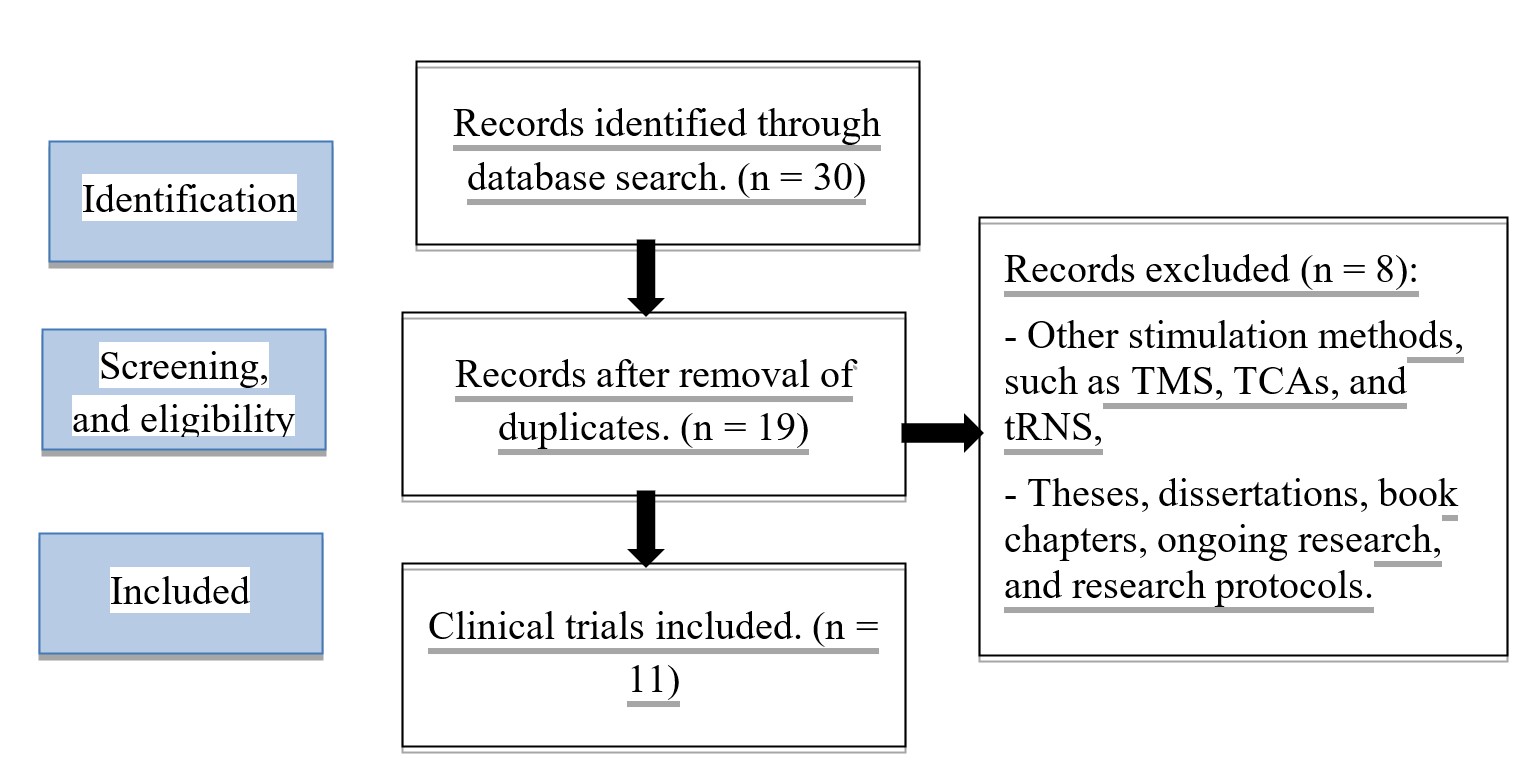 Caption: TMS: Transcranial Magnetic Stimulation; tACS:Transcranial Alternating Current Stimulation; tRNS: Transcranial Random Noise Stimulation.