
 CORRELATION BETWEEN TYPES OF SACRAL TUMOR RESECTION, HISTOLOGY, AND LOCAL RECURRENCE
ABSTRACT
Objectives: Sacrectomies are usually the treatment of choice for sacral tumors. Depending on the location, size, and histological type, different resection options can be used, with varying levels of morbidity and mortality inherent to the procedure. In Brazil, there is limited literature on complications resulting from this treatment. The purpose of this article is to correlate such surgeries with the outcomes of patients undergoing them, such as local recurrence, infection, neurological deficit, and life expectancy.
Methods: Retrospective cohort study with a sample of 16 patients with sacral tumors undergoing sacral resection from 2015 to 2023. Some variables were studied, such as histological type of the tumor, surgical modality performed, reconstructions with sacropelvic instrumentation, tumor margins, type of flap for closure, local tumor recurrence, and follow-up. Data were recorded preoperatively and at the last follow-up visit. Patients with a follow-up of less than 6 months and patients with incomplete data in the medical records were excluded from the study.
Results: Sixteen patients were selected; the ratio was 11 men (68.8%) and five women (31.2%); the mean age was 49.3 years, ranging from 24 to 76 years. The diagnosis involved benign tumors in 6 patients (37.5%) and malignant tumors in 10 of them (62.5%). Various sacropelvic reconstruction modalities were performed on eight patients (50%) when there was involvement of more than 50% of the sacroiliac joint. The average follow-up time for this patient sample was 39.5 months, with the shortest follow-up time being 6 months and the longest being 70 months. A total of 25 complications were observed in the sample, present in 13 (81.2%) patients, with 8 (61.5%) of them having two complications. The main complications were deficits (69.1%), followed by infection (61.5%), and other causes (38.4%), such as non-union and posterior perineal hernia.
Conclusion: Sacrectomy is a procedure with a high rate of complications, mainly neurological deficits - inherent to the nature of the surgery - and surgical site infection. Patient disease-free local follow-up is directly linked to sacrectomy ‘en bloc’ with clear margins. More multicenter studies with longer follow-up are needed for confirmation. Level of Evidence IV; Case Series.
Keywords:
Tumor; Sacrum; Spinal Neoplasms
RESUMO:
Objetivos: As sacrectomias são usualmente o tratamento de escolha para tumores do sacro. A depender da localização, tamanho e tipo histológico diferentes opções de ressecção podem ser usadas, com maior ou menor morbimortalidade inerente ao procedimento. Há, no Brasil, escassa literatura sobre complicações decorrentes deste tratamento. O propósito deste artigo é correlacionar tais cirurgias com os desfechos dos pacientes submetidos a elas, como recorrência local, infecção, déficit neurológico e expectativa de vida.
Métodos: Estudo de coorte retrospectivo com uma amostra de 16 pacientes com tumores sacrais submetidos à ressecção do sacro no período de 2015 a 2023. Algumas variáveis foram estudadas como tipo histológico do tumor, modalidade cirúrgica realizada, reconstruções com instrumentação sacropélvica, margens tumorais, tipo de retalho para fechamento, recidiva tumoral local e follow-up. Os dados foram registrados no pré-operatório e na última consulta de follow-up. Foi utilizado como critério de exclusão do trabalho pacientes com follow-up menor de 6 meses e pacientes com dados incompletos no prontuário.
Resultados: Foram selecionados 16 pacientes; a proporção foi de 11 homens (68,8%) e de 5 mulheres (31,2%); observou-se que a média de idade foi de 49,3 anos; distribuindo-se entre 24 e 76 anos. O diagnóstico envolveu tumores benignos em 6 pacientes (37,5%) e malignos em 10 deles (62,5%). As diversas modalidades de reconstrução sacropélvica foram realizadas em 8 pacientes (50%) quando havia o acometimento maior de 50% da articulação sacro ilíaca. O tempo médio de follow-up dessa amostra de pacientes foi de 39,5 meses, sendo o menor tempo de 6 meses e maior tempo de 70 meses. Foram observadas 25 complicações em toda amostra, estando presente em 13 (81,2%) pacientes, sendo que 8 (61,5%) deles apresentaram 2 complicações. As principais complicações foram déficit (69,1%), seguida de infecção (61,5%) e outras causas (38,4%) como pseudoartrose e hérnia perineal posterior
Conclusão: A sacrectomia é um procedimento com alto índice de complicações, principalmente déficit neurológico – inerente a própria natureza da cirurgia – e infecção de sítio cirúrgico. O seguimento do paciente livre de doença local está diretamente ligado com a sacrectomia ‘em bloc’ com margens livres. São necessários mais estudos multicêntricos com maior follow-up para confirmação. Nível de Evidencia IV; Serie de Casos.
Descritores:
Tumor; Sacro; Neoplasias da Coluna Vertebral
RESUMEN
Objetivos: Las sacrectomías suelen ser el tratamiento de elección para los tumores del sacro. Dependiendo de la ubicación, tamaño y tipo histológico, se pueden utilizar diferentes opciones de resección, con mayor o menor morbimortalidad inherente al procedimiento. En Brasil, hay escasa literatura sobre las complicaciones de este tratamiento. El propósito de este artículo es correlacionar dichas cirugías con los resultados de los pacientes sometidos a ellas, como recurrencia local, infección, déficit neurológico y expectativa de vida.
Métodos: Estudio de cohorte retrospectivo con una muestra de 16 pacientes con tumores sacros sometidos a resección del sacro en el período de 2015 a 2023. Se estudiaron algunas variables como el tipo histológico del tumor, la modalidad quirúrgica realizada, reconstrucciones con instrumentación sacropélvica, márgenes tumorales, tipo de colgajo para cierre, recurrencia tumoral local y seguimiento. Los datos se registraron en el preoperatorio y en la última consulta de seguimiento. Se utilizó como criterio de exclusión del trabajo a los pacientes con un seguimiento menor de 6 meses y a los pacientes con datos incompletos en la historia clínica.
Resultados: Se seleccionaron 16 pacientes; la proporción fue de 11 hombres (68,8%) y 5 mujeres (31,2%); se observó que la edad promedio fue de 49,3 años, distribuida entre 24 y 76 años. El diagnóstico involucró tumores benignos en 6 pacientes (37,5%) y malignos en 10 de ellos (62,5%). Se realizaron diversas modalidades de reconstrucción sacropélvica en 8 pacientes (50%) cuando la afectación era mayor al 50% de la articulación sacroilíaca. El tiempo promedio de seguimiento de esta muestra de pacientes fue de 39,5 meses, siendo el menor tiempo de 6 meses y el mayor tiempo de 70 meses. Se observaron 25 complicaciones en toda la muestra, presentes en 13 (81,2%) pacientes, siendo que 8 (61,5%) de ellos presentaron 2 complicaciones. Las principales complicaciones fueron el déficit (69,1%), seguido de la infección (61,5%) y otras causas (38,4%) como la pseudoartrosis y la hernia perineal posterior.
Conclusión: La sacrectomía es un procedimiento con un alto índice de complicaciones, principalmente el déficit neurológico, inherente a la propia naturaleza de la cirugía, y la infección del sitio quirúrgico. El seguimiento del paciente libre de enfermedad local está directamente relacionado con la sacrectomía ‘en bloc’ con márgenes libres. Se necesitan más estudios multicéntricos con un seguimiento más extenso para su confirmación. Nivel de Evidencia IV; Serie de Casos.
Descriptores:
Tumor; Sacro; Neoplasias de la Columna Vertebral
INTRODUCTION
Sacral tumors are rare pathologies with difficult diagnosis, largely due to nonspecific symptoms in the early stages of the disease. Typically diagnosed in advanced stages, they present as large tumor masses requiring complex treatment.1–3 There are few Brazilian studies on the incidence and treatment of sacral tumors.4
Most primary sacral tumors, including chordoma, chondrosarcoma, and giant cell tumor, are relatively resistant to radiotherapy and chemotherapy. Other methods, such as proton and Carbon-ion therapies, have assisted in cases of sarcomas, either as a standalone modality or as an adjuvant therapy alongside debulking.5 The drawback of these therapies is their unavailability in most reference centers. En bloc resection of the tumor with adequate margins is often the only effective method to achieve long-term disease control or cure.6,7 The choice of sacrectomy type depends on several factors, including the patient’s clinical status, tumor location and extent, histology, and disease aggressiveness.3,7,8 Due to the inherent morbidity of this surgery, outcomes such as neurological deficit are expected, as sacrificing nerve roots is part of the surgical technique, respecting the oncological concept of clear margins, and therefore not counted as a complication in itself.
Complications remain a challenge in managing such patients.9,10 With wound infections being the primary adverse outcome,11,12 several current studies analyze risk factors13,14 and flap modalities for skin closure.15,16
MATERIALS AND METHODS
This is a retrospective longitudinal cohort study involving 16 patients who underwent sacral resection due to sacral tumors at a spine tumor reference center between 2015 and 2023. The following number is the Ethics Committee protocol number: 56429322700005273. This study did not require informed consent as it involved the analysis of patient records from surgical procedures conducted at the hospital.
Eligible patients had their demographic data, surgical indications, operative details (resection level according to Fourney’s classification,17 reconstruction with instrumentation, sacrificed nerves, tumor margins, use of flaps for primary closure), complications, and recurrence recorded based on medical records. Retrospective classifications and measurements of clinical parameters were performed on all patients and independently reviewed. Long-term patient follow-up was conducted through medical consultation and radiological data.
Patients were excluded based on the following criteria: prior resection surgeries, diagnosis of tumors with other primary sites, incomplete data in medical records, and follow-up of less than six months. In addition to Fourney’s classification, which delineates sacrectomy levels, we also used Biagini, Ruggieri, and Mercuri’s18 adaptation of neurological function classification after sacral resection, which divides neurological deficit into motor, bladder, and bowel function as absent (0), partial (1), and total (2).
The Excel® software (Microsoft) was used for data management, and descriptive statistics were performed to characterize the sample. For data analysis, measures of central tendency (means) and measures of variability (standard deviation) were calculated. Student’s t-test for independent samples was used to compare means, and differences between proportions (relative frequencies) of categorical variables were compared using the chi-square test or Fisher’s exact test. All data analyses were conducted using the statistical software SPSS 26.0 (Statistical Package for the Social Sciences – Chicago, IL, 2019), and statistically significant differences were considered those with a p-value less than or equal to 0.05.
RESULTS
A total of 16 patients met the inclusion criteria. The cohort comprised 11 (68.8%) male participants and 5 (31.2%) female participants. The mean age of the participants was 49.3 years, ranging from 24 to 76 years old. The most frequent tumor was chordoma (6), followed by schwannoma and Giant Cell Tumor (GCT) (2 each); Neurofibroma, Metastatic Adenocarcinoma, Aneurysmal Bone Cyst, Osseous Liposarcoma, Osteosarcoma, and Chondrosarcoma (1 each). The most commonly performed surgery was mid-sacrectomy in 5 patients (31.3%); total sacrectomy was chosen in 4 patients (25%); and high sacrectomy in 3 patients (18.8%). In 3 patients, intralesional resection was opted for, which is the treatment of choice for some benign tumors. In our article, the postoperative infection rate was 61%. (Figure 1 and Table 2)

Number of complications observed in the cohort. Note that the same patient may present more than one outcome. Additionally, vascular injury occurred not as a result of the surgical procedure itself, but through preoperative embolization by interventional radiology.
Reconstruction with instrumentation was performed in 8 patients (50%), using various described techniques, such as the “Closed Loop - Peter Varga” method,19 and reconstruction with two or three rods. Regarding reconstruction with cutaneous flaps for wound closure, six patients underwent a medial gluteal advancement flap (GMA) (37.5%), and 3 underwent a medial gluteal rotation flap (GMR) (18.8%); in 7 patients (43.8%), flap use was not necessary. The average follow-up time was 39.5 (21.1) months, with the shortest time being 6 months and the longest 70 months. The average follow-up time for patients without the disease was 38.8 (23.0) and for patients with the disease was 40.8 (19.5), with no significant differences in the data (p=0.86).
DISCUSSION
The treatment of sacral tumors remains a challenge for surgeons and oncologists worldwide. Analysis of histological type, tumor location and extent, vascularity, and the patient’s clinical conditions are key points for defining surgical planning.20
The majority of sacral tumors consist of chordoma, chondrosarcoma, and giant cell tumor. In this series, these tumors accounted for 10 patients (62.5%). Chordoma is known for a high rate of local recurrences, especially if treatment with margin-free resection is not achieved. Current literature projects recurrence rates ranging from 5-60%.21–23 Wide resection is not achieved in 35-75% of cases due to anatomical inaccessibility, the choice to preserve neural tissue, and tumor size.24,25 This is a risk factor for recurrence.21,26 In this study, the total recurrence rate after wide resection with histopathologically clear margins was 22%. Other risk factors for local recurrence include advanced age, high sacral location, previous resection, high-grade tumor, and lack of access to radiotherapy.12,21,26–33
Despite all the variables listed (Enneking classification, type of sacrectomy, surgical reconstruction, and local recurrence) having a positive correlation with the final disease-free status of the patient, local recurrence was the only one showing statistical significance with p=0.008. (Table 2)
Motor deficit is also prevalent in this population, reaching 38-78%.9,34–38 and is directly related to the level of osteotomy and deliberate or inadvertent sacrifice of nerve roots.17 Part of the literature even considers neurological deficit not as a complication but as a natural outcome of the sacrectomy technique with oncological margin. Todd39 categorized motor and sphincter function after sacrectomy according to the degree of nerve root injury. In the group with bilateral S3-S5 lesions, a deficit of 60-75% is expected, while from bilateral sacrifice of S2-S5, there is a 100% deficit. These findings were confirmed in our series, where all patients who underwent resections involving bilateral S2-S5 developed sphincter deficit. We used the Bigiani,18 classification, which discriminates deficits as motor, bladder, and bowel; stratifying as 0 - normal; 1 - partial; and 2 - total. Only one patient had a total motor and sphincter deficit outcome, consistent with the surgery performed (total trans-lumbar sacrectomy). Also, one patient had unilateral right S1-S5 deficit due to a sagittal hemisacrectomy.
Among the expected complications in this type of treatment, the most prevalent is surgical wound infection, which in some series reaches 14-44%9,34–38 In our article, the postoperative infection rate was 61%. (Figure 1)
Total sacrectomy creates horizontal and vertical instability, especially if the resection is above S2 and compromises the integrity of the sacroiliac joints.40,41 Reconstruction allows the patient the ability to walk.41,42 However, some studies argue that this may occur due to the creation of a “biological sling” with muscles and scar tissue that allows stabilization.12,43,44
There are several techniques, ranging from the use of Galveston rods45 and modified Galveston 32 to the use of pedicle screws with mesh cage (with graft) or bone graft alone, using femur46 or fibula.47 The biomechanics of these constructs differ from each other, and mechanical failure can occur due to fatigue or loosening.48 As an option, Yu40 describes the use of two iliac screws bilaterally associated with four rods. The non-adoption of the four rods was shown to be a risk factor for failure.49 One of the patients in this article underwent this type of surgery and did not experience mechanical failure. There are several methods for reconstruction with instrumentation, to be chosen according to the desired stability and the surgeon’s expertise. In our cohort, we used methods such as Peter Varga’s Closed Loop; lumbopelvic reconstruction with two, three, four, and even five rods, like the Cathedral technique50 (Figure 2). Additionally, the female gender, due to anatomical characteristics such as the smaller size of the L5-Sacrum joint and the relatively increased mobility because of weaker ligaments, has been considered a risk factor for stabilization.49

Some of the reconstructions of our cohort: A) Peter Varga Closed Loop; B) Closed Loop + Harms; C) Cathedral Construction; and D) Four-rod Construction.
However, this was not observed in our cohort, with gender not being a risk factor for the need for stabilization. Instrumentation also increases surgical time and blood loss, which are related to an increase in complications such as surgical wound infection, hardware prominence, material failure, and osteoporotic bone fracture.11,51–55
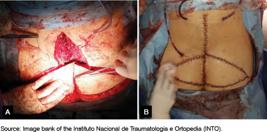
Another outcome analyzed was the need for cutaneous reconstruction using flaps. Simple median synthesis is related to seroma, infection, hematoma, fistula, and intestinal obstruction.56,57 Examples of flaps include the use of the gluteus maximus (GM) as advancement (GMA) or rotation (GMR), paraspinal muscles (PSM), rectus abdominis (VRAM) with or without omentum, and latissimus dorsi (LD).15 Each of these has advantages and disadvantages, such as the VRAM’s ability to occupy dead space and prevent intestinal herniation from the peritoneum to the posterior defect where instrumentation is located. On the other hand, it can only be created when there is both anterior and posterior access.58 The flap design varies according to the viability and availability of muscular tissue. In this study, six patients underwent gluteus maximus advancement, 3 cases opted for gluteus maximus rotation, and seven patients did not require cutaneous flap reconstruction. (Figure 3)
CONCLUSION
Sacral tumors require expertise from the entire healthcare team regarding diagnosis, preoperative planning, procedure execution, and postoperative care. Sacrectomy is a procedure with a high rate of complications, especially neurological deficit - inherent to the nature of the surgery - and surgical site infection. Patient disease-free local follow-up is directly linked to sacrectomy ‘en bloc’ with clear margins. The average follow-up time was 39.5 (21.1) months, with the shortest time being 6 months and the longest 70 months. The average follow-up time for patients without the disease was 38.8 (23.0) and for patients with the disease was 40.8 (19.5), with no significant differences in the data (p=0.86).
REFERENCES
-
1 Sohn S, Kim J, Chung CK, Lee NR, Sohn MJ, Kim SH. A Nation-Wide Epidemiological Study of Newly Diagnosed Primary Spine Tumor in the Adult Korean Population, 2009-2011. J Korean Neurosurg Soc. 2017;60(2):195-204. doi: 10.3340/jkns.2016.0505.011.
» https://doi.org/10.3340/jkns.2016.0505.011 -
2 Raque GH Jr, Vitaz TW, Shields CB. Treatment of neoplastic diseases of the sacrum. J Surg Oncol. 2001;76(4):301-7. doi: 10.1002/jso.1050.
» https://doi.org/10.1002/jso.1050 -
3 Zhang Y, Chen WG, Yang SZ, Qiu H, Sun J, Hu X, Liao TQ, Yang L, Liu YG, Chu TW. Preliminary investigation of bilateral internal iliac artery ligation and anterior tumor separation through laparoscopy before posterior resection of a giant sacral tumor. Surg Oncol. 2020;34:24-30. doi: 10.1016/j.suronc.2020.03.002.
» https://doi.org/10.1016/j.suronc.2020.03.002 - 4 Baptista PPR, Próspero JD, Volpe Neto F, Saito RY, Assumpção RMC, Fernandez MS. Giant-cell tumor of the sacrum: case report. Rev. Bras. Ortop. 1996;31(11):947-51.
-
5 Pennington Z, Ehresman J, Elsamadicy AA, Shin JH, Goodwin CR, Schwab JH, et al. Systematic review of charged-particle therapy for chordomas and sarcomas of the mobile spine and sacrum. Neurosurg Focus. 2021;50(5):E17. doi: 10.3171/2021.2.FOCUS201059.
» https://doi.org/10.3171/2021.2.FOCUS201059 -
6 Varga PP, Bors I, Lazary A. Sacral tumors and management. Orthop Clin North Am. 2009;40(1):105-23, vii. doi: 10.1016/j.ocl.2008.09.010.
» https://doi.org/10.1016/j.ocl.2008.09.010 -
7 Wei G, Xiaodong T, Yi Y, Ji T. Strategy of surgical treatment of sacral neurogenic tumors. Spine. 2009;34(23):2587-92. doi: 10.1097/BRS.0b013e3181bd4a2b.
» https://doi.org/10.1097/BRS.0b013e3181bd4a2b -
8 Puri A, Agarwal MG, Shah M, Srinivas CH, Shukla PJ, Shrikhande SV, et al. Decision making in primary sacral tumors. Spine J. 2009;9(5):396-403. doi: 10.1016/j.spinee.2008.10.001.
» https://doi.org/10.1016/j.spinee.2008.10.001 -
9 Verlaan JJ, Kuperus JS, Slooff WB, Hennipman A, Oner FC. Complications, secondary interventions and long term morbidity after en bloc sacrectomy. Eur Spine J. 2015;24(10):2209-19. doi: 10.1007/s00586-014-3729-5.
» https://doi.org/10.1007/s00586-014-3729-5 -
10 Asaad M, Rajesh A, Wahood W, Vyas KS, Houdek MT, Rose PS, et al. Flap reconstruction for sacrectomy defects: A systematic review and meta-analysis. J Plast Reconstr Aesthet Surg. 2020;73(2):255-268. doi: 10.1016/j.bjps.2019.09.049.
» https://doi.org/10.1016/j.bjps.2019.09.049 -
11 Li D, Guo W, Qu H, Yang R, Tang X, Yan T, et al. Experience with wound complications after surgery for sacral tumors. Eur Spine J. 2013;22(9):2069-76. doi: 10.1007/s00586-013-2765-x.
» https://doi.org/10.1007/s00586-013-2765-x -
12 Ruggieri P, Angelini A, Ussia G, Montalti M, Mercuri M. Surgical margins and local control in resection of sacral chordomas. Clin Orthop Relat Res. 2010;468(11):2939-47. doi: 10.1007/s11999-010-1472-8.
» https://doi.org/10.1007/s11999-010-1472-8 -
13 Ruosi C, Colella G, Di Donato SL, Granata F, Di Salvatore MG, Fazioli F. Surgical treatment of sacral chordoma: survival and prognostic factors. Eur Spine J. 2015;24. doi: 10.1007/s00586-015-4276-4.
» https://doi.org/10.1007/s00586-015-4276-4 -
14 Yamazaki T, McLoughlin GS, Patel S, Rhines LD, Fourney DR. Feasibility and safety of en bloc resection for primary spine tumors: a systematic review by the Spine Oncology Study Group. Spine. 2009;34(22 Suppl):S31-8. doi: 10.1097/BRS.0b013e3181b8b796.
» https://doi.org/10.1097/BRS.0b013e3181b8b796 -
15 Kim JE, Pang J, Christensen JM, Coon D, Zadnik PL, Wolinsky JP, et al. Soft-tissue reconstruction after total en bloc sacrectomy. J Neurosurg Spine. 2015;22(6):571-81. doi: 10.3171/2014.10.SPINE14114.
» https://doi.org/10.3171/2014.10.SPINE14114 -
16 Koh PK, Tan BK, Hong SW, Tan MH, Tay AG, Song C, et al. The gluteus maximus muscle flap for reconstruction of sacral chordoma defects. Ann Plast Surg. 2004;53(1):44-9. doi: 10.1097/01.sap.0000106423.87203.a3.
» https://doi.org/10.1097/01.sap.0000106423.87203.a3 -
17 Fourney DR, Rhines LD, Hentschel SJ, Skibber JM, Wolinsky JP, Weber KL, et al. En bloc resection of primary sacral tumors: classification of surgical approaches and outcome. J Neurosurg Spine. 2005;3(2):111-22. doi: 10.3171/spi.2005.3.2.0111.
» https://doi.org/10.3171/spi.2005.3.2.0111 - 18 Biagini R, Ruggieri P, Mercuri M, Capanna R, Briccoli A, Perin S, et al. Neurologic deficit after resection of the sacrum. Chir Organi Mov. 1997;82(4):357-72.
-
19 Varga PP, Lazary A. Chordoma of the sacrum: “en bloc” total sacrectomy and lumbopelvic reconstruction. Eur Spine J. 2010;19(6):1039-40. doi: 10.1007/s00586-010-1460-4.
» https://doi.org/10.1007/s00586-010-1460-4 -
20 Varga PP, Szövérfi Z, Fisher CG, Boriani S, Gokaslan ZL, Dekutoski MB, et al. Surgical treatment of sacral chordoma: prognostic variables for local recurrence and overall survival. Eur Spine J. 2015;24(5):1092-101. doi: 10.1007/s00586-014-3728-6.
» https://doi.org/10.1007/s00586-014-3728-6 -
21 Fuchs B, Dickey ID, Yaszemski MJ, Inwards CY, Sim FH. Operative management of sacral chordoma. J Bone Joint Surg Am. 2005;87(10):2211-6. doi: 10.2106/JBJS.D.02693.
» https://doi.org/10.2106/JBJS.D.02693 -
22 Zhang Y, Guo W, Tang X, Yang R, Yan T, Dong S, et al. Can Aortic Balloon Occlusion Reduce Blood Loss During Resection of Sacral Tumors That Extend Into the Lower Lumber Spine? Clin Orthop Relat Res. 2018r;476(3):490-498. doi: 10.1007/s11999.0000000000000053.
» https://doi.org/10.1007/s11999.0000000000000053 -
23 Wang C, Xiao Y, Qiu H, Yao J, Pan W. Factors affecting operating time in laparoscopic anterior resection of rectal cancer. World J Surg Oncol. 2014;12:44. doi: 10.1186/1477-7819-12-44.
» https://doi.org/10.1186/1477-7819-12-44 -
24 Ahmed AR. Safety margins in resection of sacral chordoma: analysis of 18 patients. Arch Orthop Trauma Surg. 2009;129(4):483-7. doi: 10.1007/s00402-008-0674-y.
» https://doi.org/10.1007/s00402-008-0674-y -
25 Baratti D, Gronchi A, Pennacchioli E, Lozza L, Colecchia M, Fiore M, et al. Chordoma: natural history and results in 28 patients treated at a single institution. Ann Surg Oncol. 2003;10(3):291-6. doi: 10.1245/aso.2003.06.002.
» https://doi.org/10.1245/aso.2003.06.002 -
26 York JE, Kaczaraj A, Abi-Said D, Fuller GN, Skibber JM, Janjan NA, et al. Sacral chordoma: 40-year experience at a major cancer center. Neurosurgery. 1999;44(1):74-9; discussion 79-80. doi: 10.1097/00006123-199901000-00041.
» https://doi.org/10.1097/00006123-199901000-00041 -
27 McGirt MJ, Gokaslan ZL, Chaichana KL. Preoperative grading scale to predict survival in patients undergoing resection of malignant primary osseous spinal neoplasms. Spine J. 2011;11(3):190-6. doi: 10.1016/j.spinee.2011.01.013.
» https://doi.org/10.1016/j.spinee.2011.01.013 -
28 Samson IR, Springfield DS, Suit HD, Mankin HJ. Operative treatment of sacrococcygeal chordoma. A review of twenty-one cases. J Bone Joint Surg Am. 1993;75(10):1476-84. doi: 10.2106/00004623-199310000-00008.
» https://doi.org/10.2106/00004623-199310000-00008 -
29 Bergh P, Kindblom LG, Gunterberg B, Remotti F, Ryd W, Meis-Kindblom JM. Prognostic factors in chordoma of the sacrum and mobile spine: a study of 39 patients. Cancer. 2000;88(9):2122-34. doi: 10.1002/(sici)1097-0142(20000501)88:9<2122::aid-cncr19>3.0.co;2-1.
» https://doi.org/10.1002/(sici)1097-0142(20000501)88:9<2122::aid-cncr19>3.0.co;2-1 -
30 Schwab JH, Healey JH, Rose P, Casas-Ganem J, Boland PJ. The surgical management of sacral chordomas. Spine (Phila Pa 1976). 2009;34(24):2700-4. doi: 10.1097/BRS.0b013e3181bad11d.
» https://doi.org/10.1097/BRS.0b013e3181bad11d -
31 Cheng EY, Ozerdemoglu RA, Transfeldt EE, Thompson RC Jr. Lumbosacral chordoma. Prognostic factors and treatment. Spine (Phila Pa 1976). 1999;24(16):1639-45. doi: 10.1097/00007632-199908150-00004.
» https://doi.org/10.1097/00007632-199908150-00004 -
32 Szövérfi Z, Lazary A, Bozsódi Á, Klemencsics I, Éltes PE, Varga PP. Primary Spinal Tumor Mortality Score (PSTMS): a novel scoring system for predicting poor survival. Spine J. 2014;14(11):2691-700. doi: 10.1016/j.spinee.2014.03.009.
» https://doi.org/10.1016/j.spinee.2014.03.009 -
33 Boriani S, Saravanja D, Yamada Y, Varga PP, Biagini R, Fisher CG. Challenges of local recurrence and cure in low grade malignant tumors of the spine. Spine. 2009;34(22 Suppl):S48-57. doi: 10.1097/BRS.0b013e3181b969ac.
» https://doi.org/10.1097/BRS.0b013e3181b969ac -
34 Koch K, Varga PP, Ronai M, Klemencsics I, Szoverfi Z, Lazary A. Complication Pattern of Sacral Primary Tumor Resection: A Study on the Risk Factors of Surgical Site Infection and Bowel or Bladder Dysfunction and Their Associations with Length of Hospital Stay. Asian Spine J. 2023;17(5):851-861. doi: 10.31616/asj.2022.0404.
» https://doi.org/10.31616/asj.2022.0404 -
35 Ruggieri P, Angelini A, Pala E, Mercuri M. Infections in surgery of primary tumors of the sacrum. Spine. 2012;37(5):420-8. doi: 10.1097/BRS.0b013e3182213a44.
» https://doi.org/10.1097/BRS.0b013e3182213a44 -
36 Guo Y, Palmer JL, Shen L, Kaur G, Willey J, Zhang T, et al. Bowel and bladder continence, wound healing, and functional outcomes in patients who underwent sacrectomy. J Neurosurg Spine. 2005;3(2):106-10. doi: 10.3171/spi.2005.3.2.0106.
» https://doi.org/10.3171/spi.2005.3.2.0106 -
37 Sciubba DM, Nelson C, Gok B, McGirt MJ, McLoughlin GS, Noggle JC, et al. Evaluation of factors associated with postoperative infection following sacral tumor resection. J Neurosurg Spine. 2008;9(6):593-9. doi: 10.3171/SPI.2008.9.0861.
» https://doi.org/10.3171/SPI.2008.9.0861 -
38 Moran D, Zadnik PL, Taylor T, Groves ML, Yurter A, Wolinsky JP, et al. Maintenance of bowel, bladder, and motor functions after sacrectomy. Spine J. 2015;15(2):222-9. doi: 10.1016/j.spinee.2014.08.445.
» https://doi.org/10.1016/j.spinee.2014.08.445 -
39 Todd LT Jr, Yaszemski MJ, Currier BL, Fuchs B, Kim CW, Sim FH. Bowel and bladder function after major sacral resection. Clin Orthop Relat Res. 2002;(397):36-9. doi: 10.1097/00003086-200204000-00006.
» https://doi.org/10.1097/00003086-200204000-00006 -
40 Yu B, Zheng Z, Zhuang X, Chen H, Xie D, Luk KD, et al. Biomechanical effects of transverse partial sacrectomy on the sacroiliac joints: an in vitro human cadaveric investigation of the borderline of sacroiliac joint instability. Spine (Phila Pa 1976). 2009;34(13):1370-5. doi: 10.1097/BRS.0b013e3181a3d440.
» https://doi.org/10.1097/BRS.0b013e3181a3d440 -
41 Reynolds JJ, Khundkar R, Boriani S, Williams R, Rhines LD, Kawahara N, et al. Soft Tissue and Bone Defect Management in Total Sacrectomy for Primary Sacral Tumors: A Systematic Review With Expert Recommendations. Spine. 2016;41 Suppl 20:S199-S204. doi: 10.1097/BRS.0000000000001834.
» https://doi.org/10.1097/BRS.0000000000001834 -
42 Macki M, De la Garza-Ramos R, Murgatroyd AA, Mullinix KP, Sun X, Cunningham BW, et al. Comprehensive biomechanical analysis of three reconstruction techniques following total sacrectomy: an in vitro human cadaveric model. J Neurosurg Spine. 2017;27(5):570-577. doi: 10.3171/2017.2.SPINE161128.
» https://doi.org/10.3171/2017.2.SPINE161128 - 43 Michel A. Total sacrectomy and lower spine resection for giant cell tumor: one case report. Chir Organi Mov. 1990;75(1 Suppl):117-8.
-
44 Simpson AH, Porter A, Davis A, Griffin A, McLeod RS, Bell RS. Cephalad sacral resection with a combined extended ilioinguinal and posterior approach. J Bone Joint Surg Am. 1995;77(3):405-11. doi: 10.2106/00004623-199503000-00010.
» https://doi.org/10.2106/00004623-199503000-00010 -
45 Allen BL Jr, Ferguson RL. The Galveston technique of pelvic fixation with L-rod instrumentation of the spine. Spine (Phila Pa 1976). 1984;9(4):388-94. doi: 10.1097/00007632-198405000-00011.
» https://doi.org/10.1097/00007632-198405000-00011 -
46 Gallia GL, Haque R, Garonzik I, Witham TF, Khavkin YA, Wolinsky JP, et al. Spinal pelvic reconstruction after total sacrectomy for en bloc resection of a giant sacral chordoma. Technical note. J Neurosurg Spine. 2005;3(6):501-6. doi: 10.3171/spi.2005.3.6.0501.
» https://doi.org/10.3171/spi.2005.3.6.0501 -
47 Dickey ID, Hugate RR Jr, Fuchs B, Yaszemski MJ, Sim FH. Reconstruction after total sacrectomy: early experience with a new surgical technique. Clin Orthop Relat Res. 2005;438:42-50. doi: 10.1097/01.blo.0000180054.76969.41.
» https://doi.org/10.1097/01.blo.0000180054.76969.41 -
48 Jackson RJ, Gokaslan ZL. Spinal-pelvic fixation in patients with lumbosacral neoplasms. J Neurosurg. 2000;92(1 Suppl):61-70. doi: 10.3171/spi.2000.92.1.0061.
» https://doi.org/10.3171/spi.2000.92.1.0061 -
49 Tang X, Yang R, Qu H, Cai Z, Guo W. Factors Associated With Spinopelvic Fixation Mechanical Failure After Total Sacrectomy. Spine. 2018;43(18):1268-1274. doi: 10.1097/BRS.0000000000002635.
» https://doi.org/10.1097/BRS.0000000000002635 -
50 Choudry UH, Moran SL, Karacor Z. Functional reconstruction of the pelvic ring with simultaneous bilateral free fibular flaps following total sacral resection. Ann Plast Surg. 2006;57(6):673-6. doi: 10.1097/01.sap.0000237058.57395.1d.
» https://doi.org/10.1097/01.sap.0000237058.57395.1d -
51 Pennington Z, Ehresman J, Feghali J, Schilling A, Hersh A, Hung B, Lubelski D, Sciubba DM. A clinical calculator for predicting intraoperative blood loss and transfusion risk in spine tumor patients. Spine J. 2021;21(2):302-311. doi: 10.1016/j.spinee.2020.09.011.
» https://doi.org/10.1016/j.spinee.2020.09.011 -
52 Bahk JH, Kim YH, Park HY, Min HK, Kim SI, Ha KY. Incidence and Risk Factors of Gastrointestinal and Hepatobiliary Complications after Spinal Fusion Surgery: a Retrospective Cohort Study. J Korean Med Sci. 2020;35(40):e345. doi: 10.3346/jkms.2020.35.e345.
» https://doi.org/10.3346/jkms.2020.35.e345 -
53 Bederman SS, Shah KN, Hassan JM, Hoang BH, Kiester PD, Bhatia NN. Surgical techniques for spinopelvic reconstruction following total sacrectomy: a systematic review. Eur Spine J. 2014;23(2):305-19. doi: 10.1007/s00586-013-3075-z.
» https://doi.org/10.1007/s00586-013-3075-z -
54 Ishida W, Elder BD, Holmes C, Goodwin CR, Lo SF, Kosztowski TA, et al. S2-Alar-Iliac Screws are Associated with Lower Rate of Symptomatic Screw Prominence than Iliac Screws: Radiographic Analysis of Minimal Distance from Screw Head to Skin. World Neurosurg. 2016;93:253-60. doi: 10.1016/j.wneu.2016.06.042.
» https://doi.org/10.1016/j.wneu.2016.06.042 -
55 Meredith DS, Taher F, Cammisa FP Jr, Girardi FP. Incidence, diagnosis, and management of sacral fractures following multilevel spinal arthrodesis. Spine J. 2013;13(11):1464-9. doi: 10.1016/j.spinee.2013.03.025.
» https://doi.org/10.1016/j.spinee.2013.03.025 -
56 Zakaria Y, Hasan EA. Reversed turnover latissimus dorsi muscle flap for closure of large myelomeningocele defects. J Plast Reconstr Aesthet Surg. 2010;63(9):1513-8. doi: 10.1016/j.bjps.2009.08.001.
» https://doi.org/10.1016/j.bjps.2009.08.001 -
57 Furukawa H, Yamamoto Y, Igawa HH, Sugihara T. Gluteus maximus adipomuscular turnover or sliding flap in the surgical treatment of extensive sacral chordomas. Plast Reconstr Surg. 2000;105(3):1013-6. doi: 10.1097/00006534-200003000-00026.
» https://doi.org/10.1097/00006534-200003000-00026 -
58 Junge K, Krones CJ, Rosch R, Fackeldey V, Schumpelick V. Mesh reconstruction preventing sacral herniation. Hernia. 2003;7(4):224-6. doi: 10.1007/s10029-003-0137-x.
» https://doi.org/10.1007/s10029-003-0137-x


