 STUDY OF INJURIES ASSOCIATED WITH TRAUMATIC SPINAL FRACTURE IN A TERTIARY HOSPITAL
ABSTRACT
Objective: To describe the clinical and epidemiological profile of patients diagnosed with spinal fracture treated at a tertiary hospital in Santa Catarina from January to December 2022 and to perform a statistical analysis of the prevalence, distribution, and correlation between spinal fractures and associated injuries, identifying possible risk factors and patterns of association.
Methods: Analytical cross-sectional observational study, data were tabulated in the Excel program and exported to the SPSS 20.0 program, the Chi-Square Test or Fisher’s Exact Test was used, and the prevalence ratios (PR) and their respective confidence intervals were presented ( IC95%). A significance level of p ≤ 0.05 was adopted.
Result: A predictive value of a higher risk of associated trauma was found in male patients, being 1,590 times greater than in women and regarding the type of trauma, traffic accident (1.41x) was the most prevalent with a significant predictive value (p 0.013).
Conclusion: Actively look for associated traumas in male patients and when the trauma mechanism is due to a traffic accident. Level of evidence III; Case-control study.
Keywords:
Spine; Spinal Fractures; Accidents; Traffic; Accidental Falls.
RESUMO
Objetivo: Descrever o perfil clínico e epidemiológico dos pacientes com diagnóstico de fratura de coluna atendidos em um hospital terciário de Santa Catarina, no período de janeiro a dezembro de 2022, e realizar a análise estatística da prevalência, distribuição e correlação entre as fraturas de coluna e os traumas associados, identificando possíveis fatores de risco e padrões de associação.
Métodos: Estudo observacional transversal analítico, os dados foram tabulados no programa Excel e exportados para o programa SPSS 20.0, foram utilizados o teste qui-quadrado ou o teste exato de Fisher, e foram apresentadas as razões de prevalência (RP) e seus respectivos intervalos de confiança (IC95%). Foi adotado um nível de significância de p ≤ 0,05.
Resultado: Verificou-se um valor preditivo de maior risco de trauma associado nos pacientes do sexo masculino sendo 1.590 vezes maior que nas mulheres e quanto ao tipo de trauma o acidente de trânsito (1.41x) foi o mais prevalente com valor preditivo significativo (p 0,013).
Conclusão: Atentar-se para busca de traumas associados nos pacientes do sexo masculino e quando o mecanismo de trauma for por acidente de trânsito. Nível de evidência III; Caso-controle.
Descritores:
Coluna Vertebral; Fraturas da Coluna Vertebral; Acidentes de Trânsito; Acidentes por Quedas.
RESUMEN
Objetivo: Describir el perfil clínico y epidemiológico de los pacientes diagnosticados con fractura de columna atendidos en un hospital terciario de Santa Catarina, de enero a diciembre de 2022, y realizar el análisis estadístico de la prevalencia, distribución y correlación entre las fracturas de columna y los traumatismos asociados, identificando posibles factores de riesgo y patrones de asociación.
Métodos: Estudio observacional analítico de corte transversal, los datos fueron tabulados en el programa Excel y exportados al programa SPSS 20.0, se utilizó la Prueba de Chi Cuadrado o Prueba Exacta de Fisher y se presentaron las razones de prevalencia (RP) y sus respectivos intervalos de confianza. (IC95%). Se adoptó un nivel de significancia de p ≤ 0,05.
Resultado: Se encontró un valor predictivo de mayor riesgo de trauma asociado en pacientes masculinos, siendo 1.590 veces mayor que en mujeres y respecto al tipo de traumatismo, el accidente de tránsito (1,41x) fue el más prevalente con un valor predictivo significativo (p 0,013).
Conclusión: Buscar activamente traumas asociados en pacientes masculinos y cuando el mecanismo del trauma se debe a un accidente de tránsito. Nivel de evidencia III; Estudio de casos y controles.
Descriptores:
Columna Vertebral; Fracturas de la Columna Vertebral; Accidentes de Tránsito; Accidentes por Caídas.
INTRODUCTION
Spinal fractures may occur as a result of traumatic and non-traumatic injuries. Despite this diversity of causes, the majority of cases are of traumatic origin, totaling 80% of occurrences.1 Causing a significant socioeconomic impact, they lead to functional dependence, affecting the family dynamics and quality of life of these patients. Studies in different countries show a significant incidence in the young male population, with most cases being victims of traffic accidents and falls, that is, high-energy mechanisms.2,3 Due to the high kinetic energy, these fractures present a high risk of association with other injuries such as abdominal or other musculoskeletal traumas.4
In the United States, 40 inhabitants per million suffer from spinal cord trauma, with 15% to 20% of these patients developing neurological injuries, and there is a gradual increase in this number each year. These figures, combined with the high economic and social costs, transform spinal injury into one of the most critical public health problems. The existing scientific literature in Brazil provides little information regarding the epidemiological data of vertebral fractures in their various aspects; this fact hinders the implementation of prevention and assistance policies for patients affected by this trauma.5
The diagnosis of these fractures and other associated injuries is not always made during treatment, as there may be life-threatening injuries, decreased level of consciousness, severe traumatic brain injury, and elevated injury severity scores (ISSs) guiding the treatment and conduct for these four relevant situations.6,7 Some of these fractures are diagnosed only after the performance of a whole-body computed tomography scan, which is indicated as a method for evaluating polytraumatized patients or those with high-energy injury mechanisms.8-10
Aiming to emphasize the importance of a more attentive perspective from the responsible professional in conducting an early diagnosis and management of spinal fractures and other associated traumas, the present study seeks to relate and outline a profile of patients treated in a tertiary hospital who presented spinal fractures with other associated traumas.
METHODOLOGY
This is an analytical cross-sectional observational study conducted in the emergency department of a tertiary hospital in the state of Santa Catarina. Medical records of 173 patients with traumatic spinal fractures treated between January 2022 and December 2022 were analyzed through electronic access to Micromed®.
The variables analyzed included age, sex, trauma mechanisms, affected vertebral level, classification of traumatic spinal fractures (AO classification), neurological deficit of patients with traumatic spinal fractures assessed using the Frankel scale, conservative treatment, and associated trauma. The Frankel scale is used for neurological deficit and is classified from A to E, with A indicating the absence of motor and sensory response and E indicating normal motor and sensory response.
The data were tabulated in Excel and exported to SPSS 20.0 software. In the description of qualitative variables, absolute and relative frequencies were used, and for quantitative variables, mean and standard deviation were employed. For the analysis of association between sex, age group, most frequent trauma mechanisms, and associated trauma, the Chi-Square Test or Fisher’s Exact Test was utilized, presenting prevalence ratios (PR) and their respective confidence intervals (CI95%). A significance level of p ≤ 0.05 was adopted.
This study was submitted for review and approved by the Ethics Committee in Research involving Human Beings, in accordance with Resolution 466/2012, under the protocol of the Certificate of Presentation for Ethical Appreciation (CAAE) 68146423.3.0000.0113.
RESULTS
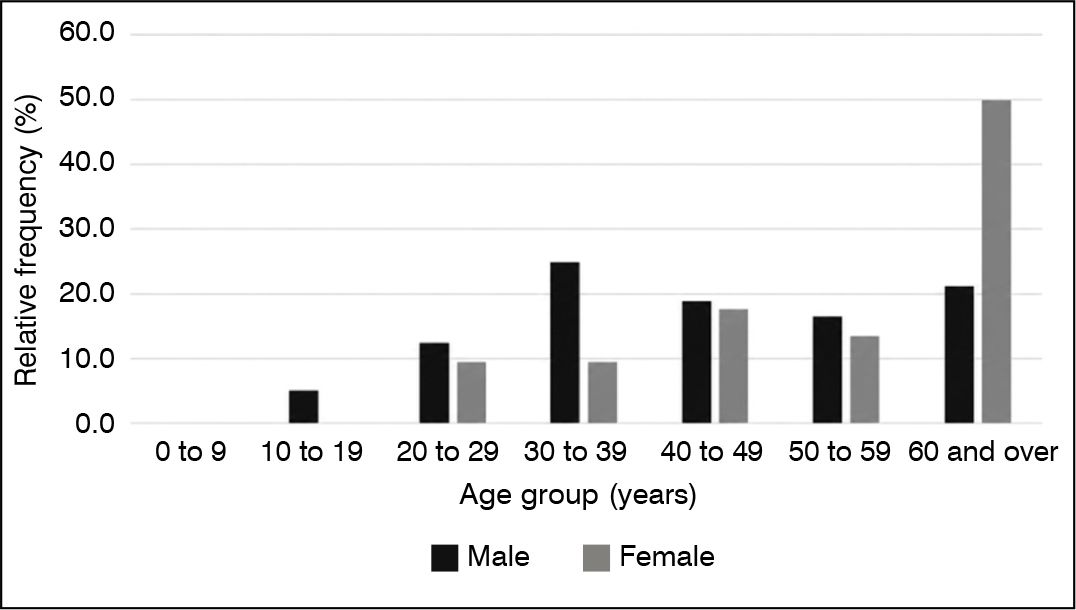
Between January 2022 and December 2022, 173 patients with traumatic spinal fractures were analyzed, affecting different levels from the cervical spine to the sacrum. In some patients, more than one type of fracture was diagnosed, totaling a number of fractures greater than the number of patients. The majority were male (69.9%), with a ratio of 2.32:1. The average age was 48.37 ± 17.54 years, ranging from 15 to 86 years, with 0.6% lost (n=1). The age group most affected among men was between 30 to 39 years (24.8%), and among women, in the age group of 60 years and older (50.0%) (Figure 1).

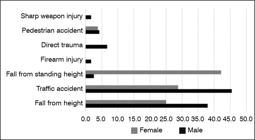
In general, the most frequent trauma mechanisms were traffic accidents (40.5%) and falls from height (34.1%). According to sex, the most frequent trauma mechanism among men was traffic accidents (45.5%), while among women it was falls from their own height (42.3%) (Figure 2).
Regarding the most affected vertebral level, the L1 vertebra was involved in 27.7% (n=48) of cases, followed by T12 at 14.5% (n=25) and C7 at 9.8% (n=17) (Table 1).
A total of 295 fractures were diagnosed in the 173 evaluated patients. The most frequent fractures occurred in the thoracolumbar regions, especially at the L1, L2, and T12 levels. Type A1 fractures were the most prevalent, accounting for 27.2% of cases, while 15.6% of patients presented more than one fracture classification (Table 2).
In the classification of fractures, the category with the highest frequency was type A1, which accounted for 27.2% of patients. The category “Others” refers to fractures classified as type F in the AO classification for cervical spine injuries, which includes isolated facet fractures without rotational or translational displacement.
Patients were examined for neurological deficits using the Frankel scale; 7.6% of patients exhibited some degree of neurological deficit during the initial assessment (Table 3).
Neurological deficit of patients with traumatic spinal fractures assessed using the Frankel scale.
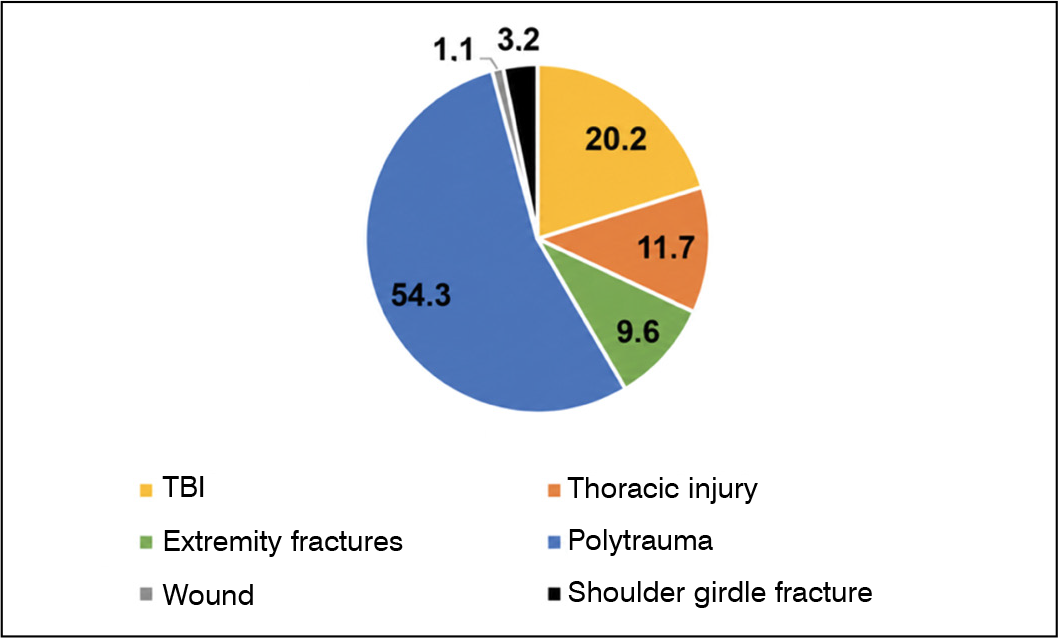
Conservative treatment was the most indicated in 71.7% (n=124) of cases, while surgical treatment was indicated in 28.2% (n=49). Approximately 54.3% (n=94) presented associated trauma, with the most common being polytrauma (n=51; 54.3%) and traumatic brain injury (TBI) at 20.2% (n=19) (Figure 3).

Among the associated fractures, the most frequent were rib fractures at 35.9% (n=23) and lower limb fractures at 20.3% (n=13) (Table 4).
Type A classifications tend to present 44.9% of associated trauma, and 24.5% of traumatic spinal fractures resulted from polytrauma. (Table 5 and 6)
There was a statistically significant association between sex and associated trauma (p= 0.006). The prevalence of associated trauma in men was 1,590 times the prevalence of associated trauma in women. The trauma mechanism due to traffic accidents also showed a statistically significant association with associated trauma (0.013), with the prevalence of associated trauma being 1,410 times higher in cases of traffic accidents. Regarding the affected vertebral level, there was a statistically significant association at the cervical level (p= 0.001), thoracic level (p= 0.045), and lumbar level (p<0.001). However, the prevalence of associated trauma was higher at the cervical level (RP= 1,589) and thoracic level (RP= 1,326). (Table 7)
DISCUSSION
The results of the present study demonstrated a significant prevalence of trauma associated with spinal fractures, approximately 54.3%, similar to a study conducted in Germany that reported 54.4%.2
In this research, the most frequent population consisted of men, accounting for 69.9% in the age range of 30-39 years. The male population is also the most frequent in other studies; however, the age range differs. Fernandes et al. found a prevalence of 85.2% of men, with the most affected age group being adults between 20-29 years; another study identified 75.2% of the male population with the most affected age range between 20 and 39 years. It is important to emphasize that both studies were conducted in Brazil, albeit in different regions.3,4,5
The most frequent trauma mechanisms in men were traffic accidents, while in women, the majority occurred due to falls from their own height. It is important to highlight that the hospital is located near BR-101, according to statistical data, in one of the stretches with the highest number of accidents in Brazil. Ouden et al. found data that differs from this, with the most frequent general trauma mechanism being falls from height; however, the most affected population was women with an average age of 55 years, while in men, traffic accidents were twice as frequent as falls from height.11
Regarding the location of spinal fractures, the most affected area was the thoracolumbar transition, with the most fractured level being L1 (27.7%), a finding that corroborates with national and international scientific literature. A published study demonstrated that the most common vertebral fracture was also L1, representing 34%.
Fractures were classified according to the AO group (Table 2). Considering the AO classification, the most frequent subtype was A1 (27.2%), and the initial neurological assessment was normal, Frankel E, in 87.3% of cases, followed by Frankel A (3.5% of cases). This result differs from a study published by Katsuura, which found 39.5% of fractures classified as type A3 and 33.6% as type A1.
In the tertiary hospital of Greater Florianópolis, the indicated treatment for the majority of spinal fractures was conservative treatment (71.7% of cases). In the study by Antonelli et al., the most frequent treatment was surgical treatment at 61.2%, which contrasts with the present research; however, it demonstrated a higher presence of more severe fractures as assessed in the AO classification and the FRANKEL scale.14
Patients who are victims of high-energy trauma often present with more than one associated injury, which may affect multiple organs or systems. Another study identified associated fractures in 38.4% of patients, while in the present study, more than half of the evaluated patients (54.3%) presented associated trauma, most often involving more than one affected organ or another associated fracture.
The associated traumas were divided into extremity fractures, scapular fractures, wounds, and thoracic spine and abdominal region traumas. Among these, the most observed were rib fractures (23 patients; 13.2%), followed by pneumothorax (19 patients; 10.9%), lower limb fractures (13 patients; 7.5%), and abdominal traumas (7 patients; 4.4%). In a national study, the most prevalent associated traumas identified were hemothorax (31.2%), pulmonary contusion (22.1%), and rib fractures (13%).14 In the meta-analysis study, it presented 21.6% thoracic traumas, 18.3% extremity trauma, and 15.4% cranial traumas, highlighting the importance of searching for associated injuries in the thoracic region and the appendicular skeleton.
Abdominal region traumas presented a lower prevalence (4.4%) at the Tertiary Hospital of Greater Florianópolis compared to the study published in the United States, where the association was 10%, with the most affected organs being the spleen, kidneys, and adrenal glands.15
However, Hershkovitz identified even higher prevalence rates of thoracic spine fractures and associated traumas in the abdominal region (16.9%), with the spleen being the most affected organ at 5.1%. We must pay attention to the search for associated injuries in the abdominal region as well. However, the population in the study was younger and had different trauma mechanisms than the research presented here, inferring higher energy trauma, with greater association to other traumas.6
In this work, a predictive value of higher risk of associated trauma was verified in male patients, and regarding the type of trauma, traffic accidents (1.41x) were the most prevalent with a significant predictive value (p 0.013).
CONCLUSION
The present study outlined a characteristic epidemiological profile of patients with spinal fractures treated at a tertiary hospital in Greater Florianópolis, predominantly consisting of male individuals (69.9%), with the most affected age group being between 30 and 39 years.
Regarding fractures, a higher prevalence was observed in the thoracolumbar transition region, particularly for the fracture of the vertebral body of L1 (27.7%). The majority of the classification of traumatic spinal fractures was of type A (A0-A4), with 56.6% of cases being in these categories. Despite being lower energy traumas, there was a prevalence of associated traumas of 44.6%. Conservative treatment was the most adopted approach, reflecting the profile of the diagnosed injuries.
The high frequency of associated traumas is noteworthy, present in 54.3% of patients, often involving multiple systems, with a higher incidence of rib fractures, pneumothorax, and lower limb fractures. The statistical analysis identified a significant predictive value for a higher risk of associated traumas among male individuals and victims of traffic accidents, with an increased risk of 1.41 times (p = 0.013).
These results reinforce the importance of a comprehensive and protocol-based clinical and radiological evaluation, aiming for the early detection of associated injuries, especially in at-risk populations, and highlight the relevance of preventive measures aimed at reducing morbidity and mortality associated with this type of trauma.
-
Study conducted by the Homero de Miranda Gomes Regional Hospital, São José, Santa Catarina, Brazil.
DATA AVAILABILITY DECLARATION
The underlying contents of the research text are contained in the manuscript.
REFERENCES
- 1 Brasil. Ministério da Saúde. Secretária de Atenção à Saúde. Departamento de Ações Programáticas Estratégicas. Diretrizes de Atenção à pessoa com lesão medular. Brasília 2013. Comissão de educação continuada da Sociedade Brasileira de Ortopedia e Traumatologia. Manual de Trauma Ortopédico. São Paulo: SBOT; 2011.
-
2 Leucht P, Fischer K, Muhr G, Mueller EJ. Epidemiology of traumatic spine fractures. Injury. 2009;40(2):166-72. doi: 10.1016/j.injury.2008.06.040.
» https://doi.org/10.1016/j.injury.2008.06.040. -
3 Fernandes RB, Gomes EGF, Gusmão MS, de Amorim JDC, Simões MTV, Gomes FG, et al. Estudo clínico epidemiológico das fraturas da coluna vertebral. Coluna/Columna. 2012;11(3):230-3. doi: 10.1590/S1808-18512012000300009.
» https://doi.org/10.1590/S1808-18512012000300009. -
4 Lomaz MB, Sales LAF, Garrote MS, Alves AP, Canto FDRT. Epidemiological profile of patients with traumatic spinal fracture. Coluna/Columna. 2017;16(3):224-7. doi: 10.1590/S1808-185120171603176399.
» https://doi.org/10.1590/S1808-185120171603176399. - 5 Zaninelli EM, Graells XS, Néri OJ, Dau L. Avaliação Epidemiológica das fraturas torácica e lombar em pacientes atendidos no Pronto Socorro do Hospital do Trabalhador da UFPR de Curitiba-Paraná. Coluna/Columna. 2005;4(1):11-5.
-
6 Hershkovitz Y, Sheffer D, Peleg K, Kessel B, Dubose J, Jeroukhimov I, et al. Thoracic vertebrae fracture: Is it an indicator of abdominal injury?. Am J Emerg Med. 2021;43:235-7. doi: 10.1016/j.ajem.2020.03.016.
» https://doi.org/10.1016/j.ajem.2020.03.016. -
7 Alkhathlan KM, Alzahrani MG, Aldosari KH, Alsheddi MI, Alqeair AA. Traumatic spinal injuries in the Kingdom of Saudi Arabia: a study of associated injuries, management and mortality. Pan Afr Med J. 2019;32:153. doi: 10.11604/pamj.2019.32.153.18047.
» https://doi.org/10.11604/pamj.2019.32.153.18047. -
8 Giannakopoulos GF, Saltzherr TP, Beenen LF, Reitsma JB, Bloemers FW, Goslings JC, et al. Missed injuries during the initial assessment in a cohort of 1124 level-1 trauma patients. Injury. 2012;43(9):1517-21. doi: 10.1016/j.injury.2011.07.012.
» https://doi.org/10.1016/j.injury.2011.07.012. -
9 Houshian S, Larsen MS, Holm C. Missed injuries in a level I trauma center. J Trauma. 2002;52(4):715-9. doi: 10.1097/00005373-200204000-00018.
» https://doi.org/10.1097/00005373-200204000-00018. -
10 Hinzpeter R, Boehm T, Boll D, Constantin C, Del Grande F, Fretz V, et al. Imaging algorithms and CT protocols in trauma patients: survey of Swiss emergency centers. Eur Radiol. 2017;27(5):1922-8. doi: 10.1007/s00330-016-4574-1.
» https://doi.org/10.1007/s00330-016-4574-1. -
11 Ouden LPD, Smits AJ, Stadhouder A, Feller R, Deunk J, Bloemers FW. Epidemiology of spinal fractures in a level one trauma center in the Netherlands: a 10 years review. Spine. 2019;44(10):732-9. doi: 10.1097/BRS.0000000000002923.
» https://doi.org/10.1097/BRS.0000000000002923. -
12 Vandenberg J, Cullison K, Fowler AS, Parsons MS, Mcandrew CM, Carpenter CR. Blunt Thoracolumbar-spine trauma evaluation in the emrgency department: A meta-analysis of diagnostic accuracy for History, physical examination and imaging. J Emerg Med. 2019;56(2):153-65. doi: 10.1016/j.jemermed.2018.10.032.
» https://doi.org/10.1016/j.jemermed.2018.10.032. -
13 Holmes JF, Miller PQ, Panacek EA, Lin S, Horne NS, Mower WR. Epidemiology of thoracolumbar spine injury in blunt trauma. Acad Emerg Med. 2001;8(9):866-72. doi: 10.1111/j.1553-2712.2001.tb01146.x.
» https://doi.org/10.1111/j.1553-2712.2001.tb01146.x. -
14 Antonelli A, Kulcheski AL, Sebben AL, Nanni FN, Santoro PGD, Benato ML. Spinal fractures and thoracoabdominal injuries in polytraumatized patients: epidemiological evaluation. Coluna/Columna. 2023;22(2):e267378. doi: 10.1590/S1808-185120222202267378.
» https://doi.org/10.1590/S1808-185120222202267378. -
15 Rabinovici R, Ovadia P, Mathiak G, Abdullah F. Abdominal injuries associated with lumbar spine fractures in blunt trauma. Injury. 1999;30(7):471-4. doi: 10.1016/s0020-1383(99)00134-5.
» https://doi.org/10.1016/s0020-1383(99)00134-5.
Edited by
-
Reviewed by:
Murilo Daher