 Joint angle variations in trotting Criollo horses under two head and neck positions: a pilot study
ABSTRACT
Kinematic analysis offers key insights into equine locomotion by linking body conformation, training, and performance. Despite their socio-economic importance in South America, detailed kinematic data on Criollo horses is scarce. This pilot study examined how head and neck position (HNP) and ground surface influenced limb angular amplitudes during trot in Criollo horses. Videos of 11 adult horses (8.2 ± 2.4 years) were recorded at 120 Hz under two HNP: free rein (HNP1) and flexed at the poll (HNP2), ridden on hard (compacted soil, n = 6) or soft (sand, n = 5) surfaces. Joint angles were measured from anatomical landmarks using Kinovea software, and angle amplitudes analyzed by a Linear Mixed Model (LMM) with Bonferroni correction (P < 0.0027). HNP significantly affected the coxofemoral joint amplitude (mean difference = 3.98º, S.D. ±1.11 P < 0.001), indicating enhanced hindlimb engagement, therefore less amplitude movement, when the poll was flexed. Surface type influenced multiple joints: the radiocarpal and carpometacarpal joints in the thoracic limb showed greater flexion on soft ground (P < 0.001), suggesting impact attenuation. In the pelvic limb, coxofemoral and tarsocrural joints exhibited larger amplitudes on soft surfaces, implying adaptation to instability to maintain propulsion. These findings contributed to optimize training, competition, and rehabilitation in Criollos and other breeds. Larger studies controlling for rider and equipment effects are necessary to confirm these preliminary results.
Key words:
angles; kinematics; Criollo horse; head and neck
RESUMO
A análise cinemática oferece importantes insights sobre a locomoção equina ao relacionar conformação corporal, treinamento e desempenho. Apesar de sua importância socioeconômica na América do Sul, dados cinemáticos detalhados sobre cavalos Crioulos são escassos. Este estudo piloto examinou como a posição da cabeça e do pescoço (HNP) e o tipo de superfície influenciam as amplitudes angulares dos membros durante o trote em cavalos Crioulos. Para isso, vídeos de 11 cavalos adultos (8,2 ± 2,4 anos) foram gravados a 120 Hz sob duas condições de HNP: a) rédea solta (HNP1) e b) flexionada na nuca (HNP2), montados em superfícies dura (solo compactado, n = 6) ou macia (areia, n = 5). Os ângulos articulares foram medidos a partir de marcadores anatômicos usando o software Kinovea, e as amplitudes angulares foram analisadas por um Modelo Linear Misto (LMM) com correção de Bonferroni (P < 0,0027). Os resultados mostram que a HNP afetou significativamente a amplitude da articulação coxofemoral (diferença média = 3,98º, DP ±1,11, P < 0,001), indicando maior engajamento dos membros posteriores e menor amplitude de movimento quando a nuca estava flexionada. Além disso, o tipo de superfície influenciou várias articulações como por exemplo, as articulações radiocárpica e carpo-metacárpica do membro torácico que apresentaram maior flexão em solo macio (P < 0,001), sugerindo atenuação do impacto. No membro pélvico, as articulações coxofemoral e tarsocrural exibiram amplitudes maiores em superfícies macias, sugerindo adaptação à instabilidade para manter a propulsão. Esses achados contribuem para otimizar treinamento, competição e reabilitação em Crioulos e outras raças. Estudos maiores controlando efeitos do cavaleiro e equipamento são necessários para confirmar esses resultados preliminares.
Palavras-chave:
ângulos; cinemática; cavalo Crioulo; cabeça e pescoço
INTRODUCTION
The analysis of angular patterns in horses during movement allows for the evaluation of forces direction on the limbs, diagnosis of injuries, monitoring of treatments, and understanding of locomotor adaptations in different breeds (BERTRAM et al., 2000; BUCHNER et al., 1996a; 1996b; CLAYTON et al., 2000; GALISTEO et al., 1997; KRAMER et al., 2000). In sports veterinary medicine, kinematic analysis is currently applied to optimize horse training and competition results, as well as to complement conformation studies with objective biomechanical data (CANO et al., 2001; FONSECA, 2018; MARTUZZI et al., 2007; NOVOA-BRAVO et al., 2018). Breed-specific kinematic characteristics have been described for horses used in trotting competitions, as well as for Arabian and Spanish breeds (CANO et al., 2001), Chilean Paso Fino (NOVOA-BRAVO et al., 2018), Bardgiano (MARTUZZI et al., 2007) and Icelandic breeds (WEISHAUPT et al., 2013), among others. Each of these breeds displays distinctive movement adaptations that reflect their morphology and functional use. However, despite the growing popularity and economic importance of the Criollo breed in South America, particularly in working cattle, endurance, and equestrian competitions, systematic kinematic data for this breed remain scarce (CARDOSO, 2022; PIZZI et al., 2024; VERNA et al., 2022).
The trot biomechanical characteristics and their relationship with riding are frequently studied due to their symmetric pattern and biomechanical relevance to equestrian sports. In special, head and neck position (HNP) at the trot directly modifies locomotor patterns, influencing stride characteristics, back motion, and hindlimb engagement (ALVAREZ et al., 2006; RHODIN et al., 2018; RHODIN et al., 2005). These changes have implications not only for athletic performance but also for equine welfare, since inappropriate or extreme postures can compromise animal and rider comfort and musculoskeletal health (GO et al., 2014; KIENAPFEL et al., 2024). Among the variables influencing locomotion, head and neck posture is key, whether voluntarily adopted by the animal or imposed by the rider (WEISHAUPT et al., 2006). Another key factor is ground type, which may alter limb loading, joint motion, and locomotor strategies. Understanding how these variables affect movement in Criollo horses is essential for improving training, injury prevention, and performance evaluation.
This study examined how two head and neck positions and two ground types (hard and soft) affect fore- and hindlimb joint angles in Criollo horses. We hypothesized that the flexed at the poll position (HNP2) would increase hindlimb engagement, while surface type would primarily influence distal joints amplitude, with hard ground enhancing flexion for impact attenuation and soft ground promoting greater motion for propulsion and stability.
MATERIALS AND METHODS
Animals
The horses enrolled in this study were accustomed to regular riding and basic work training, but none had been conditioned to intermediate or advanced performance levels. To ensure only sound individuals were included, all candidates underwent objective gait assessment with a wireless inertial sensor system (Lameness Locator®). Horses were excluded if they demonstrated any asymmetry exceeding a vector sum of 8.5 mm during trot evaluation, following the equipment recommendations (DONNELL et al., 2015). Eleven Criollo horses of Brazilian lineage met the inclusion criteria: seven mares (Mean age = 7.7y, S.D. ± 4.68) and 4 geldings/castrated males (Mean age = 5.5y, S.D. ± 1.73).
Kinematic data collection
To facilitate measurement of joint angles, temporary anatomical landmarks were marked on the skin using non-toxic washable paint, adapted from CLAYTON & SCHAMHARDT (2001). The measured angles were: Humeroradial (elbow), radiocarpal and carpometacarpal in the thoracic limb and coxofemoral, femorotibial and tarsocrural in the pelvic limb. Markers were placed over identifiable bony prominences at the following sites: lateral tuberosity of the humerus, olecranon tuber, fourth carpal bone, distal lateral surface of the metacarpal, tuber coxae, tuber ischiatic, greater trochanter, lateral malleolus of the tibia, calcaneus, and distal lateral surface of the metatarsus. These aimed to identify six overall joint angles in both the forelimb and hindlimb.
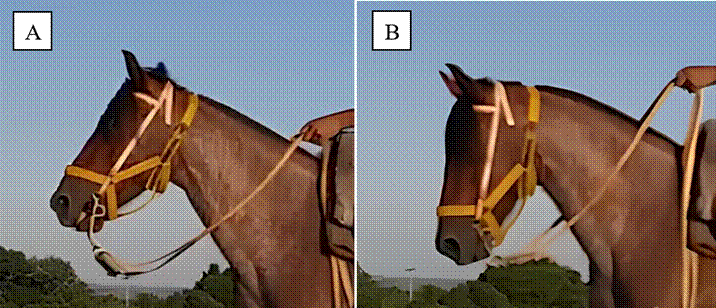
Each horse was ridden by its regular trainer (six riders in total) and trotted in a straight line either on a sand surface (soft ground, n = 5) or on compacted dirt (hard ground, n = 6). Video recordings were obtained from a lateral perspective using a high-speed digital camera placed 10 m from the track and mounted on a tripod at 1.2 m height. Recordings were captured at 120 frames per second. Two head-neck positions were adapted from previous publications (MARTINS et al., 2025; RHODIN et al., 2009; RHODIN et al., 2005) and tested in our cohort of Criollo horses: HNP1 (free rein, with little to no contact from the rider) and HNP2 (flexed at the poll with nose in front of the vertical line) (Figure 1). Prior to data collection, the horses were ridden for five minutes to warm up, allowing them to adjust to the recording environment. Each horse performed five trot passes in front of the camera in both HNPs. Kinematic data were extracted using Kinovea software, and joint angles were measured frame-by-frame, with values compiled and organized in Microsoft Excel® spreadsheets for subsequent statistical analysis.
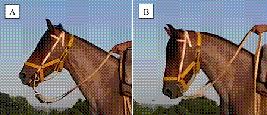
Visual demonstration of a Criollo horse in the A) HNP1 (free rein, with little to no rider contact to the reins and bit, and an extended/natural head position) and B) HNP2 (flexed at the poll, with nostrils in front of the vertical, also considered a competition position for the Criollo breed).
Statistical analysis
Descriptive statistics (mean, standard deviation, minimum, maximum, and median) were calculated for each joint angle across head-neck position (HNP) and ground type conditions. Angular amplitudes were determined from maximum and minimum joint angle values. Data distribution was assessed using the Shapiro-Wilk test for normality. The angular scales of the thoracic and pelvic limbs were subjected to a Linear Mixed Model to evaluate whether there was a difference between the head and neck position (HNP) and the interaction with type of ground on which the horses were ridden. To control multiple comparisons, we applied a Bonferroni correction, with statistical significance set at P ≤ 0.0027. For significant associations, a Tukey HSD Pairwise comparison was conducted to evaluate influence of individual parameters. All analyses and graphical representation were performed using Jamovi v2.5 (Sydney, Australia) in conjunction with the 2025 JMP v18.1 (JMP Statistical Discovery LLC, Cary, NC, EUA).
RESULTS
Effect of head and neck position
Of all joints evaluated, only the coxofemoral joint exhibited a significant influence of HNP, where horses trotted with a flexed poll posture (HNP2; mean = 17.3º, SD ± 5.34) showed a reduced angular amplitude compared to those on a free rein (HNP1; mean = 21.3º, SD ± 6.72) (P < 0.001). No notable variation was detected in thoracic, femorotibial, or tarsocrural joints, with amplitudes consistent across both postural conditions.
Effect of ground surface
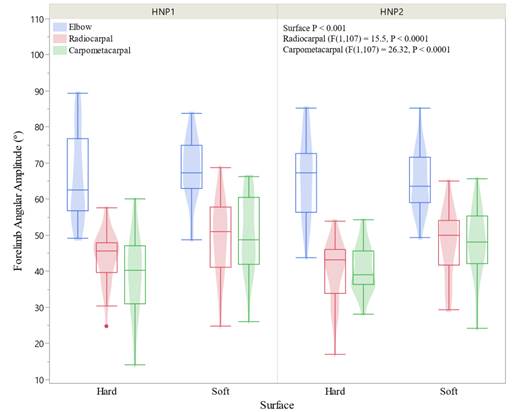
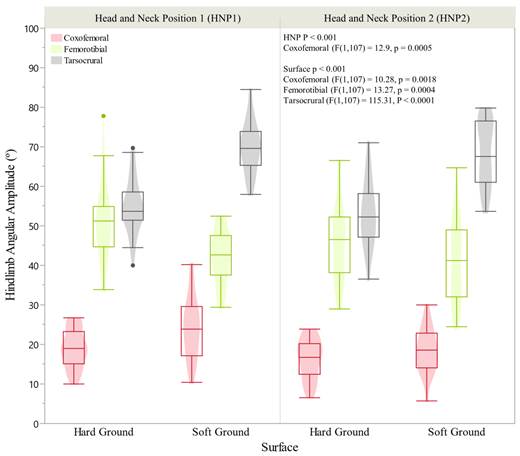
Ground surface demonstrated a broader influence on joint kinematics compared to HNP, where only the humeroradial joint was unaffected by footing type. In the thoracic limb, both radiocarpal (6.65º, S.D. ± 1.69) and carpometacarpal (9.3º, S.D. ± 1.81) joints showed greater amplitude on soft ground versus hard ground (P < 0.001) visually represented in figure 2. In the pelvic limb, the coxofemoral (3.57º, S.D. ± 1.11) and tarsocrural (15.27º, S.D. ± 1.42) joints presented significantly greater angular amplitude on soft ground when compared to hard ground (P < 0.001) as presented in figure 3. Conversely, femorotibial joint displayed significantly greater amplitude on hard ground (6.43º, S.D. ± 1.76) when compared to soft ground (P < 0.001) (Figure 3).
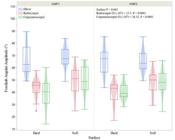
Distribution of angular amplitudes of the thoracic limb by HNP group and footing type (hard or soft) in 11 Criollo horses, with anatomical joints represented by distinct colors representing the humeroradial joint (blue), radiocarpal (red) and carpometacarpal (green).
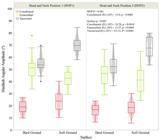
Distribution of angular amplitudes of the pelvic limb by HNP group and footing type (hard or soft) in 11 Criollo horses, with anatomical joints represented by distinct colors representing the coxofemoral joint (pink), femorotibial (green) and tarsocrural (gray).
DISCUSSION
Our study evaluated how head and neck position (HNP) and ground surface type influence limb joint kinematics in trotting Criollo horses. We demonstrate that horses trotted with a flexed poll show a smaller joint angle amplitude at the coxofemoral joint compared to free rein (3.98º, S.D. ±1.11) (P < 0.001). No significant differences related to HNP were observed in the thoracic joints, as well as in the femorotibial and tarsocrural joints, which exhibited consistent amplitude values across both postural conditions evaluated. These results aligned with prior studies showing HNP primarily modulates pelvic limb mechanics and propulsion, rather than forelimb kinematics (RHODIN, 2008).
In contrast, ground surface type exerted a broader influence on joint amplitudes, with the most notable adaptations observed in distal joints. Soft ground also produced distinct kinematic adaptations; the radiocarpal and carpometacarpal on the forelimb and coxofemoral and tarsocrural on the hindlimb showed higher amplitude, which can be due ground-related properties, when compared to the results obtained on the hard ground (CLAYTON & HOBBS, 2019; PARKES & WITTE, 2015).
The findings indicate that soft footing causes horses to exert more effort in lifting their limbs, generating propulsion for gait transition, and maintaining limb stability during the stance phase (HARRISON et al., 2024; MORALES-ACOSTA et al., 2018; WALKER et al., 2022). The greater forelimb angular amplitude present in these conditions may be beneficial for rehabilitation and tendon management, as compliant surfaces can reduce peak ground reaction forces while demanding higher energy for limb withdrawal (PARKES & WITTE, 2015; ZSOLDOS & LICKA, 2015). In terms of competition, horses rated as “good” by judges during competitions typically exhibited longer swing phases, more pronounced limb retraction, and greater flexion of the humeroradial and radiocarpal joints (HOLMSTRÖM et al., 1995; HOLMSTRÖM & PHILIPSSON, 1993).
Meanwhile the only joint that presented lower amplitude mean on soft ground was femorotibial, which can be due to compensatory mechanisms as reciprocal apparatus response to stabilize the limb, since the other two evaluated joints were presenting higher means.
These findings should be considered in light of the small sample size of Brazilian Criollo horses and possible confounding factors like rider variation, equipment, and slight differences in arena surface preparation. Additionally, using skin-mounted markers may cause minor measurement errors in joint angles due to soft tissue movement (CLAYTON & SCHAMHARDT, 2001). Future research should address these methodological factors by using larger sample sizes, standardized riding and equipment protocols, and advanced tracking technologies.
This study found that in our cohort head and neck position influenced the angular amplitude of the coxofemoral joint, suggesting that it could affect hindlimb engagement. Therefore, a reduced maximal flexion-extension range may imply that a more active muscular control and higher activation are necessary, leading to a greater potential for propulsive forces and thus, a “higher engagement” despite the smaller overall amplitude. Meanwhile surface type broadly impacted both thoracic and pelvic limb kinematics (CAURE et al., 2024). These findings have practical value for improving training and welfare in Criollo horses by adjusting surface type and posture. Further research with diverse horse groups under controlled conditions are recommended.
CONCLUSION
In Brazilian Criollo horses, head and neck adjustments mainly affected coxofemoral joint kinematics and hindlimb engagement during trot, while different ground surfaces broadly altered movement in distal fore- and hindlimb joints. These findings reinforce that equine locomotion is an adaptive process, shaped by both posture and environmental features, and highlight the importance of tailoring training and rehabilitation protocols to ground conditions and head-neck posture. While these conclusions are specific to the group of Criollo horses studied here, further research is needed to extrapolate these patterns to a larger Criollo population, particularly under more rigorously controlled experimental conditions.
ACKNOWLEDGMENTS
This work was partial funded by the Brazilian Federal Agencies: Coordenação de Aperfeiçoamento de Pessoal de Nível Superior (CAPES), Finance Code 001, and by the Conselho Nacional de Desenvolvimento Científico e Tecnológico (CNPq).
REFERENCES
-
ALVAREZ, C. G. et al. The effect of head and neck position on the thoracolumbar kinematics in the unridden horse. Equine Veterinary Journal, v.38, n.S36, p.445-451, 2006. Available from: <Available from: https://beva.onlinelibrary.wiley.com/doi/10.1111/j.2042-3306.2006.tb05585.x >. Accessed: May, 12, 2024. doi: 10.1111/j.2042-3306.2006.tb05585.x.
» https://doi.org/10.1111/j.2042-3306.2006.tb05585.x.» https://beva.onlinelibrary.wiley.com/doi/10.1111/j.2042-3306.2006.tb05585.x -
BERTRAM, J. E. et al. Comparison of the trotting gaits of Labrador Retrievers and Greyhounds. American Journal of Veterinary Research, v.61, n.7, p.832-838, 2000. Available from: <Available from: https://avmajournals.avma.org/view/journals/ajvr/61/7/ajvr.2000.61.832.xml >. Accessed: Jan. 15, 2025. doi: 10.2460/ajvr.2000.61.832.
» https://doi.org/10.2460/ajvr.2000.61.832.» https://avmajournals.avma.org/view/journals/ajvr/61/7/ajvr.2000.61.832.xml -
BUCHNER, H. et al. Head and trunk movement adaptations in horses with experimentally induced fore- or hindlimb lameness. Equine Veterinary Journal, v.28, n.1, p.71-76, 1996a. Available from: <Available from: https://beva.onlinelibrary.wiley.com/doi/10.1111/j.2042-3306.1996.tb01592.x >. Accessed: Mar. 22, 2024. doi: 10.1111/j.2042-3306.1996.tb01592.x.
» https://doi.org/10.1111/j.2042-3306.1996.tb01592.x.» https://beva.onlinelibrary.wiley.com/doi/10.1111/j.2042-3306.1996.tb01592.x -
BUCHNER, H. et al. Limb movement adaptations in horses with experimentally induced fore- or hindlimb lameness. Equine Veterinary Journal, v.28, n.1, p.63-70, 1996b. Available from: <Available from: https://beva.onlinelibrary.wiley.com/doi/10.1111/j.2042-3306.1996.tb01591.x >. Accessed: Apr. 05, 2024. doi: 10.1111/j.2042-3306.1996.tb01591.x.
» https://doi.org/10.1111/j.2042-3306.1996.tb01591.x.» https://beva.onlinelibrary.wiley.com/doi/10.1111/j.2042-3306.1996.tb01591.x -
CANO, M. R. et al. Kinematic characteristics of Andalusian, Arabian and Anglo-Arabian horses: a comparative study. Research in Veterinary Science, v.71, n.2, p.147-153, 2001. Available from: <Available from: https://www.sciencedirect.com/science/article/pii/S0034528801905041?via%3Dihub >. Accessed: Nov. 10, 2024. doi: 10.1053/rvsc.2001.0504.
» https://doi.org/10.1053/rvsc.2001.0504.» https://www.sciencedirect.com/science/article/pii/S0034528801905041?via%3Dihub -
CARDOSO, C. W. Para além da cultura: o negócio do cavalo Crioulo no Rio Grande do Sul como emprego e renda. Colloquium: Revista de Desenvolvimento Regional, v.4, n.1, p.55-70, 2022. Available from: <Available from: https://seer.faccat.br/index.php/colloquium/article/view/2288 >. Accessed: Feb. 18, 2025.
» https://seer.faccat.br/index.php/colloquium/article/view/2288 -
CAURE, S. et al. Effects of sand, asphalt, and a three degrees hind toe or heel elevation on equine cervical and thoracolumbosacral kinematics at walk and trot. Journal of Equine Veterinary Science, v.141, p.105151, 2024. Available from: <Available from: https://pubmed.ncbi.nlm.nih.gov/40914497/ >. Accessed: Mar. 20, 2025. doi: 10.1016/j.jevs.2025.105697.
» https://doi.org/10.1016/j.jevs.2025.105697.» https://pubmed.ncbi.nlm.nih.gov/40914497/ -
CLAYTON, H. M.; HOBBS, S. J. A review of biomechanical gait classification with reference to collected trot, passage and piaffe in dressage horses. Animals, v.9, n.10, p.763, 2019. Available from: <Available from: https://www.mdpi.com/2076-2615/9/10/763 >. Accessed: Jul. 20, 2024. doi: 10.3390/ani9100763.
» https://doi.org/10.3390/ani9100763.» https://www.mdpi.com/2076-2615/9/10/763 - CLAYTON, H. M.; SCHAMHARDT, H. C. Measurement techniques for gait analysis. In: BACK, W.; CLAYTON, H. M. (Eds.). Equine Locomotion. 2nd ed. London: W.B. Saunders, 2001. p.31-60.
-
CLAYTON, H. M. et al. Kinematics and ground reaction forces in horses with superficial digital flexor tendinitis. American Journal of Veterinary Research, v.61, n.2, p.191-196, 2000. Available from: <Available from: https://avmajournals.avma.org/view/journals/ajvr/61/2/ajvr.2000.61.191.xml >. Accessed: Sept. 29, 2024. doi: 10.2460/ajvr.2000.61.191.
» https://doi.org/10.2460/ajvr.2000.61.191.» https://avmajournals.avma.org/view/journals/ajvr/61/2/ajvr.2000.61.191.xml -
DONNELL, J. R. et al. Comparison of subjective lameness evaluation, force platforms and an inertial-sensor system to identify mild lameness in an equine osteoarthritis model. The Veterinary Journal, v.206, n.2, p.136-142, 2015. Available from: <Available from: https://pubmed.ncbi.nlm.nih.gov/26361749/ >. Accessed: Dec. 02, 2024. doi: 10.1016/j.tvjl.2015.08.004.
» https://doi.org/10.1016/j.tvjl.2015.08.004.» https://pubmed.ncbi.nlm.nih.gov/26361749/ -
FONSECA, M. G. Mangalarga Marchador: estudo morfométrico, cinemático e genético da marcha batida e da marcha picada. 2018. Tese (Doutorado em Zootecnia) - Escola de Veterinária, UFMG, Belo Horizonte, 2018. Available from: <Available from: https://repositorio.ufmg.br/handle/1843/BUOS-B79H9Y >. Accessed: Oct. 11, 2024.
» https://repositorio.ufmg.br/handle/1843/BUOS-B79H9Y -
GALISTEO, A. et al. Differences between breeds (Dutch warmblood vs Andalusian purebred) in forelimb kinematics. Journal of Equine Science, v.8, n.2, p.43-47, 1997. Available from: <Available from: https://www.jstage.jst.go.jp/article/jes/8/2/8_2_43/_article >. Accessed: Jun. 19, 2024.doi: 10.1294/jes.8.43.
» https://doi.org/10.1294/jes.8.43.» https://www.jstage.jst.go.jp/article/jes/8/2/8_2_43/_article -
GO, L.-M. et al. Pharyngeal diameter in various head and neck positions during exercise in sport horses. BMC Veterinary Research, v.10, p.1-9, 2014. Available from: <Available from: https://pubmed.ncbi.nlm.nih.gov/24886465/ >. Accessed: May, 30, 2025. doi: 10.1186/1746-6148-10-117.
» https://doi.org/10.1186/1746-6148-10-117.» https://pubmed.ncbi.nlm.nih.gov/24886465/ -
HARRISON, A. et al. Equine gait analysis: new techniques, trials and thinking. Frontiers in Veterinary Science, v.11, p.1378892, 2024. Available from: <Available from: https://www.jscimedcentral.com/jounal-article-info/Journal-of-Veterinary-Medicine-and-Research/Equine-Gait-Analysis:-New-Techniques,-Trials-and-Thinking-12043 >. Accessed: Aug. 01, 2025. doi: 10.47739/2378-931X/1275.
» https://doi.org/10.47739/2378-931X/1275.» https://www.jscimedcentral.com/jounal-article-info/Journal-of-Veterinary-Medicine-and-Research/Equine-Gait-Analysis:-New-Techniques,-Trials-and-Thinking-12043 -
HOLMSTRÖM, M. et al. Variation in angular pattern adaptation from trot in hand to passage and piaffe in the grand prix dressage horse. Equine Veterinary Journal, v.27, n.S18, p.132-137, 1995. Available from: <Available from: https://beva.onlinelibrary.wiley.com/doi/10.1111/j.2042-3306.1995.tb04905.x >. Accessed: Apr. 14, 2024. doi: 10.1111/j.2042-3306.1995.tb04905.x.
» https://doi.org/10.1111/j.2042-3306.1995.tb04905.x.» https://beva.onlinelibrary.wiley.com/doi/10.1111/j.2042-3306.1995.tb04905.x -
HOLMSTRÖM, M.; PHILIPSSON, J. Relationships between conformation, performance and health in 4-year-old Swedish Warmblood riding horses. Livestock Production Science, v.33, n.3-4, p.293-312, 1993. Available from: <Available from: https://www.sciencedirect.com/science/article/pii/0301622693900097 >. Accessed: Sept. 22, 2024. doi: 10.1016/0301-6226(93)90009-7.
» https://doi.org/10.1016/0301-6226(93)90009-7.» https://www.sciencedirect.com/science/article/pii/0301622693900097 -
KIENAPFEL, K. et al. Comparison of head-neck positions and conflict behaviour in ridden elite dressage horses between warm-up and competition. Applied Animal Behaviour Science, v.272, p.106202, 2024. Available from: <Available from: https://www.sciencedirect.com/science/article/pii/S0168159124000509 >. Accessed: Apr. 14, 2025. doi: 10.1016/j.applanim.2024.10620.
» https://doi.org/10.1016/j.applanim.2024.10620.» https://www.sciencedirect.com/science/article/pii/S0168159124000509 -
KRAMER, J. et al. Kinematics of the hind limb in trotting horses after induced lameness of the distal intertarsal and tarsometatarsal joints and intra-articular administration of anesthetic. American Journal of Veterinary Research, v.61, n.9, p.1031-1036, 2000. Available from: <Available from: https://avmajournals.avma.org/view/journals/ajvr/61/9/ajvr.2000.61.1031.xml >. Accessed: Jul. 08, 2024. doi: 10.2460/ajvr.2000.61.1031.
» https://doi.org/10.2460/ajvr.2000.61.1031.» https://avmajournals.avma.org/view/journals/ajvr/61/9/ajvr.2000.61.1031.xml -
MARTINS, N. A. et al. Head and neck positions affect equine kinematic variables in marcha batida gait - a pilot study. Animals, v.15, n.8, p.1090, 2025. Available from: <Available from: https://www.mdpi.com/2076-2615/15/8/1090 >. Accessed: Aug. 20, 2025. doi: 10.3390/ani15081090.
» https://doi.org/10.3390/ani15081090.» https://www.mdpi.com/2076-2615/15/8/1090 -
MARTUZZI, F. et al. Kinematics of gaits in Bardigiano horses. Italian Journal of Animal Science, v.6, n.sup1, p.653-653, 2007. Available from: <Available from: https://www.tandfonline.com/doi/abs/10.4081/ijas.2007.1s.653 >. Accessed: Feb. 25, 2024. doi: 10.4081/ijas.2007.1s.653.
» https://doi.org/10.4081/ijas.2007.1s.653.» https://www.tandfonline.com/doi/abs/10.4081/ijas.2007.1s.653 -
MORALES-ACOSTA, L. et al. Analysis and characterization of the normal gait phases of walking Warmblood horses as a tool for the diagnosis of lameness. Pesquisa Veterinária Brasileira, v.38, n.3, p.536-543, 2018. Available from: <Available from: https://www.scielo.br/j/pvb/a/TCnWMF9JQ4MdWzK468tnfYx/?lang=en&format=html >. Accessed: Jan. 21, 2025. doi: 10.1590/1678-5150-PVB-4496.
» https://doi.org/10.1590/1678-5150-PVB-4496.» https://www.scielo.br/j/pvb/a/TCnWMF9JQ4MdWzK468tnfYx/?lang=en&format=html -
NOVOA-BRAVO, M. et al. Selection on the Colombian paso horse’s gaits has produced kinematic differences partly explained by the DMRT3 gene. PLoS ONE, v.13, n.8, p.e0202584, 2018. Available from: <Available from: https://journals.plos.org/plosone/article?id=10.1371/journal.pone.0202584 >. Accessed: May, 17, 2024. doi: 10.1371/journal.pone.0202584
» https://doi.org/10.1371/journal.pone.0202584» https://journals.plos.org/plosone/article?id=10.1371/journal.pone.0202584 -
PARKES, R.; WITTE, T. The foot-surface interaction and its impact on musculoskeletal adaptation and injury risk in the horse. Equine Veterinary Journal, v.47, n.5, p.519-525, 2015. Available from: Available from: <https://beva.onlinelibrary.wiley.com/doi/10.1111/evj.12420 >. Accessed: Jun. 27, 2024. doi: 10.1111/evj.12420
» https://doi.org/10.1111/evj.12420» <https://beva.onlinelibrary.wiley.com/doi/10.1111/evj.12420 -
PIZZI, G. L. B. L. et al. 2D kinematic analysis of the esbarrada and volta sobre patas manoeuvres of Criollo breed horses competing in Freio de Ouro. Animals, v.14, n.16, p.2410, 2024. Available from: <Available from: https://www.mdpi.com/2076-2615/14/16/2410 >. Accessed: Aug. 05, 2025. doi: 10.3390/ani14162410.
» https://doi.org/10.3390/ani14162410.» https://www.mdpi.com/2076-2615/14/16/2410 -
RHODIN, M. A biomechanical analysis of relationship between the head and neck position, vertebral column and limbs in the horse at walk and trot. 2008. Tese (Doutorado) - Swedish University of Agricultural Sciences, Uppsala, 2008. Available from: <Available from: https://res.slu.se/id/publ/18925 >. Accessed: Mar. 11, 2024.
» https://res.slu.se/id/publ/18925 -
RHODIN, M. et al. The effect of different head and neck positions on the caudal back and hindlimb kinematics in the elite dressage horse at trot. Equine Veterinary Journal, v.41, n.3, p.274-279, 2009. Available from: <Available from: https://pubmed.ncbi.nlm.nih.gov/19469235/ >. Accessed: Sept. 04, 2024. doi: 10.2746/042516409x394436.
» https://doi.org/10.2746/042516409x394436.» https://pubmed.ncbi.nlm.nih.gov/19469235/ -
RHODIN, M. et al. Effect of different head and neck positions on kinematics of elite dressage horses ridden at walk on treadmill. Comparative Exercise Physiology, v.14, n.2, p.69-78, 2018. Available from: <Available from: https://www.researchgate.net/publication/325634946_Effect_of_different_head_and_neck_positions_on_kinematics_of_elite_dressage_horses_ridden_at_walk_on_treadmill >. Accessed: Jan. 12, 2025. doi: 10.3920/CEP180002.
» https://doi.org/10.3920/CEP180002.» https://www.researchgate.net/publication/325634946_Effect_of_different_head_and_neck_positions_on_kinematics_of_elite_dressage_horses_ridden_at_walk_on_treadmill -
RHODIN, M. et al. The influence of head and neck position on kinematics of the back in riding horses at the walk and trot. Equine Veterinary Journal, v.37, n.1, p.7-11, 2005. Available from: <Available from: https://beva.onlinelibrary.wiley.com/doi/abs/10.2746/0425164054406928 >. Accessed: May, 23, 2024. doi: 10.2746/0425164054406928.
» https://doi.org/10.2746/0425164054406928.» https://beva.onlinelibrary.wiley.com/doi/abs/10.2746/0425164054406928 -
VERNA, E. et al. Aspectos cinemáticos del caballo criollo argentino al trote. Ciencia Veterinaria, v.24, n.1, p.3, 2022. Available from: <Available from: https://www.scielo.org.ar/pdf/civet/v24n1/1853-8495-civet-24-01-3.pdf >. Accessed: Dec. 15, 2024.
» https://www.scielo.org.ar/pdf/civet/v24n1/1853-8495-civet-24-01-3.pdf -
WALKER, V. A. et al. Effect of ground and raised poles on kinematics of the walk. Journal of Equine Veterinary Science, v.115, p.104005, 2022. Available from: <Available from: https://www.sciencedirect.com/science/article/pii/S0737080622001435?via%3Dihub >. Accessed: Apr. 30, 2025. doi: 10.1016/j.jevs.2022.104005.
» https://doi.org/10.1016/j.jevs.2022.104005» https://www.sciencedirect.com/science/article/pii/S0737080622001435?via%3Dihub -
WEISHAUPT, M. A. et al. Effects of shoeing on intra- and inter-limb coordination and movement consistency in Icelandic horses at walk, tölt and trot. The Veterinary Journal, v.198, p.e109-e113, 2013. Available from: <Available from: https://pubmed.ncbi.nlm.nih.gov/24345777/ >. Accessed: Feb. 09, 2024. doi: 10.1016/j.tvjl.2013.09.043
» https://doi.org/10.1016/j.tvjl.2013.09.043» https://pubmed.ncbi.nlm.nih.gov/24345777/ -
WEISHAUPT, M. A. et al. Effect of head and neck position on vertical ground reaction forces and interlimb coordination in the dressage horse ridden at walk and trot on a treadmill. Equine Veterinary Journal, v.38, n.S36, p.387-392, 2006. Available from: <Available from: https://beva.onlinelibrary.wiley.com/doi/10.1111/j.2042-3306.2006.tb05574.x >. Accessed: Oct. 25, 2024. doi: 10.1111/j.2042-3306.2006.tb05574.x
» https://doi.org/10.1111/j.2042-3306.2006.tb05574.x» https://beva.onlinelibrary.wiley.com/doi/10.1111/j.2042-3306.2006.tb05574.x -
ZSOLDOS, R. R.; LICKA, T. F. The equine neck and its function during movement and locomotion. Zoology, v.118, n.5, p.364-376, 2015. Available from: <Available from: https://pubmed.ncbi.nlm.nih.gov/26163862/ >. Accessed: Mar. 14, 2025. doi: 10.1016/j.zool.2015.03.005.
» https://doi.org/10.1016/j.zool.2015.03.005.» https://pubmed.ncbi.nlm.nih.gov/26163862/
-
CR-2025-0477.R2
-
DECLARATION OF CONFLICT OF INTEREST
The authors declare no conflict of interest. The funding sources had no role in the design of the study; in the collection, analyses, or interpretation of data; in the writing of the manuscript, and in the decision to publish the results.
-
BIOETHICS AND BIOSECURITY COMMTTEE APPROVAL
All procedures performed were approved by the Animal Use Ethics Committee on the Use of Animals of the Universidade Federal de Santa Maria (CEUA-UFSM) under registration no. 6403240523.
-
DATA AVAILABILITY STATEMENT
Not applicable.
-
DECLARATION OF USE OF ARTIFICIAL INTELLIGENCE
The authors declare that no Gen AI was used in the creation of this manuscript.
Edited by
-
ASSOCIATE EDITOR:
Rudi Weiblen (0000-0002-1737-9817)
-
SCIENTIFIC EDITOR:
Roberta Blake (0000-0003-0037-5286)
Not applicable.