
 Fecal near-infrared spectroscopy (fNIRS) for estimating nutritional parameters for cattle in heterogeneous rangeland pastures
ABSTRACT:
This study developed and evaluate prediction models to estimate organic matter intake (OMI), organic matter digestibility (OMD), dietary crude protein concentration (dCPc), and fecal crude protein (fCP) based on fecal near-infrared spectroscopy (fNIRS) analysis. To develop the fNIRS models, nutritional parameters and fecal samples were obtained from 13 metabolism assays involving cattle fed diets based on native grasslands from the Pampa biome and Italian ryegrass (Lolium multiflorum L.). Calibration was performed using Partial Least Squares (PLS) regression, with preprocessing methods including Standard Normal Variate, Extended Multiplicative Scatter Correction, Detrending, Savitzky-Golay smoothing, second derivative, and smoothing. Results showed a relative prediction error for the prediction (RPEp) of 28.15% for OMI, 5.12% for OMD, 7.51% for dCPc, and 9.55% for fCP, demonstrating the potential of fNIRS to estimate nutritional parameters in grazing cattle; however, OMI estimation showed limited accuracy. Based on the correlation between diet and fecal excretion, fNIRS showed potential as a practical tool for nutritional evaluation in beef cattle production on heterogeneous rangeland pastures.
Key words:
fecal marker; Italian ryegrass; natural grassland; Pampa biome
RESUMO:
Este estudo teve como objetivo avaliar a qualidade das equações de calibração desenvolvidas para estimar a consumo de matéria orgânica (CMO), a digestibilidade da matéria orgânica (DMO), a concentração de proteína bruta na dieta (cPBd) e a proteína bruta fecal (fPB) com base na análise de espectroscopia no infravermelho próximo fecal (fNIRS). Para desenvolver os modelos de fNIRS, parâmetros nutricionais e amostras fecais foram obtidos de 13 ensaios de metabolismo realizados com bovinos alimentados com pastagens nativas do bioma Pampa e azevém anual (Lolium multiflorum L.). Além disso, a calibração foi realizada usando regressão por Partial Least Squares (PLS), com métodos de pré-processamento incluindo Standard Normal Variate, Extended Multiplicative Scatter Correction, Detrending, suavização de Savitzky-Golay, segunda derivada e Smoothing. Os resultados mostraram um erro de predição relativo para a predição (RPEp) de 28,15% para CMO, 5,12% para DMO, 7,51% para cPBd e 9,55% para fPB, demonstrando o potencial do fNIRS na estimativa de parâmetros nutricionais de bovinos em pastejo, no entanto, a estimativa do CMO apresentou desempenho insatisfatório. Com base na correlação entre dieta e excreção fecal, o fNIRS mostra potencial como uma ferramenta prática para avaliação nutricional na produção pecuária em pastagens heterogêneas.
Palavras-chave:
azevém; bioma Pampa; marcadores fecais; pastagem nativa
INTRODUCTION
Monitoring the nutritional condition of grazing cattle is a complex task, especially in heterogeneous feeding systems, where knowing the actual diet intake and its nutritional quality presents a great challenge (AZEVEDO et al., 2024; PARRA-FORERO et al., 2023). Thus, fecal analysis has been used to predict nutritional parameters of ruminants in grazing conditions, such as through near-infrared spectroscopy (NIRS) (DECRUYENAERE et al., 2012). The development of fecal NIRS (fNIRS) technology enables the prediction of dietary attributes in grazing animals (DECRUYENAERE et al., 2015; DIXON & COATES, 2009), as chemical bonds and functional groups in feces generate a specific spectrum, providing information on their chemical composition (COATES & DIXON, 2011).
The potential of using feces as a nutritional indicator applied to NIRS was demonstrated by LYONS & STUTH (1992), and COATES & DIXON (2011). Despite this, the lack of studies developing NIRS models in complex and heterogeneous environments, such as native pastures in the Pampa biome (GINDRI et al., 2019), represents a gap for further investigation. Native grasslands have great socioeconomic importance and provide ecosystem services at a global level (AZEVEDO et al., 2023), and the selective feeding behavior of herbivores creates forage canopy heterogeneity (CARAM et al., 2024). This forage complexity increases under conditions where C3 forage plants are overseeded, such as Italian ryegrass, to increase forage yield and quality in the cool season. (AZEVEDO et al., 2024).
Another difficulty in generating fNIRS models to be used in pastoral conditions is the need to conduct metabolism assays to generate data that can be used as standards for robust models. Some studies have developed their fNIRS calibration curves, with satisfactory performance, based on methodologies using fistulated animals or in vitro tests (GINDRI et al., 2019). Another approach involves conducting experiments in metabolism cages to measure real and direct nutritional parameters with individual animal data (DECRUYENAERE et al., 2015), but these studies must be carried out in different climatic conditions and over several years (PENNING, 2004).
The hypothesis of the present study was that fecal NIRS can be used as a nutritional support tool for cattle in heterogeneous forage systems. The objective was to develop and evaluate prediction models based on fecal near-infrared spectroscopy (fNIRS) to estimate nutritional parameters for intake, digestibility, dietary protein concentration, and fecal protein of beef cattle fed heterogeneous pastures in different climatic seasons in the Pampa Biome.
MATERIALS AND METHODS
Site and climatic conditions
The field experiments were conducted from 2014 to 2020, at the Anacreonte Ávila de Araújo Research Center of the Departamento de Diagnóstico e Pesquisa Agropecuária (DDPA), Secretaria da Agricultura, Pecuária, Produção Sustentável e Irrigação (SEAPI), in the municipality of São Gabriel, RS, Brazil (30°20’19” S; 54°15’02” W; 125 m above sea level). The climate is classified as humid subtropical (Cfa, Köppen-Geiger), with the minimum temperatures reaching -3 ºC in winter and maximum temperatures of 40 ºC in summer, with a mean annual precipitation of 1500 mm evenly distributed throughout the year.
Metabolism assays
Thirteen conventional metabolism assays were performed with male cattle fed native grassland (six), Italian ryegrass (Lolium multiflorum Lam.) (five), and levels of replacement of native grassland by Italian ryegrass (two), under different climatic seasons and phenological stages, as shown in table 1. Hereford cattle were used in metabolism assays 1 to 8, whereas Braford cattle were used in assays 9 to 13.
Six animals were used in each metabolism assay, with two replicates per treatment. The protocol included a 10 to 12 day adaptation period to the diet, followed by 10 days of adaptation to the metabolism cages and feeding levels, and five days of fecal collection. Thus, 78 fecal samples were obtained, 36 from animals fed exclusively on native grassland (Experiment I), 30 fed Italian ryegrass (Experiment II), and 12 from animals that received replacement levels of native grassland with Italian ryegrass (Experiment III).
Forage was provided to the animals twice a day, ad libitum or under restricted levels, in the morning and afternoon. This was cut daily in the afternoon using a mechanical mower, simulating the height of the stratum that would be grazed by the animals, 50% of the upper stratum for the native grassland and 10 cm above ground level for ryegrass. For more details, see AZEVEDO et al. (2024) and BARRETO et al. (2026).
Sample collections
The collection period lasted five days, during which fecal collection bags were used. Subsamples representing 10% of the individual daily fecal production were collected and subsequently pooled by animals at the end of the assay. The diet offered, and refusals were also weighed and sampled for the chemical analysis. All samples, both forage and feces, were pre-dried in a forced-air circulation oven at 55 ºC for 72 hours, then grouped and homogenized per animal and ground to 1 mm in a Wiley-type mill.
Chemical analyses and parameters evaluated
Laboratory analyses were conducted at the Universidade Federal do Pampa (UNIPAMPA). Forage, refusals, and feces samples were analyzed for dry matter at 105 ºC, organic matter was estimated by discounting the ash content measured by heating in an oven at 550 ºC (AOAC, 1990), and nitrogen (N) concentration was determined by the Kjeldahl method (AOAC, 1990). Neutral detergent fiber (NDF) and acid detergent fiber (ADF) fractions were determined using the methodology of VAN SOEST et al. (1991). The organic matter intake (OMI, g/day) was calculated as the difference between herbage offered and refused; organic matter digestibility (OMD, g/g) was calculated from OMI and total OM fecal output; dietary CP concentration (dCPc, g/kg OM) was estimated from the CP ingested through the feed offered and refusals; and fCP (g/kg OM) was obtained from the CP concentration in the feces.
NIRS instrumentation
Before being analyzed with the NIRS equipment, the fecal samples were placed in a forced-air circulation oven at 55 ºC for 12 hours to stabilize the moisture content (LYONS & STUTH, 1992). The equipment employed was the NIRSFOSS 5000 (Foss NIR Systems Inc., Silver Spring, MD, USA), which has a spectral range of 1100 to 2500 nm and a resolution of 2 nm. The samples were analyzed in duplicate.
Chemometric analysis
The chemometric analyses were performed using the Unscrambler 11 software. Exploratory unsupervised analysis of the data was performed through Principal Component Analysis (PCA), which aims to group similar spectra and identify outliers. Subsequently, preprocessing was applied to optimize data quality and generate models with better performance. Thus, the Standard Normal Variate (SNV) or Extended Multiplicative Scatter Correction (EMSC) analyses were applied, either alone or in combination with Detrending (DET), Savitsky-Golay (SG) with a window ranging from 3 to 15 points, second derivative (2nd), and Smoothing (SMO), resulting in eight preprocessing combinations.
The calibration model was developed using Partial Least Squares (PLS) regression. This method establishes a linear relationship between the spectral data and the properties of interest, maximizing the covariance between the predictor and response variables through a set of latent variables (LV). A smaller number of LVs is preferable, as it results in a simpler model that emphasizes the most relevant information and improves the predictive capacity of the model.
The validation process involved two stages: internal validation (cross-validation) and external validation. The cross-validation performed was a leave-one-out process, in which each sample was removed from the model, the model was fitted and validated with the initially removed sample. This process was repeated until all samples had been used for validation (LOPEZ et al., 2023). External validation was performed using a subset of the original data, called the prediction set. To achieve this, random sampling of the data was performed, considering the forage provided, forage allowance levels, climatic season, and phenological stage, aiming to ensure the representativeness of the validation set. Thus, 80% of the samples (62) were used to build the model, and 20% (16) for prediction (EZENARRO & SCHORN-GARCÍA, 2025).
The evaluation of model quality was conducted by analyzing the coefficient of determination (R2), with values close to one indicating a better fit. Specifically, values greater than 0.9 represent excellent adjustments, values between 0.8 and 0.9 indicate good adjustments, and values below 0.7 suggest low reliability (WILLIAMS & NORRIS, 2001). Additionally, the root mean square error (RMSE) was evaluated as a measure of the distance between the estimated and observed values, with lower values being desirable. Another statistic evaluated was the relative prediction error (RPE), which was calculated to express the error as a percentage, based on the ratio between the RMSE and the mean of the observed values. RPE values below 10% indicate an excellent estimate, values between 10% and 20% are considered acceptable, and values above 20% are deemed unsatisfactory (FUENTES-PILA et al., 1996). Thus, these performance measures were evaluated for calibration (c), cross-validation (cv), and prediction (p).
The models with the best calibration performance were selected, first, based on the lowest prediction RPE (RPEp), where values lower than 10% are recommended; second, on the smallest range between the RMSE values for calibration, cross-validation, and prediction; then on the R2 values, seeking values close to 1.0; and, finally, on the smallest number of latent variables, as a model with fewer LVs is a simpler model. Consequently, the two best-performing models were selected for each variable.
To complement the evaluation of the predictive performance, the uncertainty associated with the prediction set’s RMSE (RMSEp) was quantified using 95% confidence intervals. These intervals were calculated via resampling with 1,000 replicates in RStudio. This additional analysis allows evaluation of the expected variability in the model’s performance when applied to new, independent samples, thereby providing greater robustness in interpreting its predictive capacity under real-world conditions.
RESULTS
Regarding the nutritional characteristics evaluated using pooled data from the three experiments (Table 2), the mean for OMI was 4576 g/day, with minimum and maximum values of 1774 and 9349 g/day, respectively. OMD ranged from 422 to 836 g/kg. The mean values for dietary and fecal crude protein components (dCPc and fCP) were 137 and 136 g/kg OM, respectively. The principal component analysis (PCA) showed the different groupings of the samples analyzed (Figure 1). Table 3 details the performance of the fNIRS calibration and pretreatment equations for estimating OMI, OMD, dCPc, and fCP, including cross-validation and prediction metrics, for the two best-performing models for each variable. Furthermore, the number of latent variables (LVs) ranged from 4 to 7.
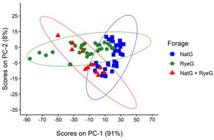
Principal component analysis (PCA) for PC-1 and PC-2 scores for fecal samples in the fecal NIRS database, obtained from cattle fed native grassland (NatG), Italian ryegrass (RyeG), and native grassland with Italian ryegrass replacement (NatG+RyeG)).
For the OMI equations, the models with the best calibration performance showed RPEp values of 28.15% and 27.23%, with corresponding R2p values of 0.30 and 0.34. In relation to the equations for OMD, the best-performing calibration performance showed RPEp values of 5.12% and 5.13%, and R2p values of 0.84. A range of 68 to 217 g/kg OM was observed in the calibration equations for dCPc. For the models with the best calibration performance, the RPEp values were 7.51% and 7.85%, and R2p values were 0.95. The calibration equations for fCP were developed using a range of 89 to 238 g/kg OM. Considering the models with the best calibration performance, the RPEp values were 9.55% and 9.60%, and R2p values were 0.87. Figure 2 shows the correlation between the observed values predicted by the best model for each variable, with R2 values of 0.37 (OMI), 0.86 (OMD), 0.95 (dCPc), and 0.87 (fCP).
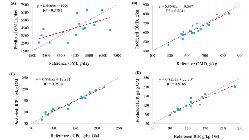
Relationship between reference and predicted values from the fecal NIRS model developed to estimate organic matter intake (A), organic matter digestibility (B), dietary crude protein concentration (C), and fecal crude protein (D) of cattle fed native grassland and Italian ryegrass, for the preprocessing method Standard Normal Variate (SNV) with three-point Savitzky-Golay smoothing, first-order polynomial and second derivative (A), only SNV (B), SNV with 13-point Savitzky-Golay smoothing, second-order polynomial and second derivative (C), and only Extended Multiplicative Scatter Correction (D).
DISCUSSION
The hypothesis that fecal NIRS can be used as a tool to estimate the OMI by cattle in heterogeneous forage systems was refuted. The calibration and validation performance for OMI estimation showed low performance, as RPEp values were higher than 20% for the two best-performing models, and R2p values were lower than 0.50. This is likely due to voluntary intake being a multifactorial phenomenon, influenced not only by diet but also by factors such as animal physiology, live weight, rumen fill capacity, social interactions, and soil and climate conditions, making it a less linear variable (DIXON & COATES, 2009).
Given these limitations of OMI estimation, some studies report insufficient performance in fNIRS calibration, both for metabolism assays with R2c of 0.61 (BOVAL et al., 2004), and for animals receiving heterogeneous diets with higher concentrate inclusion with R2c and R2cv of 0.83 and 0.75 (LANDAU et al., 2016). Although some authors have found a good correlation for estimating dry matter intake (DMI) (PETERS et al., 2023; PARRA-FORERO et al., 2023). Fecal analysis makes it difficult to estimate OMI in daily volume, especially when compared to variables obtained as a percentage. Therefore, intake calibration is less linear and accurate (FANCHONE et al., 2007). Furthermore, in our study, we chose to evaluate the intake based on organic matter, aiming to minimize potential influences from mineral matter present in the soil, and due to the distinct dynamics of minerals in the gastrointestinal tract (PENNING, 2004). For future study, we highlighted the need to expand the calibration database to account for the heterogeneity of the explored grazing systems. Additionally, external validation should be performed, and other influential variables - such as forage-related measures - should be included.
In contrast to OM intake, the hypothesis regarding digestibility was accepted, as fNIRS estimated this variable with the lowest RPEp in the study. This favorable performance can be attributed to the fact that feces reflect the characteristics of the forage ingested, making it possible to correlate them with the diet composition (DIXON & COATES, 2009). Models based on digestibility assays provide more accurate reference values, as diet-fecal pairs are collected daily without relying on indirect estimates (DECRUYENAERE et al., 2015). However, the data obtained in digestibility assays can be influenced by the restriction of the natural selective behavior of grazing cattle, an effect minimized in this study by the daily supply of freshly cut forage. Furthermore, it is worth highlighting the potential of the model considering the variability of the data. Although conducted in the same location, our trials showed heterogeneity. The structure, species participation, and quality of the native grassland of the Pampa biome varied considerably across seasons. Furthermore, the quality of the Italian ryegrass changed throughout its phenological cycle. This overall heterogeneity was reflected in the distribution of the PCA.
Other authors report satisfactory performance in OMD estimation, with calibration curves constructed based on metabolism assays (COATES & DIXON, 2011; DECRUYENAERE et al., 2015), with R2c of 0.92, and experiments using rumen-fistulated animals (GINDRI et al., 2019), with R2c of 0.83. Thus, estimating OMD via fNIRS can represent an excellent alternative when compared to other methodologies, as feces account for the selectivity of animals and, consequently, the heterogeneity of the grazing system (DECRUYENAERE et al., 2012). Thus, through spot collection, this tool can be applied to similar grazing systems, allowing the assessment of cattle feed utilization.
The hypothesis that fNIRS can estimate dCPc for cattle in heterogeneous forage systems was accepted. The quality of the model for dCPc, reflected in low RPEp, high R2, and a lower amplitude between RMSE values, stems from the strong correlation between fCP and diet quality (AZEVEDO et al., 2024). This linear relationship occurs because both endogenous and exogenous fCP sources are diet-related (LYONS & STUTH, 1992). Furthermore, with higher nutritional quality of forages, greater fermentation occurs in the gastrointestinal tract, increasing microbial synthesis and resulting in a higher concentration of fecal protein (LUKAS et al., 2005).
Moreover, chemical bonds in proteins interact strongly with near-infrared electromagnetic radiation, contributing to the accuracy of fNIRS calibration (WILLIAMS & NORRIS, 2001). Thus, fNIRS offers a fast and practical alternative for estimating dCPc in heterogeneous rangeland pastures, with R2c (0.89) similar to those in the literature (LANDAU et al., 2016). This allows for adjustments to the diet and protein supplementation, when necessary for beef cattle production (FANCHONE et al., 2007).
The hypothesis that fNIRS can estimate fecal crude protein in cattle under heterogeneous forage systems was accepted, showing satisfactory performance with good R2 and RPEp. Data variability may have contributed to the calibration performance (LANDAU et al., 2016). Similar to dCPc, fCP estimation is influenced by protein chemical bonds and their interaction with electromagnetic radiation (WILLIAMS & NORRIS, 2001). Studies confirm the potential of fNIRS for fCP estimation in different settings, including metabolism cages (PETERS et al., 2023), spot collections (LANDAU et al., 2016); and multispecies models (VILLAMUELAS et al., 2017). It is noteworthy that fCP strongly correlates with feed composition and digestibility, serving as an indicator of diet quality (LUKAS et al., 2005), and can be used to estimate intake when combined with total fecal excretion (SAVIAN et al., 2018). Since much of the fCP is of endogenous origin and remains constant per OMI unit, an increase in fCP suggests higher OMD. Thus, another way of using fNIRS is the possibility of applying models to estimate fCP, through spot fecal collections, allowing the application of this estimate to models for predicting digestibility, already published (DAVID et al., 2014; LUKAS et al., 2005), reinforcing the applicability of fNIRS under different situations.
CONCLUSION
Fecal NIRS has the potential to be used as a nutritional support tool for cattle in heterogeneous forage systems, such as the Pampa biome, with potential for expansion to other grazing systems. The performance of the fNIRS models was satisfactory in predicting OMD, dCPc, and fCP, with the exception of OMI.
ACKNOWLEDGMENTS
Conselho Nacional de Desenvolvimento Científico e Tecnológico (CNPq, 478418/2013-2 and 310629/2022-5), Fundação de Amparo à Pesquisa do Estado do Rio Grande do Sul (FAPERGS, 23/2551-0000892-0), and financed in part by the Coordenação de Aperfeiçoamento de Pessoal de Nível Superior - Brasil (CAPES) - Finance Code 001 .
REFERENCES
- AOAC-ASSOCIATION OF OFFICIAL ANALYTICAL CHEMISTS. Official Methods of the AOAC. 17th ed. Arlington, VA, EUA: Association of Official Analytical Chemists, 1990.
-
AZEVEDO, E. B. et al. Germination, overcoming seed dormancy and endozoochory dispersal by cattle of native species from natural grassland. Austral Ecology, v.49 n.1, p.e13303, 2023. Available from: <Available from: https://doi.org/10.1111/aec.13303 >. Accessed: Jun. 15, 2023. doi: 10.1111/aec.13303.
» https://doi.org/10.1111/aec.13303.» https://doi.org/10.1111/aec.13303 -
AZEVEDO, E. B. et al. Nutritional characteristics estimated by faecal protein in cattle fed with heterogeneous natural grassland. Animal Production Science, v.64, n.2, 2024. Available from: <Available from: https://doi.org/10.1071/AN22418 >. Accessed: Jun. 10, 2024. doi: 10.1071/AN22418.
» https://doi.org/10.1071/AN22418.» https://doi.org/10.1071/AN22418 -
BARRETO, M. T. et al. Can a combined cattle and sheep model based on fecal crude protein estimate the feed intake and digestibility? Animal Feed Science and Technology, v.335, p.116683, 2026. Available from: <Available from: https://www.sciencedirect.com/science/article/pii/S0377840126000520?via%3Dihub >. Accessed: Feb. 26, 2026. doi: 10.1016/j.anifeedsci.2026.116683.
» https://doi.org/10.1016/j.anifeedsci.2026.116683.» https://www.sciencedirect.com/science/article/pii/S0377840126000520?via%3Dihub -
BOVAL, M. et al. Faecal near infrared reflectance spectroscopy (NIRS) to assess chemical composition, in vivo digestibility and intake of tropical grass by Creole cattle. Animal Feed Science and Technology, v.114, p.19-29, 2004. Available from: <Available from: https://doi.org/10.1016/j.anifeedsci.2003.12.009 >. Accessed: Nov. 07, 2025. doi: 10.1016/j.anifeedsci.2003.12.009.
» https://doi.org/10.1016/j.anifeedsci.2003.12.009» https://doi.org/10.1016/j.anifeedsci.2003.12.009 -
CARAM, N. et al. Grazing intensity controls the seasonal utilization of functionally diverse patches by mediating herbivore selectivity. Rangeland Ecology & Management, v.96, p.152-162, 2024. Available from: <Available from: https://doi.org/10.1016/j.rama.2024.06.006 >. Accessed: Nov. 27, 2024. doi: 10.1016/j.rama.2024.06.006.
» https://doi.org/10.1016/j.rama.2024.06.006.» https://doi.org/10.1016/j.rama.2024.06.006 -
COATES, D. B.; DIXON, R. M. Developing robust faecal near infrared spectroscopy calibrations to predict diet dry matter digestibility in cattle consuming tropical forages. Journal of Near Infrared Spectroscopy, v.19, n.6, p.507-519, 2011. Available from: <Available from: https://doi.org/10.1255/jnirs.967 >. Accessed: Jul. 22, 2024. doi: 10.1255/jnirs.967.
» https://doi.org/10.1255/jnirs.967.» https://doi.org/10.1255/jnirs.967 -
DAVID, D. B. et al. Faecal index to estimate intake and digestibility in grazing sheep. Journal of Agricultural Science, n.152, p.667-674, 2014. Available from: <Available from: https://doi.org/10.1017/S0021859613000294 >. Accessed: Sept. 09, 2024. doi: 10.1017/S0021859613000294.
» https://doi.org/10.1017/S0021859613000294.» https://doi.org/10.1017/S0021859613000294 -
DECRUYENAERE, V. et al. Faecal near-infrared reflectance spectroscopy (NIRS) compared with other techniques for estimating the in vivo digestibility and dry matter intake of lactating grazing dairy cows. Animal Feed Science and Technology, v.173, n.3-4, 220-234, 2012. Available from: <Available from: https://doi.org/10.1016/j.anifeedsci.2012.02.005 >. Accessed: Aug. 09, 2024. doi: 10.1016/j.anifeedsci.2012.02.005.
» https://doi.org/10.1016/j.anifeedsci.2012.02.005.» https://doi.org/10.1016/j.anifeedsci.2012.02.005 -
DECRUYENAERE, V. et al. Prediction error and repeatability of near infrared reflectance spectroscopy applied to faeces samples in order to predict voluntary intake and digestibility of forages by ruminants. Animal Feed Science and Technology, v.205, p.49-59, 2015. Available from: <Available from: https://doi.org/10.1016/j.anifeedsci.2015.04.011 >. Accessed: Aug. 09, 2024. doi: 10.1016/j.anifeedsci.2015.04.011.
» https://doi.org/10.1016/j.anifeedsci.2015.04.011.» https://doi.org/10.1016/j.anifeedsci.2015.04.011 -
DIXON, R.; COATES, D. Near infrared spectroscopy of faeces to evaluete the nutrition and physiology of herbivores. Journal of Near Infrared Spectroscopy, v.17, p.1-31, 2009. Available from: <Available from: https://doi.org/10.1255/jnirs.822 >. Accessed: Jul. 16, 2024. doi: 10.1255/jnirs.822.
» https://doi.org/10.1255/jnirs.822.» https://doi.org/10.1255/jnirs.822 -
EZENARRO, J.; SCHORN-GARCÍA, D. How are chemometric models validated? A systematic review of linear regression models for NIRS data in food analysis. Journal of Chemometrics, v.39, n.6, 2025. Available from: <Available from: https://doi.org/10.1002/cem.70036 >. Accessed: Oct. 16, 2025. doi: 10.1002/cem.70036.
» https://doi.org/10.1002/cem.70036.» https://doi.org/10.1002/cem.70036 -
FANCHONE, A. et al. Faecal indices based on near infrared spectroscopy to assess intake, in vivo digestibility and chemical composition of the herbage ingested by sheep (crude protein, fibres and lignin content). Journal of Near Infrared Spectroscopy, v.15, p.107-113, 2007. Available from: <Available from: https://doi.org/10.1255/jnirs.720 >. Accessed: Oct. 10, 2025. doi: 10.1255/jnirs.720.
» https://doi.org/10.1255/jnirs.720.» https://doi.org/10.1255/jnirs.720 -
FUENTES-PILA, J. et al. Evaluation of equations based on animal factors to predict intake of lactating holstein cows. Journal of Dairy Science, v.79, p.1562-1571, 1996. Available from: <Available from: https://doi.org/10.3168/jds.S0022-0302(96)76518-9 >. Accessed: Aug. 07, 2024. doi: 10.3168/jds.S0022-0302(96)76518-9.
» https://doi.org/10.3168/jds.S0022-0302(96)76518-9.» https://doi.org/10.3168/jds.S0022-0302(96)76518-9 -
GINDRI, M. et al. Comparison of methods to estimate crude protein and digestible organic matter content of diets ingested by free-ranging sheep. Small Ruminant Research, v.178, p.37-42, 2019. Available from: <Available from: https://doi.org/10.1016/j.smallrumres.2019.06.023 >. Accessed: Sept. 15, 2024. doi: 10.1016/j.smallrumres.2019.06.023.
» https://doi.org/10.1016/j.smallrumres.2019.06.023.» https://doi.org/10.1016/j.smallrumres.2019.06.023 -
LANDAU, S. Y. et al. Faecal near-IR spectroscopy to determine the nutritional value of diets consumed by beef cattle in east Mediterranean rangelands. Animal, v.10, n.2, p.192-202, 2016. Available from: <Available from: https://doi.org/10.1017/S175173111500169X >. Accessed: Aug. 05, 2024. doi: 10.1017/S175173111500169X.
» https://doi.org/10.1017/S175173111500169X.» https://doi.org/10.1017/S175173111500169X -
LOPEZ, E. et al. The importance of choosing a proper validation strategy in predictive models. A tutorial with real examples. Analytica Chimica Acta, v.1275, 2023. Available from: <Available from: https://doi.org/10.1016/j.aca.2023.341532 >. Accessed: Oct. 16, 2025. doi: 10.1016/j.aca.2023.341532.
» https://doi.org/10.1016/j.aca.2023.341532.» https://doi.org/10.1016/j.aca.2023.341532 -
LUKAS, M. et al. Relationship between fecal crude protein concentration and diet organic matter digestibility in cattle. Journal of Animal Science, v.83, n.6, p.1332-1344, 2005. Available from: <Available from: https://doi.org/https://doi.org/10.2527/2005.8361332x >. Accessed: Oct. 22, 2024. doi: 10.2527/2005.8361332x.
» https://doi.org/10.2527/2005.8361332x.» https://doi.org/https://doi.org/10.2527/2005.8361332x -
LYONS, R. K.; STUTH, J. W. Fecal NIRS equations for predicting diet quality of free-ranging cattle. Journal of Range Management, v.45, n.3, p.230-244, 1992. Available from: <Available from: http://dx.doi.org/10.2307/4002970 >. Accessed: Oct. 23, 2024. doi: 10.2307/4002970.
» https://doi.org/10.2307/4002970.» http://dx.doi.org/10.2307/4002970 -
PARRA-FORERO, D. et al. Use of near-infrared reflectance spectroscopy on feces to estimate digestibility and dry matter intake of dietary nutritional characteristics under grazing conditions in Colombian creole steers. Tropical Animal Health and Production, v.55, n.178, 2023. Available from: <Available from: https://doi.org/10.1007/s11250-023-03571-x >. Accessed: Nov. 05, 2024. doi: 10.1007/s11250-023-03571-x.
» https://doi.org/10.1007/s11250-023-03571-x.» https://doi.org/10.1007/s11250-023-03571-x - PENNING, P. D. Herbage intake handbook. Reading: The British Grassland Society, 2004.
-
PETERS, J. F. et al. Predicting fecal composition, intake, and nutrient digestibility in beef cattle consuming high forage diets using near infrared spectroscopy. Translational Animal Science, v.7, n.1, 2023. Available from: <Available from: https://doi.org/10.1093/tas/txad043 >. Accessed: Nov. 06, 2024. doi: 10.1093/tas/txad043.
» https://doi.org/10.1093/tas/txad043.» https://doi.org/10.1093/tas/txad043 -
SAVIAN, J. V. et al. Comparison of faecal crude protein and n-alkanes techniques to estimate herbage intake by grazing sheep. Animal Feed Science and Technology, v.242, p.144-149, 2018. Available from: <Available from: https://doi.org/10.1016/j.anifeedsci.2018.06.010 >. Accessed: Nov. 15, 2024. doi: 10.1016/j.anifeedsci.2018.06.010.
» https://doi.org/10.1016/j.anifeedsci.2018.06.010.» https://doi.org/10.1016/j.anifeedsci.2018.06.010 -
VAN SOEST, P. J. et al. Methods for dietary fiber, neutral detergent fiber, and nonstarch polysaccharides in relation to animal nutrition. Journal of Dairy Science, v.74, p.3583-3597, 1991. Available from: <Available from: https://doi.org/10.3168/jds.S0022-0302(91)78551-2 >. Accessed: Aug. 15, 2024. doi: 10.3168/jds.S0022-0302(91)78551-2.
» https://doi.org/10.3168/jds.S0022-0302(91)78551-2.» https://doi.org/10.3168/jds.S0022-0302(91)78551-2 -
VILLAMUELAS, M. et al. Predicting herbivore faecal nitrogen using a multispecies near-infrared reflectance spectroscopy calibration. PLOS One, v.12, n.4, 2017. Available from: <Available from: https://doi.org/10.1371/journal.pone.0176635 >. Accessed: Nov. 16, 2024. doi: 10.1371/journal.pone.0176635.
» https://doi.org/10.1371/journal.pone.0176635.» https://doi.org/10.1371/journal.pone.0176635 - WILLIAMS, P.; NORRIS, K. Near-infrared technology. USA: American Association of Cereal Chemistry, 2001.
-
CR-2025-0143.R2
-
BIOETHICS AND BIOSECURITY COMMITTEE APPROVAL
All procedures in this study were approved by the Committee of Ethics on the Use of Animals (CEUA-DDPA, protocol 15/2013 and CEUA-IPVDF, protocol 09/2019).
-
DATA AVAILABILITY STATEMENT
The data that support the findings of this study are available from the corresponding author, upon reasonable request.
-
DECLARATION OF USE OF ARTIFICIAL INTELLIGENCE
The authors declare that no generative AI or AI-assisted technologies were used in the creation of this manuscript.
Edited by
-
ASSOCIATE EDITOR:
Rudi Weiblen (0000-0002-1737-9817)
-
Cecilia Cajarville (0000-0003-3603-3739)
The data that support the findings of this study are available from the corresponding author, upon reasonable request.


