 Activity of β-glucosidase and arylsulfatase enzymes in soils of the Sub-middle São Francisco Valley
ABSTRACT:
Soil quality is evaluated mainly by means of physical and chemical attributes, as they already have well-defined levels. However, several studies have suggested the use of soil biological attributes due to their high sensitivity, as indicators of soil quality. Given the above, the objective was to evaluate the effect of different agricultural management systems on the activity of β-glucosidase and arylsulfatase enzymes in cultivated and native Caatinga soils. The observational study was carried out in 2022, in the Sub-middle São Francisco Valley, under natural experimental conditions, in the municipalities of Petrolina, Juazeiro and Ibó, in areas with mango (Mangifera indica) and grape (Vitis vinifera) crops and area with native vegetation. In total, 77 composite soil samples were collected at 0-10 cm depth and analyzed for granulometry, pH, P, K+, Ca2+, Mg2+, total organic C, microbial biomass carbon and activity of β-glucosidase and arylsulfatase enzymes. The obtained data was subjected to principal components analysis (PCA), descriptive analysis and Pearson’s linear correlation. The cultivated areas exhibited higher β-glucosidase and arylsulfatase activities. These values should be interpreted within the context of the Caatinga, as they are not comparable to soils from other biomes, such as the Cerrado, due to differences in edaphoclimatic conditions and management practices.
Key words:
enzymatic activity; bioindicators; soil quality
RESUMO:
A qualidade do solo é avaliada, principalmente, por meio de atributos físicos e químicos. No entanto, vários estudos sugerem o uso de atributos biológicos do solo em função de sua alta sensibilidade, como indicadores de sua qualidade. Está pesquisa objetivou avaliar o efeito de diferentes sistemas de manejo agrícola sobre a atividade das enzimas β-glicosidase e arilsulfatase em solos com cultivo e com caatinga nativa. O estudo observacional foi realizado no ano de 2022, no submédio São Francisco, em condições de experimentação natural, nos municípios de Petrolina, Juazeiro e Ibó, em áreas com cultivos de mangueira (Mangifera indica) e videira (Vitis vinifera) e área com Caatinga. Foram coletadas 77 amostras compostas de solo na profundidade de 0 a 10 cm. Foram analisados, granulometria, pH, P, K+, Ca2+, Mg2+, C orgânico total, carbono da biomassa microbiana e atividade das enzimas β-glicosidase e arilsulfatase. Além disso, os dados obtidos foram submetidos à análise de componentes principais (PCA), análise descritiva e correlação linear de Pearson. As áreas cultivadas apresentaram maiores atividades de β-glicosidase e arilsulfatase. Esses valores devem ser interpretados dentro do contexto da Caatinga, pois não são comparáveis a solos de outros biomas, como o Cerrado, devido às diferenças edafoclimáticas e de manejo.
Palavras-chave:
atividade enzimática; Bioindicadores; qualidade do solo
INTRODUCTION
Intensive use of the soil and reduction of vegetation cover causes degradation of natural resources with a consequent reduction in quality, making it necessary to evaluate indicators capable of showing quantitatively or qualitatively the changes and disturbances that occur in the soil (LISBOA et al., 2012). Soil quality is evaluated by means of physical and chemical attributes, as they already have well-defined levels. However, several studies suggested biological attributes of the soil as indicators of quality, due to their high sensitivity to management and the fact that it is the most active living part of soil organic matter (BALOTA et al., 2014; MENDES et al., 2015).
Soil microbial biomass performs several highly important functions such as aggregate formation, nutrient cycling and mineralization, water retention, decomposition, and release of hormones, enzymes and plant growth inhibitors (CAVALCANTE et al., 2020). For these reasons, it is an essential component for the structure of the ecosystem, and its activity is mainly influenced by temperature, humidity, soil management and cultivation (GUIMARÃES et al., 2017).
According to LOPES et al. (2018), one of the main obstacles encountered to use microbiological parameters as routine analyses of the functioning of the soil biological machinery would be the individual interpretation of biological attributes. However, MENDES et al. (2021) and ARAGÃO et al. (2020), defined that the enzymes β-glucosidase and arylsulfatase are considered excellent indicators of soil quality, as they act on the hydrolysis of β-glycosidic bonds and sulfate esters, showing high sensitivity and rapid response to changes in agricultural management, in addition to a positive correlation with other biological indicators, this characteristic was essential for the creation of the tables that interpret the values of these indicators (LOPES et al., 2013; MENDES et al., 2019).
Through calibration trials, classes for the activity of β-glucosidase and arylsulfatase enzymes in grain production were established and are currently used in routine analyses as soil quality indicators (MENDES et al., 2021). However, considering the differences between production systems, it is essential to assess the applicability of these indicators in other agricultural contexts.
The Sub-Middle São Francisco Valley region stands out as one of Brazil’s main hubs for irrigated fruit farming, especially in mango and grape production, with significant socioeconomic impact (SANTOS JÚNIOR et al., 2024). The predominant irrigated agriculture in the region enables continuous production throughout the year but also poses challenges to soil quality due to intensive management (LEÃO et al., 2020). Thus, soil quality assessment becomes essential to ensure the sustainability of agricultural production and minimize environmental impacts.
Based on this, a prospection was carried out to ascertain the adequacy of the method for future calibration studies in fruit growing in the São Francisco Valley, in view of the edaphoclimatic particularities.
MATERIALS AND METHODS
The observational study was carried out in 2022, in the Sub-middle São Francisco, under conditions of natural experimentation, and consisted of the inclusive study of natural soil variation in cultivated areas.
Soil samples were collected in the municipalities of Petrolina, in the N4, N5, N8 and Maria Tereza irrigation centers of the Senador Nilo Coelho Irrigation Perimeter (PISNC), in Juazeiro, in the Salitre Irrigated Perimeter and in Ibó at the Agrodan Farm. The climate of the region according to Köppen’s classification is BSh, that is, hot semi-arid, with annual rainfall of less than 443, 393 and 429 mm, for Petrolina, Juazeiro and Ibó, respectively, irregularly distributed between November and April. Temperatures in the coldest months of the year are above 18 ºC, with annual average of 27 ºC, and evapotranspiration on the order of 2700 to 3000 mm per year.
A total of 1925 single soil samples were collected to obtain 77 composite samples, at 0- 10 cm depth, using a 5-cm-diameter soil sampler, subdivided into 36, 31 and 10 areas with the following crops: grape (Vitis vinifera), mango (Mangifera indica) and native Caatinga vegetation, respectively, in June and July 2022. Subsequently, the samples were sent to the Soil and Plant Analysis Laboratory of the Federal Institute of Education, Science and Technology of the Sertão Pernambucano (IF - Sertão-PE), Petrolina Campus, Rural Area.
The soil samples collected were placed in trays, spread, pounded to break up clods, and kept in a ventilated and dry place for complete drying. After drying, the soil was passed through a 2-mm-mesh sieve, and the sieved material was deposited in plastic bags.
Granulometry analysis was performed by the pipette method, which consists of determining the total clay after dispersion of the soil particles by chemical agents and mechanical action, followed by collection of the supernatant after silt sedimentation (TEIXEIRA et al., 2017).
Hydrogen potential (pH) was determined using the method of extraction in distilled water, in a ratio of 1:2.5, by immersing an electrode in the homogenized solution. P and K+ By were extracted using Mehlich-1 extractant, with P readings in molecular absorption spectrophotometer with wavelength of 660 nm and K readings in flame photometer calibrated to 20 ppm. Ca2+ and Mg2+ were extracted with 1 mol L-1 KCl, and their respective readings were obtained by atomic absorption spectrophotometry. Total organic C (TOC) was evaluated by wet oxidation and granulometry was performed using the pipette method, which consists of determining total clay after dispersion of soil particles by chemical agents and mechanical action, collecting the supernatant after sedimentation of the silt. All these indicators were determined according to the procedures recommended by TEIXEIRA et al. (2017).
Microbial biomass carbon (MBC) was estimated by the fumigation-extraction method (VANCE et al., 1987). Fumigated and non-fumigated samples were subjected to K2SO4 (0.5 M) extraction and MBC was quantified by titration with ammonia ferrous sulfate (0.033 N).
The activity of the enzymes β-glucosidase and arylsulfatase was estimated according to TABATABAI (1994), based on the colorimetric determination of the p-nitrophenol (yellow color) released by the enzymes, when the soil is incubated with a buffered solution of p-nitrophenyl β-D-glucopyranoside (PNG) and p-nitrophenyl sulfate (PNS) for the determination of β-glucosidase and arylsulfatase, respectively.
Analysis was carried out as follows: 1.00 g of soil free of organic residues was weighed and placed in a 50 mL Erlenmeyer® flask. Then, the buffered solution (sodium acetate pH 5.8 or MUB pH 6) and PNG (to determine the β-glucosidase enzyme) and/or PNS (to determine the arylsulfatase enzyme) were added, the flasks were closed with rubber stoppers to prevent evaporation, and the mixture was incubated for one hour at 37 °C. After the established time, CaCl2, THAM pH 12 and PNG or PNS were added to the control flasks, since NaOH was added instead of THAM pH 12 to the samples for arylsulfatase determination. The samples were prepared in triplicates, using two analytical replicates plus one control.
The material was filtered through a filter paper, and the yellow color was read in a spectrophotometer at wavelengths of 420 nm (β-glucosidase) and 410 nm (arylsulfatase). A standard curve prepared with the known concentrations of p-nitrophenol (0, 25, 50, 100 and 150 μg of p-nitrophenol mL-1) was used to determine the amount of this product released from the samples. Activity values were expressed in μg p-nitrophenol g-1 soil h-1.
The values obtained for the physical, chemical and microbiological attributes were used for principal component analysis (PCA), comparing areas with different crops and texture. Descriptive analysis and Pearson’s linear correlation were performed between the bioindicators (microbial biomass carbon, activity β-glucosidase enzyme and activity of arylsulfatase enzyme) and between the bioindicators and chemical and physical indicators. The analyses were performed in R software version 4.0.2 (R CORE, 2020) and Past4.09_32.
RESULTS AND DISCUSSION
It was observed that the pH values (Table 1) for grape and mango crops remained within the range considered by MORAES et al. (2018) and BUENO et al. (2018) as ideal for the multiplication of microorganisms and for enzymatic activity, which ranges from 5.3 to 6.1 in tropical soils, showing that, if this is inadequate, the activity will be reduced.
The average values for the chemical attributes of the soil under grape cultivation were classified as high, while in the areas cultivated with mango, the levels of P (99.2 mg dm-3), TOC (15.1 g kg-1) and Ca2+ (6.23 cmolc dm-3) were considered high and the levels of K+ (0.2 cmolc dm-3) and Mg2+ (0.9 cmolc dm-3) were considered low; in the native Caatinga vegetation, only K+ (0.2 cmolc dm-3) and Ca (2.5 cmolc dm-3) showed medium levels, according to soil fertility interpretation classes (SOBRAL et al., 2015).
The highest TOC values were found under grape cultivation (26.1 g kg-1), differing from the others. This increase is related to the input of organic matter, in the form of manure, which is part of the management program of these crops.
Despite receiving 20 to 30 L/plant/year of manure (CAVALCANTI et al., 2008), mango cultivation did not obtain superior results compared to the native Caatinga vegetation. Depending on the management adopted, there may be changes in SOM distribution in the soil, as the incorporated residues are usually decomposed faster, due to milder temperatures and higher humidity and aeration in the soil, favoring greater microbial attack and accelerating the decomposition processes (SHARMA et al., 2017).
Higher averages of MBC were observed under grape cultivation, 280.1 mg microbial C kg-1 soil, and this increase can be explained in large part by the higher availability of TOC. The means of MBC in the Caatinga and mango areas remained similar. According to PRIMIERI et al. (2017), in natural ecosystems (Caatinga), there is a tendency to obtain higher MBC values, which provide a greater amount of stable carbon in the soil, especially in the first layers, favored by the absence of anthropogenic action, which in turn favors the increase of microbial activity, with a direct effect on the increase of carbon in the surface soil layers.
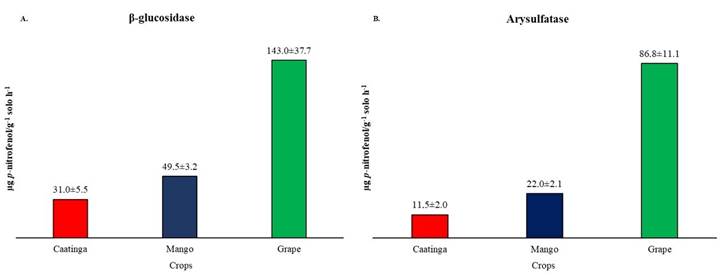
Figure 1 shows that the activity of the enzymes β-glucosidase and arylsulfatase. The highest averages of 143.0 and 86.8 μg p-nitrophenol g-1 soil h-1 for β-glucosidase and arylsulfatase; respectively, were obtained in grape cultivation compared to mango cultivation and native Caatinga vegetation. MENDES et al. (2011) highlighted that one of the main factors that can affect enzymatic activity is the quantity and quality of plant residues, which may be one of the factors that led to lower values in Caatinga areas compared to managed areas.
Enzymatic activity of β-glucosidase and arylsulfatase in areas cultivated with mango, grape and native Caatinga vegetation.
Descriptive statistical results for the parameters of central tendency (mean and median) and dispersion (standard deviation, standard error and coefficient of variation) of the enzymes β-glucosidase and arylsulfatase are described in table 2 and table 3.
Descriptive analysis of Arylsulfatase enzymatic activity in areas cultivated with mango, grape and native Caatinga vegetation.
For the enzymes β-glucosidase and arylsulfatase in grape cultivation, the mean and median, standard deviation and coefficient of variation (CV) were distant, with an oscillation in the minimum and maximum values. The areas of native Caatinga vegetation showed a negative skewness coefficient (Table 2), with a trend of a considerable number of values higher than the arithmetic mean.
When comparing the mean, minimum, and maximum values of the results obtained in table 2 and table 3 with the interpretation classes established by MENDES et al. (2019), the following classification is observed: for β-glucosidase, values are categorized as low (≤ 63), moderate (64-107), and adequate (> 108); while for arylsulfatase, the classification follows the ranges of low (≤ 30), moderate (31-70), and adequate (> 71), a discrepancy in the results is noted, also evidenced by the standard error, which may be related to the fact that the calibration trial was conducted specifically in the Cerrado biome under soybean and corn cultivation in Oxisols (LOPES et al., 2013; LOPES et al., 2018).
The BioAS technology, in addition to analyzing the activity of the arylsulfatase and beta-glucosidase enzymes, also calculates scores for key soil functions, such as cycling, maintenance, and nutrient supply. Additionally, soil quality indices (SQI) are determined, considering both chemical and biological properties together (SQIFertBio) and separately (SQIBio and SQIChem) (MENDES et al., 2021b).
Currently, the interpretation of analysis results is performed using algorithms adjusted according to characteristics such as soil texture, regional climate, and current land use. Although, these algorithms were developed for annual crops (grains) in areas of the Cerrado and the Southern region, their application to other production systems and regions has generated relevant information (MENDES et al., 2021b).
In this context, the nutrient cycling function is associated with enzymatic activity, while the nutrient storage function is essentially linked to organic matter. According to the BioAS interpretation, the SQI results for the samples presented the following values: 37 (very high), 20 (high), 15 (medium), 4 (low), and 1 (very low). Thus, 74% of the samples are classified as having healthy soil conditions (MENDES et al., 2021b).
The Sub-middle São Francisco is part of the Caatinga Biome, showing high variability of soils and perennial crops. According to FREITAS et al. (2012), it is a region where the input of SOM, applied annually in fruit crops, varies from 20 to 60 m3 ha-1 year-1, in addition to having high-frequency irrigation systems, such as drip irrigation, making nutrients available via fertigation in significant quantities, hence being directly related to the development of the microbial population. This highlighted the need for a greater number of studies to define the levels of interpretation of bioindicators, in order to significantly meet the management in different biomes and agricultural crops.
When analyzing Pearson’s linear correlation for the chemical, physical and biological attributes of the soil cultivated with grape, mango and native Caatinga vegetation, respectively (Table 4), it was observed that the variables that were significant obtained mostly positive interaction values at P < 0.01 probability level.
The enzyme arylsulfatase was the indicator that obtained the most positive correlations with TOC (0.4), P (0.5), Ca2+ (0.4) and Mg2+ (0.4). In contrast, a correlation was observed between K and the enzyme β-glucosidase. According to SANTOS (2007), positive correlations reflect the direct relationship between the two variables, showing that as the content of one variable increases, the other tends to increase as well. In negative correlations, according to SANTOS (2007), the values have an inversely proportional relationship, that is, as one variable increases, the other tends to decrease. It is observed that the enzyme β-glucosidase has a negative correlation with the sand content. According to RODRIGUES et al. (2021), this is due to a greater affinity between enzymes and clays, as they are part of the abiotic component, being complexed by clay and organic matter.
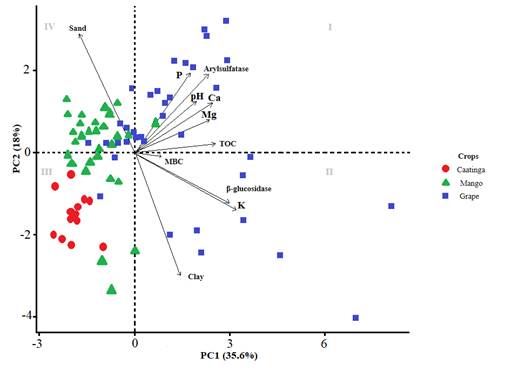
The relationship between the distribution of soil samples collected in the areas of grape, mango and native Caatinga vegetation, as well as the classification according to chemical, physical and biological attributes, was carried out through an ordering generated by multivariate principal component analysis (Figure 2).
Principal component analysis (PCA) in areas cultivated with mango, grape and native Caatinga vegetation, represented by chemical, physical and biological soil indicators.
The first two components resulting from the PCA of the cropping systems accounted for 53.6% of the total variation of the attributes, where PC1 and PC2 retain 35.6% and 18% of the original information of the data evaluated (Figure 2).
The chemical and biological attributes, in turn, were very effective in discriminating the grape areas, exhibiting higher values of basic cations in quadrant I, influenced by agricultural practices, such as nutrient supply and fertigation, in addition to the fact that, for grape cultivation, the areas received an average of 60 t/ha/year of manure (CAVALCANTI et al., 2008). It may have a direct influence on the values of β-glucosidase and Arylsulfatase, as they do not have a discriminated origin of their metabolic pathways, originating from microorganisms, plants and animals, becoming one of the biological parameters that represent the biological component (MENDES et al., 2015; RODRIGUES et al., 2021).
K+ was the basic cation that had the strongest correlation with the enzyme β-glucosidase, expressing positive direct relationships (Figure 2). Similar results were obtained by ARAGÃO et al. (2020), in areas of high coffee productivity in the Cerrado (cultivar Catuaí Vermelho IAC 144), with K+ content of 0.87 cmolc dm3, and this relationship can be explained by the fact that the evaluated areas were under intensive management, including high levels of fertilization.
In this context, there may have been an alteration of exudates, with a greater release of sugars in the exudates, and the concentration of sugars in the soil may stimulate some microbial populations. In contrast, crops in quadrants III and IV represent low fertility and biological activity and high sand content.
CONCLUSION
Cultivated areas showed higher activities of the enzymes β-glucosidase and arylsulfatase than the areas of native Caatinga vegetation. Our results showed that the enzymes β-glucosidase and arylsulfatase had levels higher than those calibrated under annual crops in the Cerrado biome.The enzyme β-glucosidase showed positive correlations with the increase in clay fraction.
ACKNOWLEDGMENTS
We would like to thank the Conselho Nacional de Desenvolvimento Científico e Tecnológico (CNPq), Coordenação de Aperfeiçoamento de Pessoal de Nível Superior (CAPES), Brasil - (Finance Code 001), Universidade Federal do Vale do São Francisco, Instituto do Sertão Pernambucano, Zona Rural Campus Petrolina, Departamento de Energia Nuclear of the Universidade Federal de Pernambuco for the support.
REFERENCES
-
ARAGÃO, O. O. S. et al. Microbiological indicators of soil quality are related to greater coffee yield in the Brazilian Cerrado region. Ecological Indicators, v.113, p.106205, 2020. Available from: <Available from: https://doi.org/10.1016/j.ecolind.2020.106205 >. Accessed: May, 30, 2024. doi: 10.1016/j.ecolind.2020.106205.
» https://doi.org/10.1016/j.ecolind.2020.106205.» https://doi.org/10.1016/j.ecolind.2020.106205 -
BALOTA, E. L. et al. Benefits of winter cover crops and no-tillage for microbial parameters in a Brazilian Oxisol: A long-term study. Agriculture, Ecosystems & Environment, v.197, p.31-40, 2014. Available from: <Available from: https://doi.org/10.1016/j.agee.2014.07.010 >. Accessed: May, 30, 2024. doi: 10.1016/j.agee.2014.07.010.
» https://doi.org/10.1016/j.agee.2014.07.010.» https://doi.org/10.1016/j.agee.2014.07.010 -
BUENO, P. A. A. et al. Indicadores microbiológicos de qualidade do solo em recuperação de um sistema agroflorestal. Acta Brasiliensis, v.2, n.2, p.40-44, 2018. Available from: <Available from: http://dx.doi.org/10.22571/2526-433896 >. Accessed: May, 30, 2024. doi: 10.22571/2526-433896.
» https://doi.org/10.22571/2526-433896.» http://dx.doi.org/10.22571/2526-433896 -
CAVALCANTE, W. F. et al. Enzymatic activity of Caatinga biome with and without anthropic action1. Revista Caatinga, v.33, n.1, p.142-150, 2020. Available from: <Available from: https://doi.org/10.1590/1983-21252020v33n116rc >. Accessed: May, 30, 2024. doi: 10.1590/1983-21252020v33n116rc.
» https://doi.org/10.1590/1983-21252020v33n116rc.» https://doi.org/10.1590/1983-21252020v33n116rc - CAVALCANTI, F. D. A. et al. Recomendação de adubação para o estado de Pernambuco: 2ª aproximação. Pernambuco, 2008. 94 p.
-
FREITAS, M. S. C. et al. Decomposição e liberação de nutrientes de estercos em função da profundidade e do tempo de incorporação. R. Semiárido De Visu, v.2, p.150-161, 2012. Available from: <Available from: https://doi.org/10.31416/rsdv.v2i1.188 >. Accessed: Jun. 06, 2024. doi: 10.31416/rsdv.v2i1.188.
» https://doi.org/10.31416/rsdv.v2i1.188.» https://doi.org/10.31416/rsdv.v2i1.188 -
GUIMARÃES, N. F. et al. Biomassa e atividade microbiana do solo em diferentes sistemas de cultivo do cafeeiro. Revista de Ciências Agrárias, v.40, n.1, p.34-44, 2017. Available from: <Available from: https://doi.org/10.19084/RCA16041 >. Accessed: Jun. 06, 2024. doi: 10.19084/RCA16041.
» https://doi.org/10.19084/RCA16041.» https://doi.org/10.19084/RCA16041 -
LEÃO, P. C. D. S. et al. Rootstocks for the new seedless table grape ‘BRS Vitória’ under tropical semi-arid conditions of São Francisco Valley. Ciência e Agrotecnologia, v.44, p.e025119, 2020. Available from: <Available from: https://doi.org/10.1590/1413-7054202044025119 >. Accessed: May, 30, 2024. doi: 10.1590/1413-7054202044025119.
» https://doi.org/10.1590/1413-7054202044025119.» https://doi.org/10.1590/1413-7054202044025119 -
LISBOA, B. B. et al. Indicadores microbianos de qualidade do solo em diferentes sistemas de manejo. Revista Brasileira de Ciência do solo, v.36, n.1, p.33-44, 2012. Available from: <Available from: https://doi.org/10.1590/S0100-06832012000100004 >. Accessed: Jun. 07, 2024. doi: 10.1590/S0100-06832012000100004.
» https://doi.org/10.1590/S0100-06832012000100004.» https://doi.org/10.1590/S0100-06832012000100004 -
LOPES, A. A. C. et al. Interpretation of microbial soil indicators as a function of crop yield and organic carbon. Soil Science Society of America Journal, v.77, p.461-472, 2013. Available from: <Available from: https://doi.org/10.2136/sssaj2012.0191 >. Accessed: May, 30, 2024. doi: 10.2136/sssaj2012.0191.
» https://doi.org/10.2136/sssaj2012.0191.» https://doi.org/10.2136/sssaj2012.0191 -
LOPES, A. A. C. et al. Temporal variation and critical limits of microbial indicators in oxisols in the Cerrado, Brazil. Geoderma Regional, v.12, p.72-82, 2018. Available from: <Available from: https://doi.org/10.1016/j.geodrs.2018.01.003 >. Accessed: Jun. 07, 2024. doi: 10.1016/j.geodrs.2018.01.003.
» https://doi.org/10.1016/j.geodrs.2018.01.003.» https://doi.org/10.1016/j.geodrs.2018.01.003 - MENDES, I. C. et al. Microbiologia do solo e sustentabilidade de sistemas agrícolas. In: FALEIRO, F. G. et al. (Ed.). Biotecnologia: estado da arte e aplicações na agropecuária. 1. ed. [s.l.] Embrapa Cerrados, p.218-242, 2011.
-
MENDES, I. C. et al. Soil quality and grain yield: A win-win combination in clayey tropical Oxisols. Geoderma, v.388, p.114880, 2021. Available from: <Available from: https://doi.org/10.1016/j.geoderma.2020.114880 >. Accessed: Jun. 07, 2024. doi: 10.1016/j.geoderma.2020.114880.
» https://doi.org/10.1016/j.geoderma.2020.114880.» https://doi.org/10.1016/j.geoderma.2020.114880 - MENDES I. C. et al. Tecnologia BioAS: Uma maneira simples e eficiente de avaliar a saúde do solo. Planaltina: Embrapa Cerrados; 2021b. (Série Documentos, 369).
-
MENDES, I. C. et al. Bioindicadores de qualidade de solo: dos laboratórios de pesquisa para o campo. Cadernos de Ciência & Tecnologia, v.32, p.191, 2015. Available from: <Available from: https://doi.org/10.35977/0104-1096.cct2015.v32.23311 >. Accessed: Jul. 06, 2024. doi: 10.35977/0104-1096.cct2015.v32.23311.
» https://doi.org/10.35977/0104-1096.cct2015.v32.23311.» https://doi.org/10.35977/0104-1096.cct2015.v32.23311 - MENDES, I. C. et al. Bioanálise de solo: Aspectos teóricos e práticos. In: SEVERIANO, E. C. et al. (Ed.). Tópicos em ciência do solo. Viçosa, MG: Sociedade Brasileira de Ciência do Solo; p.1-64, 2019.
-
MORAES, M. D. C. H. D. S. et al. Microbial biomass and enzymatic activities in sandy soil cultivated with lettuce inoculated with plant growth promoters. Revista Caatinga, v.31, p.860-870, 2018. Available from: <Available from: https://doi.org/10.1590/1983-21252018v31n408rc >. Accessed: Jul. 06, 2024. doi: 10.1590/1983-21252018v31n408rc.
» https://doi.org/10.1590/1983-21252018v31n408rc.» https://doi.org/10.1590/1983-21252018v31n408rc -
PRIMIERI, S. et al. Dinâmica do carbono no solo em ecossistemas nativos e plantações florestais em Santa Catarina. Floresta e Ambiente, v.24, 2017. Available from: <Available from: https://doi.org/10.1590/2179-8087.110314 >. Accessed: Jun. 06, 2024. doi: 10.1590/2179-8087.110314.
» https://doi.org/10.1590/2179-8087.110314.» https://doi.org/10.1590/2179-8087.110314 -
R CORE TEAM. R: A language and environment for statistical computing. R Foundation for Statistical Computing, Vienna, Austria. 2020 Available from: <Available from: https://www.R-project.org/ >. Accessed: Aug. 10, 2022.
» https://www.R-project.org/ -
RODRIGUES, R. N. et al. Soil enzymatic activity under coffee cultivation with different water regimes associated to liming and intercropped brachiaria. Ciência Rural, v.52, 2021. Available from: <Available from: https://doi.org/10.1590/0103-8478cr20200532 >. Accessed: Jul. 06, 2024. doi: 10.1590/0103-8478cr20200532.
» https://doi.org/10.1590/0103-8478cr20200532.» https://doi.org/10.1590/0103-8478cr20200532 - SANTOS, C. Estatística descritiva. Manual de auto-aprendizagem, Lisboa: Edições Sílabo, 2007. 297 p.
-
SANTOS JÚNIOR, G. P. et al. Accumulation and vertical displacement of nutrients at irrigated fruit growing areas. Acta Biologica Brasiliensia, v.7, p.29-37, 2024. Available from: <Available from: https://doi.org/10.18554/acbiobras.v7i1.7644 >. Accessed: Jul. 06, 2024. doi: 10.18554/acbiobras.v7i1.7644.
» https://doi.org/10.18554/acbiobras.v7i1.7644.» https://doi.org/10.18554/acbiobras.v7i1.7644 -
SHARMA, P. et al. Green manure as part of organic management cycle: Effects on changes in organic matter characteristics across the soil profile. Geoderma, v.305, p.197-207, 2017 Available from: <Available from: https://doi.org/10.1016/j.geoderma.2017.06.003 >. Accessed: Jun. 07, 2024. doi: 10.1016/j.geoderma.2017.06.003.
» https://doi.org/10.1016/j.geoderma.2017.06.003.» https://doi.org/10.1016/j.geoderma.2017.06.003 - SOBRAL, L. F. et al. Guia prático para interpretação de resultados de análises de solo. Aracajú: Embrapa Tabuleiros Costeiros, 2015. 13 p.
- TABATABAI, M. A. Soil Enzymes. In: WEAVER, R. W. et al. Methods of Soil Analysis: Microbiological and Biochemical Properties. Madison, Soil Science Society of America, p.775-833, 1994.
- TEIXEIRA, P. C. et al. Manual de métodos de análise de solo. Rio de Janeiro: Embrapa Solos, 573 p., 2017.
- VANCE, E. D. et al. An extraction method for measuring soil microbial biomass. Soil Biology and Biochemistry, v.19, p.703-707, 1987.
-
CR-2024-0301.R1
-
DATA AVAILABILITY STATEMENT
Not applicable.
-
DECLARATION OF USE OF ARTIFICIAL INTELLIGENCE
Artificial intelligence tools were used only for language refinement of the manuscript. All AI-assisted corrections were carefully reviewed by the authors to ensure that the scientific content was not altered.
Edited by
-
ASSOCIATE EDITOR:
Leandro Souza da Silva (0000-0002-1636-6643)
-
SCIENTIFIC EDITOR:
Frederico Costa Beber Vieira (0000-0001-5565-7593)
Not applicable.