 Critical period of smooth pigweed control in soybean
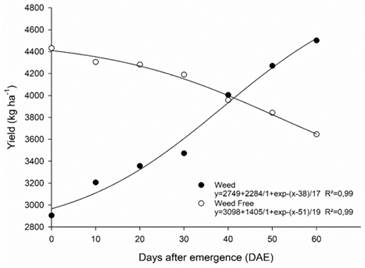
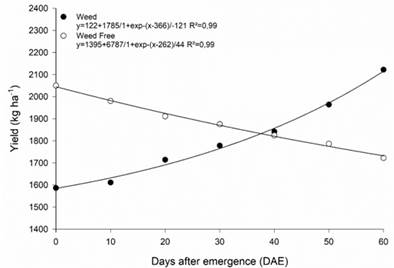
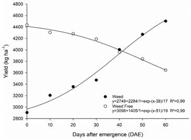
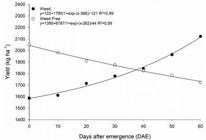
Species from the genre Amaranthus represent the main weeds present in Brazilian agricultural areas. Amaranthus hybridus (smooth pigweed) is distinguished by its ecophysiological characteristics and the presence of resistant biotypes to the ALS and EPSPs inhibiting herbicides. Crop-weed competition is one of the major constraints to grain yield. To avoid decreases in production, crop-weed competition studies are developed to determine the critical periods of interference, aiming to define the best time for weed control. The aim of this study is to determine the critical periods of A. hybridus control in soybeans and their effects on grain yield. Therefore, two experiments were carried out during the 2020/21 and 2021/22 growing seasons in an area infested naturally by A. hybridus. The treatments consisted of various coexistence periods between soybean and A. hybridus. The experimental designs were randomized block designs arranged in a factorial scheme; the first factor was the presence or absence of the weed, and the second factor was the coexistence period from 0 to 60 DAE (0, 10, 20, 30, 40, 50 and 60 DAE). The presence of A. hybridus at soybean emergence caused a 35.47% decrease in grain yield in the 2020/21 growing season and 25.26% in 2021/22. The critical control periods were determined based on the data adjusted to fit the four-parameter logistic regression model. Thus, the CWFP occurs at 7 to 56 DAE of soybean, the CTWR goes from 0 to 7 DAE, and the CPWC continues from 0 to 56 DAE of the crop.
Key words:
Amaranthus hybridus (L.); Glycine max (L.) Merril; coexistence periods; crop-weed competition; interference.
 Thumbnail
 Thumbnail
 Thumbnail