 Effects of compound fertilizer combined with biochar on potassium absorption and utilization of wheat
ABSTRACT:
This study investigated the effects of combined application of compound fertilizer and biochar on potassium (K) absorption and utilization of winter wheat to reduce the use of compound fertilizer. On the basis of conventional K application of 675 kg ha-1 (F4), three biochar levels (B1, B2, and B3) and four compound fertilizer levels (F1, F2, F3, and F4) were set up to study the effects of their combined application for two consecutive years on soil total K and available K content, as well as plant K accumulation and utilization efficiency in winter wheat. This study investigated the effects of combined application of compound fertilizer and biochar on potassium (K) absorption and utilization of winter wheat to reduce the use of compound fertilizer. On the basis of conventional K application of 675 kg ha-1 (F4), three biochar levels (B1, B2, and B3) and four compound fertilizer levels (F1, F2, F3, and F4) were set up to study the effects of their combined application for two consecutive years on soil total K and available K content, as well as plant K accumulation and utilization efficiency in winter wheat in Hebei Eastern Region of China. The results showed that B3F4 and B3F2 respectively resulted in the highest soil total K content and available K content in two years among all treatments. Compared with B1F4 (control), B3F4 led to 5.18% and 8.76% increases in total K content, and B3F2 increased the available K content by 2.10% and 60.55% in 2022 and 2023, respectively. It also enhanced the K agronomic efficiency (KAE), K uptake efficiency (KUE), and K harvest index (KHI) by 81.97%, 269.65%, 3.08% in 2022, and 258.56%, 244.67% and 37.64% in 2023, respectively, relative to B1F4. It is recommended to combine 450 kg ha-1 compound fertilizer with 7500 kg ha-1 biochar to reduce fertilizer use and improve the fertilizer efficiency for winter wheat in Hebei Eastern Region of China, providing important reference for the cultivation of winter wheat in this area. The results showed that B3F4 and B3F2 respectively resulted in the highest soil total K content and available K content in two years among all treatments. Compared with B1F4 (control), B3F4 led to 5.18% and 8.76% increases in total K content, and B3F2 increased the available K content by 2.10% and 60.55% in 2022 and 2023, respectively. Co-application of compound fertilizer with biochar enhances K accumulation in winter wheat throughout all growth stages. It also enhanced the KAE, KUE, and KHI by 81.97%, 269.65%, 3.08% in 2022, and 258.56%, 244.67% and 37.64% in 2023, respectively, relative to B1F4. Compared with B1F4, B2F3 increased the yield of the two years by 2.77% and 10.61%, respectively. These results indicated that combined application of compound fertilizer and biochar could reduce the use of compound fertilizer, and at the same time increase the total and available K content in soil, thereby increasing the agronomic utilization and absorption efficiency of K as well as the K accumulation and harvest index of winter wheat. Based on our results, it is recommended to combine 450 kg ha-1 compound fertilizer with 7500 kg ha-1 biochar to reduce fertilizer use and improve the fertilizer efficiency for winter wheat in Hebei Eastern region of China, providing important reference for the cultivation of winter wheat in this area.
Key words:
biochar; compound fertilizer; wheat; potassium accumulation; potassium utilization efficiency
RESUMO:
Este estudo investigou os efeitos da aplicação combinada de fertilizante composto e biochar na absorção de potássio (K) e a utilização de trigo de inverno para reduzir o uso de fertilizante composto. Com base na aplicação convencional de K de 675 kg ha-1 (F4), três níveis de biochar (B1, B2 e B3) e quatro níveis de fertilizantes compostos (F1, F2, F3 e F4) foram estabelecidos para estudar os efeitos de sua aplicação combinada por dois anos consecutivos no solo total e no teor de K disponível, bem como no acúmulo de K da planta e na eficiência de utilização do trigo de inverno no leste da região de Hebei, China. Os resultados mostraram que B3F4 e B3F2 resultaram nos maiores teores de K total e disponível no solo, em dois anos, entre todos os tratamentos. Em comparação com B1F4 (controle), B3F4 levou a aumentos de 5,18% e 8,76% no teor total de K, e B3F2 aumentou o teor de K disponível em 2,10% e 60,55% nos anos de 2022 e 2023. A co-aplicação de fertilizante composto com biochar aumenta o acúmulo de potássio no trigo de inverno em todos os estágios de crescimento. Além disso, aumentou a eficiência agronômica de K (KAE), a eficiência de absorção de K (KUE) e o índice de colheita de K (KHI) em 81,97%, 269,65%, 3,08% em 2022 e 258,56%, 244,67% e 37,64% em 2023, em relação ao B1F4. Em comparação com o B1F4, o B2F3 aumentou o rendimento dos dois anos em 2,77% e 10,61%,. Esses resultados indicaram que a aplicação combinada de fertilizante composto e biochar pode reduzir o uso de fertilizante composto e, ao mesmo tempo, aumentar o teor de K total e disponível no solo, aumentando assim a utilização agronômica e a eficiência de absorção de K, bem como o acúmulo de K e o índice de colheita do trigo de inverno. Portanto, com base em nossos resultados, recomendamos combinar 450 kg ha-1 de fertilizante composto com 7500 kg ha-1 de biochar para reduzir o uso de fertilizantes e melhorar a eficiência do fertilizante para trigo de inverno no leste da região leste de Hebei, China, fornecendo referência importante para o cultivo de trigo de inverno nesta área.
Palavras-chave:
biochar; adubo composto; trigo; acúmulo de potássio; eficiência de utilização de potássio
INTRODUCTION
Wheat is a crucial staple crop extensively cultivated in the world (ZORB et al., 2018; ADDIS et al., 2024). Potassium (K) is a nutrient element essential for the growth and development of wheat, and is actively involved in a multitude of physiological and biochemical reactions in wheat plants (NAWAZ et al., 2024). Appropriate application of K fertilizer can promote the growth and development of wheat, increase the number of effective tillers and photosynthetic rate of leaves, promote the accumulation, transformation, and transport of photosynthetic products, and significantly improve the yield and quality of wheat (SHARMA et al., 2022). Application of K fertilizer is an important way to solve the problem of K deficiency in soil and improve the content and utilization efficiency of K in crops (WANG et al., 2024; ADEKIYA et al., 2024). However, at present, fertilizers tend to be excessively applied in agricultural production, which will not only lower the absorption and utilization of nutrients by crops, but also cause some environmental and ecological problems (HU et al., 2023). Therefore, it is particularly important to reduce fertilizer use and improve fertilizer utilization and nutrient accumulation by crops.
Biochar is a highly aromatic, carbon-rich, and porous organic matter formed by thermal transformation of biomass under low oxygen or hypoxia conditions. It has been widely recognized for its effects to improve soil nutrients, soil physical and chemical properties, and crop growth and development (ZULFIQAR et al., 2022; CHEN et al., 2023). It has been shown that the K content in wheat straw biochar is as high as 4-91 g·kg-1 (SUN et al., 2019; LIU et al., 2017; ZHANG et al., 2021). Application of biochar to the soil can adjust the soil pH, increase the cation exchange capacity of soil, and promote the conversion of slowly available K to quick available K in the soil (LIN et al., 2018; ADEKIYA et al., 2022). Crop straws are a rich K resource, and in the carbonization process, K will be separated from the biomass and become quick available K that can be directly absorbed and used by crops (FACHINI et al., 2022; BILIAS et al., 2023).
China is an important country of grain production in the world, which plays a critical role in ensuring the global food security. Slow-release compound fertilizers are often used as basal fertilizers in wheat production, and usually contain three elements, including nitrogen (N), phosphorus (P), and K. This study hypothesizes that (1) Co-application of compound fertilizer and biochar increases soil available K content, and (2) an optimal fertilizer-biochar combination boosts K accumulation in wheat, improving K use efficiency and wheat yield. To facilitate more rational application of compound fertilizers, we studied the improved efficiency of slow-release compound fertilizer combined with wheat straw biochar on total K and available K in the soil, as well as K accumulation, absorption, and utilization of winter wheat plants in Hebei Eastern Region of China. The findings may provide theoretical reference for scientific fertilization of winter wheat in this area with the reduction of fertilizer use and improvement of fertilizer efficiency and winter wheat yield.
MATERIALS AND METHODS
Test site profile
The experiment was conducted for two consecutive years at the Experimental Station of College of Agronomy and Biotechnology (39°44′N, 119°14′E), Hebei Normal University of Science and Technology, Changli County, Qinhuangdao, Hebei Province, China, from October 2021 to June 2023. The climate in this region belongs to the warm temperate semi-humid monsoon climate. The soil in the test site is loam, with fertile soil and good drainage. The organic matter, total N, total P, alkali-hydrolyzed N, available P, and available K are 17.56 g kg-1, 2.3 g kg-1, 2.06 g kg-1, 75.67 mg kg-1, 19.47 mg kg-1, and 129.32 mg kg-1, respectively. The soil pH is 7.61.
Experimental design
The winter wheat variety “Zhongmai 886” was selected and bred by the Institute of Crop Science, Chinese Academy of Agricultural Sciences. The basic seedlings were 4 million ha-1; the plot area was 6 m2 (3 m long × 2 m wide), and the sowing row spacing was 20 cm. Three biochar levels (main zone) and four compound fertilizer levels (secondary zone) were set up in a split zone design experiment. The application amounts of biochar were 0 kg ha-1 (B1, no biochar application), 7500 kg ha-1 (B2, low biochar application), and 15000 kg ha-1 (B3, high biochar application), respectively. The application amounts of compound fertilizer were 0 kg ha-1 (F1, no application of compound fertilizer), 225 kg ha-1 (F2, low amount of compound fertilizer), 450 kg ha-1 (F3, medium amount of compound fertilizer), 675 kg ha-1 (F4, high amount of compound fertilizer), and each treatment was repeated three times. The wheat straw biochar was provided by Henan Sanli New energy Co. LTD The wheat straw biochar was prepared under anaerobic pyrolysis at 500 ℃, with an organic carbon content, total N content, total K content, total P content, ash content, C/N ratio, and pH of 480.56 g kg-1, 5.50 g kg-1, 24.66 g kg-1, 0.70 g kg-1, 18.20%, 87.37, and 9.82, respectively. Compound fertilizer used was “Sakefu” slow release fertilizer with a total N/P/K content of 43% (N 25%, P2O5 12%, K2O 6%) provided by China-Arab Fertilizer Co. LTD. Biochar was applied to the soil in the form of basal fertilizer in October 2021, and compound fertilizer was applied to the soil in the form of basal fertilizer in October 2021 and October 2022. The seeds of winter wheat were sown on October 17, 2021, and the winter wheat was harvested on June 18, 2022. The experiment was repeated from October 2022 to June 2023. Other field management was the same as farmer’s routine management.
Growth stage components
Soil samples from the 0-20 cm layer were collected from each plot at the stage of jointing, booting, flowering, and maturity of winter wheat, dried naturally and screened (60 mesh). Soil available K and total K were determined by flame spectrophotometer with NH4OAC extraction.
At the jointing, booting, flowering, and maturity stages of winter wheat, 10 plants with uniform growth were randomly selected in each plot, and killed at 105 ℃ for 30 min and then dried at 80 ℃. The dry weight of each part was weighed separately, and the dry weight of the whole plant was obtained by summing that of each part. Different tissues of the plant were boiled by concentrated sulfuric acid-hydrogen peroxide method, and the total K content was measured by a flame photometer. The samples were divided into leaves, sheaths, and stems at the jointing stage, leaves, sheaths, stems and spikes at booting stage and flowering stage, and leaves, sheaths, stalks, glume + spikes, and grains at the maturity stage. The K content in different tissues was measured by a flame photometer.
Plant K accumulation (kg ha-1) = plant dry weight × K content
K uptake efficiency (KUE) (kg kg-1) = plant K accumulation/K application
K harvest index (KHI) (kg kg-1) = K accumulation in grain/K accumulation in whole plant at maturity
K agronomic efficiency (KAE) (kg kg-1) = [crop yield in K fertilized area - crop yield in no K fertilized area]/K amount applied.
Determination of winter wheat yield
Five representative samples were selected from each plot, and 20 panicles were randomly picked from the base to determine the number of grains per spike. After wheat ripening, a 1 m2 area was selected in each plot, and the number of panicles was counted for harvest. The grains were dried naturally for threshing and weight determination. A random number of 1000-grains were taken to measure the 1000-grains weight (TGW), and the grain water content was measured at the same time. The yield and TGW under 13% water content were converted.
Data processing and statistical analysis
Data were organized using Microsoft Excel 2019. Statistical analyses, including two-way ANOVA and post-hoc tests, were performed using IBM SPSS Statistics 27.0. Graphs were generated using Origin 2021.
RESULTS
Effects of combined application of compound fertilizer and biochar on soil total and available K contents in winter wheat fields
Biochar application significantly affected soil total K content at the maturity stage in 2022 and the jointing stage in 2023. Compound fertilizer treatment significantly influenced soil total K at the jointing, booting, and flowering stages. Their interaction only significantly affected soil total K at the booting stage (Figure 1A-E). Under single application of compound fertilizer (B1F1 to B1F4), soil total K at the flowering stage exhibited an initial increase followed by stabilization with decreasing fertilizer rate, where B1F3 showed the peak value (21.95 g kg-1), which was significantly higher (7.49%) than that under B1F4 (Figure 1D). Single application of biochar (B1F1, B2F1, B3F1) produced the highest soil total K content (21.23 g kg-1) at the booting stage (B1F1) (Figure 1C). Among the 12 treatments, the maximum soil total K content reached 22.28 g kg-1 at the booting stage (B2F3) and 21.78 g kg-1 at the flowering stage (B2F3), representing significant increases of 3.58% and 6.66% compared with that under B1F4, respectively.
Effects of combined application effects of combined application of compound fertilizer and biochar on total K content in winter wheat soil (g kg-1). Note: The main treatment consisted of biochar (B) application rate, while the secondary treatment comprised compound fertilizer (F) application rate. The table presents: (1) individual effects of F application rate, (2) combined B-F application, and (3) their interaction effects. Asterisks indicate significant differences at *P < 0.05 and **P < 0.01. (4) Different lowercase letters denote significant differences at P < 0.05. The same applies below.
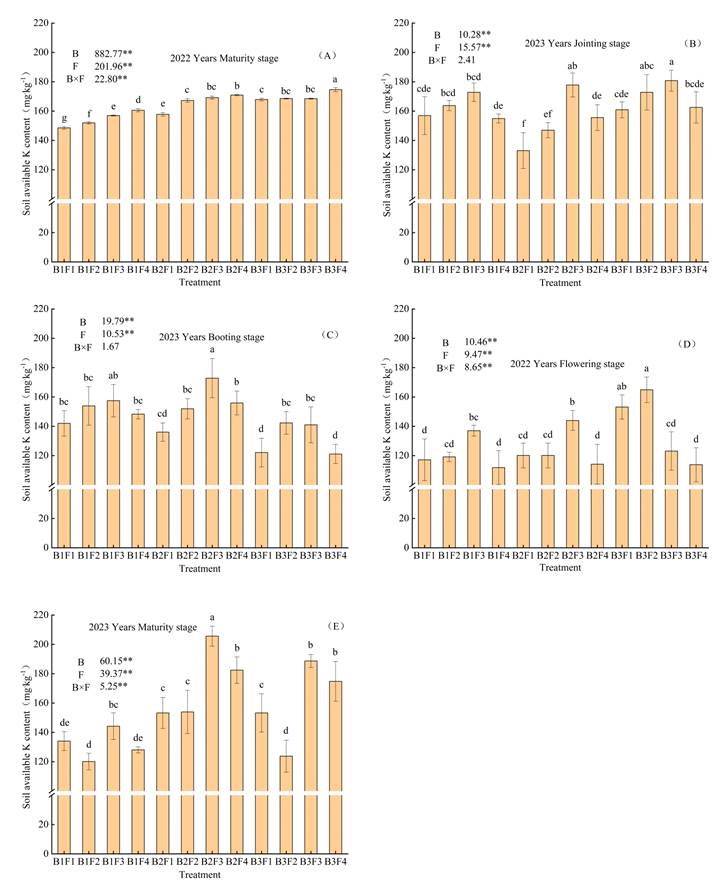
Both biochar and compound fertilizer treatments significantly affected soil available K content at the 2022 maturity stage, as well as at the 2023 jointing, booting, flowering, and maturity stages. Moreover, their interaction significantly influenced soil available K content at the 2022 maturity stage, and at the 2023 flowering and maturity stages (Figure 2A-2E). Under single compound fertilizer treatment, soil available K content in winter wheat at maturity (2022) decreased with decreasing fertilizer application rate. The maximum value (160.58 mg kg-1) was observed under B1F4 treatment (Figure 2A). Soil available K content at the jointing, flowering, and maturity stages initially increased and was then stabilized with decreasing compound fertilizer application. The maximum values were observed under B1F3 (172.82, 137.03, and 144.19 mg kg-1 for different stages), representing significant increases of 11.55%, 22.52%, and 12.59% compared with those under B1F4 (Figure 2B, 2D, 2E). Under single application of biochar, soil available K content increased with biochar application rate at the 2022 maturity stage and 2023 flowering stage. The maximum values (167.90 and 153.14 mg kg-1 for respective stages) were observed in B3F1, representing significant increases of 12.99% and 30.72% compared with those under B1F1 (Figure 2A, 2D). Among all treatments, B3F4 resulted in the highest soil available K content (174.64 mg kg-1) at 2022 maturity stage, representing an 8.76% significant increase over B1F4. At the flowering stage, B3F2 resulted in the maximum soil available K content (164.87 mg kg-1), followed by B3F1 (153.14 mg kg-1) and B2F3 (143.99 mg kg-1), which were significantly increased by 47.42%, 36.93%, and 28.75% compared with those under B1F4, respectively. At the 2023 maturity stage, peak content of soil available K was recorded in B2F3 (205.63 mg kg-1), which was significantly enhanced by 60.55% compared with that under B1F4.

Effects of combined application of compound fertilizer and biochar on available K content in winter wheat soil (mg kg-1). Note: The main treatment consisted of biochar (B) application rate, while the secondary treatment comprised compound fertilizer (F) application rate. The table presents: (1) individual effects of F application rate, (2) combined B-F application, and (3) their interaction effects. Asterisks indicate significant differences at *P < 0.05 and **P < 0.01. (4) Different lowercase letters denote significant differences at P < 0.05. The same applies below.
Effects of compound fertilizer and biochar on K accumulation and yield of winter wheat
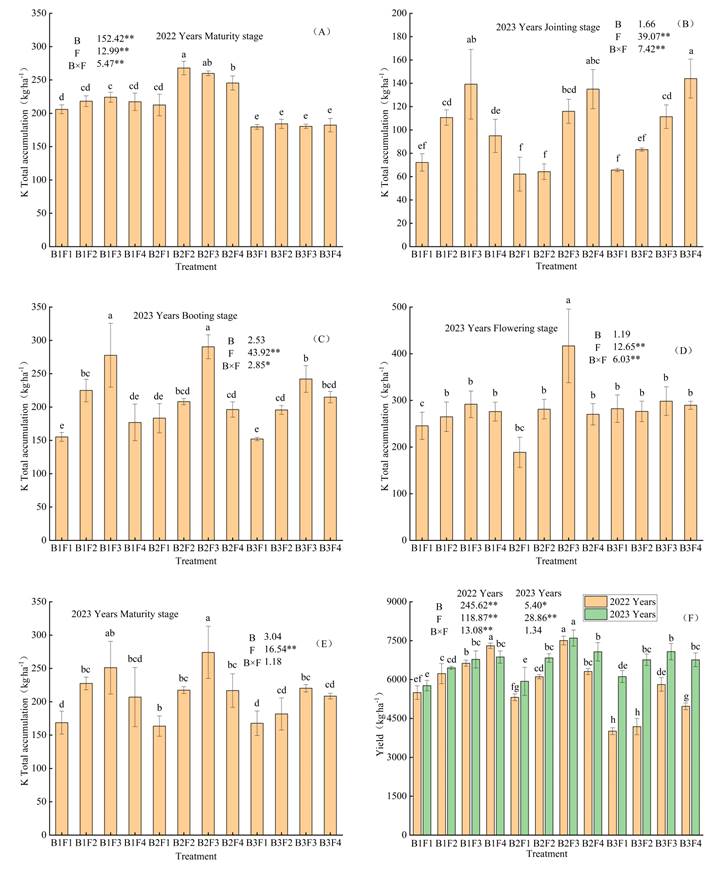
Biochar treatment significantly affected the 2022 winter wheat yield, K accumulation at maturity, and the 2023 yield. Compound fertilizer treatment significantly affected the 2022 winter wheat yield, K accumulation at maturity, and 2023 yield, K accumulation at the jointing, booting, flowering, maturity stages. Their interaction significantly influenced the 2022 winter wheat yield, K accumulation at maturity, and 2023 K accumulation at the jointing, booting, and flowering stages (Figure 3A-3F). Under single compound fertilizer treatment, K accumulation in winter wheat at the jointing and booting stages initially increased but then decreased with decreasing fertilizer application rate. The maximum accumulation occurred under B1F3 treatment, which reached 139.24 kg ha-1 and 277.74 kg ha-1 at the jointing and booting stages, respectively. These values represented significant increases of 46.57% and 56.96% compared with those under B1F4 (Figure 3B, 3C). Under single application of biochar, the maximum K accumulation occurred under B2F1 treatment, reaching 212.54 kg ha-1 at the maturity stage in 2022 and 183.40 kg ha-1 at the booting stage in 2023 (Figure 3A, 3C). Among the 12 treatments, B2F2 resulted in the highest K accumulation (268.00 kg ha-1) at winter wheat maturity in 2022, followed by B2F3 (259.88 kg ha-1). These values represented significant increases of 23.30% and 19.57%, respectively, compared with those under B1F4. At the booting, flowering, and maturity stages, B2F3 treatment led to the maximum K accumulation of 290.45, 416.81, and 274.10 kg ha-1, respectively, representing significant increases of 64.14%, 50.97%, and 32.42% compared with those under B1F4. Under single compound fertilizer treatment, the highest yields in both years were achieved by B1F4, which reached 7,303.24 kg ha-1 and 6,871.41 kg ha-1 in 2022 and 2023, respectively. Under single application of biochar, the yield showed a decreasing trend with increasing application rate in 2022, but exhibited an opposite pattern in 2023. Among all treatments, B2F3 resulted in 2.77% and 10.61% higher yields than B1F4 in 2022 and 2023, respectively (Figure 3F).
Effects of combined biochar and compound fertilizer application on winter wheat yield and plant K accumulation (kg ha-1). Note: The main treatment consisted of biochar (B) application rate, while the secondary treatment comprised compound fertilizer (F) application rate. The table presents: (1) individual effects of F application rate, (2) combined B-F application, and (3) their interaction effects. Asterisks indicate significant differences at *P < 0.05 and **P < 0.01. (4) Different lowercase letters denote significant differences at P < 0.05. The same applies below.
Effects of compound fertilizer and biochar on K utilization and distribution in winter wheat
Single biochar application had significant impacts on the KAE and KUE in two years and KHI in 2023. Single compound fertilizer application obviously affected the KAE, KUE, and KHI in both years. Their interaction had significant impacts on the KAE and KUE in 2022, while on KUE and KHI in 2023 (Table 1). Under single compound fertilizer application, the KUE of winter wheat increased over the two years with decreasing compound fertilizer application, peaking under B1F2 with values of 16.16 kg kg-1 and 11.65 kg kg-1, respectively. Over the two-year period, the KAE was the highest under B1F2 treatment, reaching 54.31 kg kg-1 and 50.68 kg kg-1, respectively. Among the 12 treatments, B2F3 and B2F2 resulted in the highest KAE in winter wheat during the two-year study, reaching 81.16 kg kg-1 and 78.92 kg kg-1, respectively. The highest KUE in both years was observed under B2F2, with values of 19.85 kg kg-1 and 11.28 kg kg-1, respectively. Compared with those under B1F4, these values showed significant increases of 81.97%, 258.56%, 269.65%, and 233.73%, respectively.
Biochar treatment exerted significant impacts on the K accumulation in leaves in two-year-old at maturity; sheaths at 2022 maturity and 2023 jointing, stems at 2023 jointing and flowering, grains at booting and flowering, and grains in mature plants. Compound fertilizer application significantly affected the K accumulation in leaves, sheaths, and stems in 2022 maturity and 2022 booting, flowering, and maturity, sheaths at booting stage (2023), glume + spikes at flowering stage (2023), and glume + spikes and grains at maturity stage (2023). The interaction between the two factors significantly affected the K accumulation in leaves, stems during the booting stage and both 2022 and 2023 mature stages, sheaths in 2022 mature stage, and grains in 2023 mature stage (Figure 4A-E). During the two-year cultivation period, K accumulation in winter wheat followed the order of grains > stems > leaves > sheaths > glume + spikes. K distribution patterns varied across different growth stages, following the order of leaves > sheaths > stems at the jointing stage, stems > sheaths > leaves > spikes at the booting stage, and stems > leaves > sheaths > spikes at the flowering stage (Figure 4).

K distribution in winter wheat under compound fertilizer and biochar application (%). Note: The main treatment consisted of biochar (B) application rate, while the secondary treatment comprised compound fertilizer (F) application rate. The table presents: (1) individual effects of F application rate, (2) combined B-F application, and (3) their interaction effects. Asterisks indicate significant differences at *P < 0.05 and **P < 0.01. (4) Different lowercase letters denote significant differences at P < 0.05. The same applies below.
Correlation analysis of soil K content, plant K accumulation and yield
The winter wheat yield of 2022 was significantly positively correlated with the yield, K accumulation at the maturity stage and booting stage, soil available K at booting stage, soil total K content at the jointing stage in 2023. The yield in 2023 was significantly positively correlated with soil available K content at the maturity stage and the yield of 2022, as well as soil total K content at the jointing stage, soil available K content at the maturity stage, and the total plant K accumulation at the jointing, booting, flowering and maturity stage of 2023 (Figure 5).

Correlation between soil K content, plant K accumulation, and yield. Note:X1-X4: Soil total K content, soil available K content, total plant K accumulation at the maturity stage and yield in 2022, respectively. X5-X8: Soil total K content at the jointing, booting, flowering, and maturity stage in 2023, respectively. X9-X12: soil available K content at the jointing, booting, flowering, and maturity stage in 2023, respectively. X13-X16: plant K accumulation at the jointing, booting, flowering, and maturity stage in 2023, respectively. X17: winter wheat yielded in 2023.
DISCUSSION
Effects of compound fertilizer combined with biochar on available K content in winter wheat soil.
Potassium is one of the three primary macronutrients essential for plant growth. Studies have shown that biochar, which contains abundant nutrients such as N, P, and K, can significantly improve soil fertility (PANDIT et al., 2018; LI et al., 2023). RAFIQUE et al. (2020) found that rice straw biochar contains 27.15 g kg-1 of K. When applied at a rate of 2.5 t ha-1, the biochar could increase the soil K content by 67.88 kg ha-1. Conducted experiments in low-fertility soils and found that combined application of biochar and K fertilizer could significantly increase the content of available soil nutrients. Specifically, addition of 2% biochar increased the soil available K content by 106% (NOVAK et al., 2009). This study demonstrated that both reduced levels of compound fertilizer combined with biochar increased the soil available K content at the two-year maturity stage. Specifically, B2F3 and B3F3 treatments significantly increased the soil available K content by 5.36% - 60.54% and 4.93% - 47.35%, respectively, compared with the control (B1F4). In 2022, at conventional fertilization levels, the combined application of biochar (B3F4 and B2F4) significantly increased the soil available K content by 6.4 5% - 8.76% compared with B1F4. In 2023, the combined application also increased soil available K content. Specifically, the B2F3 and B3F3 treatments resulted in significant increases of 60.55% and 47.35% in soil available K, respectively, compared with the control (B1F4). These experimental results provide evidence to support Hypothesis 1. The observed effects may be attributed to several mechanisms. Firstly, biochar inherently contains abundant K (RAFIQUE et al., 2020), providing direct supplementation of K to the soil K pool. Secondly, the porous structure of biochar effectively adsorbs free K+ ions, thereby minimizing leaching loss of K. Thirdly, the surface negative charges on biochar electrostatically retain cations (such as K+ and NH4 +) (XIU et al., 2023), subsequently slowing K fixation by soil colloids.
Effects of compound fertilizer-biochar interactions on K uptake and yield in winter wheat
Potassium accumulation, distribution, and utilization are critical for achieving high wheat yields. Although, compound fertilizers contain certain amounts of K, soil application of compound fertilizers leads to significant fixation and leaching loss of K, resulting in low use efficiencies. Biochar contains plant-available K, which can enhance soil K+ retention and promote the uptake, translocation, and accumulation of K in plants (XIA et al., 2024). XIE et al. (2021) demonstrated that biochar-fertilizer co-application enhances K accumulation in maize at maturity. ZHANG et al. (2019) revealed that biochar-compound fertilizer co-application significantly enhances K accumulation in pepper plants. Moreover, K accumulation showed an initial increase followed by a decrease with increasing biochar application. In this study, the reduced levels of compound fertilizer combined with biochar (B2F3) significantly enhanced K accumulation in winter wheat compared with conventional fertilization (B1F4) at maturity in 2022, and at all stages in 2023. Therefore, optimal co-application of compound fertilizer and biochar can enhance K accumulation in wheat plants (BAO et al., 2024). Furthermore, K accumulation in plants directly influences the yield formation (GEBERMEDHIN et al., 2018). BAO et al. (2023) demonstrated that biochar-K fertilizer co-application significantly increased maize yield. Specifically, the treatment combining 2.63 t ha-1 biochar with 60 kg ha-1 K fertilizer increased the yield by 19.76% compared with the control. LULU et al. (2020) demonstrated that biochar application at 5 t ha-1 significantly increased wheat grain yield. In this two-year study, the B2F3 treatment consistently showed the highest yield, which was 36.54% (2022) and 31.78% (2023) greater than that under B1F1, and 2.77% (2022) and 10.61% (2023) higher than that under conventional fertilization (B1F4). The consistent yield advantages of B2F3 across both growing seasons supports Hypothesis 2. These results demonstrated that the biochar-compound fertilizer co-application can enhance crop yield through improvement of K accumulation (WANG et al., 2025; XIU et al., 2025; GHORBANI & AMIRAHMADI, 2024).
Effects of compound fertilizer combined with biochar on KUE in winter wheat
BAO et al. (2023) demonstrated that biochar can significantly enhance crop K uptake and utilization efficiency. At an application rate of 2.63 t ha-1, the K uptake rate increased by 24.55% compared with that under control. WIDOWATI et al. (2014) showed that biochar combined with K fertilizer enhances KUE, which can help reduce the fertilizer application rate. The results of this study demonstrated that the combined application of compound fertilizer and biochar has synergistic effects on KUE. This treatment simultaneously improved KUE, KHI, and KAE. In the two-year experiment, the KAE of B2F3 was 81.97% and 208.45% higher than that of B1F4 in 2022 and 2023, respectively. Moreover, in 2023, the KUE of B2F3 increased by 130.18% compared with that of the control. The mechanisms for the improved efficiency may be ascribed to two pathways. First, the co-application of biochar and compound fertilizer significantly increases total soil K content while promoting available K release. Second, under low K conditions, crops exhibit increased dependence on the soil K pool. With the decrease in K application rate, crops will reduce their reliance on fertilizer-derived K while increasing their dependence on soil K sources. This shift will activate the “soil K pool effect,” thereby improving the K use efficiency metrics (COELHO et al., 2018; DUAN et al., 2024; NAWAZ et al., 2024). This discovery provides a theoretical basis for optimizing K fertilizer management.
CONCLUSION
Combination of low levels of compound fertilizers with appropriate biochar rates can enhance both total and available K contents in soil. This enhancement improves K uptake and utilization by winter wheat, promotes K accumulation and redistribution within plants, and ultimately increases crop yield. For winter wheat cultivation in Hebei Eastern Region of China, we recommend the application of 450 kg ha-1 compound fertilizer combined with 7500 kg ha-1 biochar to achieve the triple benefits of reduced input, improved efficiency, and increased yield.
This study has certain limitations regarding long-term effects, as it was based on a two-year short-term experiment. Future research should include long-term monitoring to evaluate the sustained improving effects. Additionally, particular attention should be paid to the impacts of prolonged biochar application on soil pH and microbial community structure.
ACKNOWLEDGMENTS
This research was supported by the Hebei Province agricultural scientific and technological achievements transformation fund project (2024V1705570221728).
REFERENCES
-
ADDIS, Z. et al. Effects of dry bio-slurry and nitrogen fertilizer on potato and wheat yields under rotation cropping system. Plos One, v.19, n.7, p.e0306625, 2024. Available from: <Available from: https://pmc.ncbi.nlm.nih.gov/articles/PMC11290689/ >. Accessed: May, 14, 2025. doi: 10.1371/journal.pone.0306625.
» https://doi.org/10.1371/journal.pone.0306625.» https://pmc.ncbi.nlm.nih.gov/articles/PMC11290689/ -
ADEKIYA, A. O. et al. Effects of wood biochar and potassium fertilizer on soil properties, growth and yield of sweet potato. Heliyon, v.8, n.11, p.e11728, 2022. Available from: <Available from: https://www.sciencedirect.com/science/article/pii/S240584402203016X >. Accessed: Nov. 21, 2024. doi: 10.1016/j.heliyon.2022.e11728.
» https://doi.org/10.1016/j.heliyon.2022.e11728.» https://www.sciencedirect.com/science/article/pii/S240584402203016X -
ADEKIYA, A. O. et al. Sole and combined application of biodigestate, N, P, and K fertilizers: impacts on soil chemical properties and maize performance. The Scientific World Journal, v.20, n.2024, p.6685906, 2024. Available from: <Available from: https://www.onlinelibrary.wiley.com/doi/10.1155/2024/6685906 >. Accessed: Feb. 20, 2025. doi: 10.1155/2024/6685906.
» https://doi.org/10.1155/2024/6685906.» https://www.onlinelibrary.wiley.com/doi/10.1155/2024/6685906 -
BAO, Z, et al. Long-term biochar application promoted soil aggregate‐associated potassium availability and maize potassium uptake. Global Change Biology Bioenergy, v.16, n.04, p.13134, 2024. Available from: <Available from: https://onlinelibrary.wiley.com/doi/10.1111/gcbb.13134 >. Accessed: Feb. 27, 2025. doi: 10.1111/gcbb.13134.
» https://doi.org/10.1111/gcbb.13134.» https://onlinelibrary.wiley.com/doi/10.1111/gcbb.13134 -
BAO, Z. R. et al. Effects of nine-year low amount biochar return and potas sium fertilization on potassium, maize yield and potassium balance in brown soil. Chinese Journal of Ecology, v.42, n.9, p.2129-2137, 2023. Available from: <Available from: https://www.cje.net.cn/EN/10.13292/j.1000-4890.202309.026 >. Accessed: Apr. 04, 2024. doi: 10.13292/j.1000-4890.202309.026.
» https://doi.org/10.13292/j.1000-4890.202309.026.» https://www.cje.net.cn/EN/10.13292/j.1000-4890.202309.026 -
BILIAS, F. et al. Biochar application as a soil potassium management strategy: a review. Science of the Total Environment, v.858, n.1, p.159782, 2023. Available from: <Available from: https://www.sciencedirect.com/science/article/abs/pii/S0048969722068826 >. Accessed: Oct. 27, 2024. doi: 10.1016/j.scitotenv.2022.159782.
» https://doi.org/10.1016/j.scitotenv.2022.159782.» https://www.sciencedirect.com/science/article/abs/pii/S0048969722068826 -
CHEN, Z. et al. Effects of biochar applied in either rice or wheat seasons on the production and quality of wheat and nutrient status in paddy profiles. Plants, v.12, n.24, p.4131, 2023. Available from: <Available from: https://www.mdpi.com/2223-7747/12/24/4131 >. Accessed: Dec. 11, 2024. doi: 10.3390/plants12244131.
» https://doi.org/10.3390/plants12244131.» https://www.mdpi.com/2223-7747/12/24/4131 -
COELHO, M. A. et al. The combination of compost or biochar with urea and NBPT can improve nitrogen-use efficiency in maize. Anais da Academia Brasileira de Ciencias, v.90, n.2, p.1695-1703, 2018. Available from: <Available from: https://pubmed.ncbi.nlm.nih.gov/29898117/ >. Accessed: Apr. 04, 2020. doi: 10.1590/0001-3765201820170416.
» https://doi.org/10.1590/0001-3765201820170416.» https://pubmed.ncbi.nlm.nih.gov/29898117/ -
DUAN, Y. et al. Effect of compound fertilizer on foxtail millet productivity and soil environment. Plants Basel, v.13, n.22, p.3167, 2024. Available from: <Available from: https://www.mdpi. com/2223-7747/13/22/3167/ >. Accessed: May, 14, 2025. doi: 10.3390/plants13223167.
» https://doi.org/10.3390/plants13223167.» https://www.mdpi. com/2223-7747/13/22/3167/ -
FACHINI, J. et al. Assessing potassium release in natural silica sand from novel K-enriched sewage sludge biochar fertilizers. Journal of Environmental Management, v.15, p.115080, 2022. Available from: <Available from: https://www.sciencedirect.com/science/article/abs/pii/ S0301479722006533 >. Accessed: Apr. 18, 2023. doi: 10.1016/j.jenvman.2022.115080.
» https://doi.org/10.1016/j.jenvman.2022.115080.» https://www.sciencedirect.com/science/article/abs/pii/ S0301479722006533 -
GEBERMEDHIN, W. Evaluation of potassium fertilizer for better wheat (Triticum aestivum L.) production at Banja District, Awi Zone of Ethiopia. World Journal of Agricultural Sciences, v.14, n.4, p.118-122, 2018. Available from: <Available from: https://xueshu.baidu.com/usercenter/ paper/show?paperid=1k0v0c00y75a0840h06h0je00c261145&site=xueshu_se&hitarticle=1 >. Accessed: Dec. 12, 2020. doi: 10.5829/idosi.wjas.2018.118.122.
» https://doi.org/10.5829/idosi.wjas.2018.118.122.» https://xueshu.baidu.com/usercenter/ paper/show?paperid=1k0v0c00y75a0840h06h0je00c261145&site=xueshu_se&hitarticle=1 -
GHORBANI, M.; AMIRAHMADI, E. Biochar and soil contributions to crop lodging and yield performance - a meta-analysis. Plant Physiology and Biochemistry, v.215, p.109053, 2024. Available from: <Available from: https://www.sciencedirect.com/science/article/abs/pii/ S0981942824007216 >. Accessed: Oct. 10, 2025. doi: 10.1016/j.plaphy.2024.109053.
» https://doi.org/10.1016/j.plaphy.2024.109053.» https://www.sciencedirect.com/science/article/abs/pii/ S0981942824007216 -
HU, Y. et al. Controlled-release nitrogen mixed with common nitrogen fertilizer can maintain high yield of rapeseed and improve nitrogen utilization efficiency. Plants, v.12, n.24, p.4105, 2023. Available from: <Available from: https://www.mdpi.com/2223-7747/12/24/4105 >. Accessed: Dec. 08, 2024. doi: 10.3390/plants12244105.
» https://doi.org/10.3390/plants12244105.» https://www.mdpi.com/2223-7747/12/24/4105 -
LI, H. et al. Response of soil nutrients retention and rice growth to biochar in straw returning paddy fields. Chemosphere, v.312, p.137244, 2023. Available from: <Available from: https://www. sciencedirect.com/science/article/abs/pii/S0045653522037377 >. Accessed: Jan. 01, 2024. doi: 10.1016/j.chemosphere.2022.137244.
» https://doi.org/10.1016/j.chemosphere.2022.137244.» https://www. sciencedirect.com/science/article/abs/pii/S0045653522037377 -
LIN, Q. et al. Assessing the potential of biochar and aged biochar to alleviate aluminum toxicity in an acid soil for achieving cabbage productivity. Ecotoxicology and Environmental Safety, v.161, p.290-295, 2018. Available from: <Available from: https://www.sciencedirect.com/science/article/abs/pii/S0147651318305001 >. Accessed: Jun. 08, 2020. doi: 10.1016/j.ecoenv.2018.06.010.
» https://doi.org/10.1016/j.ecoenv.2018.06.010.» https://www.sciencedirect.com/science/article/abs/pii/S0147651318305001 -
LIU, S. et al. Rice husk biochar impacts soil phosphorous availability, phosphatase activities and bacterial community characteristics in three different soil types. Applied Soil Ecology, v.116, p.12-22, 2017. Available from: <Available from: https://www.sciencedirect.com/science/article/abs/pii/S0929139316306904 >. Accessed: Aug. 13, 2020. doi: 10.1016/j.apsoil.2017.02003.
» https://doi.org/10.1016/j.apsoil.2017.02003.» https://www.sciencedirect.com/science/article/abs/pii/S0929139316306904 -
LULU, M. et al. Growth, yield and grain nutrients response of wheat (Triticum aestivum L.) to biochar, lime and farmyard manure amendment of the croplands in southern Ethiopia. Research Square, 2020. Available from: <Available from: https://xueshu.baidu.com/usercenter/paper/show?paperid=1q4v0pu08h560as05r5j0c30by041579&site=xueshu_se >. Accessed: Aug. 09, 2021. doi: 10.21203/rs.2.24567/v2.
» https://doi.org/10.21203/rs.2.24567/v2.» https://xueshu.baidu.com/usercenter/paper/show?paperid=1q4v0pu08h560as05r5j0c30by041579&site=xueshu_se -
NAWAZ, A. et al. Potassium and zinc improves physiological performance, nutrient use efficiency, and productivity of wheat. Frontiers in Plant Science, v.11, n.15, p.1363248, 2024. Available from: <Available from: https:///www.pubmed.ncbi.nlm.nih.gov/39055353 >. Accessed: Jul. 11. 2025. doi: 10.3389/fpls.2024.1363248.
» https://doi.org/10.3389/fpls.2024.1363248.» https:///www.pubmed.ncbi.nlm.nih.gov/39055353 -
NOVAK, J. M. et al. Impact of biochar amendment on fertility of a southeastern coastal plain soil. Soil Science, v.174, n.2, p.105-112, 2009. Available from: <Available from: https://www.ars.usda.gov/ARSUserFiles/60820000/Manuscripts/2009/Man809.pdf >. Accessed: Feb. 01, 2020. doi: 10.1097/SS.0b013e3181981d9a.
» https://doi.org/10.1097/SS.0b013e3181981d9a.» https://www.ars.usda.gov/ARSUserFiles/60820000/Manuscripts/2009/Man809.pdf -
PANDIT, N. R. et al. Biochar improves maize growth by alleviation of nutrient stress in a moderately acidic low-input nepalese soil. Science the Total Environment, v.625, p.1380-1389, 2018. Available from: <Available from: https://www.sciencedirect.com/science/article/pii/S0048969718300226 >. Accessed: Jun. 01, 2021. doi: 10.1016/j.scitotenv.2018.01.22.
» https://doi.org/10.1016/j.scitotenv.2018.01.22.» https://www.sciencedirect.com/science/article/pii/S0048969718300226 -
RAFIQUE, M. et al. Residual effects of biochar and phosphorus on growth and nutrient accumulation by maize (Zea mays L.) amended with microbes in texturally different soils. Chemosphere, v.238, p.124710, 2020. Available from: <Available from: https://www.sciencedirect.com/science/article/abs/pii/S004565351931940X >. Accessed: Sept. 04, 2022. doi: 10.1016/j. chemosphere.2019.124710.
» https://doi.org/10.1016/j. chemosphere.2019.124710.» https://www.sciencedirect.com/science/article/abs/pii/S004565351931940X -
SHARMA, S. et al. Nitrogen and potassium application effects on productivity, profitability and nutrient use efficiency of irrigated wheat (Triticum aestivum L.). Plos One, v.17, n.5, p.e0264210, 2022. Available from: <Available from: https://www.journals.plos.org/plosone/article?id=10.1371/journal.pone.0264210 >. Accessed: May, 24, 2024. doi: 10.1371/journal.pone.0264210.
» https://doi.org/10.1371/journal.pone.0264210.» https://www.journals.plos.org/plosone/article?id=10.1371/journal.pone.0264210 -
SUN, H. et al. Wheat straw biochar application increases ammonia volatilization from an urban compacted soil giving a short-term reduction in fertilizer nitrogen use efficiency. Journal of Soils and Sediments, v.19, p.1624-1631, 2019. Available from: <Available from: https://link.springer.com/article/10.1007/s11368-018-2169-y >. Accessed: Nov. 14, 2022. doi: 10.1007/s11368-018-2169-y.
» https://doi.org/10.1007/s11368-018-2169-y.» https://link.springer.com/article/10.1007/s11368-018-2169-y -
WANG, C. et al. Soil potassium depletion in global cereal croplands and its implications. Science of the Total Environment, v.10, no.907, p.167875, 2024. Available from: <Available from: https://www.sciencedirect.com/science/article/abs/pii/S0048969723065026 >. Accessed: Jan. 10, 2025. doi: 10.1016/j.scitotenv.2023.167875.
» https://doi.org/10.1016/j.scitotenv.2023.167875.» https://www.sciencedirect.com/science/article/abs/pii/S0048969723065026 -
WANG, Z. et al. Effects of long-term biochar addition on the wheat-rotated rice grain yield and the fate of N fertilizer in plant-soil system - a combined 15N study. European Journal of Agronomy, v.168, p.127645, 2025. Available from: <Available from: https://doi.org/10.1016/j.eja.2025.127645 >. Accessed: Jan. 10, 2026. doi: 10.1016/j.eja.2025.127645.
» https://doi.org/10.1016/j.eja.2025.127645.» https://doi.org/10.1016/j.eja.2025.127645 -
WIDOWATI, W.; ASNAH, A. Biochar can enhance potassium fertilization efficiency and economic feasibility of maize cultivation. Journal of Agricultural Science, v.6, n.2, 2014. Available from: <Available from: https://doi.org/10.5539/jas.v6n2p24 >. Accessed: Jan. 10, 2021. doi: 10.5539/jas.v6n2p24.
» https://doi.org/10.5539/jas.v6n2p24.» https://doi.org/10.5539/jas.v6n2p24 -
XIA, H. et al. Co-application of biochar and potassium fertilizer improves soil potassium availability and microbial utilization of organic carbon: A four-year study. Journal of Cleaner Production, v.469, p.11, 2024. Available from: <Available from: https://www.sciencedirect.com/science/article/abs/pii/S095965262402660X >. Accessed: Sept. 01, 2025. doi: 10.1016/j.jclepro.2024.143211.
» https://doi.org/10.1016/j.jclepro.2024.143211.» https://www.sciencedirect.com/science/article/abs/pii/S095965262402660X -
XIE, Y. et al. Successive biochar amendment affected crop yield by regulating soil nitrogen functional microbes in wheat-maize rotation farmland. Environmental Research, v.194, p.110671, 2021. Available from: <Available from: https://doi.org/10.1016/j.envres.2020.110671 >. Accessed: Dec. 30, 2022. doi: 10.1016/j.envres.2020.110671.
» https://doi.org/10.1016/j.envres.2020.110671.» https://doi.org/10.1016/j.envres.2020.110671 -
XIU, L. et al. The fate and supply capacity of potassium in biochar used in agriculture. Science of the Total Environment, v.902, p.165969, 2023. Available from: <Available from: https://www.ablesci.com/scholar/paper?id=3QkkqRzY8 >. Accessed: Aug. 02, 2024. doi: 10.1016/j. scitotenv.2023.165969.
» https://doi.org/10.1016/j. scitotenv.2023.165969.» https://www.ablesci.com/scholar/paper?id=3QkkqRzY8 -
XIU, L. et al. Effects of biochar amendment on potassium supply capacity and potassium accumulation in soybean across diverse soils. Plants Basel, v.14, n.13, p.1959, 2025. Available from: <Available from: https://www.mdpi.com/2223-7747/14/13/1959 >. Accessed: Jun. 26, 2026. doi: 10.3390/plants14131959.
» https://doi.org/10.3390/plants14131959» https://www.mdpi.com/2223-7747/14/13/1959 -
ZHANG, M. et al. Effects of different dosage of biochar-based fertilizer on quality and efficiency of hot pepper in Guizhou. Journal of Nuclear Agricultural Sciences, v.33, n.07, p.1457-1464, 2019. Available from: <Available from: https://www.doi.org/10.11869/j.issn.100-8551.2019.07.1457 >. Accessed: May, 14, 2021. doi: 10.11869/j.issn.100-8551.2019.07.1457.
» https://doi.org/10.11869/j.issn.100-8551.2019.07.1457.» https://www.doi.org/10.11869/j.issn.100-8551.2019.07.1457 -
ZHANG, Z. et al. Long-term straw returning improve soil K balance and potassium supplying ability under rice and wheat cultivation. Scientific Reports, v.11, n.1, p.22260, 2021. Available from: <Available from: https://doi.org/10.1038/s41598-021-01594-8 >. Accessed: Nov. 15, 2023. doi: 10.1038/s41598-021-01594-8.
» https://doi.org/10.1038/s41598-021-01594-8.» https://doi.org/10.1038/s41598-021-01594-8 -
ZORB, C. et al. Perspective on wheat yield and quality with reduced nitrogen supply. Trends in Plant Science, v.23, n.11, p.1029-1037, 2018. Available from: <Available from: https://doi.org/10.1016/j.tplants.2018.08.012 >. Accessed: Sept. 21, 2020. doi: 10.1016/j.tplants.2018.08.012.
» https://doi.org/10.1016/j.tplants.2018.08.012.» https://doi.org/10.1016/j.tplants.2018.08.012 -
ZULFIQAR, B. et al. Biochar enhances wheat crop productivity by mitigating the effects of drought: Insights into physiological and antioxidant defense mechanisms. Plos One, v.17, n.4, p.e0267819, 2022. Available from: <Available from: https://doi.org/10.1371/journal.pone.0267819 >. Accessed: Apr. 28, 2024. doi: 10.1371/journal.pone. 0267819.
» https://doi.org/10.1371/journal.pone. 0267819.» https://doi.org/10.1371/journal.pone.0267819
Edited by
-
ASSOCIATE EDITOR:
Leandro Souza da Silva (0000-0002-1636-6643)
Data are contained within the article.