 Effects of compound fertilizer combined with biochar on potassium absorption and utilization of wheat
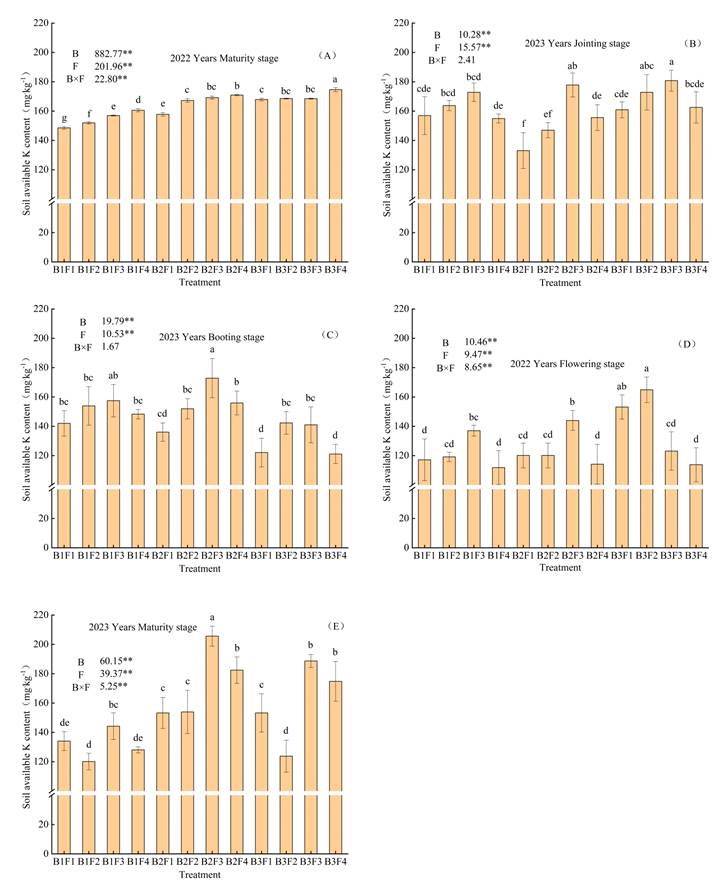
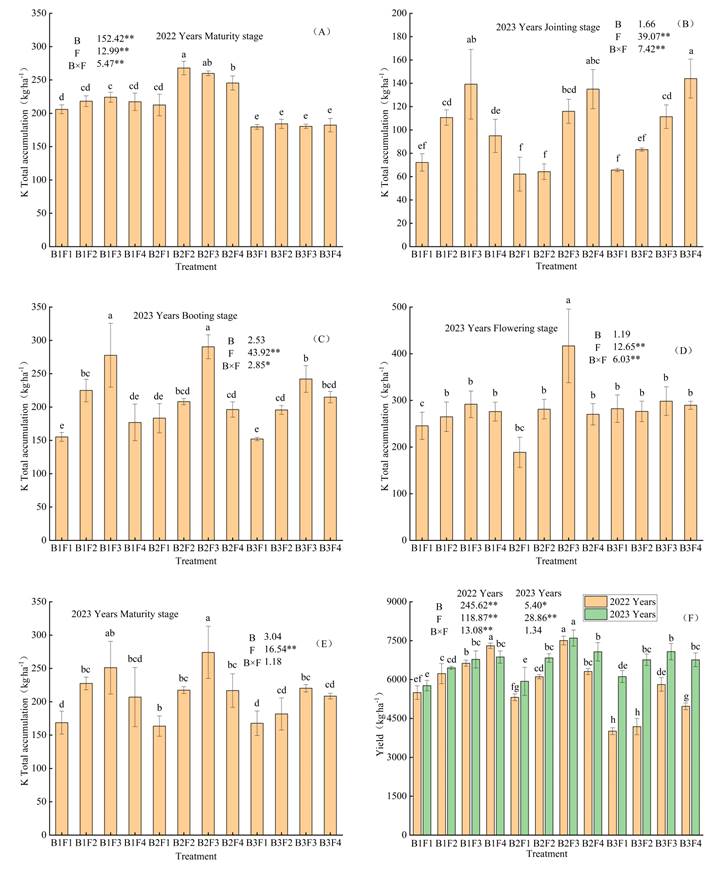
This study investigated the effects of combined application of compound fertilizer and biochar on potassium (K) absorption and utilization of winter wheat to reduce the use of compound fertilizer. On the basis of conventional K application of 675 kg ha-1 (F4), three biochar levels (B1, B2, and B3) and four compound fertilizer levels (F1, F2, F3, and F4) were set up to study the effects of their combined application for two consecutive years on soil total K and available K content, as well as plant K accumulation and utilization efficiency in winter wheat. This study investigated the effects of combined application of compound fertilizer and biochar on potassium (K) absorption and utilization of winter wheat to reduce the use of compound fertilizer. On the basis of conventional K application of 675 kg ha-1 (F4), three biochar levels (B1, B2, and B3) and four compound fertilizer levels (F1, F2, F3, and F4) were set up to study the effects of their combined application for two consecutive years on soil total K and available K content, as well as plant K accumulation and utilization efficiency in winter wheat in Hebei Eastern Region of China. The results showed that B3F4 and B3F2 respectively resulted in the highest soil total K content and available K content in two years among all treatments. Compared with B1F4 (control), B3F4 led to 5.18% and 8.76% increases in total K content, and B3F2 increased the available K content by 2.10% and 60.55% in 2022 and 2023, respectively. It also enhanced the K agronomic efficiency (KAE), K uptake efficiency (KUE), and K harvest index (KHI) by 81.97%, 269.65%, 3.08% in 2022, and 258.56%, 244.67% and 37.64% in 2023, respectively, relative to B1F4. It is recommended to combine 450 kg ha-1 compound fertilizer with 7500 kg ha-1 biochar to reduce fertilizer use and improve the fertilizer efficiency for winter wheat in Hebei Eastern Region of China, providing important reference for the cultivation of winter wheat in this area. The results showed that B3F4 and B3F2 respectively resulted in the highest soil total K content and available K content in two years among all treatments. Compared with B1F4 (control), B3F4 led to 5.18% and 8.76% increases in total K content, and B3F2 increased the available K content by 2.10% and 60.55% in 2022 and 2023, respectively. Co-application of compound fertilizer with biochar enhances K accumulation in winter wheat throughout all growth stages. It also enhanced the KAE, KUE, and KHI by 81.97%, 269.65%, 3.08% in 2022, and 258.56%, 244.67% and 37.64% in 2023, respectively, relative to B1F4. Compared with B1F4, B2F3 increased the yield of the two years by 2.77% and 10.61%, respectively. These results indicated that combined application of compound fertilizer and biochar could reduce the use of compound fertilizer, and at the same time increase the total and available K content in soil, thereby increasing the agronomic utilization and absorption efficiency of K as well as the K accumulation and harvest index of winter wheat. Based on our results, it is recommended to combine 450 kg ha-1 compound fertilizer with 7500 kg ha-1 biochar to reduce fertilizer use and improve the fertilizer efficiency for winter wheat in Hebei Eastern region of China, providing important reference for the cultivation of winter wheat in this area.
Key words:
biochar; compound fertilizer; wheat; potassium accumulation; potassium utilization efficiency
 Thumbnail
 Thumbnail
 Thumbnail
 Thumbnail
 Thumbnail