
 Trend of maternal mortality in Paraná, Brazil, and health regions, between 2005 and 2020
Abstract
This is a time series analysis that aimed to investigate the trend of maternal mortality, according to avoidability criteria, in Paraná, Brazil, and in its health regions, from 2005 to 2020. Maternal mortality ratios (MMR) were evaluated based on the number of maternal deaths of women residing in the state per 100,000 live births, and then analyzed according to health region, age group and ICD-10 groups. The variations of the MMR were calculated by the Prais-Winsten auto-regression model. The results pointed to a reduction in the MMR in the state, with emphasis on women aged 10 to 19 years and deaths that occurred in the puerperal period. Most of the health regions showed a tendency towards stability. The magnitude of maternal mortality in the current scenario presents itself as a serious public health problem for Brazilian women that, despite the significant improvement, it is still at alarming levels. Thus, more efficient public health actions and policies are needed to improve the quality of health care for pregnant and postpartum women.
Key words:
Maternal mortality; Women’s health; Health care quality
Resumo
Estudo de série temporal com o objetivo de analisar a tendência de mortalidade materna segundo os critérios de evitabilidade, no Paraná, Brasil, e em suas regionais de saúde no período de 2005 a 2020. Foram analisadas as razões de mortalidade materna (RMM) a partir do número de óbitos maternos de mulheres residentes por 100 mil nascidos vivos, conforme regional de saúde, faixa etária e grupos CID-10. Foram calculadas as variações das RMM por meio do modelo de autorregressão de Prais-Winsten. Os resultados apontaram redução da RMM no estado, com destaque para as mulheres de 10 a 19 anos e para os óbitos que ocorreram no período puerperal. A maioria das regionais de saúde apresentou tendência de estabilidade. A magnitude da mortalidade materna no cenário atual apresenta-se como um grave problema de saúde pública das mulheres brasileiras, ainda encontrando-se, apesar da significativa melhora, em patamares alarmantes. Dessa forma, são necessárias ações e políticas de saúde pública mais eficientes no sentido de melhorar a qualidade de assistência à saúde às gestantes e puérperas.
Palavras-chave:
Mortalidade materna; Saúde da mulher; Qualidade da assistência à saúde
Resumen
Estudio de series temporales con el objetivo de analizar la tendencia de la mortalidad materna, según criterios de prevenibilidad, en Paraná, Brasil, y en sus regiones de salud, de 2005 a 2020. Se analizaron las razones de mortalidad materna (RMM) con base en el número de muertes de mujeres residentes por cada 100.000 nacidos vivos, según región sanitaria, grupo de edad y grupos CIE-10. Las variaciones en las RMM se calcularon utilizando el modelo de autorregresión de Prais-Winsten. Los resultados mostraron una reducción del RMM en el estado, con énfasis en las mujeres de 10 a 19 años y las muertes ocurridas en el período puerperal. La mayoría de las regiones sanitarias mostraron una tendencia hacia la estabilidad. La magnitud de la mortalidad materna en el escenario actual se presenta como un grave problema de salud pública para las mujeres brasileñas que, a pesar de una mejora significativa, aún se encuentra en niveles alarmantes. Por lo tanto, se necesitan acciones y políticas de salud pública más eficientes para mejorar la calidad de la atención médica para las mujeres embarazadas y posparto.
Palabras clave:
Mortalidad materna; Salud de la mujer; Calidad de la atención de salud
Introduction
The indicator ‘maternal mortality’ is the best epidemiological measure of women’s health in the population and is indispensable as a tool for evaluating the impact of public policies directed to reducing the phenomenon of maternal mortality1. A women’s death during pregnancy, childbirth or puerperium is a clear demonstration of a failure of policy guidelines, health staffs and thus the population as a whole, given that it is an avoidable tragedy in 92.0% of cases2-3.
Biological factors, socioeconomic position, health care quality, gender inequalities and the political will to promote public health are all revealed in maternal deaths. The main indicator used to monitor maternal deaths is the maternal mortality ratio (MMR) expressed in deaths per 100,000 live births (LBs). Through that lens, a high MMR reflects an important public health problem, making it fundamentally important to find solutions to address this persistent, anachronic issue4.
The main causes of maternal mortality are complications during pregnancy, childbirth and postpartum, including gestational hypertensive diseases, haemorrhages, infections, complications of childbirth and unsafe abortions. On that view, a large proportion of maternal deaths are considered avoidable in that there are known health care solutions to prevent or control those disorders5.
Avoidable or reducible causes of death can be conceptualised as those that are totally or partially preventable by effective health sector action available at a specific place and time6. In that regard, maternal deaths should not occur, given that it is possible to prevent and/or treat the disorder or condition causing them. Avoidable death can be seen as a “sentinel event” for health surveillance, indicating a need to improve quality of care at all levels of prevention7.
In Brazil, the MMR declined from 141 deaths per 100,000 LBs, in 1990, to 64 deaths per 100,000 LBs, in 2011, a fall of 55.0%. In 2018, MMR in Brazil fell still further, to 59.1 deaths per 100,000 LBs, with the South region returning the lowest MMR, of 38.2 deaths per 100,000 LBs, revealing a downward trend in recent decades. However, these values are a far cry from the 35 deaths per 100,000 LBs set in the 2000s as a target of the United Nations Sustainable Development Goals and also from the maximum value admitted by the World Health Organisation, of 20 deaths per 100,000 LBs. These trends reflect improved access to health services, the rising number of antenatal appointments and care from qualified practitioners, but still fall short of WHO recommendations8-9.
In view of the foregoing, there is an evident need to improve maternal health care, because these data express health policy failures, low levels of socioeconomic development and difficult access to quality health care services. In addition, the issue of maternal mortality needs to be explored so as to corroborate better targeted and efficient health measures to address the problem, particularly in Paraná, the state with the highest MMR in the South region. In 2020, for example, MMR there was 52.0 per 100,000 LBs, while Santa Catarina and Rio Grande do Sul returned 31.6 and 41.3, respectively. Despite the improvements resulting from introduction of the Paraná Mothers’ Network (Rede Mãe Paranaense), designed to enable all health care services to act jointly with a view to reducing maternal mortality, the results are still inferior to those of neighbouring states10-12. In order to understand that scenario, and given the scarcity of studies on women’s health in Brazil, and particularly in Paraná, further research on the subject is essential in order to mitigate avoidable deaths. On those assumptions, this study examined the trend in maternal mortality, by avoidability criteria, in Paraná and its health regions.
Methods
This time series study examined the trend in maternal mortality, by avoidability criteria, in Paraná and health regions, from 2005 to 2020. The state is divided into four health macro-regions: East, West, North and Northwest, which are subdivided into 22 health regions. The East macro-region comprises the regions of Paranaguá, the (Curitiba) Metropolitan region, Ponta Grossa, Irati, Guarapuava, União da Vitória and Telêmaco Borba. The West macro-region comprises the Pato Branco, Francisco Beltrão, Foz do Iguaçu, Cascavel and Toledo regions. The regions of the North macro-region are Apucarana, Londrina, Cornélio Procópio, Jacarezinho and Ivaiporã. The Northwest macro-region comprises the regions of de Campo Mourão, Umuarama, Cianorte, Paranavaí and Maringá.
The maternal deaths included in this study were those of women residing in the state of Paraná obtained from official data publicly available from the mortality information system (Sistema de Informação sobre Mortalidade, SIM) and live births information system (Sistema de Informação sobre Nascidos Vivos, SINASC) of the ministry of health’s information department (Datasus). Maternal deaths were recorded with reference to the 10th revision of the International Classification of Diseases (ICD-10: O-00 to O-99). Demographic data were obtained from the census data and population estimates of Brazil’s official bureau of statistics (Instituto Brasileiro de Geografia e Estatística, IBGE).
MMR was calculated as the number of maternal deaths per 100,000 LBs in the population resident in to specific geographical area in the year in question. MMRs were examined by health region, age group (10 to 19 years, 20 to 29 years, 30 to 39 years and 40 to 49 years) and ICD 10 classification. By the latter variable, maternal deaths were grouped as follows: O00 to O02 - Complications of pregnancy; O03 to O26 - Complications of labour and delivery; and O29 to O99 - Complications of pregnancy, childbirth and puerperium (7).
The trend in maternal mortality was examined by taking MMRs as dependent variables (Y - dependent) and sequential years as independent variables (X - independent). Variations in MMR were calculated for the period from 2005 to 2020. That interval was analysed by two time cut-offs - the first eight years (2005 to 2012) and the following eight years (2013 to 2020) - as the comparability criterion for change in this indicator in the state of Paraná. To that end the Prais-Winsten model of autoregression was applied, as is recommended in order to correct serial autocorrelation in time series. The series was tested for autocorrelation by the Durbin-Watson test, which is interpreted on a scale from 0 to 4: values close to zero indicate the existence of positive autocorrelation, values close to 4 point to negative autocorrelation and values close to 2 indicate there is no serial autocorrelation.
The chosen regression model was applied using the method suggested by Antunes & Cardoso (13). First, log transformation was applied to the Y values, followed by application of the Prais-Winsten model of autoregression, so as to estimate b1 values of standardised mortality rates, by sex and total. Subsequently, annual percent changes (APCs) were calculated from the b1 values corresponding to each of the rates, by means of the formula: APC = [-1+10b1]*100%
In the final stage of modelling, confidence intervals (CIs) were calculated for the b1 measures and APCs, by applying the formulae: 95%CI = [-1+10b1 lower]*100%; [-1+10b1 upper]*100%.
The lower b1 and upper b1 values were taken from within the confidence interval generated by the statistical analysis programme and were applied in the formula, the lower b1 value corresponding to the lower bound of the CI and the upper b1 value corresponding to the upper bound of the CI.
Microsoft Excel 2019 was used to construct the indicators and to standardise and prepare the tables. The trend in maternal mortality was analysed using Bioestat 5.0 statistics software (Universidade Federal do Pará, UFPA) and Tabwin for Windows (Datasus). In this study, a 5% level of significance was used.
Results
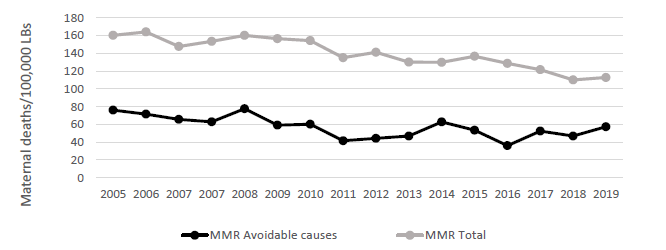
In the study period, 3,456 maternal deaths were reported in Paraná. Of these, 1,409 (40.8%) were considered to have resulted from avoidable complications of pregnancy, childbirth and the puerperium. Figure 1 shows change in MMR over time in Paraná State, by comparison of total deaths to deaths from avoidable causes. Total deaths showed a 29.6% decrease in risk, with coefficients declining from 160.3 deaths per 100,000 LBs in 2005 to 112.8 deaths per 100,000 LBs in 2020. A 15.7% reduction was observed between 2005 and 2012 and 20.1% between 2013 and 2020. The indices for deaths from avoidable causes decreased from 76.1 deaths per 100,000 LBs in 2005 to 57.4 deaths per 100,000 LBs in 2020, that is, a decrease of 24.6%. There was a 45.3% decrease between 2005 and 2012, but a 29.6% increase between 2013 and 2020. From the historical series, deaths from avoidable causes can be seen to increase in 2009, then decrease in 2014, increase again in 2015 and then oscillate in the following years of the study period. Total mortality declined from 2009 onwards until the end of the study period.
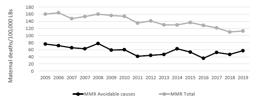
Table 1 shows percentage deaths and MMRs, by age group, in the state of Paraná. Women from 20 to 29 years old accounted for the highest percentages and MMRs in the study period, although alternating with the 30 to 39 year age group. In the former age group, MMRs fell from 32.4 deaths per 100,000 LBs in 2005 to 21.9 deaths per 100,000 LBs in 2020, representing a drop of 32.6%. Nonetheless, the largest reduction (52.9%) was found in the 10 to 19 year age group. Women in the 40 to 49 year age group returned the lowest percentages and ratios, ranging from 5.6 deaths per 100,000 LBs in 2005 to 4.1 deaths per 100,000 LBs in 2020, a 26.9% decrease. However, the largest reductions in all periods were seen in women 10 to 19 years old: 53.0% from 2005 to 2020, 55.4% from 2005 to 2012 and 36.1% from 2013 to 2020, this being, by age group, the largest decrease. On the other hand, between 2013 and 2020, the 20 to 29 year age group returned a 70.1% increase.
Prominent among the causes of maternal death were preventable causes from complications of childbirth and puerperium, as can be seen in Table 2. Rates for the former cause decreased from 21.2 deaths per 100,000 LBs in 2005 to 12.3 deaths per 100,000 LBs in 2020, a reduction of 42.0%. Complications of the puerperium accounted for more than 60.0% of avoidable deaths, the highest percentage. MMRs from this cause decreased from 54.3 deaths per 100,000 LBs in 2005 to 45.1 in 2020, a reduction of 16.9%. The highest rate in the study period (56.3 deaths/100,000 LBs) was recorded in 2009. The MMR from complications of pregnancy increased by a factor of three in the study period.
By health region in Paraná, the highest number of deaths from avoidable causes was in the Metropolitan region, with 386 deaths (27.4%), while the lowest was the União da Vitória region, with 16 deaths (1.1%), as in Table 3. Examination of the trends in MMR, by health regions of Paraná, found most stable and only two regions displaying downward trends: the Metropolitan health region (β = -0.019; R² = 0.461; APC = -4.28%; 95%CI = -6.62 to -1.89; p = 0.002) and the Jacarezinho region (β = -0.475; R² = 0.666; APC = 6.89%; 95%CI = -12.25 to -1.20 p = 0.020).
In Paraná, total MMR showed an upward trend (β = -0.011; R² = 0.796; APC = -2.5%; 95%CI = 2.89 to -2.02; p < 0.001), as did deaths from avoidable causes (β = -0.013; R² = 0.287; APC = -2.9%; 95%CI = -5.32 to -0.52; p = 0.014) (Table 4). Deaths from complications of childbirth tended to decrease (β = -0.016; R² = 0.344; APC = -3.62%; 95%CI = -5.97 to -1.21; p = 0.008), as did causes relating to the puerperium (β = -0.011; R² = 0.215; APC = -2.50%; 95%CI = -4.88 to - 0.06 p = 0.028). By age, deaths decreased in the 10 to 39 year age group, particularly among women 10 to 19 years old (β = -0.023; R² = 0.413; APC = -5.2%; 95%CI = -7.93 to -2.31; p = 0.004).
Discussion
The study findings revealed the magnitude of maternal mortality from avoidable causes in Paraná and health regions in the study period. MMR decreased in the state, particularly for deaths occurring primarily in the puerperium among women from 20 to 29 years of age.
Nearly half (40.8%) of the maternal deaths recorded in the historical series were considered avoidable. Avoidable deaths and total deaths returned similar percentage reductions (24.6% and 29.6%, respectively). Note that from 2013 to 2020, total deaths declined, although avoidable deaths increased by about 30.0%. A study in Rio de Janeiro, from 2006 to 2018, detected 2,192 maternal deaths in that period14. The study reported here, although the study period is slightly longer (three years), found 1,264 more deaths in Paraná than the number found in Rio de Janeiro. In interpreting that finding, it is important to emphasise not just the population difference between the states, but also the variations in quality of health care for the public of pregnant and puerperal women.
Another issue to be raised in view of these scenarios is the timely and correct completion of death certificates, in view of avoidability criteria, particularly after expansion of the maternal mortality committees. These committees are known to be decisive in investigating the circumstances, causes and technical and administrative responsibilities in each death, setting targets for remediating irregularities and advancing education measures on women’s health for the community and health practitioners15. Accordingly, correct completion of the fields of death certificates regarding deaths of women of fertile age provides valuable information on the conditions and causes of the death, which then informs monitoring with a view to developing and implementing measures to reduce such occurrences16.
In spite of the context presented here, the indicators in this study were always higher than the values set by the WHO for Brazil, of 30 maternal deaths per 100,000 LBs by 203017. In 2020, the last year of the historical series, a total MMR of 130.0 deaths per 100,000 LBs was observed, with 60 deaths from avoidable causes per 100,000 LBs, corresponding to 4.3 and 2.0 times greater than the target. High MMR values can reveal that health service provision to this group is inadequate. In that regard, measures involving family planning, antenatal and puerperal care should be evaluated better and this indicator should be monitored in services periodically in order to detect shortcomings in care provision18.
A Brazilian study of the trend in maternal mortality nationwide and in five subnational regions between 2001 and 2012 found the highest MMR in 2009 (77 per 100,000 LBs) and lowest in 2012 (65 per 100,000 LBs), while the South and Northeast subnational regions returned higher MMR between 2001 and 200819. From 2009 onwards, however, the South region returned the lowest MMR values in the country. That finding corroborates the study reported here, by demonstrating that health care for pregnant and puerperal women was inefficient, but has improved considerably in recent years, although it is still far from ideal. Measures involving frequent antenatal monitoring, quality hospital care and measures for puerperal visits constitute decisive steps towards changing the scenario of maternal mortality. In that respect, Health Ministry Order No. 1,153, of 2014, redefined the criteria for certification by the child-friendly hospital initiative (Iniciativa Hospital Amigo da Criança, IHAC), a strategy sponsored by the WHO and UNICEF to promote, protect and support breastfeeding and comprehensive health care for mother and child, including respectful, humanised care during labour and delivery, the right to choose a companion and 24-hour skin contact with the newborn baby. In Paraná, the 21 facilities holding this national certification represent the state’s commitment to the mother and child dyad20.
Percentage maternal mortality decreased in most of the health regions studied, notably in the Metropolitan region and Jacarezinho, where there was a significant downward trend in MMR. The substantial restructuring of women’s health care services in the former health region, including improved supply and access, together with better qualified professional care, may be related to its larger population. That fact can be corroborated by the higher concentration of facilities recognised to be child-friendly hospitals in the Paraná Metropolitan region, which has 9 of the state’s 21 accredited hospitals21. Although the Jacarezinho health region has a smaller population, its primary health care services are also properly structured, as can be seen in the monitoring of first-quarter pregnancies, making for the identification of possible risk factors and early introduction of antenatal care22. However, it should be considered that maternal health policy and service planning must be specific to each region, to take account of the population contingent, primary health care coverage and the different rates and causes of death over the years.
By age group, maternal deaths were concentrated among women from 20 to 29 years old, which is the public where pregnancy rates are highest. A survey in the state of Bahia, from 2010 to 2014, also found highest maternal mortality in this age group: the value of 39.7% was close to the 38.1% found in the state of Paraná in 202023. As regards differences in MMR by age group, it has to be remembered that maternal deaths relate much more to social and health care issues than solely to age. Another social factor that influences maternal mortality is skin colour, even in developed countries. A study of black women in New York, USA, found higher MMR, even with better schooling, a good standard of income and normal weight, demonstrating that age group was a secondary factor compared with social issues24. From the standpoint of avoidability, maternal death should be understood as a violation of the rights to life, personal freedom and safety, family life, equality and non-discrimination25. It is essential to understand skin colour-related differences in mortality in order to build critical awareness of the severity of the scenario in Brazil and thence to mitigate the situation.
As regards the causes of maternal death, the highest percentage death rates and MMR were associated with the puerperium, even despite reductions during the partial period from 2005 to 2012 and the total period from 2005 to 2020, which were not greater than the deaths from complications of childbirth. Puerperal deaths have been associated primarily with infections acquired during childbirth. A study of maternal mortality in Rio de Janeiro from 2006 to 2018 found that infections during the puerperal period accounted for 47.2% of cases and that the trend in this group of deaths was stable14. That situation gives cause for concern, in that puerperal care measures should be based on surveillance and guided by protocols in place in health services26. It is important that risk factors predictive of infection during puerperium are detected in a timely fashion, particularly in cases of premature rupture of membranes, gestational diabetes mellitus and body mass index over 25 kg/m2. Another associated factor that also increases the risk of puerperal infection is caesarean section performed with no medical indication, which reinforces the argument for not performing the procedure without due care, including antibiotic prophylaxis, which should be assessed according to established and current protocols27.
Estimates published by the WHO, UNICEF and World Bank as to trends in maternal mortality from 1990 to 2010 show MMR decreasing in Brazil, from 120.0 deaths per 100,000 LBs in 1990 to 56.0 deaths per 100,000 LBs in 2010, a decrease of 51.0% (18). This is evidence that Brazil is progressing towards attaining the reduction expected by the WHO. On the other hand, 830 women still die daily in Brazil from preventable causes related to pregnancy and childbirth15. Despite this alarming scenario in women’s health, total deaths and deaths from avoidable causes can be seen to have decreased significantly in Paraná, reflecting positive aspects of health service organisation and ongoing improvements to antenatal, childbirth and puerperal care.
That trend can be explained by the impact of health policies at the national and state levels. In 2012, following the example of the federal Stork Network, the Paraná State health department set up the Paraná Mothers’ Network for the purpose of promoting comprehensive health care for women during pregnancy, childbirth and puerperium and for children through their early infancy. Comparison of maternal mortality rates before and after implementation of the programme in Paraná shows a considerable reduction in deaths. An earlier study in the state which compared mortality among health macro-regions, between 2009 and 2014, found indicators declining, particularly in the West health macro-region, which contains the Foz do Iguaçu health region, where the greatest reduction was reported, from 70.0 deaths per 100,000 LBs at the start of the series to 14.0 deaths per 100,000 LBs at the end28. In the study reported here, the MMR in that same region had increased in the period from 2013 to 2020, but without statistical significance.
When Brazilian states are compared, Paraná can be seen to show a stronger trend towards lower maternal death rates, suggesting that the state’s health policies, although insufficient to achieve the target set by the WHO, are more effective. Comparisons of maternal mortality must consider the variations between countries and regions. A study in Argentina identified provinces with values two to three times above the 2017 national mean of 29 deaths per 100,000 LBs29. The improvement in health care during pregnancy and puerperium can be explained by reference to various different measures, including strengthening of Brazil’s family health strategy, antenatal care provided by better qualified practitioners following care protocols and standardised, full completion of pregnancy health record cards.
Lastly, there are certain limitations to the study reported here. The timeframe, which was chosen in order to examine data that were more recent, comparable and of better quality, may not have been sufficient to demonstrate certain trends in maternal mortality. Also, there may be flaws in the data available in widely accessible information systems, either from under-reporting or faulty completion of death certificates, even in locations with extensive coverage by vital records. Under-reporting is thus related to a lack of awareness, on the part of practitioners providing women’s health care, of the importance to the health system of properly completing death certificates, which provide two specific fields for recording deaths of women of fertile age. This, together with the lack of research on the subject, undermines the effectiveness of funding allocated to women’s health care during health care planning and perpetuates the problem.
It was concluded that MMR decreased substantially in the state of Paraná during the study period, both in deaths considered to be avoidable and in total deaths, although both continue at alarming levels. In that light, it is of fundamental importance to activate the maternal mortality committees, with support from health professionals, civil society and managers, in order to apply policies designed to reduce maternal mortality. Expanding the health care system with policies, such as the Paraná Mothers’ Network, is thus an important health care strategy applied by the state of Paraná and one which should be introduced state-wide, while respecting local particularities.
It is essential to build awareness among health practitioners and managers of the importance of completing death certificates properly and of providing the corresponding data to information systems in order to ensure faithful monitoring of maternal deaths, particularly during the puerperium. Accordingly, prevention and health surveillance protocols and early detection of risk factors predictive of infection are crucial to women’s health care. Moreover, accreditation of more child-friendly hospitals, with care staffs comprising particularly obstetric nurses, besides demonstrating a commitment to mother and child health, enables more funding to be raised for institutions and better monitoring of care quality by the ministry of health and state health department.
In summary, the findings of this study made it possible to identify the main risk groups and time trends in Paraná State. It is thus hoped that the results, despite their inherent limitations, will contribute towards more efficient public health measures and policies to improve the quality of complete health care for pregnant and puerperal women and thus minimise maternal deaths in the state of Paraná and in Brazil.
References
- 1 Viana RC, Novaes MRCG, Calderon IM. Mortalidade materna: uma abordagem atualizada. Comun Cienc Saude 2011; 22(Supl.1):141-152.
- 2 Dias JMG, Oliveira APS, Cipolotti R, Monteiro BKSM, Pereira RO. Mortalidade materna. Rev Med Minas Gerais 2015; 25(2):173-179.
- 3 Brasil. Ministério da Saúde (MS). Secretaria de Vigilância em Saúde. Guia de Vigilância Epidemiológica do Óbito Materno. Brasília: MS; 2009.
- 4 Alencar Júnior CA. Editorial. Os elevados índices de mortalidade materna no Brasil: razões para sua permanência. Rev Bras Ginecol Obstet 2006; 28(7):377-379.
-
5 Organização Pan-Americana da Saúde (OPAS). Mortalidade materna [Internet]. 2018 [acessado 2022 nov 11]. Disponível em: https://www3.paho.org/bra/index.php?option=com_content&view=article&id=5741:folha-informativa-mortalidadematerna&Itemid=820#:~:text=Todos%20os%20dias%2C%20aproximadamente%20830,rurais%20e%20comunidades%20mais%20pobres
» https://www3.paho.org/bra/index.php?option=com_content&view=article&id=5741:folha-informativa-mortalidadematerna&Itemid=820#:~:text=Todos%20os%20dias%2C%20aproximadamente%20830,rurais%20e%20comunidades%20mais%20pobres - 6 Malta DC, Sardinha LMV, Moura L, Lansky S, Leal MC, Szwarcwald CL, França E, Almeida MF, Duarte EC. Atualização da lista de causas de mortes evitáveis por intervenções do Sistema Único de Saúde do Brasil. Epidemiol Serv Saude 2010; 19(2):173-176.
- 7 Malta DC, Duarte EC, Almeida MF, Dias MAS, Neto OLM, Moura L, Ferraz W, Souza MFM. Lista de causas de mortes evitáveis por intervenções do Sistema Único de Saúde do Brasil. Epidemiol Serv Saude 2007; 16(4):233-244.
- 8 Roma JC. Os objetivos de desenvolvimento do milênio e sua transição para os objetivos de desenvolvimento sustentável. Cienc Cult 2019; 71(1):33-39.
- 9 Theme Filha MM, Silva RI, Noronha CP. Mortalidade materna no Município do Rio de Janeiro, 1993 a 1996. Cad Saude Publica 1999; 15(2):397-403.
- 10 Rio Grande do Sul. Secretaria da Saúde do Estado do Rio Grande do Sul. Mortalidade Materna, Infantil e Fetal 2022. Boletim Epidemiológico do Estado do Rio Grande do Sul. Porto Alegre; 2022.
- 11 Santa Catarina. Secretaria de Estado da Saúde de Santa Catarina. Diretoria de Vigilância Epidemiológica. Mortalidade Materna no Estado de Santa Catarina. Boletim Epidemiológico Barriga Verde. Florianópolis; 2022.
- 12 Paraná. Secretaria de Saúde. Seminário de Atualização da Linha de Cuidado Materno Infantil do Paraná Cuidado Compartilhado. Curitiba; 2022.
- 13 Antunes JLF, Cardoso MRA. Uso da análise de séries temporais em estudos epidemiológicos. Epidemiol Serv Saúde 2015; 24(3):565-576.
- 14 Mendonça IM, Silva JBF, Conceição JFF, Fonseca SC, Boschi-Pinto C. Tendência da mortalidade materna no Estado do Rio de Janeiro, Brasil, entre 2006 e 2018, segundo a classificação CID-MM. Cad Saude Publica 2022; 38(3):e00195821.
- 15 Sá MFS. Maternal Mortality and the Public Health Service in Brazil. Rev Bras Ginecol Obstet 2021; 43(9):645-647.
- 16 Gil MM, Gomes-Sponholz FA. Declaração de óbitos de mulheres em idade fértil: busca por óbitos maternos em Sistemas de Informações sobre Mortalidade. Epidemiol Serv Saude 2013; 66(3):429-430.
- 17 Souza JP. A mortalidade materna e os novos objetivos de desenvolvimento sustentável (2016-2030). Rev Bras Ginecol Obstet 2015; 37(12):549-551.
- 18 World Health Organization (WHO), United Nations Children's Fund (Unicef), United Nations Population Fund (UNFPA), World Bank. Trends in maternal mortality: 1990 to 2010 - WHO, UNICEF, UNFPA and The World Bank estimates. Geneva: WHO; 2012.
- 19 Silva BGC, Lima NP, Silva SG, Antúnez SF, Seerig LM, Restrepo-Méndez MC, Wehrmeister FC. Mortalidade materna no Brasil no período de 2001 a 2012: tendência temporal e diferenças regionais. Rev Bras Epidemiol 2016; 19(3):484-493.
- 20 Brasil. Ministério da Saúde (MS). Portaria nº 1.153, de 22 de maio de 2014. Redefine os critérios de habilitação da Iniciativa Hospital Amigo da Criança (IHAC), como estratégia de promoção, proteção e apoio ao aleitamento materno e à saúde integral da criança e da mulher, no âmbito do Sistema Único de Saúde (SUS). Diário Oficial da União 2014; 23 maio.
-
21 Paraná. Secretaria da Saúde. Saúde atua para assegurar certificado de Amigo da Criança a hospitais do Paraná [Internet]. 2023 [acessado 2024 jan 23]. 2023. Disponível em: https://www.saude.pr.gov.br/Noticia/Saude-atua-para-assegurar-certificacao-de-Amigo-da-Crianca-hospitais-do-Parana#
» https://www.saude.pr.gov.br/Noticia/Saude-atua-para-assegurar-certificacao-de-Amigo-da-Crianca-hospitais-do-Parana - 22 Brasil. Ministério da Saúde (MS). Sociedade Beneficente Israelita Brasileira Albert Einstein. Nota técnica para organização da rede de atenção à saúde com foco na atenção primária à saúde e na atenção ambulatorial especializada - saúde da mulher na gestação, parto e puerpério. São Paulo: MS; 2019.
- 23 Mascarenhas PM, Silva GR, Reis TT, Casotti CA, Nery AA. Análise da mortalidade materna. Rev Enferm UFPE online 2017; 11(Supl. 11):4653-4662.
- 24 Cox KS. Global maternal rate declines - Except in America. Nursing Outlook 2018; 66(5):428-429.
- 25 Freitas-Júnior RA. Avoidable maternal mortality as social injustice. Rev Bras Saude Matern Infant 2020; 20(2):607-614.
- 26 Brasil. Ministério da Saúde (MS). A mortalidade materna no Brasil: diferenças regionais e desafios para o alcance da meta do Objetivo do Desenvolvimento Sustentável (ODS) em 2030. In: Ministério da Saúde (MS). Saúde Brasil 2019 - uma análise da situação de saúde com enfoque nas doenças imunopreveníveis e na imunização. Brasília: MS; 2019. p. 71-94.
- 27 American College of Obstetricians and Gynecologists (ACOG). Practice Bulletin n. 199: use of prophylactic antibiotics in labor and delivery. Obstet Gynecol 2018; 132(3):103-119.
- 28 Scholze AR, Iense TLR, Costa LDM, Prezotto KH, Alcantara LRS, Melo EC. Mortalidade materna: comparativo após implantação da Rede Mãe Paranaense. J Nurs Health 2020; 10(2):e20102007.
- 29 Kantor IN. Mortalidad materna em la Argentina. Medicina (Buenos Aires) 2020; 80(2):171-172.

 Source: SIM/SINASC/DATASUS.