
 Comparative analysis of Brazilian health and public security records on sexual violence against boys and men
Abstract
This study aimed to analyze notification and reporting data of sexual violence and rape against boys and men in Brazil using two databases: the Notification of Health Complications Information System (SINAN) and the Brazilian Forum on Public Security (FBSP). Records from 2010 to 2022 were analyzed based on the characteristics of the victims and the violence, estimating rates per 100,000 men and calculating the regression coefficient to analyze the trend of notifications. Our results indicate that the rates of rape and vulnerable rape have declined in several Brazilian states, while notification rates have increased. It was also observed that during the COVID-19 pandemic, there was a significant drop in sexual violence notifications. Furthermore, notifications were concentrated in the Southeast region, particularly among boys aged 0 to 14 years, predominantly white and brown. Based on these data, we recommend that prevention strategies be adopted for all populations, as well as training healthcare professionals to provide support for boys and men who are victims.
Key words:
Pandemic; Men; Notification; Secondary Data Analysis
Resumo
Este estudo teve como objetivo analisar os dados de notificação e denúncia de violência sexual e estupro contra meninos e homens brasileiros, a partir de duas bases de dados, o Sistema de Informação de Agravos de Notificação e o Fórum Brasileiro de Segurança Pública. Foram analisados os registros entre os anos de 2010 e 2022, a partir das características da vítima e da violência, estimando as taxas por 100 mil homens e calculando o coeficiente de regressão, para analisar a tendência das notificações. Nossos resultados indicam que as taxas de estupro e estupro de vulnerável apresentaram uma queda em vários estados brasileiros, mas as taxas de notificações apresentaram aumento. Observou-se também que, durante a pandemia da COVID-19, houve uma queda importante nas notificações de violência sexual. Além disso, as notificações concentraram-se na região Sudeste, entre meninos de 0 a 14 anos, brancos e pardos. A partir desses dados, consideramos que estratégias de prevenção sejam adotadas para todos os públicos, assim como sensibilização dos profissionais de saúde para acolher meninos e homens vítimas.
Palavras-chave:
Pandemia; Homens; Notificação; Análise de Dados Secundários
Resumen
Este estudio tuvo como objetivo analizar los datos de notificación y denuncia de violencia sexual y violación contra niños y hombres brasileños a partir de dos bases de datos: el Sistema de Información de Notificación de Enfermedades (SINAN) y el Foro Brasileño de Seguridad Pública (FBSP). Se analizaron los registros entre 2010 y 2022, a partir de las características de la víctima y de la violencia, estimando las tasas por 100,000 hombres y calculando el coeficiente de regresión para analizar la tendencia de las notificaciones. Nuestros resultados indican que las tasas de violación y violación de menores mostraron una disminución en varios estados brasileños, pero las tasas de notificación mostraron un aumento. También se observó que durante la pandemia de COVID-19, hubo una caída importante en las notificaciones de violencia sexual. Además, las notificaciones se concentraron en la Región Sudeste, especialmente entre niños de 0 a 14 años, blancos y mestizos. A partir de estos datos, recomendamos que se adopten estrategias de prevención para todas las poblaciones, así como sensibilización de los profesionales de salud para apoyar a los niños y hombres víctimas.
Palabras clave:
Pandemia; Hombres; Notificación; Análisis de Datos Secundarios
Introduction
Violence is a historical and social phenomenon with significant impacts on the health of individuals and communities1,2. From a historical perspective, its inclusion as an important topic in the field of health is relatively recent. In 2002, the World Health Organization (WHO) published its first global report on violence and health, recognizing violence as a major public health issue and recommending local, national, and global actions to address it3. Among various types of violence, sexual violence (SV) stands out due to its association with several negative outcomes, including significant physical, mental, and sexual health impacts on victims4,5.
When it comes to sexual violence against men, it remains an often invisible and underexplored issue in social and academic discussions6-8, despite its serious consequences in victim’s life6,9. While sexual violence is frequently associated with women and children, men can also be victims, facing particular challenges when it comes to disclosure, reporting, and seeking support9.
Recently, the Institute for Applied Economic Research (Ipea) published a report estimating the incidence of rape in Brazil. To generate these estimates, Ipea analyzed multiple data sources, including notifications from the Ministry of Health. Since 2011, all cases of sexual violence reported in healthcare facilities must be compulsorily notified, providing a robust database for epidemiological analysis. Additionally, the report incorporated data from the 2019 National Health Survey (PNS), which, for the first time, included questions related to sexual violence. Ipea researchers also examined data from the Brazilian Public Security Forum (FBSP), which records official reports filed with state security departments. When analyzed by gender, the report estimated that cases of rape against boys and men amount to approximately 92 thousand occurrences per year10.
This data highlights a serious and widespread problem. However, there is a lack of nationwide studies addressing this issue. One of the few studies with a representative sample of Brazilians, the 2015 National School Health Survey (PeNSE), included questions on sexual violence among students and found a 3.7% prevalence rate among boys11. Another study based on a representative sample from the 2019 National Health Survey (PNS) found that 0.45% of Brazilian men aged 18 or older had experienced sexual violence in the 12 months before the survey, excluding children and teenagers from the sample12. Additionally, a literature review on sexual violence against Brazilian men indicates that prevalence rates can range from 1% to 35%8.
This discrepancy between research data from representative national surveys and other self-reported cross-sectional studies highlights a significant information gap. Furthermore, Brazil is a vast and highly unequal country, meaning that sexual violence prevalence and incidence rates likely vary across different regions and social contexts. Given this scenario, this study aims to estimate the notification rates of sexual violence using data from the Notification of Health Conditions Information System (Sinan) and the reported cases of rape and statutory rape from the FBSP over the years. Aiming to analyze temporal trends in data related to Brazilian boys and men across different states.
Methodology
This is a descriptive ecological time-series study based on secondary data, analyzing reports of sexual violence (SV) against Brazilian boys and men using data from the Notification of Health Conditions Information System (Sinan) and reports filed with the Brazilian Public Security Forum (FBSP). Three types of analysis were conducted: Time-series analysis (2017-2022), comparing trends for Brazil and its federal units, using data from both sources: notifications from Sinan and police reports from FBSP; Comparison of SV notification rates and the number of reporting municipalities, based on Sinan data and an analysis of notification characteristics based on selected variables for 2010 and 2022, using Sinan data.
The Sinan (Notification of Health Conditions Information System) is a platform maintained by the Brazilian Ministry of Health, compiling data on various diseases and health conditions, including cases of violence. The FBSP (Brazilian Public Security Forum), on the other hand, is an organization that collects public security data in Brazil, including information on crimes, violence, and other incidents. FBSP data comes from police reports filed in municipalities and later sent to state public security departments. The main difference between these two databases lies in their recording contexts-one belongs to the health sector, while the other pertains to public security. Additionally, the data differ in nature. Sinan records mandatory notifications of suspected and/or confirmed violence cases while FBSP records police reports that initiate criminal investigations.
Regarding Sinan data, the variables selected for analysis were sexual violence (SV) and male sex. In addition to these, the study considered the region of the country where the notification occurred, the age group, race, and education level of the victim. Information about the characteristics of the violence was also collected, including the perpetrator, location of occurrence, whether it was a repeated act of violence, and whether alcohol was involved in the SV. These data were gathered from 2010 to 2022, the most recent available year. For FBSP data, the analyzed variables were rape and statutory rape, recorded between 2017 and 2022, with data stratified by sex.
To analyze temporal trends between 2017 and 2022, the study calculated the SV notification rate per 100,000 men and the rates of rape and statutory rape using data from Sinan and FBSP, respectively, for Brazil and each federal unit. The Prais-Winsten regression coefficient was estimated to assess the temporal trends in notification and reporting rates over time. Positive coefficients with a p-value≤0.05 were considered indicators of increasing rates, while negative coefficients with a p-value≤0.05 indicated decreasing rates. All rates per 100,000 men were estimated using population projections from Sinan’s 2018 edition for Brazil’s federal units, covering the period from 2010 to 2060.
To verify changes in the characteristics of SV notifications against boys and men between 2010 and 2022, percentage distributions were compared for each selected variable in both years. A chi-square test was conducted to assess differences in distributions. Additionally, the number of municipalities reporting SV cases against boys and men from 2010 to 2022 was compared with the notification rate per 100,000 men to observe trends.
Since this study relied on public secondary data with no individual or identifiable information, it did not require approval from an Ethics Committee, in accordance with Resolution No. 510/2016 of the National Research Ethics Commission (Conep).
Results
Table 1 presents the records of police reports on rape and statutory rape compiled by FBSP, as well as notifications of sexual violence from the Ministry of Health. The table also includes notification rates per 100,000 men in Brazil and each state during the period from 2017 to 2022. The analysis of the presented data indicated statistically significant variations in the reporting rates of rape and statutory rape, as well as in the notifications of sexual violence against Brazilian men.
Regarding reports of rape and statutory rape, a significant variation in rates was observed between 2017 and 2022 across several states. In most states, there was a negative variation, such as in Amazonas (-53.7%, p<0.05), the Federal District (-50.2%, p<0.05), Minas Gerais (-47.8%, p<0.05), and São Paulo (-35.5%, p<0.05). The only statistically significant positive variation in reports was observed in Rio Grande do Norte, with an increase of 150.1% (p<0.05) (Table 1).
Regarding notifications of sexual violence, the results also showed statistically significant variations; however, unlike the FBSP data, most of these variations were positive. The highest increases in notification rates were observed in Roraima (+289.9%, p<0.05) and Alagoas (+287.3%, p<0.05). Other positive variations, though not as pronounced as those in Roraima and Alagoas, were observed in Mato Grosso (+73.0%, p<0.05), Paraíba (+26.3%, p<0.05), Rio de Janeiro (+43.9%, p=0.05), Rondônia (+28.4%, p=0.05), Santa Catarina (+31.2%, p<0.05), and São Paulo (+37.5%, p<0.05) (Table 1).
The above results correspond to the period from 2017 to 2022. However, as we had access to Sinan data from 2010 onwards, we estimated the Prais-Winsten regression coefficient for the data from Brazil (2010-2022) and observed a positive and statistically significant coefficient (p<0.001). This result suggests that, although only eight states showed a statistically significant increase in the number of notifications between 2017 and 2022, it is possible that this increase was not reflected in the results above due to a decrease in notifications caused by the COVID-19 pandemic.
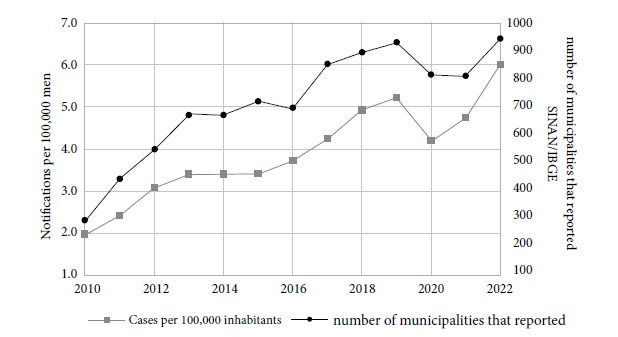
Figure 1 illustrates that the notification rate of sexual violence against boys and men per 100,000 men in health services increased consistently, reaching the highest recorded rate in the historical series (6.0) in 2022. A closer examination reveals that the notification rate had been increasing since 2010 but experienced a sharp decline in 2020. In 2021, the rate began to rise again, reaching a level slightly below that of 2018, and in 2022, it increased substantially. The number of municipalities reporting cases followed a similar upward trend, with an interruption in 2020 and a peak in 2022. Additionally, between 2013 and 2015, the notification rates remained stable; however, there was an increase in the number of reporting municipalities in 2015, suggesting greater coverage in reporting regions during that period. Conversely, between 2015-2016 and 2020-2021, the number of reporting municipalities decreased, but the total number of notifications increased, suggesting that the municipalities that reported cases did so at a higher rate or that there was a surge in cases during these specific years (Figure 1).

Notification Rates of Sexual Violence Against Boys and Men per 100,000 Men and Number of Municipalities That Reported Cases of Sexual Violence Against Boys and Men - 2010-2022 (SINAN).
Regarding the sociodemographic characteristics of the victims and the nature of the violence, the results highlight a significant increase in notifications between 2010 and 2022. However, the proportions of notifications remained similar. Among the country’s regions, the South showed the highest percentage variation (+534.8%), followed by the Northeast (+534.4%). In terms of age groups, there was an increase of 595.8% among adolescents and young adults (15-19 years old) and 1386% among adults aged 20 years and older. Regarding race, the highest variations were observed among mixed-race individuals (+651.8%) and Indigenous individuals (+850%). In terms of education level, there was a significant increase among those who had completed high school (+6400%). Concerning the perpetrator, the greatest variations were observed among family members (+617.0%) and unknown aggressors (+575.7%). As for the location of the occurrence, notable increases were observed in residences (+468.5%) and collective housing (+546.7%) (Table 2).
Additionally, regarding the results in Table 2, the proportions among categories remained similar between the beginning of the records (2010) and the most recent year with available data (2022). For example, the variable indicating whether the violence was a repeated occurrence represented 34.7% in 2010 and 34.8% in 2022. The occurrence location being the victim’s or perpetrator’s residence accounted for 57.3% in 2010 and 59.7% in 2022. The presence of alcohol use during the violent act was recorded in 13.1% of cases in both 2010 and 2022 (Table 2).
Analysis of the chi-square test results revealed that most variables were statistically significantly associated with the analyzed period, including region, age group, race, education level, and the victim’s relationship with the perpetrator (Table 2).
Discussion
This is the first Brazilian study to analyze notification data of sexual violence (SV) from Sinan and records of rape and statutory rape from the FBSP exclusively involving boys and men. Based on our results, it is observable that SV notification rates are increasing, while rape and statutory rape rates are decreasing; however, even with this decrease, they remain higher than the SV rates reported in Sinan. In the study conducted by Ipea, using data from the 2019 PNS and the FBSP, it was found that crimes recorded by the police represent 8.5% of all cases, whereas only 4.2%10 are notified in the health system. These data are consistent with the nature of SV situations, as not all victims seek immediate medical attention. For example, cases of sexual violence (SV) can include unwanted touching, forced kisses, exposure to pornography, or masturbation over clothing, which do not always result in seeking medical care. However, all these situations are classified as crimes and should be reported to police stations. A study that analyzed the barriers to seeking medical care in cases of violence identified that victims do not perceive medical care as necessary, thus hindering the search for health services13. This factor likely contributes to the observed discrepancy, with higher notification rates in public safety records compared to health system data.
Another aspect observed is that notification rates in Sinan have increased over time, but they are lower than the rates observed in studies with girls and women. A study that also used Sinan data, from 2011 to 2019, on violence notifications against children, found that notification rates per 100,000 children were higher for female children (76 in 2011 and 56 in 2019) compared to notifications for boys (22 in 2011 and 20 in 2019)14. These rates are considerably higher than those found by us. However, our study included people of all age groups, and the result of the cited study included only children and adolescents, the main ones affected by SV in Brazil. We also emphasize that, just as the estimated rates are higher among girls and women, prevalence studies also indicate that women are the main victims6.
A scoping review on sexual violence (SV) against Brazilian boys and men noted that prevalence studies concentrate efforts on estimating prevalences among girls and women, and there are studies that do not disaggregate the sex of child victims because it is assumed that all are female6. The researchers effort to study violence against girls and women produces a greater quantity of data compared to data on men. In any case, the present study presents significant rates of SV against boys and men and also indicates that these rates are increasing, perhaps due to greater awareness among workers who receive victims in health services, perhaps because boys and men are more secure in seeking health assistance. In this scenario, it is necessary that we be attentive and strongly engaged in promoting the prevention of SV for all populations.
The comparison with health and public safety data made it possible to observe trends in both sectors. In public safety, for some unknown reason, reporting rates have fallen in Brazil, in some states. In contrast, health data indicate an increase in some states, and in Brazil, the increase was only statistically significant when analyzed since 2010. Sinan data from 2017 to 2022 indicate an increase, but without statistical significance. On the other hand, in the data from 2010 to 2022, there is a statistically significant increase. Our hypothesis for this result is that the Covid-19 pandemic significantly compromised notifications between the years 2020 and 2021. Around the world and in Brazil, notifications of certain diseases and health conditions also fell during the pandemic15-17, that is, these results are consistent with what we found in our study.
In specific cases of sexual violence (SV), some studies indicate that the majority of sexual assaults occur within the victim’s own residence, perpetrated by close individuals, typically family members18,19. This may have substantially contributed to the underreporting of SV during the pandemic period and influenced the estimated rates in this study. At the time when social isolation measures were adopted, children and adolescents spent most, if not all, of their time with family members at home, which is the location with the highest risk for violence. During this period, individuals only sought health services for emergency situations, and children and adolescents did not attend school. A study investigating the registration time of violence and the severity of cases in records from a specialized service identified that health services and schools can offer a protective effect by reporting abuse more rapidly than family or friends20, and in the pandemic scenario, this possibility was precluded.
As observed, the COVID-19 pandemic affected the manner in which diseases and health conditions were reported in the health sector, but it was in 2019, a year before the pandemic, that public safety recorded the largest decrease in its records. Within the public safety sphere, offenses such as rape and statutory rape have consistently shown higher notification rates than those of the health sector throughout the historical series. However, for reasons that still require investigation, a near halving of the reporting rates for these crimes was observed in 2019. More detailed analyses of FBSP data on rape and statutory rape are necessary to better understand the reasons behind the fluctuations in records.
Regarding the country’s regions, we observed that the North concentrated the highest rates of rape and statutory rape among the analyzed data. The Northern Region presents a primary healthcare service coverage lower than what is recommended21, in addition to concentrating more prominent poverty indices than other regions of the country22. This context is often associated with an increase in violence23. It is possible that in regions where there is little state presence, through policies and services, there is a greater sense of impunity, and this may be why the rates in the North are higher, compared to other regions of the country. Additionally, in the National School Health Survey (PeNSE) of 2015, a study with a representative sample of Brazilian schoolchildren identified that the highest prevalences of SV were estimated in the Northern Region of the country24, result that aligns with the rates estimated in this study.
Concerning the demographic distribution of reported cases, the data revealed a predominance of male victims aged 0-14, with a notable concentration in the Southeast region and a higher proportion identifying as brown-skinned. Regarding the characteristics of violence, it is possible to affirm that the aggressors are people known to the victim (family and friends), that the violence occurs without the presence of alcohol and has an important repetitive character. In relation to the repetitive character, the study that analyzed the data from medical records of a specialized service between 2004 and 2013 identified that boys suffer more severe and lasting abuse. The authors explain that gender issues are involved in this theme and that boys fear being identified as homosexuals25, therefore taking longer to speak out. Additionally, it is common for victims to live with their aggressors, making notification even more difficult, and allowing aggressors to commit more severe and lasting violence, assured of impunity.
Our study brings to the agenda of violence a topic still little studied but with growing interest from researchers26, violence against boys and men. Boys have been included in some studies27,28, but men are neglected. The scope review that analyzed works with this cut in Brazil identified that men, in addition to boys, can also be victims6. A Brazilian study with men who have sex with other men, which analyzed victimizations in adulthood, identified that 4.3% of participants were victims of violence in adulthood29. In our study, the most accentuated percentage variation in relation to age group records was among adults, indicating a need for attention to the theme. The fact that men are mostly the main sexual aggressors creates an imaginary that they are only in the role of aggressors26. However, research indicates that adult men can also be victims and need equal attention.
This study has a series of potentialities, it gathers records from different databases and can help in the problematization of violence in Brazil, mainly with boys and men. However, it presents some limitations. The FBSP data could only be compared with the Sinan data between 2017 and 2022, which, from the point of view of time series, is a short analysis time. Additionally, notification or occurrence registration data do not correspond to the real magnitude of the problem, making it impossible to accurately estimate the prevalence and incidence of violence against boys and men in Brazil. Nevertheless, the study provides clues for new research and indicates that health and public security workers need to be aware of sexual violence against boys and men. Although the rates are lower than against girls and women, it is a serious problem that must be faced with good public policies of prevention and reception for victims.
Additionally, the analysis of victim characteristics of violence presents important information, but there are limitations that can impact the interpretation of data and comparison between different periods: the quality of the collected information and the lack of information in official records (Sinan and FBSP). Therefore, it is urgent to implement measures aimed at improving the completeness and quality of these records, in order to guarantee a more precise and comparative analysis of the data on violence against men. In this sense, we consider it pertinent that other researchers expand efforts to include a greater and more diversified range of information to capture a broader image of violence against boys and men in Brazil. We also endorse that it is necessary for the social movement and health and public security workers to mobilize in relation to the records of notification systems, since this problem is not new30.
References
- 1 Minayo MCS, Assis SG. Novas e velhas faces da violência no Século XXI: Visão da literatura brasileira do campo da saúde. Rio de Janeiro: Editora Fiocruz; 2017.
- 2 Chaui M. Ética e Violência no Brasil a Ethics and Violence in Brazil Ética y violencia en Brasil. Rev Centro Univers São Camilo 2011; 5(4):378-383.
- 3 Dahlberg LL, Krug EG. Violência: um problema global de saúde pública. Cien Saude Colet 2006; 11(Supl.):1163-1178.
- 4 Dworkin ER. Risk for Mental Disorders Associated with Sexual Assault: A Meta-Analysis. Trauma Violence Abuse 2018; 21(5):1011-1028.
- 5 Ferreira DG, Bortoli MC, Pexe-Machado P, Saggese GSR, Veras MA. Sexual violence against men in Brazil: underreporting, prevalence, and associated factors. Rev Saude Publica 2023; 57:23.
- 6 Ferreira DG, Bortoli MC, Pexe-Machado P, Saggese GSR, Veras MA. Sexual violence against men in Brazil: underreporting, prevalence, and associated factors. Rev Saude Publica. 2023; 57:23.
- 7 Hohendorff J Von, Habigzang LF, Koller SH. Violência sexual contra meninos: dados epidemiológicos, características e consequências. Psicol USP 2012; 23(2):395-416.
- 8 Winzer L. Frequency of self-reported sexual aggression and victimization in Brazil: a literature review. Cad Saude Publica 2016; 32(7):S0102.
- 9 Thomas JC, Kopel J. Male Victims of Sexual Assault: A Review of the Literature. Behav Sci 2023; 13(4):304.
-
10 Ferreira H, Santa D, Coelho C, Cerqueira D, Alves P, Semente M. Elucidando a Prevalência de Estupro no Brasil a Partir de Diferentes Bases de Dados [Internet]. Rio de Janeiro; 2023 [acessado 2024 abr 16]. Disponível em: http://dx.doi.org/10.38116/td2880-port
» http://dx.doi.org/10.38116/td2880-port - 11 Santos MJ, Mascarenhas MDM, Malta DC, Lima CM, Silva MMA. Prevalência de violência sexual e fatores associados entre estudantes do ensino fundamental - Brasil, 2015. Cien Saude Colet 2019; 24(2):535-544.
- 12 Minayo MCS, Pinto LW, Silva CMFP. A violência nossa de cada dia, segundo dados da Pesquisa Nacional de Saúde 2019. Cien Saude Colet 2022; 27(9):3701-3714.
- 13 Kamke K, Mullin TM, Goodman KL. Barriers to Seeking Medical Care Among Youth Victims of Sexual Violence. J Adolesc Health 2023; 73(6):1077-1082.
- 14 Sartori LRM, Oliveira KAS, Moura KF, Soares PO, Matos VVG, Karam SA. Notificações de violência física, violência sexual, violência psicológica e negligência praticadas contra crianças no Brasil, 2011-2019: estudo ecológico de série temporal. Epidemiol Serv Saude 2023; 32(3):e2023246.
- 15 Silveira JRS, Lima SVMA, Santos AD, Siqueira LS, Santos GRS, Sousa ÁFL, Oliveira LB, Mendes IAC, Ribeiro CJN. Impact of the COVID-19 Pandemic Surveillance of Visceral Leishmaniasis in Brazil: An Ecological Study. Infect Dis Rep 2024; 16(1):116.
- 16 Rocha CAO, Santana GBA, Cavalcantieal T, Paiva JPS, Silva LF, Santos LG, Nunes BEBR, Carmo RFD, Souza CDF. Impact of the COVID-19 pandemic on compulsory notification of meningitis during the first wave of the pandemic in Brazil: an ecological study using P-score. Sao Paulo M J 2022; 140(2):305-309.
- 17 Facciolà A, Laganà A, Genovese G, Romeo B, Sidoti S, D'Andrea G, Raco C, Visalli G, DI Pietro A. Impact of the COVID-19 pandemic on the infectious disease epidemiology. J Prev Med Hyg 2023; 64(3):E274-E282.
- 18 Miranda MHH, Fernandes FECV, Melo RA, Meireles RC. Violência sexual contra crianças e adolescentes: uma análise da prevalência e fatores associados. Rev Esc Enferm USP 2020; 54:e03633.
- 19 Gaspar RS, Pereira MUL. Trends in reporting of sexual violence in Brazil from 2009 to 2013. Cad Saude Publica 2018; 34(11):e00172617.
- 20 Vertamatti MAF, Strufaldi R, Evans DP, Drezett J, Barbosa CP, Abreu LC de. Factors associated with reporting delays and severity of childhood sexual abuse in São Paulo, Brazil. Psychol Health Med 2019; 24(6):739-748.
- 21 Soares Filho AM, Vasconcelos CH, Dias AC, Souza ACC, Merchan-Hamann E, Silva MRF. Atenção Primária à Saúde no Norte e Nordeste do Brasil: mapeando disparidades na distribuição de equipes. Cien Saude Colet 2022; 27(1):377-386.
- 22 Silva AF, Sousa JS, Araujo JA. Evidências sobre a pobreza multidimensional na região Norte do Brasil. Rev Admin Publica 2017; 51(2):219-239.
- 23 Ribeiro E, Cano I. Vitimização letal e desigualdade no Brasil: Evidências em nível municipal. Civitas 2016; 16(2):285-305.
- 24 Terribele FBP, Munhoz TN. Violência contra escolares no Brasil: Pesquisa Nacional da Saúde do Escolar (PeNSE, 2015). Cien Saude Colet 2021; 26(1):241-254.
- 25 Vertamatti MAF, Strufaldi R, Evans DP, Drezett J, Barbosa CP, Abreu LC de. Factors associated with reporting delays and severity of childhood sexual abuse in São Paulo, Brazil. Psychol Health Med 2019; 24(6):739-748.
- 26 Thomas JC, Kopel J. Male Victims of Sexual Assault: A Review of the Literature. Behav Sci (Basel) 2023; 13(4):304.
- 27 Costa FBS, Miranda CES, Rodrigues MTP, Mascarenhas MDM. Violência Sexual entre Adolescentes Escolares Brasileiros. Rev Adolesc Saude 2018; 72-80.
- 28 Winzer L. Frequency of self-reported sexual aggression and victimization in Brazil: a literature review. Cad Saude Publica 2016; 32(7):S0102.
- 29 Ferreira DG, Veras MA, Saggese GSR, Guimarães MDC, Magno L, Dourado I, Macena RHM, Leal AF, Kendall C, Mércham-Hamann E, Bermúdez XPD, Knauth D, Kerr LRS. Prevalence, Characteristics, and Factors Associated With Sexual Violence in Adulthood Among Brazilian MSM. Am J Mens Health 2022; 16(6):15579883221142173.
- 30 Sousa CMS, Mascarenhas MDM, Lima PVC, Rodrigues MTP. Incompletude do preenchimento das notificações compulsórias de violência - Brasil, 2011-2014. Cad Saude Colet 2020; 28(4):477-487.
The data sources adopted in the research are indicated in the article’s body.

 Source: Authors.