
 Sex differences in the association between multimorbidity and intrinsic capacity: results from ELSI-Brazil
Abstract
Multimorbidity is an important public health problem due to its adverse health outcomes, such as decreased intrinsic capacity. The objective of this article is to analyze the association between multimorbidity and intrinsic capacity in men and women, aged 50 and over. This work was a cross-sectional study using data from the Brazilian Longitudinal Study of Aging (Estudo Longitudinal da Saúde dos Idosos Brasileiros - ELSI-Brazil) cohort (2015/16). Intrinsic capacity score consisted of five domains: cognitive; psychological; sensory; locomotor; and vitality. The variable multimorbidity (≥2 chronic diseases) was determined by self-reporting the number of chronic diseases diagnosed among 15 diseases. Linear regressions were adjusted (p<0.05), using the Stata SE 17.0 program; 7,260 participants were included in the study, 3,228 (46.8%) men and 4,032 (53.2%) women. The presence of multimorbidity was negatively associated with the intrinsic capacity score for both men (β=-2.35; 95%CI=-3.70; -1.00) and women (β=-1.74; 95% CI=-3.09; -0.38). Multimorbidity was associated with a worse intrinsic capacity for both sexes, even after adjusting for several relevant characteristics, both individual and contextual.
Key words:
Healthy Aging; Multimorbidity; Chronic disease; Elderly Health
Resumo
A multimorbidade configura-se como um importante problema de saúde pública devido aos seus desfechos adversos à saúde, como a diminuição da capacidade intrínseca. O objetivo deste artigo é analisar a associação entre multimorbidade e capacidade intrínseca em homens e mulheres, com 50 anos ou mais. Este trabalho foi um estudo transversal utilizando dados da coorte Estudo Longitudinal da Saúde dos Idosos Brasileiros - ELSI-Brazil (2015/16). O escore de capacidade intrínseca foi composto por cinco domínios: cognitivo; psicológico; sensorial; locomotor; e vitalidade. A variável multimorbidade (≥2 doenças crônicas) foi determinada pelo autorrelato do número de doenças crônicas diagnosticadas entre 15 doenças. Foram realizadas regressões lineares ajustadas (p<0.05), com auxílio do programa Stata SE 17.0; 7.260 participantes foram incluídos no estudo, 3.228 (46,8%) homens e 4.032 (53,2%) mulheres. A presença de multimorbidade associou-se negativamente ao escore de capacidade intrínseca tanto para homens (β=-2,35; IC95%=-3,70; -1,00) quanto para mulheres (β=-1,74; IC95%=-3,09; -0,38). A multimorbidade associou-se a uma pior capacidade intrínseca para ambos os sexos, mesmo após ajuste para diversas características relevantes, tanto individuais quanto contextuais.
Palavras-chave:
Envelhecimento Saudável; Multimorbidade; Doença Crônica; Saúde do Idoso
Resumen
La multimorbilidad es un importante problema de salud pública debido a sus consecuencias adversas para la salud, como la disminución de la capacidad intrínseca. El objetivo de este artículo es analizar la asociación entre la multimorbilidad y la capacidad intrínseca en hombres y mujeres de 50 años o más. Este trabajo fue un estudio transversal con datos de la cohorte Estudio longitudinal sobre la salud de los ancianos brasileños (Estudo Longitudinal da Saúde dos Idosos Brasileiros - ELSI-Brazil) (2015/16). La puntuación de capacidad intrínseca consistió en cinco dominios: cognitivo; psicológico; sensorial; locomotor; y vitalidad. La variable multimorbilidad (≥2 enfermedades crónicas) se determinó mediante el autoinforme del número de enfermedades crónicas diagnosticadas entre 15 enfermedades. Se realizaron regresiones lineales ajustadas (p<0.05), con la ayuda del programa Stata SE 17.0. Se incluyeron 7.260 participantes en el estudio: 3.228 (46,8%) hombres y 4.032 (53,2%) mujeres. La presencia de multimorbilidad se asoció negativamente con la puntuación de capacidad intrínseca tanto en hombres (β=-2,35; IC95%=-3,70; -1,00) como en mujeres (β=-1,74; IC95%=-3,09; -0,38). La multimorbilidad se asoció con una peor capacidad intrínseca en ambos sexos, incluso tras ajustar por diversas características relevantes, tanto individuales como contextuales.
Palabras clave:
Envejecimiento saludable; Multimorbilidad; Enfermedad crónica; Salud del adulto mayor
Introduction
Population aging is a global and growing phenomenon. In 2022, approximately 10% of the global population was aged 65 or older, a proportion projected to reach 16% by 2050. In Latin America and the Caribbean, including Brazil, the corresponding share is expected to increase from 9% in 2022 to 19% by 20501. It is increasingly necessary to adopt strategies that enable individuals to enjoy additional years of life free from disabilities. In 2015, the World Health Organization (WHO) released the World Report on Aging and Health, proposing a new conceptual model - Healthy Aging - based on the development and maintenance of functional ability and the optimization of intrinsic capacity. In this model, intrinsic capacity is defined as a component that involves the individual’s physical and mental capacity, comprising the locomotor, sensory, cognitive, psychological, and vitality domains. Additionally, intrinsic capacity is determined by genetic and individual characteristics, both of which are largely influenced by environmental and health characteristics2.
Evidence from studies conducted in high-income countries such as Australian, China, England, Japan, Spain and the United States of America (USA), indicates that several individual chronic diseases are negatively associated with healthy aging and intrinsic capacity. Considering older adults (50 years or older), the literature shows a negative association among respiratory, joint, and cardiovascular diseases, diabetes3,4; osteoporosis; cancer3; depression4,5; and healthy aging. Likewise, arterial hypertension6,7, chronic obstructive pulmonary disease, osteoarthritis8, depression, dementia, stroke9, chronic kidney disease, and diabetes7 were negatively associated with intrinsic capacity in people aged 60 or over. In Brazil, one study conducted with participants aged 50 or over from the Brazilian Longitudinal Study of Aging (Estudo Longitudinal da Saúde dos Idosos Brasileiros - ELSI-Brazil) found, a higher prevalence of cardiovascular and pulmonary diseases, diabetes, and osteoarthritis among participants with worse levels of intrinsic capacity10.
Although chronic diseases, are individually associated with less healthy aging, it is well-known that concomitant chronic diseases can be even more harmful. Multimorbidity, commonly defined by the occurrence of two or more chronic diseases11, is a common condition that, worldwide, affects women, aged 18 or over, more than men (39.4% vs. 32.8%, respectively)12. This scenario can also be observed in Brazil, where the prevalence of multimorbidity among women, aged 50 or over, reaches 75.5%, as compared to a prevalence of 58.9% among men13, a situation that can further compromise the healthy aging of the female population10.
In addition to the deleterious effects of each chronic disease, multimorbidity affects the concentration of different inflammatory markers, such as increased interleukin 6 (IL-6) and C-reactive protein (CRP) and decreased dehydroepiandrosterone (DHEAS)14, generating a progressive deterioration of the individual’s physiological, homeostatic, endocrine, and metabolic mechanisms15. Multimorbidity has been associated with a worse quality of life16, functional decline17, frailty18, mortality19, and a decrease in healthy aging20,21 and intrinsic capacity22-24.
Despite the evidence presented above, population-based studies on the association between multimorbidity and intrinsic capacity are still scarce, especially in the Brazilian scenario. One survey carried out with data from the English Longitudinal Study of Aging (ELSA), among individuals aged 60 or over, showed a negative association between multimorbidity and intrinsic capacity and its cognitive, locomotor, psychological, and vitality domains23. Another study, including individuals aged 60 years or older, participating in the China Health and Retirement Longitudinal Study (CHARLS), also showed a negative association between multimorbidity and intrinsic capacity and its psychological and sensory domains22. In another study, carried out with data from the Longitudinal Aging Study Amsterdam (LASA), among individuals, aged 55 to 85 years, participants with multimorbidity showed lower intrinsic capacity scores24. The present study therefore aims to analyze the association between multimorbidity and intrinsic capacity in Brazilian men and women, aged 50 or over.
Method
Study design and sample
This cross-sectional study used baseline data (2015-2016) from ELSI-Brazil, which is a nationally representative longitudinal study of the population aged 50 and over. The sampling process was based on selection stages, considering municipalities, census sectors, and households. In total, 70 municipalities located in the five Brazilian macro-regions were included. All individuals, aged 50 or over, living in the selected households were eligible to participate in the study, making a total sample of 9,412 participants. Data collection includes a home-based interview to assess household and sociodemographic characteristics; an individual interview addressing physical and mental health conditions; and a series of physical performance tests, including measurements of weight, height, waist and hip circumferences, resting blood pressure, pulse, handgrip strength, walking and balance, repeated at each follow-up wave. Additionally, blood samples are collected for laboratory analysis in a subsample of participants. Detailed information can be found in previous publications and on the study homepage25,26.
Intrinsic capacity
Intrinsic capacity was the dependent variable of the study, defined based on the Healthy Aging model, proposed by the WHO. An intrinsic capacity score was used, obtained through a bifactor model based on its five domains and which had been previously validated for Brazil10:
Cognitive domain: included four variables related to temporal orientation (year, month, day, and day of the week); delayed memory (recall of 10 words after a five-minute pause); semantic memory (assessed through four questions on general knowledge); and semantic verbal fluency (number of animals recalled in one minute).
Psychological domain: comprised of a variable related to depressive symptoms (8-item scale from the Center for Epidemiological Studies-Depression - CES-D and another on sleep quality (self-assessment of sleep quality and frequency of use of medications to sleep).
Sensory domain: consisting of three variables related to the self-assessment of hearing deficit, visual acuity at long distances, and visual acuity at short distances.
Locomotor domain: structured through two variables, gait speed (time to walk three meters at a usual pace, with or without auxiliary devices) and balance (through the Short Physical Performance Battery - SPPB).
Vitality domain: consisting of four variables related to handgrip strength (assessed by a Saehan portable dynamometer in the dominant hand); weight loss (self-report of unintentional weight loss ≥3 kg in the last three months); exhaustion (frequency of not being able to move things forward in the last week); and low resistance (frequency of great effort needed to carry out daily activities in the last week).
Multimorbidity
The multimorbidity variable was determined through the number of chronic diseases previously diagnosed by a doctor and self-reported by the participant. In total, 15 diseases were included to determine multimorbidity: arterial hypertension; diabetes; dyslipidemia; “heart disease” (indicated by the previous occurrence of a heart attack, angina, and/or heart failure); stroke; asthma; chronic lung disease; arthritis or rheumatism; osteoporosis; back pain; depression; cancer; chronic renal failure; Parkinson’s disease; and Alzheimer’s. Multimorbidity was operationalized as follows: no chronic disease; one chronic disease; and multimorbidity (≥2 chronic diseases)13.
Covariates
The covariates in this study were divided into sociodemographic, health, and social environmental characteristics, based on the theoretical model of healthy aging:
Sociodemographic characteristics: age group (50-59 years, 60-69 years, ≥70 years); marital status (with and without a partner); and education (0-4 years, 5-8 years or ≥9 years).
Health characteristics: smoking (non-smoker, ex-smoker, current smoker); alcohol consumption, in any quantity (no, yes); insufficient physical activity, measured by the short version of the International Physical Activity Questionnaire, considering the time (up to 150 minutes per week) spent walking, moderate activities, and vigorous activities (no, yes).
Characteristics of the physical and social environment: area of residence (urban, rural); frequency of social contact (less than 1x/week, at least 1x/week), defined by the frequency of social contact with children, relatives or friends who did not live with the participant, through face-to-face meetings; and loneliness, categorized as “no” (never) and “yes” (sometimes and always), assessed through the following question: “How often do you feel lonely?”.
Statistical analysis
For the present analysis, the original Z score of intrinsic capacity (ranging from -3.07 to 3.87)10 was modified to a scale of 0 to 100 in order to facilitate the interpretation of values, with higher scores indicating better intrinsic capacity, using the following formula:
For i = 1,…,n, where ICi is the original Z score of the intrinsic capacity, min(IC i ) ⁓ -3,07 is the lowest value of IC i , max(IC i ) ⁓ 3,87 is the highest value of IC i and n is the sample size.
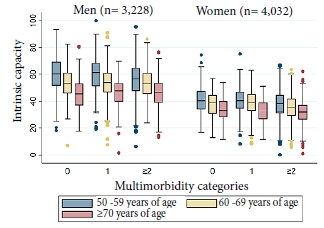
A descriptive analysis of sociodemographic, health, and social environment characteristics was carried out, using the proportion and means according to the total intrinsic capacity score stratified by sex (men and women). Pearson’s chi-squared tests were applied to assess differences between proportions, and Wald tests were used to verify differences between means. In addition, boxplots of the intrinsic capacity score were produced by multimorbidity categories, according to sex and age group.
Linear regression stratified by sex was used to estimate the slope coefficient β and corresponding 95% confidence intervals (95%CI) of the association between multimorbidity and the intrinsic capacity score, ensuring that the assumption of normality were met10. The regression analysis included four models: Model 1, unadjusted; Model 2, adjusted for sociodemographic variables; Model 3, adjusted for sociodemographic and health variables; Model 4, adjusted for sociodemographic, health, and physical and social environment variables. An overall interaction test between sex and multimorbidity was performed in Model 4 to assess whether the associations between intrinsic ability and multimorbidity were statistically equal for both sexes. The assumptions of normality and homoscedasticity for the final multiple linear regression model (Model 4), stratified by sex, were evaluated visually using residual plots. These plots, which illustrate the distribution of residuals and the consistency of variance, are displayed in Figures 1 and 2, respectively.

Kernel density estimates of residuals of the Model 4* in (A) men and (B) women, compared to normal density: ELSI-Brazil (2015-16).

Scatter plot of residuals versus fitted values of the Model 4* in (A) men and (B) women: ELSI-Brazil (2015-16).
All analyses were performed in the Stata SE 17.0 program, using procedures for complex samples, which include the sampling weight of individuals and the effect of the sampling design.
Results
All participants with complete information regarding intrinsic capacity were included in the study, resulting in a total of 7,260 individuals. Of these, 3,228 (46.8%) were men and 4,032 (53.2%) women. The sample studied showed a higher frequency of younger individuals (50-59 years of age), with a low level of education (0-4 years of study), and multimorbidity (≥2 chronic diseases) for men (51.8%; 47.2 % and 51.1%, respectively) and women (50.3%; 49.4% and 70.4%, respectively) (Table 1).
The overall mean and standard deviation (SD) of the intrinsic capacity score was higher among men (55.0±12.31) than among women (36.9±10.19) (p<0.001). When taking individual and contextual characteristics into account, the mean intrinsic capacity scores were consistently higher for men across all categories of each of the analyzed covariates. In Table 2, separately for each sex, significant differences can be seen between the mean intrinsic capacity scores (p<0.05) for sociodemographic, health, and physical and social environment characteristics. Only among women no significant differences were found for smoking and area of residence. Men and women with multimorbidity had a lower mean intrinsic capacity than those without multimorbidity (53.4±12.4 and 35.9±10.0, respectively). Lower intrinsic capacity means were also observed for individuals who smoked and who did not practice sufficient physical activity, both for men (54.2±12.4 and 52.8±13.2, respectively) and women (36.0±10.4 and 34.6±10.2, respectively).
Figure 3 shows the boxplots of the intrinsic capacity score by multimorbidity categories, according to sex and age group. Men exhibited numerically higher median intrinsic capacity scores than women, in all age groups, and that intrinsic capacity was lower for both sexes in the presence of multimorbidity (≥2 chronic diseases). Furthermore, in both men and women, the lowest median intrinsic capacity scores were observed in the most advanced older age groups.

Medians of intrinsic capacity scores by multimorbidity categories, according to sex and age group: ELSI-Brazil (2015-16).
The unadjusted and adjusted associations between multimorbidity and the intrinsic capacity score for men and women are presented in Table 3. All models showed a negative association (p<0.05) between multimorbidity (≥2 chronic diseases) and the total score of intrinsic capacity, for both men and women. This association became weaker as adjustments were made for sociodemographic characteristics (for men) and for sociodemographic characteristics and the physical and social environment (for women), and it was always stronger for men than for women. However, even with this numerical difference, the final values of the estimates were statistically equal between men and women (p-value of the global test for interaction: p=0.34). According to the final model (Model 4), men with multimorbidity (≥2 chronic diseases) had a mean intrinsic capacity score that was lower by 2.35 units (95%CI -3.70; -1.00) when compared to men without multimorbidity and no chronic diseases. Similarly, women with multimorbidity (≥2 chronic diseases) had a mean intrinsic capacity score that was lower by 1.74 units (95%CI -3.09; -0.38) when compared to women without multimorbidity and no chronic diseases. On the other hand, no significant difference was found for the group without multimorbidity and one chronic disease relative to the group without multimorbidity and no chronic disease, in any of the models, for both sexes.
Discussion
The findings of the present study reveal a negative association between multimorbidity and intrinsic capacity among Brazilian women and men, aged 50 or over, living in the community. The strength of this association was similar between men and women, although women with multimorbidity had a lower mean intrinsic capacity score than men (36.0 and 53.4, respectively). However, the absence of multimorbidity with the presence of one chronic disease had no significant association with intrinsic capacity.
Results from population-based studies with older adults, aged 55 and over, corroborate our findings regarding the association between multimorbidity and intrinsic capacity22-24. By contrast, although previous studies have shown an association between individual chronic diseases and intrinsic capacity6-9, such as arterial hypertension6,7 and diabetes7, the findings of the present study showed no association between having a single chronic illness, regardless of what it is, and intrinsic capacity. These results extrapolate previous evidence by showing that the combination of chronic diseases results in a negative effect on intrinsic capacity and shed light on new investigative possibilities that some patterns of multimorbidity may well affect intrinsic capacity more than do others.
One possible explanation for the negative association between multimorbidity and intrinsic capacity is the increase or decrease in inflammatory markers observed when two or more chronic diseases occur concomitantly. Previous studies have demonstrated that high levels of IL-6 and CRP are associated with worse intrinsic capacity27,28. Furthermore, chronically elevated CRP decreases intrinsic capacity scores within 5 years27 and decreased DHEAS can lead to the deterioration of intrinsic capacity within 10 years29. In a randomized clinical trial, increased DHEAS was positively associated with intrinsic capacity30. Systematic reviews have also highlighted the association between an increase in inflammatory markers and some isolated indicators that integrate the different domains of intrinsic capacity, such as cognitive decline31, depression32, and decreased handgrip strength33. It is known that chronic inflammation leads to tissue degeneration through catabolism, resulting in impaired physical and mental functions34, which will eventually contribute to a decrease in the individual’s intrinsic capacity.
Although previous evidence shows that sex can modify the association between intrinsic capacity and functional ability, with a greater impact on women10, and that women have a higher prevalence of chronic diseases, the present study found no difference in the strength of the association between multimorbidity and intrinsic capacity between the sexes. When evaluating the adjusted models, it was noted that the inclusion of sociodemographic characteristics reduced the strength of association equally between the sexes. However, in Model 4, which included characteristics of the physical and social environment, the strength of the association was more heavily attenuated among women when compared to men, although they were still similar. Previous Brazilian data showed that the prevalence of loneliness, a characteristic of the social environment, reduced the chance of healthy aging only among women35. These findings reinforce the need for investment in public policies aimed not only at improving intrinsic capacity, but also at improving the physical and social environment in which people live. A systematic review showed that social support, in the sense of establishing and maintaining social relationships, and social participation are essential in order to promote healthy aging36. In this sense, promoting elderly-friendly cities, which emphasize the importance of supportive, accessible, walkable, and safe communities, is necessary to enable the autonomy and dignity of elderly people and promote greater participation of women in the community2.
Furthermore, the negative association found between multimorbidity and intrinsic capacity denotes that the presence of two or more chronic diseases may be capable of discriminating individuals according to their health status24. In light of this argument, one recommended strategy consists of implementing public policies focused on Primary Health Care (PHC), which can play a key role in the care network to reduce multimorbidity, through the prevention and control of chronic Non-Communicable Diseases (NCDs). Since more than 70% of all Brazilians, aged 50 and over, are exclusive users of SUS, strengthening the Family Health Strategy (FHS), can strongly contribute to the prevention of multimorbidity. Bad experiences with PHC related to access, communication, continuity, coordination, and resoluteness of care can harm the management of different health outcomes, such as care for chronic NCDs and multimorbidity37.
This study has some limitations. First, the multimorbidity variable was based on participants’ self-reported medical diagnoses, which may lead to underestimation of prevalence, as diagnosis depends on access to health services. However, self-report is widely recognized as an adequate and commonly used source of information in population-based studies on multimorbidity38. Furthermore, the multimorbidity measure captures only the accumulation of chronic conditions and does not account for variations in disease combinations. Future research should therefore investigate which multimorbidity patterns most affect intrinsic capacity. Second, although the measure of intrinsic capacity was validated, it does not incorporate certain biological biomarkers and allows for variability in how domains are operationalized across studies22-24, which hinders comparability between studies. Finally, the cross-sectional design raises the possibility of reverse causality in the observed association between multimorbidity and intrinsic capacity.
Despite these limitations, this study has notable strengths. It employs an innovative and validated metric to assess positive aspects of healthy aging, providing the first examination of the association between multimorbidity and intrinsic capacity in the Brazilian context of rapid population aging. Moreover, the analysis draws on a nationally representative sample of the population, encompassing all five major Brazilian regions.
Conclusion
In conclusion, the results of this study showed a negative association between multimorbidity and intrinsic capacity, which proved to be similar in older men and women. Therefore, considering the strategies for the decade of healthy aging (2021-2030), these findings can support public health strategies focused on an integrated care model, encompassing multidimensional interventions to maintain intrinsic capacity and adequate management of multimorbidity, which has considerable potential for improving and maintaining functional ability and chronic disease management.
References
- 1 World Health Organization (WHO). World Population Prospects 2022: Summary of Results. Geneva: WHO; 2022.
- 2 World Health Organization (WHO). World report on ageing and health. Geneva: WHO; 2015.
- 3 Caballero FF, Soulis G, Engchuan W, Sánchez-Niubó A, Arndt H, Ayuso-Mateos JL, Haro JM, Chatterji S, Panagiotakos DB. Advanced analytical methodologies for measuring healthy ageing and its determinants, using factor analysis and machine learning techniques: The ATHLOS project. Sci Rep 2017; 7:43955
- 4 Sanchez-Niubo A, Forero CG, Wu YT, Giné-Vázquez I, Prina M, La Fuente J, Daskalopoulou C, Critselis E, La Torre-Luque A, Panagiotakos D, Arndt H, Ayuso-Mateos JL, Bayes-Marin I, Bickenbach J, Bobak M, Caballero FF, Chatterji S, Egea-Cortés L, García-Esquinas E, Leonardi M, Koskinen S, Koupil I, Mellor-Marsá B, Olaya B, Pajak A, Prince M, Raggi A, Rodríguez-Artalejo F, Sanderson W, Scherbov S, Tamosiunas A, Tobias-Adamczyk B, Tyrovolas S, Haro JM; ATHLOS Consortium. Development of a common scale for measuring healthy ageing across the world: Results from the ATHLOS consortium. Int J Epidemiol 2021; 50(3):880-892.
- 5 Marin IB, Fernández D, Ayuso-Mateos JL, Leonardi M, Tobiasz-Adamczyk B, Koskinen S, Sanchez-Niubo A, Cristóbal-Narváez P. Healthy aging and late-life depression in Europe: Does migration matter? Front Med (Lausanne) 2022; 9:866524
- 6 Leung AYM, Su JJ, Lee ESH, Fung JTS, Molassiotis A. Intrinsic capacity of older people in the community using WHO Integrated Care for Older People (ICOPE) framework: a cross-sectional study. BMC Geriatr 2022; 22(1):304.
- 7 Tang WH, Yu TH, Lee HL, Lee YJ. Interactive effects of intrinsic capacity and obesity on the KDIGO chronic kidney disease risk classification in older patients with type 2 diabetes mellitus. Diabetol Metab Syndr 2023; 15(1):1.
- 8 Ma L, Chhetri JK, Zhang L, Sun F, Li Y, Tang Z. Cross-sectional study examining the status of intrinsic capacity decline in community-dwelling older adults in China: Prevalence, associated factors and implications for clinical care. BMJ Open 2021; 11(1):e043062.
- 9 Prince MJ, Acosta D, Guerra M, Huang Y, Jacob KS, Jimenez-Velazquez IZ, Jotheeswaran AT, Llibre Rodriguez JJ, Salas A, Sosa AL, Acosta I, Mayston R, Liu Z, Llibre-Guerra JJ, Prina AM, Valhuerdi A. Intrinsic capacity and its associations with incident dependence and mortality in 10/66 Dementia Research Group studies in Latin America, India, and China: A population-based cohort study. PLoS Med 2021; 18(9):e1003097.
- 10 Aliberti MJR, Bertola L, Szlejf C, Oliveira E, Piovezan RD, Cesari M, Andrade FB, Lima-Costa MF, Perracini MR, Ferri CP, Suemoto CK. Validating intrinsic capacity to measure healthy aging in an upper middle-income country: Findings from the ELSI-Brazil. Lancet Reg Health Am 2022; 12:100284.
- 11 Nunes BP, Batista SRR, Andrade FB, Souza Junior PRB, Lima-Costa MF, Facchini LA. Multimorbidity: The Brazilian Longitudinal Study of Aging (ELSI-Brazil). Rev Saude Publica 2018; 52(Supl. 2):10s.
- 12 Chowdhury SR, Chandra Das D, Sunna TC, Beyene J, Hossain A. Global and regional prevalence of multimorbidity in the adult population in community settings: a systematic review and meta-analysis. EClinicalMedicine 2023; 57:101860.
- 13 Nunes BP, Batista SRR, Andrade FB, Souza Junior PRB, Lima-Costa MF, Facchini LA. Multimorbidity: The Brazilian Longitudinal Study of Aging (ELSI-Brazil). Rev Saude Publica 2018; 52(Supl. 2):10s.
- 14 Ferreira GD, Simões JA, Senaratna C, Pati S, Timm PF, Batista SR, Nunes BP. Physiological markers and multimorbidity: A systematic review. J Comorb 2018; 8(1):2235042X1880698.
- 15 López-Otín C, Blasco MA, Partridge L, Serrano M, Kroemer G. The hallmarks of aging. Cell Elsevier BV 2013; 153:1194.
- 16 Makovski TT, Schmitz S, Zeegers MP, Stranges S, Akker M. Multimorbidity and quality of life: Systematic literature review and meta-analysis. Ageing Res Rev 2019; 53:100903.
- 17 Ryan A, Wallace E, O'Hara P, Smith SM. Multimorbidity and functional decline in community-dwelling adults: A systematic review. Health Qual Life Outcomes 2015; 13(1):168.
- 18 Vetrano DL, Palmer K, Marengoni A, Marzetti E, Lattanzio F, Roller-Wirnsberger R, Lopez Samaniego L, Rodríguez-Mañas L, Bernabei R, Onder G; Joint Action ADVANTAGE WP4 Group. Frailty and multimorbidity: A systematic review and meta-analysis. J Gerontol A Biol Sci Med Sci 2019; 74(5):659-666.
- 19 Nunes BP, Flores TR, Mielke GI, Thumé E, Facchini LA. Multimorbidity and mortality in older adults: A systematic review and meta-analysis. Arch Gerontol Geriatr 2016; 67:130-138.
- 20 Nguyen H, Moreno-Agostino D, Chua KC, Vitoratou S, Matthew Prin A. Trajectories of healthy ageing among older adults with multimorbidity: A growth mixture model using harmonised data from eight ATHLOS cohorts. PLoS One 2021; 16(4):e0248844.
- 21 Nguyen H, Wu YT, Dregan A, Vitoratou S, Chua KC, Prina AM. Multimorbidity patterns, all-cause mortality and healthy aging in older English adults: Results from the English Longitudinal Study of Aging. Geriatr Gerontol Int 2020; 20(12):1126-1132.
- 22 Beard JR, Si Y, Liu Z, Chenoweth L, Hanewald K. Intrinsic Capacity: Validation of a New WHO Concept for Healthy Aging in a Longitudinal Chinese Study. J Gerontol A Biol Sci Med Sci 2022; 77(1):94-100.
- 23 Beard JR, Jotheeswaran AT, Cesari M, Carvalho IA. The structure and predictive value of intrinsic capacity in a longitudinal study of ageing. BMJ Open 2019; 9(11):e026119.
- 24 Koivunen K, Hoogendijk EO, Schaap LA, Huisman M, Heymans MW, Schoor NM. Development and validation of an intrinsic capacity composite score in the Longitudinal Aging Study Amsterdam: a formative approach. Aging Clin Exp Res 2023; 35(4):815-825.
- 25 Lima-Costa MF, Andrade FB, Souza PRB, Neri AL, Duarte YADO, Castro-Costa E, Oliveira C. The Brazilian Longitudinal Study of Aging (ELSI-Brazil): Objectives and Design. Am J Epidemiol 2018; 187(7):1345-1353.
- 26 Lima-Costa MF, Mambrini JVM, Andrade FB, Souza PRB, Vasconcellos MTL, Neri AL, Castro-Costa E, Macinko J, Oliveira C. Cohort Profile: The Brazilian Longitudinal Study of Ageing (ELSI-Brazil). Int J Epidemiol 2022; 52(1):e57-e65.
- 27 Giudici KV, Barreto PS, Guerville F, Beard J, Carvalho IA, Andrieu S, Rolland Y, Vellas B; MAPT/DSA group. Associations of C-reactive protein and homocysteine concentrations with the impairment of intrinsic capacity domains over a 5-year follow-up among community-dwelling older adults at risk of cognitive decline (MAPT Study). Exp Gerontol 2019; 127:110716.
- 28 Lu WH, Gonzalez-Bautista E, Guyonnet S, Lucas A, Parini A, Walston JD, Vellas B, Barreto PS; MAPT/DSA Group. Plasma inflammation-related biomarkers are associated with intrinsic capacity in community-dwelling older adults. J Cachexia Sarcopenia Muscle 2023; 14(2):930-939.
- 29 Lee WJ, Peng LN, Lin MH, Loh CH, Hsiao FY, Chen LK. Intrinsic capacity differs from functional ability in predicting 10-year mortality and biological features in healthy aging: results from the I-Lan longitudinal aging study. Aging 2023;15(3):748-764.
- 30 Lee WJ, Peng LN, Lin MH, Kim S, Hsiao FY, Chen LK. Enhancing Intrinsic Capacity and Related Biomarkers in Community-Dwelling Multimorbid Older Adults Through Integrated Multidomain Interventions: Ancillary Findings From the Taiwan Integrated Geriatric (TIGER) Trial. J Am Med Dir Assoc 2023; 25(5):757-763.
- 31 Leonardo S, Fregni F. Association of inflammation and cognition in the elderly: A systematic review and meta-analysis. Front Aging Neurosci 2023;15:1069439.
- 32 Osimo EF, Pillinger T, Rodriguez IM, Khandaker GM, Pariante CM, Howes OD. Inflammatory markers in depression: A meta-analysis of mean differences and variability in 5,166 patients and 5,083 controls. Brain Behav Immun 2020; 87:901-909.
- 33 Tuttle CSL, Thang LAN, Maier AB. Markers of inflammation and their association with muscle strength and mass: A systematic review and meta-analysis. Ageing Res Rev 2020; 64:101185.
- 34 Ferrucci L, Fabbri E. Inflammageing: chronic inflammation in ageing, cardiovascular disease, and frailty. Nat Rev Cardiol 2018; 15(9):505-522.
- 35 Torres JL, Vaz CT, Pinheiro LC, Braga LS, Moreira BS, Oliveira C, Lima-Costa MF. The relationship between loneliness and healthy aging indicators in Brazil (ELSI-Brazil) and England (ELSA): sex differences. Public Health 2023; 216:33-38.
- 36 Abud T, Kounidas G, Martin KR, Werth M, Cooper K, Myint PK. Determinants of healthy ageing: a systematic review of contemporary literature. Aging Clin Exp Res 2022; 34(6):1215-1223.
- 37 Silva AMM, Mambrini JVM, Andrade JM, Andrade FB, Lima-Costa MF. Fragilidade entre idosos e percepção de problemas em indicadores de atributos da atenção primária à saúde: resultados do ELSI-Brasil. Cad Saude Publica 2021; 37(9):e00255420.
- 38 Nunes BP, Chiavegatto Filho ADP, Pati S, Cruz Teixeira DS, Flores TR, Camargo-Figuera FA, Munhoz TN, Thumé E, Facchini LA, Batista SRR. Contextual and individual inequalities of multimorbidity in Brazilian adults: a cross-sectional national-based study. BMJ Open 2017; 7(6):e015885.

 *Model 4: adjusted for sociodemographic, health, and physical and social environment characteristics. Source: Authors.
 *Model 4: adjusted for sociodemographic, health, and physical and social environment characteristics. Source: Authors.
 Source: Authors.