
 What changed after two years of COVID-19: the PAMPA Cohort update profile and methodology
Abstract
The PAMPA Cohort aimed to evaluate the long-term impact of the COVID-19 pandemic on the physical and mental health outcomes of adults. We present data from the fourth wave of the PAMPA Cohort, the updated cohort profile and methodology. The PAMPA Cohort is a prospective study initially designed to have three data collection waves (June 2020, December 2020, and June 2021). With the pandemic progression, three new waves were programmed in addition to the previous waves: 2022. 2023, and 2024. Participants answered about physical activity, mental health, low back pain, healthcare access, and COVID-19, among others. Overall, 2,691 participants answered the wave four. Physical activity levels increased, and symptoms of anxiety and depression were reduced compared to the first assessment. However, a high proportion of chronic diseases was observed, and one-third of participants experienced some degree of food insecurity. Additionally, three-quarters were classified as having long COVID. The indirect effects of the pandemic on both physical and mental health persist in the lives of individuals.
Key words:
COVID-19; Exercise; Low back pain; Mental health; Chronic diseases
Resumo
O estudo PAMPA foi desenhado para avaliar os impactos de longo prazo da pandemia de COVID-19 na saúde física e mental de adultos. Apresentamos dados da quarta onda da Coorte PAMPA, o perfil atualizado da coorte e a metodologia. A Coorte PAMPA é um estudo prospectivo inicialmente desenhado para ter três ondas (junho de 2020, dezembro de 2020 e junho de 2021). Com a progressão da pandemia, foram programadas três novas ondas: 2022, 2023 e 2024. Os participantes responderam sobre atividade física, saúde mental, dor lombar, acesso à saúde e COVID-19, entre outros aspectos. No geral, 2.691 participantes responderam à onda quatro. Os níveis de atividade física aumentaram e os sintomas de ansiedade e depressão diminuíram em comparação com a primeira avaliação. No entanto, foi observada uma elevada proporção de doenças crônicas e um terço dos participantes vivenciava algum grau de insegurança alimentar. Além disso, três quartos foram classificados como tendo COVID longa. Os efeitos indiretos da pandemia na saúde física e mental persistem na vida dos indivíduos.
Palavras-chave:
COVID-19; Exercício; Dor lombar; Saúde mental; Doenças crônicas
Resumen
El estudio PAMPA fue diseñado para evaluar los impactos a largo plazo de la pandemia de COVID-19 en la salud física y mental de los adultos. Presentamos datos de la cuarta ola de la cohorte PAMPA, el perfil de cohorte actualizado y la metodología. La cohorte PAMPA es un estudio prospectivo diseñado inicialmente para tener tres olas (junio de 2020, diciembre de 2020 y junio de 2021). A medida que avanza la pandemia, se han programado tres nuevas olas: 2022, 2023 y 2024. Los participantes respondieron preguntas sobre actividad física, salud mental, dolor lumbar, acceso a atención médica y COVID-19, entre otros. En total, 2.691 participantes respondieron a la cuarta ola. Los niveles de actividad física aumentaron y los síntomas de ansiedad y depresión disminuyeron en comparación con la primera evaluación. Sin embargo, se observó una alta proporción de enfermedades crónicas y un tercio de los participantes experimentaba algún grado de inseguridad alimentaria. Además, tres cuartas partes fueron clasificadas como portadoras de COVID prolongada. Los efectos indirectos de la pandemia sobre la salud física y mental persisten en la vida de las personas.
Palabras clave:
COVID-19; Ejercicio; Dolor lumbar; Salud mental; Enfermedades crônicas
Introduction
The COVID-19 pandemic had far-reaching social, health, and economic impacts on a global scale1. In particular, when considering population health, the effects can be categorized as direct (i.e., those directly related to infection, hospitalization, and mortality) and indirect (i.e., consequences associated with the social restrictions implemented to curb the virus spread)2.
One of the most notable effects of the pandemic social distancing measures was decreased physical activity3. During the initial months of the pandemic, there was a significant decline in people’s engagement in physical activity, raising concerns about the potential consequences for their physical and mental well-being4-6. Simultaneously, there was an increase in anxiety and depression symptoms, highlighting the growing concerns regarding mental health issues within the population during this period7-9.
The COVID-19 pandemic had a profound impact on healthcare systems worldwide. The urgent focus on treating COVID-19 patients resulted in compromised management of other medical conditions, particularly in developing countries such as Brazil, where demand for public healthcare services is substatial10. A specific concern arose about individuals with chronic health conditions (e.g., hypertension, diabetes) who faced challenges accessing medications and effectively managing their diseases11.
As vaccination efforts commenced in January 2021 in the Rio Grande do Sul state, restrictions gradually eased. Before the third wave (June 2021), immunization had been initiated in Brazil, with nearly 40,000 individuals in the Rio Grande do Sul state receiving their first vaccine dose12. Even though 79.7% of the Brazilian adult population has completed the COVID-19 vaccination protocol, the long-term effects of the pandemic might still exert an impact on people’s health and the public healthcare system, both directly and indirectly. The PAMPA Cohort was designed to evaluate the long-term impact of the COVID-19 pandemic on the physical and mental health outcomes of adults residing in the southernmost state of Brazil. Here, we presented the data from the wave 4, the updated cohort profile and methodology.
Methods
Study design and sample
The PAMPA Cohort is a prospective cohort study designed to assess the long-term impacts of the COVID-19 pandemic on the physical, mental, and behavioral well-being of adults. The study protocol was approved by the ethics board of the Physical Education faculty at the Federal University of Pelotas, Brazil (CAAE: 31906920.7.0000.5313). The study occurs in the Rio Grande do Sul, the southernmost Brazilian state bordering Argentina and Uruguay. As of September 2022, the state had reported more than 2,728,937 confirmed cases of COVID-19 and 41,029 deaths13.
Initially, we planned to conduct three data collections: June 2020 (assessed before [retrospectively] and during the COVID-19 pandemic), December 2020, and June 2021. With the pandemic progression, three additional data collection waves were planned, with the first in June 2022 (wave 4), followed by waves 5 and 6 in the same months in 2023 and 2024, respectively. Briefly, the study sample consists of adults aged 18 years and over living in Rio Grande do Sul state. We conducted a sample size calculation aiming to balance the sample within all the state regions, and after accounting for losses and refusals, the required sample size was 1,767. More details about sample size calculation can be found elsewhere14.
Participant recruitment
The recruitment was conducted in two phases, each lasting four weeks. Briefly, a four-arm approach was adopted to reach participants in all regions of the state (Missioneira, Norte, Sul, Centro-Oeste, Serra, Vales, Metropolitana, in Portuguese). This approach involved sending messages to researchers personal contacts, creating social media campaigns to disseminate the questionnaire link, sending a press release to local media and state agencies (i.e., health departments), and sending messages to universities to be shared with their students, faculty, and staff.
The second recruitment phase involved following up with participants who had completed the questionnaire during the first data collection in June/July 2020. Participants who provided contact information (n = 1,132) were contacted via email, SMS, or WhatsApp/Instagram messages, with three attempts made on each network on each network over a three-day interval. Those who did not respond were considered lost to follow-up.
Questionnaire
An online-based, self-administered questionnaire was created using the RedCap platform15. Participants answered questions on mental health, physical activity, low back pain (LBP), chronic disease management, sleep, COVID-19, and food security. The assessment for each variable is presented in Table 1, and further details are outlined below.
Participants were asked about LBP in the last six months. LBP was assessed by participants experience (i.e., yes/no), pain intensity (i.e., numerical pain rating scale), activity limitation related to LBP (i.e., yes/no), and care-seeking behavior (e.g., General Practitioner, Physiotherapist)16.
Mental health was assessed through the Hospital Anxiety and Depression Scale (HADS), which has 14 items, seven in each domain (i.e., depression and anxiety). The maximum score is 21 points, as each item can be scored from 0 to 3. Thus, participants are classified, based on their scores, as follows: non-cases (less than 7 points), mild (between 8 and 10 points), moderate (between 11 and 14 points), and severe cases (between 15 and 21 points)17,18. In addition, a single question on self-rated memory was included, aiming to identify subjective cognitive decline19,20.
We assessed chronic diseases (e.g., diabetes, high blood pressure, cancer, heart disease, HIV/AIDS) through questions used on the Brazilian Surveillance of Risk and Protection Factors for Chronic Diseases by Telephone Survey (VIGITEL) 21 and the National Health Survey22. A binary variable was built considering participants who report at least one disease and those who report none. Additionally, we asked participants about medication-related (e.g., access, adherence to treatment, and reasons not to take), healthcare characteristics (e.g., type), and access (e.g., reasons not to seek care)11.
Participants also provided data on moderate-to-vigorous leisure-time physical activity practice (i.e., yes or no), frequency (i.e., days per week), and time (i.e., minutes per day) in the last seven days23. In addition, we included questions on physical activity type (e.g., walking/running, strength exercises), place (i.e., at or out of home)24, motivation to practice, and use of digital platforms. Participants were classified as active or inactive based on the WHO 150 min/week recommendation25.
Sleep time was assessed by asking participants about their average nightly sleep duration over the past two weeks. We also evaluated the use of sleep medication during the same period, with responses classified as “No” or “Yes” 26. Body mass index (BMI) was calculated based on self-reported weight and height, and participants were classified as normal (< 18.5 km/m2), overweight (18.5 or < 25 km/m2), or obese (25 or < 30 km/m2).
We used the Brazilian Household Food Insecurity Measurement Scale (Escala Brasileira de Insegurança Alimentar, EBIA), a validated tool designed to assess food insecurity within the Brazilian population27. Our assessment utilizes a concise version composed of eight items. Each item is a dichotomous question; the possible answers are “yes” or “no.” Based on the cumulative scores derived from these responses, we categorized the food situation into the following levels: food security (0 points), mild (1-3 points), moderate (4-5 points), and severe food insecurity (6-8 points)27. For analysis purposes, we simplified this variable into two categories: “food security” (0 points) and “food insecurity” (1-8 points), grouping participants who exhibited any level of food insecurity.
Participants reported whether they did COVID-19 tests and, in case any of these, had a positive result. A list of symptoms (e.g., fatigue, cough, headache) was displayed for those participants who reported a positive test for COVID-19. For each symptom, there were the following answering options: 1) did not have, 2) three months, 3) six months, 4) 12 months, 5) 15 months, and 6) 18 months or more. Based on this information, we defined long COVID as experiencing any COVID-related symptoms that lasted at least three months28.
Data analyses
Data were exported to Stata 15.0 (StataCorp, College Station, Texas). We performed descriptive analyses, and data were reported in proportion with their respective 95% confidence interval (95%CI). Significant differences between prevalence levels were considered when there was no overlap between 95%CI categories.
Results
Table 2 shows the sociodemographic and nutritional characteristics of the 2,691 participants in wave 4. Most of the participants were female (74.5%), mid-age (59.1%), white (88.8%), lived with a partner (64.0%), had tertiary education (68.9%), and were classified as overweight/obese (55.8%).
Table 3 presents the study outcomes in wave 4 (June/July 2022) and compares them with wave 1 (June/July 2020). The prevalence of participants meeting recommended physical activity levels was higher in wave 4 than in wave 1 (32.7% and 23.9%, respectively), and health was the main reason reported for practicing physical activity. Also, we observed an increased prevalence of participants practicing physical activity out of home in wave 4 compared to wave 1 (49.3% and 31.0%). No differences were observed in LBP prevalence within waves, and 75.1% of participants reported LBP in the last survey.
Regarding mental health outcomes, fewer participants in wave 4 were classified as having moderate-to-severe anxiety (29.9%) and depressive symptoms (19.0%) compared to wave 1. However, a higher proportion of participants reported bad/very bad subjective memory in wave 4 (36.5%) (Table 3).
Overall, 70.8% of participants reported having a diagnosed chronic disease, and 42.6% used medication to manage their condition, which was higher than in wave 1. Healthcare access increased from wave 1 to 4, and most participants reported seek care in the private system. In Wave 1 fear of being contaminated with COVID-19 was the most reported reason for not seeking care, and financial issues was the most reported reason in wave 4. Most participants reported sleeping between 7 and 8 hours (55.7%). Roughly one-third reported any level of food insecurity (29.3%) (Table 3).
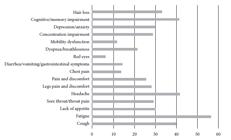
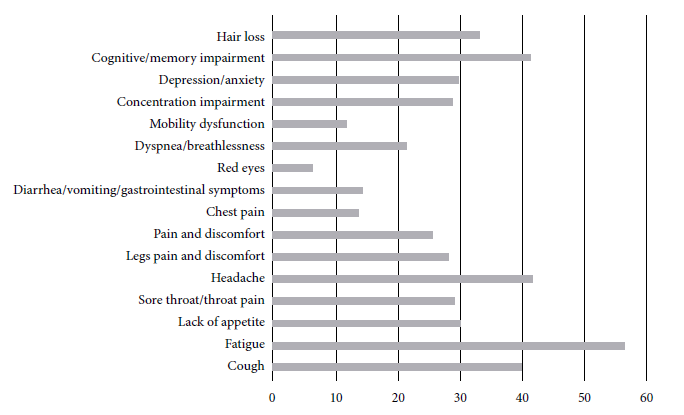
Regarding COVID-19 outcomes, 84.2% of participants had at least one COVID-19 test, and 59.9% had a positive result (Table 3). Among participants with positive tests, 75% lived with long COVID-19. The most common symptoms reported were fatigue (56.7%), headache (41.9%), memory impairment (41.4%), and cough (40.0%) (Figure 1).
Discussion
The COVID-19 pandemic has left a lasting impact on global populations, both directly and indirectly, necessitating ongoing vigilance. We revealed that even 27 months after the commencement of social restrictions in the state of Rio Grande do Sul, the population is still experiencing adverse effects of the pandemic, including a high prevalence of LBP, reduced levels of physical activity, and moderate-to-severe cases of anxiety and depression.
At the onset of the COVID-19 pandemic, concerns centered around physical inactivity and mental health issues (i.e., depression and anxiety). Previous studies primarily focused on the early pandemic months or specific periods, such as lockdowns29. Although long-term surveillance of physical activity is vital, studies in high-income countries reported fluctuations in activity levels throughout the pandemic, and data on low/mid-income countries are still needed30,31. In Brazil, we observed an initial decrease in physical activity during restrictions, followed by a gradual increase24. However, even after 27 months of the restrictions onset, activity levels in Rio Grande do Sul remained below pre-pandemic levels 6.
Depression and anxiety symptoms surged during the initial restriction period and persisted for nearly ten months4,5. In contrast to countries such as the UK, where these symptoms decreased post-lockdown, moderate-to-severe symptoms remained elevated in Brazil due to the absence of federal social distancing measures24. This situation contributed to increased COVID-19 cases and deaths in Brazil, economic instability, and an uncertain future32. These findings underscore the urgency for policymakers to prioritize mental health as a public health concern.
LBP poses a significant challenge, causing substantial productivity losses in Brazil33,34. The prolonged periods of staying at home and changes in work routines raised concerns about LBP. However, few studies have investigated the prevalence and effects of LBP during the pandemic35,36. Worryingly, LBP prevalence remained stable compared to initial data collected in 2020, potentially leading to increased physical, psychosocial, and economic burdens associated with LBP.
This is the first study to prospectively investigate the prevalence of long COVID in a large Brazilian adult population, revealing that three out of four adults in Rio Grande do Sul experienced this condition. Long COVID has emerged as a significant consequence of the pandemic, with fatigue and cognitive/memory issues being prominent symptoms37-39. Crunfli et al. (2022) recently highlighted structural changes in the cerebral cortex associated with COVID-19, potentially leading to “brain fog,” memory complaints, and attention deficits40,41. Previous studies have also suggested the role of vascular-related proinflammatory biomarkers in fatigue symptoms42. Thus, it is imperative to continually monitor the consequences of COVID-19 to prepare the healthcare system to address the needs of those living with long COVID.
Adequate sleep is crucial for overall well-being43. Sleep disturbances were more prevalent during lockdown (42.5%) compared to non-lockdown (37.9%) periods and in 2021 compared to 2020 (47.1% and 36.2%, respectively)44. Both short and long sleep durations, as well as sleep disturbances, have been linked to chronic diseases and multimorbidity45,46. We showed that nearly 45% of the participants failed to achieve the recommended hours of sleep (i.e., between seven and eight hours), raising concerns about future health consequences.
The pandemic disrupted healthcare provision for individuals with chronic conditions (e.g., diabetes, cardiovascular diseases) and became a concern since the systems were primarily focused on managing COVID-19 patients. Furthermore, the upheaval in daily routines was expected to contribute to an increase in chronic diseases such as obesity, cardiovascular diseases, and multimorbidity47,48. We revealed a significant rise in the prevalence of chronic diseases (70.8%) compared to the initial assessment, indicating a concerning prospect for long-term health conditions.
Ensuring sufficient, abundant, and safe food access to meet the nutritional needs of all individuals is known as food insecurity49. The COVID-19 pandemic has exacerbated food insecurity in Brazil and globally50,51. Food insecurity affected 29.2% of the population, underscoring the need for government intervention through social and public health policies to address this problem.
Some limitations of our study should be acknowledged. Firstly, although in-person research is currently allowed, we opted for a self-reported online-based approach to ensure data comparability with the previous cohort waves. Secondly, our study design precluded an equiprobable sample. While our sample represents a mid/high-income and educated population, it should be noted that in a low-income and less educated population, the scenario should be worsened. Thirdly, online assessments usually have reduced responses from older and less educated/income individuals due to internet restrictions or the inability to use technology. Nevertheless, the demographic characteristics of our sample correspond with the Rio Grande do Sul state population (i.e., most are white and women)52. However, the PAMPA cohort is the only ongoing, prospective study initiated during the COVID-19 pandemic involving over 10,000 adults in southern Brazil. The data collected will inform public health policies and help prepare the healthcare system for future needs. We are to continue monitoring the population of Rio Grande do Sul state until 2024.
Conclusion
Our data shows that this sample continues to grapple with the enduring impacts of the COVID-19 pandemic on both their physical and mental well-being. Remarkably, even 27 months into the pandemic-era restrictions, physical inactivity, LBP, and mental health issues persist at levels higher than those observed before the pandemic onset.
In light of these findings, it is evident that robust public health strategies are imperative. These strategies should aim to enhance the overall health of the population and mitigate the lingering consequences of the pandemic. Notably, such measures can help safeguard against the indirect effects that may arise in future pandemic scenarios necessitating social restrictions.
Acknowledgements
This study was financed in part by the Coordination for the Coordenação de Aperfeiçoamento de Pessoal de Nível Superior (CAPES) - Finance Code 001.
References
- 1 Kneip T, Börsch-Supan A, Andersen-Ranberg K. Social, health and economic impact of the COVID-19 pandemic from a European perspective. Eur J Ageing 2022; 19(4):789-792.
-
2 Feter N, Caputo EL, Doring IR, Leite JS, Cassuriaga J, Reichet FF, Silva MC, Rombaldi A. Longitudinal study about low back pain, mental health, and access to healthcare system during COVID-19 pandemic: protocol of an ambispective cohort [Internet]. 2020 [cited 2020 jul 26]. Available from: https://www.medrxiv.org/content/10.1101/2020.07.22.20160309v1
» https://www.medrxiv.org/content/10.1101/2020.07.22.20160309v1 - 3 Caputo EL, Reichert FF. Studies of Physical Activity and COVID-19 During the Pandemic: A Scoping Review. J Phys Act Health 2020; 17(12):1275-1284.
- 4 Feter N, Caputo EL, Leite JS, Smith EC, Doring IR, Cassuriaga J, Delpino FM, Huckembeck CM, Alt R, Reichert FF, da Silva MC, Coombes JS, Rombaldi AJ. Depression and anxiety symptoms remained elevated after 10 months of the COVID-19 pandemic in southern Brazil: findings from the PAMPA cohort. Public Health 2022; 204:14-20
- 5 Feter N, Caputo EL, Doring IR, Leite JS, Cassuriaga J, Reichert FF, Silva MC, Coombes JS, Rombaldi AJ. Sharp increase in depression and anxiety among Brazilian adults during the COVID-19 pandemic: findings from the PAMPA cohort. Public Health 2021; 190:101.
- 6 Caputo EL, Feter N, Doring IR, Leite JS, Cassuriaga J, Rombaldi AJ, Silva MC, Reichert FF. How has COVID-19 social distancing impacted physical activity patterns? Data from the PAMPA cohort, Brazil. J Exerc Sci Fit 2021; 19(4):252.
- 7 Yuan K, Zheng YB, Wang YJ, Sun YK, Gong YM, Huang YT, Chen X, Liu XX, Zhong Y, Su SZ, Gao N, Lu YL, Wang Z, Liu WJ, Que JY, Yang YB, Zhang AY, Jing MN, Yuan CW, Zeng N, Vitiello MV, Patel V, Fazel S, Minas H, Thornicroft G, Fan TT, Lin X, Yan W, Shi L, Shi J, Kosten T, Bao YP, Lu L. A systematic review and meta-analysis on prevalence of and risk factors associated with depression, anxiety and insomnia in infectious diseases, including COVID-19: a call to action. Mol Psychiatry 2022; 27(8):3214-3222.
- 8 Daniali H, Martinussen M, Flaten MA. A global meta-analysis of depression, anxiety, and stress before and during COVID-19. Health Psychol 2023; 42(2):124-138.
- 9 Salari N, Hosseinian-Far A, Jalali R, Vaisi-Raygani A, Rasoulpoor S, Mohammadi M, Rasoulpoor S, Khaledi-Paveh B. Prevalence of stress, anxiety, depression among the general population during the COVID-19 pandemic: a systematic review and meta-analysis. Glob Health 2020; 16(1):57.
- 10 Guimarães RA, Policena GM, Paula HSC, Pedroso CF, Pinheiro RS, Itria A, Braga Neto OO, Teixeira AM, Silva IA, Oliveira GA, Batista KA. Analysis of the impact of coronavirus disease 19 on hospitalization rates for chronic non-communicable diseases in Brazil. PLoS One 2022; 17(3):e0265458.
- 11 Leite JS, Feter N, Caputo EL, Doring IR, Cassuriaga J, Reichert FF, Silva MC, Rombaldi AJ. Managing noncommunicable diseases during the COVID-19 pandemic in Brazil: findings from the PAMPA cohort. Cien Saude Colet 2021; 26(3):987-1000.
-
12 Rio Grande do Sul. Secretaria de Saúde/RS. Imunização Covid-19/RS [Internet]. [acessado 2022 out 16]. Disponível em: https://vacina.saude.rs.gov.br/
» https://vacina.saude.rs.gov.br -
13 Rio Grande do Sul. Secretaria de Saúde/RS. Coronavirus [Internet]. [acessado 2022 set 21]. Disponível em: https://ti.saude.rs.gov.br/covid19/
» https://ti.saude.rs.gov.br/covid19 - 14 Feter N, Caputo EL, Doring IR, Leite JS, Cassuriaga J, Reichert FF, Silva MC, Coombes JS, Rombaldi AJ. Longitudinal study about the impact of COVID-19 pandemic in a southern Brazilian state: the PAMPA cohort. An Acad Bras Cienc 2022; 94(2):20201718.
- 15 Harris PA, Taylor R, Minor BL, Elliott V, Fernandez M, O'Neal L, McLeod L, Delacqua G, Delacqua F, Kirby J, Duda SN; REDCap Consortium. The REDCap consortium: Building an international community of software platform partners. J Biomed Inform 2019; 95:103208.
-
16 Caputo EL, Ferreira PH, Feter N, Alt R, Cassuriaga J, Rombaldi AJ, Silva MC. What Was the Impact of COVID-19 Pandemic on Low Back Pain? Data from the PAMPA Cohort, Brazil [Internet]. 2021 [cited 2022 ago 25]. Available from: https://www.researchsquare.com
» https://www.researchsquare.com - 17 Bjelland I, Dahl AA, Haug TT, Neckelmann D. The validity of the Hospital Anxiety and Depression Scale: An updated literature review. J Psychosom Res 2002; 52(2):69-77.
- 18 Montgomery SA, Asberg M. A new depression scale designed to be sensitive to change. Br J Psychiatry 1979; 134(4):382-389.
- 19 Feter N, Caputo EL, Smith EC, Doring IR, Cassuriaga J, Leite JS, Reichert FF, da Silva MC, Coombes JS, Rombaldi AJ. Association between physical activity and subjective memory decline triggered by the COVID-19 pandemic: Findings from the PAMPA cohort. Prev Med 2021; 145:106415.
- 20 Feter N, Caputo EL, Koth AP, Delpino FM, Tomaz GS, Doring IR, Leite JS, Cassuriaga J, Treptow JG, Weymar MK, Alt R, Reichert FF, Silva MC, Rombaldi AJ. Association between specific types of physical activity during the COVID-19 pandemic and the risk of subjective memory decline: findings from the PAMPA Cohort. Public Health 2021; 200:49-55.
- 21 Enes CC, Nucci LB. A Telephone Surveillance System for Noncommunicable Diseases in Brazil. Public Health Reports 2019; 134(4):324.
-
22 Instituto Brasileiro de Geografia e Estatística (IBGE). Pesquisa Nacional de Saúde 2019 [Internet]. [acessado 2022 out 16]. Disponível em: https://www.ibge.gov.br/estatisticas/sociais/saude/9160-pesquisa-nacional-de-saude.html?=&t=resultados
» https://www.ibge.gov.br/estatisticas/sociais/saude/9160-pesquisa-nacional-de-saude.html?=&t=resultados - 23 Milton K, Bull FC, Bauman A. Reliability and validity testing of a single-item physical activity measure. Br J Sports Med 2011; 45(3):203-208.
- 24 Caputo EL, Feter N, Leite JS, Doring IR, Cassuriaga J, Delpino FM, Huckembeck CM, Alt R, Silva MC, Rombaldi AJ, Reichert FF. Physical activity trajectory in the first 10 months of the COVID-19 pandemic in Southern Brazil: a follow-up study. BMC Sports Sci Med Rehabil 2022; 14(1):58.
-
25 World Health Organization (WHO). WHO guidelines on physical activity and sedentary behaviour [Internet]. [cited 2021 abr 28]. Available from: https://www.who.int/publications/i/item/9789 240015128
» https://www.who.int/publications/i/item/9789 240015128 - 26 Delpino FM, Caputo EL, Arcêncio RA, Cassuriaga J, Huckembeck CM, Nunes BP, Rombaldi AJ, Reichert FF, Silva MC, Feter N. Association of Sleep Duration and Use of Sleeping Medication with Multimorbidity in Adults: Results from the PAMPA (Brazil) Cohort Study. Sleep Sci 2023; 16(1):68-74.
- 27 Interlenghi GS, Reichenheim ME, Segall-Correâ AM, Pérez-Escamilla R, Moraes CL, Salles-Costa R. Suitability of the eight-item version of the Brazilian Household Food Insecurity Measurement Scale to identify risk groups: evidence from a nationwide representative sample. Public Health Nutr 2019; 22(5):776-784.
-
28 A clinical case definition of post COVID-19 condition by a Delphi consensus, 6 October 2021 [Internet]. [cited 2023 set 13]. Available from: https://www.who.int/publications/i/item/WHO-2019-nCoV-Post_COVID-19_condition-Clinical_case_definition-2021.1
» https://www.who.int/publications/i/item/WHO-2019-nCoV-Post_COVID-19_condition-Clinical_case_definition-2021.1 - 29 Caputo EL, Reichert FF. Studies of Physical Activity and COVID-19 during the Pandemic: A Scoping Review. J Physical Act Health 2020; 17(12):1275-1284.
- 30 To QG, Duncan MJ, Itallie A van, Vandelanotte C. Impact of COVID-19 on Physical Activity Among 10,000 Steps Members and Engagement with the Program in Australia: Prospective Study. J Med Internet Res 2021; 23(1):e23946.
- 31 de Boer WIJ, Mierau JO, Schoemaker J, Viluma L, Koning RH. The impact of the Covid-19 crisis on socioeconomic differences in physical activity behavior: evidence from the Lifelines COVID-19 cohort study. Prev Med 2021; 153:106823.
-
32 Our World in Data. Brazil: Coronavirus Pandemic Country Profile [Internet]. [cited 2022 out 16]. Available from: https://ourworldindata.org/coronavirus/country/brazil
» https://ourworldindata.org/coronavirus/country/brazil - 33 Hartvigsen J, Hancock MJ, Kongsted A, Louw Q, Ferreira ML, Genevay S, Hoy D, Karppinen J, Pransky G, Sieper J, Smeets RJ, Underwood M; Lancet Low Back Pain Series Working Group. What low back pain is and why we need to pay attention. Lancet 2018; 391(10137):2356-2367.
- 34 Carregaro RL, Tottoli CR, Rodrigues DS, Bosmans JE, Silva EN, van Tulder M. Low back pain should be considered a health and research priority in Brazil: Lost productivity and healthcare costs between 2012 to 2016. PLoS One 2020;15(4):e0230902.
- 35 Šagát P, Bartík P, González PP, Tohănean DI, Knjaz D. Impact of COVID-19Quarantine on Low Back Pain Intensity, Prevalence, and Associated Risk Factors among Adult Citizens Residing in Riyadh (Saudi Arabia): A Cross-Sectional Study. Int J Environ Res Public Health 2020; 17(19):1-13.
- 36 Minoura A, Ishimaru T, Kokaze A, Tabuchi T. Increased Work from Home and Low Back Pain among Japanese Desk Workers during the Coronavirus Disease 2019 Pandemic: A Cross-Sectional Study. Int J Environ Res Public Health 2021; 18(23):12363.
- 37 Ladds E, Rushforth A, Wieringa S, Taylor S, Rayner C, Husain L, Greenhalgh T. Persistent symptoms after Covid-19: qualitative study of 114 "long Covid" patients and draft quality principles for services. BMC Health Serv Res 2020; 20(1):1144.
- 38 Han Q, Zheng B, Daines L, Sheikh A. Long-Term Sequelae of COVID-19: A Systematic Review and Meta-Analysis of One-Year Follow-Up Studies on Post-COVID Symptoms. Pathogens 2022; 11(2):269.
- 39 Pinzon RT, Wijaya VO, Jody A al, Nunsio PN, Buana RB. Persistent neurological manifestations in long COVID-19 syndrome: A systematic review and meta-analysis. J Infect Public Health 2022; 15(8):856-869.
- 40 Crunfli F, Carregari VC, Veras FP, Silva LS, Nogueira MH, Antunes ASLM, Vendramini PH, Valença AGF, Brandão-Teles C, Zuccoli GDS, Reis-de-Oliveira G, Silva-Costa LC, Saia-Cereda VM, Smith BJ, Codo AC, de Souza GF, Muraro SP, Parise PL, Toledo-Teixeira DA, Santos de Castro ÍM, Melo BM, Almeida GM, Firmino EMS, Paiva IM, Silva BMS, Guimarães RM, Mendes ND, Ludwig RL, Ruiz GP, Knittel TL, Davanzo GG, Gerhardt JA, Rodrigues PB, Forato J, Amorim MR, Brunetti NS, Martini MC, Benatti MN, Batah SS, Siyuan L, João RB, Aventurato ÍK, Rabelo de Brito M, Mendes MJ, da Costa BA, Alvim MKM, da Silva Júnior JR, Damião LL, de Sousa IMP, da Rocha ED, Gonçalves SM, Lopes da Silva LH, Bettini V, Campos BM, Ludwig G, Tavares LA, Pontelli MC, Viana RMM, Martins RB, Vieira AS, Alves-Filho JC, Arruda E, Podolsky-Gondim GG, Santos MV, Neder L, Damasio A, Rehen S, Vinolo MAR, Munhoz CD, Louzada-Junior P, Oliveira RD, Cunha FQ, Nakaya HI, Mauad T, Duarte-Neto AN, Ferraz da Silva LF, Dolhnikoff M, Saldiva PHN, Farias AS, Cendes F, Moraes-Vieira PMM, Fabro AT, Sebollela A, Proença-Modena JL, Yasuda CL, Mori MA, Cunha TM, Martins-de-Souza D. Morphological, cellular, and molecular basis of brain infection in COVID-19 patients. Proc Natl Acad Sci USA 2022; 119(35):e2200960119.
- 41 Lu Y, Li X, Geng D, Mei N, Wu PY, Huang CC, Jia T, Zhao Y, Wang D, Xiao A, Yin B. Cerebral Micro-Structural Changes in COVID-19 Patients - An MRI-based 3-month Follow-up Study. EClinicalMedicine 2020; 25:100484.
- 42 Wang HY, Li XL, Yan ZR, Sun XP, Han J, Zhang BW. Potential neurological symptoms of COVID-19. Ther Adv Neurol Disord 2020; 13:1756286420917830.
- 43 Ramar K, Malhotra RK, Carden KA, Martin JL, Abbasi-Feinberg F, Aurora RN, Kapur VK, Olson EJ, Rosen CL, Rowley JA, Shelgikar AV, Trotti LM. Sleep is essential to health: an American Academy of Sleep Medicine position statement. J Clin Sleep Med 2021; 17(10):2115-2119.
- 44 Jahrami HA, Alhaj OA, Humood AM, Alenezi AF, Fekih-Romdhane F, AlRasheed MM, Saif ZQ, Bragazzi NL, Pandi-Perumal SR, BaHammam AS, Vitiello MV. Sleep disturbances during the COVID-19 pandemic: A systematic review, meta-analysis, and meta-regression. Sleep Med Rev 2022; 62:101591.
- 45 Sindi S, Pérez LM, Vetrano DL, Triolo F, Kåreholt I, Sjöberg L, Darin-Mattsson A, Kivipelto M, Inzitari M, Calderón-Larrañaga A. Sleep disturbances and the speed of multimorbidity development in old age: results from a longitudinal population-based study. BMC Med 2020; 18(1):382.
- 46 Nicholson K, Rodrigues R, Anderson KK, Wilk P, Guaiana G, Stranges S. Sleep behaviours and multimorbidity occurrence in middle-aged and older adults: findings from the Canadian Longitudinal Study on Aging (CLSA). Sleep Med 2020; 75:156-162.
- 47 Van den Bulck S, Crèvecoeur J, Aertgeerts B, Delvaux N, Neyens T, Van Pottelbergh G, Coursier P, Vaes B. The impact of the Covid-19 pandemic on the incidence of diseases and the provision of primary care: A registry-based study. PLoS One 2022; 17(7):e0271049.
- 48 Delpino FM, Caputo EL, Silva MC, Reichert FF, Nunes BP, Feter N, Leite JS, Cassuriaga J, Huckembeck CM, Alt R, Rombaldi AJ. Incidence of multimorbidity and associated factors during the COVID-19 pandemic in Brazil: a cohort study. Sao Paulo Med J 2022; 140(3):447-453.
- 49 Simelane KS, Worth S. Food and Nutrition Security Theory. Food Nutr Bull 2020; 41(3):367-379.
-
50 Rede Brasileira de Pesquisa em Soberania e SAN. 2o Inquérito Nacional sobre Insegurança Alimentar no Contexto da Pandemia da Covid-19 no Brasil [Internet]. [acessado 2022 out 17]. Disponível em: https://pesquisassan.net.br/2o-inquerito-nacional-sobre-inseguranca-alimentar-no-contexto-da-pandemia-da-covid-19-no -brasil/
» https://pesquisassan.net.br/2o-inquerito-nacional-sobre-inseguranca-alimentar-no-contexto-da-pandemia-da-covid-19-no -brasil - 51 Food and Agriculture Organization (FAO). The State of Food Security and Nutrition in the World 2022. Rome: FAO; 2022.
-
52 Brasil. Istituto Brasileiro de Geografia e Estatística (IBGE). Censo 2010 [Internet]. 2010. [acessado 2020 ago 9]. Disponível em: https://censo2010.ibge.gov.br/
» https://censo2010.ibge.gov.br

 Source: Authors.