| “Prenatal Care” Domain |
| Early identification for the start of prenatal care |
79.8 |
| Average proportion of pregnant women who start prenatal care in their first pregnancy trimester |
74.1 |
| Recording of prenatal care in medical records, Pregnancy Card and Perinatal Form |
92.1 |
| Health visits during prenatal care and in the last month of pregnancy |
83.9 |
| Identification of high-risk pregnant women |
93.6 |
| Referral of high-risk pregnant women to a reference service and maintenance of follow-up at the basic health unit |
61.7 |
| Special care for pregnant women aged 10 to 19 |
37.5 |
| Laboratory tests requested in the first trimester of pregnancy to identify complications that may cause prematurity, developmental changes or fetal death |
10.8 |
| Laboratory tests requested in the second and/or third trimester of pregnancy to identify complications that may cause prematurity, developmental changes or fetal death |
3.0 |
| Electrocardiogram performed at the unit |
47.3 |
| DTaP vaccine (diphtheria, tetanus and acellular pertussis) administered |
77.3 |
| Benzathine penicillin (Benzetacil) administered at the unit |
71.8 |
| Prevention of vertical transmission of syphilis |
76.5 |
| Prevention of vertical transmission of HIV |
77.1 |
| Treatment of syphilis for pregnant women and their partners with benzathine penicillin at the basic health unit |
74.3 |
| Guidance for partner(s) to come for evaluation and counseling in cases suggestive of sexually transmitted diseases |
83.9 |
| Prevention of anemia and changes in nutritional status during pregnancy |
75.4 |
| Indication of the use of medications with lesser effects on the fetus during pregnancy |
81.2 |
| Assessment of the risks of smoking and the use of alcoholic beverages and other drugs during pregnancy |
86.6 |
| Assessment of working conditions for pregnant women |
58.4 |
| Assessment of birth complications in immediate postpartum care |
79.6 |
| Guidance on breastfeeding and iron supplementation in immediate postpartum care |
62.8 |
| Guidance for pregnant women on breastfeeding and support for women who will not be able to breastfeed |
89.3 |
| Training and/or ongoing education for professionals at the basic health unit on women’s health carried out in the last year |
71.7 |
| “Child Health Care” Domain |
| Birth conditions of the newborn and guidelines on basic care in the immediate postpartum period |
87.1 |
| Guidelines for newborn care (vaccination, exams, others) in the immediate postpartum period |
89.0 |
| Scheduling the newborn’s first health appointment at the unit |
70.3 |
| Guidance on newborn heel prick, ear and eye tests |
87.5 |
| Application of the BCG vaccine |
56.0 |
| Application of the Polio vaccine/oral polio vaccine/OPV and Inactivated Polio vaccine/inactivated polio vaccine/IPV |
76.6 |
| Administration of the Pentavalent vaccine (DTP + Hib + HB) |
78.4 |
| Application of the DTP vaccine (Triple Bacterial) |
78.1 |
| Application of the Triple Viral vaccine (Measles, Mumps and Rubella - MMR) |
78.3 |
| Application of the Tetra Viral vaccine (Measles, Mumps, Rubella and Chickenpox) |
76.5 |
| Application of the Meningococcal C vaccine |
77.5 |
| Application of the 10-valent Pneumococcal vaccine |
75.9 |
| Vaccination in institutions for children such as schools and daycare centers |
66.9 |
| Scheduled calendar of health visits for children up to 2 years old, in addition to occasional unscheduled appointments |
52.7 |
| Parents’ groups |
20.2 |
| Evaluation of children’s growth and neuropsychomotor development of the child |
81.0 |
| Evaluation and nutritional child guidance (breastfeeding, introduction of foods, others) |
92.0 |
| Identification of child development disorders (genetic, biological, socio-familial) |
75.5 |
| Guidelines for preventing domestic accidents to protect children’s health |
57.2 |
| Evaluation of visual acuity in institutions for children such as schools and daycare centers |
38.9 |
| Evaluation of hearing acuity in institutions for children such as schools and daycare centers |
16.3 |
| Guidelines for neuropsychomotor stimuli in institutions for children such as schools and daycare centers |
13.8 |
| Actions for social inclusion and combating prejudice in institutions for children such as schools and daycare centers |
13.9 |
| Actions for preventing domestic accidents in institutions for children such as schools and daycare centers |
21.7 |
| Absence of cases of congenital syphilis in the last three years |
47.4 |
| Use of a care protocol for detecting violence against children and adolescents |
28.9 |
| Identification of physical and psychological symptoms/complaints to detect violence against children and adolescents |
76.7 |
| Raising awareness and training staff to identify cases of violence against children and adolescents |
34.5 |
| Monitoring of child labor (under 16 years of age) as an alert situation - sentinel event |
8.8 |
| Meetings with CRAS on child health care |
39.1 |
| Referral to a milk bank or access to modified milk if necessary (HIV, others) |
55.0 |
| Training and/or ongoing education on Child Health carried out in the previous year |
55.0 |
| Domain “Prevention of Disabilities in Chronic Diseases and Injuries” |
| Dressing of acute and chronic ulcers |
94.7 |
| Activities in conjunction with the epidemiological and/or health surveillance team in the community in cases of diseases or conditions requiring compulsory notification |
73.8 |
| Registration of patients with chronic non-communicable diseases differentiated risk |
43.7 |
| Guidelines for preventing work-related accidents and diseases |
33.8 |
| Compulsory notification of work-related conditions. |
44.2 |
| Active search for patients with chronic non-communicable diseases who are not adhering to treatment |
68.8 |
| Eye fundus examination for patients with type II diabetes mellitus |
63.3 |
| Control, assessment and guidance on foot care for patients with type II diabetes mellitus |
67.2 |
| Eye fundus examination for patients with high blood pressure |
62.3 |
| Actions for men’s health with a focus on cardiovascular risk |
65.1 |
| Evaluation of the mental health of older adults (depressive conditions, dementia and others) |
69.0 |
| Evaluation of the functional capacity of the elderly (Activities of Daily Living and Instrumental Activities) |
51.1 |
| Actions for preventing falls in older adults |
64.0 |
| Encouragement and guidance on physical activity and physical exercise for older adults |
72.2 |
| Investigation of family and social support for older adults |
56.3 |
| Guidance on the Rights of the Elderly |
41.5 |
| Diagnosis of new cases of leprosy |
52.7 |
| Monitoring of leprosy cases |
34.3 |
| Control of the number of leprosy cases under monitoring |
41.7 |
| Dispensing of leprosy medication |
78.9 |
| Supervised treatment at the Unit or at home for leprosy |
20.6 |
| Active search for intra-household contacts in leprosy cases |
34.0 |
| Active search for those who have missed leprosy treatment |
54.5 |
| Educational actions in the family and community about leprosy |
64.5 |
| Active search in cases of disease or condition requiring compulsory notification with indication of control of contacts and/or the environment |
88.0 |
| Mandatory notification of leprosy cases |
69.3 |
| Investigation and control of comorbidities associated with alcohol dependence |
39.4 |
| Investigation and control of comorbidities associated with drug abuse |
37.9 |
| Training and/or continuing education on mental health carried out during the previous year |
48.8 |
| Training and/or continuing education on older adults health carried out in the previous year |
40.9 |
| Team training on diseases or conditions requiring compulsory notification |
63.2 |
| Team training to care for leprosy cases |
45.2 |
 Construction of a logical theoretical model to assess disability care in Primary Health Care services
 Thumbnail
 Thumbnail
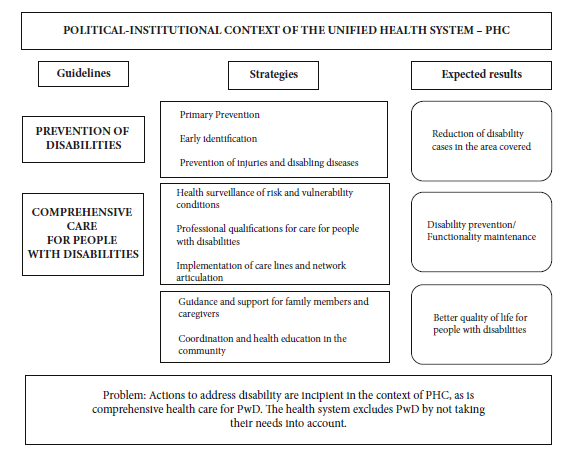 Source: The authors.
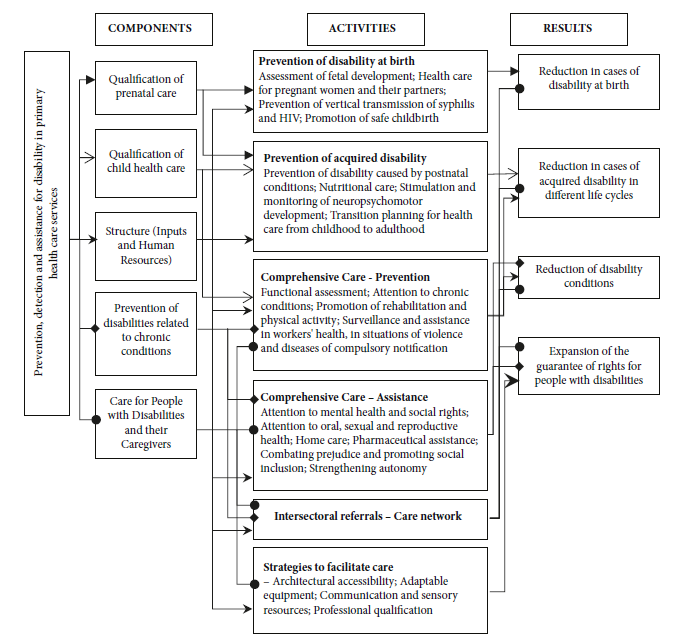 Source: The authors.