| MM.3: It wasn’t calm [...] at the beginning, everyone was very scared, no one knew anything [...] it seemed like everyone was kind of lost. |
Uncertainty and insecurity |
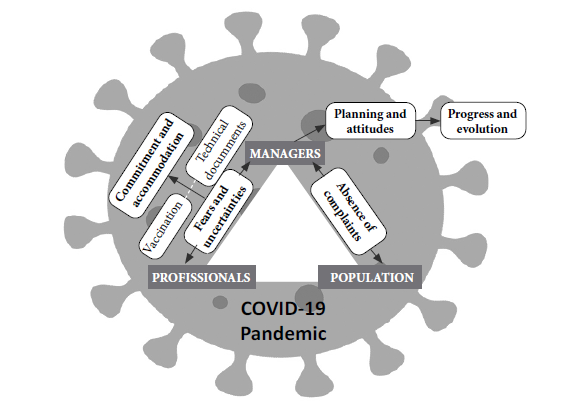
You had to instill confidence in the professionals, even though you were feeling very scared |
| MM.1: [...] the process caught everyone by surprise [...] and we had no knowledge of the microorganism, the transmission process, and it was, I think, a discovery for everyone [...]. |
Misinformation and doubts |
| MM.2: The fear was really about the disease [...] at that moment there was fear and a refusal to attend [...]. |
Fear of contamination |
| MM.7: So, we were all really desperate, everyone, scared [...]. |
Despair and fear |
| MM.1: [...] when the guidelines were established, and those guidelines allowed for the organization of the work [...] it somewhat eased our nerves and the [sense of] despair [...]. |
Technical support for decision-making |
Factors intervening in the management process during the pandemic |
| MM.3: [...] but I think the first year for me was the most critical, until the vaccine arrived and started to provide some confidence, both for the professionals and for the population. |
Vaccination as facilitating management |
| MM.1: [...] I think everyone understood the needs of the population that couldn’t be left without care and the need to share the work with colleagues [...]. |
Commitment to serving the population |
Participation of healthcare professionals in management |
| MM.7: [...] I see that others took advantage of the moment, still take advantage, to do the bare minimum, to do the least possible, and don’t care much about the population, you know? |
Complacency and excuses on the part of the workers |
| MM.4: [...] some healthcare centers returned immediately, followed the guidelines, understood. And others kept saying they were only taking emergencies [...] We had to make sporadic visits to healthcare centers or districts [...]. |
Horizontalization of the management process |
| MM.5: [...] I’m very understanding of each person’s individuality, you know? [...] it builds trust, you see [...] with clear and open dialogue, without hiding anything, I’ve never had difficulty with professionals [...] |
Vision and positions of the managers |
| MM.7: [...] we assigned the rest of the dentists to do that flu syndrome screening, which they didn’t like very much. If they felt undervalued [...], they realized they are too much for that. |
Relocation of professionals |
| MM.4: The population was very scared because of the aerosols created [...]. Many didn’t want to make an appointment [...] |
Patients’ refusal to take up treatments |
“The population seems to have understood more than the professionals” |
| MM.9: We didn’t have any complaints. Can you believe that? I thought that when I returned, there would be a lot of complaints. We hardly have any ombudsman [cases]. I think before the pandemic people even complained more [...] |
Understanding on the part of the population |
| MM.5: But the population in general, some understand, others don’t understand; there are some political legacies you have to accept, but we’ve managed to control and address them. |
Reflection of politicization in services |
| MM.9: I learned a lot about stepping out of our comfort zone [...] we had to transform, restructure, and reorganize ourselves. And it’s not easy for us to step out of that comfort zone [...] And I think we have to move forward, keep developing. |
Learning and skills acquisition during the crisis |
“We had to transform, restructure, and reorganize ourselves” |
| MM.1: [...] the need for the technical professionals, the managers, the representatives of the population, to come [...] together [...] to talk to each other and be aware of the reality and what can be done; it’s necessary to discuss [things] together. |
Inclusion of professionals and the population in decision-making |
| MM.2: [...] Before, it was quite siloed. Everyone kept to themselves. After the pandemic, things came together. That was a positive point, things came together quite a bit. People even became more helpful, the dental staff, the people from the team saw dentistry in a different light [...] |
Recognition of dentistry |
“Dentistry has to move on like the others; it has to keep pace and not lag behind.” |
| MM.3: [...] dentistry has to move on like the others, it has to keep pace and not lag behind. I’m not going to tell you it’s easy. Actually, it’s hard. We have to fight for it every day. But when you have a manager with a more open mind, it gets less difficult. |
Importance of dentistry |
| MM.1: What we would like, right, is the issue of expanding the network, having better infrastructure, the issue of physical infrastructure, right? Not having to be in a rented property; having greater comfort for us professionals to provide care and for patients [...] |
Necessary advancements |
 Theorizing oral health management in the COVID-19 scenario: a qualitative study in the municipalities of Minas Gerais, Brazil
 Thumbnail
 Source: Authors.