 Epidemiological profile of mortality in indigenous children under five years of age in Brazil: an integrative literature review
Abstract
The aim is to identify the epidemiological profile of mortality among Brazilian indigenous children under five years of age, through an integrative review. Articles that evaluated the mortality of indigenous Brazilian children under one and/or five years of age, from 2000 to 2020, in Portuguese, English, and/or Spanish, in the LILACS, SciELO, and MEDLINE databases were included. Of the 3,229 publications found, 22 were included in the review. Infant mortality ranged from 15.2/1,000 live births (LB) (1995-1999) for the Kayabí ethnic group to 307.7/1,000 LB (2000) for the Hupdäh ethnic group. Among the studies that evaluated infant mortality by age components, the post-neonatal period stands out, with proportions that varied from 15.2% (1990-1994), for indigenous children from Paraná, to 83.3% (2007- 2008) for the Guarani ethnic group. The main cause of mortality was respiratory diseases, ranging from 17.1% (2010) to 75% (2007-2008) among the Guarani ethnic group. Brazilian indigenous children under one year of age experienced high mortality rates, when compared to non-indigenous children, for all ethnicities and regions of the country. Among the IMT components, a high number of deaths were observed in the post-neonatal period, with respiratory system diseases representing the main causes of death.
Key words:
Child mortality; Indian people; Basic health indicators; Infant mortality
Resumo
O objetivo é identificar, por meio de uma revisão integrativa, o perfil epidemiológico da mortalidade em crianças indígenas brasileiras menores de cinco anos. Foram incluídos artigos que avaliaram a mortalidade de crianças indígenas brasileiras menores de um e/ou cinco anos, entre 2000-2020, em português, inglês e/ou espanhol, nas bases LILACS, SciELO e MEDLINE. Das 3.229 publicações encontradas, 22 foram inseridas na revisão. A mortalidade infantil variou de 15,2/1.000 NV (1995-1999) para a etnia Kayabí a 307,7/1.000 NV (2000) para a etnia Hupdäh. Entre os estudos que avaliaram a mortalidade infantil pelos componentes etários, destaca-se o período pós-neonatal, com proporções que variaram de 15,2% (1990-1994), para crianças indígenas do Paraná, a 83,3% (2007-2008) para a etnia Guarani. A principal causa de mortalidade foram as doenças respiratórias, variando de 17,1% (2010) a 75% (2007-2008) entre a etnia Guarani. Crianças indígenas brasileiras menores de um ano apresentaram taxas de mortalidade elevadas, quando comparadas às crianças não-indígenas, para todas as etnias e regiões do país. Entre os componentes de TMI, observou-se elevado número de óbitos no período pós-neonatal, tendo como principal causas de óbito as doenças do aparelho respiratório.
Palavras-chave:
Mortalidade da criança; Povos indígenas; Indicadores básicos de saúde; Mortalidade infantil
Resumen
El objetivo es identificar el perfil epidemiológico de la mortalidad en niños indígenas brasileños menores de cinco años, a través de una revisión integradora. Se incluyeron artículos que evaluaron la mortalidad de niños indígenas brasileños menores de uno o cinco años, entre 2000-2020, en portugués, inglés o español, en las bases de datos LILACS, SciELO y MEDLINE. Se incluyeron 22 de las 3.229 publicaciones encontradas en la revisión. La mortalidad infantil osciló entre 15,2/1.000 NV (1995-1999) para el grupo étnico Kayabí y 307,7/1.000 NV (2000) para el grupo étnico Hupdäh. Entre los estudios que evaluaron la mortalidad infantil por componentes de edad, se destaca el período posneonatal, con proporciones que variaron desde el 15,2% (1990-1994), para los niños indígenas de Paraná, hasta el 83,3% (2007-2008) para la etnia guaraní. La principal causa de mortalidad fueron las enfermedades respiratorias, oscilando entre el 17,1% (2010) y el 75% (2007-2008) entre la etnia guaraní. Los niños indígenas brasileños menores de un año experimentaron altas tasas de mortalidad en comparación con los niños no indígenas en todas las etnias y regiones del país. Entre los componentes del TMI, se observó un elevado número de muertes en el período posneonatal, siendo las enfermedades del sistema respiratorio las principales causas de muerte.
Palabras clave:
Mortalidad de niños; Pueblos indígenas; Indicadores básicos de salud; Mortalidad infantil
Introduction
Mortality in children under five years of age is considered an important public health problem worldwide1, with rates ranging from 2/1,000 live births (LB), in developed countries such as Japan, to 122/1,000 LB. in very poor countries like Somalia (UN IGME, 2020). Although mortality rates in this age group have decreased globally over the years, they still remain substantially high in some countries1,2.
In Brazil, the childhood mortality rate has been declining since 19851,2, so much so that the country reached target 4 of the Millennium Development Goals (MDGs) before 20152-4. In 2018, it presented rates below the minimum level established in target of 3.2 of the UN Sustainable Development Goals (SDGs), with a childhood mortality rate of 14/1,000 children under five years of age and eight neonatal deaths for every one thousand births2.
By contrast, the health situation of indigenous peoples in Brazil is characterized by marked disparities in several health indicators when compared to the rest of the national population5,6. This population group shows worse health and nutritional conditions, high rates of morbidity and mortality due to infectious and parasitic diseases, malnutrition, and anemia, when compared to the general population7,8. Studies show that Brazilian indigenous peoples have high mortality rates in indigenous children under five years of age, which, in some cases, are two or three times higher than the mortality rates found for non-indigenous children5-9.
One key example is the study developed by Campos et al.10 which presents estimates of mortality by sex in different age groups for indigenous and non-indigenous people based on data from the 2010 Demographic Census. This points out that mortality for female children under five years of age was 34.6/1,000 LB for indigenous people and 17.4/1,000 LB among non-indigenous people; while for male children under five years of age, mortality was 38.0/1,000 LB for indigenous people and 19.9/1,000 LB for non-indigenous people, with estimates for indigenous people being twice as high as those found for non-indigenous people.
In this light, understanding the context in which these deaths occur would allow us to determine more clearly how much these specificities contribute to the magnitude of mortality rates among indigenous peoples. In this sense, the study of the mortality of indigenous children under five years of age becomes relevant, as it serves to monitor the epidemiological profile of child deaths and determine which aspects on the subject still require investigation or in-depth study, thus contributing to the efficiency of the health management of indigenous peoples in order to promote the reduction of existing inequities.
Therefore, this article aimed to identify the epidemiological profile of mortality in Brazilian indigenous children under five years of age through an integrative literature review.
Method
This work is an integrative literature review, following a six-step procedure: identification of the theme and selection of the hypothesis, establishment of the research strategy, collection and extraction of data, analysis of the extracted data, interpretation, and presentation of results11,12. For better methodological precision, the review of the process was also based on the recommendations of the Preferred Reporting Items for Systematic Reviews and Meta-Analyses (PRISMA) conference list (http://www.prisma-statement.org/)13, whose study protocol was registered in the International Prospective Register of Systematic Reviews (PROSPERO) (http://www.crd.york.ac.uk/PROSPERO/), logged under registration number CRD42020191186.
Initially, the theme and research question were defined by specifying three components: population included in the studies (indigenous Brazilians under five years of age), study design (observational studies), and analyzed outcome (mortality). Therefore, the guiding question for conducting this integrative review was: “What is the epidemiological profile of Brazilian indigenous mortality in children under five according to the existing literature?” At this stage, the objective of the study and keywords were also defined.
The eligibility criteria consisted of original articles that, among their analyses, had assessed the mortality of Brazilian indigenous children aged less than one and/or five years, found in national and international literature; written in Portuguese, English, or Spanish; and published from January 2000 to May 202014. Review articles, editorials, letters to the editor, laboratory studies, abstracts, reports, monographs, dissertations, theses, and duplicate articles were excluded from the analysis.
The electronic databases of LILACS (via Virtual Health Library - http://lilacs.bvsalud.org/), MEDLINE (via PubMed - https://www.ncbi.nlm.nih.gov/pubmed/), and SciELO (http://www.scielo.org/php/index.php) served as the sources for the publications. These databases were chosen because they index the main (inter)national journals in the area of public health. To reduce publication bias, non-indexed sources were also considered, such as Google Scholar (https://scholar.google.com.br/), conference proceedings, government reports, and reference lists of sentinel works (handsearch), following recommendations from the Canadian Agency for Drugs and Technologies in Health manual (https://www.cadth.ca/resources/finding-evidence/grey-matters).
The keywords used to electronically search for studies on the topic were predefined based on the PICOT strategy (population, intervention/exposure, comparator, outcome, study design) and were verified in MeSH (Medical Subject Headings - www.ncbi.nlm.nih. gov/mesh/) and in DeCS (Health Sciences Descriptors - https://decs.bvsalud.org/), three base strategies being constructed in English, Spanish, and Portuguese, which were used to electronically search for studies in the months from July 2019 to May 2020. The search strategy was adapted for each database used (Chart 1).
The Zotero software (https://www.zotero.org/) was used to organize and manage the selected studies, excluding publications that presented duplication between the databases. The study selection process consisted of two stages, carried out from June to September 2020. First, the team members carried out an independent pre-selection, reading the title and abstract, and applying the established inclusion and exclusion criteria. In the second stage, the texts of the pre-selected works were retrieved for complete reading in order to confirm their eligibility. After a full reading each selected article, each reference was discussed in detail in an attempt to achieve consensus.
Data extraction from full texts was carried out using a standardized collection instrument, containing the following information: authors, year of publication, place and period of study, study design, inclusion and exclusion criteria, population characteristics, main results, and conclusions. From this instrument, the data were synthesized in the Microsoft Excel version 2016 program, and an easy-to-access and manageable database was constructed, which visually displayed the results of individual studies and syntheses.
Next, the data from the selected studies were grouped in a table describing the findings related to mortality rates in children under five years of age (by period, age group, and/or component of the infant mortality rate), proportional mortality (by period, age group, and/or component of the infant mortality rate) and main causes of death. Finally, the data was compiled in the Microsoft Excel program, and subsequent graphs were created to present the relationship between the year and the Infant Mortality Rate (IMR) per 1,000 LB; the relationship between annual intervals and IMR according to the neonatal and post-neonatal components; and the relationship between annual intervals and proportional mortality in children under one year of age according to components of early neonatal, late neonatal, and post-neonatal infant mortality.
The processes described above were carried out by two reviewers, working independently, and any disagreements were resolved by a third reviewer.
Results
Figure 1 presents the PRISMA flowchart of study selection. The databases identified 3,229 studies, of which 1,413 duplicate studies were removed, resulting in a total of 1,816 articles eligible for screening.

Flowchart of selection of articles on mortality among Brazilian indigenous children under five years of age, 2000-2020.
Among the eligible studies, 1,785 (98.3%) were excluded after applying the inclusion and exclusion criteria, leaving 31 articles for full reading and assessment of real eligibility. After reading the full text, nine articles were excluded because they did not provide details by age group and/or accurate information on mortality in children under five years of age. At the end of the process, 22 articles were eligible to be included in the present review.
Among the 23 articles included in this study, 10 (43%) were carried out with data from indigenous peoples in the Midwest region9,15-23, followed by the North (n = 2)24,25, Southeast (n = 2)26,27, and South (n = 2)27,28 regions. Seven studies analyzed national data10,29-35. It is also important to note that some studies covered more than one Brazilian region (Table 1).
Regarding the objectives of the studies, two evaluated the consistency of the data source used29,30, four estimated infant mortality according to self-declared skin color23,25,31,32, six evaluated mortality indicators in different age groups9,10,27,28,33-35, and ten studies carried out a survey of the demographic profile of a specific indigenous people15-22. The ethnicities studied included the Boróros (n = 1)19, Guarani (n = 1)27, Hupd’äh (n = 1)24, Kayabí (n = 1)21, Suyá (n = 1)17, Kamaiurá (n = 1)18, Xakriabá (n = 1)26, and Xavante (n = 3)15,20,22. Of the selected articles, 12 (56.5%) carried out general data analysis without specifying ethnicity9,10,23,25,28-35 (Table 1).
Regarding the age group considered, it was observed that one study verified mortality in indigenous people under 20 years of age34; six studies analyzed indigenous people under one year of age23,25,29,30,32,33; and 15 analyzed the mortality of indigenous people with ages ranging from zero to over 50 years of age9,10,15-20,22,24,26-28,31,35 (Table 1).
High mortality rates were identified in Brazilian indigenous children under five years of age, with emphasis on children under one year of age, who presented and IMR ranging from 15.2/1,000 LB (1995-1999) for the Kayabí ethnic group16 to 307, 7/1,000 LB (2000) for the Hupd’äh ethnic group24. Of the studies that evaluated mortality in children under one year of age by age components, the post-neonatal period stands out, with proportions that varied from 15.2% (1990-1994), for indigenous children from Paraná of unspecified ethnicity28, and 83.3% (2007-2008) for the Guarani ethnic group from the South and Southeast regions27. In studies that analyzed the causes of mortality, respiratory diseases stand out as the main group of causes, with a proportion that varied from 17.1% (2010)33 to 75% (2007-2008) for the Guarani people27 (Table 1).
In Figure 2, two distinct periods of change in the IMR were identified. In the period between 1975 and 2000, there was a successive increase in the IMR of indigenous children. In the period from 2000 to 2013, a decrease was observed in mortality rates among indigenous children under one year of age over time. This scenario is observed both for studies with year-to-year IMRs and for studies that presented IMRs at annual intervals (Figure 2-A and Figure 2-B)9-34.

A: overall infant mortality rate of all studies included in this review9-34. B: infant mortality rates in indigenous children in Brazil, 1975-2013, according to the type of time used in the original studies. Black: studies that analyzed IMR at annual intervals during the study period (9 studies)9,16-18,21,22,26-28. Gray: studies that analyzed IMR annually during the study period (13 studies)10,15,19,20,23-25,29-34.
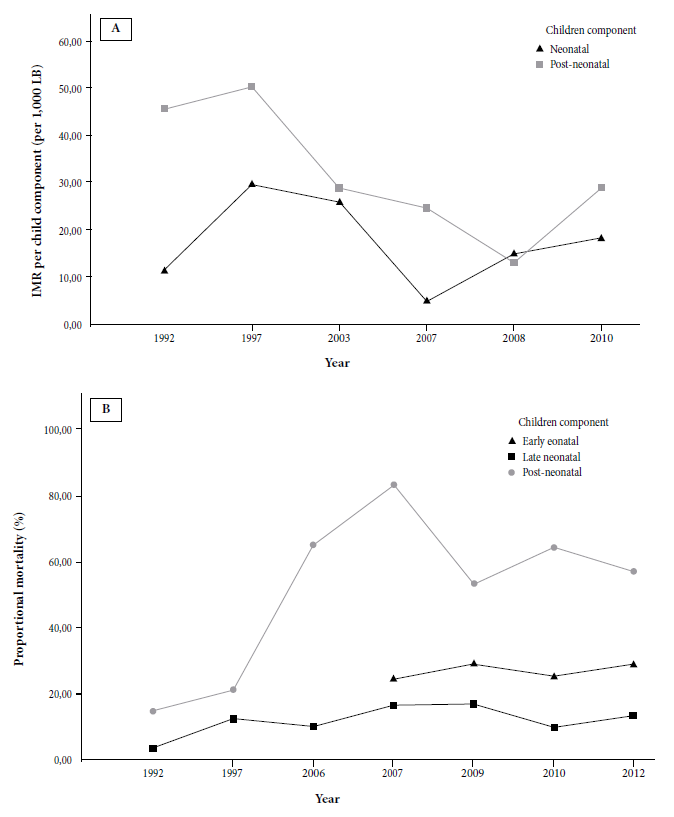
In Figure 3-A, which consists of the IMR according to the neonatal and post-neonatal components from 1990 to 2010, it was found that both components showed a decline in their rates from 1995 onwards, increasing again between 2006 and 200925-28,32.
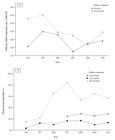
A: infant mortality rate according to infant mortality components (neonatal and post-neonatal), 1992-2010 (5 studies)25-28,32. B: proportional mortality in children under one year of age according to infant mortality components (early neonatal, late neonatal, and post-neonatal), 1990-2013 (5 studies)23,27,28,32,33.
In Figure 3-B, which contains Proportional Mortality in children under one year of age according to the components, early neonatal, late neonatal, and post-neonatal from 1990 to 2013, a substantial increase in the proportion of indigenous deaths for the post-neonatal component was observed from 1995 onwards, with a downward trend from 2008 onwards, while there is a stabilization in the proportions of infant mortality in the early neonatal and late neonatal components. In both graph A and graph B, it was observed that the number of deaths for the post-neonatal component remained above the neonatal infant component during all periods considered in this study23,27,28,32,33.
Discussion
The results of this study point to high mortality rates among indigenous children under five years of age, with emphasis on IMRs. Although reductions in IMR have been identified over time in studies that compared different periods, these remain considerably high when compared with non-indigenous populations9,16,17,20-22,30,35.
Among the studies that evaluated mortality by age components among children under one year of age, the highest rates and proportions of indigenous infant mortality were observed in the post-neonatal period23,25-28,32,33, which includes deaths in children with aged between 28 days and less than one year of age. In studies that analyzed the causes of mortality among indigenous children under five years of age, the main causes of death groups were diseases of the respiratory system, perinatal conditions, infectious and parasitic diseases, and deaths from ill-defined causes9,25,27,33,35. Such results are associated with a scenario with a greater relevance of deaths related to unfavorable living conditions (environmental, nutritional, and socioeconomic), as well as precarious access and quality of health actions provided to these people9,14,25-27,32,33,36.
In studies that specified the ethnic group under study15,17-22,24,26,27, variations in IMR and its components were observed between ethnic groups from different regions of Brazil, so much so that the Suyá ethnic group from the state of Mato Grosso, between 2000 and 2004, presented an IMR of 28.2/1,000 LB17, similar to the IMR for all of Brazil (29.7/1,000 LB) in the year 2000 according to the IBGE29. The Hupd’ah ethnic group, located in the state of Amazonas, expressed an IMR of 116.3/1,000 LB24 between 2000 and 2003. Such results demonstrate that such factors as ethnicity and geographic location influence the magnitude of IMR.
The discussion concerning the health of indigenous peoples in Brazil needs to consider the historical processes of social, economic, and environmental transformations, which have occurred in different regions of the country for centuries, which significantly interfered in the profile of the determinants of indigenous health in the country14. The Brazilian colonization process, aimed at economic expansion, triggered the spread of diseases, indigenous territorial usurpation, persecution, and the death of many indigenous people or even entire communities over the years14. Since then, indigenous populations, especially children, have experienced a high burden of disease, resulting from the countless inadequate circumstances to which they are subjected. Consequently, mortality indicators reveal a worse situation for indigenous children than for non-indigenous children, as observed in the studies investigated in the present review, reflecting the broad social and health inequality14,37.
The studies analyzed in this study also demonstrated that deaths occurring in the post-neonatal period are those that most contribute to the high mortality rates in children under one year of age. Post-neonatal mortality is an indicator that is related to the environmental, nutritional, and living conditions of a population38. In addition to this, the main basic causes of death identified by the present study are also linked to socioeconomic and environmental factors, mainly affecting more vulnerable population groups, subject to precarious housing, food, and hygiene conditions9,25,27,33,35.
A large part of the morbidities that affect indigenous peoples are related to unsatisfactory sanitation and housing circumstances. Several studies suggest that some indigenous populations live in poor basic sanitation conditions, face difficulties in accessing drinking water, and have inadequate sanitary practices, such as the disposal of human waste and solid waste in residential areas and close to springs. Such factors contribute to the high prevalence of intestinal parasites, the increase in respiratory diseases, diarrhea, and skin diseases14,39.
When analyzing the health conditions of indigenous peoples in Brazil, some morbidities are identified as more recurrent, such as: infectious-parasitic diseases (worms, diarrhea, tuberculosis, and malaria), diseases of the respiratory system (pneumonia, bronchitis, and asthma), metabolic diseases (such as malnutrition), and blood diseases (such as anemia). When dealing with the subject, it should be noted that these diseases and conditions could be resolved, or significantly reduced, with systematic and continuous primary health care (PHC) actions14,38,39.
Naturally, the lack of infrastructure for garbage collection and the lack of drinking water in villages lead to the widespread dissemination of parasites and intestinal infections14,38,39. Environmental conditions favorable to the transmission of intestinal worms and protozoa are also conducive to the contamination of drinking water and food by enterobacteria and rotavirus. The direct result of this scenario is the high morbidity and mortality related to gastroenteritis, which correspond to almost half of hospitalizations of indigenous children and 60% of child deaths40.
Among Brazilian indigenous peoples, hepatitis is an important cause of morbidity and mortality, with a high prevalence of types B and D5. This disease is considered serious and can progress to chronicity, leading to cirrhosis and liver cancer. Once this disease becomes chronic, the individual becomes the largest reservoir to spread the virus5. Although hepatitis A and E are milder, as they do not evolve into chronic forms, they are transmitted through fecal-oral contact, leading to large epidemics in regions with poor basic sanitation conditions5. Many customs and practices that are considered cultural with a ritualistic, cosmetic, and curative nature are also mechanisms of transmission of hepatitis viruses in different indigenous societies41.
Morbidities related to sanitation and housing conditions are also associated with the nutritional deficit that is often observed in indigenous children42. This is because infectious and parasitic diseases negatively influence an individual’s nutritional status, increasing the risk of malnutrition and anemia, as well as low weight and short stature in children, which, in turn, aggravate infections, making them more severe or prolonging their duration, especially in the first years of life39,42. One national survey carried out among the indigenous population of children under 60 months and women aged 14-49 years from all regions of the country, in 2008 and 2009, showed high percentages of anemia, low weight, and short stature in children, associated with worse socioeconomic levels, homes with poor sanitary conditions, and mothers who had anemia and hospitalizations of their children in the first months of life43,44.
Improving water quality, changing hygiene habits, adapting sewage systems, as well as environmental and health education are important interventions for disease control. However, these are complex actions that require knowledge and humanization to be effectively implemented, as they need to consider and respect the specificities of health and the diversity of indigenous peoples14,39.
With regard to the influence of ethnicity and geographic location on the magnitude of mortality rates, it is essential to consider the major social diversity that exists in the country and the fact that each indigenous ethnic group has sociocultural particularities that directly reflect on the health situation presented by these people40. Even small social or behavioral differences can produce important epidemiological differences between indigenous groups and be closely related to the health-disease process presented by these populations40.
The current model of indigenous health care in Brazil is based on a biomedical point of view, which emphasizes the planning and execution of health plans and services, assuming that only the transmission of information will automatically transform the population’s behavior in the face of disease. However, this method ignores several sociocultural factors that directly interfere with the attitude used towards the disease and the risk of falling ill40,45. To enable the success of health actions among indigenous peoples, it is essential to consider the cultural concepts of body, health/disease, contagion, treatment, and prevention that each of them has40,46. Although indigenous peoples currently receive medical care from Western health institutions in their territories, traditional systems of interpretation, prevention, and treatment of indigenous diseases are still the main health resources for the majority of these populations40,46.
Based on these traditional indigenous health systems, individuals distinguish between health and illness and establish what their relationship will be like with health professionals and the actions they carry out. In this sense, it is essential that indigenous health professionals understand the habits, beliefs, and health practices, as well as knowledge about treatment/prevention and health priorities for indigenous people, in order to ensure that the community understands, participates, and is engaged in the health actions employed40, 46, 47.
Taking this into account, some studies have been developed with the purpose of understanding the knowledge of health professionals regarding the particularities required for indigenous health care. A recently published study on the subject is the literature review developed by Reis and Borges (2019)48, whose main objective was to expose the difficulties faced by nurses in intercultural work. According to the authors, of the 18 articles selected, 89% reported that, among the main difficulties encountered, the most common was the cultural barrier, since beliefs and customs directly influence the providing of medical care; 78% declared the language barrier as a difficulty; 56% were unable to identify who or what the indigenous people attribute their illness to; and 44% did not understand the health-disease process in the indigenous view as something that goes beyond the physical body, involving spirits and invisible forces present in nature. For the authors, the lack of knowledge of the cultural specificities of the indigenous population on the part of health professionals leads to unpreparedness for intercultural action, contributing to the predominance of the biomedical model of care, which in turn does not value traditional indigenous health care systems48.
Other difficulties highlighted by health professionals in intercultural work, which hinder the providing of care and increase the risk of developing diseases in these ethnic minorities, include the difficulty in continuing care through health services; ethnic differences; language and illustrations in education booklets on health services that are inappropriate for the indigenous context; communication barriers with professionals; a lack of adequate means of transport to health units, among others49. Furthermore, there is evidence that the lack of physical infrastructure and human resources in indigenous communities, accompanied by a high turnover of professionals and the consequent discontinuity in the provision of health services, compromise the quality of care provided by the indigenous health care network50.
In the study conducted by Pícoli and Cazola (2019)23 in Mato Grosso do Sul, aimed at analyzing infant deaths in children under one year of age and their preventability criteria through self-declared skin color, based on the trienniums of 2005-2007, 2008-2010, and 2011-2013, the authors observe the predominance of the group of causes reducible by adequate health promotion and health care actions (42.9%, 31.2%, 38.5%, respectively) for indigenous children, when compared to the State and other ethnic categories, highlighting the need to improve healthcare services provided to indigenous children23. Another study, which analyzed infant mortality among indigenous and non-indigenous people in several micro-regions of Brazil, based on data from the 2010 Demographic Census and the Mortality Information System (Sistema de Informações sobre Mortalidade - SIM), found that indigenous infant deaths were, in general, preventable through interventions within the scope of PHC33.
It is also important to highlight the role of the quality of indigenous health data in this entire scenario, considering that adequate recording, access, and availability of information are essential in order to understand and evaluate health services, the health situation, and the health conditions of the lives of these people25. Some studies have observed problems related to the systematic recording of information for indigenous peoples, which cause distortions in indicators, resulting from low coverage and/or undercounting of deaths and births for indigenous peoples, incomplete variables, and a low quality of information on the basic causes of death, preventing these data from being overgeneralized to all people9,24,25,29,33.
Although the Indigenous Health Care Information System (Sistema de Informação da Atenção à Saúde Indígena - SIASI), developed to specifically serve the Brazilian indigenous population, was officially implemented in 2000, to this day, this base has some deficiencies that limit the analysis of indigenous health data and communication with the various information systems of the Ministry of Health (MH). Nevertheless, SIASI has great potential for a multiplicity of information on indigenous peoples, allowing the disaggregation of data at the level of villages and ethnicities, and even family units and individuals24,43,44.
The main limitations of the present study are those inherent to literature reviews of observational studies that used secondary databases in their analyses. Some of the selected studies highlighted the low quality of information on deaths and births. The quality of these data for the Brazilian indigenous population constituted an important limitation for studies on mortality, given that the reliability of the information can be compromised by health system coverage problems, mainly caused by the underreporting of deaths and errors in filling out information, such as in the ‘race/color’ field. Furthermore, despite the recognized importance of using these data, caution is needed when drawing comparisons and conclusions, especially related to indigenous peoples, given the methodological particularities used in each of the information systems and the significant social diversity between ethnicities, which includes an extensive variety of geographic contexts, acculturation, access to health services, and understanding of the health-disease process.
On the other hand, this is the first review study seeking to compile and organize information regarding mortality in Brazilian indigenous children under five years of age, enabling the visualization of the epidemiological profile of indigenous child deaths in Brazil based on previously published studies. Furthermore, seeking to improve the methodological precision of the study, PRISMA recommendations were used as a basis for the present review, with two independent reviewers for the selection and evaluation of studies. Therefore, the results presented here demonstrate the importance of measures that contribute to reducing existing social and health inequalities among the indigenous peoples of Brazil, in addition to providing subsidies to better monitor infant mortality among these peoples. However, more robust studies are still warranted, especially regarding mortality in indigenous children under five years of age in Brazil, as compared to non-indigenous children, seeking to explore the associated factors.
Conclusion
The present study highlighted a mortality profile among Brazilian indigenous children under five years of age, characterized by high mortality rates in children under one year of age. Among the components of infant mortality, the high number of deaths in the post-neonatal period stands out and the main groups of causes of death are diseases of the respiratory system, perinatal conditions, infectious and parasitic diseases, and deaths from ill-defined causes. Furthermore, important differences in IMR and its components were observed between the different ethnic groups studied in different regions of Brazil, corroborating those specific factors, such as ethnicity and geographic location, are clearly related to indigenous infant mortality, which may be a reflection of access to services and health plans aimed at indigenous peoples.
In other words, Brazilian indigenous children under the age of five experience important health inequities that promote a more unfavorable scenario for them when compared to non-indigenous children, thus depicting a profile that is intrinsically related to potentially preventable causes through improvements in socioeconomic conditions, basic sanitation, and the quality of healthcare resources.
The measures necessary to improve the national mortality scenario among indigenous children under five years of age are complex and corroborate the importance of developing more effective intersectoral public policies, as well as the improvement and better surveillance of health actions at the local, state, and national levels. In this sense, it is imperative that future studies on the subject consider the factors associated with high mortality rates among Brazilian indigenous children, providing an in-depth investigation into biological mechanisms, as well as socioeconomic and healthcare factors, so as to determine the living and health conditions of these people and reinforce the need to develop inclusive policies and investments that promote the reduction of existing social and health inequities.
References
-
1 United Nations Children's Fund (Unicef). Levels & Trends in Child Mortality: Report 2020 [Internet]. 2020. [cited 2020 dez 3]. Available from: https://www.unicef.org/reports/levels-and-trends-child-mortality-report-2020
» https://www.unicef.org/reports/levels-and-trends-child-mortality-report-2020 -
2 World Health Organization (WHO). World Health Statistics 2020: Monitoring health for the SDGs [Internet]. 2020. [cited 2020 set 20]. Available from: https://www.who.int/gho/publications/world_health_statistics/2020/en/
» https://www.who.int/gho/publications/world_health_statistics/2020/en -
3 Brasil. ONU: Brasil cumpre meta de redução da mortalidade infantil [Internet]. 2015. [acessado 2020 set 6]. Disponível em: http://www.brasil.gov.br/cidadania-ejustica/2015/09/onu-brasil-cumpre-meta-de-reducao-damortalidade-infantil
» http://www.brasil.gov.br/cidadania-ejustica/2015/09/onu-brasil-cumpre-meta-de-reducao-damortalidade-infantil -
4 United Nations (UN). United Nations Millennium Declaration [Internet]. 2000. [cited 2020 set 3]. Available from: www.un.org/millennium/declaration/ares552e.htm
» www.un.org/millennium/declaration/ares552e.htm - 5 Garnelo L. Saúde indígena: uma introdução ao tema. Pontes ALM, organizador. Brasília: Unesco, MEC; 2012.
- 6 Mendes AM, Leite MS, Langdon EJ, Grisotti M. O desafio da atenção primária na saúde indígena no Brasil. Rev Panam Salud Publica 2018; 42:184.
- 7 Renato Minoru Yamamoto, organizador. Manual de Atenção à Saúde da Criança Indígena Brasileira. Brasília: MS; 2004.
- 8 Coimbra Jr. CE, Santos RV, Welch JR, Cardoso AM, Souza MC, Garnelo L, Rassi E, Follér ML, Horta BL. The First National Survey of Indigenous People's Health and Nutrition in Brazil: rationale, methodology, and overview of results. BMC Public Health 2013; 13(1):52.
- 9 Ferreira MEV, Matsuo T, Souza RKT. Aspectos demográficos e mortalidade de populações indígenas do Estado do Mato Grosso do Sul, Brasil. Cad Saude Publica 2011; 27(12):2327-2339.
- 10 Campos MB, Borges GM, Queiroz BL, Santos RV. Diferenciais de mortalidade entre indígenas e não indígenas no Brasil com base no Censo Demográfico de 2010. Cad Saude Publica 2017; 33(5):e00015017.
- 11 Whittemore R, Knafl K. The integrative review: updated methodology. J Adv Nurs 2005; 52(5):546-553.
- 12 Mendes KDS, Silveira RCCP, Galvão CM. Revisão integrativa: método de pesquisa para a incorporação de evidências na saúde e na enfermagem. Texto Contexto Enferm 2008; 17(4):758-764.
- 13 Page MJ, McKenzie JE, Bossuyt PM, Boutron I, Hoffmann TC, Mulrow CD, Shamseer L, Tetzlaff JM, Akl EA, Brennan SE, Chou R, Glanville J, Grimshaw JM, Hróbjartsson A, Lalu MM, Li T, Loder EW, Mayo-Wilson E, McDonald S, McGuinness LA, Stewart LA, Thomas J, Tricco AC, Welch VA, Whiting P, Moher D. The PRISMA 2020 statement: an updated guideline for reporting systematic reviews. BMJ 2021; 372:n71.
- 14 Borges MFSO, Silva IF, Koifman R. Histórico social, demográfico e de saúde dos povos indígenas do estado do Acre, Brasil. Cien Saude Colet 2020; 25(6):2237-2246.
- 15 Souza LG, Santos RV. Perfil demográfico da população indígena Xavante de Sangradouro-Volta Grande, Mato Grosso (1993-1997), Brasil. Cad Saude Publica 2001; 17(2):355-365.
- 16 Pagliaro H. Demografia dos povos indígenas no Brasil. Azevedo MM, Santos RV, organizadores. Rio de Janeiro, Campinas: Editora Fiocruz, Associação Brasileira de Estudos Populacionais; 2005.
- 17 Pagliaro H, Carvalho N da S, Rodrigues D, Baruzzi RG. Demographic dynamics of the Suyá, a Jê people of the Xingu Indigenous Park, Central Brazil, 1970-2004. Cad Saude Publica 2007; 23(5):1071-1081.
- 18 Pagliaro H, Junqueira C, Mendaña LGS, Mendonça SB, Baruzzi RG. Dinâmica demográfica dos Kamaiurá, povo Tupi do Parque Indígena do Xingu, Mato Grosso, Brasil, 1970-1999. Rev Bras Estud Popul 2008; 25(2):377-388.
- 19 Souza LG, Pagliaro H, Santos RV. Perfil demográfico dos índios Boróro de Mato Grosso, Brasil, 1993-1996. Cad Saude Publica 2009; 25(2):328-336.
- 20 Souza LG, Santos RV, Coimbra Jr. CEA. Estrutura etária, natalidade e mortalidade do povo indígena Xavante de Mato Grosso, Amazônia, Brasil. Cien Saude Colet 2010; 15(Supl. 1):1465-1473.
- 21 Pagliaro H. A revolução demográfica dos povos indígenas no Brasil: a experiência dos Kayabí do Parque Indígena do Xingu, Mato Grosso, Brasil, 1970-2007. Cad Saude Publica 2010; 26(3):579-590.
- 22 Souza LG de, Santos RV, Pagliaro H, Carvalho MS, Flowers NM, Coimbra Jr. CEA. Demography and health of the Xavante Indians of Central Brazil. Cad Saude Publica 2011; 27(10):1891-1905.
- 23 Pícoli RP, Cazola LHO, Nascimento DDG. Mortalidade infantil e classificação de sua evitabilidade por cor ou raça em Mato Grosso do Sul. Cien Saude Colet 2019; 24(9):3315-3324.
- 24 Machado M, Pagliaro H, Baruzzi RG. Perfil demográfico dos Hupd'äh, povo Maku da região do Alto Rio Negro, Amazonas (2000-2003). Rev Bras Estud Popul 2009; 26(1):37-50.
- 25 Gava C, Cardoso AM, Basta PC. Infant mortality by color or race from Rondônia, Brazilian Amazon. Rev Saude Publica 2017; 51:35.
- 26 Pena JL, Heller L, Dias Júnior CS. A população Xakriabá, Minas Gerais: aspectos demográficos, políticos, sociais e econômicos. Rev Bras Estud Popul 2009; 26(1):51-59.
- 27 Cardoso AM, Coimbra Jr. CEA, Barreto CTG, Werneck GL, Santos RV. Mortality among Guarani Indians in Southeastern and Southern Brazil. Cad Saude Publica 2011; 27(Supl. 2):s222-s236.
- 28 Melchior SC, Soares DA, Andrade SM, Izumi RMK. Avaliação da mortalidade de grupos indígenas do norte do Paraná - 1990 a 1999. Inf Epidemiol SUS 2002;11(2):61-68.
- 29 Cardoso AM, Santos RV, Coimbra Jr. CEA. Mortalidade infantil segundo raça/cor no Brasil: o que dizem os sistemas nacionais de informação? Cad Saude Publica 2005; 21(5):1602-1608.
- 30 Garnelo L, Brandão LC, Levino A. Dimensões e potencialidades dos sistemas de informação geográfica na saúde indígena. Rev Saude Publica 2005; 39(4):634-640.
- 31 Júnior CSD, Verona APA, Pena JL, Machado-Coelho GLL. Desigualdades demográficas e socioeconômicas entre brancos e indígenas no Brasil. REDES 2010; 15(2):16.
- 32 Caldas ADR, Santos RV, Borges GM, Valente JG, Portela MC, Marinho GL. Mortalidade infantil segundo cor ou raça com base no Censo Demográfico de 2010 e nos sistemas nacionais de informação em saúde no Brasil. Cad Saude Publica 2017; 33(7):e00046516.
- 33 Marinho GL, Borges GM, Paz EPA, Santos RV. Mortalidade infantil de indígenas e não indígenas nas microrregiões do Brasil. Rev Bras Enferm 2019; 72(1):57-63.
- 34 Santos RV, Borges GM, Campos MB, Queiroz BL, Coimbra CEA, Welch JR. Indigenous children and adolescent mortality inequity in Brazil: what can we learn from the 2010 National Demographic Census? SSM Popul Health 2020; 10:100537.
- 35 Lima JFB, Silva RAR, D'Eça Júnior A, Batista RFL, Rolim ILTP. Analysis of the mortality trend in the indigenous population of Brazil, 2000-2016. Public Health 2020; 186:87-94.
- 36 Nascimento SG, Oliveira CM, Sposito V, Ferreira DK da S, Bonfim CV. Infant mortality due to avoidable causes in a city in Northeastern Brazil. Rev Bras Enferm 2014; 67(2):208-212.
- 37 França EB, Lansky S, Rego MAS, Malta DC, França JS, Teixeira R, Porto D, Almeida MF, Souza MFM, Szwarcwald CL, Mooney M, Naghavi M, Vasconcelos AMN. Principais causas da mortalidade na infância no Brasil, em 1990 e 2015: estimativas do estudo de Carga Global de Doença. Rev Bras Epidemiol 2017; 20(Supl. 1):46-60.
- 38 Ferrari RAP, Bertolozzi MR. Mortalidade pós-neonatal no território brasileiro: uma revisão da literatura. Rev Esc Enferm USP 2012; 46(5):1207-1214.
- 39 Borges MFSO, Silva IF, Koifman RJ. Morbidade hospitalar em populações indígenas do Brasil. Rev Eletr Acervo Saude 2017; 9:1328-1340.
-
40 Barros DC, Silva DO, Gugelmin SA. Vigilância alimentar e nutricional para a saúde Indígena [Internet]. 2007. [acessado 2020 nov 24]. Disponível em: http://books.scielo.org/id/fyyqb
» http://books.scielo.org/id/fyyqb - 41 Coimbra Jr. CEA, Santos RV. Saúde, minorias e desigualdade: algumas teias de inter-relações, com ênfase nos povos indígenas no Brasil. Cien Saude Colet 2000; 5(1):125-132.
- 42 Leite MS, Cardoso AM, Coimbra CE, Welch JR, Gugelmin SA, Lira PCI, Horta BL, Santos RV, Escobar AL. Prevalence of anemia and associated factors among indigenous children in Brazil: results from the First National Survey of Indigenous People's Health and Nutrition. Nutr J 2013; 12:69.
- 43 Horta BL, Santos RV, Welch JR, Cardoso AM, Santos JV, Assis AMO, Lira PC, Coimbra CE Jr. Nutritional status of indigenous children: findings from the First National Survey of Indigenous People's Health and Nutrition in Brazil. Int J Equity Health 2013; 12:23.
- 44 Coimbra Jr. CEA. Saúde e povos indígenas no Brasil: reflexões a partir do I Inquérito Nacional de Saúde e Nutrição Indígena. Cad Saude Publica 2014; 30(4):855-859.
- 45 Uchôa E, Vidal JM. Antropologia médica: elementos conceituais e metodológicos para uma abordagem da saúde e da doença. Cad Saude Publica 1994; 10(4):497-504.
- 46 Brasil. Fundação Nacional de Saúde (FNS). Política Nacional de Atenção à Saúde dos Povos Indígenas. Brasília: MS; 2002.
- 47 Diehl EE, Pellegrini MA. Saúde e povos indígenas no Brasil: o desafio da formação e educação permanente de trabalhadores para atuação em contextos interculturais. Cad Saude Publica 2014; 30(4):867-874.
- 48 Reis LS, Borges RCF. Política nacional de atenção à saúde dos povos indígenas: atuação do enfermeiro no contexto intercultural. Rev Inst Cienc Saude 2019; 37:178-181.
- 49 Gomes SC, Esperidião MA. Acesso dos usuários indígenas aos serviços de saúde de Cuiabá, Mato Grosso, Brasil. Cad Saude Publica 2017; 33(5):e00132215.
- 50 Sandes LFF, Freitas DA, Souza MFNS, Leite KB de S. Primary health care for South-American indigenous peoples: an integrative review of the literature. Rev Panam Salud Publica 2018; 42:e163.

 Source: Authors.
 Source: Authors.
 Source: Authors.