
 Premature mortality due to non-communicable diseases and deprivation in a Brazilian state capital
This study aims to investigate the inequality in the distribution of premature mortality from non-communicable chronic diseases (NCDs) in the city of Belo Horizonte and its temporal evolution. Descriptive ecological study. Mortality rates were calculated according to the Brazilian Deprivation Index (BDI) in 2010-2012 (T1) and 2017-2019 (T2). The rates and the percentage variation (PV) were compared by BDI and triennia. Higher rates were found in the most deprived group in both T1 and T2 for: all NCDs (T1=287.4; T2=272.2), cardiovascular diseases (T1=132.7; T2=105.1); diabetes (T1=18.0; T2=22.1); and chronic respiratory diseases (T1=19.5; T2=15.6). The rates decreased in all BDI strata, with greatest reduction in the least deprived strata for NCDs (PV=-22.4%) and cardiovascular diseases (PV=-37.2%). Rates for neoplasms and diabetes increased in the most deprived stratum (PV=10.4% and PV=22.6%), while rates for respiratory diseases increased in the least deprived stratum (PV=5.3%). The most deprived strata showed lower reductions in the risk of dying from the set of NCDs, cardiovascular diseases, neoplasms and diabetes, increasing the inequalities between the most and the least deprived groups.
Key words:
Noncommunicable Diseases; Premature Mortality; Health Inequality Monitoring; Social Deprivation; Ecological Studies
 Thumbnail
 Thumbnail
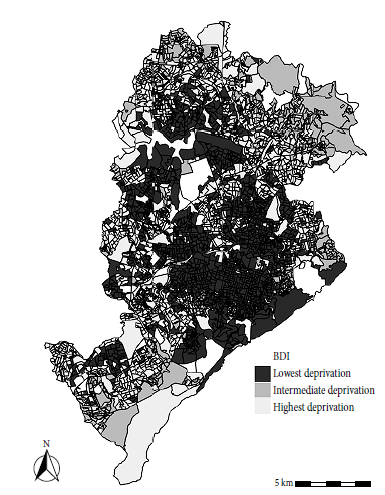 Note: BDI = Brazilian Deprivation Index; Lowest deprivation = 1st quintile; Intermediate deprivation = 2nd quintile; Highest deprivation = 3rd, 4th and 5th quintiles of BDI.Source: Authors.
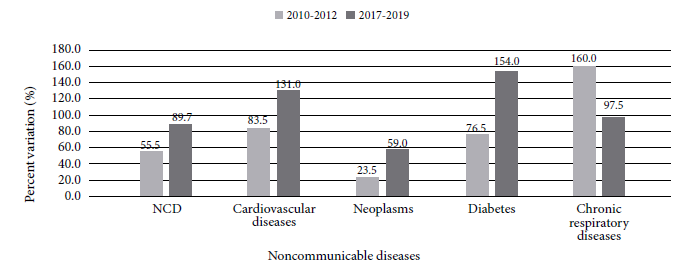 Note: the NCD category consists of the four main groups of chronic diseases (cardiovascular, neoplasms, diabetes, and chronic respiratory) combined. Source: Authors.