| Baral et al. 22/Nepal |
Low-income |
I1: 33 I2: 42 C: 81 |
7 DOTS-plus centers |
Mixed-method (intervention and qualitative) |
MDR-TB patients (Jan-Dec 2008) |
I1: counselling. I2: counselling and financial support |
Cure (I1: 85%; I2: 76%; C: 67%) |
| Cantalice Filho 37/Brazil |
Upper middle-income High TB-burden |
142 (I: 74, C: 68) |
Primary care clinics in Duque de Caxias, Rio de Janeiro State |
Retrospective comparative study (7 points) |
≥ 15 years old with confirmed TB diagnosis (Jan 2004-Jul 2006) |
Monthly food baskets delivered in the healthcare clinic |
Cure (I: 87.1%; C: 69.7%) |
| Ciobanu et al. 27/Republic of Moldova |
Lower middle-income |
4,870 (I: 2378, C: 2492) |
National data, before (2008) and after (2011) incentives |
Retrospective cohort study (14 points) |
≥ 18 years old, TB patients treated in 2008 and in 2011 |
Cash, non-cash or both incentives. (I: groups that received cash) |
TSR (I: 88%; C: 79%; p < 0.001) |
| Clarke et al. 31/South Africa |
Upper middle-income High TB-burden |
89 (I: 47, C: 42) |
211 farms (I: 106; C: 105) |
Cluster randomized controlled trial |
Permanent farm dwellers ≥ 15 years old treated (from Nov 1, 2000 to Oct 31, 2001) |
Adult farm dwellers trained as lay health workers |
TSR (I: 83%; C: 64.3%; p = 0.042) |
| Datiko & Lindtjørn 19/Ethiopia |
Low-income High TB-burden |
318 (I: 230, C: 88) |
51 kebeles in two rural districts of Southern Ethiopia |
Community-randomized trial |
All new smear-positive pulmonary TB cases |
Trained community health workers |
TSR (I: 89.3%; C: 81.3%; p = 0.012) |
| Demissie et al. 20/Ethiopia |
Low-income High TB-burden |
128 (I: 64, C: 64) |
2 rural districts of Northern Ethiopia |
Mixed-method - cohort and qualitative (12 points) |
Smear-positive TB patients (from July 1 to Oct 15, 1998) |
TB patients in rural kebeles organized in “TB clubs” |
TCR (I: 68.7%; C: 46.8%; p = 0.02) |
| Gärden et al. 23/Russia |
High-income High TB-burden |
518 (I: 142, C: 376) |
St. Petersburg’s TB dispensary |
Historical controlled intervention study (11 points) |
Homeless patients referred to TB dispensary (from Dec 2001 to Jan 2004) |
Food packages delivered once a day 5 days a week and support from a social worker |
TSR (I: 78.2%; C: 31.0%) |
| Jakubowiak et al. 24/Russia |
High-income High TB-burden |
1,389 (I: 382, C: 1,007) |
4 regions with TB services |
Cross-sectional study (5 points) |
New pulmonary TB patients ≥ 15 years old treated (from Jan 1, 2004 to Mar 31, 2005) |
Social support during TB treatment (food packs, hygiene kits, transportation incentives, etc.) |
28.1% of adherents and 18.4% of non-adherents with incentives |
| Kliner et al. 29/Swaziland |
Lower middle-income |
1,077 (I: 161, C: 916) |
Hospital in a rural district |
Pragmatic controlled interventional study (12 points) |
TB patients (Jan 2010-Sep 2011) |
Treatment support from community workers |
TSR (I: 73% vs. C: 60%; p = 0.003) |
| Lönnroth et al. 38/Myanmar |
Lower middle-income High TB-burden |
253 (non-controlled) |
National case notification data and survey in clinics in Yangon |
Cross-sectional study (10 points) |
All patients treated in Sun Quality Health (SQH) clinics in Yangon (from Sep 1 to Oct 30 2004) |
Sun Quality Health (SQH), a social franchise that licensed practitioners with clinics serving low-income people |
TSR for new smear-positive cases was 84% |
| Lutge et al. 43/South Africa |
Upper middle-income High TB-burden |
4,091 (I: 2,107, C: 1,984) |
20 public sector clinics in Kwazulu-Natal |
Cluster-randomized controlled trial |
TB patients within (July 1, 2009 to Mar 31, 2010) |
Monthly vouchers (US$ 15) redeemable at specific general stores |
TSR (I: 76.2% vs. C: 70.7%; p = 0.107) |
| Martins et al. 30/Timor-Leste |
Lower-middle income |
265 (I: 136, C: 129) |
3 primary clinics in Dili: government, private and church operated) |
Randomized controlled trial |
TB patients aged ≥ 18 and that agree to treatment at diagnostic clinic for eight months |
Daily meal in attendance to the clinic and unprepared food to take home, in continuation phase |
TSR (I: 76% vs. C: 78%; p = 0.7) |
| Ngamvithayapong-Yanai et al. 35/Thailand |
Upper middle-income High TB-burden |
759 (I: 192, C: 567) |
Chiang Rai, Thailand’s northern province |
Intervention study - before and after (7 points) |
Extremely poor TB patients, living alone, with elderly caregivers or isolated from community |
Engagement of Chiang Rai women’s organization to support them financially and socially |
TSR (I: 69.3% vs. C: 51.6%; p < 0.00) |
| Ritchie et al. 21/Malawi |
Low-income |
110 (I: 30, C: 80) |
28 health centers in Zomba district |
Cluster randomized controlled trial |
All lay health workers involved in providing care to TB patients |
Two knowledge translation interventions: educational outreach and reminders |
TSR (I: 70% vs. C: 58%; p = 0.578) |
| Rocha et al. 28/Peru |
Upper middle-income |
1,861 (I: 307, C: 1,554) |
Eight contiguous slums in Northern Lima |
Intervention study (4 points) |
Subsequently diagnosed TB patients and their household contacts (Dec 2007-Oct 2010) |
Household visits, counselling, food and cash transfers, microenterprise, microcredits and training |
TSR (91% before vs. 97% after intervention) |
| Singh et al. 32/India |
Lower middle-income High TB-burden |
617 (I:1 41, C: 476) |
One tuberculosis unit covering a population of 600,000 in Haryana State |
Intervention study (10 points) |
New sputum smear-positive patients registered in the tuberculosis unit for treatment |
Directly Observed Treatment (DOT) from community volunteers vs. government health workers |
TSR (I: 78% vs. C: 77%) |
| Soares et al. 33/Brazil |
Upper middle-income High TB-burden |
2,623 (I: 1,771, C: 852) |
Rocinha Favela, the largest urban slum in South America |
Intervention study (before and after) (13 points) |
All patients with pulmonary or extra-pulmonary TB who started treatment between 2001 and 2008 |
DOT implementation and training 40 lay persons as community health workers |
TSR (83.2% vs. 67.6%; p < 0.001) pre- and post-intervention |
| Sripad et al. 25/Ecuador |
Upper middle-income |
191 (I: 105, C: 86) |
Ecuador’s NTP |
Non-randomized trial with historical controls (8 points) |
Drug-resistant (DR-TB) patients (from Aug 2011 to Jan 2012 - intervention and from Jan to Aug 2010 - pre-program) |
Ecuador’s NTP enacted a monetary incentive program giving adherent DR-TB patients a USD 240 bonus each month |
1-year default rate (9.5% vs. 26.7%; p < 0.05), in program and pre-program |
| Sudarsanam et al. 36/India |
Lower middle-income High TB-burden |
97 (I: 48, C: 49) |
One of four clinics in Vellore town, southern Indian state of Tamil Nadu |
Randomized controlled trial |
Patients aged > 12 years diagnosed with TB (recruited between Jan and Nov 2005) |
Macronutrient supplement (cereal and lentil mixture) and micronutrients (one-a-day multivitamin table) |
Higher poor outcomes in the non-supplemented HIV-TB co-infected group |
| Torrens et al. 42/Brazil |
Upper middle-income High TB-burden |
7,255 (I: 5,788, C: 1,467) |
Brazilian national databases (SINAN and CadÚnico) |
Retrospective cohort (14 points) |
All new TB cases diagnosed in 2010, recorded in SINAN database and registered in CadÚnico |
Brazilian national conditional cash transfer (Brazilian Income Transfer Program) |
Cure rates (I: 82.1% vs. C: 76.9%; p < 0.001) |
| Wei et al. 39/China |
Upper middle-income High TB-burden |
183 (I: 90, C: 93) |
2 districts of Shanghai (1 intervention/1 control) |
Controlled intervention study - before and after (8 points) |
Poor migrants TB patients |
Financial incentives to poor migrant TB patients (transportation and living subsidies) |
TCR (I: from 78% to 89%; and C: from 73% to 76%; p = 0.03) |
| Yao et al. 40/China |
Upper middle-income High TB-burden |
9,194 (I: 5,449, C: 3,745) |
Fifty poor counties of Shanxi (Fidelis project) and 51 control counties |
Pilot evaluation study (8 points) |
New TB cases in baseline (Jan-Sep 2004) and during the intervention (Jan-Sep 2005) using routine TB reporting data |
Financial incentives for doctors. Incentives to village leaders for community health education |
TSR baseline (I: 95.3 vs. C: 93.9%; p < 0.01); project (I: 96.9 vs. C: 96.9%; p > 0.05) |
| Zou et al. 41/China |
Upper middle-income High TB-burden |
356 (I: 263, C: 93) |
Three districts located in Shanghai: (i) Communicable Disease Research Consortium (COMDIS), (ii) The Global Fund Project, (iii) control |
Intervention study (case study) - before and after (8 points) |
Poor migrants TB patients living in Shanghai, China, targeted by two projects involving financial incentives (introduced in Oct 2007) |
COMDIS: single living and transportation subsidies Global Fund Project: living and, transportation incentives, plus incentives to clinic staff for each extended working hour |
TCR District I (78 vs. 89%); District II (73 vs. 88%); Control (73 vs. 76%). |
| Zwarenstein et al. 34/South Africa |
Upper middle-income High TB-burden |
98 (I: 54, C: 44) |
Four clinics in Elsies River, suburb (20km from Cape Town) |
Randomized controlled trial |
Adult (aged > 15 years) pulmonary TB patients, who started TB treatment (new and retreatment) |
Supervision by volunteers lay health workers in a poor community/Supervision by clinic nurse/Self-supervision |
% of success: lay health workers (74%), clinic DOT (57%) and self-supervision (59%) |
| Álvarez Gordillo et al. 26/Mexico |
Upper middle-income |
87 (I: 44, C: 43) |
Health centers in Chiapas |
Controlled intervention study |
>15 years old with sputum smear-positive pulmonary TB (Feb 2001-Jan 2002) |
Training program for health professionals and self-help groups for TB patients |
TSR (I: 97.7%; C: 81.4%) |

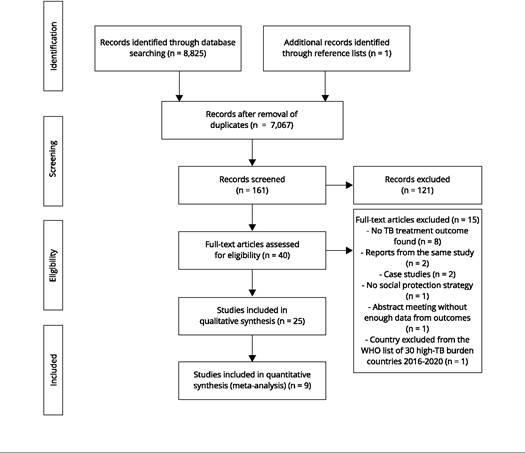
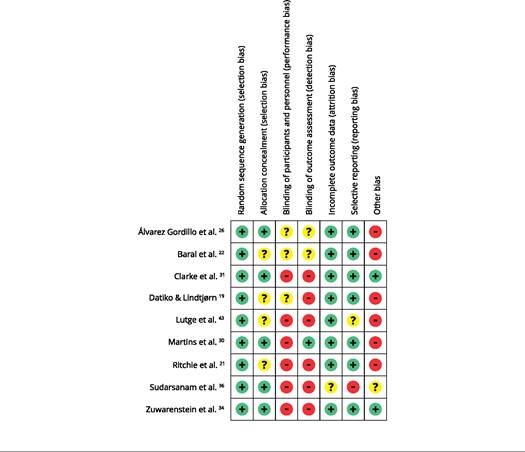
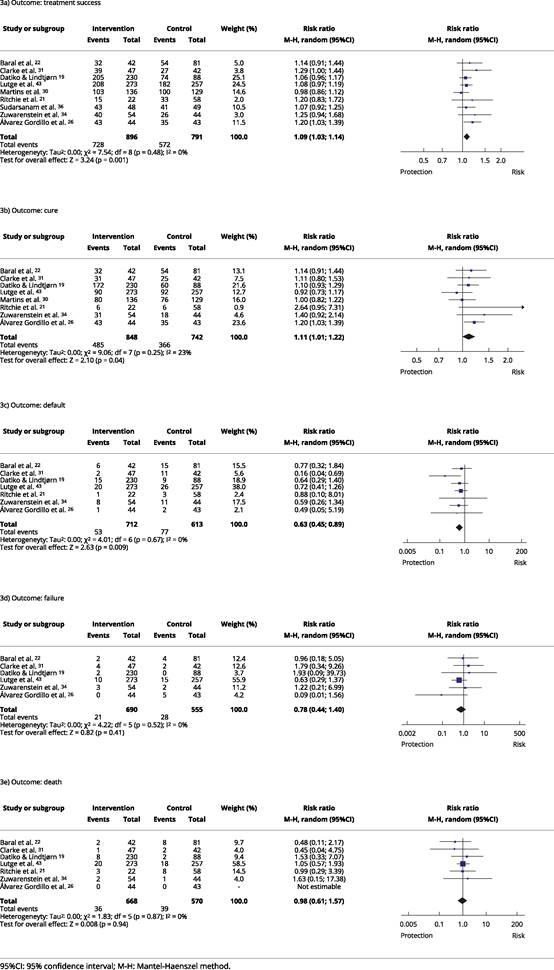
 Effects of social protection on tuberculosis treatment outcomes in low or middle-income and in high-burden countries: systematic review and meta-analysis
 Thumbnail
 Thumbnail
 Thumbnail