
 Prevalence of autism spectrum disorder in children: complete census of a Brazilian municipality
Abstract:
The prevalence of autism spectrum disorder (ASD) has been an issue of great concern worldwide, leading to attempts to estimate prevalence based on population samples, including those conducted in Brazil. No epidemiological study in this field has covered an entire population. We aimed to determine the prevalence of ASD in a Brazilian population. This complete census was conducted from March to December 2024 in the municipality of Coxilha, Rio Grande do Sul State, Brazil. All children aged 2.5 to 12 years were screened using the Mini-TEA scale. Children with a score above the 100% sensitivity threshold (> 4 points) were then examined by a neurologist with experience in ASD to establish the diagnosis according to the Diagnostic and Statistical Manual of Mental Disorders. Demographic data were obtained. There was no refusal to participate. Among the 475 children (240 boys and 235 girls), we found 16 ASD cases (15 boys and 1 girl), i.e., 1 in 30 children (1 in 16 boys and 1 in 235 girls), yielding an overall prevalence of 3.36% (6.25% among boys and 0.42% among girls). All ASD cases had also been diagnosed by other professionals. Only one child’s previous diagnosis of ASD was rejected. ASD showed a high prevalence and male predominance in this unprecedented complete census. The overall prevalence is similar to that reported in the United States but higher than previous Brazilian estimates. Further research is necessary to investigate etiological factors.
Keywords:
Autism Spectrum Disorder; Child; Censuses; Prevalence
Resumo:
A frequência do transtorno do espectro autista (TEA) tem sido motivo de grande preocupação em todo o mundo, levando a tentativas de estimar os números com base em amostras populacionais, inclusive no Brasil. Não existe estudo epidemiológico nesta área que abranja uma população inteira. Nosso objetivo foi obter o dado de prevalência no Brasil. Este censo completo foi realizado de março a dezembro de 2024 no Município de Coxilha, Rio Grande do Sul. Todas as crianças de 2,5 a 12 anos de idade foram avaliadas com o auxílio da escala Mini-TEA. As crianças com pontuação acima do limiar de sensibilidade de 100% (> 4 pontos) foram então examinadas por um neurologista com experiência em TEA para definir o diagnóstico de acordo com o Manual Diagnóstico e Estatístico de Transtornos Mentais. Dados demográficos foram coletados. Não houve recusa em participar da pesquisa. Entre as 475 crianças (240 meninos e 235 meninas), encontramos 16 casos de TEA (15 meninos e 1 menina), ou seja, um caso de TEA para cada 30 crianças (1 para 16 meninos e 1 para 235 meninas), resultando em uma proporção de 3,36% de crianças com TEA (6,25% dos meninos e 0,42% das meninas). Todos os casos de TEA também foram diagnosticados por outros profissionais. Apenas o diagnóstico anterior de TEA de uma criança foi descartado. O TEA apresentou alta prevalência e predominância masculina neste censo completo inédito. A prevalência geral é semelhante à relatada nos Estados Unidos, porém maior do que estimativas brasileiras anteriores. Mais pesquisas são necessárias para investigar fatores etiológicos.
Palavras-chave:
Transtorno do Espectro Autista; Criança; Censos; Prevalência
Resumen:
La prevalencia del trastorno del espectro autista (TEA) ha sido motivo de gran preocupación a nivel mundial, llevando a que se hayan realizado intentos por estimar las cifras a partir de muestras de la población, incluso en Brasil. No existe ningún estudio epidemiológico en este campo que abarque a toda la población. Nuestro objetivo fue obtener la cifra de prevalencia en Brasil. Este censo completo se efectuó entre marzo y diciembre de 2024 en el municipio de Coxilha, estado de Rio Grande do Sul, Brasil. Se evaluó a todos los niños de entre 2,5 y 12 años mediante la escala Mini-TEA. Posteriormente, los niños con una puntuación superior al umbral de sensibilidad del 100% (> 4 puntos) fueron examinados por un neurólogo con experiencia en el TEA para establecer el diagnóstico de acuerdo con el Manual Diagnóstico y Estadístico de los Trastornos Mentales. Se recopilaron datos demográficos. No hubo ningún caso de rechazo a participar en la encuesta. Entre los 475 niños (240 niños y 235 niñas) se identificaron 16 casos de TEA (15 niños y 1 niña), es decir, un caso de TEA por cada 30 niños (1 por cada 16 niños y 1 por cada 235 niñas), lo que da como resultado una proporción del 3,36% de niños con TEA (6,25% de los niños y 0,42% de las niñas). Todos los casos de TEA también habían sido diagnosticados por otros profesionales. Solo se rechazó el diagnóstico previo de TEA de un niño. El TEA presentó una gran prevalencia y un predominio masculino en este censo completo sin precedentes. La prevalencia general es similar a la reportada en Estados Unidos, pero más alta que las estimaciones brasileñas anteriores. Se justifica realizar más investigaciones para estudiar los factores etiológicos.
Palabras-clave:
Trastorno del Espectro Autista; Niño; Censos; Prevalencia
Introduction
The diagnostic criteria of autism spectrum disorder (ASD) require persistent deficits in social communication and interaction across multiple contexts, as well as restricted, repetitive patterns of behavior, interests, or activities 1. These symptoms must impair social, occupational, or other important areas of functioning 1. No biomarkers specific to the diagnosis of ASD have been identified 2. The gold standard of diagnosis is the careful observation of the individual’s behavior and interviews with caregivers conducted by experienced professionals 2, focused on the presence of developmental abnormalities and behaviors typically first evident in infancy or childhood 1.
The prevalence of ASD has been an issue of great concern, leading to several attempts to estimate the true prevalence. In an incomplete census performed in Scotland in 2011 3, the prevalence estimate - derived from parental reports and complemented by a projection for non-responders - was 2.9% at age 11. On the other hand, a recent meta-analysis of 79 studies worldwide found a pooled prevalence of 0.72% 4, but estimates were higher for studies that used records-review surveillance rather than other designs, in North America compared with other geographical regions, and in high-income compared with low-income countries. In the United States, a survey periodically reviews the registries of active surveillance programs. It extracts data from developmental evaluations and records from community medical and educational service providers in several states 4. The 2022 survey estimated that 1 in 31 children aged 8 years had ASD, a figure higher than previous estimates using the same method, suggesting that both the prevalence and the rate of diagnosis of ASD are increasing 5.
In Brazil, few studies based on questionnaires administered to mothers or caregivers aiming to estimate the prevalence of psychiatric disorders in childhood and early adolescence described symptoms suggestive of ASD in 0.3% to 0.5% of samples from Pelotas and Porto Alegre (Rio Grande do Sul State), and São Paulo 6,7,8. A survey conducted in Atibaia (São Paulo) using standardized instruments and clinical evaluations in a sample of children found an ASD prevalence of only 0.27% 9. These figures are much lower than those reported in the United States and highlight the critical need for greater research and surveillance efforts in Brazil 10.
Although using different approaches, all the aforementioned surveys estimated ASD frequency. Therefore, this study aimed to determine the prevalence by a complete census that assessed all children aged 2.5 to 12 years from a Brazilian municipality.
Methods
This complete census was conducted from March to December 2024 in the municipality of Coxilha, Rio Grande do Sul, the southernmost state in Brazil. The study was approved by both the mayor of the municipality and the Research Ethics Committee of the University of Passo Fundo (approval n. 6,462,894, October 26, 2023), which was created in 2000 and is registered under number 5,342 with the Brazilian National Health Council. The survey was carried out in accordance with the Helsinki Declaration.
This collaborative initiative involved the UPF School of Medicine and the Association of Parents and Friends of Exceptional Children (APAE, acronym in Portuguese) of Passo Fundo. The APAE system is a nationwide network of entities devoted to the social, educational, and health care of people with disabilities. The APAE of Passo Fundo houses a Regional Reference Center for ASD of the TEAcolhe Program, a program for improving the diagnosis and management of ASD supported by the state government of Rio Grande do Sul. This survey was nested within the research portfolio of that program.
The population of Coxilha consisted of 2,667 inhabitants according to the Brazilian census conducted in 2022 11. The municipality is divided into seven areas, four of which are rural. All families are visited regularly by community health workers, which allowed the creation of a municipal population registry, including those who moved in and out during the study period. According to this registry, there were 475 children aged 2.5 to 12 years in 2024. Most of them were enrolled in the two schools maintained by the municipality.
In the first phase of the survey, we invited the children’s parents (or guardians) in both schools to participate and obtained their written consent. When possible (if the child was literate), we also obtained the child’s assent. Then, a face-to-face interview with the parents/guardians was conducted to screen for ASD using the Mini-TEA scale, a questionnaire recently developed and validated in Brazilian Portuguese, designed for adults responsible for children aged 2.5 to 12 years (from ≥ 2.5 years to < 13 years) 12.
The scale yields a score ranging from 0 to 15, with 98.3% sensitivity for ASD at a cutoff score > 8. To determine the prevalence of ASD, we employed the cutoff score with 100% sensitivity (higher than 4) 12.
In the second phase, after screening the students, we located all children of the target age in both urban and rural areas whose parents/guardians had not been interviewed at the schools. This was accomplished with the help of the community health workers who were regularly updating the municipal population registry, resulting in complete coverage of the target population. There was no refusal to participate in the survey.
In parallel with the first and second screening phases, all children whose parents/guardians scored above 4 on the Mini-TEA scale were evaluated by a single neurologist with experience in neurodevelopmental disorders according to the criteria of the Diagnostic and Statistical Manual of Mental Disorders, 5th Edition, Text Revision (DSM-5-TR) 1.
Demographic data from all 475 children included age, sex, and area of origin (urban or rural). We recorded the diagnoses of ASD and other neurodevelopmental disorders established during the evaluation of children whose parents/guardians scored above 4 on the Mini-TEA scale. The time spent interviewing parents/guardians during screening was also recorded.
Categorical variables are presented as absolute numbers and percentages; quantitative data are described with median and interquartile range (IQR) because of asymmetric distribution. Only descriptive statistics were performed to describe the study population as this survey is a complete census and does not require inferential statistics derived from samples 13.
Results
Figure 1 shows the study flowchart. Among the 475 children aged 2.5 to 12 years (240 boys and 235 girls), we identified 16 ASD cases (15 boys and 1 girl). This corresponds to 1 in 30 children (1 in 16 boys and 1 in 235 girls), i.e., an overall prevalence of 3.36% (6.25% of boys and 0.42% of girls).
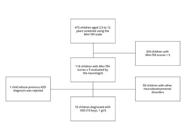
Study flowchart from screening of the target population to diagnostic confirmation of autism spectrum disorder (ASD) cases.
The children diagnosed with ASD had already been diagnosed or were diagnosed during the research period by other professionals (neurologists or psychiatrists). Notably, the study neurologist rejected only one child’s previous ASD diagnosis because the child did not meet the diagnostic criteria.
Table 1 presents the demographic characteristics of the total population and of the ASD and non-ASD groups. The distribution of Mini-TEA scores across the population is shown in Figure 2, and the scores for the ASD cases are shown in Figure 3. Scores for the ASD cases ranged from 9 to 15, with most scores being 14 or 15. The median time spent administering the screening scale to parents/guardians was 7.1 minutes (IQR: 6-9.5 minutes).


Table 2 describes the frequency of neurodevelopmental disorders among children who scored above 4 on the Mini-TEA scale (116 subjects, i.e., 24.4% of the study population). All children with such a diagnosis or with symptoms consistent with other clinical or psychiatric conditions were referred for neurological, psychiatric, or pediatric follow-up as appropriate.
Discussion
This is the first survey to evaluate an entire population for ASD. We screened all children of the target age and carefully examined those with Mini-TEA scores above the threshold corresponding to 100% sensitivity, without any refusal - an unprecedented complete census.
Our findings show a high prevalence of ASD, which we partly attribute to the complete population coverage. The prevalence estimate is indeed very close to that published in the most recent bulletin of the U.S. Autism and Developmental Disabilities Monitoring (ADDM) Network 5. The ADDM Network surveillance, conducted periodically in the United States, is considered the most robust epidemiological survey, even though it does not directly evaluate the children. The convergence of results, despite different approaches, locations, and populations, supports the observed prevalence estimate.
Previous studies on the prevalence of symptoms suggestive of ASD in a few Brazilian cities found figures much lower than those reported in our survey 6,7,8,9, probably because of methodological limitations, including the sampling method 10. The Brazilian Institute of Geography and Statistics (IBGE, acronym in Portuguese), the Brazilian agency responsible for the national census, recently published a note indicating an estimate of the frequency of ASD in the population according to age, derived from the incomplete census conducted in 2022 14. The highest figure was 2.6% (1 in 38) among children aged 5 to 9 years. We believe this is an underestimate due to the sampling methods: census agents did not visit all households; only a proportion of respondents were randomly asked about an ASD diagnosis among household members; and those reported to have ASD were not clinically evaluated by the census agents. A similar methodology was used in Scotland in 2011 and yielded an estimated prevalence of 2.9% at age 11, with the same limitations 3.
This epidemiological survey reinforces the value of the Mini-TEA as a screening method for ASD in Brazilian Portuguese and its clinical cut-off score (≥ 9) with high sensitivity 12. Most children had a low score, whereas all cases of ASD scored from 9 to 15. In a context where the Modified Checklist for Autism in Toddlers, Revised with Follow-up (M-CHAT-R/F) is not widely used for children under 2.5 years, despite the availability of a translated and validated form 15,16, the Mini-TEA scale provides a second opportunity for those who were not screened previously. A theoretical limitation of the survey is the absence of diagnostic evaluation in children who scored below the screening cut-off score (< 5 points) on the Mini-TEA scale, potentially resulting in false-negative cases. However, the scale was validated in two studies involving hundreds of children evaluated for fulfillment of DSM-5-TR criteria 12,17, a large proportion of whom had ASD. The cut-off score used in this survey had 100% sensitivity in those studies.
ASD was not the only diagnosis associated with moderate or high Mini-TEA scores, an expected finding given the scale’s moderate specificity (59% at a cut-off ≤ 8). This explains the 50 cases of other neurodevelopmental disorders diagnosed among the 116 children who scored above 4.
The DSM-5-TR criteria were chosen because of logistical and economic constraints. Established diagnostic instruments such as the Autism Diagnostic Observation Schedule, 2nd Edition (ADOS-2), and the Autism Diagnostic Interview - Revised (ADI-R) are expensive and time-consuming, making them infeasible for an extensive census. This should be recognized as a limitation, particularly because the comprehensive clinical evaluation such tools can provide was not obtained. Another limitation is the lack of a second rater for diagnostic confirmation; all diagnoses were made by a single neurologist, albeit one with expertise in neurodevelopmental disorders, which raises the possibility of measurement bias. However, all children diagnosed with ASD by the study neurologist had been diagnosed previously or during the research period by other attending neurologists.
Although ASD is highly familial, indicating a strong genetic contribution, epigenetic and environmental factors may also play important roles 18. This complexity makes identifying possible etiologic factors challenging. The absence of an etiological investigation in our survey is a limitation, but the study was not designed for that purpose.
Male predominance is a ubiquitous finding worldwide 5,19,20, but our male-to-female ratio was the highest ever reported. This inevitably raises concern, reflecting a current issue in the literature: the possibility of underdiagnosis among females 21,22,23. Many girls with ASD exhibit mild symptoms and may escape early diagnosis, being identified only in adulthood, if ever 21. In addition, the use of ADOS as a confirmatory diagnostic measure has been linked to the exclusion of females with ASD from the research studies at a rate over 2.5 times higher than that of males with ASD 22. This concern does not apply to our survey because we did not use ADOS. Nonetheless, the possibility of missing a girl with extremely mild ASD cannot be completely excluded, although we consider it remote because we screened all children from the community with a high sensitivity instrument and evaluated all those above the cut-off. Resolving this issue requires further census-based studies to avoid sampling bias and to determine the true prevalence of ASD.
An additional limitation is that Coxilha is a small municipality with a predominantly agricultural economy and a significant proportion of inhabitants living in rural areas, a reality far different from that of medium-sized and large cities. This may limit the generalization of our results to the Brazilian population. Nevertheless, this pioneer initiative serves as a starting point to encourage further epidemiological research in Brazil. Sampling strategies in different settings will be necessary, given the logistical obstacles to conducting a complete census in a large urban population. We emphasize the importance of this study for planning the health resources required to adequately support people with ASD in Brazil.
In conclusion, this unprecedented complete census screened children in a Brazilian municipality for ASD using the Mini-TEA scale. The results revealed the highest prevalence and male-to-female ratio ever reported. The prevalence estimate is close to that reported in the United States and higher than those described in previous Brazilian studies that assessed symptoms suggestive of ASD or ASD diagnoses in population samples, including the last national census. Because of the complete population coverage, we propose the city of Coxilha as a promising site for further etiologic research. Finally, these results should guide public health policies and help private health insurers provide adequate care for people with ASD.
Acknowledgments
We thank the municipality of Coxilha, represented by its mayor, as well as the school teachers and the health staff (nurses and community health workers). Their outstanding commitment to the survey played a central role in its success. We also thank the TEAcolhe Program of the state government of Rio Grande do Sul, Brazil, for including this survey. This research was partially funded by the University of Passo Fundo (UPF) and the APAE of Passo Fundo.
References
- 1 American Psychiatric Association. Diagnostic and statistical manual of mental disorders. 5th Ed. Washington DC: American Psychiatric Association; 2022.
- 2 Hirota T, King BH. Autism spectrum disorder: a review. JAMA 2023; 329:157-68.
- 3 Rydzewska E, Hughes-McCormack LA, Gillberg C, Henderson A, MacIntyre C, Rintoul J, et al. Age at identification, prevalence and general health of children with autism: observational study of a whole country population. BMJ Open 2019; 9:e025904.
- 4 Talantseva OI, Romanova RS, Shurdova EM, Dolgorukova TA, Sologub PS, Titova OS, et al. The global prevalence of autism spectrum disorder: a three-level meta-analysis. Front Psychiatry 2023; 14:1071181.
- 5 Shaw KA, Williams S, Patrick ME, Valencia-Prado M, Durkin MS, Howerton EN, et al. Prevalence and early identification of autism spectrum disorder among children aged 4 and 8 years - Autism and Developmental Disabilities Monitoring Network, 16 sites, United States, 2022. MMWR Surveill Summ 2025; 74:1-22.
- 6 Petresco S, Anselmi L, Santos IS, Barros AJD, Fleitlich-Bilyk B, Barros FC, et al. Prevalence and comorbidity of psychiatric disorders among 6-year-old children: 2004 Pelotas Birth Cohort. Soc Psychiatry Psychiatr Epidemiol 2014; 49:975-83.
- 7 La Maison C, Munhoz TN, Santos IS, Anselmi L, Barros FC, Matijasevich A. Prevalence and risk factors of psychiatric disorders in early adolescence: 2004 Pelotas (Brazil) birth cohort. Soc Psychiatry Psychiatr Epidemiol 2018; 53:685-97.
- 8 Salum GA, Gadelha A, Pan PM, Moriyama TS, Graeff-Martins AS, Tamanaha AC, et al. High risk cohort study for psychiatric disorders in childhood: rationale, design, methods and preliminary results. Int J Methods Psychiatr Res 2015; 24:58-73.
- 9 Paula CS, Ribeiro SH, Fombonne E, Mercadante MT. Brief report: prevalence of pervasive developmental disorder in Brazil: a pilot study. J Autism Dev Disord 2011; 41:1738-42.
- 10 Dellazari L, de Bem EB, Falcão AB, Manjabosco FM, Sorato GB, Berto LF, et al. Mind the gap: the inconceivable void in the epidemiology of autism spectrum disorders in Brazil. Braz J Psychiatr 2025; 47:e20243956.
- 11 Instituto Brasileiro de Geografia e Estatística. Censo Demográfico 2022. População e domicílios: primeiros resultados. Rio de Janeiro: Instituto Brasileiro de Geografia e Estatística; 2022.
- 12 Forcelini CM, Ampese R, de Melo HY, Pasin CPN, Pádua JRD, Moura IT, et al. Psychometric characteristics of the Mini-TEA scale: a screening instrument for autism spectrum disorder in children. J Pediatr (Rio J.) 2025; 101:101419.
- 13 Dodge Y, editor. The Oxford dictionary of statistical terms. New York: Oxford University Press; 2003.
- 14 Instituto Brasileiro de Geografia e Estatística. Censo Demográfico 2022. Pessoas com deficiência e pessoas diagnosticadas com transtorno do espectro autista: resultados preliminares da amostra. Rio de Janeiro: Instituto Brasileiro de Geografia e Estatística; 2025.
- 15 Robins DL, Casagrande K, Barton M, Chen CM, Dumont-Mathieu T, Fein D. Validation of the Modified Checklist for Autism in Toddlers, Revised with Follow-up (M-CHAT-R/F). Pediatrics 2014; 133:37-45.
- 16 Losapio MF, Siquara GM, Lampreia C, Lázaro CP, Pondé MP. Translation into Brazilian Portuguese and validation of the M-CHAR-R/F scale for early screening of autism spectrum disorder. Rev Paul Pediatr 2022; 41:e2021262.
- 17 Forcelini CM, Ampese R, de Melo HY, Pasin CPN, Pádua JRD, Spanholo CB, et al. Proposal of a screening instrument for autism spectrum disorder in children (Mini-TEA Scale). Arq Neuropsiquiatr 2024; 82:1-8.
- 18 Masini E, Loi E, Veja-Benedetti AF, Carta M, Doneddu G, Fadda R, et al. An overview of the main genetic, epigenetic and environmental factors involved in autism spectrum disorder focusing on synaptic activity. Int J Mol Sci 2020; 21:8290.
- 19 Fombonne E. Epidemiology of pervasive developmental disorders. Pedriatr Res 2009; 65:591-8.
- 20 Posserud M-B, Soldberg BS, Engeland A, Haavik J, Klungsoyr K. Male to female ratios in autism spectrum disorders by age, intellectual disability and attention-deficit/hyperactivity disorder. Acta Psychiatr Scand 2021; 144:635-46.
- 21 Lai MC, Baron-Cohen S. Identifying the lost generation of adults with autism spectrum conditions. Lancet Psychiatry 2015; 2:1013-27.
- 22 D'Mello AM, Frosch IR, Li CE, Cardinaux AL, Gabrieli JDE. Exclusion of females in autism research: empirical evidence for a "leaky" recruitment-to-research pipeline. Autism Res 2022; 15:1929-40.
- 23 Castro K, Riesgo R, Gadia C. Autism spectrum disorder: overdiagnosis or a new pandemic? J Pediatr (Rio J.) 2026; 102 Suppl 1:101439.
The research data are available upon request to the corresponding author.


