
 A corpus-based study on the translation of female middlebrow novels from the interwar period (1918-1939) into Spanish
Abstract
The interwar period (1918-1939) in Britain coincided with the height of the so-called female middlebrow novel, which middle-class female authors wrote as a testament to the complexity and richness of their inner worlds and domesticity. These novels have already been thoroughly examined in their literary polysystem, but a lot remains to be done regarding their translation. Thus, the aim of this paper is to shed light on the dissemination of this type of novel in the Spanish literary polysystem. By conducting a corpus-based study, aspects such as how many of these novels remain untranslated, when did most of them reach the Spanish market or which factors governed these exchanges have been explored. Findings suggest that the modern revival of the female middlebrow novel in Britain—motivated, among other factors, by the efforts to rebalance the literary canon gender-wise—has found its echo in Spain through translation. This frames the female middlebrow novel within the phenomenon of the re-configuration of the canon, confirming it to be a proper case study for a wider investigation on the role of translation in this matter. However, the results presented in this paper also bring up new questions, mainly on the reasons behind these trends, which at the moment are merely speculative and which would need to be more thoroughly considered in the future.
Keywords
female middlebrow novel; interwar period; corpus-based study; Spanish literary polysystem; sociology of translation
1. Introduction
This paper centres around the translation of the female middlebrow novel and its dissemination in Spain. The term, coined by Nicola Beauman (1983), refers to the type of novel that was written during the interwar period (1918-1939) by British female authors, which targeted a mostly female and middle-class audience, and which dealt with their lives and domesticity, becoming extremely popular (Beauman, 1983). The period of years chosen for this research is 1918-1939, since it is considered the heyday of this fiction (Beauman, 1983; Humble, 2007).
The question that prompted the present investigation is whether, in a world which was becoming increasingly global (Morton, 1938), when a flourishing publishing industry (Galligani, 2011) was motivating further exchange between literary polysystems—as understood by Even-Zohar (1979)—, this type of literature was brought into the Spanish market through translation. The topics covered by some of these authors—divorce, homosexuality, socialist movements—lead to the hypothesis that any translation must have taken place before Franco’s dictatorship (1939-1975), under the cloak of the Second Spanish Republic (1931-1939), while only those novels deemed harmless may have reached a Spanish audience from 1939 onwards. What is more, although the female middlebrow novel is the main question for this paper, it serves as a case study for a larger investigation whose ultimate interest is to study the effects that translational activity—or the lack of thereof—has on the making of the new literary canon, and thus on society.
With this in mind, a corpus-based study was conducted including the most representative female middlebrow authors. Some examples of these authors are Elizabeth Bowen, Vera Brittain, Ivy Compton-Burnett, Stella Gibbons, Margaret Kennedy, Ethel Mannin or Rachel Ferguson. The data obtained suggests that an overwhelming majority of these novels has not been translated into Spanish yet. As for the years and motivations behind the translations into Spanish, the results do not seem to confirm the initial hypothesis, as the number of reprints in the original polysystem happens to be a key and unforeseen factor.
The detailed results, along with the interpretation of the data under various criteria, are offered at the end of this article. As for the first section, a three-pillar theoretical framework is established based on the work by scholars specialised in the female middlebrow—Nicola Beauman (1983), Nicola Humble (2007), Alison Light (2013)—, the reconfiguration of the literary canon through translation—Olga Castro (2012, 2020), María Vicenta Hernández Álvarez (2018), Antonella Cagnolati (2019)—, and translation theory—Andrew Chesterman (2009), Itamar Even-Zohar (1979) and Michaela Wolf (2007, 2012). The paper goes on to provide further historical and social context for the two literary polysystems under consideration, along with a thorough description of the female middlebrow novel as a literary object, which serves to justify the definition used for the purposes of the present study. Next, the methodology, namely the creation of the corpus and the handling of the data, is concisely explained. Finally, some conclusions are drawn from the data, contributing to shed light on the reception of this unique and long-forgotten type of novel that told life from a female perspective and whose journey in Spain is still unclear.
2. A three-pillar theoretical framework
Given the intersectionality of this study, which deals with questions related to literary theory, history and Translation Studies, a three-pillar theoretical framework has been developed. First and foremost, this research draws from the valuable work carried out by scholars like Nicola Beauman (1983), Suzanne Clark (1991), Janet Montefiore (1996), Nicola Humble (2007) or Alison Light (2013)—whose various books have been used for the manual extraction of the corpus—on the immense body of literature produced by female British authors during the first half of the 20th century. What is more, although this remains an understudied subject in Spanish academia1, research like the one conducted by M. ª Goretti Zaragoza Ninet (2008), on the translation of female British authors during the whole 20th century, has been vital to this investigation. Likewise, the work of scholars like Diana Holmes (2019), who has already been studying the reception and impact of female middlebrow novels in France, serves as a token of the importance of looking into the behaviour of this literary trend, so key to interwar Britain, in a foreign literary polysystem.
Additionally, this article is embedded within the same academic trend that has already dealt with the making of a new literary canon through the translation of female authors who wrote in Italian (Cagnolati, 2019), French (Hernández Álvarez, 2018), Galician (Castro, 2012) or German (Martín Martín, 2019). The academic significance of this endeavour is further justified by the fact that female authors in general seem to be systematically less translated than their male counterparts (Castro, 2020). What is more, the relevance of this matter exceeds the field of Translation Studies: scholars like Francisco Fuster (2023) have recently been studying the need for a new literary canon that fully represents the national production of the Spanish Silver Age.
Thirdly, one of the key concepts of this paper is literary polysystem, which we owe to Even-Zohar (1979). In his words, “the historical study of literary polysystems cannot confine itself to the so-called ‘masterpieces’” (Even-Zohar, 1979, p. 292). Thus, investigating peripheral literature (Even-Zohar, 1979) like female middlebrow novels is key to understanding the polysystem as a whole. Moreover, this paper is undoubtedly framed within the scope of the sociology of translation. This approach considers “the issues that arise when viewing translation and interpreting as social practice as well as symbolically transferred interaction” (Wolf, 2007, p. 4). It is directly linked to the theories developed by experts like Pierre Bourdieu (2010), which were key to the so-called Sociological Turn in Translation Studies (Fouces Diaz & Monzó, 2020; Wolf, 2012) and to related approaches like the relabelling of the field as “Translator Studies” rather than “Translation Studies” (Chesterman, 2009; Fólica, 2015). As it has been mentioned, this paper is part of broader research on the role that translation plays on the re-configuration of the literary canon, so Bourdieu’s theories on the legitimacy of literature constitute another key concept and are crucial to the analysis of all issues concerning the canon.
3. The female reading audience in interwar Britain
Britain went through a lot of changes during the interwar period. However, for the purposes of this research, two deserve special attention. On the one hand, the blurring of class divisions that took place after World War I (1914-1918) and that resulted in the expansion of the middle classes (Humble, 2007). On the other hand, the process of democratisation of literature and reading that happened during the first third of the 20th century, mostly linked to an improved access to education. The series of education acts that started coming into force from 1860 onwards ended up driving literacy to almost 100% across all social classes and genders (Sanderson, 1999). This meant that not only the bourgeois and highest classes were avid readers anymore (Ewins, 2015), and so a larger reading audience was born: the British middle classes.
Another pivotal change that occurred after World War I was the improved situation of women in society. Many of them had accessed the labour market during the conflict because of the shortage of men. As a matter of fact, “by 1918 there were over one and a quarter million more women working than there had been in 1914” (Beauman, 1983, p. 25). In addition, as explained above, they had better access to education: “There was a great increase in the number of girls who obtained a secondary education from 185,000 in 1920 to 500,000 in 1936, but girls attending recognised secondary schools were far outnumbered by boys” (Beddoe, 1989, p. 40). And, finally, a more generalised use of contraception (Cook, 2007) contributed to a decrease in the size of middle-class families compared to the Victorian model, drastically changing the daily lives of housewives (Humble, 2007).
As a result, after World War I, female roles widened, and the so-called new woman was born. According to Das (2023, p. 463), this idea “is more accurately characterized as a pluralistic form of femininity, marked by its difference from the traditional mid-Victorian domestic angel”. The appearance of this new figure meant that two main models of femininity coexisted. On the one hand, the domestic angel, encouraged, for instance, by educational institutions, that during the interwar years still taught young girls domestic chores such as cleaning, cooking, sewing or taking care of children (Beddoe, 1989). On the other hand, the new woman, who pursued a career and did not necessarily marry. This new role model for women was in many cases portrayed through feminist magazines and female middlebrow novels, “[reinforcing] the cause of feminist progress by depicting an attractive form of femininity that was ‘fit, strong, skilled, and competitive’” (Das, 2023, pp. 463-464).
The appearance of new female models did not lead to such a radical shift in gender roles as it had seemed at first:
The reality is that socially and economically the lives of the vast majority of women remained much the same as before the First War. A woman’s place was in the home and if she went out to work it was as a low paid worker
(Beddoe, 1989, p. 7).
So, even though the concept of the new woman widened many women’s horizons and contributed to the expansion of feminism and political action against inequality (Offen, 2015), lifestyles such as pursuing a career or just staying single were still frowned upon, and the same media which praised the housewife portrayed very negatively the figures of the spinster or the lesbian (Beddoe, 1989).
Thus, for women, the period that followed World War I was, on the one hand, mostly linked to the domestic, and on the other hand, marked by an unstoppable shift in gender roles. Although these two poles may seem irreconcilable at first, experts such as Alison Light (2013, p. 10) argue that the interwar period was a revolutionising period for women, but that “a history which can encompass this kind of narrative as well as the more conventional and self-consciously political forms of emancipation” is needed. At the end of the day, the house has been the only territory accorded to women for a long time, so we are left to wonder why it should be rejected when portraying and researching the female experience (Beddoe, 1989).
The female middlebrow novel could, then, be regarded as one of those spaces where these two narratives are reconciled. As a matter of fact, it was these middle-class housewives—who were more educated and had more free time—who made these novels so popular (Beauman, 1983) They preferred this type of book for reasons that will be developed later, but that had to do with the themes explored—namely, women’s lives—and the style used—classic, subtle, witty. The truth is that the new type of reading audience that appeared during the interwar period had a predilection for these themes and, more specifically, for the type of fiction that encouraged the suspension of disbelief, something which can also be noted in other literary polysystems, like the Spanish one (Lozano Sampedro, 2018). Those female readers were very interested in the version of events told by other women, something which Beauman links to the idea that:
Only when women are certain of an overall female audience […] they are free to explore one of the most basic of female preoccupations—the reconciliation and connections of the everyday with the issues which society defines as broader and more important
(Beauman, 1983, p. 141).
Another key factor for the massive development of this female reading audience were libraries and book clubs2, whose users were mostly women (Humble, 2007). Many of them spent a lot of their free time alone, something which Bourdieu (2010) has defined as the inevitable breeding ground for reading. Some examples of these libraries would be Boots Booklovers Library, Maudie’s and W. H. Smith’s Library3 (Humble, 2007); as for book clubs, Book of the Month Club, Book Society and Book Guild were highly popular (Humble, 2007). At the end of the day, during the twenties, middle classes in Britain were “more affluent, newly leisured, and with an increasingly sophisticated taste in narratives encouraged by the cinema” (Humble, 2007, p. 10), a key factor in the rapid development of the market of leisure. This, together with the evolution of the publishing industry, led to a “commodification” of books (Humble, 2007) that boosted the popularity of reading. Because of their large scope, such libraries and book clubs became influential cultural agents (Bourdieu, 2010) and helped “to ensure that large numbers of people read the same books, [while they] also guaranteed that this literature became a talking point, a shared cultural reference against which their largely middle-class female readers could define themselves” (Humble, 2007, p. 46). Their influence contributed to the expansion and popularisation of female middlebrow literature, as they contained a large selection of these novels.
4. The female middlebrow novel in Britain
Although experts argue that the female middlebrow novel was not invented at the beginning of the 20th century, but that it was just the natural evolution of the type of narrative written by authors such as Jane Austen or the Brontë Sisters (Humble, 2007), it is also generally agreed that female middlebrow novels are mostly interwar literature (Beauman, 1983). As a matter of fact, even if these novels already existed before World War I, it was after this conflict, at the heyday of modernism, that fiction widely read by the public started to be defined as middlebrow (Humble, 2007).
4.1 A brief history of everything middlebrow
The term middlebrow was born as a “derivative of ‘highbrow’, a slang label for intellectuals which seems to have originated in America in 1911, and which, according to Robert Graves, was popularized in England by H. G. Wells” (Beauman, 1983, p. 9-10). However, it is essential to underline that this concept was “the product of powerful anxieties about cultural authority and processes of cultural transmission” (Brown & Grover, 2011, p. 1), meaning that, during the interwar years, middlebrow was used as “a nexus of prejudice towards the lower middle classes, [...] and towards narrative modes regarded as outdated” (Brown & Grover, 2011, p. 1).
The middle-classes made up most of the British reading audience during the interwar years (Humble, 2007). This newly expanded public also contributed to the growth of the bookselling industry, which developed into a much more complex field—as understood by Bourdieu (2010)—similar to what it is today: “The enormous growth in the bookselling industry in the early 20th century, together with such phenomena as the emergence of best-sellers’ lists and the development of a literary prize culture, created new stratifications in the literary field” (Galligani, 2011, p. 27).
It was in this new field that took place the famous Battle of the Brows, meaning the public debate that, during the 1920s and 1930s, centred on the divisions between highbrow and middlebrow (Gordon, 2022). At this point, when the differences between classes were increasingly blurring into a wider middle-class, underlining the specificities of high and low culture allowed the old elite to still distinguish itself from the masses of general public who did not access real culture and who, therefore, were easily manipulated (Beauman, 1983). Furthermore, it could be argued that the real battle did not take place among high, middle and low cultures. It took place between modernism and everything else (Holmes, 2019; Bluemel, 2009), since “[b]y the 1930s, modernism—the radical avant-garde of two decades earlier—had been transmuted into the dominant prestige artistic form; that is, it had become identified with ‘established literary values’” (Hammill, 2009, p. 77). Therefore, and especially after World War II, “[modernism left] little space to accord value to a cultural category that [was] chiefly distinguished by its lack of the formal, experimental features often identified as the sole arbiters of artistic worth” (Hubble, 2011, p. 203). Real or high literature ended up being identified with difficult literature, widening the gap between this type of texts and those that remained accessible to a larger reading audience (Holmes, 2019).
Nonetheless, even at the time, there were some cultural agents who opposed this sharp distinction, which in many cases may have been promoted by critics and journalists rather than by writers themselves. Hugh Walpole (1884-1941), a British novelist and critic, author of the famous book Rogue Herries (1930), was one of those public opponents. A good friend of Virginia Woolf, his and her narratives represented, as he put it, “the opposite end[s] of the bloody stick” (Walpole, 1940, as cited in Gordon, 2022, p. 1126), but he always argued that said division was “a division of technique and manner rather than of essentials”, and that “there are all kinds of publics built up in one man” (Walpole, 1940, as cited in Gordon, 2022, p. 1110-1120), a statement that many scholars would agree with today. As a matter of fact, new literary movements are being explored that would blur the distinction between modernism and the rest of interwar British literature, namely intermodernism4 (Bluemel, 2009).
What remains certain is that this was a time when “‘intellectual’ and ‘popular’ cultures were viewed as ‘inevitably oppositional’” (Gordon, 2022, p. 1111), leading to the modernist prejudice that still today accords special value to difficult and experimental literature against texts approachable and enjoyed by the public (Holmes, 2019). What is more, if a gendered perspective is taken, it can be noted that this prejudice did not only impact traditional literary styles, but also everything that had to do with sentimentalism. As Beauman (1983, p. 20) argues, “[w]omen’s writing is conventionally assigned to the department marked personal relations and emotional response”, so at the time women novelists were among the most affected by modernists’ exclusion (Clark, 1991). The problem, then, would lie not only in the fact that this controversy damaged the intellectual reputation of middlebrow literature, but that it brought especially hard and long-term consequences for female middlebrow literature, “gender[ing] mass culture, identifying woman with the mass and regarding its productions as ‘kitsch’, as ‘camp…” (Clark, 1991, p. 4). In the words of Bourdieu (2010, p. 268), “a book never reaches its audience unmarked”, and these marks—“kitsch”, “camp”, “sentimental”—ended up legitimating the introduction of serious literature in the literary canon and school curriculum (Holmes, 2019) against the almost total removal of some of these female writers from literary history (Beauman, 1983)5.
4.2 On becoming female middlebrow
For a book to be considered middlebrow, formal or thematic choices were taken into account, but the key factor was the type of readers that it attracted: “… once a novel became widely popular, it became suspect, and bestseller status, or adoption as a Book-of-the-Month choice by a major book club was sufficient to demise it beneath serious attention” (Beauman, 1983, p. 13). This, together with the fact that “[i]n the literary world defined by modernism, the writer who wrote for women, whose audience included ‘the ladies’, opened herself to the most terrible critical scorn” (Clark, 1991, p. 10), resulted in a perfect breeding ground for the female middlebrow novel to be especially undermined.
Now that experts have taken a gendered perspective on the matter, it seems clear that in many cases these novels were not devalued because of purely literary reasons (Clark, 1991; Holmes, 2019). As Galligani (2011, p. 26) explains, when we study this type of fiction, we get “a fuller understanding of the literary landscape in all its gendered, classed and racialized complexity”. In fact, Holmes (2019) argues that, even if these novels were just middlebrow fiction and meant to entertain, they also helped readers to reflect on a rapidly changing world.
As far as formal aspects are concerned, experts agree that, once again, female middlebrow fiction is not as easy and straightforward as its detractors say. In fact, “much middlebrow writing has been ignored by the academy because of a misconception that it is so straightforward as to require no analysis, while in fact, its witty, polished surfaces frequently conceal unexpected depths and subtleties” (Hammill, 2007, p. 6). Not to mention that, as Galligani (2011, p. 32) argues, writers who seek to reach wider audiences tend to use simpler structures, and that “[the fact] that many middlebrow authors have sought to reach large numbers of readers […] hardly invalidates the often acute social critiques embedded in their works”.
Although this is a heterogeneous literary trend, experts have identified some features that characterise female middlebrow novels and that allow us to distinguish them from other types of narrative. Firstly, the tone (Humble, 2007); secondly, the high level of intertextuality (Holmes, 2018); thirdly, the portrayal of a changing society, embodied by the reconceptualization of the middle class (Humble, 2007) and other key consequences of World War I (Beauman, 1983); and, finally, the typically feminine themes (Holmes, 2019).
As far as themes are concerned, in female middlebrow literature, the portrayal of female experience was not static, and it evolved at a similar pace as the role of women in society. Precisely because of this responsiveness, controversial questions were often present. For instance, they focused on the domestic, but as a source of conflict that interested women. Cleaning, cooking and controlling the household’s budget was the occupation of the majority of women at the time (Beddoe, 1989), and it was from this realm that most of their inner debates arose, such as the problematic choice between aspiring to personal or career success and the social obligation of staying at home to be a housewife, which was central to many of these novels’ plots (Beauman, 1983). It was also common for these novels to portray eccentric and numerous families, a sort of parody from the Victorian institution (Humble, 2007).
Another controversial topic at the time were gender roles. Female middlebrow novels echoed the public debate that was taking place at the time, and reflected the different forms of femininity and masculinity that resulted from World War I. So much so that not only were eroticized men and masculinised women portrayed together, “creating a new language of romance” (Beauman, 1983, p. 209-231), but also a new model of marriage—one between equals and subject to divorce—was also depicted. Homosexual male and female relationships were featured in these novels, although they tended to end dramatically, and lesbians seemed to be less accepted than their male counterparts (Beddoe, 1989).
5. The female middlebrow novel in Spain
5.1 The new woman in Spain
Although the situation of women in society differs greatly from one country to another, there is no denying that the 20th century was a turning point for equality in most Western societies. In the case of Spain, the most significant changes took place during the Second Spanish Republic (1931-1939), impacting different aspects of life, namely culture and literature (Centeno, 2006).
However, the birth of the so-called modern woman was faster in those countries where World War I had a larger impact, like the United Kingdom, while in Spain the new models of womanhood arrived mostly through bourgeois women who had travelled around (Jiménez Tomé, 2006). Another important historical factor was the Industrial Revolution, which had not been as groundbreaking in Spain as in other parts of Europe (Gil-Abarellos, 2006). This may seem unconnected, but industrialised societies tend to be more modern, and some of the most important factors for equality—birth rates, work opportunities, etc.—start to operate in such contexts, fuelling key debates, such as the access of women to the labour market (Capel Martínez, 2006).
There were, however, some similarities between both countries. For instance, just as it had happened in Britain with Victorianism (Light, 2013), the modern working woman in Spain was perceived as the opposite pole of the 19th century’s domestic angel (Rubio Martín, 2006). And, just as in the United Kingdom, Spanish modern women devoted considerable efforts to the fight for equality, which was mainly focused on the fight for education and, later on, the vote. Their role was key to the development of Spanish feminism, which, according to experts such as Geraldine M. Scanlon (1986), was not as consistent as in other countries.
As for the interwar period, it was lived quite differently to the rest of the European continent. If the dates 1918-1939 are taken as a reference, the so-called interwar years actually encompass the Spanish Civil War (1936-1939), which obviously had very relevant consequences of its own. In the case of women and equality, if the Second Spanish Republic had been a period of progress6, of dissemination of new models of femaleness, of openness to the rest of the world, the years that followed the Civil War were a huge setback. Many of the women who had represented the new woman in Spain were in danger once Franco was in power, since the regime’s ideal of womanhood was the aforementioned domestic angel prior to the Second Spanish Republic (Payeras Grau, 2006).
5.2 The reading habits of Spanish women in the interwar period
As far as reading habits are concerned, there are some points in common between the British and the Spanish context. The 19th century was a turning point for the massive addition of bourgeois women to the reading audience in both countries; this, together with the increase in the female literacy rate7 during the 20th century, resulted in a large new audience that many publishing houses and authors wished to reach (Correa Ramón, 2006).
During the last third of the 19th century and the first third of the 20th century, just as in Britain, it was very popular among bourgeois Spanish women to read love novels with female characters. As a result, publishing houses started issuing collections especially devoted to their female readers, which focused mainly on romance and, in many cases, tried to disseminate a Catholic moral (Lozano Sampedro, 2018). A double standard was then created: on the one hand, many cultural agents (Bourdieu, 2010) warned society about the dangers of reading for women, but those very agents published books that promoted what they thought was the right lifestyle for women, thus accepting the educational role that reading could have for those ladies (Correa Ramón, 2006).
However, as the 20th century advanced, and especially in the context of the Second Spanish Republic, the appearance of that modern woman would also propel the publishing of books that showed other models of womanhood and that tried to bridge the gap between the domestic angel and the new woman8 (Rubio Martín, 2006). These were the books that most closely resembled female middlebrow novels in Britain, although, just as in the United Kingdom, until recently they had been mostly ignored by research and literary history, thus undermining the key role that reading—these and other books—may have had on the creation of the new female identity at such an important time for feminism as the turning of the century (Correa Ramón, 2006).
5.3 A corpus-based historical study
The question which prompted this research was whether this specific type of novel, whose features and sociocultural context have been described in previous sections, was brought into the Spanish polysystem through translation when it was most popular in its own polysystem, meaning the interwar years. The social repercussions of said hypothetical arrival—which, given the circumstances of the Spanish context and the themes treated in these novels, most likely took place before 1936—may be of interest to a larger research framework involving the re-configuration of the literary canon through translation. Therefore, to obtain representative data that could help to address these questions, a historical corpus-based study has been conducted. The methodology used, along with results obtained, are presented below accompanied by some tables and figures.
For the basis of said corpus, a manual extraction of the most representative female middlebrow authors was carried out using the books by Beauman (1983), Humble (2007) and Montefiore (1996) as a reference. Then, another filter was applied: all authors in the final list had British nationality9, being this literary polysystem one of the objects of study. After that, a second extraction took place, involving all the books published by the authors in the list during the interwar period. For this purpose, the catalogue of the British Library (n.d.) was the source of information. Some examples of the criteria used to filter this second extraction and make the sample as representative as possible are the following: all non-fiction was discarded; only novels were selected, being this genre the particular object of study; theme-wise, only the novels that aligned with the definition of female middlebrow novel that is being used for this research—the type of novel that was written during the interwar period by British female authors, which targeted a mostly female and middle-class audience, and which dealt with their lives and domesticity, becoming extremely popular—were left10.
Table I shows the three phases, along with the number of books handled in each one of them.
Once the corpus was ready, the resulting data was interpreted and classified following various criteria. An explanation of the most relevant ones is provided below, namely, the number of translated vs. untranslated novels, a chronological classification of the translations, and the importance of the number of reprints of the original novels in the source literary polysystem.
Firstly, the data obtained from the British Library (n.d.) and the Biblioteca Nacional (n.d.)11 allowed for a classification into two main categories: the novels that have been translated into Spanish and the ones that have not. The result is that an overwhelming 83.5% of the novels of the corpus is yet to be translated, which serves as an eloquent first statement about this trend in the target literary polysystem. Table 2 contains the translated novels, the year of the original publication and the corresponding data of the first Spanish edition.
On the other hand, and according to the sources consulted, Table 3 includes the data of the novels that have not been translated into Spanish yet. Their titles, authors and years of original publication are provided.
Secondly, and concerning the translated novels, their first editions were classified by year, which shed light to an important fact: the period when most of these translations were published in Spain was not during the interwar years, but during the forties. As for the second peak in relevance, it took place during the 21st century, more specifically, from 2011 onwards (Figure 1).

Two main questions arise. On the one hand, why were most of these novels translated in the forties or the 21st century? On the other hand, why have certain novels been translated—and even retranslated12—, while others remain untranslated? Although the peak reached during the forties could be related to the usual delay between the publication of the original and its corresponding translation—which was presumably longer during those years—, there seem to be further issues at stake, especially because these first results clearly reject the initial hypothesis, formulated around the idea that most translational activity must had taken place before Franco’s regime.
Thirdly, the application of another criterion of interpretation—the number of reprints and the year of the latest edition of the translated and untranslated novels in Britain—has helped to partially clarify the situation. Indeed, one of the reasons explaining the peak in the 21st century could be the revival in the interest for these authors that has taken place in the source literary polysystem, following the work of publishing houses such as Virago or Persephone Books. As a matter of fact, according to the information provided by the British Library, almost 90% of the translated novels have been reprinted in English; what is more, in most cases, the latest edition was published during the 21st century (Figure 2):

This clearly signals an ongoing interest for these authors in Britain that could have penetrated the Spanish polysystem. Said interest for the themes explored in female middlebrow fiction is echoed by other cultural products, such as TV series and films13, which have been equally successful in both polysystems14. This theory is further supported by the fact that most untranslated novels have never been reprinted in Britain; moreover, the chronology of the latest edition of these titles is very different, as it can be noted in Figures 3 and 4.

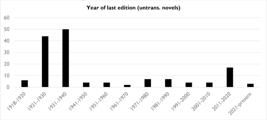
The graphics show that the peak in the latest edition took place during the interwar years, whereas in the case of the translated novels, it happened during the 21st century. This could also be the answer to the second question: the criterion used to decide which titles were translated and which ones were not could be related to the existence of new reprints and, thus, a renewed interest in these books in the source literary polysystem.
This would be one of many causes, and more detailed research needs to be done to properly answer this complex question. Nonetheless, symbolic capital—as understood by Bourdieu (2010)—embodied by popularity or critical success, does not seem to be key in this case: some of the untranslated novels are considered modern classics in the source literary polysystem and have been adapted to television or audiobooks15.
The theme of the novels does not appear to be a key issue, either. While it is true that some of the topics covered by these novels—sexuality, women’s careers or their subordinated place in society—may have impacted their arrival in the Spanish literary polysystem during Franco’s regime, there does not appear to be a big difference between the themes of the novels that were translated in the forties and those that have been translated in a democratic context. There are some specific cases where this could be the reason—The Well of Loneliness, by Radclyffe Hall, featuring a lesbian relationship, was not translated until 1989, sixty years after its publication—, but the subtlety of these authors may have been key to their arrival in the Spanish polysystem during the first half of the 20th century. Nonetheless, although censorship-related matters exceed the extent of the present research, a thorough analysis of those translations should be conducted to see whether manipulation or censorship was present.
6. Conclusions
The research question which prompted this investigation was whether female middlebrow novels reached a Spanish audience during the interwar years (1918-1939). After creating a corpus comprising a total of 182 novels, the answer seems to be that they did not. Contrary to the initial hypothesis, the first peak in the number of translations took place in the forties, when Franco’s regime was already in place. Then, the Spanish polysystem appears to imitate the British one, and several decades go by when these authors are mostly forgotten; however, during the 21st century, a revival in the interest for female middlebrow novels can be noted, probably linked to the reprints by British publishing houses.
Additionally, some other conclusions can be drawn from this study. Firstly, most of the novels in the corpus have not been translated into Spanish yet, so it could be stated that this type of fiction remains, in the terms of Even-Zohar (1979), in the periphery of the Spanish literary polysystem. Secondly, the first wave of translations did not take place during the Second Republic, as expected, but during the forties, so further research needs to be conducted on the circumstances that governed this exchange. Finally, many of these translations have been published in the 21st century, probably as part of the new literary trends that demand the making of a new literary canon, particularly from a gendered perspective (Fuster, 2023). This seems to suggest that the themes most addressed by these authors in their fiction, which were demeaned at their time precisely because of their supposed triviality and accessibility, are still very much appreciated by contemporary audiences.
As the results obtained allow for female middlebrow novels to be also included in the category of peripheral literature in the Spanish polysystem, we may continue investigating the present case study as part of a larger research concerning the social impact of translation in the making of a new literary canon. This seems especially relevant in today’s literary and academic landscape, when interest for a fairer representation of female experience has been awakened. Delving into the reasons for this marginalisation and the compensatory mechanisms that are being applied seems necessary to obtain a full image of the phenomenon of re-conceptualization of the literary canon. Future lines of research include a more in-depth look at this object of study through the use of more catalogues, especially those from Latin American libraries, which could help to shed light on the situation in other Spanish-speaking polysystems, which is particularly interesting given the fact that many Spanish publishing houses exiled in these countries after 1939 (Behiels, 2018). What is more, and following the latest trends in the field, it could be of interest to take a translator's approach—rather than a translational one—to see whether the impact of the professional’s agency has anything to do with said re-configuration of the canon.
-
Research dataset
The data used for this research was obtained from the catalogues of Biblioteca Nacional de España and The British Library within the framework of a PhD research project and exclusively for this purpose (PhD thesis supervised by David González-Iglesias González, PhD; and Claudia Toda-Castán, PhD).
-
Funding
It does not apply.
-
Image copyright
All images belong to the author.
-
Approval by ethics committee
It does not apply.
-
1
Some scholars have already dealt with the reception of the work of specific female middlebrow authors in Spain, such as Riba and Sanmartí (2018), whose research centres around Elinor Glyn.
-
2
These so-called “libraries” and “book clubs” became very popular at the time, but they differed from the modern concepts. In most cases, customers paid a subscription fee so they could borrow and return books.
-
3
With time, class divisions were established, and each library catered a particular social group (Humble, 2007), with “twopenny” libraries becoming more popular among the working classes and supposedly lowbrow readers, and libraries like Boots, more focused on the middle classes (Beauman, 1983).
-
4
According to Bluemel (2009, p. 5), intermodernism is “a category that alludes to both period and style. On the one hand, it designates the interwar, wartime and immediately postwar years, and thus offers itself as a ‘new’ historical period […] [that pretends to] challenge the process by which modernism has expanded to take over the field of twentieth-century cultural studies”.
-
5
During the seventies and eighties, publishing houses like Virago focused their efforts on rescuing many of these novels from oblivion. Their collection Virago Modern Classics, which was born in 1978, pretends “to celebrate women writers, to demonstrate the existence of a canon of women’s writing and to redefine the often-narrow idea of a ‘classic’” (Virago, n. d.).
-
6
The beginning of the 20th century was a turning point for the situation of women in Spain. On the one hand, they accessed new spaces, such as the political sphere or universities, which led to the creation of institutions such as the Residencia de Señoritas, the Misiones Pedagógicas or the Lyceum Club Femenino (Museo Reina Sofía, n.d.). On the other hand, their private lives also improved thanks to new social trends, such as “conscious maternity” (Merino Hernández, 2016, p. 25); to new and more comfortable clothes and, all in all, to the fact that they had more time for leisure activities, such as practising sports or reading.
-
7
In 1900, 69.3% of women were illiterate in Spain; in 1930, the figure had decreased to 39.2% (Instituto Nacional de Estadística, 2004).
-
8
Authors such as Mercedes Ballesteros, Luisa Carnés, Rosa Chacel, Concha Espina, Carmen de Icaza, María Luz Morales or Elisabeth Mulder published novels resembling female middlebrow literature during the interwar period in Spain.
-
9
For the purposes of this research, the concept “British” encompasses the whole empire of that time.
-
10
Many of these novels are not easily trackable nowadays, so a total of 19 titles still needs to be assessed. As the means available now do not allow for a clear idea of their theme to be obtained, they were not added to the group of the Third Phase.
-
11
It is acknowledged that there are more catalogues that could provide further information about the Spanish context, especially from 1936 onwards, but these are the sources of information chosen for the present corpus, which were deemed enough for the purposes of this paper.
-
12
For instance, The Death of the Heart, by Elisabeth Bowen, has been retranslated into Spanish.
-
13
Downton Abbey (2010-2015) is the perfect example, as it takes place during the turn of the century and centres around a family of the dying aristocracy, both reflecting the personal lives of the characters, mostly women, and portraying the many changes faced by the society of their time.
-
14
In Britain, some episodes of Downton Abbey were watched by around 9 million people (Plunkett, 2015), the same figure of Spaniards that watched the series’ finale in 2015 (Objetivo TV, 2015). As a matter of fact, the number of viewers in Britain that specific night was 7.6 million, which meant that even more people followed it in Spain than in its own country.
-
15
Just to give a couple of examples, William – An Englishman, by Cicely Hamilton, received the prestigious Femina – Vie Heureuse Prize; likewise, The Rector’s Daughter, by F. M. Mayor, is nowadays one of BBC Radio 4’s audiobooks; finally, National Velvet, by Enid Bagnold, was adapted to the big screen and starred by actresses Elizabeth Taylor and Angela Lansbury.
Data availability statement
The data from this research, which are not included in this work, may be made available by the author upon request.
References
- Beauman, N. (1983). A Very Great Profession Virago Press.
- Beddoe, D. (1989). Back to Home and Duty: Women between the Wars, 1918-1939. Pandora.
-
Behiels, L. (2018). Rosa Chacel: novelista y traductora española exiliada. Cadernos de Tradução, 38(1), 47–64. https://doi.org/10.5007/2175-7968.2018v38n1p47
» https://doi.org/10.5007/2175-7968.2018v38n1p47 -
Biblioteca Nacional de España (n.d.). Portal de datos bibliográficos de la Biblioteca Nacional de España. Biblioteca Nacional de España. https://datos.bne.es/inicio.html
» https://datos.bne.es/inicio.html - Bluemel, K. (Ed.). (2009). Intermodernism: Literary Culture in Mid-Twentieth Century Britain. Edinburgh University Press.
- Bourdieu, P. (2010). El sentido social del gusto: elementos para una sociología de la cultura (A. Gutiérrez, Trans.). Siglo Veintiuno Ediciones.
-
British Library (n.d.). British Library Interim Catalogue. British Library. https://bll01.primo.exlibrisgroup.com/discovery/search?vid=44BL_INST:BLL01⟨=en
» https://bll01.primo.exlibrisgroup.com/discovery/search?vid=44BL_INST:BLL01⟨=en - Brown, E., & Grover M. (2011). Middlebrow Literary Cultures: The Battle of the Brows, 1920-1960 Palgrave Macmillan.
- Cagnolati, A. (Ed.). (2019). Escritoras en lengua italiana: renovación del canon literario. Comares.
- Capel Martínez, R. M. (2006). La mujer española en el siglo XIX: coordenadas históricas. In P. Celma Valero & C. Morán Rodríguez (Eds.), Con voz propia: la mujer en la literatura española de los siglos XIX y XX (pp. 17–28). Instituto Castellano y Leonés de la Lengua.
- Castro, O. (2012). La traducción como mecanismo de (re) canonización: el discurso nacional y feminista de Rosalía de Castro en sus traducciones al inglés. Quaderns: Revista de Traducció, (19), 199–217.
-
Castro, O. (2020). Por una geopolítica feminista de la traducción: escritoras (gallegas) traducidas en el mercado editorial británico. Transfer, 15(1–2), 52–92. https://doi.org/10.1344/transfer.2020.15.52-92
» https://doi.org/10.1344/transfer.2020.15.52-92 - Centeno, F. (2006). La musa ultraísta. In A. Villar et al. (Ed.), Mujer y literatura en el siglo XX (pp. 10–31). Centro Cultural Generación del 27.
-
Chesterman, A. (2009). The Name and Nature of Translator Studies. HERMES, (42), 13–22. https://doi.org/10.7146/hjlcb.v22i42.96844
» https://doi.org/10.7146/hjlcb.v22i42.96844 - Clark, S. (1991). Sentimental Modernism: Women Writers and the Revolution of the Word Indiana University Press.
-
Cook, H. (2007). Sexuality and Contraception in Modern England: Doing the History of Reproductive Sexuality. Journal of Social History, 40(4), 915–932. https://doi.org/10.1353/jsh.2007.0090
» https://doi.org/10.1353/jsh.2007.0090 - Correa Ramón, A. (2006). El siglo de las lectoras. In P. Celma Valero & C. Morán Rodríguez (Eds.), Con voz propia: la mujer en la literatura española de los siglos XIX y XX (pp. 30–38). Instituto Castellano y Leonés de la Lengua.
-
Das, R. (2023). New Woman. Victorian Literature and Culture, 51(3), 463–466. https://doi.org/10.1017/S1060150323000098
» https://doi.org/10.1017/S1060150323000098 -
Even-Zohar, I. (1979). Polysystem Theory. Poetics Today, 1(1/2), 287–310. https://doi.org/10.2307/1772051
» https://doi.org/10.2307/1772051 - Ewins, K. (2015). “Revolutionizing a Mode of Life”: Leftist Middlebrow Fiction by Women in the 1930s. ELH: English Literary History, 82(1), 521–279.
- Fólica, L. (2015). Al compás del traductor: últimos “giros” en torno al agente. In G. Corpas Pastor, M. Seghiri Domínguez, R. Gutiérrez Florido & M. Urbano Mendaña (Eds.), Nuevos horizontes en los Estudios de Traducción e Interpretación (pp. 322–331). Editions Tradulex.
-
Fouces Diaz, O., & Monzó, E. (2020). Como seria uma sociologia aplicada aos estudos da tradução? (T. Serpa & P. Tavares Pinto, Trans.). Cadernos de Tradução, 40(1), 440–455. https://doi.org/10.5007/2175-7968.2020v40n1p440
» https://doi.org/10.5007/2175-7968.2020v40n1p440 -
Fuster, F. (2023). Repensar el canon: la ausencia de mujeres en la historiografía sobre la Edad de Plata. Historia y Comunicación Social, 28(2) 429–434. https://doi.org/10.5209/hics.88866
» https://doi.org/10.5209/hics.88866 - Galligani, J. (2011). Middlebrow Reading and Undergraduate Teaching: The Place of the Middlebrow in the Academy. In E. Brown & M. Grover (Eds.), Middlebrow Literary Cultures: The Battle of the Brows, 1920-1960 (pp. 25–33). Palgrave Macmillan.
- Gil-Abarellos, S. (2006). Presentación. In P. Celma Valero & C. Morán Rodríguez (Eds.), Con voz propia: la mujer en la literatura española de los siglos XIX y XX (pp. 1–16). Instituto Castellano y Leonés de la Lengua.
-
Gordon, P. T. (2022). “Opposite Ends of the Bloody Stick”: Virginia Woolf and Hugh Walpole, Intersections of the Highbrow and Middlebrow. ELH: English Literary History, 89(4), 1107–1134. https://doi.org/10.1353/elh.2022.0038
» https://doi.org/10.1353/elh.2022.0038 - Hammill, F. (2007). Women, Celebrity, and Literary Culture between the Wars University of Texas Press.
- Hammill, F. (2009). Stella Gibbons, Ex-centricity and the Suburb. In K. Bluemel (Ed.), Intermodernism: Literary Culture in Mid-Twentieth-Century Britain (pp. 76–90). Edinburgh University Press.
- Hernández Álvarez, M. V. (2018). Escritoras en lengua francesa. Renovación del canon literario Comares.
- Holmes, D. (2018). Middlebrow Matters: Women’s Reading and the Literary Canon in France since the Belle Époque. Liverpool University Press.
-
Holmes, D. (2019). Une littérature illégitime – le “ middlebrow ”. Belphégor, (17), 1–12. https://doi.org/10.4000/belphegor.1774
» https://doi.org/10.4000/belphegor.1774 - Hubble, N. (2011). Imagism, Realism, Surrealism: Middlebrow Transformations in the Mass-Observation Project. In E. Brown & M. Grover (Eds.), Middlebrow Literary Cultures: The Battle of the Brows, 1920-1960 (pp. 202–217). Palgrave Macmillan UK.
- Humble, N. (2007). The Feminine Middlebrow Novel, 1920s to 1950s: Class, Domesticity, and Bohemianism Oxford University Press.
- Instituto Nacional de Estadística. (2004). La sociedad española tras 25 años de Constitución. INE.
- Jiménez Tomé, M. J. (2006). Soles y agonías de las escritoras del 27: María Teresa León, Concha Méndez y Ernestina de Champourcín. In A. Villar et al. (Ed.), Mujer y literatura en el siglo XX (pp. 47–66) Centro Cultural de la Generación del 27.
- Light, A. (2013). Forever England: Femininity, Literature, and Conservatism between the Wars Routledge.
- Lozano Sampedro, M. T. (2018). Aproximación a la obra de Delly (1875-1947): difusión en España y función de la mujer en el género de la novela sentimental. In M. V. Hernández Álvarez (Ed.), Escritoras en lengua francesa. Renovación del canon literario (pp. 135–142). Comares.
- Martín Martín, J. M. (Ed.). (2019). Escritoras en lengua alemana: renovación del canon literario. Comares.
- Merino Hernández, R. M. (2016). La Segunda República, una coyuntura para las mujeres españolas: cambios y permanencias en las relaciones de género. Universidad de Salamanca.
- Montefiore, J. (1996). Men and Women Writers of the 1930s: The Dangerous Flood of History. Routledge.
- Morton, A. L. (1938). A People’s History of England. Lawrence & Wishart.
-
Museo Reina Sofía (n.d.). Las mujeres durante la II República. Museo Reina Sofía. https://www.museoreinasofia.es/coleccion/proyectos-investigacion/mujeres-guerra-civil-espanola/mujer-ii-republica
» https://www.museoreinasofia.es/coleccion/proyectos-investigacion/mujeres-guerra-civil-espanola/mujer-ii-republica -
Objetivo TV (2015, November 10). ‘Downton Abbey’ dice adiós con récord de audiencia Antena 3. https://www.antena3.com/objetivotv/analisis/downton-abbey-dice-adios-record-audiencia_201511105791356a6584a8b7b42a9b3e.html
» https://www.antena3.com/objetivotv/analisis/downton-abbey-dice-adios-record-audiencia_201511105791356a6584a8b7b42a9b3e.html - Offen, K. (2015). Feminismos europeos 1700-1950: una historia política (P. A. Piedras Monroy, Trans.). Akal.
- Payeras Grau, M. (2006). Escritoras bajo el franquismo. Poesía 1939-1959. In A. Villar et al. (Ed.), Mujer y literatura en el siglo XX (pp. 68–91). Centro Cultural Generación del 27.
-
Plunkett, J. (2015, September 21). Downton Abbey Begins Final Series with Lowest Ever Launch Audience. The Guardian. https://www.theguardian.com/media/2015/sep/21/downton-abbey-begins-final-series-with-lowest-launch-audience
» https://www.theguardian.com/media/2015/sep/21/downton-abbey-begins-final-series-with-lowest-launch-audience -
Riba, C., & Sanmartí, C. (2018). The Reception of Elinor Glyn’s Work in Spain (1926–57). Women: A Cultural Review, 29(2), 188–215. https://doi.org/10.1080/09574042.2018.1447040
» https://doi.org/10.1080/09574042.2018.1447040 - Rubio Martín, M. (2006). La mujer como receptora. España 1900-1936 (Propuestas para una investigación). In P. Celma Valero & C. Morán Rodríguez (Eds.), Con voz propia: La mujer en la literatura española de los siglos XIX y XX (pp. 125–133). Instituto Castellano y Leonés de la Lengua.
- Sanderson, M. (1999). Education and Economic Decline in Britain, 1870 to the 1990s Cambridge University Press.
- Scanlon, G. M. (1986). La polémica feminista en la España contemporánea (1868-1974) (R. Mazarrasa, Trans.). Akal.
-
Virago (n.d.) About Virago. Virago. https://www.virago.co.uk/imprint/lbbg/virago/page/about-virago/
» https://www.virago.co.uk/imprint/lbbg/virago/page/about-virago/ - Wolf, M. (2007). Introduction: The Emergence of a Sociology of Translation. In M. Wolf & A. Fukari (Eds.), Constructing a Sociology of Translation (pp. 1–38). John Benjamins.
-
Wolf, M. (2012). The Sociology of Translation and its ‘Activist Turn’. Translation & Interpreting Studies, 7(2), 129–143. https://doi.org/10.1075/tis.7.2.02wol
» https://doi.org/10.1075/tis.7.2.02wol -
Zaragoza Ninet, M. G. (2008). Censuradas, criticadas... olvidadas: las novelistas inglesas del siglo XX y su traducción al castellano. [Doctoral Dissertation]. Universitat de València. http://hdl.handle.net/10550/15270
» http://hdl.handle.net/10550/15270
Edited by
-
Section editors
Andréia Guerini – Willian Moura
-
Style editors
Alice S. Rezende – Ingrid Bignardi – João G. P. Silveira – Kamila Oliveira

 Source: Author (2025)
 Source: Author (2025)
 Source: Author (2025)
 Source: Author (2025)