
 Evidential English adverbials and their French equivalents in a specialised parallel corpus
Abstract
This research paper investigates the translation procedures applied to English evidential adverbials within a parallel corpus of specialized technical information in English and French aimed at popularisation. We analyse the strategies deployed by translators to ensure a natural reading in the target language, taking into consideration variation in metadiscourse functions. Corpus linguistics methods are used to analyse adverbial positioning, morphological characteristics, metadiscourse functions, and translation strategies. Our anticipated conclusions highlight the manifold functions of evidential adverbials, from enhancing meaning to conveying the author’s attitude, often influenced by cultural and professional factors, resulting in variable translation strategies.
Keywords
parallel corpus; translation procedures; evidentiality; boosters; hedging
1. Introduction
This research paper explores the translation procedures used in the rendering of English evidential adverbials in a parallel corpus of specialized technical information in English and French. The forms analysed are specifically “clearly,” “obviously,” “presumably,” “evidently,” “apparently,” “supposedly,” “conceivably,” “undoubtedly,” “allegedly,” “reportedly,” “arguably,” “unquestionably,” and “seemingly,” which are attested to own evidential meaning in this language (cf. Álvarez-Gil, 2022). With this, our intention is to shed light on the strategies deployed by translators to ensure that these linguistic markers read naturally in the target language, if there might be variation as to the metadiscourse function adverbials could fulfil in the translation process. The indexical nature of these evidential adverbials implies that the translation procedure should be carefully chosen, if the interactive or interpersonal dimension of these adverbials are to be preserved. Adverbials in the Ss may also be omitted in the target texts (TTs), thus obliterating the meanings. For our study, we use corpus linguistics methods to analyse a parallel corpus of English and French texts in the field of economics called the UNESCO Corpus meant for wide dissemination and popularisation. This corpus has been prepared by the Computational Linguistics Group (SLI), University of Vigo (Spain). In our study, we examine adverbials, focusing on their positioning, morphological characteristics, metadiscourse functions, and translation strategies, using statistical analysis. Our metadiscourse perspective categorizes these markers into transitions and frame markers for interactive metadiscourse, and hedges, boosters, attitude markers, and relational markers for interpersonal metadiscourse, as per Hyland’s (2005) framework. Anticipated conclusions will be that evidential devices should primarily be used to enhance the meaning of the utterance, although other functions, e.g. to show the author’s attitude or to mitigate the utterance’s contents to avoid imposition, could also be an option justifying its rendering into the target language. As translation needs to accommodate to cultural traits and other professional demands, we expect variability as to the number of translating strategies used and these may not align with the functions of adverbials in the Ss.
The structure of this paper unfolds as follows. First, we describe evidentiality and its relation to adverbials. Section 3 provides insight into the corpus used and the methodology underpinning our investigation. Within this section, we offer a definition of metadiscourse and introduce a taxonomy of translation procedures that accommodate our findings. Section 4 constitutes the core of this paper, discussing our findings in accordance with criteria such as the positioning of adverbials in source text (ST ) and TTs, their form in the TTs, the translation procedures employed, and their metadiscourse functions. Lastly, the concluding section offers the insights from our study.
2. Evidentiality and adverbials
For many authors, the origin of information, known as evidentiality (Nishiguchi, 2006, p. 10), serves as a significant indicator of an author’s trustworthiness and dedication. This assessment hinges upon evaluating how authors signify the means by which they have procured their information. Plungian (2001, p. 353) offers the following definition of evidentials: “Evidential values delineate the source of information available to the speaker regarding proposition P, where P denotes a described situation.” Exemplifications of evidential markers encompass statements like “I believe that P,” “I witnessed that P,” “It appears that P,” “I’ve received reports that P,” and “It is imperative that P.” Each of these expressions signifies distinct wellsprings of knowledge or cognitive processes employed to arrive at proposition P. Scholars discern within the use of these diverse forms of evidence an implicit assessment regarding the veracity of the proposition. Consequently, “I witnessed that P” is generally considered more dependable than “I’ve heard that P”. In essence, visual evidence (Willett, 1988) frequently carries greater credibility than hearsay evidence.
This assessment often serves the purpose of substantiating claims, a notion supported by Mur-Dueñas (2011), Kranich (2009), Domínguez Romero (2013), Álvarez-Gil (2022). In this context, evidentiality aligns closely with epistemic modality. As articulated by Diewald et al. (2009, p. 190), “Evidentiality focuses on indicating the information source upon which the speaker relies when making a claim, placing it alongside epistemic modality without merging the two.” In fact, both Chafe and Nichols (1986) and Palmer (1986) consider evidentiality to be a subset of epistemic modality. According to Mushin (2001, p. 31), “the comprehensive definitions of evidentiality in Chafe and Nichols (1986) and Palmer (1986) center on expressing a speaker’s belief in the validity of their knowledge as the primary meaning of evidential forms”. This perspective embraces the inclusive nature of evidentiality and epistemic modality.
Epistemic modality is defined as “the assessment of the likelihood that a certain hypothetical state of affairs, or some aspect thereof, will occur, is occurring, or has occurred in a possible world” (Nuyts, 2001, p. 21). Thus, it appears closely intertwined with the concept of truth and authors’ accountability for their statements (Almeida-Silva & Carvalho, 2015; Stukker et al., 2009; Sweetser, 1990; Traugott, 1989). Van der Auwera and Plungian (1998) emphasize the concept of evidential inferentiality, highlighting the interplay between epistemic necessity and inference. A prime example of this is the statement “Mary must be there now,” where the modal verb “must” signifies the speaker’s inference based on the chosen contextual premises.
Another perspective on the relationship between these two concepts is presented in the disjunctive model, as discussed by Cornillie (2009). According to Cornillie, epistemic modality and evidentiality are distinct categories. He posits that the confusion regarding the overlap of these domains arises from the frequent association of the mode of knowing and the degree of the speaker’s commitment regarding proposition P. In Cornillie’s (2009, p. 47) view, evidentiality “pertains to the reasoning processes that lead to a proposition”, whereas epistemic modality “assesses the likelihood that this proposition is true”. In a similar vein, Aikhenvald (2004, p. 6) interprets evidentiality as solely indicating the source of knowledge, with no inherent connection to the truth of the statement. However, she acknowledges that “Evidentials may acquire secondary meanings related to reliability, probability, and possibility.”
The ongoing debate surrounding evidentiality extends to the definition of what constitutes an evidential unit. According to Aikhenvald (2004, p. 1), evidentiality is a grammatical category, and therefore, evidentials are markers rather than lexical expressions. This perspective relies on a strict semantic criterion. With the exception of modals, which Aikhenvald (2004) considers borderline cases, English, in her view, lacks true evidential devices. On the contrary, Wiemer (2010) argues that evidentials can be realized through both complex linguistic structures and single linguistic items. This is evident in examples (a) and (b) below. While “must” in (a) clearly expresses deontic modality, this form conveys inferential evidentiality in (b). The reason for this distinction lies in the combination of “must” and the progressive aspect. Wiemer (2010) refers to this combination as a complex structure.
-
She must study.
-
She must be studying.
Lastly, Boye and Harder (2009, p. 17) propose a unique perspective by avoiding a rigid distinction between grammatical and lexical definitions of evidentiality. Instead, they prefer to conceptualize evidentiality as a substance domain.
In this paper, our analysis of evidentials adopts a disjunctive approach to evidentiality and epistemic modality. From a methodological standpoint, we treat these two linguistic aspects as separate and distinct. Evidential devices include a variety of forms, including adverbs, as in this paper.
Adverbs constitute a notably diverse and challenging grammatical category, characterized by a lack of clear definition and conceptual unity. Esteemed linguists such as van der Auwera and Plungian (1998), Haspelmath (2001), and Eisenberg (2013) have alluded to this heterogeneity, describing adverbs as the “most problematic major word class” (Haspelmath, 2001, p. 16543), an “elusive” component of speech (Van der Auwera & Plungian, 1998, p. 3), and occasionally “confusing” (Eisenberg, 2013, p. 212). This inherent variability and the absence of a precise demarcation for the adverbial category have led to its role as an umbrella term encompassing a wide array of words that do not neatly align with other established grammatical categories. As pointed out in Álvarez-Gil (2017, 2018, 2019), this can be attributed to the diverse morphological structures exhibited by adverbs, their ability to occupy various positions within clauses, and the multitude of syntactic functions they can fulfil. Scholars have previously underscored this issue of misclassifying several words as adverbs, as exemplified by Huddleston and Pullum (2002). Consequently, it is not uncommon to encounter words that, from a formal perspective, may appear to be adverbs.
In the framework proposed by Biber et al. (1999), adverbs are classified into three distinct categories, each serving a specific linguistic function. First, there are circumstance adverbs, which provide information about the circumstances surrounding an action or event, e.g. “quickly” and “yesterday.” The second category is linking adverbs, which serve as connectors within a sentence to establish relationships between clauses or ideas, e.g. “therefore” and “furthermore.” The last category is stance adverbs, which convey the speaker’s attitude, perspective, or evaluation of a situation or statement (see “arguably,” “certainly,” and “presumably”). This category is further subdivided into epistemic and attitude adverbials, therefore fulfilling an interpersonal dimension (see Rodrigues, 2019). Within the first subclass, Biber et al. (1999) include the so-called category “source of knowledge,” e.g. “surely” and “apparently,” which encompasses the evidential adverbials we focus our study on.
3. Description of corpus and method
In our article on evidential adverbials, we analyse a set of linguistic forms, namely, “clearly,” “obviously,” “presumably,” “evidently,” “apparently,” “supposedly,” “conceivably,” “undoubtedly,” “allegedly,” “reportedly,” “arguably,” “unquestionably,” and “seemingly.” These adverbs were drawn from a compilation provided by Wierzbicka in her work English: Meaning and Culture (2006), where she examines the significance of epistemic elements, including these evidential adverbs, in the English language in relation to cultural contexts. By incorporating these evidential elements into our research, we aim to mitigate the potential for mediated selection bias that could compromise the outcomes of our investigation.
Our research methodology employs a corpus linguistics approach to analyse texts, focusing specifically on data retrieved from a parallel corpus of English texts and their French translations in the field of economics. Although the UNESCO Corpus of English-Galician-French-Spanish Scientific-Technical Divulgation includes texts in multiple languages (English, Galician, French, and Spanish), our study is limited to the English and French components. The texts analysed were sourced from The UNESCO Courier and cover the period between 1998 and 2001. This corpus has been meticulously designed and curated by the Computational Linguistics Group (SLI) at the University of Vigo, Spain. To explore the corpus and retrieve concordances in both languages, we utilize the corpus tool developed by the SLI team. In terms of size, the UNESCO Corpus contains a total of 3,724,620 words, distributed across 47,424 translation units, which are further organized into different subcorpora. For our analysis, the English subcorpus comprises 927,698 words, while the French subcorpus includes 932,605 words.
In addition, we make a comprehensive examination of adverbials, involving a meticulous analysis and categorization of each instance. We employ Microsoft Excel to ensure precision in our statistical findings. This analysis encompasses various aspects, including the positioning of adverbials in both source and target languages, the morphosyntactic characteristics of the source adverbial, the metadiscourse functions performed by the translated material, and the translation strategies employed in the French rendition.
From a metadiscourse perspective, we anticipate that these markers could potentially be classified into two categories: transitions and frame markers within the realm of interactive metadiscourse strategies, and hedges, boosters, attitude markers, and relational markers within the domain of interpersonal metadiscourse strategies, as described by Hyland (2005, p. 49), also in Carrió-Pastor (2012, 2016a, 2016b, 2016c, 2019), and Carrió-Pastor and Muñiz-Calderon (2015). Interactive markers are employed to shape the text and guide the reader, while interactional markers are used to make the author’s perspectives explicit and engage readers by enabling them to respond to the evolving text (Hyland, 2005, p. 49). Table 1 presents definition of each category within each domain with examples, all taken from Hyland (2005, p. 49), also from Alonso-Almeida and Álvarez-Gil (2021).
The translation procedures applied to render English adverbials into French are identified in our corpus using the terminology outlined in Table 2 below. Translation procedures serve as mechanisms for producing a TT that aligns with the author’s intended meaning. These encompass textual and cultural aspects. In total, there are 11 distinct categories into which adjustments can be classified. These categories are further organized into 5 overarching groups, which offer a structured framework for understanding the relationship between the S and the TT, as detailed in Table 2 taken from Alonso-Almeida and Sánchez (2016), and Alonso-Almeida and Álvarez-Gil (2021), after Cruz García (2014).
The outcomes of our analysis will present an overview of the distribution of variables related to clause position, the formal characteristics of the French renderings, their metadiscourse categorization, and the translation procedures used in the TT. These findings will be presented in both raw numerical figures and percentages, facilitating a meaningful comparison between the two subcorpora. Such comparisons will shed light on variations and trends, which thereby may provide valuable insights into the cognitive processes undertaken by translators when deciding whether to omit or select equivalents. Furthermore, our analysis will underscore that English adverbs often share similar functional attributes with their French counterparts if the former are not left untranslated.
4. Analysis and discussion of findings
The examination of the corpus has yielded a total of 258 instances of the analysed evidential forms. Figure 1 visually illustrates the distribution of these forms within the UNESCO subcorpus of the CLUVI corpus.
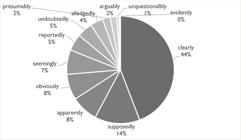
The distribution of the examined evidential adverbs within the corpus is uneven. Among the various evidential adverbs examined, “clearly” stands out as the most prominently used, occurring a total of 114 times. It is followed by “supposedly,” which is employed 35 times, and “apparently,” appearing 21 times. “Obviously” and “seemingly” demonstrate relatively high frequencies as well, with 20 and 19 instances, respectively. Further down the list, “reportedly” is noted 13 times, while “undoubtedly” appears in 12 instances. “Allegedly” follows with 10 occurrences, and “presumably” is found 6 times. “Arguably” is used in 5 instances. Interestingly, “unquestionably” makes only a marginal appearance, appearing just twice. The adverb “evidently,” with just a single occurrence in the corpus, may reflect a stylistic preference for adverbs that are clearer in meaning and more aligned with the conventions of technical and popularized discourse. Certainly, this distribution offers valuable insights into the varying degrees of usage and significance of these evidential adverbs within this technical corpus with a focus on dissemination and popularization.
In line with Alonso-Almeida and Álvarez-Gil (2021), our examination of these adverbial forms in both the source and TTs encompasses three key aspects: (a) the position of these adverbials within sentences and their corresponding translations, (b) the specific linguistic structure they adopt in the TTs, and (c) their underlying meanings and roles within these TTs. As we proceed further into our analysis, the disparities in translations will illuminate the translators’ comprehension of the original source adverbials.
4.1. Position of adverbs
Figure 2 visually illustrates the position of the adverbials analysed in the Ss:
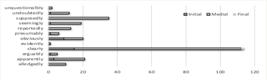
As shown in this figure, adverbials positioned at the beginning of sentences, such as “clearly,” exhibit a notable presence with 15 occurrences, indicating a predilection for commencing sentences with unequivocal statements. Likewise, “obviously” and “arguably” frequently make their appearances at the outset, signalling their role in establishing the tone or asserting a strong standpoint. In the middle of sentences, the majority of adverbials, including “clearly,” with 97 cases, followed by “apparently,” “seemingly,” “obviously,” “presumably,” “reportedly,” “undoubtedly,” and “arguably,” find their place, serving to offer supplementary context and clarification. On the other hand, in a noteworthy observation, only a select few adverbials are found in terminal positions; among them, ‘clearly’ appears just twice. Conversely, certain adverbials like “allegedly,” “evidently,” “unquestionably,” and “supposedly” demonstrate minimal or absent occurrences in specific positions, implying a more restricted or context-dependent usage. In sum, these findings underscore the deliberate placement of different adverbials within sentences, enabling the conveyance of diverse nuances and the accentuation of particular points throughout the text. Some examples are the following:
These adverbial forms undergo distinct translations in the TTs, and their syntactic position may vary in comparison to the Ss, as depicted in Figure 3, below:

Figure 3 offers a comprehensive overview of the positions in which various S (ST) adverbial forms are situated within sentences in the French subcorpus. The renderings of “clearly” emerges as the prevailing adverbial in the initial position, appearing 8 times, followed closely by “obviously” with 9 occurrences. In the medial position, “clearly” maintains its dominance, occurring a substantial 61 times, making it the most frequent in this category. “Supposedly” follows with 20 instances. Within the final position, “clearly” reasserts its prominence, appearing 3 times, while “apparently” and “reportedly” each manifest once. Notably, among adverbials that are omitted in the TT (TT), “clearly” leads with 42 instances, trailed by “supposedly” with 15, “reportedly” with 8, and “seemingly” with 8. The adverbials “supposedly” and “reportedly” emerge as substantial contenders of “clearly”, particularly when they are omitted in the TT. The choice of position for these adverbials appears to play a pivotal role in conveying nuanced emphasis within the text.
Table 3 illustrates the relationship between the source and TTs concerning the positioning of adverbials and their corresponding translated variants (I, initial, M, medial, F, final, N, no adverb).
The analysis of the position of adverbials in the ST and their correspondent adverbials underscores how some adverbials exhibit clear preferences for specific positions, while others demonstrate greater flexibility. Left periphery does not seem a common position for evidential adverbials in the English subcorpus and the French subcorpus either. Even if there are cases in which the adverbial is kept in the same initial position in both subcorpora, syntactic variation is also attested. The adverb “clearly” is the commonest form found in thematic position with 15 cases. This is followed by the form “obviously,” with 9 cases. However, it is “clearly” the one revealing more shifts in authorial perspectivisation, as shown in the instances, below. Less frequent adverbs in initial position in either subcorpora are “reportedly,” “apparently,” “undoubtedly,” “arguably,” “presumably,” “seemingly,” and “evidently.”
In (4), syntactic similarity suggests that the author’s perspective remains consistent across languages. The author emphasizes the strength of the demand for external broadcasters right from the start, maintaining the clarity and certainty of their statement. In (5), the adverbial “obviously” has shifted from initial in English to medial in French. This shift may imply a subtle difference in the author’s perspectivization. In English, by starting the sentence with “obviously,” the author immediately signals their confidence in the assertion about variations between groups. In French, by placing “manifestement” (manifestly) in a medial position, the emphasis may not be as strong as in the English counterpart, potentially suggesting a slightly less assertive perspective. In the subsequent example, the adverbial “clearly” appears at the beginning of the English sentence but shifts to a final position in the French translation. This shift in position maintains the author’s perspective, still reinforcing the idea that the financial success is unmistakable and beyond doubt. Finally, in (7), the adverbial “obviously” in English does not have a direct equivalent in the French translation. This omission suggests that the author’s perspective might have been deemed less relevant or appropriate in the French context. The French version conveys the same information but without the explicit marker of certainty, potentially indicating a shift in perspectivization.
In the case of English adverbials in medial position, there is a notable tendency to maintain the same position in the TTs. However, it is also common for the adverbial to be omitted. In cases where the preferred syntactic pattern in the TTs is different, English medial adverbials may be occasionally rendered as initial or final adverbials, in this order, reflecting the flexibility of translation strategies for these forms, as shown in the instances below.
In (8), the adverbial “obviously” in English maintains its medial position when translated into French as “évidemment”. This consistency in positioning emphasizes the author’s certainty regarding the statement. In the subsequent instance, the English adverbial “clearly” in medial position is omitted into the French TT. The absence of a corresponding French adverbial suggests that the translator has chosen not to emphasize the certainty conveyed by “clearly”, therefore potentially reflecting a difference in language-specific preferences. In (10), the adverbial “undoubtedly” in English, which is originally in medial position, is shifted to the initial position in the French translation as “incontestablement”. This adjustment maintains the emphasis on certainty as probably intended in the original text. Finally, in example (11), the English adverbial “apparently” is originally in medial position but is shifted to the final position in the French translation as “semble-t-il”. This shift reflects the flexibility of translation strategies, as the translator has chosen to maintain the adverbial’s emphasis on apparent certainty while adapting it to the preferred syntactic pattern in French. This translation choice may also indicate a heightened authorial emphasis on the previously introduced idea within the utterance, as placing the adverbial at the end of the sentence in French often serves to highlight or reinforce the information presented earlier. By shifting ‘apparently’ from a medial position in English to a final position in French (“semble-t-il”), the translator strategically underscores the adverbial’s evaluative function, making it more prominent. This positioning allows the statement’s interpretative nature to resonate with the reader, drawing attention to the level of apparent certainty conveyed about the preceding content.. Additionally, it could be driven by a stylistic motivation to prevent the separation of the verb and the object; the translator maintains, therefore, a smoother and more natural flow in the target language.
In the case of adverbials in final position in STs, or right periphery, there are only 2 cases with “clearly” in the English subcorpus, and these have been consistently given in medial position in TTs, as shown in (12) and (13), below. However, these cases are not evidential, as they are used to indicate manner rather than justification.
In example (12), the English adverb “clearly” in the right periphery is rendered into French as “(fort) bien” within the verbal phrase. Similarly, in example (13), “clearly” also in final position is placed in the medial position in French before the verb “définir”. This strategic shift seems to serve to accentuate the nuances and significance of the verbal expressions in both instances.
4.2. Form of adverbials
The occurrences of the translated forms of evidential adverbials in the French texts are shown in Figure 4:

Based on the provided data, it is evident that there is a notable preference for omitting evidential adverbials in the TTs in French, totalling 97 occurrences. Among these, besides “clearly” with 42 occurrences, the other more frequent adverbials are “supposedly” (16), “reportedly” (8), and “seemingly” (8). It is worth noting that the adverbial “arguably” does not fall within this category.
The second most frequent structure observed in the data is the adverb form in -ly, which appears in 83 cases. This structure is commonly employed in the French translations of expressions like “clearly” (48 occurrences), “obviously” (9 occurrences), “apparently” (6 occurrences), and “undoubtedly” (6 occurrences). However, it’s noteworthy that the variants “evidently” and “reportedly” are not rendered as adverbial phrases in the TTs in the French subcorpus.
The third most frequent structure observed in the data is the use of a clause, which appears in 46 cases. Among these, “clearly” is the most common with 12 occurrences, followed by “apparently” (7), “reportedly” (5), and “supposedly” (5). It should be noted that “evidently” and “unquestionably” are not translated as clauses in the French renditions.
The structures that appear less frequently in the analyzed dataset are the adjective phrase and the prepositional phrase, with 17 and 15 occurrences, respectively. Among the adjective phrases, “supposedly” is the most recurrent, with 8 instances. In contrast, other evidential adverbials such as “clearly,” “apparently,” “arguably,” “evidently,” “obviously,” “presumably,” “reportedly,” “undoubtedly,” and “unquestionably” are not translated as adjective phrases. The adverbials “alledgedly,” “arguably,” “evidently,” “reportedly,” “undoubtedly,” and “unquestionably” are not rendered as prepositional phrases in the TTs.
Indeed, the use of a wide range of structures in the translation process can be attributed to a myriad of factors, which demonstrates the complexity and adaptability of language. These factors may include stylistic preferences, the need to enhance meaning or clarification, and deliberate adaptation to the cultural nuances of the target language.
4.3. Meaning, function and translation of adverbials
The translation of the adverbials under analysis exhibits a significant degree of variation in the TTs. Omission, literal translation, and equivalence are the most frequently observed translation procedures identified in the texts being examined. The distribution of these procedures employed in the translation of these adverbials in the TTs is presented in Figure 5:

In most cases, omission happened. Literal translation is a common practice, with 76 instances of directly translating the S word-for-word, though this doesn’t necessarily entail exact formal correspondence. This approach prioritizes faithfulness to the S but may result in a less idiomatic or natural TT. Equivalence was employed in 51 instances, often to address language-specific differences, cultural nuances, or idiomatic expressions. Amplification was used 15 times, involving the expansion or elaboration of the content from the S in the TT.
Partial creation was employed in 5 instances, suggesting the introduction of new elements in the translation. Compensation was observed in 8 cases, occasionally involving specific syntactic arrangements elsewhere to preserve meaning or effect lost in translation. Modulation, which altered the emphasis or focus of the text to convey a different nuance or meaning, was deployed in 5 instances. This procedure is employed to adapt the text to the expectations of the target audience. Additionally, there was a single instance of addition, where entirely new information was included for clarification or emphasis.
Table 5 below provides a detailed account of the French correspondences found in the corpus for the adverbials examined in the parallel corpus. These correspondences result from the described translation procedures highlighted in Figure 5. Additionally, the table offers a comprehensive analysis of the metadiscourse functions fulfilled by these renderings in the TTs, following the theoretical framework described in section 2, above.
The interactive domain is the least represented in the translating process to render the English adverbials in the TTs with only 12 cases. While frame markers (8 occurrences) are the result of amplification, literal translation, and compensation, as shown in examples (23), (24) and (25), transitions follow from the use of literal translation and partial creation processes, as in (26) and (27), respectively.
Considering the indexical properties of evidential adverbials, their high frequency in the TTs (TTs) as interpersonal devices is unsurprising. Attitude markers are the least frequent function in the corpus, with the only case being presented in (28). In contrast, the use of adverbials as boosters is the most important function with the form clearly standing out in frequency and greater variation followed by “obviously.” This is the result of applying mostly literal translation and equivalence procedures, as shown in (29) and (30), respectively.
The English adverbial “clearly” in (28) functions as a booster. However, in the French translation, the word “flagrant” serves as an equivalent attitudinal marker, carrying a strong connotation of disapproval or criticism, as it conveys both the emphasis and the evaluative attitude present in the original English sentence. In (30), the adverbial “clearly” in English accentuates an idea of certainty, which the equivalent adverbial French “à l’évidence” preserves, thus enhancing the sense of clarity and certainty conveyed in the original. The same applies in the case of (29) with the use of the literal translation “évidemment” to suggest an interpersonal function.
The above expectation regarding the expression of interpersonality is, however, toned down when contrasting instances where these adverbials from the STs are not rendered into the TTs, ultimately leading to the obliteration of interpersonal cues within the English version, as in (31). This affects up to 102 occurrences, and this count also includes the transformation of some adverbials into adjective phrases (AdjPs), as in (32), thereby cancelling the evidential status of these forms in the French subcorpus. The omission of adverbials in translation, along with the transformation of some into AdjPs, negates or seriously reduces their fundamental role in shaping interpersonal dynamics and the sourcing of information in translated texts.
In (31), the English version includes the adverbial “reportedly”, which conveys an element of uncertainty or hearsay. However, the French translation does not incorporate an equivalent adverbial, thus removing the interpersonal cue of uncertainty from the translated text. In the case of “clearly” in (32), the adverbial emphasizes the evident nature of the situation. However, the French translation does not include an equivalent form, which results in a subtle toning down of the certainty or clarity conveyed in the English version. This means that the choice of whether to include or omit adverbials in translation can impact the perception of certainty, hearsay, or clarity in the text, therefore potentially altering the way the information is presented to the reader as the result of selected procedure techniques.
5. Conclusion
In conclusion, the examination of the specialized parallel corpus encompassing English evidential adverbials and their French equivalents has revealed a rich landscape of translation strategies and linguistic patterns employed in the transfer of meaning and interpersonal dynamics from the Ss to the TTs. Notably, the distribution of these adverbials within the corpus points to significant variations in their use, with “clearly” emerging as the most prevalent, indicative of its frequent role in asserting clarity and certainty within the texts. This finding signifies the pivotal role of adverbials as a means to reinforce the author’s standpoint in the Ss, a role often preserved in the translations.
The position of these evidential adverbs within sentences presents a nuanced interplay of linguistic choices, highlighting the translators’ skill in adapting these adverbials to suit the reader’s expectations and linguistic patterns of the target language. While certain adverbials maintain their positions, others exhibit shifts that potentially influence the perceived degree of authorial commitment or doubt. This analysis underscores the translators’ sensitivity to the S’s nuances and the need to convey these nuances in the target language effectively.
The translated forms of these adverbials in the French TTs follow various structures and offer valuable insights into the adaptability of the French language to express or cancel evidential nuances. The choice between omission, literal translation, equivalence, amplification, and other procedures plays a crucial role in conveying the intended interpersonal dynamics and meanings from the Ss to the TTs, highlighting the various aspects of translation in specialized domains. Ultimately, this study sheds light on the linguistic and translational complexities surrounding evidential adverbials and their significance in disseminating technical knowledge and opinions across languages.
Indeed, this analysis of specialized parallel corpora, particularly focusing on the translation of evidential adverbials from English to French, carries significant implications for translation professionals and linguists alike. Translation professionals can improve their ability to convey authorial nuances, commitments, and interpersonal dynamics more effectively in TTs. The identification of diverse translation procedures employed in conveying evidential adverbials helps translators refine their choices based on the specific communicative goals and target audience. For linguists, this study offers an intricate exploration of the cross-linguistic variations and adaptations of evidential adverbials, which can contribute to a deeper understanding of linguistic patterns, syntactic structures, and discourse strategies in both English and French. This not only enriches the understanding of these languages individually but also fosters a comparative perspective that can be extended to other language pairs and domains. Furthermore, this study also highlights the significance of metadiscourse and evidentiality within written texts, particularly from a cultural standpoint. This aspect holds substantial value for researchers in the field of linguistics, especially those specializing in cognitive linguistics and cognitive translation. It helps in the examination of the cognitive processes that underlie decision-making in the context of language and translation. These decisions shed light on the intricacies of how linguistic units are comprehended in relation to their semantic and pragmatic attributes, thereby enriching the understanding of language categories.
-
Research dataset
Not applicable.
-
Funding
Not applicable.
-
Image copyright
Not applicable.
-
Approval by ethics committee
Not applicable.
-
Publisher
Cadernos de Tradução is a publication of the Graduate Program in Translation Studies at the Federal University of Santa Catarina. The journal Cadernos de Tradução is hosted by the Portal de Periódicos UFSC. The ideas expressed in this paper are the responsibility of its authors and do not necessarily represent the views of the editors or the university.
Data availability statement
The data from this research, which are not included in this work, may be made available by the authors upon request.
References
- Aikhenvald, A. (2004). Evidentiality Oxford University Press.
-
Almeida-Silva, A., & Carvalho, A. P. L. de (2015). Análise enunciativa das marcas modais presentes em corpus de interpretação simultânea de libras-português. Cadernos de Tradução, 35(esp. 2), 289−318. https://doi.org/10.5007/2175-7968.2015v35nesp2p289
» https://doi.org/10.5007/2175-7968.2015v35nesp2p289 -
Alonso-Almeida, F., & Álvarez-Gil, F. J. (2021). The discourse markers indeed, in fact, really, and actually and their Spanish equivalents in economy. Revista de lingüística y lenguas aplicadas, 16, 11−23. https://doi.org/10.4995/rlyla.2021.14397
» https://doi.org/10.4995/rlyla.2021.14397 -
Alonso-Almeida, F., & Sánchez, A. (2016). ‘If they have not the French’: Translation choices in The Happy Deliverie of Women (1612). The Translator, 22(1), 40−58. https://doi.org/10.1080/13556509.2015.1032535
» https://doi.org/10.1080/13556509.2015.1032535 -
Álvarez-Gil, F. J. (2017). In fact and actually in English history texts (1700-1900). Revista de lenguas para fines específicos, 23(2), 247−262. http://dx.doi.org/10.20420/rlfe.2017.181
» https://doi.org/10.20420/rlfe.2017.181 -
Álvarez-Gil, F. J. (2018). Epistemic modals in early modern English history texts. Analysis of gender variation. Revista de lingüística y lenguas aplicadas, 13(1), 13−20. https://doi.org/10.4995/rlyla.2018.7801
» https://doi.org/10.4995/rlyla.2018.7801 - Álvarez-Gil, F. J. (2019). An analysis of certainly and generally in late Modern English history texts. Research in Language, 17(2), 179−195.
- Álvarez-Gil, F. J. (2022). Stance devices in tourism-related research articles: A corpus-based study Peter Lang.
- Carrió-Pastor, M. L. (2012). A contrastive analysis of epistemic modality in scientific English. Revista de lenguas para fines específicos, 18, 45−70.
- Carrió-Pastor, M. L. (2016a). A contrastive study of interactive metadiscourse in academic papers written in English and in Spanish. In F. Alonso Almeida, L. Cruz García & V. González Ruiz (Eds.), Corpus-based studies on language varieties (pp. 80−102). Peter Lang.
- Carrió-Pastor, M. L. (2016b). A contrastive study of the hedges used by English, Spanish and Chinese researchers in academic papers. In F. Alonso Almeida et al. (Eds.), Input a word, analyze the world: Selected approaches to Corpus Linguistics (pp. 477−492). Cambridge Scholars.
-
Carrió-Pastor, M. L. (2016c). Mitigation of claims in medical research papers: A comparative study of English and Spanish writers. Communication & Medicine, 13, 1−25. https://doi.10.1558/cam.28424
» https://doi.org/10.1558/cam.28424 -
Carrió-Pastor, M. L. (2019). Authorial engagement in business emails: a cross-cultural analysis of attitude and engagement markers. In C. Sancho Guinda (Ed.), Engagement in professional genres (pp. 47−65). John Benjamins. https://doi.org/10.1075/pbns.301.03car
» https://doi.org/10.1075/pbns.301.03car -
Carrió-Pastor, M. L., & Muñiz Calderón, R. (2015). A contrastive analysis of metadiscourse features in business e-mails written by non-native speakers of English. Procedia, Social and Behavioral Sciences, 173, 214−221. https://doi.org/10.1016/j.sbspro.2015.02.055
» https://doi.org/10.1016/j.sbspro.2015.02.055 - Chafe, W., & Nichols, J. (Eds.). (1986). Evidentiality: The linguistic coding of epistemology Ablex.
- Cornillie, B. (2009). Evidentiality and epistemic modality: On the close relationship between two different categories. Functions of Language, 16(1), 44−62.
-
Cruz García, L. (2014). Copy Adaptation, or How to Translate a Source Product for a Target Market. Meta, 58(2), 347−372. https://doi.org/10.7202/1024178ar
» https://doi.org/10.7202/1024178ar - Diewald, G., Kresic, M., & Smirnova, E. (2009). The grammaticalization channels of evidentials and modal particles in German: Integration in textual structures as a common feature. In M. M. Hansen & J. Visconti (Eds.), Current trends in diachronic semantics and pragmatics (pp. 189−209). Emerald.
- Domínguez Romero, E. (2013). Spanish vs. English mediated lectures: A contrastive approach to the use of evidential markers. Revista de lenguas para fines específicos, 19, 287−308.
- Haspelmath, M. (2001). Word classes and parts of speech. In P. B. Baltes & N. J. Smelser (Eds.), International encyclopedia of the social and behavioral sciences (pp. 16538–16545). Pergamon.
- Hyland, K. (2005). Metadiscourse: Exploring interaction in writing Continuum.
-
Mur-Dueñas, P. (2011). An intercultural analysis of metadiscourse features in research articles written in English and in Spanish. Journal of Pragmatics, 43(12), 3068−3079. https://doi.org/10.1016/j.pragma.2011.05.002
» https://doi.org/10.1016/j.pragma.2011.05.002 - Mushin, I. (2001). Evidentiality and epistemological stance: Narrative retelling John Benjamins.
- Nishiguchi, S. (2006). Presupposition Accommodation by Discourse-Initial Evidential Marker “Mo” [Presented at the International Conference on Revisiting Japanese Modality]. University of London, SOAS.
- Nuyts, J. (2001). Subjectivity as an evidential dimension in epistemic modal expressions. Journal of Pragmatics, 33, 383−400.
- Palmer, F. (1986). Mood and modality Cambridge University Press.
-
Plungian, V. (2001). The place of evidentiality within the universal grammatical space. Journal of Pragmatics, 18, 245−273. https://doi.org/10.1016/S0378-2166(00)00006-0
» https://doi.org/10.1016/S0378-2166(00)00006-0 -
Rodrigues, R. R. (2019). Appraisal in sentences with modal adjuncts of the short story “Grace”, by Joyce, and of two of its reinstantiations into Brazilian Portuguese. Cadernos de Tradução, 39(3), 249−271. https://doi.org/10.5007/2175-7968.2019v39n3p249
» https://doi.org/10.5007/2175-7968.2019v39n3p249 - Stukker, N., Sanders, T., & Verhagen, A. (2009). Categories of subjectivity in Dutch causal connectives: A usage-based analysis. In T. Sanders & E. Sweetser (Eds.), Causal categories in discourse and cognition (pp. 119−172). De Gruyter.
- Sweetser, E. (1990). From etymology to pragmatics: Metaphorical and cultural aspects of semantic structure Cambridge University Press.
-
Traugott, E. C. (1989). On the rise of epistemic meanings in English: An example of subjectification in semantic change. Language, 65(1), 31−55. http://doi.org/10.2307/414841
» https://doi.org/10.2307/414841 - Van der Auwera, J., & Plungian, V. A. (1998). Modality’s semantic map. Linguistic Typology, 2, 79−124.
- Wiemer, B. (2010). Hearsay in European languages: toward an integrative account of grammatical and lexical marking. In G. Diewald & E. Smirnova (Eds.), Linguistic realization of evidentiality in European languages (pp. 59−129). Mouton de Gruyter.
- Wierzbicka, A. (2006). English: Meaning and culture Oxford University Press.
-
Willett, T. (1988). A cross-linguistic survey of the grammaticalization of evidentiality. Studies in Language, 12(1), 51−97. http://doi.org/10.1075/sl.12.1.04wil
» https://doi.org/10.1075/sl.12.1.04wil
Edited by
-
Section editors
Andréia Guerini – Willian Moura
-
Technical editing
Alice S. Rezende – Ingrid Bignardi – João G. P. Silveira – Kamila Oliveira

 Source: The authors’ (2025)
 Source: The authors’ (2025)
 Source: The authors’ (2025)
 Source: The authors’ (2025)
 Source: The authors’ (2025)