 Transitivity in different registers: the system of process type
Abstract
In this paper, I am concerned with registerial variation in selections from the experiential system of the grammar of the clause - i.e. the system of transitivity, focussing one of its main component systems, the system of process type: drawing on extensive manual analysis of English texts instantiating different registers, I will present some quantitative findings regarding the relative frequencies of the terms of the system - of ‘material’, ‘behavioural’, ‘mental’, ‘verbal’, ‘relational’ and ‘existential’ process types - and also qualitative findings regarding characteristic discourse uses of these process types in different registers. This second aspect of the study constitutes the bulk of the paper. I will suggest that characteristic discourse uses of different process types correlate with the field of activity within context, i.e. with “what’s going on” in a given context. Here I will draw on our work on a context-based typology of register, particularly the differentiation of different fields of activity (e.g. Matthiessen, 2014 a, 2015 a, b , 2019 ; Matthiessen & Teruya, 2015 ; Steiner, 2024 ). The quantitative and qualitative findings are, of course, part of the same picture of the system of process type - complementary aspects of its profile of use. By bringing the two together, I am continuing the work within the SAL (Systemics Across Languages) research programme, initiated by Leila Barbara, and developed by Natalia Ignatieva, other Systemic Functional Linguists in Latin America, and a few of us in other parts of the world.
Keywords:
transitivity
;
process type
;
experiential metafunction
;
Systemic Functional Linguistics
;
register
;
field of activity
;
probabilistic system
;
frequency, discourse use
Resumo
Neste artigo, preocupo-me com a variação registral nas seleções do sistema experiencial da gramática da oração, ou seja, o sistema de transitividade, com foco em um de seus principais subsistemas: o sistema de tipos de processos. A partir de uma análise manual extensiva de textos em inglês que instanciam diferentes registros, apresentarei alguns resultados quantitativos referentes às frequências relativas dos termos do sistema, tipos de processo “material”, “comportamental”, “mental”, “verbal”, “relacional” e “existencial”, bem como resultados qualitativos sobre os usos discursivos característicos desses tipos de processo em diferentes registros. Este segundo aspecto do estudo constitui a parte principal do artigo. Argumentarei que os usos discursivos característicos de diferentes tipos de processo se correlacionam com o campo de atividade dentro do contexto, ou seja, com “o que está acontecendo” em um determinado contexto. Para isso, apoiarei-me em nossos trabalhos sobre uma tipologia contextual de registro, especialmente na diferenciação de distintos campos de atividade (por exemplo, Matthiessen, 2014 a, 2015 a, b , 2019 ; Matthiessen & Teruya, 2015 ; Steiner, 2024 ). Os achados quantitativos e qualitativos são, naturalmente, partes complementares de um mesmo quadro do sistema de tipos de processo - aspectos complementares de seu perfil de uso. Ao unir esses dois enfoques, dou continuidade ao trabalho desenvolvido no programa de pesquisa SAL (Systemics Across Languages), iniciado por Leila Barbara e desenvolvido por Natalia Ignatieva, outros linguistas sistêmico-funcionais da América Latina e alguns de nós em outras partes do mundo.
Palavras-chave:
transitividade
;
tipo de processo
;
metafunção experiencial
;
Linguística Sistêmico-Funcional
;
registro
;
campo de atividade
;
sistema probabilístico
;
frequência
;
uso discursivo
1. Introduction
This article is intended as a companion paper to Matthiessen (2018), an overview of the systemic functional interpretation and description of transitivity - commissioned by Leila Barbara and Sara Cabral for a special issue on transitivity for a journal: Cabral & Barbara (2018), Estudos de transitividade em linguística sistêmico-funcional. It also relates to the collaboration we have had within SAL, Systemics Across Languages, a very productive group we established around 2006, which Leila led and inspired (e.g. Cabral & Barbara, 2018; and several conference presentations) and energized and illuminated by Natalia Ignatieva and her team (e.g. Ignatieva, 2014, 2019, 2021; Ignatieva & Zamudio, 2011; Ignatieva et al., 2012; Ignatieva & Rodríguez-Vergara, 2015). Their contributions have focussed on Portuguese and Spanish, also in comparison with English. The work I report on here is concerned with English.
The system of transitivity is the experiential part of the clause grammar in many languages, probably all (cf. Matthiessen, 2004); it operates together with the other major systems of the clause - the interpersonal system of mood and the textual system of theme, and alongside the textual system of information of the information unit (e.g. Halliday & Matthiessen, 2014: Chapter 5). The system of transitivity is a resource for construing our experience of the flow of events (goings-on, or “flux”) as a quantum of change in this flow. It represents a quantum of change as a configuration of a process unfolding in time, the participant or participants involved in this process, bringing it about or being affected by it in some way, and less directly involved, attendant, circumstances. This account was pioneered originally by Halliday (1967/8) during the period when Fillmore (1968, 1977) was developing “case grammar” and Gruber (1965, 1976) explored “theta roles” within Chomsky’s generative linguistics. Halliday expanded his description in Chapter 5 of the first edition of his Introduction to Functional Grammar (1985a: Ch. 5), and this account has formed the foundation for many descriptive expansions, and it has been used extensively in systemic functional text analysis supporting a wide range of applications in varied institutional settings. It has also served as a descriptive guide as systemic functional linguists have developed descriptions of a growing number of languages (for overviews, see e.g. Teruya & Matthiessen, 2015; Mwinlaaru & Xuan, 2016; Kashyap, 2019). The description used here is presented in Chapter 5 of Halliday & Matthiessen (2014).
As an introductory example, let’s consider the clause A very nice woman of about 60 stopped me in the street recently (an example taken from an anecdote told by Dirk Bogarde in an interview with him). Here the process is stopped, there are two participants involved in it, a very nice woman of about 60 and me, and two circumstances attendant on it, in the street and recently: see Figure 1. This figure shows the experiential transitivity analysis of the clause together with the textual thematic analysis and the interpersonal modal analysis. Each structure is the realization of options in independently variable systems of choice; for example, keeping the experiential choices constant, we can explore interpersonal variants such as a very nice woman of about 60 stopped me in the street recently, didn’t she?, did a very nice woman of about 60 stop me in the street recently; and we can similarly explore textual variants such as recently a very nice woman of about 60 stopped me in the street, I was stopped by a very nice woman of about 60 in the street recently. By the same token, the experiential choices can also be varied; for example, the clause is ‘effective’, with an Agent, but we can relate it to a ‘middle’ variant, where the Agent is not present, and not even implied: I stopped in the street recently. In the ‘middle’ version, the Medium is the Subject (interpersonal), and thus also the (topical) Theme in the unmarked case.
In the experiential structure of the clause, the transitivity elements related to the process - participants and circumstances - are labelled according to their roles in the configuration. Participant roles are determined by the nature of the process - the system of process type of the clause; in this case, the process type is ‘material’, and the participant roles specific to this type of ‘material’ clause are Initiator and Actor (other common roles being Goal and Scope, and also Recipient and Client). These process-type specific participant roles are complemented by generalized ergative roles, Agent and Medium, controlled by the system of agency (cf. immediately below; see e.g. Halliday & Matthiessen, 2014: Section 5.8).

Metafunctional analysis of a clause - textual (theme), interpersonal (mood & polarity) and experiential (transitivity)
The system of transitivity is composed of three subsystems that construe different facets of our experience of a quantum of change in the flow of events, viz.:
• The system of process type: the nature of the domain of experience in which the process is unfolding in time - ‘material’, ‘behavioural’, ‘mental’, ‘verbal’, relational’ or ‘existential’;
• The system of agency: the number of participants involved in the process, based on the primary contrast between ‘middle’ clauses and ‘effective’ ones - the choice between the construal of the unfolding of the process being caused by an external Agent (‘middle’) or not (‘middle’);
• The system of circumstantiation: the number and nature of circumstances attendant on the process - circumstances augmenting the process or the process plus participants.
The system of transitivity has evolved to construe many different kinds of experience in texts instantiating a vast variety of registers (text types, functional varieties of language). As new registers evolve, new transitivity patterns may emerge with them, as shown by Halliday (1988): as part of the evolution of scientific English over the last half millennium or so, certain types of ‘relational’ clause became increasingly frequent (e.g. those of proof, as in Darwin’s But the case of the short-faced tumbler, which when twelve hours old possessed its proper characters, proves that this is not the universal rule [“The Origin of Species”, Chapter VIII]). Similarly, as children and adolescents learn new registers during their learning journeys, they encounter new transitivity patterns and integrate them into their lexicogrammars (see e.g. Painter, 1999; Christie & Derewianka, 2008); for example, ‘relational’ clauses of proving are learnt fairly late in secondary school, as Christie & Derewianka show (e.g. Mark Haddon’s novel … demonstrates [[that people’s perceptions of the world are often hindered by a lack of understanding and empathy]] [p. 77]; (the movement produced in the plate) shows [[that a magnetic field can produce movement]] [p. 161]).
Thus, different registers make different demands on the resources of transitivity; for example, some may be concerned with actions and activities (e.g. in recounts, narratives, and sequential explanations), others with states of being (e.g. in taxonomic reports); some may be concerned with the concrete world accessible to our senses, others with the world of abstractions. To tell a story, one needs certain transitivity resources, including centrally ‘material’ clauses to construe the basic event line; to draw a verbal map of some territory, one needs to access other parts of the overall system of transitivity, including centrally ‘relational’ clauses of the ‘circumstantial’ subtype to construe the spatial arrangement of the territory.
In the remainder of this paper, I will focus in particular on the deployment of the system of process type in different registers, identifying key “discourse uses” of the different process types. I will begin by giving some indication of relative frequencies of selections of the different process types - in general and in representative examples of different registers (Section 2). Then I will discuss each process type in turn, identifying characteristic discourse uses in different registers (Section 3).
2. Registerial variation in selections of process types
Like all semantic and lexicogrammatical systems (i.e. all systems of the two strata constituting the content plane of language), the system of process type varies across registers: different registers make different demands on this system - they put different process types “at risk” (cf. Halliday, 1978). This is how the system of process type has evolved and continues to evolve in texts belonging to different registers, by adapting itself to new contextual conditions in the construal of experience, at the same time changing these conditions by making available to communities of languages users new ways of meaning - as hinted at above in the reference to Halliday’s (1988) work on the evolution of the macro-register of scientific English. In short, languages are simply aggregates of the registers they are composed on, and they evolve through changes in their registerial composition. To provide a frame of reference for the variation in selections of process types across registers, I will begin by presenting the average frequencies in 10,382 clauses from a small corpus of texts belonging to a variety of registers (a larger sample than the ones used in Matthiessen, 1999, and 2006).
2.1. Average frequencies of process types
In Halliday’s (1985a) description of the system of process type, he recognizes six primary types: ‘material’, ‘behavioural’, ‘mental’, ‘verbal’, ‘relational’ and ‘existential’ (for more detailed description, see Halliday & Matthiessen, 2014, and Matthiessen, 1995, 2014b; for the semantics of process type, see Halliday & Matthiessen, 2006; and for a brief history of the development of his description, see Matthiessen, 2018.). These six types can be interpreted on qualitative grounds as three major types, ‘material’, ‘mental’ and ‘relational’, and three minor ones, ‘behavioural’, ‘verbal’ and ‘existential’, as shown in Figure 2. However, when these types are described systemically as the system of process type within the system of transitivity, this system has typically been represented as having six terms (systemic options), viz. (entry condition:) ‘major clause’: (terms:) ‘material’ / ‘behavioural’ / ‘mental’ / ‘verbal’ / ‘relational’ / ‘existential’, as shown in Figure 3.

The system of process type represented as a “topology” with major types (‘material’, ‘mental’, and ‘relational’) and minor ones (‘behavioural’, ‘verbal’, and ‘existential’)

The system of process type (within the overall system of transitivity) in the “paradigmatic” partition, with realization statements for each term in the system in the “syntagmatic” partition
In text analysis, clauses are assigned to process types according to their structural properties as indicated in Figure 3 - but based not on this simplified display but on the kind of system network presented as part of the description in Halliday & Matthiessen (2014: Ch. 5) and Matthiessen (1995: Ch. 4), and with the additional guidance provided by Martin, Matthiessen & Painter (2010) and Matthiessen & Teruya (2024) 1. Since it is not yet really possible to do reliable automated analysis of process types in large volumes of registerially mixed texts2, it is still necessary to rely on manual analysis of smaller samples, using this form of analysis in an exploratory way, as shown in Matthiessen (1999, 2006).
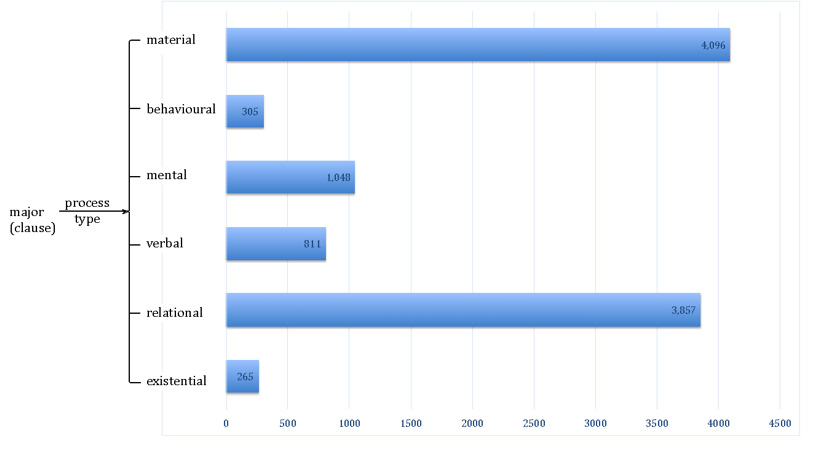
Let me give an updated version of the counts for process type here, based on a larger number of clauses (10,382) than before (Matthiessen, 2006: 6,525 clauses analysed in terms of process type): see Figure 4. I have continued to use Wu Canzhong’s SysFan, a database tool designed to support manual analysis: see Wu (2009). The frequencies are based on a sample that is neither sufficiently large nor registerially varied enough to be taken as an accurate picture of the global systemic probabilities of process type; but they are nevertheless suggestive - an indication of what kind of profile can be expected in a much larger sample. (The practical constraint is simply that this kind of analysis still needs to be done manually [cf. Wu, 2009; Matthiessen & Teruya, 2024: Chapter 4], and since I have not had funding for the research, I have had to do all the analysis myself. To increase the sample of texts analysed by one or a couple of orders of magnitude, one would need a team of expert analysts with extensive training and practice.)

Relative frequencies of selections of terms in the system of process type in a registerially varied sample of texts (N = 10,382 clauses)
The raw counts and percentages are given in Table 1. This exploratory investigation suggests that process types are ordered into three frequency bands:
• material, relational > mental, verbal > behavioural, existential
The most frequent types are thus ‘material’ and ‘relational’, accounting for around – of all selections in process type. This ordering in relative frequency correlates with certain other quantitative properties such as number of circumstances per clause and number of verb senses operating within each process type, as I show in Matthiessen (1999, 2006); but I will continue to focus specifically on relative frequency of selection when I consider variation across registers.
Using the frequency profile visualized in Figure 4 as a frame of reference, we can begin to investigate texts instantiating different registers, asking to what degree and in what ways the frequency profiles vary across registers. We should in fact expect the profiles to vary in view of Halliday’s (e.g. 1978) characterization of registers as resettings of global systemic probabilities. But before I look into registerial variation, I need to introduce an account of the contextual parameter that I will use to investigate the variation: see the interlude in Section 2.2. This is the field of activity within the field parameter of context. The reason for the choice of field rather than either of the other two contextual parameters, viz. tenor and mode, is that field “resonates with” the ideational metafunction (e.g. Halliday, 1978); selections within ideational systems such as that of process type vary with the variation in field values. In other words, different ideational meanings are at risk in different fields.
Relative frequencies of terms in process type in a registerially mixed sample of 10,382 clauses
2.2. Interlude: a brief account of field of activity within context
Context is the semiotic environment of language, extending from the context of culture, in which the overall meaning potential of a language operates, via cultural domains and situation types, in which registers and text types operate, to the context of situation in which particular texts unfold as acts of meaning that instantiate the meaning potential. This is the extension along the cline of instantiation from potential to instance via the intermediate region that can be viewed as sub-potentials or instance types (e.g. Halliday, 1991, 2002; Matthiessen, 2006, 2007, 2023). It is this intermediate region that is in focus here since this is the region of register variation - of variation in linguistic options according to context of use.
Since the 1960s (Halliday, McIntosh & Strevens, 1964), context has been modelled and described in terms of three parameters - field, tenor and mode; and Halliday (1978) hypothesized that values the three parameters correlate with selections in ideational, interpersonal and textual systems, respectively (see further Martin, 1992): Table 2. Within context, I will focus on the field of activity, using values within this variable to characterize the registers that are instantiated by the texts that I have analysed in terms of process type.
Field of activity is “what is going on” in a given context - the social and/or semiotic processes that people in a community take part in. Halliday (1978: 142-143) characterizes it as follows:
that which is ‘going on’, and has recognizable meaning in the social system; typically a complex of acts in some ordered configuration, and in which the text is playing some part […] the nature of the activity: what socially recognized action the participants are engaged in, in which the exchange of verbal meanings has a part. This includes everything from, at one end, types of action defined without reference to language, in which language has an entirely subordinate role, various forms of collaborative work and play such as unskilled manipulation of objects or simple physical games; through intermediate types in which language has some necessary but still ancillary function, operations requiring some verbal instruction and report, games with components of scoring, bidding, planning, and the like; to types of interaction defined solely in linguistic terms, like gossip, seminars, religious discourse and most of what is recognized under the heading of literature.
There are, of course, various ways in which one might sort and typologize the continuum of ‘goings on’ indicated by Halliday (see e.g. Martin, 1992; Hasan, 1999, 2009). Drawing on unpublished work by Jean Ure that she gave me at ISFC in Helsinki in 1989, I will use a typology of fields of activity that we have developed and used for various purposes (e.g. Matthiessen, 2014a, 2015a,b; Matthiessen & Teruya, 2015; Halliday & Matthiessen, 2014; Matthiessen, Teruya & Lam, 2010). In this typology, there are eight primary fields of activity, each of which has been described in further delicacy: two steps in delicacy are presented in summary form in Table 3. It takes another two or three steps in delicacy in the differentiation of fields of activity to reach the “genres” that have been identified, characterized and classified in the “genre model” of systemic functional linguistics (e.g. Martin, 1992; Martin & Rose, 2008; Eggins & Slade, 2005), as shown in e.g. Matthiessen (2015a).
Having sketched the typology of fields of activity in context in this contextual “interlude”, I can now return to registerial variation in the selection of terms from the system of process type: I will present certain aspects of the analysis of texts differentiated according to the fields of activity set out in Table 3 above.
2.3. Examples of registerial differences in relative frequency
If we take the relative frequencies of process types in Figure 4 as suggestive of the global probabilities of the system, we can ask a whole range of questions about variation across registers, e.g.
• Is the ordering into three frequency bands the same across all registers?
• Are there registers where either ‘material’ or ‘relational’ is much more frequent than the other instead of the two being roughly equally frequent?
• Are there registers where one or both of the middle frequency band, i.e. ‘mental’ and/or ‘verbal’, will typically dominate, overtaking ‘material’ and ‘relational’ in frequency?
• Does registerial variation in frequency apply to more delicate subtypes of the six primary types?
In addition, there are, of course, questions concerning contextual factors correlating with variation in selection within process type. I will explore this second set of questions in qualitative terms later (Section 3), but let me continue with the quantitative exploration for a little bit longer.
Clearly, to answer questions of the kind illustrated above, we would need to undertake a fairly large-scale multi-person research project supported by a reasonable level of funding. In the absence of such a project, all I can do here is give some illustrations based on my own relatively small-scale analyses of different samples of texts. Starting with primary delicacy in the differentiation of fields of activity in Table 3 above, I have counted the selections in process type in texts operating within contexts characterized by one or other of the eight primary types: see Table 4. The relative frequencies are visualized in the chart in Figure 5.
Selections of terms in the system of process type in 9,150 clauses in texts classified according to the eight primary fields of activity set out in Table 3

Relative frequencies of selections of terms in the system of process type in texts differentiated contextually with reference to the eight primary fields of activity (N = 9,150 clauses)
As can be seen clearly when we examine Figure 5 (a), ‘material’ and ‘relational’ clauses dominate in frequency in the samples of texts serving in contexts characterized by all eight primary fields of activity. In some registers, ‘material’ is more frequent, in others ‘relational’, and in yet others, they are roughly equally frequent:
• ‘material’ > ‘relational’: recreating, doing, enabling, exploring
• ‘relational’ > ‘material’: expounding, sharing
• ‘material’ ≈ ‘relational’: reporting, recommending
Turning now to the next frequency band, we can see in the chart in Figure 5 (a) that it covers ‘mental’ and ‘verbal’ clauses. These two are more frequent than ‘behavioural’ and ‘existential’ clauses - with the exception of texts operating in ‘enabling: instructing’ contexts, where they are less common than ‘existential’ clauses. The reason for this is simply that the sample includes many touring texts, i.e. walking and driving tour texts from guidebooks, where ‘existential’ clauses have an important role to play as a strategy for introducing places of interest along the journey constructed by ‘material’ clauses. Like ‘existential’ clauses, ‘behavioural’ clauses are not very frequent, but they are more common in ‘recreating’ and ‘sharing’ texts, and also in ‘reporting’ ones. These are texts where human behaviour is likely to be of interest (note that many verbs serving in ‘behavioural’ clauses have positive or negative connotations, so in addition to construing behaviour based on their denotations, they serve to enact assessments based on their connotations; cf. Martin & White, 2005).
It remains to be seen how “robust” the tendencies just presented and discussed are; it is certainly possible that they will change when the sample size is increased significantly, say by an order of 10 or 100 (which is almost certainly beyond the capacity of a single analyst, even a dedicated one). When the sample size is increased, we are likely to find more variation within each registerial domain. For example, once we differentiate ‘expounding’ into ‘explaining’ and ‘categorizing’, and then, by another step, ‘explaining’ into ‘sequential’ explanations and other types (for a typology of explanations in education, see Veel, 1997; Martin & Rose, 2007, 2008), we will see that ‘material’ clauses are dominant in sequential explanations and ‘relational’ clauses in the other types such as factorial explanations. Similarly, texts serving in ‘instructing’ contexts vary in their make-up in terms of the division of labour between ‘material’ and relational’ clauses. Thus while ‘material’ clauses are likely to be favoured in all such texts, they are more dominant in culinary procedures (recipes) than in topographic procedures (touring texts in guided books): in culinary procedures, virtually all clauses are ‘material’, representing the operations involved in preparing a dish, but in topographic procedures, ‘material’ clauses of motion construing the route that readers have to follow are typically interrupted by passages of historical background and of description of places of interest, which are likely to contain a good number of ‘relational’ clauses.
The general principle is therefore that when we increase the size of our text sample, we must make sure that we can also increase the delicacy of the differentiation of registers. Let me illustrate with counts from two samples representing texts operating in ‘enabling’ contexts - ‘instructing’: recipes vs. ‘regulating’: the Universal Declaration of Human Rights. The selections in the system of process type in these two samples are contrasted in Table 5. Both samples are dominated by ‘material’ and ‘relational’ clauses, but in different proportions: in recipes, ‘material’ clauses make up almost three fourths of all clauses, most of the remainder being ‘relational’; but in the Universal Declaration of Human Rights, ‘relational’ clauses make up around two thirds of all clauses, the other third being ‘material’ clauses. This can be illustrated by a typical clause from each sample:
(a) Recipe
Pour ingredients into a bowl
(b) Declaration
Article 6: Everyone has the right to recognition everywhere as a person before the law.
The two examples above are representative of their registers, and they differ not only in process type but also in congruence: Example (a) is a congruent ‘material’ clause, but (b) is an incongruent ‘relational’ clause. This ‘relational’ clause involves a grammatical metaphor (see e.g. Halliday, 1985a: Ch. 10, 1998; Halliday & Matthiessen, 2006: Ch. 6, 2014: Ch. 10; Simon-Vandenbergen, Taverniers & Ravelli, 2003; Yang, 2015; Taverniers, 2017; for an overview of systemic functional accounts of grammatical metaphor, see Xuan & Chen, 2019): a modulation of permission (as in everyone may be recognized everywhere as a person before the law ) has been re-construed as an abstract metaphorical thing, right, that can be possessed by people, as shown by the analyses of the congruent and incongruent versions in Figure 6. In this case, the congruent version is also a ‘relational’ clause - an ‘attributed’ one of assignment of Attribute to Carrier; but incongruent ‘relational’ clauses are often related to congruent clauses of other process types, in particular ‘material’ and ‘mental’ ones. Here are some examples of such clauses included in the count of ‘relational’ clauses in Table 4 (verbs in relational clauses in bold italics, verbs in material clauses in bold; congruent versions in square brackets), the first two being from the Universal Declaration:
Everyone has the right to the protection of the law against such interference or attacks. [‘everyone may be protected by the law …’]
Everyone has the right to freedom of movement and residence within the borders of each state. [‘everyone may move and reside freely within the borders of each state’]
The relatively high sun angle of November and December coupled with this shift in the location of the ozone minimum likely resulted in a significant UV impact on the aquatic ecosystem of that region. [‘because the angle of the sun was relatively high and the location of the ozone minimum shifted, UV impacted the aquatic ecosystem of that region’]
This implies [[that the temperature change is a result of ozone depletion rather than a cause of it]]. [‘… the temperature has changed because ozone has been depleted …’

Incongruent ‘relational’ clauses are more likely to occur in texts operating in contexts characterized by certain fields of activity - perhaps in particular ‘expounding’ (though with variation among subtypes), ‘exploring’ and ‘enabling: regulating’. According to Halliday (e.g. 1988), the evolution of scientific English was the leading edge, but the metaphorical mode of construal has now also spread to many other registers. There has, in fact, been a large-scale shift from predominantly congruent modes of construal to a combination of congruent and incongruent modes, with the incongruent mode being dominant in many registers. This is systemic, like the redshift in physics3; and it depends on contextual factors beyond the field of activity, viz. both the two other contextual variables - mode and tenor:
• mode: the metaphorical mode of construal is characteristic of prototypically written medium rather than spoken medium (see e.g. Halliday, 1985c);
• tenor: the metaphorical mode of construal becomes more frequent in texts addressed to, and written by, adolescent and adult language users; it is a feature of secondary education rather than primary education and pre-school learning (see e.g. Derewianka, 1995, 2003; Painter, Derewianka & Torr, 2007; Christie & Derewianka, 2008; Liardét, 2015; McCabe, 2021); in addition, it also seems that the metaphorical mode of construal becomes more frequent in texts where there is an element of persuasions and a pay-off in potentially suppressing participants and giving processes the status of being assumed rather than negotiable.
This suggests that if we compare texts operating in contexts characterized by the same field of activity but with differences in the values of the contextual parameters of mode and tenor along the lines specified above, we should expect to texts with a higher proportion of incongruent ‘relational’ clauses when we compare prototypically written variants (e.g. in text books, academic articles) with spoken variants (e.g. in lessons or lectures) and more educationally advanced texts (e.g. in late secondary school or university material) with more introductory texts (e.g. in late primary school). The contrast between congruent and incongruent construals is a matter of degree, as can be illustrated through examples taken from Halliday & Matthiessen (2006: 257). The first example is an authentic one4, and the second is the last of a series of increasingly more congruent rewordings intended for increasingly younger addressees5:
[original:] The truest confirmation of the accuracy of our knowledge is the effectiveness of our actions.
[reworded for a 3-year-old:] Look - wasn’t it good that we watered that philodendron? See how well it’s growing!
The authentic example is a typical incongruent ‘relational’ clause, with the structure Value: nominalization + Process: ‘be’ + Token: nominalization. The reworded example is completely congruent; it includes two ‘material’ clauses (that we watered the philodendron and how well it’s growing), the first being framed by an evaluative ‘relational’ clause (wasn’t it good) and the second by a ‘mental’ clause of perception (see).
3. Discourse uses of process types according to register
Having given an indication of quantitative differences among the terms in the system of process type in terms of relative frequency in texts instantiating different registers, I will now switch to a qualitative overview of what appear to me to be major discourse uses of clauses belonging to the different process types. I will continue to draw on the typology of fields of activity within context (see above, Table 3) to characterize these discourse uses in registerial terms: see Table 6.
Examples of prominent discourse uses of different options in the system of process type according to field of activity in context
In Table 6, terms in the system of process type are column headings, starting with ‘material’, and fields of activity are row headings. At the intersection of process types and fields of activity, I have specified characteristic discourse uses of process types. For example, in texts operating in ‘expounding’ contexts, ‘material’ clauses are characteristic of sequential explanations, but ‘relational’ clauses are characteristic of taxonomic reports.
3.1. ‘Material’ clauses
Material clauses play a central role in many registers, in particular in the construal of event lines in narratives and recounts, in the construal of stages in sequential explanations, and in the construal of steps in procedures. For example:
• Sequential explanations (steps in sequences): Text 1 is an explanation of how paper is made, where ‘material’ clauses construe the stages in the explanation, e.g. the woodchipping begins. As is often the case in sequential explanations in English, most of the clauses that have a distinction in voice are ‘passive’ and ‘non-agentive’ rather than ‘active’ (thus implying agency, e.g. ‘effective: passive: non-agentive’: the pulp is bleached rather than ‘middle’: the pulp then bleaches; contrast the ‘middle’ clause schist forms in: Schist forms when extreme heat melts the minerals and then high pressure squeezes them into flat shapes.). In these clauses the Subject is the Goal being impacted, and in a number of instances the outcome of the impact is represented by the “particle” of phrasal verbs (cut down, cut off, rolled out) or by circumstances of Role: product (into small pieces, into pulp) or Place (to a log landing, onto a truck).
• Narratives (event lines): Text 2 is an extract from an English retelling of a traditional Akan folktale, where ‘material’ clauses construe the event line of the narrative. In this passage, the protagonist, Ananse, makes a doll out of wood. He serves as Actor in all the clauses - the animate and volitional being characteristic of stories, and is construed in ‘creative’ or ‘transformative’ clauses as impacting Goals - inanimate objects and substances. The impact is represented explicitly by circumstances of Place in a number of clauses (in the doll’s hand, in a brass pot, around the doll’s waist, at the foot of the odum tree …).
• Reminiscences (event lines): Text 3 is an excerpt from a casual conversation among friends where they are sharing their experiences of a freak hailstorm on 14 April 1999, in Sydney. Here ‘material’ clauses represent vignettes of this physical disaster, with humans as Actor (e.g. someone in someone’s throwing bottles around) or objects (e.g. tiles in tiles were actually, you know, cascading off the roof).
• Procedures (steps in methods): Text 4 is an excerpt from a ‘how-to’ text, an instruction setting out the procedure for making a rag doll. Here ‘material’ clauses construe the operations that make up the procedure, with the addressee as Subject/ Actor, typically as the implicit Subject of the ‘imperative’ clauses that constitute the instruction, and objects or substances as Goal. The outcome of the impact on the Goal may again be represented circumstantially (e.g. inside out, into the arm, on top of the pinned arms).
Text 1: Examples of ‘material’ clauses, with Process elements in bold, construing stages in a sequential explanation, Woodchipping6; ‘relational’ clauses, with Process elements in italics, providing definitions and characterizations
[0] Woodchipping
[1] Woodchipping is a process [[[ used || to obtain pulp and paper product from the forest]]]. [2] About 10 percent of Australia’s state owned forest land, and large areas of privately owned forest, are involved in woodchip projects. [3.1] The woodchipping process begins [3.2] when the trees are cut down in a selected area of the forest [[called a coupe]]. [4.1] After that, the tops and branches are cut off [4.2] and the logs are dragged to a log landing [4.3] where they are loaded onto a truck. [5.1] Next the bark of the logs is removed [5.2] and the logs are taken to a chipper [5.3] which cuts them into small pieces [[called woodchips]]. [6.1] The woodchips are then screened [6.2] to remove dirt and other impurities. [7.1] At this stage the woodchips are either exported to Japan in this form [7.2] or converted into pulp by chemicals, heat and pressure. [8.1] The pulp is then bleached [8.2] and the water content removed. [9.1] Finally it is rolled out [9.2] to make paper.
Text 2: Examples of ‘material’ clauses (Process elements in bold) in an excerpt from a traditional folk tale, Spider and the Sky God: an Akan legend7
[…] [1.1] When Ananse reached the village, [1.2] he carved a flat-faced wooden doll, an Akua’s child, from an odum tree. [2.1] He tapped some sticky fluid from a gum tree [2.2] and painted the doll’s face and body with it. [3] Then he pounded eto from mashed yams. [4] He put some eto in the doll’s hand. [5.1] He pounded more yams [5.2] and put them in a brass pot. [6.1] After tying a string around the doll’s waist, [6.2] he took the doll [6.3] and placed it at the foot of the odum tree, the place [[[ where Fairies came || to play]]].
Text 3: Examples ‘material’ clauses (Process elements in bold) in an excerpt from a casual conversation where friends are reminiscing about a freak hailstorm in Sydney, sharing their experiences with one another; at the beginning of the excerpt, Penny is eliciting a story from Clive
Penny: I mean I only heard a little bit about it from Di. So what actually happened?
Clive: Ah. ... Well I mean the strange thing about it was that when it started at about eight o’clock at night ... um we were sitting watching the TV and suddenly I thought ... God there’s a bloody riot going on in the street; someone’s throwing bottles around, you know.
[…]
Clive: And then opened the door and the first thing I realised was that that this ice-block shoots horizontally through the door. And we thought “oh my God” and then all hell breaks loose. We go outside and everyone’s outside by this stage but really dangerous because tiles were actually ... you know cascading off {Penny: Mm. God yeah. ... Mm.} the roof. And you know car bang bang bang cars going off.
Di: Was everybody in the street?
Clive: Yeah. But then it got too bad, so everyone had to rush in because it was dangerous. I mean it literally was ... not just the ice-blocks but the tiles coming off.
Text 4: Examples ‘material’ clauses (Process elements in bold) in an excerpt from an instruction in how to make a rag doll, Making a Rag Doll8
[…] [1.1] Now you will need to sew the doll [1.2] and stuff it. [2] First sew two arms. [3] Then snip the tips of the arms to the thread. [4] Then turn the arms inside out. [5.1] You can use a pencil || [5.2] to stuff the poly into the arm. [6] Now pin the two arms to your cloth [[cut out of the body]]. [7] Place the other cloth body on top of the pinned arms. [8.1] Sew the body, [8.2] taking care with [[where the arms are pinned]]. [9.1] Once done [9.2] turn the body inside out. [10] Stuff the doll. [11.1] Now sew [11.2] and stuff the legs. [12.1] You can also add “knees” to the legs [12.2] by sewing two small dots side by side [12.3] where you think [12.4] the knee should be. [13.1] Then pin the legs to the bottom of the doll [13.2] and sew.
3.2. ‘Mental’ clauses
While ‘mental’ clauses make up only around 11% of all clauses in the cross-registerial sample in Figure 4, they do play an important role in various registers involving the participation of humans or human-like beings; for instance, they make it possible for story tellers in recreating contexts to represent the “inner world” of their characters - their perceptions, thoughts, desires and feelings. For example:
• Narrative: In the extract from a folk tale in Text 5, the protagonists’ actions are rational because we are told what they sense: the seven kids wanted to see the paws first; she thought they were all dead and so on. In this way, actions and activities performed by the protagonists are motivated in the narrative by their processes of consciousness. Similarly: One day, Kukul was hunting in the forest. He heard the rustling of leaves and raised his bow and arrow. Here perception of the sound of potential game precedes action.
• Casual conversation: In sharing contexts, people engage in casual conversation, sharing their personal experiences but also their thoughts, desires, feelings and attitudes, and thus ‘mental’ clauses play an important role here. They tend to be dispersed through casual conversations, but can be illustrated by short excerpts from conversations among family members and friends: see Text 6. In excerpt (a), a young boy of seven, Dano, uses ‘mental’ clauses of the ‘emotive’ type to construe his feelings towards lasagne, resisting his mother’s attempts to evaluate it objectively in terms of its own properties by means of ‘relational’ clauses (what’s wrong with lasagne; what’s the matter with it). In (b), the family members use ‘mental’ clauses of the ‘cognitive’ type to reminisce about past events, most of them ‘negative’, as it happens: I can’t remember. Interspersed with these are ‘cognitive’ clauses that serve as metaphorical representations of modality (Halliday & Matthiessen, 2014: 686-698), more specifically of explicitly subjective assessments of probability (I don’t think so).
• Literature reviews: In literature reviews, writers may deploy ‘mental’ clauses of ‘cognition’ to represent the ideas of scholars regarding some domain of phenomena, as illustrated in the excerpt in Text 7: Lamarck believed/ thought that …. The Sensers may be realized by nominal groups denoting particular (named) scholars or groups of scholars or even disciplines, e.g.:
Many scholars in the area of second language acquisition (SLA) believe that learning a new language mainly involves learning a set of grammatical “rules” and certain new sounds and sound combinations.
Brentano actually saw the intentional attitude as the hallmark of mental phenomena and believed that physical phenomena lacked intentional attitudes and aboutness.
James thought that the self-as-object, the material me, was the sum total of all that a man could call his-“not only his body and his psychic powers, but his clothes and his wife and children, his ancestors and friends, his reputation and works, his lands and horses, and yacht and bank account.”
Psychology has long recognized the existence of unconscious foundations of behavior and studied them under the rubrics of instinct, automatic behaviors, drives, and motivations.
• Evidenced-based arguments: In arguments where people draw on evidence, they often select ‘mental’ clauses of ‘perception’ to represent what they or other witnesses have sensed, and they use ‘cognitive’ clauses represent the degree of knowledge, as illustrated in the excerpt from the jury room drama Twelve Angry Men in Text 8. The issue being deliberated by the jury of “twelve angry men” is whether a young man of eighteen killed his father or not, so the jurors are concerned with what witnesses saw or heard, starting with Juror 2 saying somebody saw [[him do it]] in the passage quoted here, which is later picked up by Juror 10: right across the street she sees [[the kid stick the knife into his father]]. The clauses [[him do it]] and [[the kid stick the knife into his father]] are non-finite, representing acts rather than simple things. They serve as Phenomenon in the ‘perceptive’ clauses, as shown in Figure 7, these clauses being macro-phenomenal rather than simply phenomenal, as in he heard loud noises in the apartment upstairs. The ‘mental’ clauses of perception are supported by ‘behavioural’ clauses (she looks out of the window) and ‘verbal’ ones (He claimed he was at the movies during the time of the killing).

Macro-phenomenal mental clause of perception used in exploration of evidence for an act somebody is accused of performing
Text 5: Examples of ‘mental’ clauses (shown in bold italics) in an excerpt from a traditional folk tale, The Wolf and the Seven Kids
Now the wolf went once again to the house door of the seven kids and said, “Dear children, let me in. I’m your mother, and I’ve brought something for each of you.”
The seven kids wanted to see the paws first, and when they saw [[that they were snow white]] and heard [[the wolf speak so softly]], they thought he was their mother and opened the door. Once the wolf entered, however, they recognized him and quickly hid themselves as best they could. The first kid slid under the table, the second hid in the bed, the third in the oven, the fourth in the kitchen, the fifth in the cupboard, the sixth under the large washbasin, and the seventh in the clock case. However, the wolf found them all, and swallowed them, except for the youngest in the clock case, who remained alive.
When the wolf had satisfied his craving, he went off. Shortly afterward, the mother goat came home, and oh, what a terrible sight! The wolf had been there and had devoured her dear children! She thought they were all dead, but then the youngest jumped out of the clock case and told her how everything had happened.
Text 6: Examples of ‘mental’ clauses (shown in bold italics) in excerpts from casual conversations in sharing contexts
(a) Mother in conversation before dinner with her seven-year-old son
Mother: Yeah, well, then we’ll give you the raw carrots to eat.
Dano: [inaudible] Raw?
Mother: No, well, you don’t want raw, do you? Do you want lasagne?
Dano: Oh, I hate lasagne.
Mother: What’s wrong with lasagne?
Dano: I hate the taste.
Mother: What’s the matter with it?
Dano: I hate it.
Mother: Dano, you’re awfully negative today.
Dano: Oh, I’m just starving and all you’ll feed me is something rotten, or something I hate .
Mother: Hmmm.
Dano: I hate lasagne and I don’t want rotten carrots. ... I only want salted carrots.
(b) Parents in conversation over dinner with their two sons, Joshua (16 years old) and his one-year-old younger brother, reminiscing about a school excursion Joshua went on
Mother: Didn’t you go in Primary School?
Joshua: I can’t remember , I don’t think so.
Mother: I have a feeling that you have gone to it
Joshua: ⎣ probably did ... yeah I might have gone in Primary School but I don’t remember it.
Mother: ⎣You can’t remember any convicts? Have you seen any convicts because [inaudible]
Younger Son: I only remember when you made Joshua dress up as a convict.
Joshua: Yeah [laughter]
Younger Son: And you drew that, all the arrows on him. That looked really funny.
Mother: Arrows ? I can’t remember . Did we have a photograph of that?
Joshua: ⎣Yeah yeah black on the [inaudible]
Younger Son: I don’t think so. But he was like the white outfit [inaudible]
Father: ⎣That was when you were at Primary School.
Joshua: Yeah yeah and we had to dress up as convicts.
(c) Family members (Mother, Father and their two daughters, Jane and Kate) and a family friend (Craig) in conversation over dinner, excerpt starting when they’re discussing a legal case; Kate is doing the recording
Jane: I don’t think any of this should be transcribed.
Kate: No, I will I will just ... do bleep out the names.
Craig: I wouldn’t worry ; it’ll be in the papers.
Jane: No no no no. It just suddenly occurred to me.
Kate: No don’t worry ; I wouldn’t I wouldn’t do that.
Craig: Oh Kate.
Jane: Oh dear. I’m very...[whispers] I absolutely hate the smell of fish cooking.
Mother: What?
Jane: Turn it down.
Craig: She says she prefers cigarettes to fish.
Jane: Oh shut up. I didn’t say that.
Mother: ⎣Well that’s a fair comment.
Craig: Oh so.
Kate: Just leave her alone.
Craig: Oh.
Kate: Nothing worse than bloody ...
Craig: Vigilantes.
Kate: Non-smokers.
Jane: Oh look will you all shut up.
Craig: [laughs]
Jane: I really do hate the smell of fish.
Text 7: Examples of ‘mental’ clauses of ‘cognition’ (shown in bold italics) in the review of ideas developed by scholars, in an excerpt from “The legacy of Lamarckism”9
Lamarck’s Lamarckism
Jean-Baptist Lamarck (1744-1829) was the first consistent evolutionist. […]
Lamarck believed that the natural laws operating on living matter are the same as those operating on non-living matter. The difference between living and non-living is a consequence of the way in which the material is organized. Under certain special conditions, which allow the action of what were known in Lamarck’s time as ‘subtle fluids’, inanimate matter can be reorganized in a way which changes it into living matter. According to Lamarck, the spontaneous generation of living organisms is a normal, and not uncommon, occurrence of both the past and the present. A certain combination of material constituents and the right environment produce a living organism which is a self-sustaining, growing, and self-complicating entity.
Once generated, simple life forms change. Lamarck thought that there are two reasons for change. […] Thus according to Lamarck, the inherent tendency for a slow, gradual increase in complexity is a consequence of the basic properties of the living body. It occurs because the motions of the body fluids produce results that have a snowball effect.
If the self-complicating property of living organisms were the only factor causing changes, the series from simple to complex forms would be progressive and linear. However, Lamarck believed that a second factor is involved. […]
Lamarck’s ideas about the nature of evolutionary adaptation and the mechanisms involved are summed up in the laws given in his Philosophie zoologique: […]
Text 8: Examples of ‘mental’ clauses of ‘perception’ an excerpt from Twelve Angry Men10
2ND JUROR [flustered]: […]. I-what I meant- well, the man is guilty. I mean, somebody saw [[him do it]]. [He looks around helplessly.]
3RD JUROR: OK. [He refers to his notes.] Now, here’s what I think , and I have no personal feelings about this. I’m talking facts. Number one. Let’s take the old man who lived on the second floor right underneath the room where the murder took place. At ten minutes after twelve on the night of the killing he heard loud noises in the apartment upstairs. He said it sounded like a fight. Then he heard [[[the kid shout out, || “I’m gonna kill you.”]]] A second later he heard [[a body fall]] and he ran to the door of his apartment, looked out and saw [[the kid running down the stairs and out of the house]]. Then he called the police. They found the father with a knife in his chest.
FOREMAN: And the coroner fixed the time of the death at around midnight.
3RD JUROR: Right. I mean, there are facts for you. You can’t refute facts. This boy is guilty. Look, I’m as sentimental as the next guy. I know the kid is only sixteen, but he’s still got to pay for what he did.
7TH JUROR: I’m with you, pops.
4TH JUROR [removing his eyeglasses]: It was obvious to me, anyway, that the boy’s entire story was flimsy. He claimed he was at the movies during the time of the killing and yet one hour later he couldn’t remember what films he saw or who played in them.
3RD JUROR: That’s right. Did you hear that? [To the 4TH JUROR.] You’re absolutely right.
4TH JUROR: No one saw [[him going into or out of the theatre]].
10TH JUROR: Listen, what about that woman across the street? If her testimony don’t prove it, nothing does.
11TH JUROR: That’s right. She was the one who actually saw the killing.
FOREMAN [half rising]: Let’s go in order here.
10TH JUROR [rising, handkerchief in hand]: Just a minute. Here’s a woman . . . [He blows his nose.] Here’s a woman who’s lying in bed and can’t sleep. She’s dying with the heat. Know what I mean? Anyway, she looks out the window and right across the street she sees [[the kid stick the knife into his father]]. The time is twelve ten on the nose. Everything fits. Look, she’s known the kid all his life. His window is right opposite hers, across the el tracks, and she swore she saw [[him do it]].
8TH JUROR: Through the windows of a passing elevated train.
3.3. ‘Verbal’ clauses
Unlike ‘material’ and ‘relational’ clauses, the two most common process types at around 40% each (as shown above, Figure 4), ‘verbal’ clauses, with an average frequency of around 9%, do not occur in all registers; for example, they are uncommon in instructions and explanations. However, they make a crucial contribution to a number of registers, serving to construe different “voices”, i.e. sources to which information is attributed (for accounts of the uses of ‘verbal’ clauses in Spanish in different registers, see the publications by Natalia Ignatieva and her team cited in the Introduction); for example:
• Narratives: In narratives, ‘verbal’ clauses provide narrators with a resource to “dramatize” the story through the inclusion of dialogue, as illustrated in Text 9, an excerpt from The Velveteen Rabbit (cf. Matthiessen & Veloso, 2023) - quotes (direct speech) projected by ‘verbal’ clauses with the unmarked verb of saying, say, or verbs denoting some aspect of exchanges in dialogue such as ask, demand, suggest, claim (speech function) or continue, add, interrupt (turn taking). In particular in popular fiction, ‘behavioural’ clauses may be pressed into projecting service, thereby adding descriptive features to ‘say’, e.g. smile, frown, grimace. In the representation of dramatic dialogue, quoted passages may continue after the clause complex in which the projecting ‘verbal’ clauses occurs, as in [8] and [10] through [12] in Text 9. In this story, the Sayers are mostly non-human characters endowed with consciousness and the ability to speak. The excerpt also illustrates how ‘verbal’ clauses and ‘cognitive’ ‘mental’ ones complement one another in storytelling.
• News reports: In news reports, ‘verbal’ clauses provide reporters with a resource to “attribute” information to sources, ranging from eyewitnesses to disasters and other reportable events (cf. Halliday, 1993, on the major motifs in news), experts, professionals, government officials - and, of course, anonymous sources11. As the excerpt from a maritime disaster news report in Text 10 illustrates, projections of reports (indirect speech) and quotes (direct speech) alternate, one pattern being reports preceding quotes, as in [17] through [19]. When projecting ‘verbal’ clauses are brought in to substantiate information already given in unprojected mode, the projecting clause often precedes the projected material, and the Process may be given the status of Theme (e.g. There are other ways. Says Flavel: “If the son has to play tough, there are two options open to him. […]”). In news reports, ‘verbal’ clauses are used together with other manifestations of projections such as circumstances of Angle (e.g. according to in According to the Guardian, BBC news chiefs met to discuss the problem after the broadcaster carried several reports later shown to be inaccurate.).
• Literature reviews: In literature reviews, ‘verbal’ clauses provide scholars with a resource to cite scholarly contributions, working together with ‘mental’ clauses of ‘cognition’, which were illustrated above in Figure 5. While ‘mental’ clauses are used primarily to report scholarly ideas, ‘verbal’ clauses are used not only to report but also to quote, exemplified in Text 11, where all the quoted passages are set out as “block quotations”. We also find mixtures of quoting and reporting, as in: Hymes (1972) asserts somewhat less boldly that ‘there are rules of use without which the rules of grammar would be useless’ (p. 278). In addition to ‘verbal’ and ‘mental’ clauses, other, less explicit strategies have also evolved; they usually only specify the scholar (the equivalent of the Sayer) without a representation of the process of saying, as in:
Latin is (unsurprisingly, given its centrality in the grammatical tradition) one of those ‘synthetic’ languages where a need for a ‘word-and-paradigm’ approach to inflectional morphology has been seen as most evident (see for example Robins (1959); Matthews (1972)).
The elements in both (2) and (3) are not ordered in sequence; the trees in (2) are ‘wild trees’ (Staal 1967).
Text 9: Examples of ‘verbal’ clauses with projections (underlined: single - quotes; double - reports) serving as dramatizations in narrative, an excerpt from The Velveteen Rabbit12
[…] [1] For a long time he lived in the nursery. [2.1] He was naturally shy, [2.2] and some of the more expensive toys snubbed him. [3.1] The mechanical toys were very superior, [3.2] and pretended [3.3] they were real. [4.1] The model boat caught the tone [4.2] and referred to the rigging in technical terms. [5] Even the jointed wooden lion put on airs. [6.1] The only person [[who was kind to him at all]] was the Skin Horse, [6.2] who had lived longer in the nursery than any of the others.
[7.1] “What is REAL?” [7.2] the Rabbit asked the Skin Horse one day. [8] “Does it mean [[having things [[that buzz inside you]] and a stick-out handle]]?"
[9.1] “Real isn’t [[how you are made]],” [9.2] said the Skin Horse. [10] “It’s a thing [[that happens to you]]. [11.1] When a child loves you for a long, long time, [11.2] you become Real. [12.1] Generally, by the time you are Real, [12.2] most of your hair has been loved off, [12.3] and you get very shabby.”
[13.1] “I suppose [13.2] you are Real?” [13.3] said the Rabbit.
[14.1] “The Boy’s uncle made me Real many years ago,” [14.2] said the Skin Horse. [15.1] “Once you are Real, [15.2] it lasts for always.”
[16] The Rabbit sighed. [17.1] He thought [17.2] it would be a long time [17.3] before this magic [[called Real]] happened to him. […]
Text 10: Examples of ‘verbal’ clauses (verbs underlined in italics) with projections (underlined: single - quotes; double - reports) serving to attribute information to sources in an excerpt from a news report about a maritime disaster13
[0] Cops Probe Pilot in New York Ferry Crash
[1] Police Investigate Pilot for Possibly Falling Asleep in Staten Island Ferry Crash That Killed 10
[2] The Associated Press
[3] NEW YORK Oct. 16 - [4.1] Police were investigating [4.2] whether a Staten Island ferry pilot fell asleep during a routine trip across a windy New York Harbor [4.3] before the mighty vessel slammed into a pier, [4.4] killing 10 people [4.5] and injuring dozens of others, including three who lost limbs.
[5.1] The pilot bolted the scene so quickly [[that he left behind his gear and his keys]], [5.2] then broke into his house [5.3] where he slit his wrists [5.4] and shot himself with a pellet gun, [5.4] a law enforcement source told The Associated Press.
[6.1] The pilot, << [6.2] identified by the source as Richard Smith,>> was in critical condition after surgery at St. Vincent’s Hospital, the same place [[where 22 victims including at least one amputee were rushed after the 3:20 p.m. crash]], the city’s worst mass transit accident in at least a generation.
[7.1] “The scene was total chaos,” [7.2] said passenger Frank Corchado, 29, of Staten Island, [7.3] recounting a tableau of horrific sights: a decapitated man, a legless woman, a fellow passenger [[bleeding from his eyes]].
[8.1] “There was a lady without legs, right in the middle of the boat,” [8.2] he said. [9] “She was screaming. [10] You ever see anything like that?"
[10.1] A co-worker told authorities [10.2] that Smith had been asleep, [10.3] slumped over the controls, [10.4] the law enforcement source told the AP. [11.1] He was being represented by an attorney, [11.2] said police, [11.3] who obtained a sample of his blood for testing. [12] Telephone messages left at his home were not returned.
[13.1] The ferry’s crew was to be interviewed [13.2] and tested for drugs and alcohol, [13.3] said Mayor Michael Bloomberg. [14] The crewmembers referred investigators to their union lawyers.
[15.1] The 300-foot craft was carrying an estimated 1,500 people, [15.2] 36 of whom were treated at the scene [15.3] or were immediately taken to hospitals. [16.1] Six others walked away injured [16.2] and went to hospitals later.
[17.1] Corchado said [17.2] he tried to help as many people as possible get out. [18.1] Witnesses said [18.2] some jumped into the wind-swept 62-degree water [18.3] and others ran [18.4] as the pier chewed up the side of the boat.
[19.1] “Most of the people [[who died]] were older people, [[19.2] I believe , [19.3] who couldn’t move [19.4] or didn’t have enough time [[to get out of the way]],” [19.5] Corchado said.
[…]
Text 11: Examples of ‘verbal’ clauses (verbs underlined in italics) with projections (underlined: single - quotes; double - reports) in citations of writings by scholars, in an excerpt from “The legacy of Lamarckism”14
Molecular genetics has tended to reinforce the attitude to heredity adopted by the Mendelian geneticists. The genotype has become identified with DNA, the phenotype with proteins or the products of proteins. The genotype is regarded as a set of instructions, subject to only random changes; the phenotype is the result of the implementation of these instructions, and can be modified by the environment in an adaptive way. One of the most explicit articulations of this position has been made by Dawkins, who claimed:
The inheritance of acquired characteristics not only doesn’t happen; it couldn’t happen in any life-form whose embryonic development is epigenetic rather than performationistic. (Dawkins 1986, p. 298; Dawkins’s italics)
Since embryonic development is not performationistic - genes do not contain a description of the adult characters - Dawkins argued that if a character is modified by the environment, information about the change cannot, even in theory, be fed back into genes. Dawkins pointed out that DNA is not, as is sometimes said, a blueprint; it is more like the recipe for a cake: a set of instructions for carrying out a process. The words of the recipe (the DNA sequences) do not correspond to crumbs of the cake (parts of the body); they represent stages in the process of making the cake (parts of the body). Consequently, a word difference leads to a whole-cake difference:
‘Baking powder’ does not correspond to any particular part of the cake: its influence affects the rising, and hence the final shape, of the whole cake. If ‘baking powder’ is deleted, or replaced by ‘flour’, the cake will not rise […] (Dawkins 1986, p. 297)
Using this cake analogy, Dawkins says of Lamarckian inheritance:
We can no more imagine acquired characteristic being inherited than we can imagine the following. […] (Dawkins 1986, p. 298)
This cake analogy is a clear and comprehensible expression of the current dogma about Lamarckian inheritance. It also exposes the weakness of that dogma. […]
3.4. ‘Relational’ clauses
Like ‘material’ clauses, ‘relational’ clauses occur in most registers, with a relative frequency of around 40% (as shown above, Figure 4). Their contribution ranges from small but significant, as in instructions where they serve to construe conditions (e.g. in a recipe, until vegetables are very tender as a temporal qualification of the imperative material clause simmer), to major, as in taxonomic reports and topographic reports, which may be almost entirely ‘relational’ in nature. Examples:
• Taxonomic reports: In texts concerned with construing general categories of phenomena, classifying and dissecting them, ‘relational’ clauses serve to construe membership in classes, assignment of properties, part-whole relations. Examples of taxonomic reports dominated by ‘relational’ clauses are given in Text 12. Text 12 (a) is a classifying report concerned with kinds of bodies of water and examples of the different kinds. Many of the ‘relational’ clauses are in fact ‘identifying’ in nature, either providing definitions (e.g. A gulf is a wide deep area of ocean [[reaching into land]]; A large inland body of water is called a lake) or examples (of the identifying kind, e.g. Examples of seas are Read Sea, Celebes Sea, Dead Sea, Mediterranean Sea and South China Sea). Text 12 (a) can be contrasted with Text 15; this text is also concerned with water, but with the processes it undergoes in the course of the water cycle rather than with its classification, so ‘material’ clauses dominate, and ‘relational’ ones play a minor role. Text 12 (b) is a compositional report concerned with the make-up of the earth’s atmosphere. A number of the ‘relational’ clauses are of the ‘possessive’ type, e.g. The Earth’s atmosphere has five layers.
• Descriptive passages: Description is not a register in its own right; i.e. it is not a type of text that normally operates as a self-contained in its own context of situation - but descriptive passages occur as supporting text segments in texts instantiating a variety of registers, including chronicling texts, recreating texts such as traditional folk tales, promoting texts such as advertisements. An example of ‘relational’ clauses in a descriptive passage in a narrative is given in Text 13, an excerpt from Chapter 1 of Joseph Conrad’s Lord Jim. Here the ‘relational’ clauses are mostly ‘ascriptive’, and serve to characterize the protagonist of the novel, Jim. While ‘relational’ clauses are the most frequent in process type, ‘material’ ones also occur; they are mostly also in the simple ‘past’, but these time references have the sense of habitual occurrences (e.g. he advanced straight at you, meaning ‘he would advance …’), as is brought out in one clause, he would leave suddenly …, which is ‘modal’ rather than ‘temporal’ - more specifically, modality of the type ‘usuality’, marked by would.
• Evaluative passages: Like descriptive passages, evaluative passages serve as supporting text segments in texts belonging to a variety of registers, including narratives, phases of gossip and opinion in casual conversation, promoting texts such as advertisements, and reviews. Here, interleaved with descriptions, ‘relational’ clauses are typically used to construe value - to assign qualities of positive or negative value to the thing being evaluated, as in The movie is almost totally unfunny and emotionally unengaging, or to set up identities of positive or negative value, as in Mitchum’s Harry Powers is one of the most evil characters on film. The use of ‘relational’ clauses to construe value is illustrated by the review in Text 14 of Charles Laughton’s Night of the Hunter. In the evaluative passages, there are 10 ‘attributive’ clauses with the film, a scene from the film, the direction, the acting as Carrier and a highly positive evaluation as Attribute (e.g. as good as it gets, sublime, top draw), and there are 2 ‘identifying’ clauses of the exemplifying type with the film and Gish’s role as Token and ‘one of’ plus very positive evaluation as Value (one the greatest films …, one of the great feminine roles of all times).
Text 12: Examples of ‘relational’ clauses in taxonomic reports, from a Philippine textbook; Processes in ‘relational’ clauses in bold small capitals
(a) A taxonomic report concerned with the classification of bodies of water (a classifying report, accompanied by images of bodies of water), Water
[0] WATER
[1] About three-fourth (75%) of the Earth’s surface is covered with water. [2] This portion includes oceans, bays, gulfs, lakes and rivers.
[3] The biggest water form is the ocean. [4] These are the Pacific Ocean, Arctic Ocean, Indian Ocean, Atlantic Ocean and Antarctic Ocean or Southern Ocean. [5] Which of them is the widest? [6.1] Yes, it is the Pacific Ocean [6.2] which is located on the eastern part of the Philippines.
[7] Smaller than oceans are seas. [8.1] Examples of seas are Read Sea, Celebes Sea, Dead Sea, Mediterranean Sea and South China Sea [8.2] which is situated on the western part of the Philippines.
[9] A bay is a wide inlet of a sea or lake. [10] An example is the Bengal Bay in India. [11.1] In the Philippines, we have the Manila Bay, [11.2] known for its beautiful sunset.
[12] A gulf is a wide deep area of ocean [[reaching into land]]. [13] The Persian Gulf, Gulf of Mexico, and Lingayen Gulf in Pangasinan are examples of this water form.
[14] A large inland body of water is called a lake. [15] The common examples are Laguna Lake in Laguna, Lake Taal in Batangas and Lake Buhi in Bicol.
[16] A river is a large natural stream of freshwater [[flowing into an ocean or lake]]. [17] The Amazon River and the Nile River are the two longest rivers in the world. [18] The Pasig River in the Philippines was a witness to many historical events in the country since the time of Dr. Jose Rizal. [19] The official residence of the President of the Philippines, the Malacañang Palace overlooks the Pasig River.
(b) A taxonomic report concerned with the composition of a phenomenon (a compositional report, accompanied by a figure showing the layers of the atmosphere), The Atmosphere
[0] THE ATMOSPHERE
[1] The Earth holds an ocean of air [[called the atmosphere]]. [2] The atmosphere is a mixture of gases [[that protects living things from the dangerous radiation of sunlight [[which holds some of the sun’s warmth]] ]]. [3.1] The atmosphere contains oxygen [3.2] which many living things need [3.3] to live.
[4] The Earth’s atmosphere has five layers. [5.1] The bottom layer, <<< [5.2] where temperature decreases [5.3] as the altitude increases, >>> is the troposphere. [6.1] After the troposphere is the stratosphere [6.2] where the temperature remains the same. [7.1] The next layer is the mesosphere [7.2] where temperature decreases with height until about 80 km above the Earth. [8.1] Extending upward [8.2] is the thermosphere, a layer [[which contains a small fraction of the atmosphere’s mass]]. [9] The outermost layer is the exosphere.
Text 13: Examples of ‘relational’ clauses in an excerpt from a narrative text, the beginning of Joseph Conrad’s Lord Jim
[1.1] He was an inch, perhaps two, under six feet, powerfully built, [1.2] and he advanced straight at you with a slight stoop of the shoulders, head forward, and a fixed from-under stare [[which made you think of a charging bull]]. [2.1] His voice was deep, loud, [2.2] and his manner displayed a kind of dogged self-assertion [[which had nothing aggressive in it]]. [3.1] It seemed a necessity, [3.2] and it was directed apparently as much at himself as at anybody else. [4.1] He was spotlessly neat, [4.2] apparelled in immaculate white from shoes to hat, [4.3] and in the various Eastern ports [[where he got his living as ship-chandler’s water-clerk]] he was very popular. […]
[5] To the white men in the waterside business and to the captains of ships he was just Jim--nothing more. [6.1] He had, of course, another name, [6.2] but he was anxious [[that it should not be pronounced]]. [7.1] His incognito, << [7.2] which had as many holes as a sieve,>> was not meant to hide a personality but a fact. [8.1] When the fact broke through the incognito [8.2] he would leave suddenly the seaport [[where he happened to be at the time]] [8.3] and go to another - generally farther east. [9.1] He kept to seaports [9.2] because he was a seaman in exile from the sea, [9.3] and had Ability in the abstract, [9.4] which is good for no other work but that of a water-clerk.
Text 14: Examples of ‘relational’ clauses in a “user review” of Charles Laughton’s Night of the Hunter15; Processes in ‘relational’ clauses in bold small capitals, with evaluations underlined
[0] Laughton crafts a nightmarish fairytale [[that stands up now as a true masterpiece]].
10/10
Author: Spikeopath from United Kingdom
4 March 2008
[1] A religious maniac marries an idiotic widow and mother of two children in the hope [[of finding out [[where the $10,000 is hidden [[that the now executed husband and father garnered from a robbery]] ]] ]].
[2] Upon release back in 1955, the critics of the time kicked this first directorial effort from Charles Laughton to such a degree [[he never directed again]]. [3.1] Watching the film now [3.2] and observing the tide of praise for it [3.3] as each year goes by, [3.4] one can only hope [3.5] that those critics were rounded up [3.6] and sent to a faraway island [3.7] to learn about how to view with open heart.
[4] The Night Of The Hunter is to me quite simply one of the greatest film’s [[ever laid down on the screen]]. [5.1] Firstly you have to ask yourself [5.2] exactly what genre the film belongs to? [6] That alone should lead you to find out [[[that the film is something different, even unique, || because it covers so many bases]]]. [7] Perhaps that is [[what the critics back then couldn’t quite fathom]]? [8] Is it Crime? [9] Is it a Thriller? [10] Horror, Drama, Noir, even a terrifying mother goose fairytale (that last one was Laughton’s terming of his masterpiece), truth is, is that it’s a multitude of earthly traits masquerading as a good versus evil parable.
[11.1] The work on the film is as good as it gets, [11.2] the direction from Laughton is sublime, [11.3] his visual style alone makes the film a feast for the sharp eye connoisseur. [12.1 Observe some of the cutaway sets, [12.2] take in the expressionist use of shadows, [12.3] an underwater sequence [[that is gorgeous yet terrifying at the same time]]. [13.1] I dare you [13.2] to stop the hairs on your neck standing up on end [13.3] as the silhouette of Mitchum’s evil preacher Harry Powell looms large over the children at bedtime. [14.1] The film is full of striking images [[that in themselves are telling the story]], [14.2] witness the pursuit of the children by Powell, [14.3] the children’s river journey is all dreamy and calm, [14.4] rabbits, frogs and spiders all are prominent [14.5] to give the feeling [[that the kids are safe]], [14.6] cut to Powell all in black, cloaked in evil, always one step away from his prey, perhaps a devil in priests attire?
[15.1] The acting is top draw, [15.2] Mitchum (in a career making role) plays it perfect, evil personified mixed with gentle panto fusion at just the right times. [16.1] Lilian Gish, in [[what surely has to be one of the great feminine roles of all time]], is precious, quite simply precious, [16.2] while the children are a believable delight [16.3] because Laughton has got us viewing this uncertain world through such untainted eyes. [17.1] Crowning it off is the cinematography from Stanley Cortez, [17.2] I can only describe it as bleakly beautiful, [17.2] it impacts on the eyes as much as the head [17.3] as this truly majestic piece of work unfolds.
[18.1] If you don’t see this as a masterpiece [18.2] then I urge you [18.3] to watch it every year [18.4] until you do. [19.1] Because when it hits you, that bit [[that you just didn’t get]], [19.2] it’s the point [[[when you realise || why you love cinema after all]]]. 10/10 in every respect.
Text 15: Examples of ‘material’ clauses (Process elements in bold) and ‘relational’ clauses of change (Processes underlined italics) in a sequential explanation, The Water Cycle16
The Water Cycle
The water cycle, which is sometimes referred to the rain cycle, begins when heat from the sun turns the water molecules (tiny particles) in lakes, rivers and oceans into vapour (gas). This is called evaporation.
This vapour or water molecules in the form of gas rise up in the air.
As they get higher the water molecules are cooled and they begin to join together. This process is called condensation and we see it happening when clouds are forming particularly over mountains.
When the droplets in the clouds get big enough they can fall as rain. If the cloud is very high up the droplets may be swept up to the top of the cloud where they get even colder. These drops then fall as snow or hailstones.
When the rain reaches the ground, some of it goes into the ground and becomes part of ground water or the water table but most of the rain flows across the ground and into streams, rivers and lakes.
Streams, lakes and rivers eventually reach the ocean where evaporation of the water molecules begins again.
3.5. Take-away
In this section, I have identified significant “discourse uses” of process types that I have been able to identify after years of text analysis. They are obviously not by any means exhaustive; to keep within a reasonable space, I’ve had to leave out interesting uses of the process types I have considered here - ‘material’, ‘mental’, ‘verbal’ and ‘relational’; and I have not given separate sub-sections to the two least frequent process types, ‘behavioural’ and ‘existential’ clauses.
This does not mean that they are insignificant. On the contrary, as illustrated by the examples of registers given in Table 6 above, they make specialized by crucial contributions to texts belonging to a good many different registers. For example, when we consider ‘existential’ clause, we will probably think of their contribution to the Placement segment of traditional narratives; but they also have other key uses, e.g. introducing places of interest in guidebook texts - and the complement ‘relational’ clause as a strategy in incongruent (metaphoric) construals of our experience.
Similarly, ‘behavioural’ clauses make key contributions to texts belonging to certain registers. For example, in narrative texts (‘recreating’ field of activity), they often accompany ‘verbal’ clauses, thereby providing further characterization. And, more generally, because verbs serving in ‘behavioural’ clauses embody not only experiential denotation of behaviour but also interpersonal connotation, ‘behavioural’ clauses are frequently engaged in the service of “appraisal” (cf. Martin & White, 2005).
4. Conclusion
In this paper, I have related two strands of research, one concerned with the extension of the description of the system of transitivity in English (e.g. Matthiessen, 1999, 2006, 2014b) and the other with the development of a map of English showing its registerial composition - the project of registerial cartography (e.g. Matthiessen, 1993, 2014a, 2015; Matthiessen & Teruya, 2015). Specifically, I have explored the relative frequency of different options within the system of process type in different registers differentiated according to the field of activity of the context in which they operate against the background of their cross-registerial frequencies (Figure 4): see Figure 5.
This investigation shows, among other things, that ‘material’ and ‘relational’ clauses are the most frequent in a mixed-registerial sample, but that either one or the other type may dominate in a given register identified in terms of field of activity; for example, in ‘expounding’ texts, ‘relational’ clauses dominate, but in ‘recreating’ texts ‘material’ clauses dominate. As the size of the sample of texts from different registers is increased by one or two orders of magnitude and as more registers are represented, the relative frequencies shown in Figure 5 are very likely to change; and as the sample size is increased, it will be possible to increase the delicacy in the differentiation of fields of activity and also in the description of the system of process type (see Matthiessen, 2014b). However, the registerially varied profiles of selections of terms in the system of process type is likely to be confirmed in various respects, such as the favouring of ‘mental’ clauses in ‘sharing’ contexts and of ‘relational’ clauses in ‘expounding’ contexts.
Complementing this quantitative account of registerial variation in the selection of terms in the system of process type, I have also investigated favoured patterns in more qualitative terms. This investigation has again been exploratory: for each process type, I have identified salient “discourse uses” in terms of the different fields of activity listed in Table 3 above. This is a step in the direction of showing what lies behind the quantitative profiles reported in Figure 5. For example, we can relate the predominance of ‘material’ clauses in ‘recreating’ contexts to the point that they are used to construe the event lines of narratives. Similarly, we can relate the relatively higher frequency of ‘verbal’ clauses in ‘reporting’ texts to the role they play in news reports, providing reporters with a resource for attributing the information they give to their sources.
The line that I have drawn in this paper between fields of activity within context, corresponding registers of language (functional varieties, text types), and deployment of different process types within lexicogrammar, with variation in frequency from one register to another is illustrated for one slice through the strata in Figure 8. Here the field of activity is that of ‘reporting’ - chronicling the news, and the contextual structure of chronicling the news is projected onto the register of news reporting. In a sample of news reports, we can examine the verbs operating as Process in ‘verbal’ clauses, and establish a profile of relative frequency: the most common ones are said > told > say > says > saying - i.e. forms of say and tell, followed by asked. Against this frequency profile, we can identify more loaded verbs with the sense of ‘say’ plus some feature of assessment or stance, e.g. claim. Such preferences for favourite patterns vary across registers; cf. Hyland (2004) in verbs of saying in different disciplinary discourses.

Field of activity within context, text type (register) frequency of process types within lexicogrammar, illustrated for ‘verbal’ clauses
Thus, an important part of the future research agenda is to add discourse uses to overviews of the kind illustrated by Table 6 above. At the same time, we need to extend the size of the corpus significantly. Here it will be possible to use tools for automatic analysis for certain lexical items of high frequency, like say and tell in ‘verbal’ clauses as in Figure 8 (cf. Footnote 11), to complement the richer manual analysis of smaller samples. There is also great need for comparable work on languages other than English - Portuguese and Spanish have been illuminated by members of the SAL group, prominently Leila Barbara and Natalia Ignatieva; and studies of translations of samples from various registers can also be quite useful as an approach to the comparison of systems in different languages (e.g. Rojo & Valenzuela, 2001; Matthiessen, Arús-Hita & Teruya, 2021).
References
- Bateman, J., McDonald, D., Hiippala, T., Couto-Vale, D., & Costetchi, E. (2019). Systemic functional linguistics and computation: new directions, new challenges. In G. Thompson, W. L. Bowcher, L. Fontaine, & D. Schöntal (Eds.), The Cambridge handbook of systemic functional linguistics (pp. 561-586). Cambridge University Press.
- Cabral, S. R. S., & Barbara, L. (Eds.). (2018). Estudos de transitividade em linguística sistêmico-funcional [Transitivity studies in systemic functional linguistics]. Programa De Pós-Graduação em Letras - PPGL UFSM.
- Christie, F., & Derewianka, B. (2008). School discourse: Learning to write across the years of schooling Continuum.
- Derewianka, B. (1995). Language development in the transition from childhood to adolescence: the role of grammatical metaphor [Tese de Doutorado não publicada]. Macquarie University.
- Derewianka, B. (2003). Grammatical metaphor in the transition to adolescence. In A.-M. Simon-Vandenbergen, M. Taverniers, & L. Ravelli (Eds.), Grammatical metaphor: views from systemic functional linguistics (pp. 185-220). John Benjamins.
- Eggins, S., & Slade, D. (2005). Analysing casual conversation Equinox.
- Fillmore, C. J. (1968). The Case for Case. In E. Bach & R. T. Harms (Eds.), Universals in linguistic theory (pp. 1-88). Holt, Rinehart and Winston.
- Fillmore, C. J. (1977). The case for case reopened. In P. Cole & J. M. Sadock (Eds.), Syntax and semantics volume 8: Grammatical relations (pp. 59-81). Academic Press.
- Gruber, J. (1965). Studies in lexical relations [Tese de Doutorado não publicada]. Massachusetts Institute of Technology.
- Gruber, J. S. (1976). Lexical structures in syntax and semantics North-Holland.
- Halliday, M. A. K. (1978). Language as social semiotic: the social interpretation of language and meaning Edward Arnold.
- Halliday, M. A. K. (1985a). An introduction to functional grammar Edward Arnold.
- Halliday, M. A. K. (1985b). Dimensions of discourse analysis: grammar. In T. A. van Dijk (Ed.), Handbook of discourse analysis (Vol. 2, pp. 29-56). Academic Press.
- Halliday, M. A. K. (1985c). Spoken and written language Deakin University Press.
- Halliday, M. A. K. (1988). On the language of physical science. In M. Ghadessy (Ed.), Registers of written English: situational factors and linguistic features (pp. 162-178). Pinter Publishers.
- Halliday, M. A. K. (1991). The notion of ‘context’ in language education. In T. Le & M. McCausland (Eds.), Interaction and development: proceedings of the international conference, Vietnam, 30 March - 1 April 1991 (pp. 1-26). University of Tasmania: Language Education.
- Halliday, M. A. K. (1998). Things and relations: regrammaticizing experience as technical knowledge. In J. R. Martin & R. Veel (Eds.), Reading science: critical and functional perspectives on discourses of science (pp. 185-235). Routledge.
- Halliday, M. A. K. (2002). Computing meanings: some reflections on past experience and present prospects. In G. Huang & Z. Wang (Eds.), Discourse and language functions (pp. 3-25). Foreign Language Teaching and Research Press.
- Halliday, M. A. K. (2005). Notes on transitivity and theme in English 1-3. Journal of Linguistics, 3(1), 37-81; 3(2), 199-244; 4(2), 179-215. (Trabalho original publicado em 1967/8).
- Halliday, M. A. K., & Matthiessen, C. M. I. M. (2006). Construing experience through meaning: a language-based approach to cognition Continuum.
- Halliday, M. A. K., & Matthiessen, C. M. I. M. (2014). Halliday’s introduction to functional grammar (4th ed.). Routledge.
- Halliday, M. A. K., McIntosh, A., & Strevens, P. (1964). The linguistic sciences and language teaching Longman.
- Halliday, M. A. K., & Webster, J. J. (Eds.). (2009). A companion to systemic functional linguistics Continuum.
- Hasan, R. (1999). Speaking with reference to context. In M. Ghadessy (Ed.), Text and context in functional linguistics: systemic perspectives (pp. 219-328). John Benjamins.
- Hasan, R. (2009). The place of context in a systemic functional model. In M. A. K. Halliday & J. Webster (Eds.), A companion to systemic functional linguistics (pp. 166-189). Continuum.
- Hyland, K. (2004). Disciplinary discourses University of Michigan Press.
- Ignatieva, N. (2014). Participantes y proyección en los procesos verbales en español: un análisis sistémico de géneros académicos estudiantiles. Onomázein Revista de lingüística filología y traducción, (Especial ALSFL), 53-79.
- Ignatieva, N. (2019). Transitive and Attitudinal Aspects in a Functional Analysis of Academic Discourse in Spanish. Open Journal of Modern Linguistics, 9, 165-178.
-
Ignatieva, N. (2021). Análisis ideacional e interpersonal de escritos estudiantiles de historia en español dentro del marco sistémico. Revista Signos, 54(105), 169-190. https://doi.org/10.4067/S0718-09342021000100169
» https://doi.org/https://doi.org/10.4067/S0718-09342021000100169 - Ignatieva, N., Herrero Rivas, L. E., Rodríguez-Vergara, D., & Zamudio, V. (2013). Analizando procesos verbales en géneros académicos de las humanidades en español. Signos Lingüísticos, 9(17), 53-79. (Trabalho original publicado em 2012).
-
Ignatieva, N., & Rodríguez-Vergara, D. (2015). Verbal processes in academic language in Spanish: exploring discourse genres within the systemic functional framework. Functional Linguistics, 2(2), 1-14. https://doi.org/10.1186/s40554-015-0014-9
» https://doi.org/https://doi.org/10.1186/s40554-015-0014-9 -
Ignatieva, N., & Zamudio, V. (2012). Functional perspective of verbal processes in the writing in Spanish of students of Literature and History. DELTA Documentação de Estudos em Lingüística Teórica e Aplicada, 28(SPE), 561-579. https://doi.org/10.1590/S0102-44502012000300007 (Trabalho original publicado em 2011).
» https://doi.org/https://doi.org/10.1590/S0102-44502012000300007 - Kashyap, A. K. (2019). Language typology. In G. Thompson, W. L. Bowcher, L. Fontaine, & D. Schöntal (Eds.), The Cambridge handbook of systemic functional linguistics (pp. 767-792). Cambridge University Press.
- Liardét, C. (2015). Academic Literacy and Grammatical Metaphor: Mapping Development. TESOL International Journal, 10(1), 29-46.
- Martin, J. R. (1992). English text: system and structure Benjamins.
- Martin, J. J. R., Matthiessen, C. M. I. M., & Painter, C. (2010). Deploying functional grammar (Rev. ed.). Commercial Press.
- Martin, J. R., & Rose, D. (2007). Working with discourse: meaning beyond the clause Continuum.
- Martin, J. R., & Rose, D. (2008). Genre relations: mapping culture Equinox.
- Martin, J. R., & White, P. R. R. (2005). The language of evaluation: appraisal in English Palgrave Macmillan.
- Matthiessen, C. M. I. M. (1993). Register in the round: diversity in a unified theory of register analysis. In M. Ghadessy (Ed.), Register analysis: theory and practice (pp. 221-292). Pinter.
- Matthiessen, C. M. I. M. (1995). Lexicogrammatical cartography: English systems International Language Sciences Publishers.
- Matthiessen, C. M. I. M. (1999). The system of transitivity: an exploratory study of text-based profiles. Functions of Language, 6(1), 1-51.
- Matthiessen, C. M. I. M. (2004). Descriptive motifs and generalizations. In A. Caffarel, J. R. Martin, & C. M. I. M. Matthiessen (Eds.), Language typology: a functional perspective (pp. 537-673). Benjamins.
- Matthiessen, C. M. I. M. (2006). Frequency profiles of some basic grammatical systems: an interim report. In S. Hunston & G. Thompson (Eds.), System and corpus: exploring connections (pp. 103-142). Equinox.
- Matthiessen, C. M. I. M. (2007). The “architecture” of language according to systemic functional theory: developments since the 1970s. In R. Hasan, C. M. I. M. Matthiessen, & J. Webster (Eds.), Continuing discourse on language (Vol. 2, pp. 505-561). Equinox.
- Matthiessen, C. M. I. M. (2014a). Appliable discourse analysis. In F. Yan & J. J. Webster (Eds.), Developing systemic functional linguistics: theory and application (pp. 135-205). Equinox.
- Matthiessen, C. M. I. M. (2014b). Extending the description of process type in delicacy: verb classes. Functions of Language, 21(2), 139-175.
- Matthiessen, C. M. I. M. (2015a). Register in the round: registerial cartography. Functional Linguistics, 2(9), 1-48.
- Matthiessen, C. M. I. M. (2015b). Modelling context and register: the long-term project of registerial cartography. Revista Letras, (50), 15-90.
- Matthiessen, C. M. I. M. (2018). Transitivity in Systemic Functional Linguistics: achievements and challenges. In S. R. S. Cabral & L. Barbara (Eds.), Estudos de transitividade em linguística sistêmico-funcional (pp. 14-108). Programa de Pós-Graduação Em Letras - PPGL UFSM.
- Matthiessen, C. M. I. M. (2019). Register in Systemic Functional Linguistics. Register Studies, 1(1), 10-41.
- Matthiessen, C. M. I. M., Arús-Hita, J., & Teruya, K. (2021). Translations of representations of moving and saying from English into Spanish. WORD, 67(2), 188-207.
- Matthiessen, C. M. I. M., & Teruya, K. (2015). Registerial hybridity: indeterminacy among fields of activity. In D. Miller & P. Bayley (Eds.), Permeable contexts and hybrid discourses Equinox.
- Matthiessen, C. M. I. M., & Teruya, K. (2024). Systemic functional linguistics: a complete guide Routledge.
- Matthiessen, C. M. I. M., Teruya, K., & Lam, M. (2010). Key terms in systemic functional linguistics Continuum.
- Matthiessen, C. M. I. M., & Veloso, F. O. D. (2023). “Real” and imaginary worlds in children’s fiction: The Velveteen Rabbit. Semiotica, 251, 161-191.
- McCabe, A. (2021). A functional linguistic perspective on developing language Routledge.
- Mwinlaaru, I. N., & Xuan, W. W. (2016). A survey of studies in systemic functional language description and typology. Functional Linguistics, 3(8), 1-19.
- O’Donnell, M., & Bateman, J. A. (2005). SFL in Computational Contexts. In R. Hasan, C. M. I. M. Matthiessen, & J. Webster (Eds.), Continuing discourse on language a functional perspective (Vol. 1, pp. 343-382). Equinox Publishing.
- Painter, C. (1999). Learning through language in early childhood Cassell.
- Painter, C., Derewianka, B., & Torr, J. (2007). From microfunctions to metaphor: learning language and learning through language. In R. Hasan, C. M. I. M. Matthiessen, & J. J. Webster (Eds.), Continuing discourse on language: a functional perspective (Vol. 2, pp. 563-588). Equinox.
- Rojo, A., & Valenzuela, J. (2001). How to say things with words: ways of saying in English and Spanish. Meta: Translators' Journal, 46(3), 467-477.
- Simon-Vandenbergen, A.-M., Taverniers, M., & Ravelli, L. (Eds.). (2003). Grammatical metaphor: views from systemic functional linguistics John Benjamins.
- Steiner, E. (2024). Christian Matthiessen and register. In B. Wang & Y. Ma (Eds.), Theorizing and applying systemic functional linguistics: developments by Christian M.I.M. Matthiessen (pp. 39-69). Routledge.
- Taverniers, M. (2017). Grammatical metaphor. In T. Bartlett & G. O’Grady (Eds.), The Routledge handbook of systemic functional linguistics (pp. 354-372). Routledge.
- Teich, E. (2009). Computational linguistics. In M. A. K. Halliday & J. Webster (Eds.), A companion to systemic functional linguistics (pp. 113-127). Continuum.
- Teruya, K., & Matthiessen, C. M. I. M. (2015). Halliday in relation to language comparison and typology. In J. J. Webster (Ed.), The Bloomsbury companion to M.A.K. Halliday (pp. 427-452). Bloomsbury Academic.
- Veel, R. (1997). Learning how to mean - scientifically speaking: apprenticeship into scientific discourse in the secondary school. In F. Christie & J. R. Martin (Eds.), Genre and institutions: social processes in the workplace and school (pp. 161-195). Cassell.
- Wu, C. (2009). Corpus-based research. In M. A. K. Halliday & J. Webster (Eds.), A companion to systemic functional linguistics (pp. 128-142). Continuum.
- Xuan Wenhui, W., & Chen Shukun. (2019). A synthesis of research on grammatical metaphor: meta-data and content analysis. Word, 65(4), 213-233.
- Yang Yanning. (2015). Grammatical metaphor in Chinese Equinox.
-
1
Alternative descriptions have been proposed: for some discussion, see Matthiessen & Teruya (2024: Chapter 5).
-
2
And no corpora already grammatically annotated for process types are available among the “tree banks” that have been produced by means of parsers (cf. O’Donnell & Bateman, 2005; Teich, 2009; Bateman et al., 2019).
-
3
Or, to use an analogy from linguistics, it is like shifting the whole vowel space by advancing the tongue root. The point is simply that the shift is systemic — described in Halliday & Matthiessen (2006: Ch. 6) in terms of syndromes of related shifts.
-
4
From: Leszek Kolakowski (1981), Main currents in Marxism. Translated by P.S. Falla. Oxford: Oxford University Press.
-
5
I have tried this exercise with Microsoft’s Copilot, and it is remarkably good at producing plausible versions for different age groups.
-
6
Source: http://www.schools.nsw.edu.au/media/downloads/schoolsweb/studentsupport/programs/lrngdificulties/writespellsec5.pdf
-
7
Source: Spider and the Sky God: an Akan Legend, retold by Deborah M. Newton Chocolate. 1993. Troll Associates.
-
8
Source: http://www.instructables.com/id/Making-a-Rag-Doll/
-
9
Source: Jablonka, Eva & Marion Lamb (1995), Epigenetic inheritance and evolution: the Lamarckian dimension. Oxford: Oxford University Press. p. 3.
-
10
Source: e.g. https://thescriptlab.com/wp-content/uploads/scripts/12AngryMen.pdf
-
11
In a small corpus of news reports dominated by the war against Iraq that I compiled in 2007, by far the most common lexical item is the verb said (2,864 tokens), followed at quite some distance by items related to the field of discourse (Iraq: 1,541; Iraqi: 1,276; war: 1,134; Baghdad: 984; U.S.: 903; people: 857; Bush: 760). After said, the next most common verb serving in a ‘verbal’ clause is told (484 tokens), and then say (356 tokens).
-
12
Margery Williams. 1987. The Velveteen Rabbit. Platt & Munk, Publishers. [Abridged]
-
13
Source: http://abcnews.go.com/wire/US/ap20031016_272.html
-
14
Source: Jablonka, Eva & Marion Lamb (1995), Epigenetic inheritance and evolution: the Lamarckian dimension. Oxford: Oxford University Press. pp. 18-19.
-
15
Source: http://www.imdb.com/title/tt0048424/reviews?start=40
-
16
Source: http://www.decd.sa.gov.au/literacy/files/links/link_157535.pdf
Edited by
-
EDITORA GERAL:
Marcia Veirano Pinto http://orcid.org/0000-0002-0795-6297
The data used in this study are available in the article.