 Modeling water use from non-strategic reservoirs for irrigation of annual crops in the Brazilian semi-arid region
Abstract
In the semi-arid region of northeastern Brazil, irregular rainfall, high evaporation rates, and frequent droughts make water supply highly vulnerable. Water provision depends on networks of reservoirs constructed by public authorities and civil society. However, most small reservoirs do not ensure continuous supply and often dry out. In this context, the NeStRes model was developed to define irrigation conditions for temporary crops using non-strategic reservoirs, aiming to maximize irrigator income. The model was applied to 23 reservoirs in the Fogareiro Reservoir basin, Ceará, considering crops such as rice, sweet potato, beans, maize, and sorghum. Key input parameters included crop water demand, crop cycle duration, root zone depth, crop coefficient, production cost per hectare, and market price. Results indicate that the water use that maximizes agricultural income and optimal economic return vary according to reservoir characteristics, geometry, climatic conditions, and crop type. Annual crops are more suitable for non-strategic reservoirs that frequently dry out, as they reduce losses associated with water deficit. However, the main limitation is related to management, since the methodology does not account for multiple water uses and is therefore recommended exclusively for irrigation planning.
Keywords:
small reservoirs; water use efficiency; irrigated agriculture
Introduction
Natural resources such as soil and water are fundamental for agricultural production. Soil acts as a support medium and as a reservoir of water and nutrients, whereas water is essential for transport, nutrient uptake, respiration, gas exchange, and carbohydrate synthesis in plants. According to Soares et al. (2024), irregular and highly concentrated rainfall is one of the main challenges for agriculture in semi-arid regions. Such variability limits water availability, constraining agricultural systems and potentially leading to economic losses.
In Brazil, a substantial portion of the Northeast region has a semi-arid climate, characterized by temporally concentrated rainfall and high evaporation rates, which create uncertainty for farmers who depend exclusively on rainfall (Ribeiro Neto et al., 2022). Limited natural water availability has led to the construction of a dense network of reservoirs by public authorities and civil society (de Araujo & Medeiros, 2013; Medeiros & Sivapalan, 2020). Many of these reservoirs are small and classified as non-strategic because they do not supply urban centers or large-scale demands (Pereira et al., 2019). Despite their widespread distribution, these reservoirs do not ensure reliable water supply and cannot meet population needs over extended periods (Meira Neto et al., 2024). This limitation is mainly associated with high evaporation rates characteristic of the region (Rodrigues et al., 2023).
Campos et al. (2003) analyzed reservoir water balance based on inflows and evaporation, concluding that larger reservoirs are more hydrologically efficient. Similar studies have highlighted limitations of small reservoirs in regulating streamflow with high reliability. This issue is critical for rural communities that depend on hydrologically inefficient small reservoirs. According to Meira Neto et al. (2024), reservoir networks also generate regional hydrological impacts. Although they contribute to water security, increased reservoir density over the past century in Ceará has intensified evaporation losses in medium- and small-sized reservoirs and has led to a gradual reduction in downstream flow.
Low hydrological efficiency of small reservoirs discourages water use by farmers, compromising agricultural production. Main consequences include: (i) predominance of rainfed agriculture; (ii) restriction to annual crops; (iii) limited cropping periods, often restricted to a single cycle per year; and (iv) elevated risk of yield loss due to rainfall variability, including dry spells. Under these conditions, livelihoods and agricultural development remain highly dependent on direct rainfall as the primary water source (Salviano et al., 2023). In addition, no agricultural policy currently provides water resource–based criteria and tools to support decision-making by smallholders regarding irrigation use or to integrate small reservoirs into water management strategies in drought-prone regions (Lima et al., 2023).
Pék et al. (2024) reported that small-scale irrigated agriculture in developing countries faces challenges such as limited access to resources and technology. In addition, proper water management is widely recognized as essential for enabling effective use of small reservoirs. However, underutilization of stored water reduces overall system performance, as observed by Sekyi-Annan et al. (2018) in Ghana. In China, Cao et al. (2023) demonstrated that irrigated agriculture in water-scarce regions can benefit from integrated hydro-agro-economic modeling approaches.
Given challenges faced by smallholders in the Brazilian semi-arid region, one approach to mitigate impacts on agricultural production is to optimize use of water from small reservoirs, balancing withdrawals with evaporation losses to generate economic returns. One strategy is to explore use of non-strategic reservoirs for supplemental irrigation of annual crops by evaluating water-use conditions that maximize farmer income. When water-saving strategies are adopted, prolonged storage in reservoirs can result in substantial evaporation losses. A study by Brasil & Medeiros (2020) showed that more intensive use of water from small reservoirs transforms it from a passive stored resource into a productive asset, generating higher returns. Therefore, it is essential to evaluate the trade-off between evaporation losses and irrigation withdrawals, considering potential net income (Brasil & Medeiros, 2020).
To estimate income generation from agricultural production, several hydro-agro-economic models for water management have been proposed. These include satellite-based approaches, water–energy–food nexus models using multi-objective programming and fuzzy techniques, as well as agent-based models that address water-use conflicts, climate change, and policy scenarios (Li et al., 2019a; Li et al., 2019b; Maneta et al., 2020; Tian et al., 2020; Guo et al., 2021). These approaches provide valuable tools for scenario simulation, resource optimization, and regional policy planning.
Following this approach, Brasil & Medeiros (2020) developed the NeStRes model, which differs from existing models by integrating small-reservoir dynamics with socioeconomic aspects of smallholder agriculture under conditions typical of northeastern Brazil.
In this study, the NeStRes model (Brasil & Medeiros, 2020) was applied to simulate 23 reservoirs in the Central Sertão region of Ceará, evaluating their use for irrigation of annual crops commonly cultivated in the area. By simulating different water-use strategies and corresponding economic outcomes, the model identifies irrigation conditions for non-strategic reservoirs that maximize farmer income.
This study aims to assess how reservoir operation conditions vary according to crop type and to propose regional water-use indicators that support agricultural planning and income generation in smallholder farming systems in the Brazilian semi-arid region.
Material and Methods
This study uses the Model for Operation of Non-Strategic Reservoirs for Irrigation in Drylands (NeStRes), developed by Brasil & Medeiros (2020), to support decision-making on irrigation under water-limited conditions. The model comprises three modules: (i) Hydrological Module, which computes reservoir water balance to assess water availability; (ii) Agricultural Module, which uses outputs from the previous module to estimate irrigation requirements and crop production; and (iii) Economic Module, which calculates financial performance to estimate income from agricultural activity.
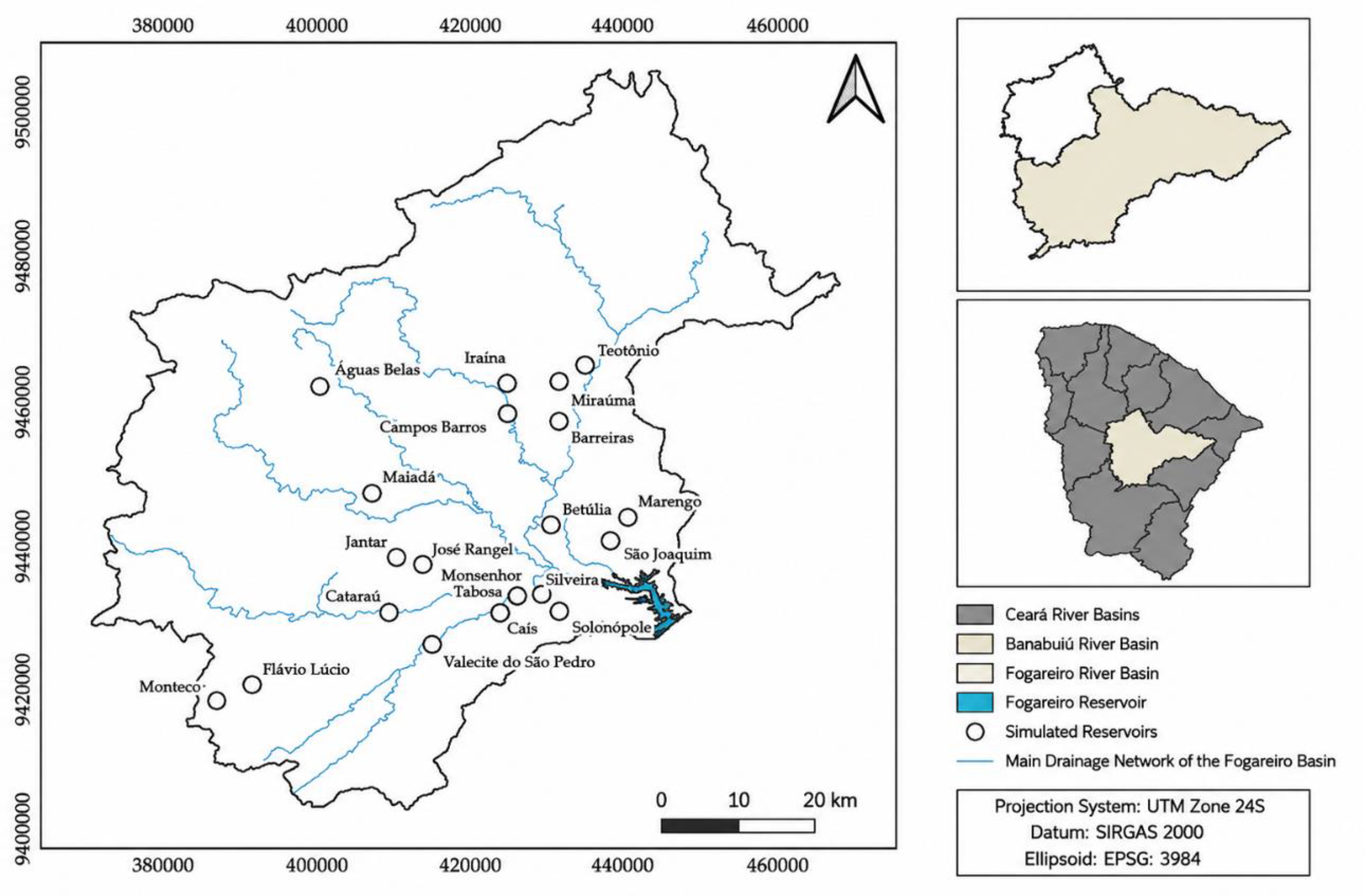
The study was conducted in the Fogareiro reservoir watershed, located in the Central Sertão region of Ceará State (Figure 1), with an area of approximately 5,100 km2. The Fogareiro dam, located at the basin outlet, has a storage capacity of 118 million m3 (Zhang et al., 2016) and a regulated flow of 2.05 m3 s⁻1 (Cogerh, 2022).

According to the Köppen climate classification, the region has a hot semi-arid climate, with monthly temperatures ranging from 25 to 29 °C, average annual rainfall of approximately 700 mm, and potential evaporation around 2,000 mm year⁻1. Natural vegetation is predominantly composed of Caatinga species, with open and dense shrub formations prevailing. Geology is characterized by predominance of crystalline basement rocks (Nascimento et al., 2019).
The studied watershed includes 23 reservoirs constructed by the National Department of Works Against Droughts (DNOCS), in cooperation with rural landowners, with storage capacities ranging from 4.9 × 10⁵ m3 to 1.7 × 10⁷ m3 (Table 1). These reservoirs were selected because they are classified as non-strategic, meaning they do not supply municipal centers or urban clusters and are therefore suitable for smallholder agriculture. In addition, these reservoirs have required technical data for simulation, including storage capacity, watershed area, depth, and coefficients describing reservoir geometry.
The Fogareiro reservoir, located at the basin outlet, was not included in simulations. Because it serves multiple purposes, including human water supply, its operation is regulated by the Water Resources Management Company of Ceará (COGERH), making it unsuitable for simulation focused on irrigation use.
In this study, reservoir geometry was estimated following Pereira et al. (2019), using power-law functions to represent relationships between water level and volume (elevation–volume curve) and between water level and flooded area (elevation–area curve) (Equations 1 and 2):
Where:
V(h) is the storage volume (m3) corresponding to water level h(m);
A(h) is the corresponding flooded area (m2),
K and α are opening and shape coefficients, respectively, obtained by fitting power-law functions to paired V and h data derived from elevation-area-volume curves (Pinheiro, 2004) of the studied reservoirs.
The hydrological module of the NeStRes model uses rainfall and potential evaporation as input variables, along with reservoir characteristics (Table 1). Water availability is estimated using the water balance approach (Equation 3) by simulating temporal dynamics of reservoir storage. Water inputs—direct rainfall over the reservoir surface and inflow generated by basin runoff—and outputs—evaporation, spillway discharge, and water withdrawals—determine irrigation withdrawal rates in each simulation.
Where:
dV represents change in reservoir storage over time interval dt (m3);
Qin is the sum of all inflows to the reservoir (m3 day-1), and
Qout is the sum of all outflows from the reservoir (m3 day-1).
Runoff within the basin and, consequently, reservoir inflow were estimated using the Curve Number (CN) method (Equation 4), developed by the US Department of Agriculture (USDA) and widely applied in hydrological studies. Equation 5 was used to calculate direct surface runoff for each rainfall event in the input data series.
Where:
S is potential maximum water retention, expressed as a function of the parameter curve number - CN (mm);
Q is direct surface runoff (mm);
P is rainfall (mm). In each case, the CN parameter was calibrated based on average runoff coefficient of the corresponding watershed.
Reservoir water availability is estimated by simulating different irrigation withdrawal rates. In each simulation, a withdrawal rate is defined, and the corresponding level of supply reliability is calculated.
In the agricultural module, soil and crop characteristics are provided by the user (Table 2), and the model estimates agricultural production based on soil water dynamics, as described below. For soil characterization and model parameterization, representative properties of textural classes (sandy, medium, clayey, very clayey, and silty) were used. The Fogareiro watershed has more than 72% of its area composed of Luvisols and Neosols (FUNCEME, 2024), which, according to Embrapa (2018), present good agricultural potential, with significant clay content in subsurface layers, although not within the range of clayey to silty textures. Therefore, the medium textural class was adopted as representative of the study area.
Average input parameter values consistent with this texture were used, including soil moisture at field capacity (wfc) of 22%, soil moisture at wilting point (wwp) of 10%, and soil bulk density (ρs) of 1.4 g cm⁻3.
The crops simulated were rice, sweet potato, beans, maize, and sorghum. These crops were selected due to their short production cycles and their relevance to local smallholder systems, where they are cultivated under rainfed conditions and constitute part of the regional diet.
Data for simulated crops included production costs and market prices (Table 2), obtained from studies conducted in the semi-arid Northeast and compiled by Oliveira (2023). Crop water demand ranged from 600 to 850 mm over the production cycle. Simulations considered the maximum possible number of cropping cycles per year based on water availability, adopting a 10-day interval between successive cycles.
A conventional sprinkler irrigation system was adopted due to its operational simplicity and compatibility with the technological level of local agricultural practices. Soil water balance was computed to determine timing and amount of irrigation based on crop water demand.
This module accounts for water inputs to the soil—rainfall and irrigation—and outputs, including evaporation, surface runoff, percolation, and plant water uptake.
Where:
Peffi is effective rainfall (mm), defined as fraction of total rainfall available for plant water uptake, and
Pi is daily total rainfall (mm).
Reference evapotranspiration was estimated using the equation proposed by Hargreaves & Samani (1985), selected based on availability of long-term climatological data (Brasil & Medeiros, 2020).
Where:
ET0 stands for reference evapotranspiration (mm),
Tmax is maximum daily temperature (°C),
Tmin is minimum daily temperature (°C),
Tave is average daily temperature (°C),
Ra represents extraterrestrial solar radiation (MJ m-2),
ETc represents crop evapotranspiration (mm), and
kc is crop evapotranspiration coefficient.
For irrigation, a variable irrigation schedule was adopted (Equations 9 and 10), based on maximum soil water availability, with the objective of restoring soil moisture to field capacity before onset of crop water stress.
Where:
PAW is plant-available water (mm);
f is the fraction of soil water at which crop water stress begins (dimensionless);
ASW is maximum available soil water (mm);
wfc and wwp are gravimetric soil moisture contents at field capacity and wilting point (g g-1), respectively;
ρs and ρw are soil and water densities (g cm-3);
RDeff is effective root depth (mm).
Maximum daily net crop water demand due to evapotranspiration per unit cultivated area is determined using [eq. (11)].
Where:
qd is net crop water demand per unit area (m3 ha-1 day-1),
CWD represents average crop water demand (mm; Table 2);
kcmax is the crop coefficient at the stage of maximum crop water demand, and
tc stands for crop cycle duration (days).
Gross water withdrawal (Equation 12), Qabs (m3 day⁻1), was calculated considering irrigation system efficiency, assumed to be 75% in this study.
In each simulation, potential cultivable area (Ap, ha) was determined as the ratio between irrigation withdrawal (Qabs, m3 day⁻1) and net crop water demand per unit area (qd, m3 ha⁻1 day⁻1). This relationship defines maximum cultivated area per cycle based on crop water demand.
Finally, in the economic module, input data include production costs and sale prices, as well as applied interest and return rates. This module estimates financial performance based on costs and revenues within the agricultural production system, indicating potential farmer income.
Total costs included production system components (soil preparation, seeds, pesticides, fertilizers, among others), electricity consumption, and initial investment in the irrigation system. An average investment of R$ 9,000 ha⁻1 was assumed, consistent with a sprinkler irrigation system. Revenue was estimated based on product sales at the end of the crop cycle, using a fixed price per kilogram (R$ kg⁻1).
Monthly financial balance was calculated using Equations 13 to 15. A monthly return rate of 0.65% was applied to positive balances, while an annual interest rate of 12% was applied to negative balances. Electricity costs were calculated separately from production costs, based on the tariff of the Enel utility for rural producers in 2022 (R$ 0.18 kWh⁻1).
Where:
NR is net revenue from crop production (R$);
GR is gross revenue from crop production (R$);
Ct is total production cost (R$);
Cp is agricultural operating cost (R$);
Ce is electricity cost (R$);
Ic is farmer monthly income, assumed constant (R$);
Rs is balance return, which may be positive or negative (R$), and
subscript n (NRn) denotes final day of simulation.
Income varies until the financial balance reaches zero at the end of the simulation period, allowing fluctuations throughout the simulation. This value represents attainable farmer income for a given combination of withdrawal rate and crop type.
Simulations conducted with the NeStRes model assume that reservoirs are used exclusively for irrigation, with no withdrawals for other purposes. This assumption reflects water-use patterns of rural populations in the study region, where cisterns are primarily used for domestic supply and reservoirs for agricultural production (Silva et al, 2020).
Brasil & Medeiros (2020) defined criteria for model applicability based on reservoir flow regulation capacity. Only non-strategic reservoirs capable of regulating less than 5% of inflow with 90% reliability are considered suitable for operation under the proposed framework.
Results and Discussion
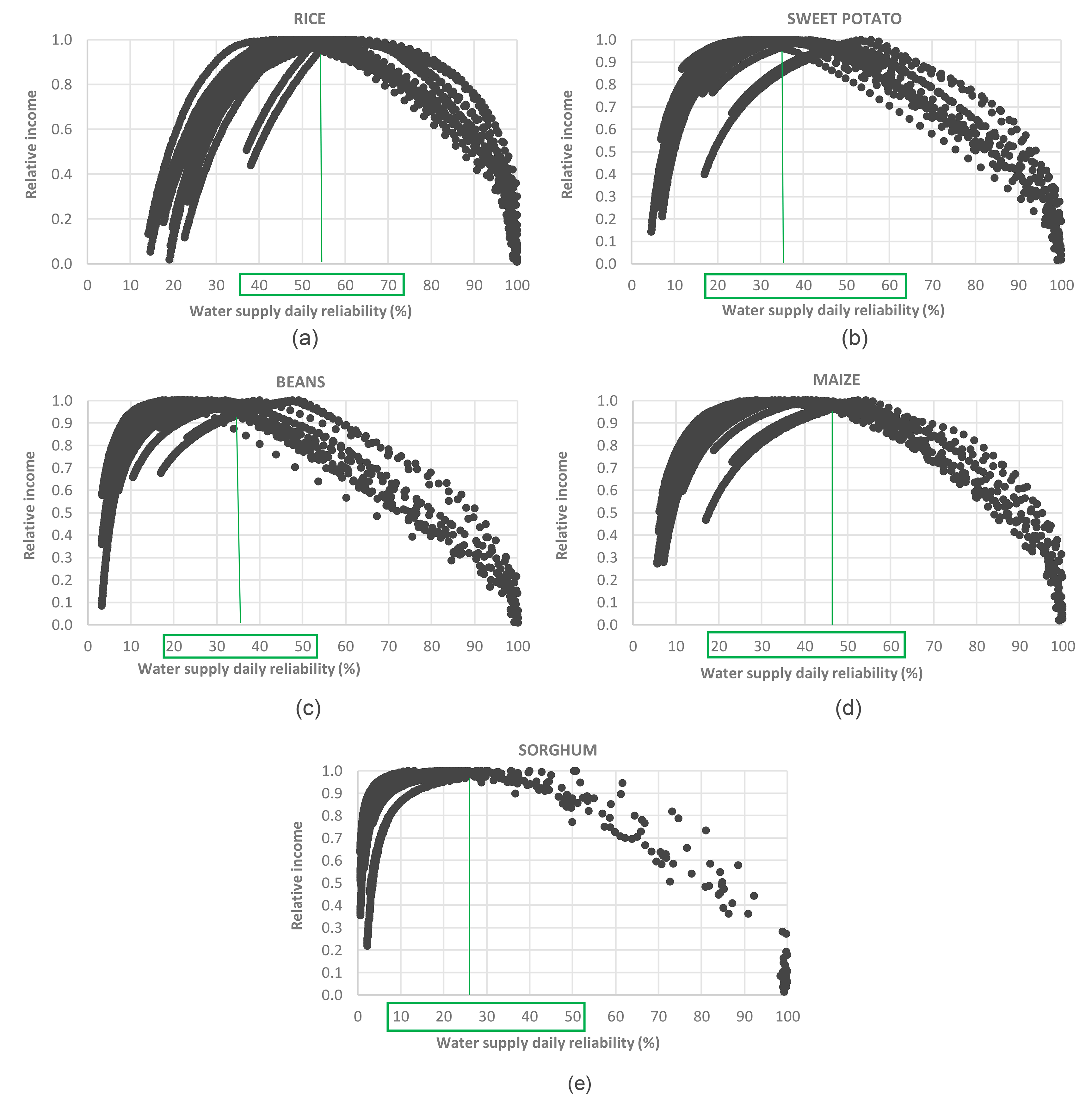
Results obtained for the 23 reservoirs simulated with the NeStRes model for irrigation of five annual crops are presented in Figure 2, which illustrates the relationship between guaranteed daily water supply and relative income, defined as the ratio between income obtained in a given simulation and maximum attainable income for each reservoir.

Relationship between guaranteed water supply and relative income for irrigated production of rice (a), sweet potato (b), beans (c), maize (d), and sorghum (e).
Figure 2 shows that maximum yield is achieved when reservoirs operate with water supply reliability levels between 10% and 70%. Thus, optimal reservoir operation for irrigation varies considerably with crop type, associated water demand, and reservoir characteristics. The wide range of operating conditions observed across reservoirs highlights importance of tools such as the NeStRes model for identifying optimal water-use strategies in each case.
For the simulated crops, results indicate that:
-
For rice, a reliability level of 54% allows attainment of at least 93% of maximum yield across all reservoirs;
-
For sweet potato, at least 95% of maximum yield is achieved at 36% reliability;
-
For beans, yields exceeding 93% of maximum are obtained at 35% reliability;
-
For maize, yields exceeding 94% of maximum are achieved at 48% reliability;
-
For sorghum, 96% of maximum yield is achieved at 28% reliability.
In general, high reliability levels (e.g., 90%, as adopted in Ceará by the Water Resources Management Company—COGERH) are used to regulate strategic reservoirs that serve multiple uses and large demands (Araújo et al., 2018), such as urban water supply and industrial consumption. This operating strategy restricts water withdrawals to reduce risk of supply failure during drought periods. However, for small, non-strategic reservoirs, such as those evaluated in this study, this approach is hydrologically inefficient.
As noted by Brasil & Medeiros (2020), prolonged water storage in small reservoirs increases evaporation losses, which in the Brazilian semi-arid region can reach approximately 2,000 mm year⁻1. Moreover, these reservoirs are generally unable to sustain high reliability levels due to complete depletion during dry periods.
Results similar to those shown in Figure 2 were reported by Brasil & Medeiros (2020), who argue that prolonged water storage in small reservoirs increases evaporation losses. Nevertheless, these reservoirs are generally unable to provide water with high reliability due to complete depletion.
In this study, adopting withdrawal rates with lower water supply reliability (ranging from 35% to 70%) demonstrates that it is possible to achieve income exceeding 80% of maximum attainable income for irrigation of short-cycle crops. The use of short-cycle crops shows strong adaptability to hydrological dynamics of small reservoirs, allowing irrigated area to vary in each cycle according to water volume stored at the beginning of the cycle. Similarly, Sekyi-Annan et al. (2018), in a study conducted in Ghana, showed that proper management of supplemental irrigation improves tomato and maize production.
In this context, it is possible to adopt withdrawal rates with lower water supply reliability for irrigation of short-cycle crops, which are well adapted to hydrological dynamics of this type of reservoir. This approach allows irrigated area to vary in each cycle according to water volume available in the reservoir at the beginning of the period.
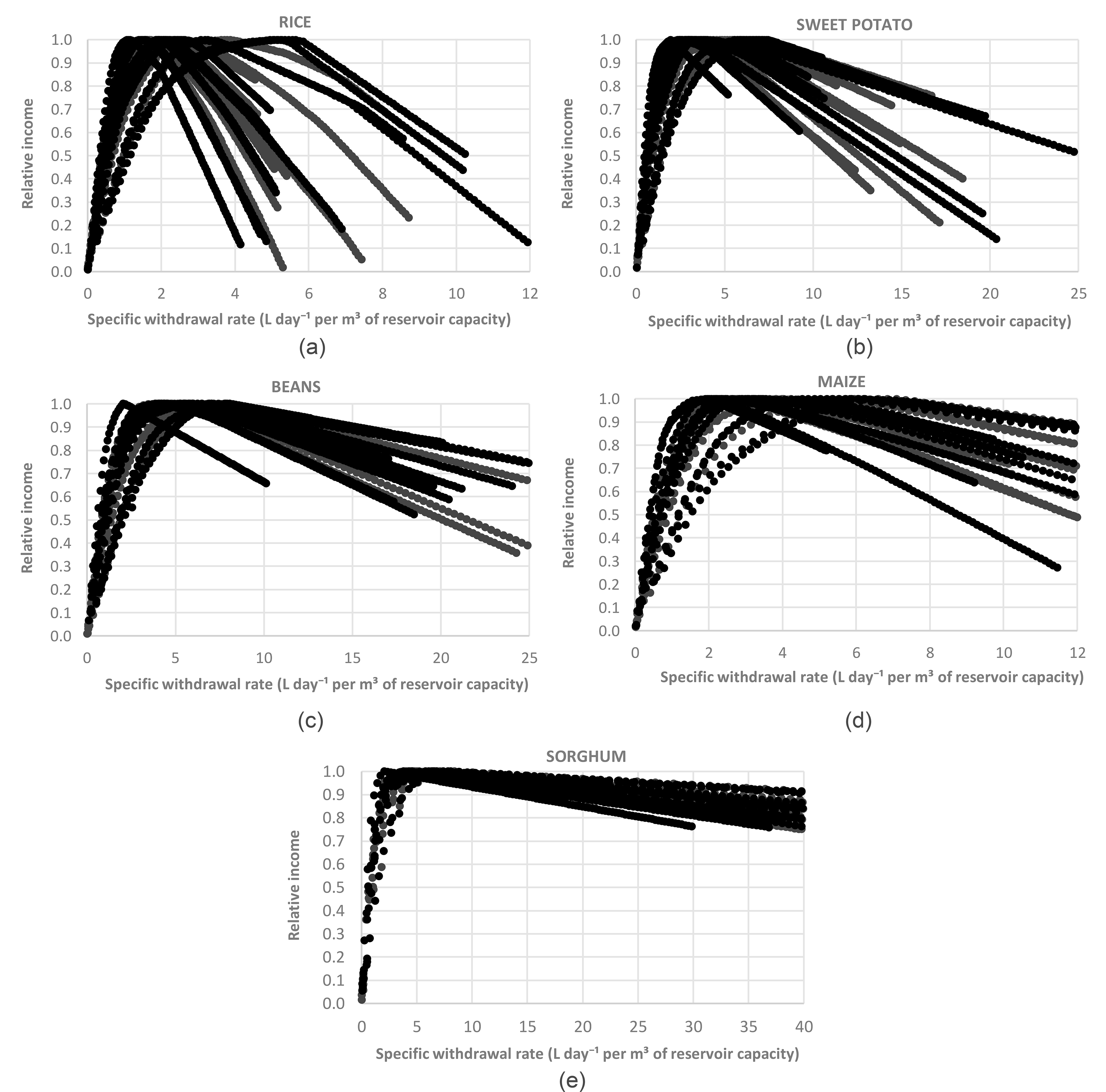
Water supply reliability enables evaluation of reservoir operating conditions, particularly probability of depletion and duration of interruptions in agricultural production. However, this information has limited practical value for water-use planning. Therefore, in addition to analyzing income variation as a function of reliability, this study relates income to a specific withdrawal rate, defined as the ratio between daily withdrawal and reservoir storage capacity, as shown in Figure 3.

Relationship between specific irrigation withdrawal rate (L day⁻1 per m3 of reservoir capacity) and relative income for irrigated production of rice (a), sweet potato (b), beans (c), maize (d), and sorghum (e).
Graphs in Figure 3 exhibit similar patterns across crops. At low specific withdrawal rates, income increases rapidly with increasing withdrawals until reaching a maximum, after which it declines as withdrawal rates continue to increase. Extremely low withdrawal rates correspond to irrigation of very small areas, whereas very high withdrawal rates require substantial investment in irrigation systems, both resulting in reduced economic efficiency.
For rice cultivation, maximum income was obtained at a specific irrigation withdrawal rate of 2 L day⁻1 m⁻3 of reservoir capacity, calculated as the ratio between withdrawal flow rate (L day⁻1) and reservoir storage capacity. For sweet potato, this value was 5 L day⁻1 m⁻3; for beans, 6 L day⁻1 m⁻3; for maize, 2 L day⁻1 m⁻3; and for sorghum, 5 L day⁻1 m⁻3, all corresponding to maximum attainable income.
Based on simulation results, any reservoir evaluated in this study, when operated at a withdrawal rate of 3 L day⁻1 m⁻3, ensures income exceeding 80% of maximum attainable income. These values are highly relevant for planning water use in non-strategic reservoirs for irrigation of annual crops in the Brazilian semi-arid region, where data for defining operational criteria are limited.
In this study, irrigation consistent with crop water demand was assumed. Another important aspect in the use of non-strategic reservoirs is water-use efficiency. For example, Paiva (2019), in the Morada Nova irrigated district, reported that water applied to rice, maize, beans, and sorghum exceeded crop requirements. Comparable results were observed by Frizzone et al. (2021) in the Jaguaribe River basin. According to a technical report by the Ceará State Development Agency, water allocation in irrigated perimeters in the Lower Jaguaribe region in December of 2015 exceeded crop requirements by up to 22% (Oliveira, 2023).
In other dry regions, such as the Hetao Irrigation District in China, excessive irrigation has also been reported, leading to increased soil salinity (Sekyi-Annan et al., 2018). Inefficiencies in field application, characterized by over-irrigation and low application efficiency (25%–68%), were also observed in small-scale systems in Ghana (Cao et al., 2023). These findings highlight need for improved water management, from storage to allocation strategies, including technical interventions in soil–water–plant systems to increase productivity while reducing water use.
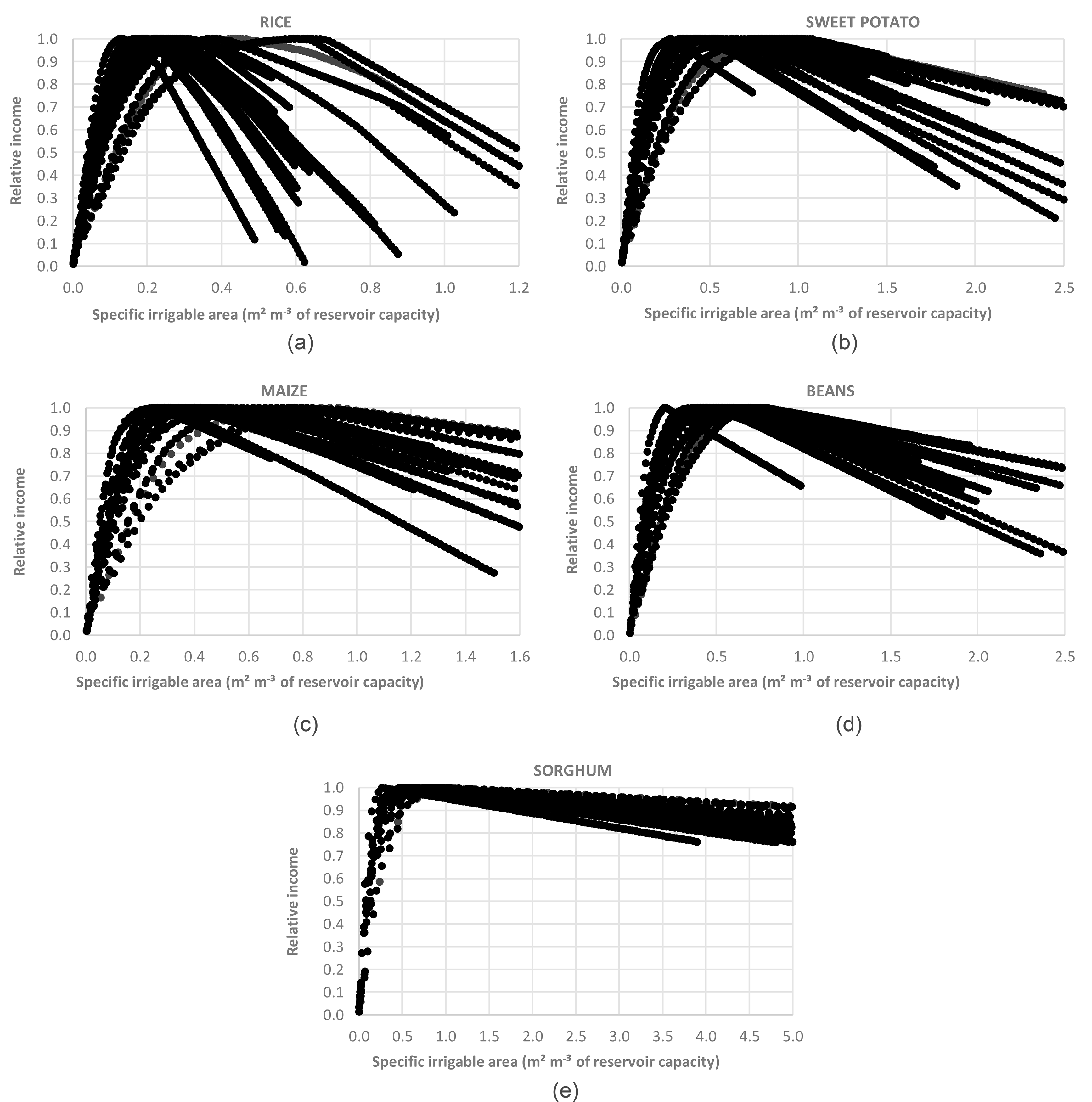
Income variation from supplemental irrigation using small reservoirs was also evaluated as a function of specific maximum irrigable area, defined as the ratio between irrigated area in each simulation (as a function of the withdrawal flow rate) and reservoir storage capacity. Results are presented in Figure 4.

Relationship between specific irrigable area (m2 m⁻3 of reservoir capacity) and relative income for irrigated production of rice (a), sweet potato (b), beans (c), maize (d), and sorghum (e).
Considering ranges of irrigable area that allow income exceeding 80% of maximum attainable values, specific maximum irrigable areas were estimated between 0.20 and 0.40 m2 m⁻3 of reservoir capacity for rice; 0.40 to 1.0 m2 m⁻3 for sweet potato and beans; 0.30 to 0.90 m2 m⁻3 for maize; and 0.04 to 5.0 m2 m⁻3 for sorghum.
Specific irrigable area corresponding to maximum income varies among crops, as shown in Table 3. For rice, an irrigable area of approximately 0.3 m2 m⁻3 of reservoir capacity yields highest income across simulated reservoirs. For sweet potato and beans, this value is 0.6 m2 m⁻3, whereas for maize it is 0.5 m2 m⁻3 and for sorghum 0.7 m2 m⁻3.
Specific irrigable area (m2 m⁻3 of reservoir maximum capacity) that yields maximum income across simulated reservoirs for each crop.
These results demonstrate capacity of reservoirs to convert stored water into irrigated area and can serve as an indicator for crop selection.
Among all crops analyzed, sorghum presents the largest irrigable area while maintaining yields above 80% of maximum attainable values. Among the simulated crops, sorghum shows great adaptability to irrigation conditions in non-strategic reservoirs, allowing satisfactory yields under a wide range of water-use conditions and irrigated areas.
Results obtained in this study indicate that efficient use of non-strategic reservoirs for irrigation of annual crops benefits both agricultural production and water resources management by promoting more effective allocation of available water. Establishing operational criteria for small reservoirs also contributes to diversification of water sources for agricultural production, reducing dependence on strategic reservoirs and alleviating pressure on them (Lima et al., 2023). In contexts where operational data for small reservoirs are limited, values obtained in this study—such as reliability levels, specific irrigation withdrawal rates, and specific irrigable areas associated with high yields—can serve as practical indicators.
Non-strategic reservoirs are highly sensitive to climatic variability and may dry out at least once every five years in the study area. Highly variable hydrological dynamics in this region make these structures unsuitable for strategic uses such as urban water supply (Zhang et al., 2021). Peter et al. (2014) reported that construction of a dense network of reservoirs of varied sizes in Northeast Brazil has reduced regional vulnerability to drought. Similarly, Meira Neto et al. (2024) demonstrated increased water security in the Upper Jaguaribe basin due to progressive densification of the reservoir network, particularly large strategic reservoirs. In contrast, small reservoirs, such as those analyzed in this study, are more suitable for irrigation of annual crops and can strengthen smallholder agriculture in the Brazilian semi-arid region by enhancing income generation.
Reservoir filling and depletion dynamics observed in the study area are also reported in other regions, such as east-central Mississippi, USA. Ouyang et al. (2018) observed that a reservoir with a storage capacity of 105 m3 used for irrigation of maize, cotton, and soybean may dry out twice within a ten-year period. Although this region receives approximately 1,300 mm of annual rainfall and has evapotranspiration around 600 mm, representing more favorable conditions than those in the Brazilian semi-arid region, where annual potential evaporation ranges from 2,000 to 2,600 mm and rainfall from 500 to 850 mm (Araújo et al., 2018). In Ethiopia, inadequate water management combined with water scarcity has been identified as a major constraint on performance of most small-scale irrigation systems (Yohannes et al., 2017).
Agricultural production is influenced not only by water balance but also by crop development conditions. Shorter crop cycles reduce exposure to climatic variability and associated risks (Breinl et al., 2020). In this context, simulations with the NeStRes model indicate that water from non-strategic reservoirs can be used efficiently for irrigation of short-cycle crops in the Brazilian semi-arid region, supporting management of small reservoirs and smallholder systems. Results suggest potential to increase cropping frequency from two to three cycles per year, depending on crop duration, compared with predominantly rainfed systems in the region. In this study, crops with cycle durations of 70 to 120 days were considered, allowing 10-day intervals between successive cycles.
Brasil & Medeiros (2020) argue that strategic use of water from small reservoirs can reduce evaporation losses by converting stored water into productive use, thereby increasing agricultural income. Their results indicate that regions in Ceará with higher rainfall and lower evaporation rates, such as coastal and mountainous areas, are more favorable for increasing agricultural production using small reservoirs. In contrast, in drier regions, achieving high yields is more challenging due to faster reservoir depletion. In such cases, income gains depend on more intensive water use, which requires larger irrigated areas and, consequently, higher initial investment.
Conclusions
Simulation of 23 reservoirs in the Fogareiro Reservoir basin, Ceará, for irrigation of annual crops indicates that water-use conditions that maximize income vary according to reservoir characteristics and crop type. However, results show that average operating conditions with satisfactory performance can be defined across multiple reservoirs. Further simulations including a broader range of reservoirs and crops are recommended to establish more general operational criteria for non-strategic reservoirs in the Brazilian semi-arid region.
Income exceeding 80% of maximum attainable values can be achieved when reservoirs operate with water supply reliability between 35% and 70%, regardless of crop type. This wide range indicates that highly specific operating conditions are not required to achieve high income levels. Moreover, this range corresponds to more intensive water use, suggesting that water-saving strategies aimed solely at increasing reliability are not efficient for non-strategic reservoirs.
Results also indicate that practical indicators can be defined to support decision-making by irrigators. A specific irrigation withdrawal rate (i.e., the ratio between withdrawal flow rate and reservoir capacity) of 3 L day⁻1 m⁻3 ensures income above 80% of maximum attainable values. Corresponding specific irrigable areas (the ratio between irrigable area and maximum reservoir capacity) that maximize income are 0.3 m2 m⁻3 for rice, 0.6 m2 m⁻3 for sweet potato and beans, 0.5 m2 m⁻3 for maize, and 0.7 m2 m⁻3 for sorghum.
Given low reliability of non-strategic reservoirs for human supply, simulations using the NeStRes model demonstrate that these resources of water can be used efficiently for agricultural production. This approach strengthens role of small reservoirs and contributes to decentralization of water resources management. In this context, it is important to distinguish between reservoirs designed for human supply, which require high reliability, and non-strategic reservoirs, which are more suitable for agricultural use.
Acknowledgements
The authors acknowledge the Chief Scientist in Agriculture Program of the Government of Ceará State (Agreement No. 14/2022 SDE/ADECE/FUNCAP; Process No. 08126425/2020/FUNCAP), the National Council for Scientific and Technological Development (CNPq; Grant No. 406570/2022-1), the Ceará Foundation for Scientific and Technological Development (FUNCAP; INCT-35960-62747.65.95/51), and the Coordination for the Improvement of Higher Education Personnel (CAPES) for financial support provided within the framework of the National Institute of Science and Technology in Sustainable Agriculture in the Tropical Semi-Arid Region (INCTAgriS).
References
-
Araújo, J. C. de, Mamede, G. L., & de Lima, B. P. (2018). Hydrological guidelines for reservoir operation to enhance water governance: Application to the Brazilian Semiarid region. Water (Switzerland), 10 (11). https://doi.org/10.3390/w10111628
» https://doi.org/10.3390/w10111628 -
Cao, Z., Zhu, T., & Cai, X. (2023). Hydro-agro-economic optimization for irrigated farming in an arid region: The Hetao Irrigation District, Inner Mongolia. Agricultural Water Management, 277, 108095. https://doi.org/10.1016/j.agwat.2022.108095
» https://doi.org/10.1016/j.agwat.2022.108095 -
Brasil, P., & Medeiros, P. (2020). NeStRes - Model for Operation of Non-Strategic Reservoirs for Irrigation in Drylands: Model Description and Application to a Semiarid Basin. Water Resources Management, 34 (1), 195-210. https://doi.org/10.1007/s11269-019-02438-x
» https://doi.org/10.1007/s11269-019-02438-x -
Breinl, K., Di Baldassarre, G., Mazzoleni, M., Lun, D., & Vico, G. (2020). Extreme dry and wet spells face changes in their duration and timing. Environmental Research Letters, 15 (7), 74040. https://doi.org/10.1088/1748-9326/ab7d05
» https://doi.org/10.1088/1748-9326/ab7d05 -
Campos, J. N. B., Studart, T. D. C., Martinz, D. D. G., & Nascimento, L. S. V. (2003). Contribuições ao Debate Sobre as Eficiências de Pequenos e Grandes Reservatórios. Revista Brasileira de Recursos Hídricos, 8 (2), 31 - 38. https://doi.org/10.21168/rbrh.v8n2.p31-38
» https://doi.org/10.21168/rbrh.v8n2.p31-38 - EMBRAPA. (2018). Sistema brasileiro de classificação de solos. Embrapa Solos.
- FUNCEME. (2024). Levantamento de reconhecimento de média intensidade dos solos do Estado do Ceará. Fundação Cearense de Meteorologia e Recursos Hídricos. ISBN 978-65-983255-0-3
-
Frizzone, J. A., Lima, S. C. R. V., Lacerda, C. F., & Mateos, L. (2021). Socio-economic indexes for water use in irrigation in a representative basin of the tropical semiarid region. Water (Switzerland), 13 (19), 1-20. https://doi.org/10.3390/w13192643
» https://doi.org/10.3390/w13192643 -
Hargreaves, G. H., & Samani, Z., A. (1985). Reference Crop Evapotranspiration from Temperature. Applied Engineering in Agriculture, 1 (2), 96-99. https://doi.org/10.13031/2013.26773
» https://doi.org/10.13031/2013.26773 -
Guo, S., Zhang, F., Engel, B., Wang, Y., Guo, P., & Li, Y. (2021). A distributed robust optimization model based on water-food-energy nexus for irrigated agricultural sustainable development. Journal of Hydrology, 127394. https://doi.org/10.1016/j.jhydrol.2021.127394
» https://doi.org/10.1016/j.jhydrol.2021.127394 -
Li, M., Fu, Q., Singh, V., Ji, Y., Liu, D., Zhang, C., & Li, T. (2019a). An optimal modelling approach for managing agricultural water-energy-food nexus under uncertainty. The Science of the Total Environment, 651, 1416-1434. https://doi.org/10.1016/j.scitotenv.2018.09.291
» https://doi.org/10.1016/j.scitotenv.2018.09.291 -
Li, M., Fu, Q., Singh, V., Liu, D., & Li, T. (2019b). Stochastic multi-objective modeling for optimization of water-food-energy nexus of irrigated agriculture. Advances in Water Resources https://doi.org/10.1016/j.advwatres.2019.03.015
» https://doi.org/10.1016/j.advwatres.2019.03.015 -
Lima, T. B. R., Medeiros, P. H. A., Mamede, G. L., & de Araújo, J. C. (2023). Impact of intensive water use from farm dams on the storage dynamics in strategic reservoirs. Hydrological Sciences Journal, 68 (16), 2422-2434. https://doi.org/10.1080/02626667.2023.2272669
» https://doi.org/10.1080/02626667.2023.2272669 -
Maneta, M., Cobourn, K., Kimball, J., He, M., Silverman, N., Chaffin, B., Ewing, S., Ji, X., & Maxwell, B. (2020). A satellite-driven hydro-economic model to support agricultural water resources management. Environmental Modelling & Software, 134, 104836. https://doi.org/10.1016/j.envsoft.2020.104836
» https://doi.org/10.1016/j.envsoft.2020.104836 -
Medeiros, P.H.A., Sivapalan, M. (2020) From hard-path to soft-path solutions: slow-fast dynamics of human adaptation to droughts in a water scarce environment. Hydrological Sciences Journal. https://doi.org/10.1080/02626667.2020.1770258
» https://doi.org/10.1080/02626667.2020.1770258 -
Meira Neto, A. A., Medeiros, P., de Araújo, J. C., Pereira, B., & Sivapalan, M. (2024). Evolution of Drought Mitigation and Water Security Through 100 Years of Reservoir Expansion in Semi-Arid Brazil. Water Resources Research, 60 (9). https://doi.org/10.1029/2023WR036411
» https://doi.org/10.1029/2023WR036411 -
Nascimento, A. T. P. do, Cavalcanti, N. H. M., Castro, B. P. L. de, & Medeiros, P. H. A. (2019). Decentralized water supply by reservoir network reduces power demand for water distribution in a semi-arid basin. Hydrological Sciences Journal, 64 (1), 80-91. https://doi.org/10.1080/02626667.2019.1566728
» https://doi.org/10.1080/02626667.2019.1566728 -
Oliveira, R. S. (2023). Aproveitamento racional de açudes não estratégicos para irrigação de culturas agrícolas temporárias no semiárido brasileiro [Dissertação mestrado, Universidade Federal do Ceará]. http://repositorio.ufc.br/handle/riufc/76854
» http://repositorio.ufc.br/handle/riufc/76854 -
Ouyang, Y., Feng, G., Leininger, T. D., Read, J., & Jenkins, J. N. (2018). Pond and Irrigation Model (PIM): a Tool for Simultaneously Evaluating Pond Water Availability and Crop Irrigation Demand. Water Resources Management, 32 (9), 2969 - 2983. https://doi.org/10.1007/s11269-018-1967-8
» https://doi.org/10.1007/s11269-018-1967-8 -
Paiva, P. V. V. (2019). Análise econômico-social dos principais sistemas de produção no Perímetro Irrigado Morada Nova, Ceará. [Dissertação de mestrado, Universidade Federal do Ceará]. http://www.repositorio.ufc.br/handle/riufc/52112
» http://www.repositorio.ufc.br/handle/riufc/52112 -
Pék, É., Ferto, I., Giusti, S., & Salman, M. (2024). Combined Systematic Review and Meta-Analysis of Ground-Level Impacts of Management Transfer to Poor Farmers in Developing Countries. Water Resources Management, 38 (5), 1737 - 1752. https://doi.org/10.1007/s11269-024-03763-6
» https://doi.org/10.1007/s11269-024-03763-6 -
Pereira, B., Medeiros, P., Francke, T., Ramalho, G., Foerster, S., & De Araújo, J. C. (2019). Assessment of the geometry and volumes of small surface water reservoirs by remote sensing in a semi-arid region with high reservoir density. Hydrological Sciences Journal, 64 (1), 66 - 79. https://doi.org/10.1080/02626667.2019.1566727
» https://doi.org/10.1080/02626667.2019.1566727 -
Peter, S. J., De Araújo, J. C., Araújo, N. A. M., & Herrmann, H. J. (2014). Flood avalanches in a semiarid basin with a dense reservoir network. Journal of Hydrology, 512, 408-420. https://doi.org/10.1016/j.jhydrol.2014.03.001
» https://doi.org/10.1016/j.jhydrol.2014.03.001 - Pinheiro, F.D. (2004). Açudagem particular em cooperação no Ceará. Departamento Nacional de Obras Contra as Secas.
-
Ribeiro Neto, G., Melsen, L. A., Martins, E. S. P. R., Walker, D. W., & van Oel, P. R. (2022). Drought Cycle Analysis to Evaluate the Influence of a Dense Network of Small Reservoirs on Drought Evolution. Water Resources Research, 58 (1). https://doi.org/10.1029/2021WR030799
» https://doi.org/10.1029/2021WR030799 -
Rodrigues, G. P., Rodrigues, Í. S., Raabe, A., Holstein, P., & de Araújo, J. C. (2023). Direct measurement of open-water evaporation: a newly developed sensor applied to a Brazilian tropical reservoir. Hydrological Sciences Journal, 68 (3), 379 - 394. https://doi.org/10.1080/02626667.2022.2157278
» https://doi.org/10.1080/02626667.2022.2157278 -
Salviano, J. I. de A., Lemos, J. de J. S., & Martins, E. C. (2023). Sinergias entre instabilidade pluviométrica e a produção de lavouras alimentares de sequeiro no semiárido do estado do Ceará - Brasil. Contribuciones a Las Ciencias Sociales, 16 (7), 5647-5665. https://doi.org/10.55905/revconv.16n.7-027
» https://doi.org/10.55905/revconv.16n.7-027 -
Sekyi-Annan, E., Tischbein, B., Diekkrüger, B., & Khamzina, A. (2018). Performance evaluation of reservoir-based irrigation schemes in the Upper East region of Ghana. Agricultural Water Management, 202, 134-145. https://doi.org/10.1016/j.agwat.2018.02.023
» https://doi.org/10.1016/j.agwat.2018.02.023 -
Silva, J. P. da, Bezerra, C. E., & Ribeiro, A. de A. (2020). Avaliação da qualidade da água armazenada em cisternas no semiárido cearense. Brazilian Journal of Biosystems Engineering, 14 (1), 27-35. https://doi.org/10.18011/bioeng2020v14n1p27-35
» https://doi.org/10.18011/bioeng2020v14n1p27-35 -
Soares, N. S., Costa, C. A. G., Carneiro de Lima, J. B., Francke, T., & de Araújo, J. C. (2024). Method for identification of hydrological seasons in the semi-arid Caatinga biome, Brazil. Hydrological Sciences Journal, 69 (3), 309 - 320. https://doi.org/10.1080/02626667.2024.2311758
» https://doi.org/10.1080/02626667.2024.2311758 -
Tian, P., Zhu, T., Zohidov, B., Ni, G., Lu, H., & Liu, H. (2020). Exploring synergies in the water-food-energy nexus by using an integrated hydro-economic optimization model for the Lancang-Mekong River basin. The Science of the Total Environment, 728, 137996. https://doi.org/10.1016/j.scitotenv.2020.137996
» https://doi.org/10.1016/j.scitotenv.2020.137996 -
Yohannes, D. F., Ritsema, C. J., Solomon, H., Froebrich, J., & van Dam, J. C. (2017). Irrigation water management: Farmers' practices, perceptions and adaptations at Gumselassa irrigation scheme, North Ethiopia. Agricultural Water Management, 191 (2017), 16-28. https://doi.org/10.1016/j.agwat.2017.05.009
» https://doi.org/10.1016/j.agwat.2017.05.009 -
Zhang, S., Foerster, S., Medeiros, P., de Araújo, J. C., Motagh, M., & Waske, B. (2016). Bathymetric survey of water reservoirs in north-eastern Brazil based on TanDEM-X satellite data. Science of the Total Environment, 571, 575 - 593. https://doi.org/10.1016/j.scitotenv.2016.07.024
» https://doi.org/10.1016/j.scitotenv.2016.07.024 -
Zhang, S., Foerster, S., Medeiros, P.H.A., Araújo, J.C. de, Duan, Z., Bronstert, A., & Waske, B. (2021). Mapping regional surface water volume variation in reservoirs in northeastern Brazil during 2009-2017 using high-resolution satellite images. Science of the Total Environment, 789, 147711. http://dx.doi.org/10.1016/j.scitotenv.2021.147711
» http://dx.doi.org/10.1016/j.scitotenv.2021.147711
-
Data Availability Statement
The datasets generated during and/or analyzed during the current study are available from the corresponding author on reasonable request.
Edited by
-
Area Editor:
Samuel Beskow
The datasets generated during and/or analyzed during the current study are available from the corresponding author on reasonable request.